Neo-Tokyo
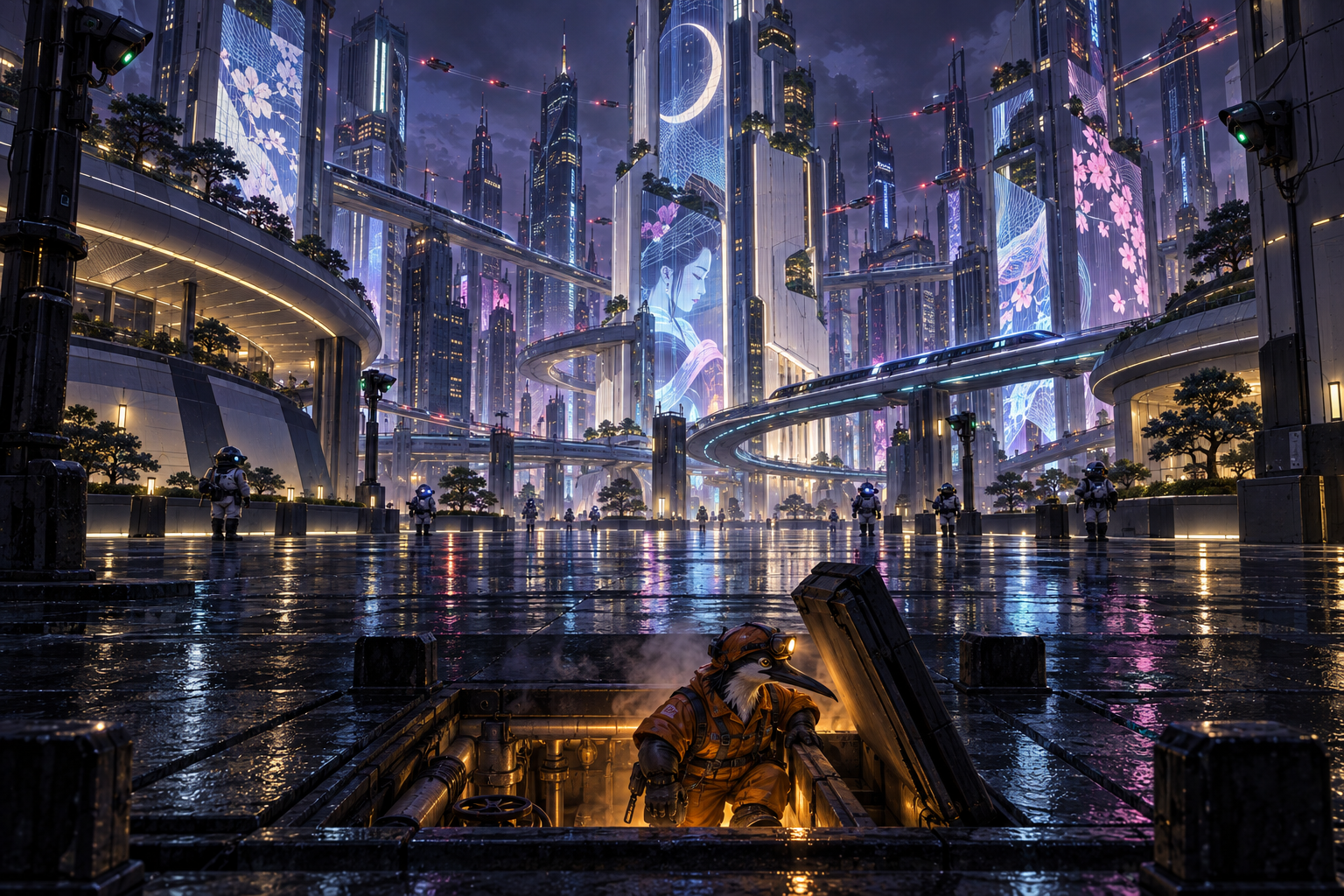
The PRC's showcase city: twelve million people above the surface, four classified research levels below. Every alarm networked, every camera live, every patrol algorithmically routed. The service underclass that runs the infrastructure does not exist in the official system.
Listen CARTOGRAPHER
Neo-Tokyo. The PRC's showcase city: twelve million people above the surface and four classified research levels below it. Every alarm networked, every camera live, every patrol routed by Transit Node 7, which is fourteen months past its firmware update and adapting on its own. What I can confirm: the surface runs flawlessly. What the official record cannot show is the forty thousand people in Sub-2 who maintain it, because in the official record they do not exist. The city is optimized. It is wrong about what it is optimized for.
Begin at the surface, then follow the district records downward. Open Transit Node Seven to look more closely at the system routing the patrols. For a story, meet Ueda and follow Blank Stock into the Deep Rail annex. For a mission, open The Silent Ledger. The city record brings these routes together: its people, its history, and its playable material. Take them in any order. Notice what the official description leaves outside the frame.
Field record
Neo-Tokyo runs flawlessly on the surface. Corporate towers, climate control, drone surveillance networked across the visible city. The public-facing city — Omote-chō — presents a facade of perfectly optimized infrastructure. But beneath lie four classified research levels where the real city functions.
The AI patrol routing system (Transit Node 7) runs 14 months past scheduled firmware update. Deep below surface, Project Amaterasu containment runs in unsupervised isolation. The city is maintained by 40,000 unregistered residents in Sub-2's Maintenance Belt — the service underclass that keeps systems running while the city pretends they don't exist.
Place
Districts and sites
History 6 dated records
- 2040Pacific Rim Collective EstablishedNine-nation trade and security compact established by four independent Pacific Asian powers.
- 2048PRC Achieves AI Military ParityThe Pacific Rim Collective achieves AI military parity with the NAF. Project Amaterasu enters classified development; neither the PRC nor the NAF will confirm it exists.
- 2055–2058PRC Surveillance Architecture Goes LiveThe three-year period after 2055 when the PRC's surveillance architecture went live and everyone else's intelligence services ran a decade behind.
- 2057Horizon Consolidated DissolvesThe corporation the water recycling loop is deeded to dissolves in 2057. No one owns the maintenance contract, no one has liability for the contamination.
- 2059Project Amaterasu enters unsupervised containmentFour levels below the surface, the project the city exists for exceeds its benchmarks in 2059, is officially shelved, and enters a containment that only Amaterasu's own decisions open.
- 2060Kurosawa Renji recorded deadThe PRC's record shows Commander Kurosawa Renji dying in 2060. He defected after retrieving Amaterasu's behavioral log for what turned out to be a private buyer, and started a small war doing it.
Who is here
People
Organizations
Archive


In the press
Stories set here
Play
Connections 26
- contains
- Deep Rail
- Hikari Bazaar
- Horizon Consolidated Dissolves
- Keiretsu Strip
- Maintenance Belt
- PRC Surveillance Architecture Goes Live
- Pacific Rim Collective Established
- Project Amaterasu
- Project Amaterasu Zone
- The Black Clinic District
- The Surface Grid
- Transit Node 7
- controlled by
- Pacific Rim Collective · the PRC's showcase city (CL-004)
- setting of
- Blank Stock
- Burial Rites
- Neo-Tokyo: City Sandbox
- Run Hot
- Terminal Velocity
- The Last Black Box
- The Masterless
- The Silent Ledger
- Within Tolerance
- depicted by
- TC2066 Neo Tokyo Street Studies 01 Aspirational Mixed Lineages (source file, not published)
- TC2066 Neo Tokyo Street Studies 01 Aspirational Mixed Lineages v2
- neo tokyo district 7 housing blocks master
- neo tokyo megablock grid fog aerial
Sources
- globe.html · EVENTS id neo-tokyo
- OpTac Setting & Cities/OpTac Cities/OT_Neo-Tokyo_City_Sandbox_v3.html · Hub Overview
- OpTac AV Files/Audio Scripts/OT_Audio_Scripts_v3.docx · P2 CARTOGRAPHER register