The
Wardrobe
How the world dresses, how Warranty Void dresses, and why the jacket is the only layer you control
Fashion in 2066 is documentation. What you wear is where you've been, what you were issued, what you kept, and what you want read across a room. Five approved plates, five fits each, and one man in regulation to state the argument in reverse.
Before you read
The wardrobe bible's public edition: the crew's approved looks, the world's fashion system, and the register system the fits run on.

This is the public edition of the Warranty Void wardrobe bible, compiled 2026-08-27 from the production document. The register system, the negative-space lists, and the shopping map were ratified the same day and are canon. Withheld here: the art-generation tooling the production runs on (prompt blocks, character locks, verification batteries) and the rulings ledger. Everything else is the real document, plates included.
Where it sits. The crew's identities, voices, and story canon live in the IP Bible. The world's style chapter is published in the Pop Culture collection. This document is the layer between the two: what the five of them actually put on their bodies, and what the world reads when they walk in.
How 2066 Dresses
The salvage stack, the two layers, the faction codes, the houses, and the three garments that can get you killed.
The thesis
Fashion in 2066 is documentation. In a world where your genome is your citizenship — registered, owned, machine-readable at the nape — the jacket is the only layer of identity you fully control. Every wardrobe in the setting is an answer to that fact, from the arcology floors down to the swap meets. The doctrine underneath everything is the salvage stack: no uniform, no catalog, assembly as authorship.
The salvage stack
Four source streams, worn on one body:
- Faction surplus stripped of faction identity. Military-spec gear from competing states on the same body, insignia removed or covered. The cut is operational; the styling is personal. You don't reject the gear — you strip it of the flag.
- Salvage civilian. What survives in contested zones: pre-Upheaval garments, market pieces, borough-manufactured replacements. Worn, repaired, sometimes repaired again.
- The build worn as aesthetic. Heat-management silhouettes on thermal-adapted operators; proportions slightly wrong for standard issue; the modification is the tag, the body is the wall.
- Dead credential decoration. Expired genomic registration tags as jewelry, dead clearance badges on chains, previous-employer insignia as patch material.
The grammar that reads the stack: kit archaeology (reading an operator's history from accumulated modifications), the dead stack (expired IDs worn as jewelry), the personal register (a visual signature so developed it functions as identification — which is the point, and the risk: a register consistent enough to be yours is consistent enough to be filed). The idiom set is canon: Strip the faction, keep the jacket. What's on your kit is who you are. The kit knows where you've been.
The two layers
Every wardrobe decision is a layer assignment. The system layer belongs to states and corporations: engineered, grid-perfect, registration-clean, cold, undecorated. The human layer belongs to people: self-authored, thrifted, comfort-maximalist, warm, assembled by one person over years on a small budget. Where the two layers meet on a body, that collision is the storytelling — a ripped-off unit patch, a stolen gauge cluster, a regulation garment with a non-regulation repair. Faction colors on self-authored bodies appear only as scar tissue: ghost outlines, covered patches, stolen parts.
Faction dress
| Bloc | Dress logic |
|---|---|
| Kavast | The red discipline: red is never decorative, only claim. A single red thread on a stripped Kavast jacket is either an oversight or a provocation, and nobody claims oversight twice. |
| Protectorate | Green-is-live / white-is-filed. Dead Protectorate kit is by definition filed, so wearing it white-tagged is wearing a closed case — the most legible surplus on the market. |
| Eastern Compact | Endurance formality: cold-weather wool, slate blue, square pockets, hard hems; insignia sewn, garments maintained for decades. The adult in the surplus room. |
| EO | Commission culture: the oligarch body as portfolio; the Peacock's iridescence as the reference point for an entire tier of display. |
| NAF | Corporate clean — the absence of story, which is its own story. |
| PCU | Modesty-engineering: heat-management silhouettes satisfying both the cultural office and the desert. |
| SCA | The living wardrobe of the debt-party circuit: color as solvency. |
| Nordics | Dressed like the audit is tomorrow, because for the Nordics it always is. |
The houses
The fashion board, one line each: GHOST KIT (the flagship; stripped tactical wear, prior operational life worn as feature). ROPE KIDS (Flooded London youth label; built for lateral motion). DEAD STACK COLLECTIVE (expired credentials as jewelry; the lookbook is a stolen Kavast unit archive, which Kavast knows). MARK HAND STUDIO (bespoke augmentation-integrated, commission only). FACTION SURPLUS (the styling is in the stripping). BARE BUILD (one off-grey; legible neutrality, therefore instantly recognizable). CLADE DRIP (cut to gene-forged origin category; wearing the wrong clade reads). OPEN KIT (modular; a one-page brand manual, a four-hundred-page community archive). SCAFFOLD STYLE (Splice Punk at home). SPLICEWEAR (community-verified maker mark). DEAD REGISTER (expired registration codes printed inside the linings; luxury as classified information). STATION WEAR (the Interchange vendor aesthetic, registered out from under its vendors).
Above the board sits MAISON VEY, the bespoke gene-forged atelier — the absence of a model number is the luxury; the product is a silhouette no one else can have. Beneath everything, the counter-movement: ORIGINAL EQUIPMENT — no logo, undyed long-staple cotton, nothing else. Plain fabric as maximal statement: I have not been edited. My grandparents had water.
Dangerous fashion
Three garments can get you killed in 2066, and all three are popular: copied Burn Run marks (indistinguishable from live operational signage — wearing one broadcasts field information you cannot read to people who can); counterfeit medical seals (a jacket becomes a fraudulent eligibility document at every venue that checks); and a live-registry dead stack (a credential that turns out not to be expired converts jewelry into impersonation the moment a reader pings it). The rope-kid rule of thumb: wear the dead, never the living.
The body as the garment
The deepest layer of 2066 fashion is not cloth. Wearing the build and owning the drift make the body the stack's bottom layer; Maison Vey tailors to commissioned anatomy, Clade Drip cuts to lineage, and Original Equipment sells the counter-position at flagship prices. The fashion question of the age is the setting's identity question wearing a jacket: how much of what you're looking at did they choose?
The Crew-Wide Rules
The design law every Warranty Void image and scene obeys, whatever anyone is wearing.
- The crew lives entirely in the human layer. Street style built from dead institutions' leftovers: patched military surplus, defunct sports merch, foam slides, taped-together equipment. Where the system layer appears on a crew body, that collision is the storytelling.
- One accent color each, rationed hard, appearing once above the collarbone. Danka's Civilian pink, Theo's hi-viz orange, Cas's Caseline teal, Ozzy's price-gun fluoro — and Grigor's accent is deliberately none. He is the only member of this crew with nothing of his own; do not give him one.
- Faction colors as scar tissue only: ghost outlines, covered patches, stolen parts. Never live.
- Nobody dresses from the same catalog. Five wardrobes, five acquisition logics, five budgets.
- How each defector handled their patches is characterization: Danka's violent rip-and-cover; Grigor's needle-unpicked seams with hemmed holes; Theo's dead-stock anonymity; Cas relabeling everything; Ozzy, who never had a flag and wears everybody's dead ones as collage.
- Earned wear. Every scuff specific — a particular repair, sun-fade on the street-facing side. Never a grunge filter.
- The silhouette test. All five identifiable in solid black, from behind, and at security-camera grain.
- Paper against the heart. Every lead carries a document on their body: the ceremonial key, the laminated deregistration receipt, the unsent letters, the card of eight, the folded first bill. The garage sweats; paper is laminated, sleeved, or in a tin.
The Baselines and the Plates
Each lead's current Chibi-Punk identity, their accent and its rationing, what they'd never wear — and a five-fit wardrobe reissue.
Danka Ivel
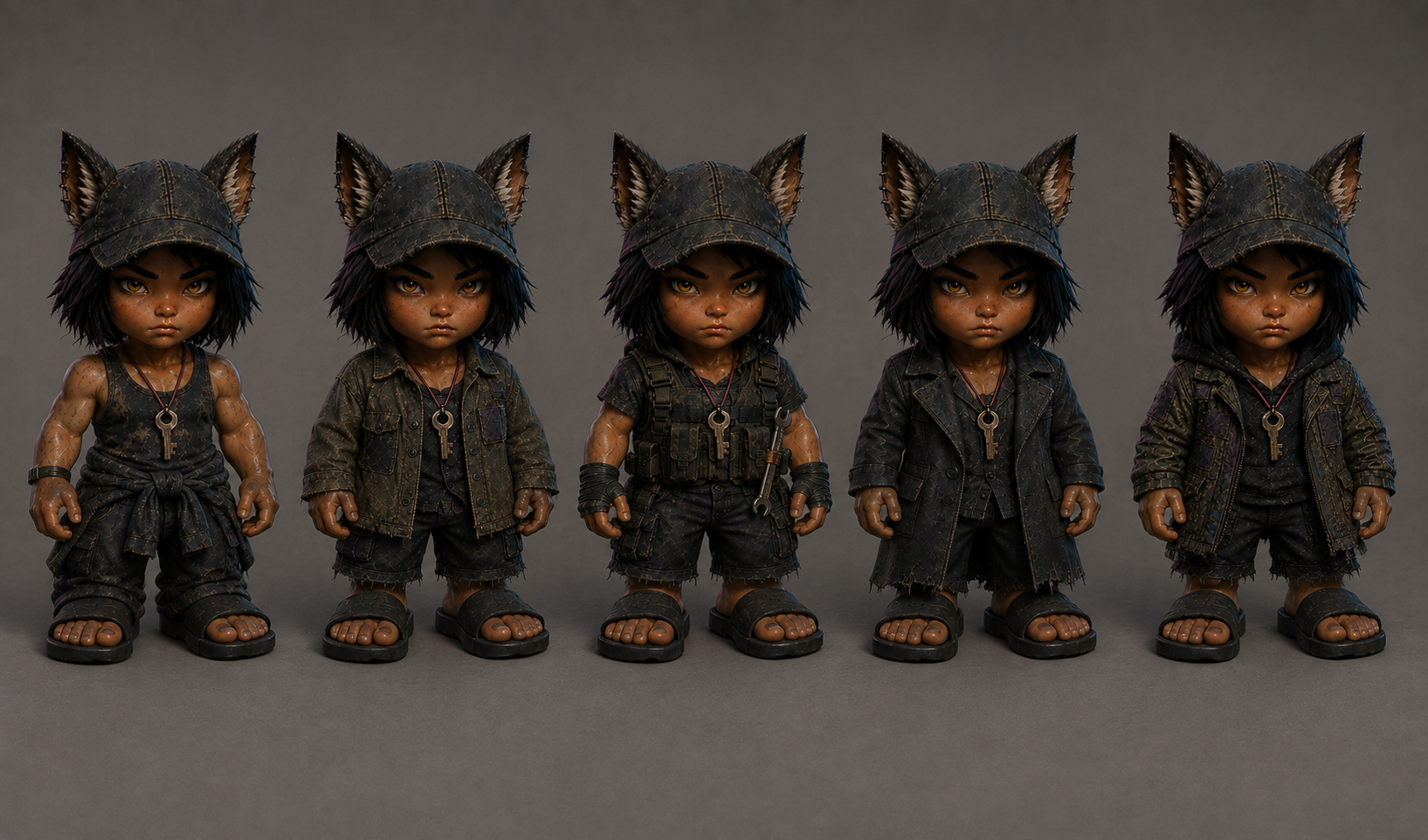
Baseline. Kavast-issue olive field jacket, unit markings ripped out, mismatched grocery-store patches sewn over the ghost outlines. Warm-up trousers. Foam slides, always — including pursuits. Faded junk-shop trucker cap with a squared brim, wolf ears through and above it, the left-ear notch clear of the crown. A hand-cut ceremonial key on a cord at the throat; her car is keyless, and the key is the point.
Accent. Civilian pink, on exactly three things in the world: the car, the key cord, one respray drip on the right slide's toe. Never wears: anything with live Kavast red; new clothes bought at retail; laced footwear; anyone else's fit.
Theo Ashe
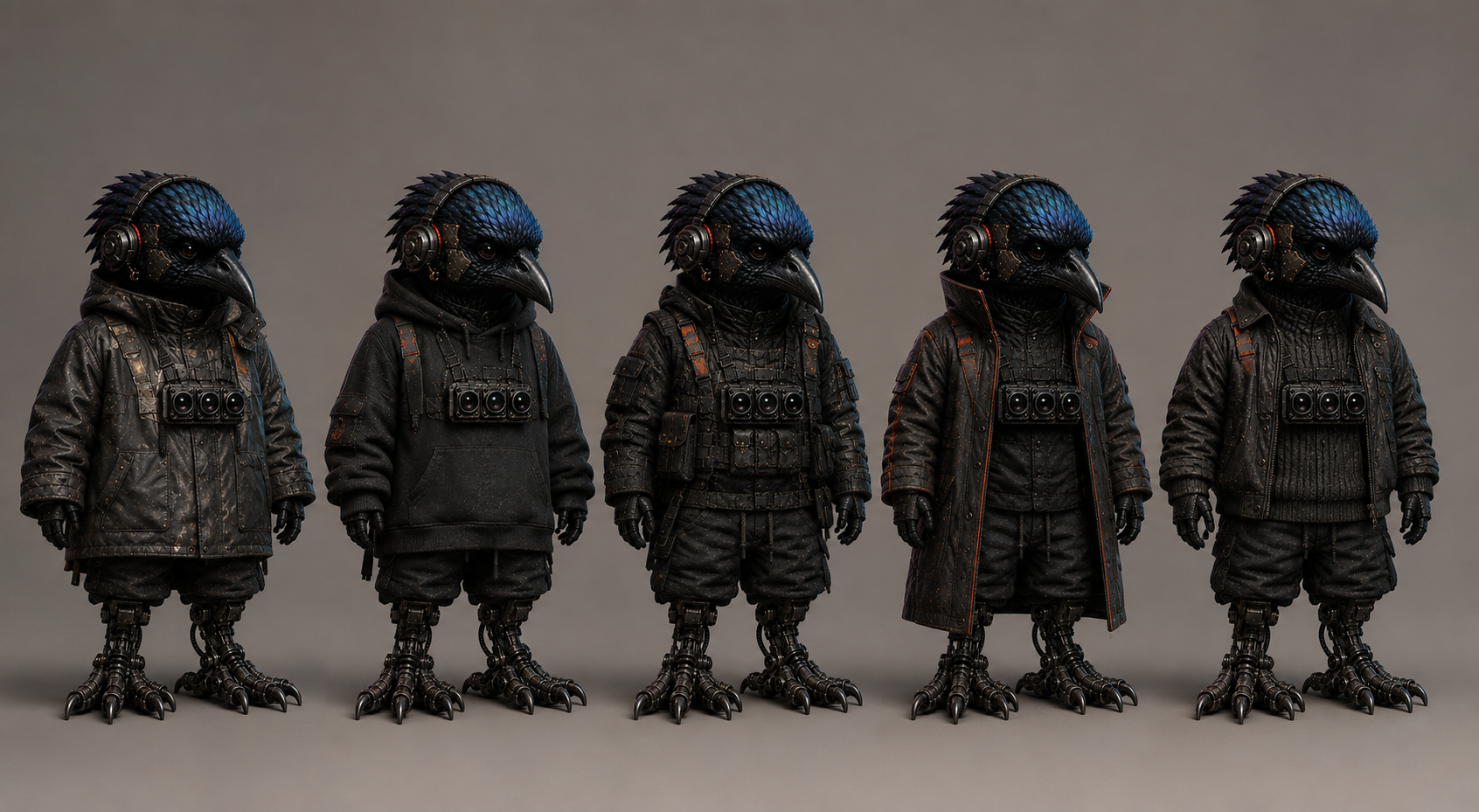
Baseline. Dead-stock courier windbreaker two sizes big, open over unacknowledged armor plate; wide cropped trousers above disproportionately short custom mechanical lower legs and articulated talons; the chest-strapped lens rig, three optics on thrifted frames with tape and paint-pen serials; augment-maintenance patches worn on the face like pimple patches; a plain hoop in the left ear.
Accent. Hi-viz roadworker orange: one strap and a beanie. A raven in hi-viz is the right joke. The rule: the feather ruff is their biometric fingerprint — covered on jobs, shown only in their own posts. Never wears: anything sincere-register; visible Protectorate green; a fitted garment.
Grigor Tam
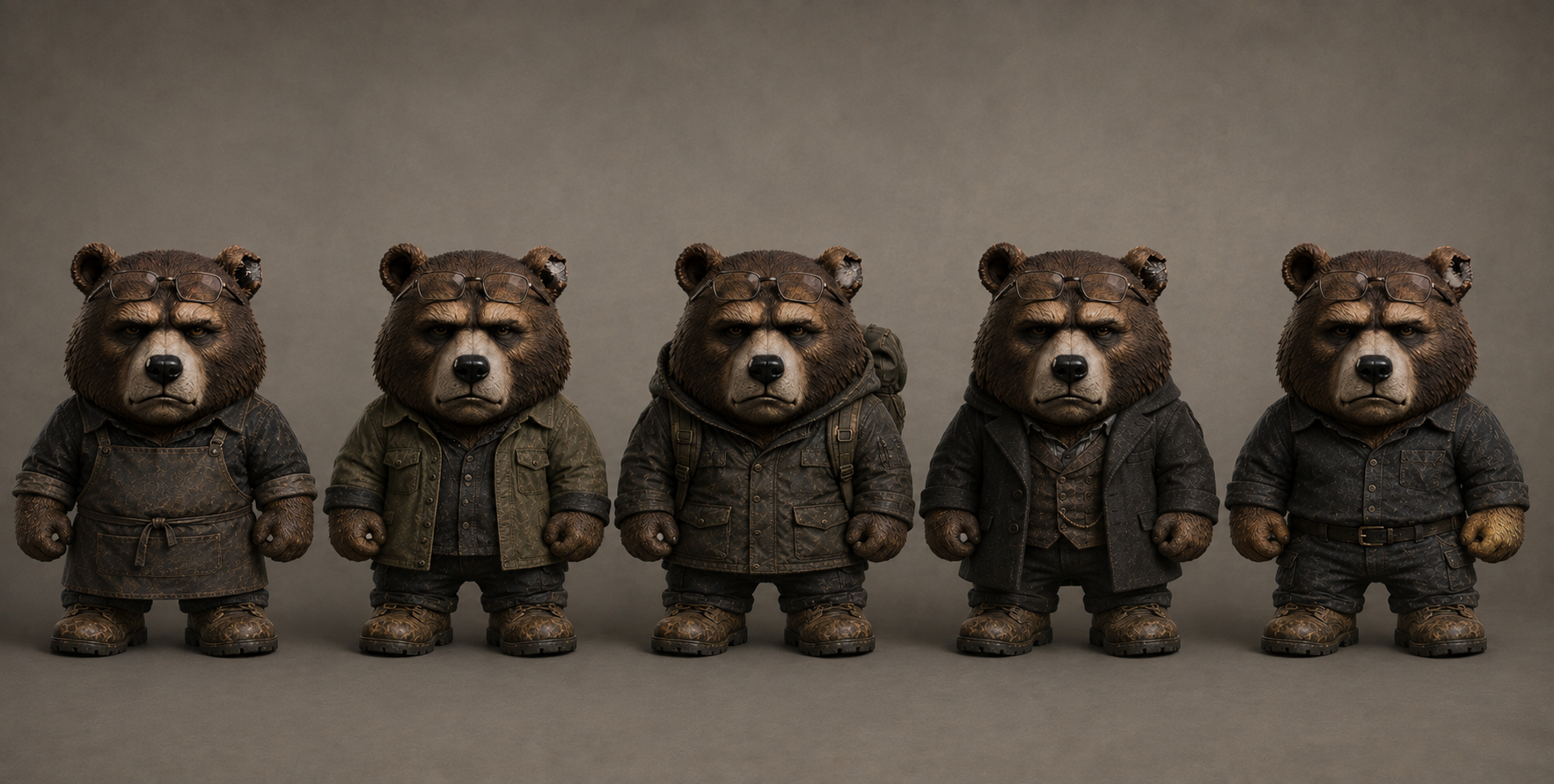
Baseline. Plain Eastern Compact cold-weather surplus: wool overshirt and muted olive-grey anorak, sherpa collar, insignia removed by unpicking the seams and hemming the holes. Work trousers. Boots maintained nightly. Exactly one pair of wire readers, worn on the brow. A round man in strictly rectilinear clothes — square pockets, straight plackets, hard hems — and the collision is the characterization.
Accent. None, and the absence is deliberate. Copper belongs to his kitchen — the pans, the spoon wood, the warm light — never to the clothes. In any frame he is a cold-dressed man in warm light. Never wears: an accent color; combat styling (his knife is a paring knife, and his clothes make the same argument); unmaintained footwear; a logo.
Cas
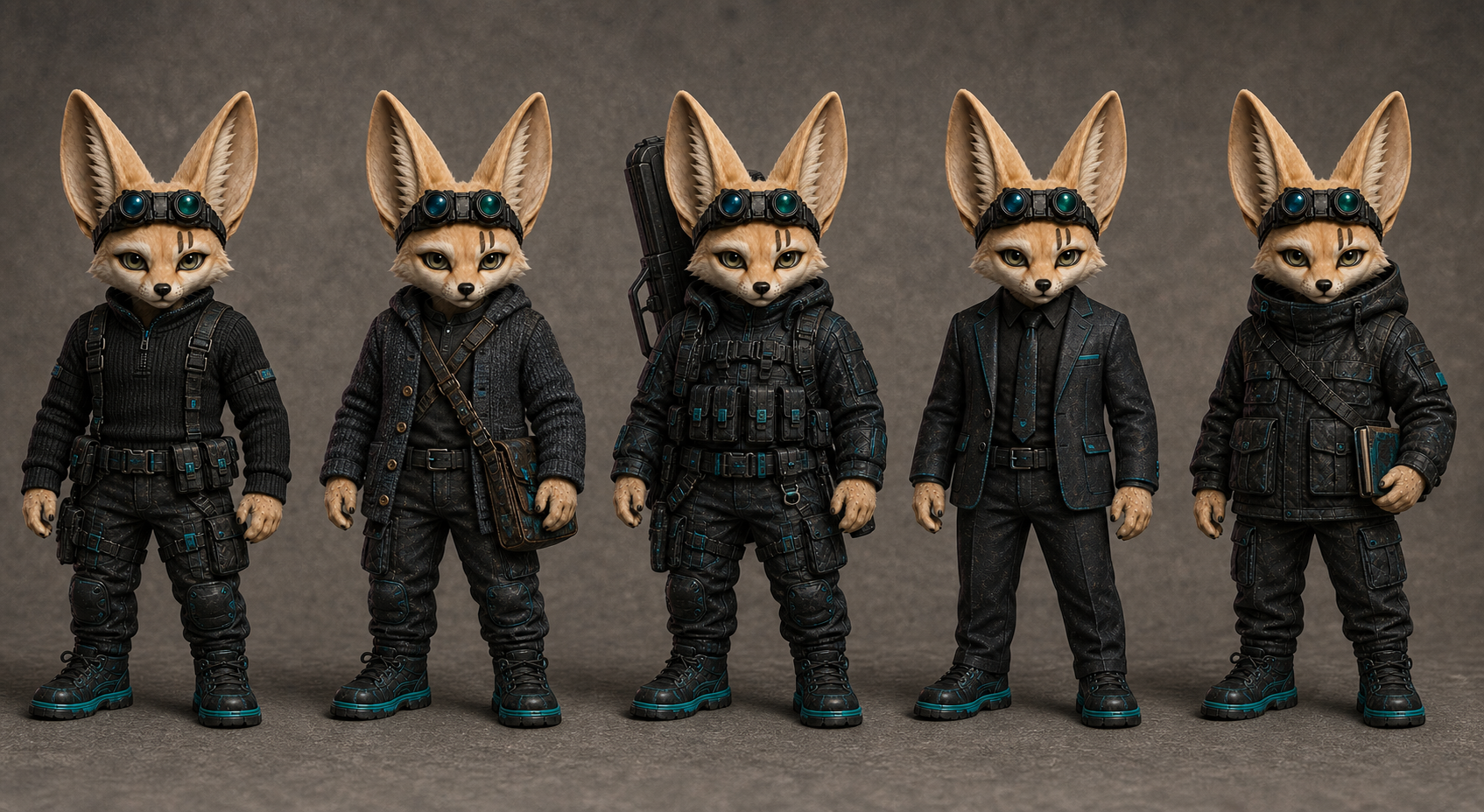
Baseline. A high-collar surplus smock from a defunct army over a modular chest rig, everything labeled; cargo trousers with the contents of each pocket hand-written on the outside in paint pen. No cap, no beanie, nothing covering the ears — the enormous open fennec ears are the headwear. In its place, a forehead-mounted dual-lens night-vision / sensor goggle rig worn just below the ears, teal/cyan lens coloration with visible serial etching.
Accent. Caseline corporate teal — her dead manufacturer's color, reclaimed as her personal coding system: tape, labels, filing. Whether she did that consciously is a question the design leaves open. Never wears: anything unlabeled; borrowed clothes; headwear of any kind; the teal as decoration rather than as filing.
Ozzy Okonkwo-Cruz
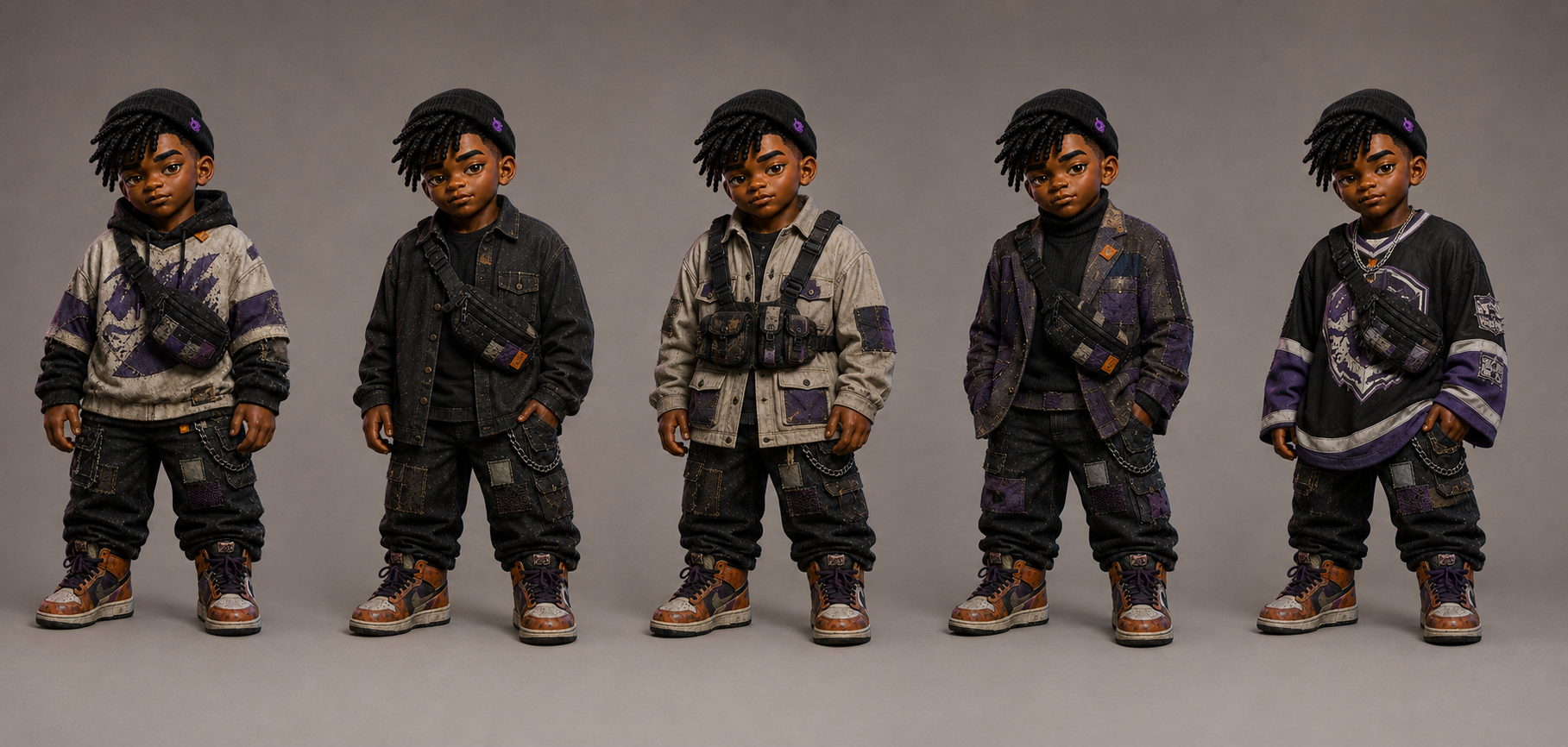
Baseline. Thrift-core chaos from defunct sports teams: an oversized jersey over a dark hoodie, baggy patched denim or cargo shorts against all weather advice, worn sneakers, and the beat-up vendor sample bag. The most cluttered body silhouette in the crew against the smallest, softest head. No animal traits and no augment shapes anywhere on him — the absence is the design, and OEM is the answer, printed on shirts.
Accent. Price-gun fluoro, the markdown-sticker orange-yellow: merch tags, stall signage, and one lace or strap at all times. Never wears: the bagged, never-worn GENE FORGED REUNION TOUR grail shirt, in any register, ever; a full uncollaged faction flag; anything augment-shaped, even as a joke.
Where the crew shops
Danka's patches come from grocery-store bins, not from FACTION SURPLUS — paying a label to strip a jacket she can strip herself is, verbatim, "paying twice." Cas buys dead-army surplus by the crate and relabels it. Theo's dead-stock courier gear is STATION WEAR adjacent: vendor-grade, pre-registration. Ozzy's stall competes downmarket of SPLICEWEAR and his bootlegs are better than official merch, which Theo calls art to his face. Nobody on this crew has ever bought GHOST KIT: they are what Ghost Kit costs four figures to look like, which is the joke of the label's entire market position.
The Five Registers
Ratified 2026-08-27. Every fit a lead wears is one of these five, and the rule that governs all of them: the register changes how much of the baseline they're wearing and how it's worn — never the acquisition logic, never the accent, never the silhouette.
R1 · Garage fit — home, nobody watching
- Danka: jacket hung on Civilian's mirror; grease-marked work tank, a coverall tied off at the waist, the slides, cap backward. The key cord never comes off.
- Theo: windbreaker worn as a blanket, hood up; rig off but within arm's reach; sock feet on the counter; ruff visible — home is the only safe frame.
- Grigor: anorak off, sleeves rolled to the elbow, scar map visible, a plain hemmed canvas apron; readers on the brow above a shopping list written like an operations order.
- Cas: smock off, rig hung inside its painted pegboard outline; the goggle rig pulled down over the eyes at the bench; teal tape once around the left wrist, like a bracelet she'd deny is a bracelet.
- Ozzy: the folding uniform — hoodie only, jersey off and folded, shorts, slides borrowed from Danka's supply that she has never acknowledged lending.
R2 · Contract fit — the job, the baseline tightened
- Danka: identical to baseline. The joke is that she pursues in slides; protect the joke.
- Theo: ruff covered, rig taped down so nothing swings, plated side out.
- Grigor: anorak closed, boots freshly maintained, the paring knife where others carry combat blades. Nothing else changes, because nothing else ever changes.
- Cas: full rig, every pouch touched in sequence before rollout, rifle case anonymous and immaculate.
- Ozzy: laces actually tied, bag strapped tight across the chest, the drape pulled in — he secretly trains at dawn to never be the reason an exfil slows down.
R3 · Race-night fit — the Tooth and Gear
- Danka: the same fit, laundered. The crew can tell she dressed up because the slides match. The long coat lives in R5 and comes out for R5 occasions only.
- Theo: best windbreaker, hoop polished, beanie off, bare crest. Drinks at the Tooth; has never posted a frame.
- Grigor: the one pressed Compact formal shirt under the overshirt, collar buttoned — formality worn sincerely, which in this company reads radical.
- Cas: rig off, which reads to the room as "unarmed" and is not true; least-military surplus jacket, still labeled inside; notebook out, working The Line's numbers.
- Ozzy: peak stall fit — the loudest dead-league jersey in inventory, chain, fresh sneakers held for the occasion, fluoro on two items: the only register where his accent doubles.
R4 · Weather layer — heat dome and Low Coast rain
- Danka: a salvage rain poncho from Civilian's trunk, olive, one grocery-store patch matching the jacket's set.
- Theo: the windbreaker finally zipped — the one state in which it fits; lens covers hand-cut from bottle plastic.
- Grigor: heat is his enemy — sleeves rolled, apron off, and the crew learns what "Grigor, hydrate" sounds like from Cas, because pain suppression means he cannot read his own overheating.
- Cas: a clear taped-seam rain shell over the rig so the pocket manifests stay legible through it — the only crew member whose rain gear is transparent, for exactly that reason.
- Ozzy: a garbage-bag-grade poncho worn open like a cape, because cover is for stock, not for him; the bag gets the good waterproofing.
R5 · Dress fit — a funeral, a court date, a client who pays in advance
The plates' tailored look, ratified as its own register. Every lock invariant holds; the tailoring is thrift-run and self-authored, never rented, never new.
- Danka: the long coat — thrift-run tailoring in the same argyle-textured olive-black as her jacket, over the black fit. Cap stays, key cord over the collar, slides stay. The state would call the slides insolence; she calls them shoes.
- Theo: the high-collar long coat with orange piping — the one garment where the accent is built in instead of strapped on. Rig off, one camera in hand; the coat photographs as a silhouette with no face in it, which is the point.
- Grigor: Compact formal all the way down — pressed shirt, waistcoat, tailored overcoat, decades old and maintained like the boots. The single pair of readers stays on the brow. The only crew member whose dress fit predates the crew.
- Cas: the closed-collar suit — severe, square-shouldered, labeled inside every seam; goggle rig up on the forehead, idle, a ledger in hand. Reads as staff rather than guest, which is deliberate.
- Ozzy: the patched blazer over a turtleneck — thrifted tailoring with the patch panels showing on purpose, fluoro zip-pull at the lapel, the good sneakers. The family-dinner fit's older brother; his mother approves and says nothing.
The Other Half
One commander in regulation, and the whole argument stated in reverse.
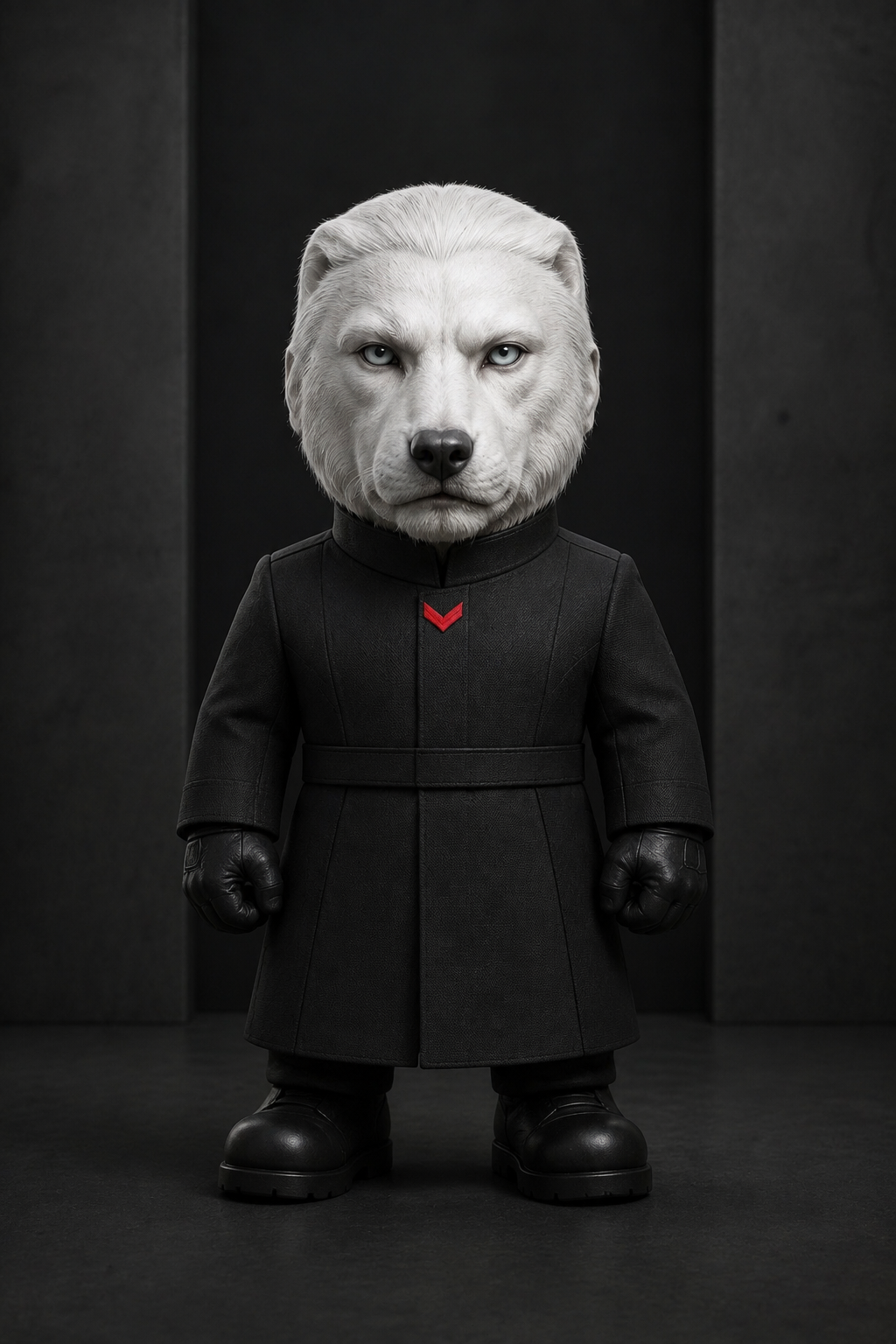
Commander Ilya Vroza dresses the way the crew's wardrobe argues against: zero personalization, nothing self-authored on his body, the black Kavast regulation greatcoat with a single red rank chevron — red as claim, exactly as the doctrine writes it. Twenty-nine years a pack commander; the uniform has never once been wrong about him. Grava Pack dresses in pack-synchronized regulation, and on camera the synchrony reads beautiful first and wrong second, in that order, every time.
Every fit in this document is something somebody chose. His is the reminder of what the alternative looks like — and the reason the choosing matters.
Appendix: Sources and Status
Where this document comes from and what it binds.
Compiled 2026-08-27 from the production wardrobe bible, which itself compiles the Illustrator Brief, the IP Bible v2's Approved Ensemble Look, the character design specs, the approved plate set, and the published Style chapter of the Pop Culture collection. The five fashion plates and the register system were approved and ratified 2026-08-27. Wardrobe statements here are design canon: art, fiction, and the show system are checked against them.
Withheld from this edition: the production's art-generation tooling (prompt blocks, character locks, verification batteries) and the rulings ledger. Everything else is the real document.
The crew's identities, voices, secrets, and story canon live in the IP Bible; the crew as playable pre-gens lives in the Mission Book. This document is what they put on in the morning.