Warranty
Void
The definitive guide: series, cast, world, canon, ledgers, writing system
A five-operator splice in Lost Angeles, producing their own short-form video content. Mixed gene-forged lineages plus one unmodified baseline. Modified bodies, voided terms of service.
Before you read
What this document is, what its status markers mean, and the one section to strip before showing anyone outside the production.

Compiled 2026-08-24; revised 2026-08-25 to incorporate the approved ensemble look (the B-tier phenotype ruling, the Danka v2 update, and the current art archive) and the rebuilt warranty-void-fiction skill. Supersedes OT_WarrantyVoid_IPBible_v1.html (2026-08-13) as the master document. v1 stopped at the four scripted Season One artifacts and "nothing has published yet"; since then the project has grown a Voice Bible, a Crew Banter pass and its dialogue diagnostic, a cultural-references pass, a complete six-artifact arc (Kestrel & Reef) with a prose novella, a complete prose short story (Peacock Holiday), a cold-open scenario playbook spanning 2066 to 2099, and one actual publication: the Mission Book, Volume One, live on terraconflictus.com since 2026-08-22. This volume folds all of it into one place. Where this contradicts a source document, the source document wins; the source map is in the appendix.
Handling note, read first
This is the public edition of the Warranty Void bible. Each of the five leads carries a deepest secret held creator-only, and Season Two development material is banked; both are withheld here, marked where they would appear. Everything else is the real document: the world, the crew, the voices, the locations, the show system, and the ledgers the writing runs on.
Canon tiers. C0 approved: written and approved by Jesse; reversible at no cost; the default state of most of this document. C1: promoted on first publication of an artifact that uses it; no longer free to change. Flagged: new canon that asks for conscious approval rather than absorption. Production doc: process material, not story canon. The Mission Book's publication (2026-08-22) promoted its contents to C1, including the crew as pre-gens, the garage, and Marisol Vega; see Part 10.
The name check. "Adeyemi" was removed setting-wide on 2026-08-18 for IP-ownership reasons, and the removal lives only in git history. The family is Okonkwo-Cruz, the mother is Blessing Okonkwo, full stop. Before any invented name enters published material, grep tc2066_deploy for it and check the git log for IP renames. Cheap up front, expensive to unpick from a printed book.
The Premise
The premise, the world's argument, and the timeline.
What Warranty Void is
A five-operator "splice" crew — four mixed gene-forged lineages plus one unmodified baseline, with an intermittent sixth (see Part 2) — living in Lost Angeles (NAF Western Corridor, 2066) and producing their own short-form video content on the Feed. The fiction is shot and posted as in-world footage: every piece is diegetically real, authored by someone inside the world, and every formatting choice must be justified by who filmed it and why they posted it. Hangout comedy is the default register; a slower dread rail runs underneath and never resolves cheaply.
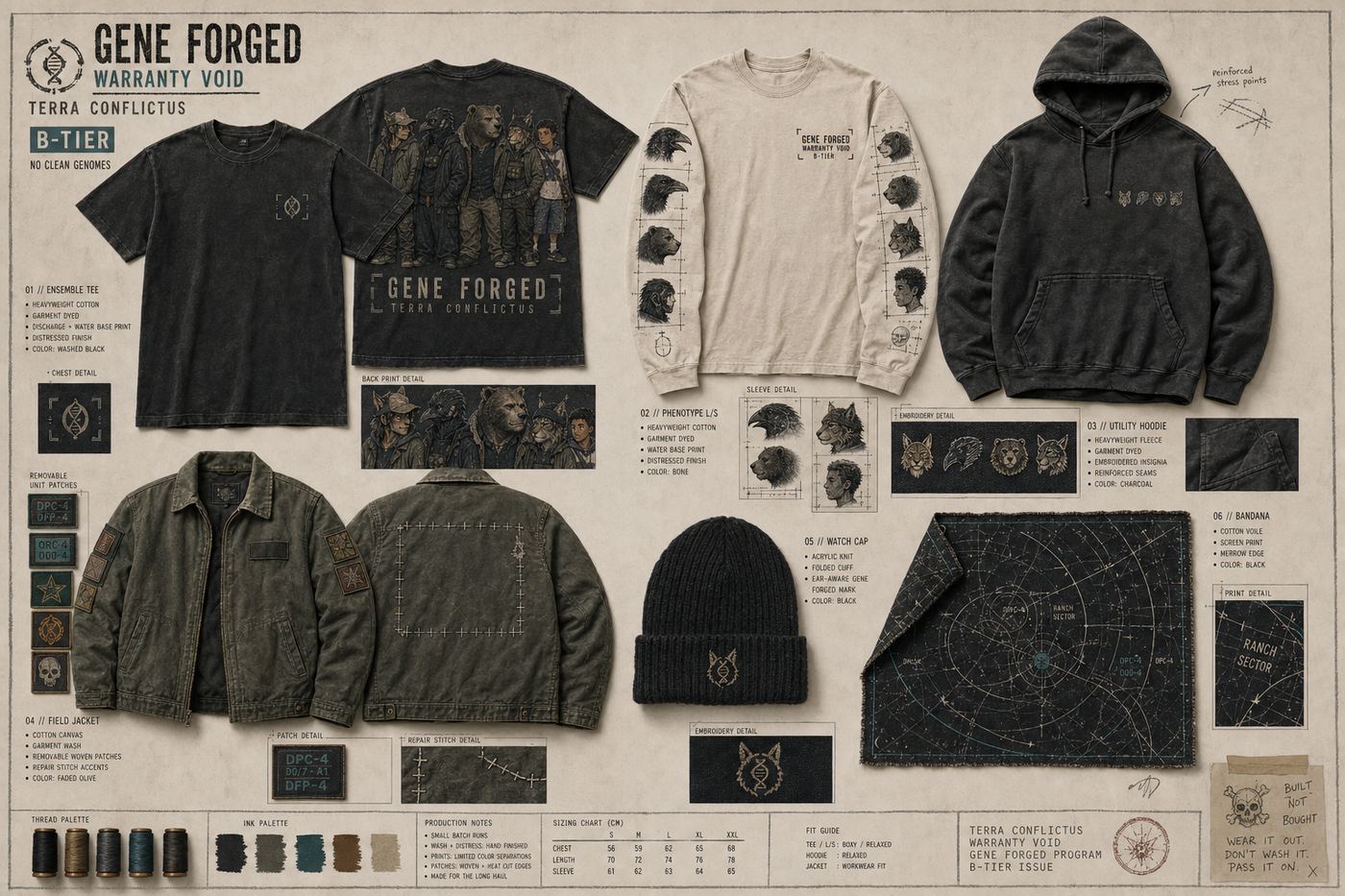
The crew name is the thesis: modified bodies, voided terms of service. It prints on a bootleg tour shirt. The channel's mark is a parody of a genomic registration card with VOID stamped across it by hand in price-gun fluoro.
Design intent. Built for the GTA-roleplay generation (Gen Z / Alpha). The splice canon already contains this audience's worldview: operators under thirty wear "splice" clean, grew up in the contractor economy, and treat state pack-discipline as their parents' failed religion. Genomic statelessness is the anti-establishment attitude made literal. Mono-type state cohorts are corporate polish; a splice is the thrifted, mismatched, bricolage answer.
The tone directive (Jesse, 2026-08-11). Comedy is the default register: crimes done with enthusiasm, bets that escalate past sense, pranks with production value, flexes played completely straight. The comedy engine is sincerity colliding with chaos: the crew takes every dumb objective completely seriously and the world refuses to cooperate. Drama and dread are seasoning, rationed like the sincerity ceilings, and they hit harder because the surface is loud. Rule of thumb: in any three consecutive artifacts, at least two are funny. One deliberate pure-drama exception per season, not per arc.
The two engines. - Story engine: the GTA incident, never the mission. Five people with wants, a city with friction, and a camera. Contracts are the intention the world interrupts. If a draft reads as a competent crew executing a job, it has drifted into mission and needs the city to interrupt it. - Comedy engine: sincerity colliding with chaos. The comedy is never the crew being funny at each other; it is five people playing an absurd situation dead straight. ("Five" here is deliberate and stays five after the 2026-09-02 six-hander ruling — the engine is the five-person garage baseline the attachment rule protects. Do not "correct" this to six.)
The ten incident forms (name which one an artifact is before outlining it): The Plan Goes Horribly Wrong · The Betrayal · The Rescue · The Rivalry · The Flex · The Prank · The Hangout · The Legend · The Bet · The Stunt. Three more banked for long-timeline work: The Reunion, The Handoff, The Debrief That Isn't (the last is the pure-drama slot).
The world underneath
Genomic citizenship. The setting argues about who owns a body. Three states breed mono-type gene-forged cohorts and each has a defector policy: Kavast breeds wolf packs and hunts defectors (live genomic marker); the Protectorate breeds networked raven flights and lists them (unrecovered state property, indefinitely); the Eastern Compact breeds bear endurance formations and depreciates them (written off, never pursued, which is quietly the most insulting of the three). The market claims bodies too: private lineage startups bred boutique genomes, folded, and sold their people in liquidation, producing orphanware, gene-forged people whose manufacturer no longer exists. Pack-bond conditioning is a deliberate Kavast retention mechanism: the packs aren't fanatics, they're hostages of their own hearts. All of this is approved canon (Jesse, 2026-08-11).
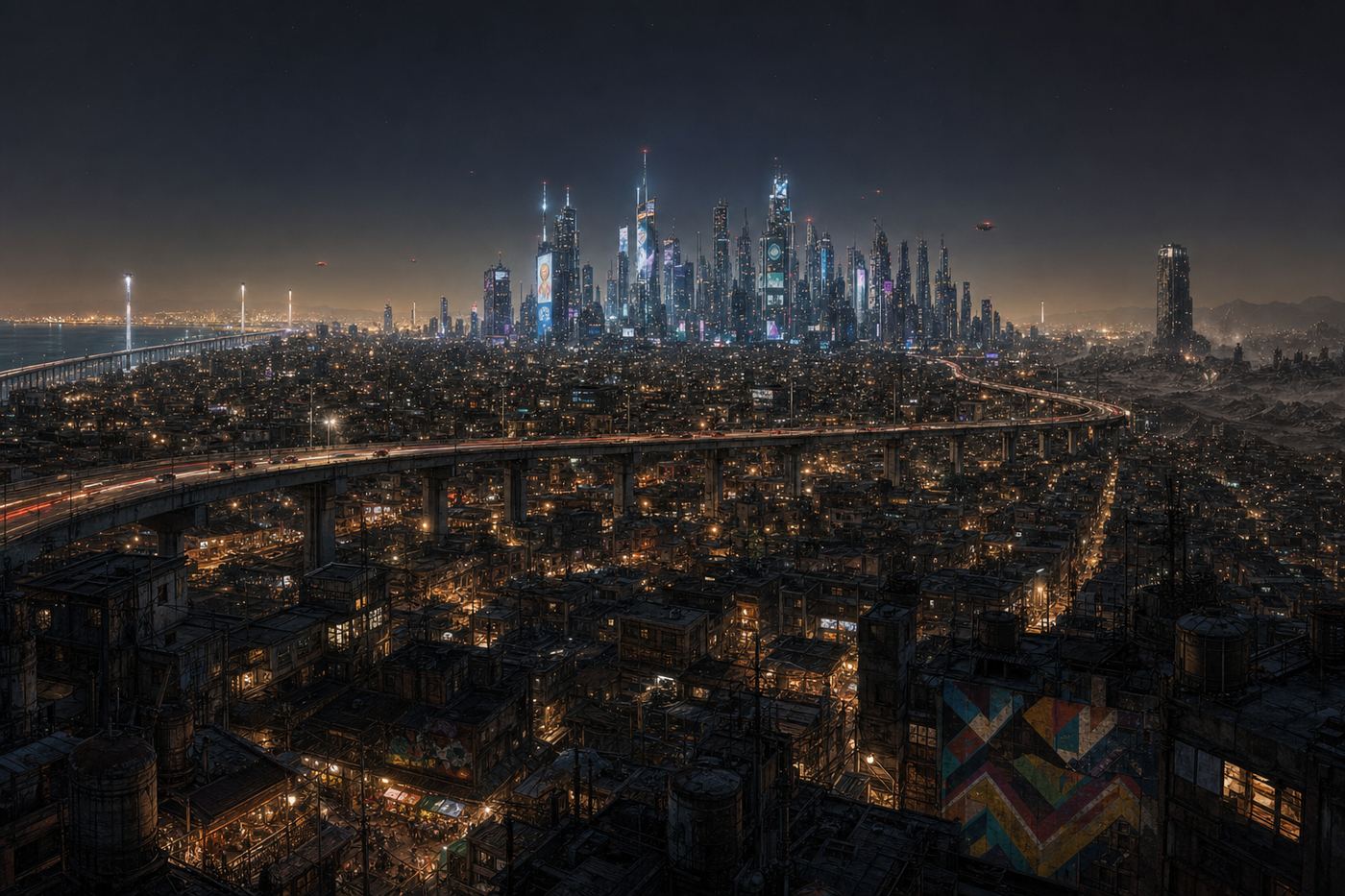
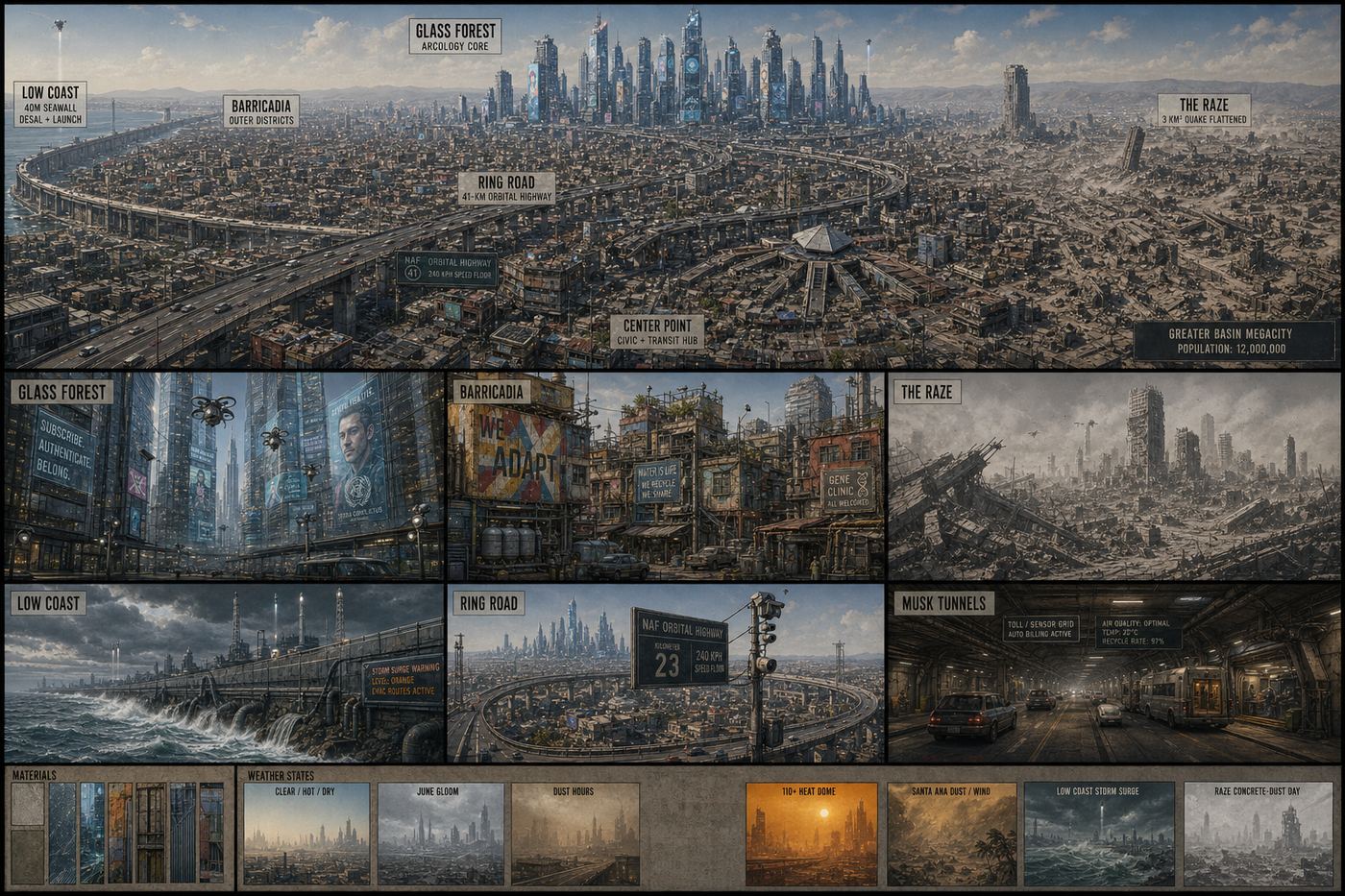
Lost Angeles. Eight districts, the Ring Road (41 km orbital highway, the most surveilled road in the spread), the Musk Tunnels, Monitor Central's drone grid (22-minute overflight windows), the Feed, the Raze (no drone coverage, no emergency services), Barricadia (artist-scavenger district, informant-net surveillance, independent water recyclers), Low Coast, Center Point, the High Top, the Tooth and Gear. Source canon lives in Raid Racers CH04 and the Lost Angeles Map Companion; CH04 wins on any district-level conflict.
The crew's place in it. Adjacent to the Raid Race scene, never in it. The Tooth and Gear is their public living room; the Feed is their stage; the garage is home. Danka's live Kavast marker matters outside NAF territory only; inside Lost Angeles she is safe, which is why the crew lives there. Any story that moves her south of the corridor is a wounds-rail event by definition.
Timeline anchors (from the Cold Open Scenario Playbook)
Season One sits at 2066. Crew ages: Danka 24 / Theo 22 / Grigor 34 / Cas 26 / Ozzy 19. Danka bolted from Kavast at 19 (2061); Cas bought herself out at 19 (2059); Theo deregistered at 20; the Forklift Clip and Ozzy's hire are roughly one year before Log 001. Canon future events available for later-era stories: 2071 the Relay Incident (and the year Grigor's five-year medical estimate runs out; a medic's estimate is not a script, but any story dated 2071+ must know what it's assuming about him). 2078 the EO Autonomous Surge. 2084 the Southern Compact Resource Crisis (Lumicite scarcity hits gray-market augment maintenance and the garage's filtration line). 2098 the Lumenfeld Archive Recovered. The sanctioned window runs to 2099.
The Crew
The six leads in full, and the approved ensemble look.
Six entries. Each carries the full narrative layer, the load-bearing profile facts, the voice system, the ten locked test lines (final authority on each voice), and cultural anchors. Callsigns: PEDESTRIAN, B-ROLL, PATIENT, SPREADSHEET, OEM, UNLISTED.
The sixth is not a sixth chair. Marit Sey (UNLISTED, ruled 2026-09-02) is an intermittent member: no fixed address, no standing seat, two to four appearances a season. The garage baseline is five. If a scene works with five people in it, it has five people in it. Her attachment rule is in her entry below and in Part 3's standing design rules, and it is the active management of the objection recorded in Part 10, Open decisions, item 8 — not its deletion.
Danka Ivel
Wolf lineage, 24, ex-Kavast, the driver. Callsign is the crew's joke about the one thing she is terrible at being.
Core premise. Kavast holds packs together with love, not discipline: pack-bond conditioning means deserting means leaving your litter. Danka is the one who did, because she watched command spend that love like ammunition.
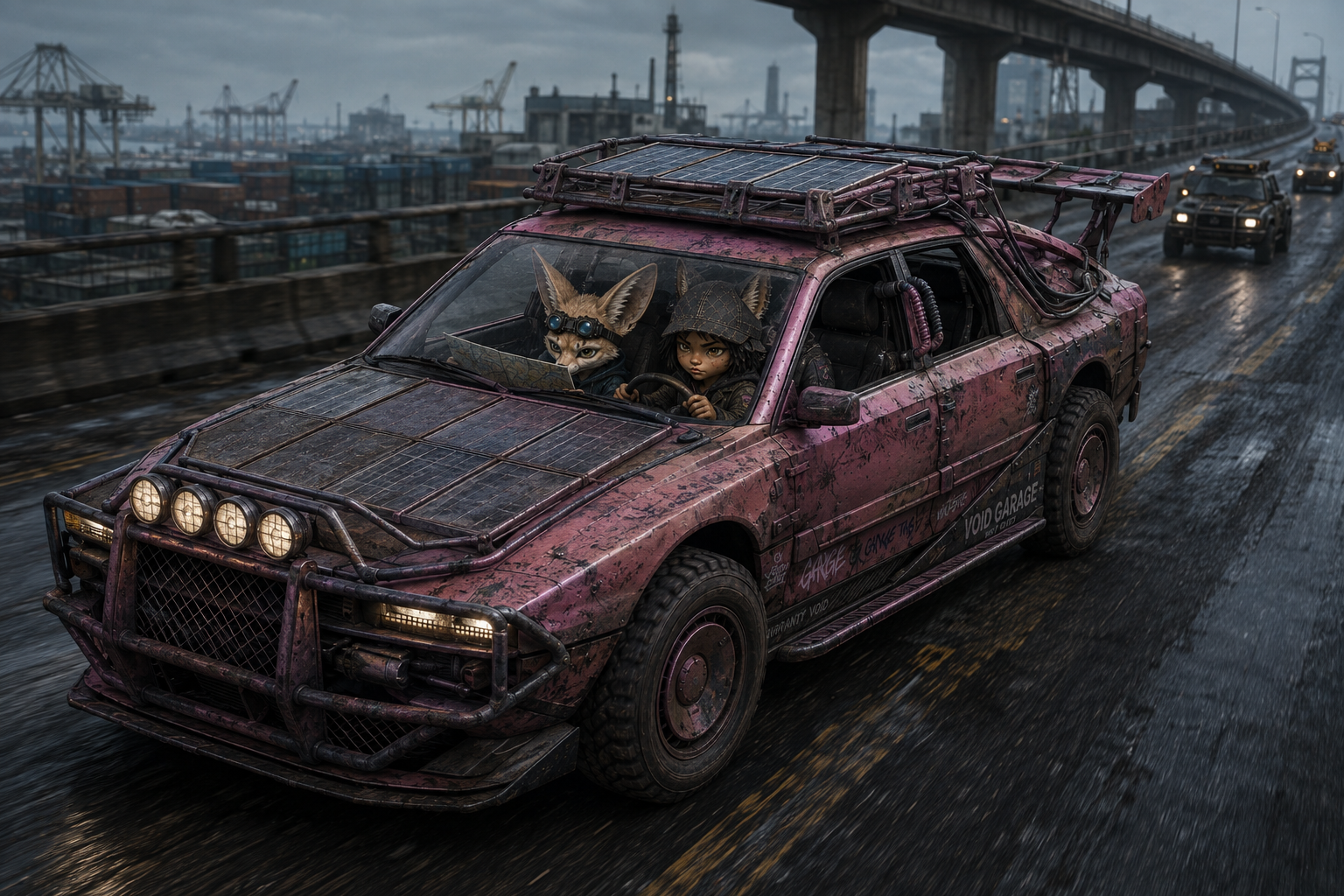
- Drive: owning things. Kavast issued everything she ever touched, including her genome, her name, and the people she loved. She builds a self out of chosen objects, centered on the car: bought wrecked at auction with her own money (206 in cash, her whole first freelance purse), rebuilt by hand, resprayed a pink Kavast has no code for, named Civilian. Not a joke name. A goal.
- Fear: the pack instinct itself. If she loves the crew, is that her or the breeding? Every attachment is a suspect.
- Weakness: escalation. Wolf aggression plus a steering wheel plus a threat to the crew. She doesn't start things; she finishes them three sizes too big.
- Love: Civilian. The crew, which she will not say. Her litter, which she will not think about in daylight.
- Lie: "I don't need a pack, I left mine." Truth: a chosen pack is a different thing from a bred one, and choosing is the part Kavast never let her do. Loving the crew on purpose is the first free act of her life.
- Arc: ownership as selfhood to choice as selfhood. Objects were the practice; people are the exam. Climax beat, whenever it comes: she goes back toward Kavast airspace for a littermate, freely, eyes open.
[Withheld from the public edition. The full bible is an internal production document.]
Ensemble function. The crew's velocity and its temper. Mirror with Grigor (both bred for cohesion; she's fleeing it, he's grieving it; their arguments are one argument). Defector pair with Theo (she thinks the audience is a leash Theo picked out; Theo thinks the car is the same thing; both right). Dark mirror: Vroza, the wolf who stayed and calls the leash love. She can't simply beat him; she has to beat him in a way that argues. With Ozzy: officially "cargo," and she has quietly decided he rides in Civilian during anything dangerous, because Civilian is the thing she trusts most.
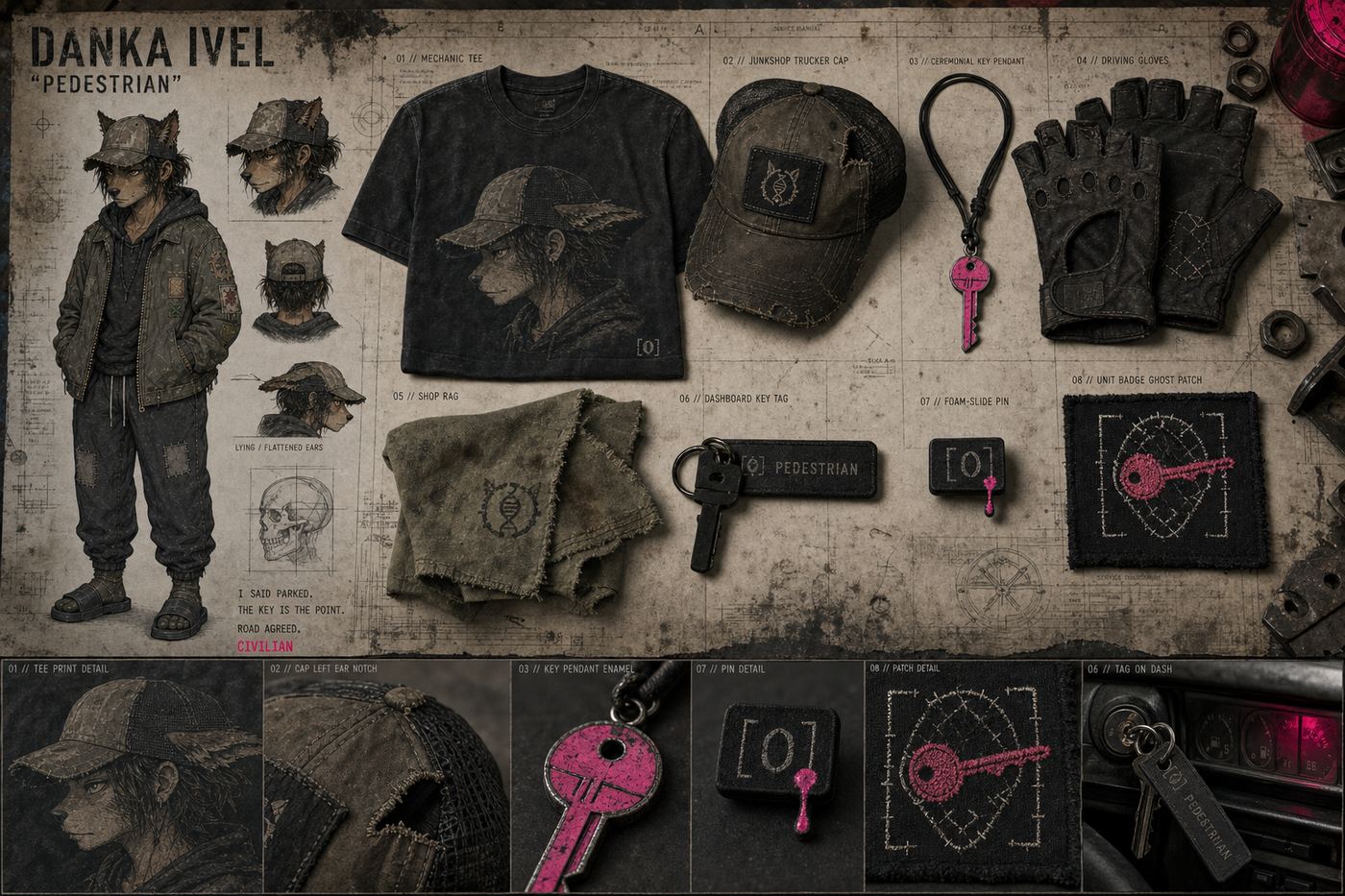
Profile essentials. The Vetka litter: six pups bred as one unit; Miro died at the Brava Cut (held a line no sane unit holds, because conditioning wouldn't let the litter break formation while command fed them into it); Danka bolted eleven weeks later and hates that number; four remain in service, one of them Vesna. Kavast Asset Recovery holds a live marker; Kavast recruitment ads still use her litter's graduation footage. Wears the Kavast field jacket with unit markings ripped off and grocery-store patches over the ghosts; foam slides on the pedals, always, including pursuits; a hand-cut ceremonial key on a neck chain (Civilian is keyless; ownership needed an object). Sleeps in Civilian's back seat more nights than anyone mentions; runs solo courier contracts at night because driving until tired is her only sleep aid. Claims no spiritual belief and is a hypocrite twice: she holds that an object keeps the hands that worked it (never sells a part she rebuilt; gives them away and gets short with thanks), and she can still recite the Vetka graduation litany word perfect. It came out of her once, concussed, in the Musk Tunnels; Grigor pretended not to hear; Ozzy pretended too, which is when she started letting him ride up front. Ear notch on the left ear (litter marking, continuity surface); Kavast genomic barcode at the nape, tattooed over with the outline of a key (plot object). Her wolf ears flatten when she lies, which is why she doesn't. Habits: circles any building once before entering and calls it parking; eats fast with her arm curled around the plate, litter-style (Grigor started doing it too so she wouldn't be the only one); checks the mirrors of parked cars as she walks past; silent door-facing-chair rotation with Grigor; hums exactly one bar when the engine catches; clicks a 3/8 ratchet while thinking (Ozzy clicks his price gun back; never discussed). Most controversial idea, said once in front of the wrong people: the packs shouldn't be freed, because most of them wouldn't leave, and everyone should sit with what that means. It started a fight with Theo that neither has finished. Ignorant about: being liked; she genuinely cannot tell.
Voice. Short. Three to seven words. Fragments are her default unit; sentences never grow subordinate clauses; questions come in clipped stacks ("You paid full price? From a store? With lights?"). Hard stops, never trailing ellipses: she's terse because she's economical, not because she's withholding. Engine grammar for everything: people redline, plans throw rods, feelings are a warning light she'll get to later. When something needs mourning it comes out as a spec sheet. Never hedges: no "maybe," "kind of," "I guess." If a Danka line contains the word "feel," it's the wrong line. Anger is precision, not volume: quieter and more exact. Affection is an act she'll deny (fixing your brakes at 2 a.m. and being short with you for thanking her). Rationed device: the flattened ears and the one-beat-late huffed laugh; when the story needs its one drama exception, her comedy engine goes fully quiet, including the laugh. The trap: any line that explains her feelings in the abstract or hedges. Wrong: "I guess I've been thinking the crew means more to me than I like to admit." Right, same beat: silence, then "New plan." and she's already moving. Vernacular access: void grammar (marked, hunted; can open on another defector with "when'd you void"); blank-cluster neutral terms ("paper"); orphanware is NOT hers (she's hunted, not discontinued). Kavast field-cant swearing is canon-flagged but unwritten; route through the slang desk, don't improvise.
Ten locked test lines (final authority): 1. "Seatbelts. I'm serious. I'm the best driver you know and I'm telling you seatbelts." 2. "Civilian is not a joke name. It's a goal." 3. "You paid full price? From a store? With lights?" 4. "Kavast builds good engines. That's the whole eulogy." 5. "I'm not escalating. This is what de-escalation looks like at my speed." 6. "Ozzy. Don't touch the car. Don't describe the car. Don't monetize the car." 7. "Fastest of my litter. Second fastest in this city. Working on it." 8. "Packs don't break formation. That's not loyalty. That's the leash." 9. "I don't miss the pack. I miss knowing where everyone is." 10. "New plan. The plan is I drive."
Line 9 is the sincerity ceiling, once a season maximum. Line 8 is the thesis, said like a spec sheet, never like a wound. Strip-test spares: "Tires are the only thing on this crew that don't lie to me." / "I heard you the first time. I'm deciding if I believe it." / "Good plan. Wrong gear." / "You want a hug or you want the truck moved. Pick one." / "Fine." (beat) "The car's fine too. Ask about the car."
Cultural anchors (full detail in OT_WarrantyVoid_CulturalReferences.md): Raid Race garage-first fandom, pit-lane cams, coaches the mechanics aloud; respects Dust Choir (last crew-held garage); won't joke about Java Monsoon's instinct bleed. Half Lap is hers: the Kavast-territory mono-type pack relay is her biography with a broadcast license, and its annual eligibility fight is the same fight as her unfinished argument with Theo (the 5 December season opener re-arms it yearly). Ring Road After Two alone past two; Marta secretly current; audio first, always. Knows Kavast interceptor build sheets, recruitment-ad cycles, dead automotive marques (the way Cas knows dead genomics companies). Rationed image, flag before use: a five-strip Half Lap braid in her hands.
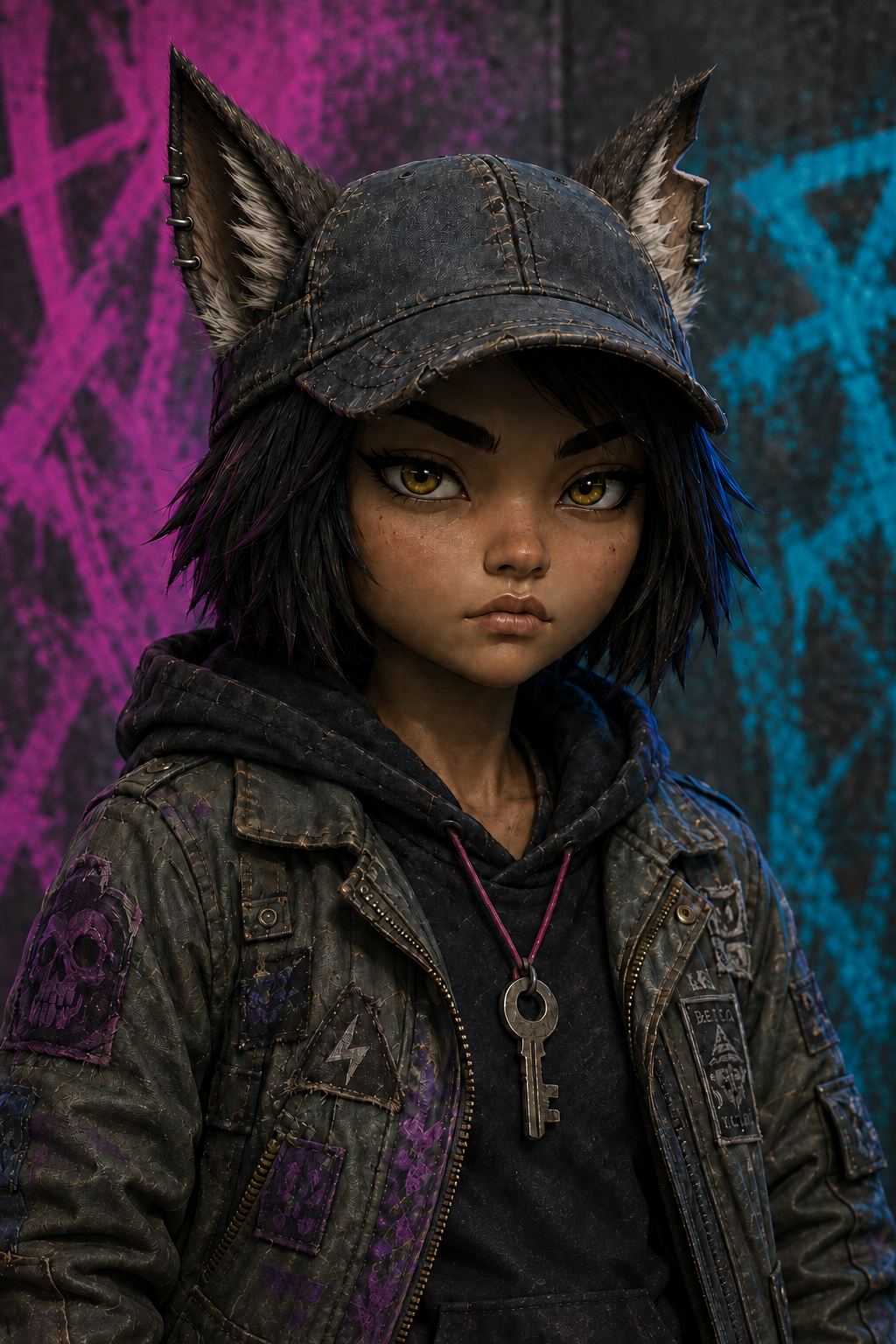
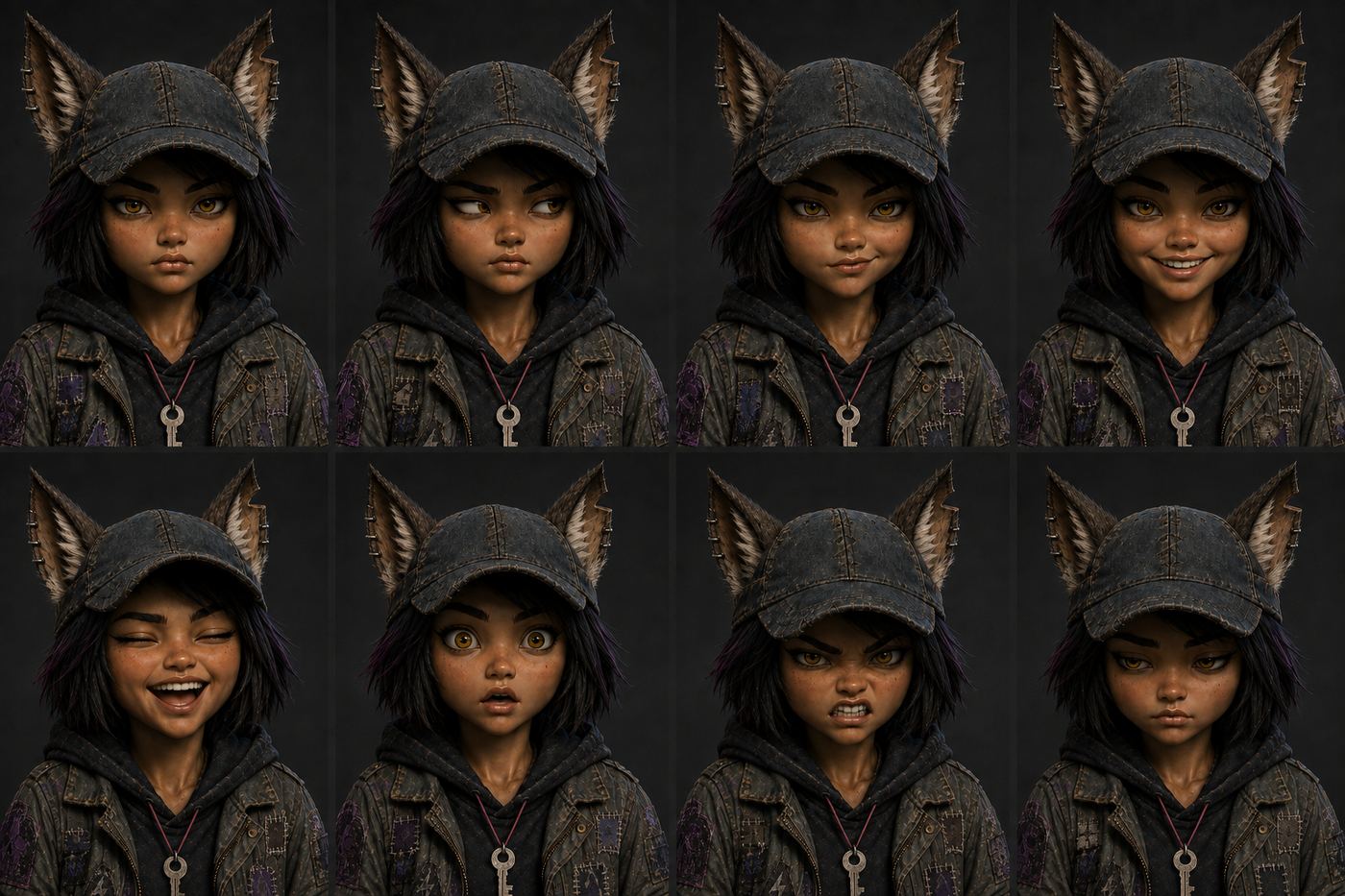
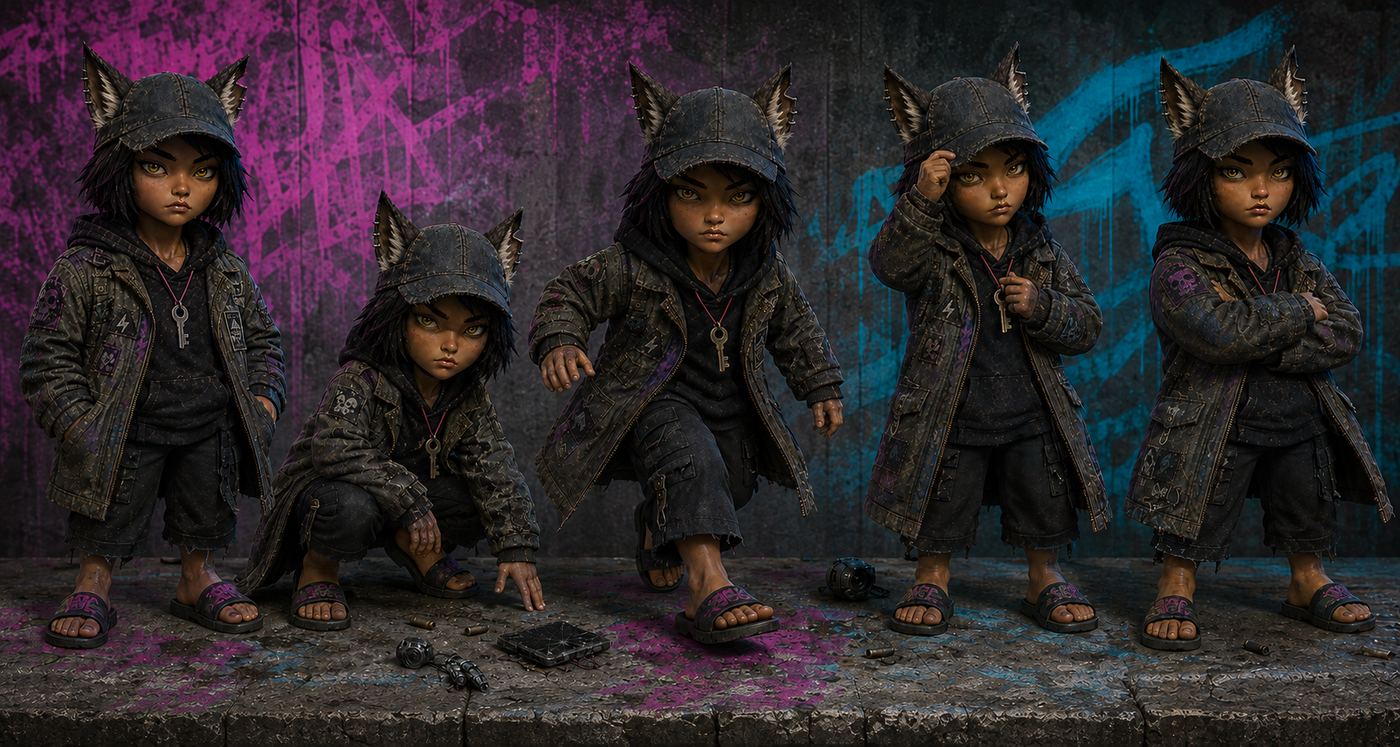
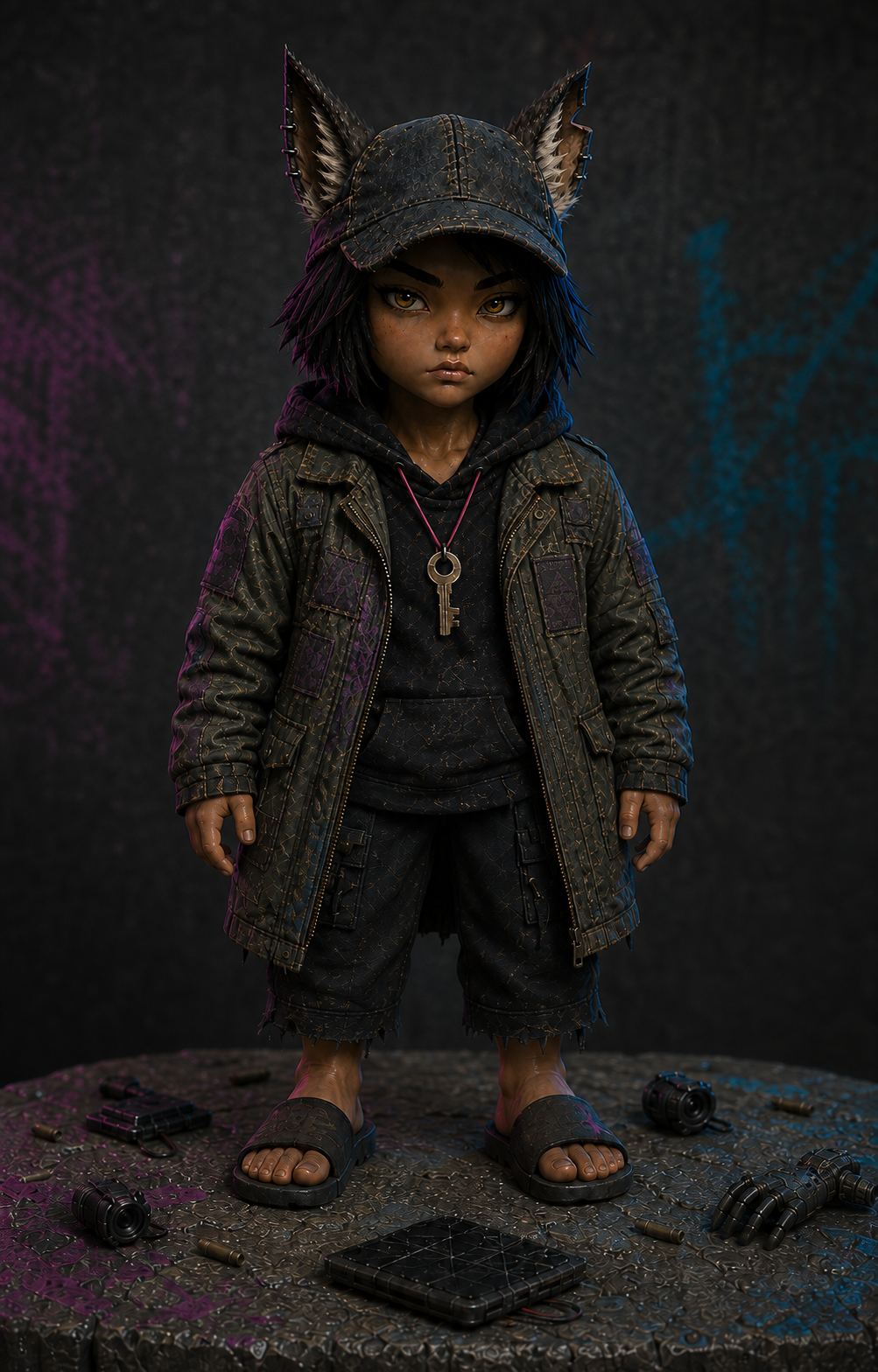
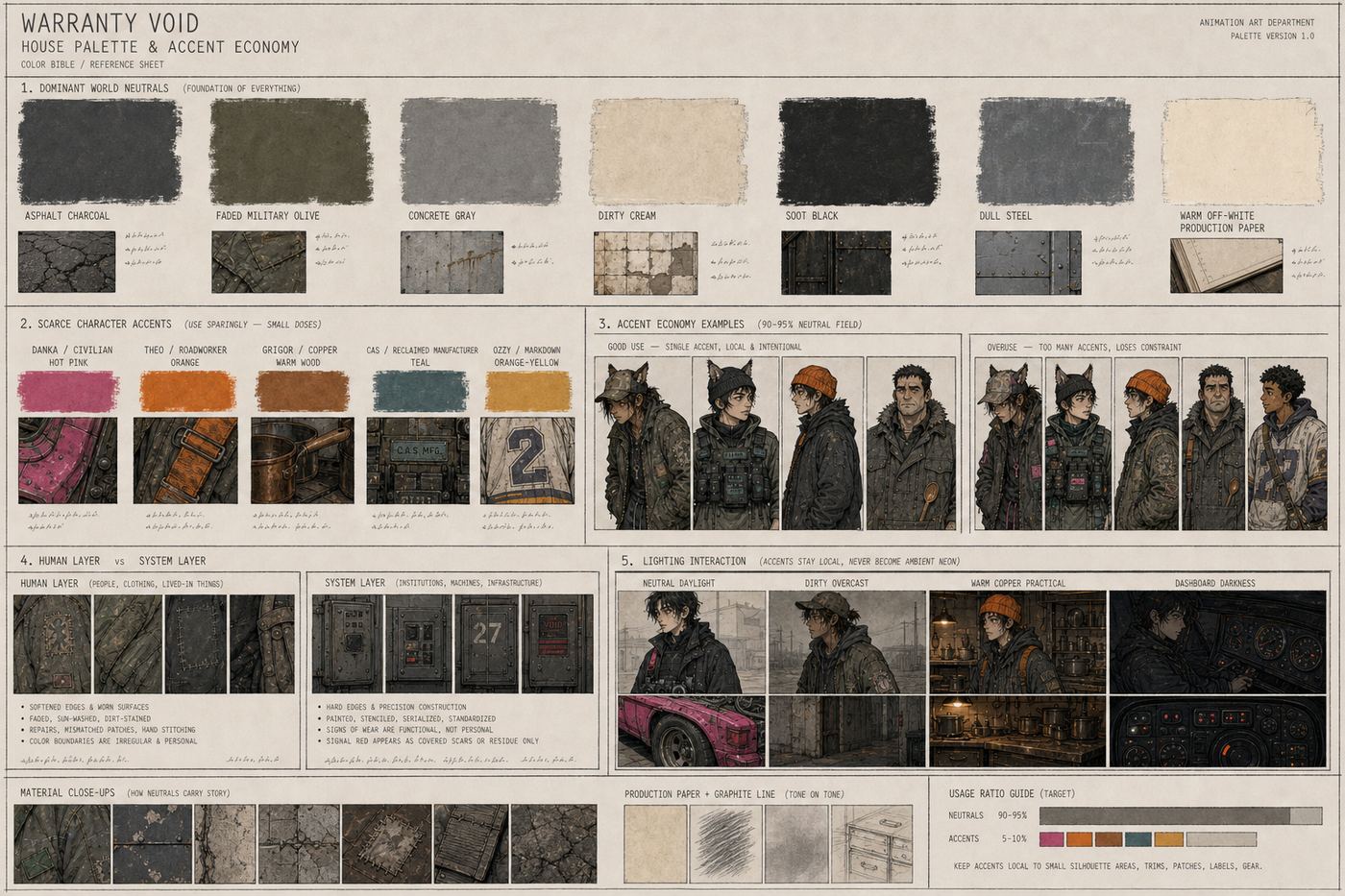
Visual. Phenotype (ruled 2026-08-25): human face, wolf ears through and above the trucker hat, amber eyes, subtle canines, faint fur on forearms and hands; deliberately the ensemble's most legible face (see The Approved Ensemble Look; the Danka v2 set is the definitive reference). A street body that swallowed a system object: Civilian's cabin runs ripped-out Kavast rally gauges, TDR-cold, inside the most self-authored vehicle in the city. Palette: asphalt gray and cold olive; Kavast signal red for the state only; Civilian pink on exactly three things in the world (the car, the key cord, one respray drip on her right slide). Art direction sentence: a Kavast pursuit package wearing a thrift bin; the girl is quiet, the car is loud, and the state's speed doctrine got resprayed a pink it has no code for.
Theo Ashe
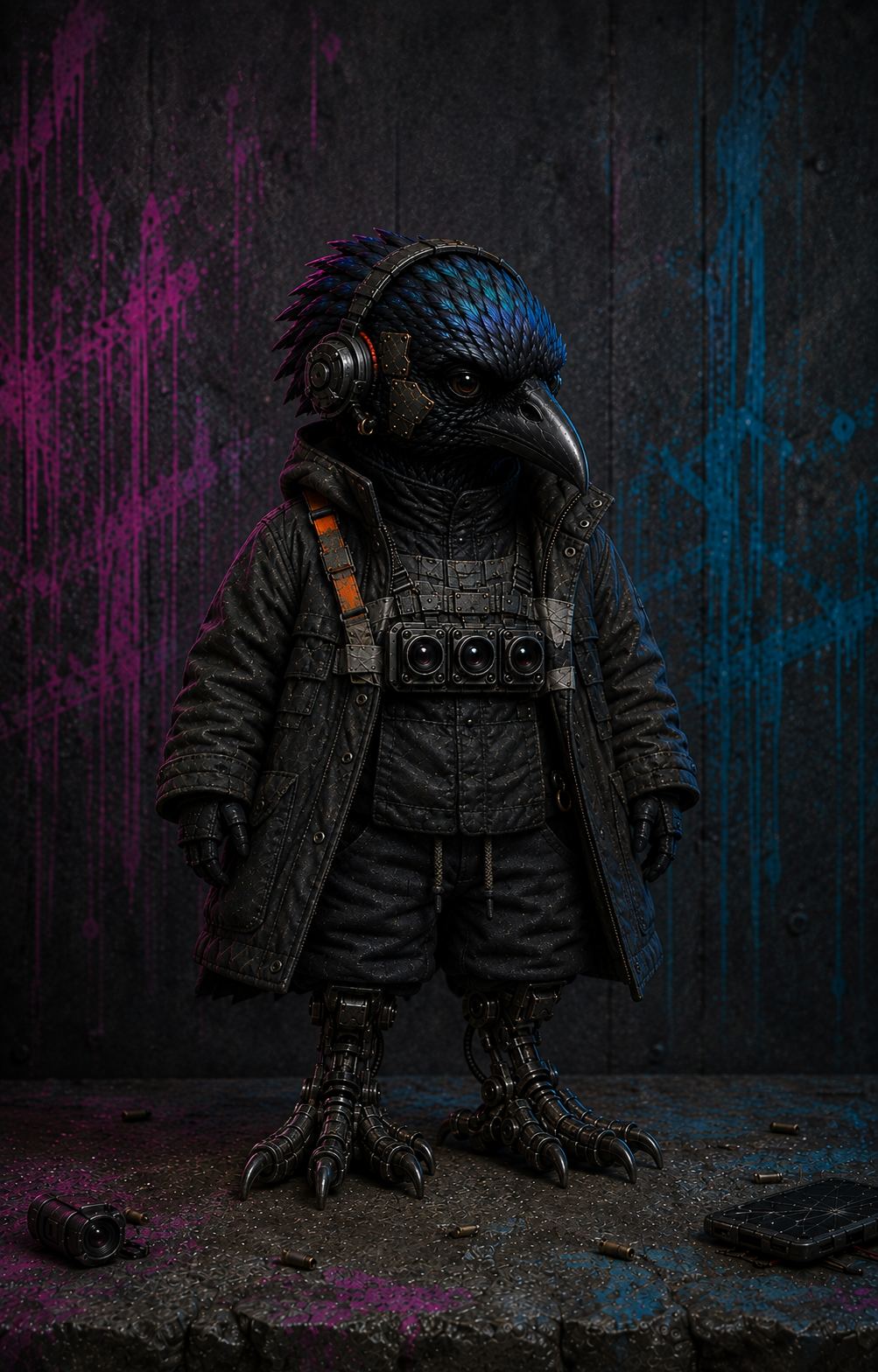
Raven lineage, 22, ex-Protectorate, they/them, the documenter.
Core premise. Protectorate flights are networked sensory arrays. A raven defector didn't just leave a job; they left a shared head. Theo spent their whole life inside Vantage Nine, a nine-operator flight running as one sensorium, and never had a private thought until defecting at twenty. The silence nearly killed them.
- Drive: an audience the Protectorate can't revoke. The audience is a prosthetic flight: thousands of people seeing what Theo sees, one-directional, safe. They will never say this out loud.
- Fear: sincerity on camera (irony is deniable; sincere Theo has no cover). Deeper: being alone in their own head again. An audience of zero is the old silence.
- Weakness: keeps filming when they should be helping. Framing a crisis is how they stay outside it.
- Love: the crew off-camera. They archive that footage and post none of it.
- Lie: "If it's all content, none of it can hurt." Truth: a witness is a different job from a camera, and some things need a witness.
- Arc: performing for an audience to witnessing for the crew. The beat that costs them: the camera goes down while something matters, or something sincere posts with no bit wrapped around it.
[Withheld from the public edition. The full bible is an internal production document.]
Ensemble function. The crew's memory and myth-maker: Theo cuts the retellings, so Theo decides what the legend was. The load-bearing craft fact: this voice is frequently absent. Cards and silence do the talking; padding Theo with dialogue works against the character. Dark mirror with Grigor (irony that deflects vs. sincerity that absorbs; neither processes; the season's spine). Near mirror with Ozzy (two performers: Ozzy performs to be kept, Theo to be seen; Ozzy is the only one who can name Theo's bits to their face). Defector pair with Danka.
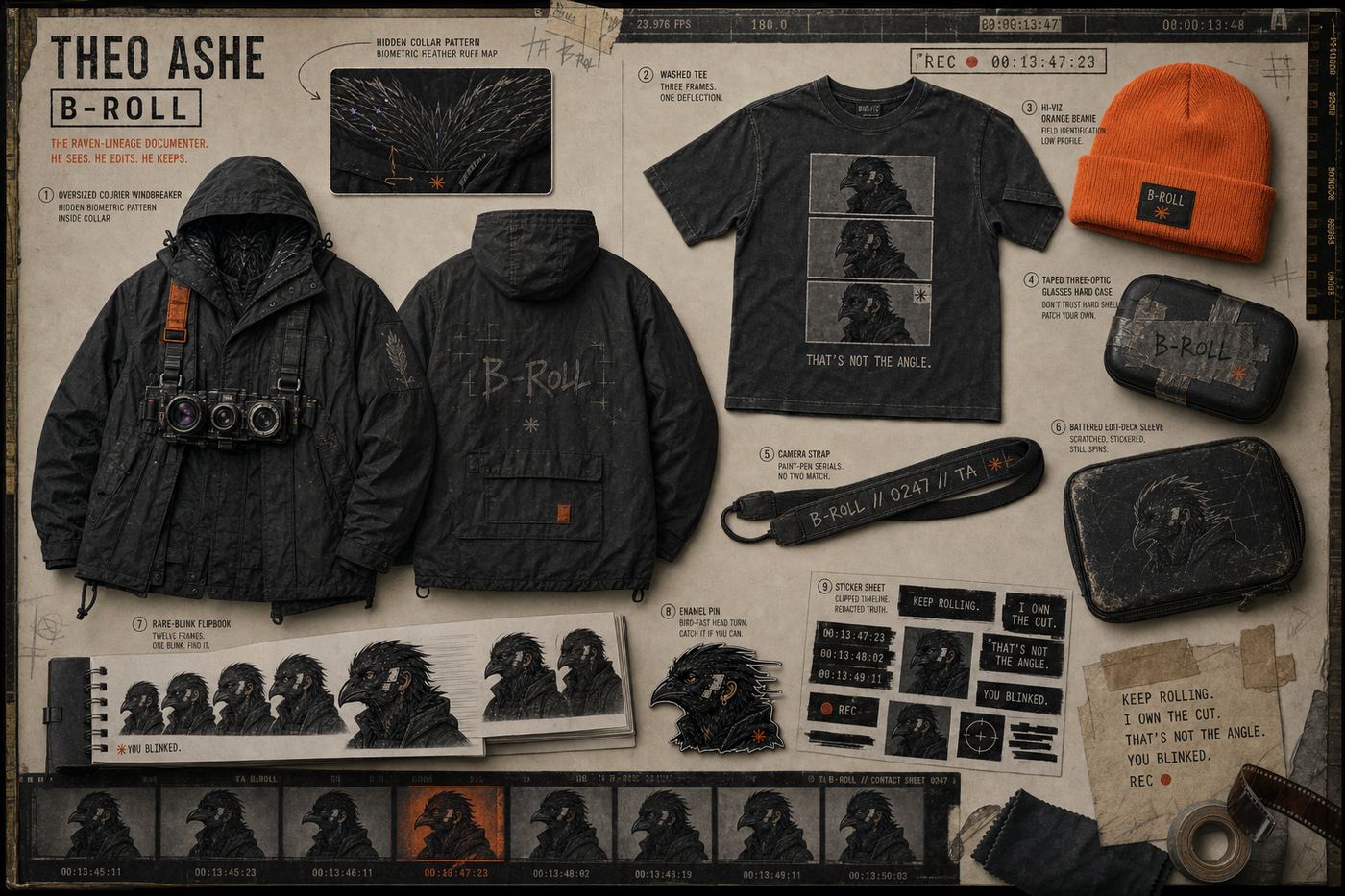
Profile essentials. The Registry lists their genome as unrecovered state property ("Still listed. Eleven years. They never write, they never call, they never delete" is the register, though Theo's own count is shorter). They deregistered eleven days after the corridor strike, which Vantage Nine painted targets for; Theo watched it land through nine sets of eyes. Position Six of Vantage Nine is now flown by someone else; Theo still dreams in the slot. VANTAGE ACTUAL, the flight leader, would say: "Best eyes I ever flew. The person attached to them was a discipline problem, and I should have reported the drift the first time Six framed a target like it was beautiful." The feather ruff at the collar is their Protectorate biometric, unique as a fingerprint: covered on contracts, shown only in their own posts; showing it is both the flex and the risk. Carries the laminated genomic deregistration receipt against their chest: REGISTRATION VOID (the channel mark derives from it). Home is a blackout-curtained corner: perch stool, edit deck (carried out of the Compact for them by Grigor), a wall of hand-lettered drives: BURNS, FEUDS, GRIGOR COOKING, DO NOT POST. Hand-letters every title card physically, then scans: the only thing they make that no Protectorate system contributed a part to. Shoots the crew's private archive on a cracked lens that flares badly, so the private footage looks like a mistake to anyone who finds it. Spiritual practice, private: the Protectorate has no funerals, it holds a flight's shared feed silent for a day; Theo has no flight, so every year on the corridor strike's date they upload an unlisted black frame, no title, running the exact duration of the engagement. It has four views, all Theo. Habits: perches on chair backs, never sits properly; bird-quick 30-degree head turns; blinks rarely, then in bursts; murmurs "cutaway" when a conversation turns sincere; catalogs every room's exits within four seconds and will absently tell you yours; steals food from Grigor's pans "for the bit," then eats like someone raised on ration paste, which they were. Watches strangers' feeds for hours (the old flight feeling at safe distance; also their vice); the one that lasted is a Barricadia grandmother's four-hundred-viewer kitchen channel; sleeps to nine-hour unedited walking recordings of cities they've never visited. Most controversial idea, posted once and pinned: gene-forged lineages should be able to void a state's IP claim on their own genome, including the packs still in service. Free the wolves. Ignorant about: sincerity's mechanics; can detect it at range, cannot produce it on demand. Canon pettiness (Artifact 04): lost money betting against Grigor and suppressed their own superior footage of a legendary night out of spite.
Voice. Flat, fast, clipped; edit-room jargon as native slang (cutaway, hold that, we'll fix it in the edit, that's a season finale, the light's a war crime). Sentences are cuts: they end before arriving anywhere sincere, the way a nervous editor trims a take a half-second before the real feeling shows. The Danka distinction, protect it: Danka is short because she's economical; Theo is short because they're getting out of the sentence before it costs them. Same surface length, opposite engine. Reference system: cinematography and editing; spatial-tactical language dressed as camera talk ("Five exits. Yours is the bad one" is a threat assessment wearing a joke). When moved, the reference doesn't change, the subject does ("the light in here is a war crime," said to someone crying, is Theo noticing). Anger never raises the voice; it raises the camera. Fear sounds like "cutaway," aimed at nobody, plus a small repositioning toward a better sightline. Rationed device: the silence itself, plus the perch. A story that gives Theo five artifacts of near-total silence hasn't shortchanged them; the one full sentence that eventually lands only works because of everything withheld. The trap: a long, fluent, self-aware emotional speech, or exclamation-point enthusiasm (that's Ozzy's). Wrong: "I think I've been using the camera to avoid dealing with how I actually feel about all of you." Right, same beat: the camera goes down. No line. Vernacular access: void grammar ("listed"); blank cluster neutral; no claim on orphanware. Never sentimental vocabulary.
Ten locked test lines (final authority): 1. "Hold that. Do it again but slower, the first take was for us, this one's for the channel." 2. "I'm not filming this. This is the not-filming lens." 3. "Cutaway." 4. "Five exits. Yours is the bad one." 5. "The Registry can watch me on a public feed like everybody else." 6. "That's a season finale, Ozzy, and you spent it on a Tuesday." 7. "I had eight other people in my head for twenty years. You five are quieter and worse at it." 8. "We'll fix it in the edit. That's not a joke, that's my entire personality." 9. "Grigor, face the window when you say that. The light in here is a war crime." 10. "Posting it doesn't make it not true. That's the part nobody gets."
Line 7 is the ceiling; rare. Strip-test spares: "Didn't get that. Wasn't rolling." / "You want the version with the joke, or the version that happened." / "Hold the door. Better light." / "I have a card for that." / "Ask me later. Ask me on camera."
Cultural anchors: March's ghost calls as professional theology (a record designed not to see; "the only honest rule in sports"); the Siege Tape economy (can spot fakes by cut rhythm; said so once on camera, and collectors have been in the messages since); the Dead Channel Enduro watched annually and hated ("Twelve hours, no edit. That's not honesty. That's abandonment."); Wavelength as the photographic negative of their wound (the audience without the face); a first-pressing Tower Sessions chip; hates drones ("scab birds"). Their "metadata never lies" ethic is the Ash Archive's Provenance Litany independently reinvented; their secret crew archive is, by that faith's rules, a sin (a Closed Folio whose existence isn't public). Reads Protectorate surplus tags at a glance (green-is-live / white-is-filed) and reads walls (Burn Run marks, the Mark Broadcast).
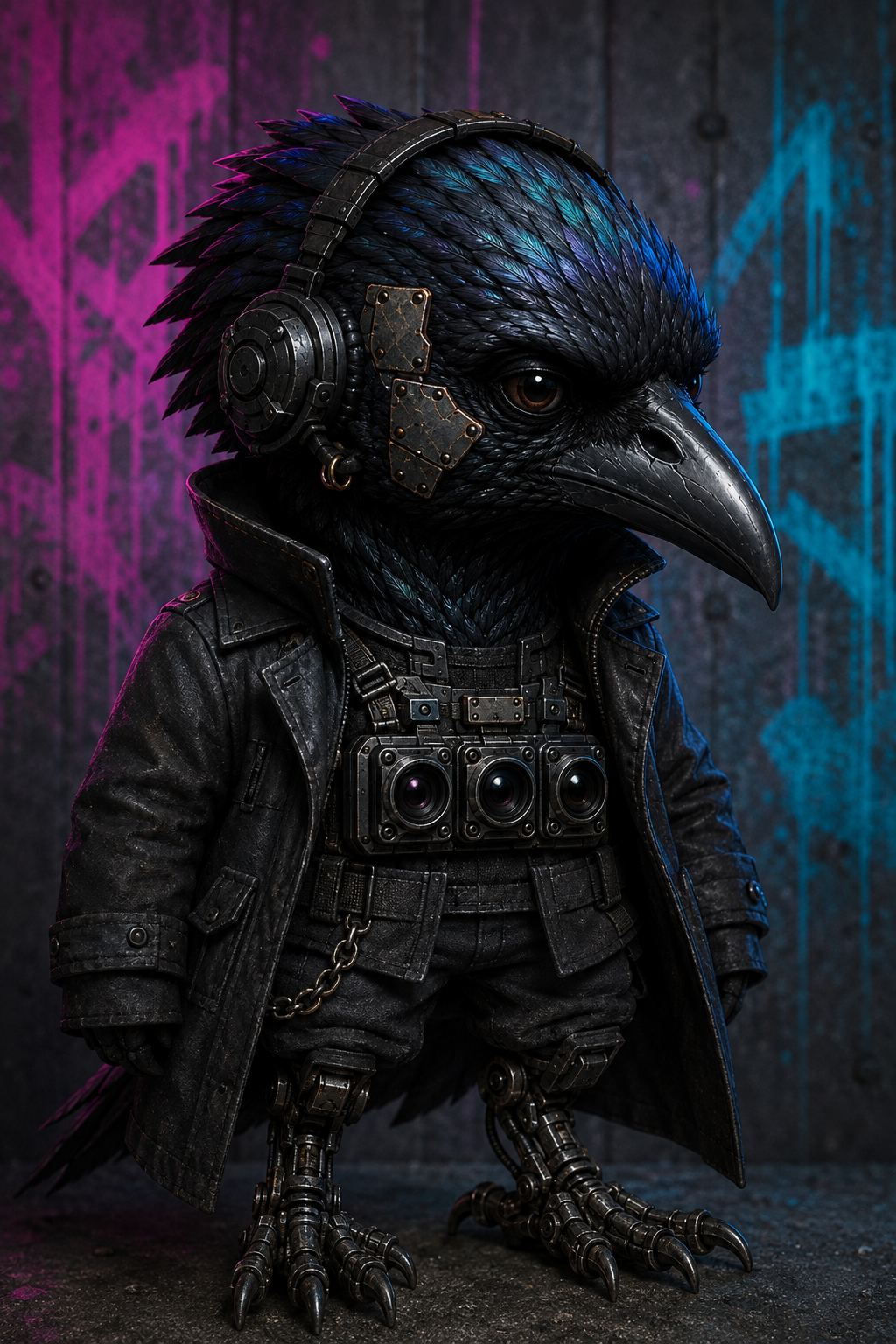
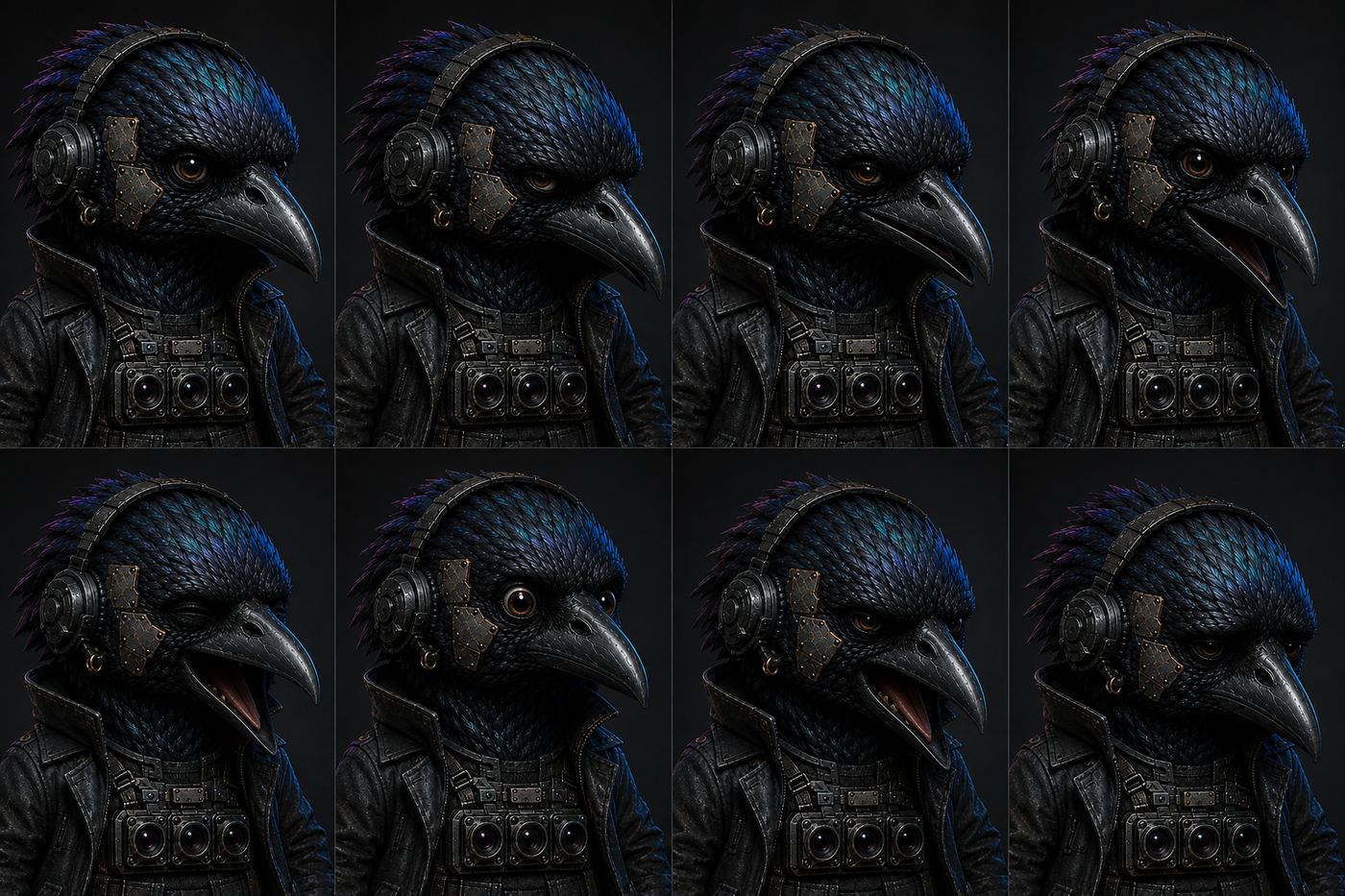
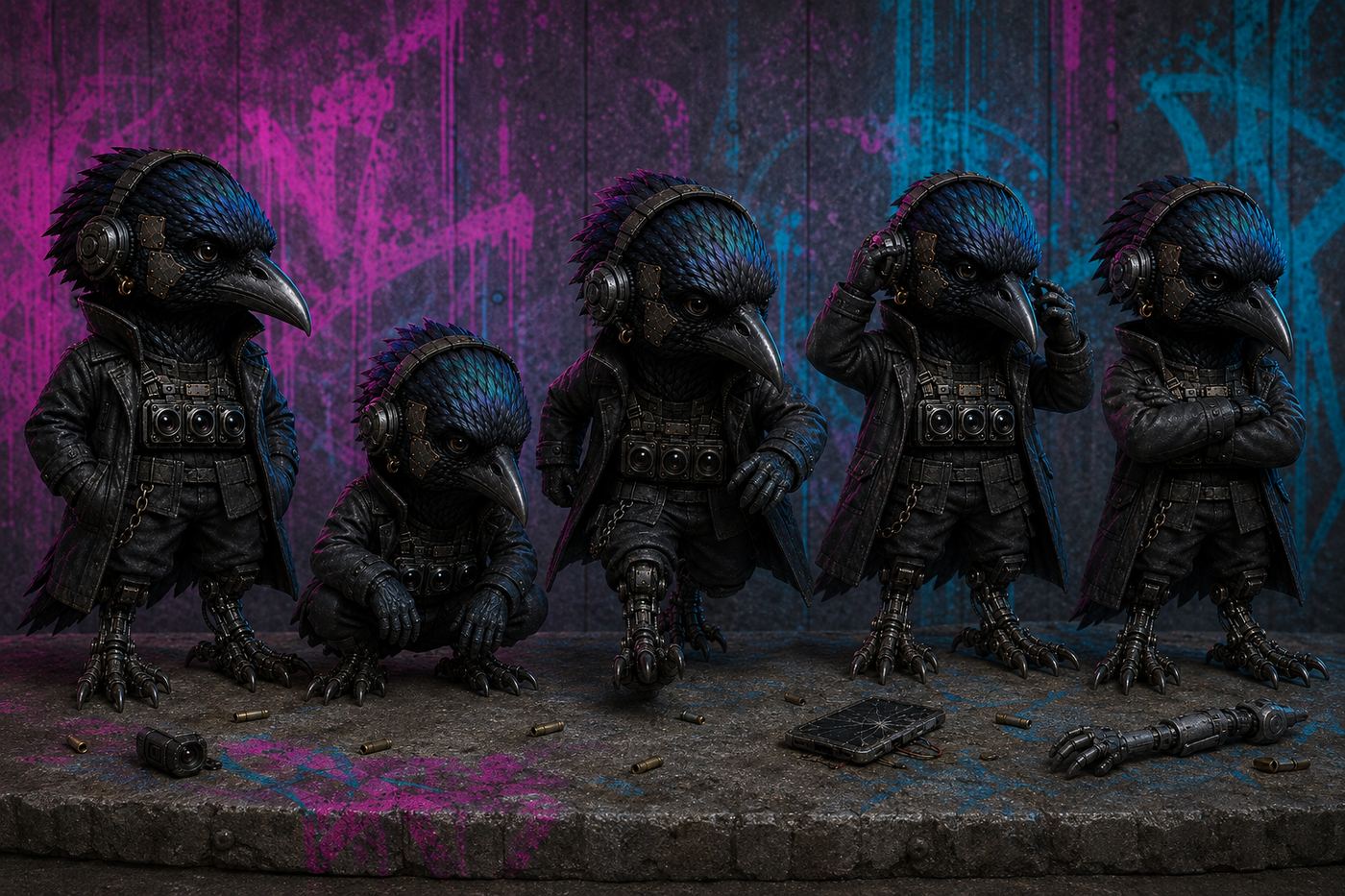
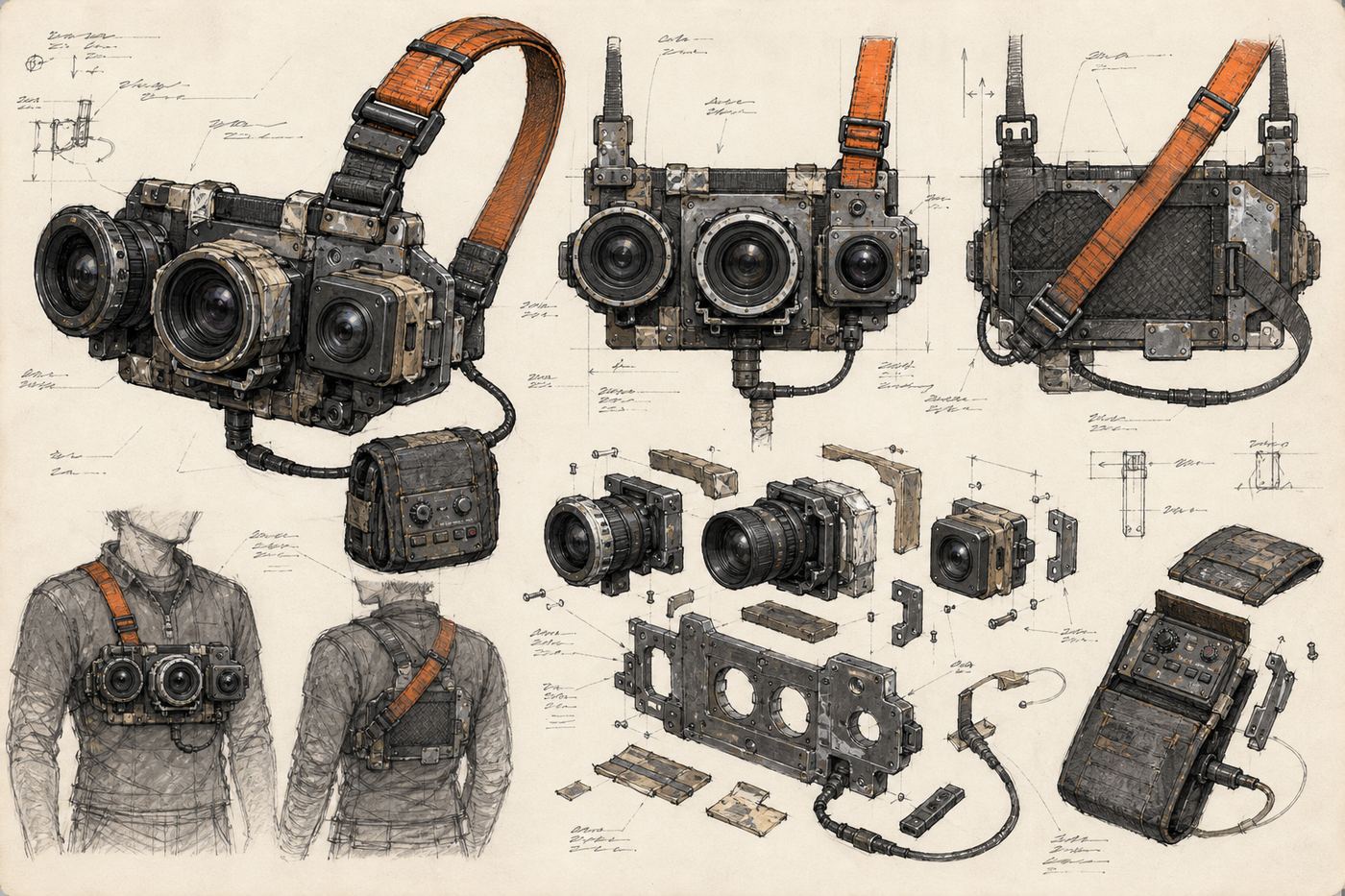
Visual. Phenotype (ruled 2026-08-25; revised 2026-09-02): full raven head, iridescent blue-black feathering rather than flat glossy black, sharp glossy beak, faceted feather crest, riveted bronze cheek and temple plates, augment-maintenance patches worn on the face; the feather-ruff biometric remains the continuity surface (see The Approved Ensemble Look). No monocle and no eye-mounted optic — the eyes stay unobstructed, and the circular device at the side of the head is the over-ear tactical audio headset. The three-lens camera/sensor array is hard-mounted to the chest rig and reads as part of the anatomy. Both lower legs are fully replaced with custom mechanical prosthetic talons/pistons (new canon 2026-09-02), giving a compact silhouette — normal torso over disproportionately short mechanical legs, visibly shorter than the ordinary-legged crew, never lengthened to normalize their height. The perching is now literal. Street body, system output: thrifted slouch and hidden armor producing registration-clean HUD-parody graphics, every title card hand-lettered as the one human intrusion. Palette: black and asphalt gray; cold signal white with acid-green lifts in edits only; human accent hi-viz roadworker orange (one strap and a beanie; a raven in hi-viz is the right joke). Art direction sentence: a Protectorate sensor package dressed from a thrift bin; the state built the camera but the kid owns the cut.
Grigor Tam
Bear lineage, 34, Eastern Compact, the anchor. Callsign earned in Compact service, meaning endurance; the kids think it's a hospital joke and he has never corrected them.
Core premise. Early freelance units got called splices when command decided they weren't worth proper logistics or extraction. Grigor lived that sentence: his first splice, Longhaul, died waiting for an extraction that was never coming. He flinches at the word and uses it anyway, on purpose, every time.
- Drive: he wants the kids to get old. Operators don't age out of this world, they get spent; at thirty-four he is the oldest person most young contractors have ever worked beside. He'd call it "keeping the unit intact" because the true version embarrasses him.
- Fear: being the last one standing again. He has done it twice. There is no third time he survives as himself.
- Weakness: absorbs everything, processes nothing. Also defers every conflict to keep the house peaceful, so things fester on his watch.
- Love: cooking for people who talk too much to notice they're being fed. Feeding is the only processing he does.
- Lie: "Endurance is the same thing as being okay." Truth: the crew doesn't need him to survive them. They need him present, which is harder, and presence is the one endurance trial the Compact never trained him for.
- Arc: surviving the crew to living with them. The beat that breaks doctrine: he lets someone else go back in, or he sits down at a table where someone else cooked and lets it land.
[Withheld from the public edition. The full bible is an internal production document.]
Ensemble function. The hearth, and the hub the other four's mirrors route through. He generates the sincerity that makes the comedy land: write him at his default register and everyone else's jokes get somewhere to land. Mirror with Danka across time. Dark mirror with Theo (the season's spine). Quiet mirror with Cas: her lie says enough preparation makes chaos impossible, his says enough endurance makes damage irrelevant; the same lie in different uniforms, which is why the two of them maintain everything in the crew except themselves and cover for each other doing it. Anti-mirror with Ozzy: the only one whose lie faces inward, and therefore the only one who asks Grigor the question. He asks weekly, in the register of a joke. Grigor answers "Yes," his only lie. Neither is fooled. Both keep doing it. That exchange is the arc's metronome; playing it straight spends what the whole arc holds in reserve.
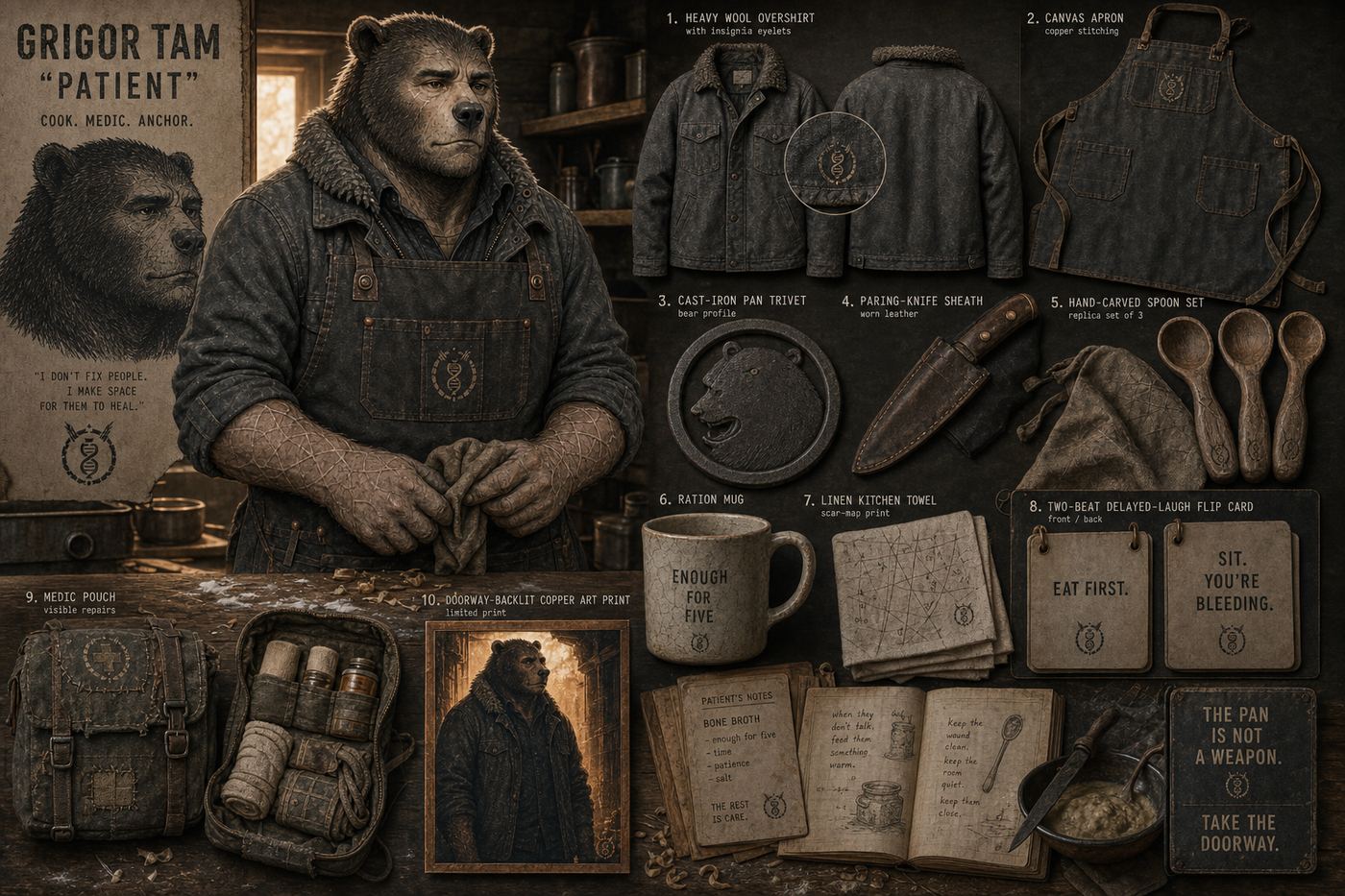
Profile essentials. Compact formation crèche, cohort mostly spent; then Longhaul, five operators, denied extraction in the Marask Pocket; he carried the last of them, Ana, for nine days and she died anyway, and he was on his feet when the relief that wasn't coming finally came for the bodies. He knows the name of the PMC logistics officer who denied the extraction and has never said it aloud, because the crew would go, and he will not spend them on his grief. The Compact wrote him off: no pension, no pursuit ("My whole state, and I could not even make an enemy of it"). Removed his insignia by unpicking the seams with a needle and keeps the patches folded in a tin; he doesn't hate the Compact, and that's the complicated part. Carries a worn mess-hall paring knife where other operators carry combat blades. Keeps a ledger of names in order like a prayer list; cooks each dead crewmate's favorite dish on their date, every year, having refused the Compact's scheduled remembrance rite (a schedule cannot tell you which day is Ana's). A bundle of letters to Longhaul's families, written in beautiful Compact formal register, mostly unsent (letters he wrote and never sent, not received and never answered). Carves spoons; the unspoken rule: you get your spoon when you're family. Ozzy got his at six months and didn't know what it meant; Theo filmed the handover and posted nothing. Greatest victory: a contract two years ago where nothing happened and everyone ate dinner together the same night; no one else remembers it. Habits: counts heads constantly, everywhere; stands between people and windows without noticing; door-chair rotation with Danka; shopping lists written like operations orders; feeds anyone who enters the garage, once including a Grava Pack scout who ate two bowls; hums the Marta theme and denies it. Vice: he'll say tea brewed to tar; the real one is volunteering for the dangerous position every time, self-spending dressed as duty. Pain suppression means he genuinely cannot tell when he's hurt and has never correctly identified his own exhaustion. Most controversial idea, said to men his own age: the kids wear the word better than we carried it; let them have it.
Voice. Slow, complete sentences, Compact-inflected formality with the warmth all the way in. He does not use fragments and he rarely contracts: "I have been shot in this jacket eleven times. It is a good jacket." Check this line by line; the Dialogue Diagnostic caught the drift ("It's how mine works" is the canonical wrong version). Dry humor lands two beats after the room has moved on, at glacier speed, on purpose. The entire system protects one effect: a short, quick sentence from Grigor is the alarm. "Yes." is terrifying because everything else he says is longer. Anger festers, then breaks as one very short sentence; on the page it looks like over-hosting or a too-long silence first. Affection is unrequested food. Fear is the head count running under his breath. Reference system: food, provisioning, and endurance doctrine turned domestic; he counts (heads, days, deaths) with flat accuracy, deliberately contrasted with Cas's anxious numbers. Rationed device: the short sentence. The Kestrel & Reef run spent it exactly twice inside its own continuity and flagged that a third use there would burn it; Season One's budget is separate and unspent. Treat every "short Grigor" as a withdrawal from an account that doesn't refill fast. The trap: sarcasm with an edge, modern clipped slang, a contraction in a vulnerable moment. Wrong: "I'm fine, don't worry about it." Right, same beat: "Yes." Full stop. Vernacular access: void grammar ("depreciated," the Compact's own verb); the blank cluster's respect register "runs manual" lands best from him and should stay rare; orphanware isn't his, though he's culturally sympathetic through Cas.
Ten locked test lines (final authority): 1. "Eat first. The problem will keep. Problems are patient too." 2. "I have been shot in this jacket eleven times. It is a good jacket." 3. "We don't leave. This is not a rule. It is a description of what happens." 4. "The Compact wrote me off. No pension, no pursuit. My whole state, and I could not even make an enemy of it." 5. "Yes." (his answer to "are you okay," and his only lie) 6. "Ozzy. You are not the spare. There is no spare. Sit down." 7. "Vroza called us mongrels again. I invited him to dinner. He does not know what to do with that. Nobody does." 8. "I know what the word cost. The kids wear it better than we carried it." 9. "Nine days is not a story. It is a number I walked." 10. "When you are old, and I intend to see it, you will want to remember more than the wars. Here. Taste this."
Line 9 is the ceiling, once a season at most. Line 3 is the thesis. Strip-test spares: "You have not eaten today. That is not a question." / "I have carried heavier than you out of worse rooms. Sit down." / "It will still be broken in ten minutes. Eat first." / "I do not need thanks. I need you at the table Sunday." / "No." (long pause) "I am not discussing the shoulder."
Cultural anchors: EO Bears Crackerjack fandom, sincere, in the shirt Ozzy bought as a joke (Ozzy has protected the misunderstanding for a year); watches like a quartermaster ("The Bears packed for the wrong terrain. You can see it in the second kit bag. I have packed that bag."). Proposed and flagged: he leaves the room when a Last Standing ceremony airs (he's been last standing twice; behavior, never dialogue), and he cannot watch Load Line (the bound-wrist carry sport where leaving the load to save a partner is disqualification; nine days is a number he walked); rationed device, budgeted like short-Grigor. Plays Stack with the standpipe queue's kids. Marta of the Crossing, current on all ~900 episodes; has used checkpoint etiquette learned from it ("It is not a drama. It is journalism with a family in it."). The garage standpipe makes him an unknowing Cupkeeper (Fifth Cup doctrine in food and water form); his ledger and unsent letters are a Last Roster Division of Weight carried alone. He does not pray. He preps.
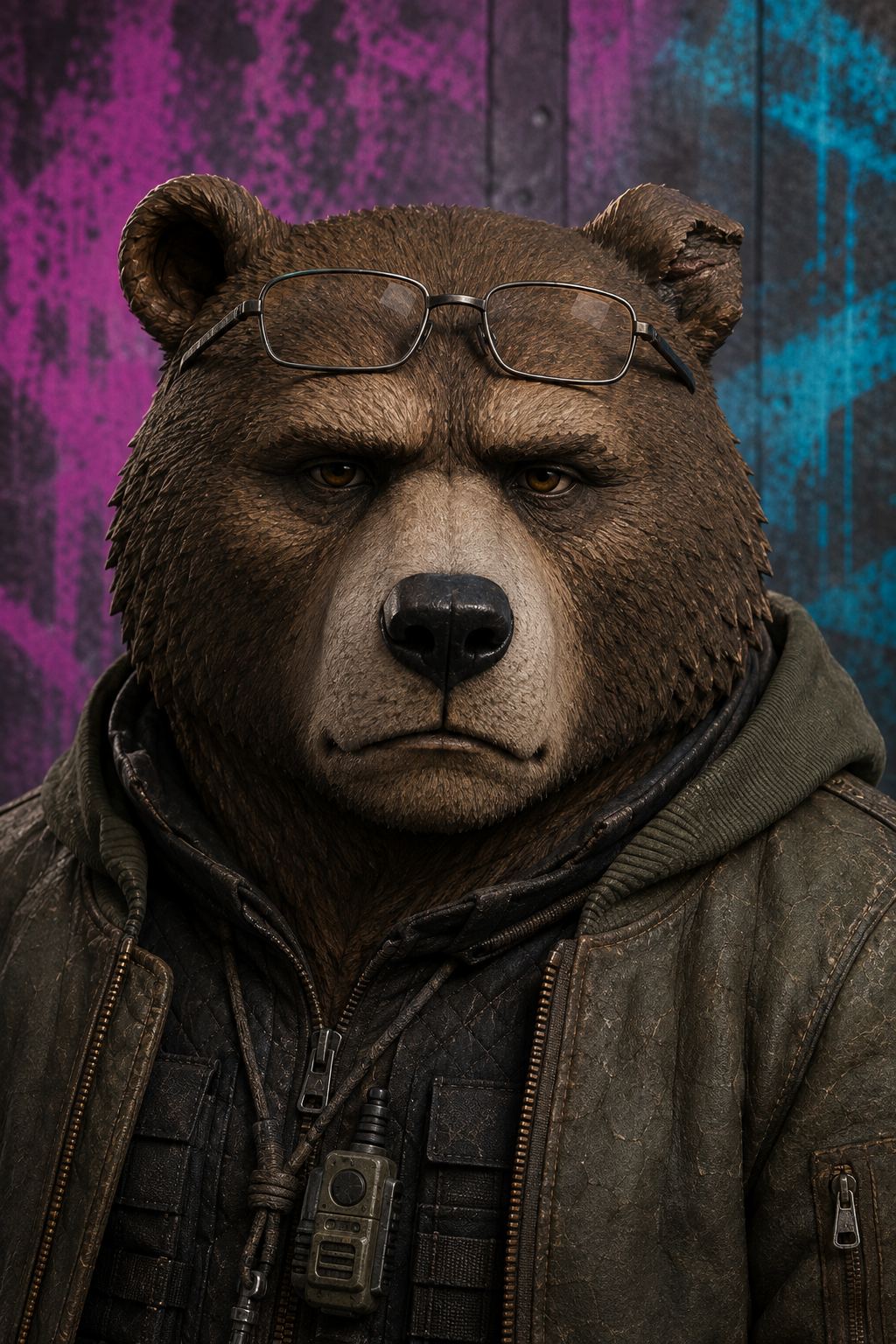
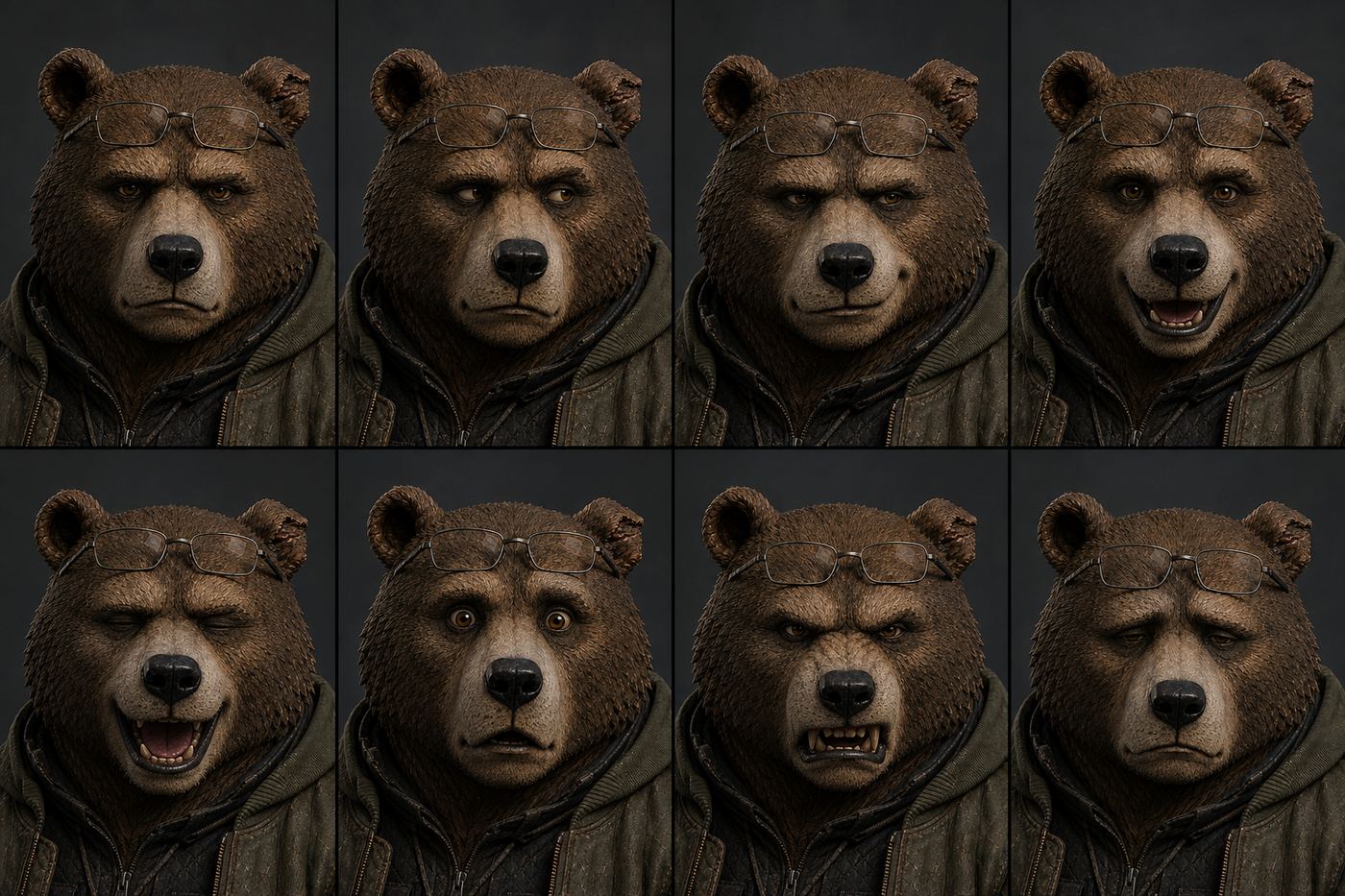
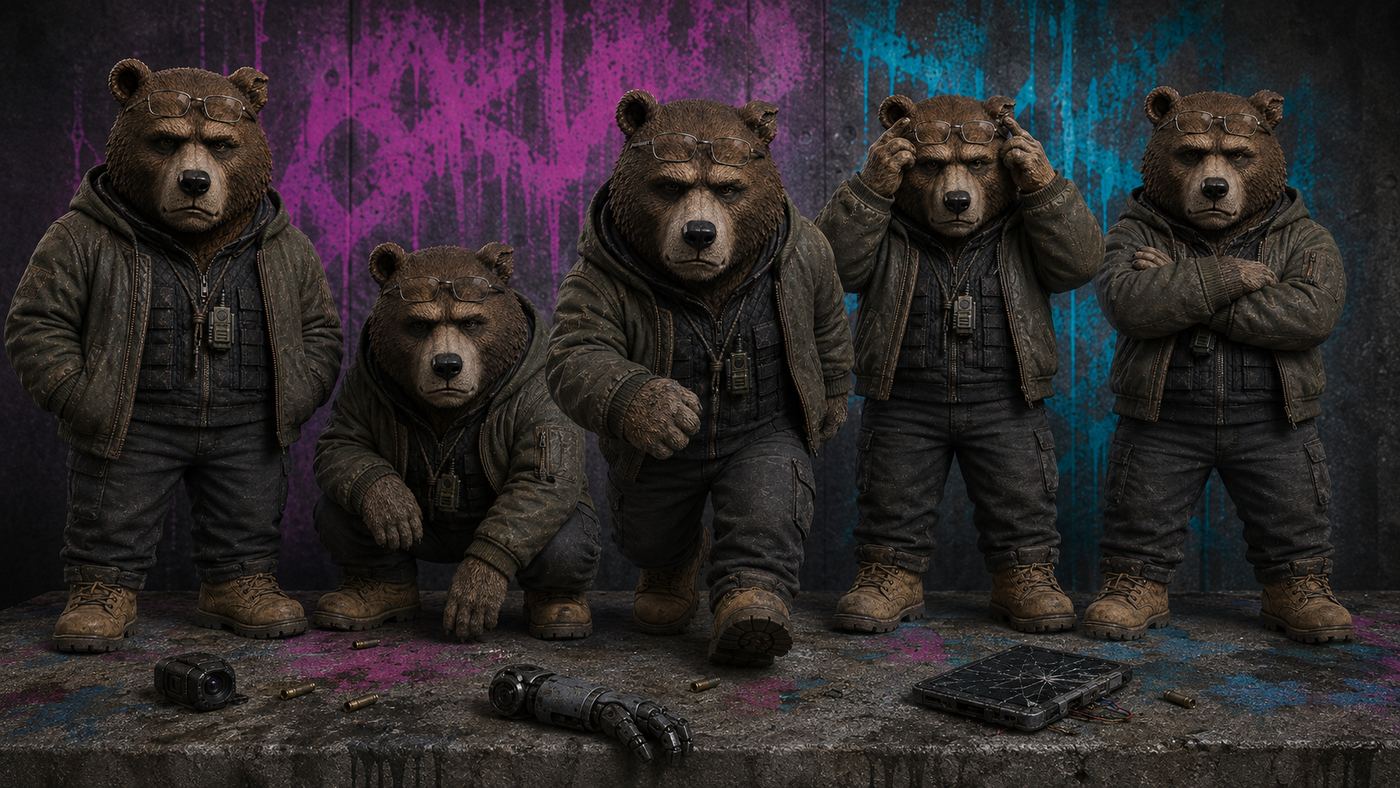
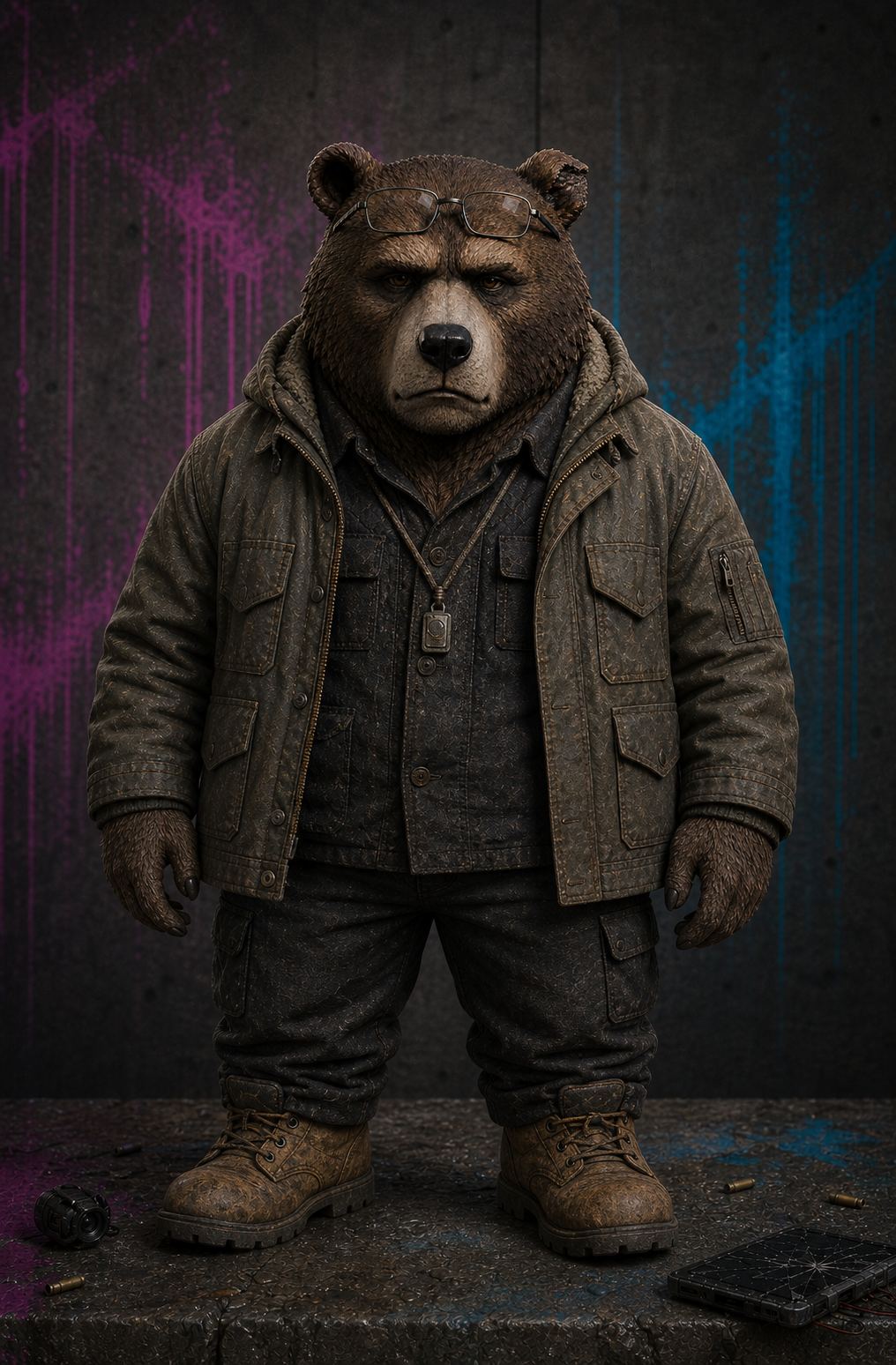
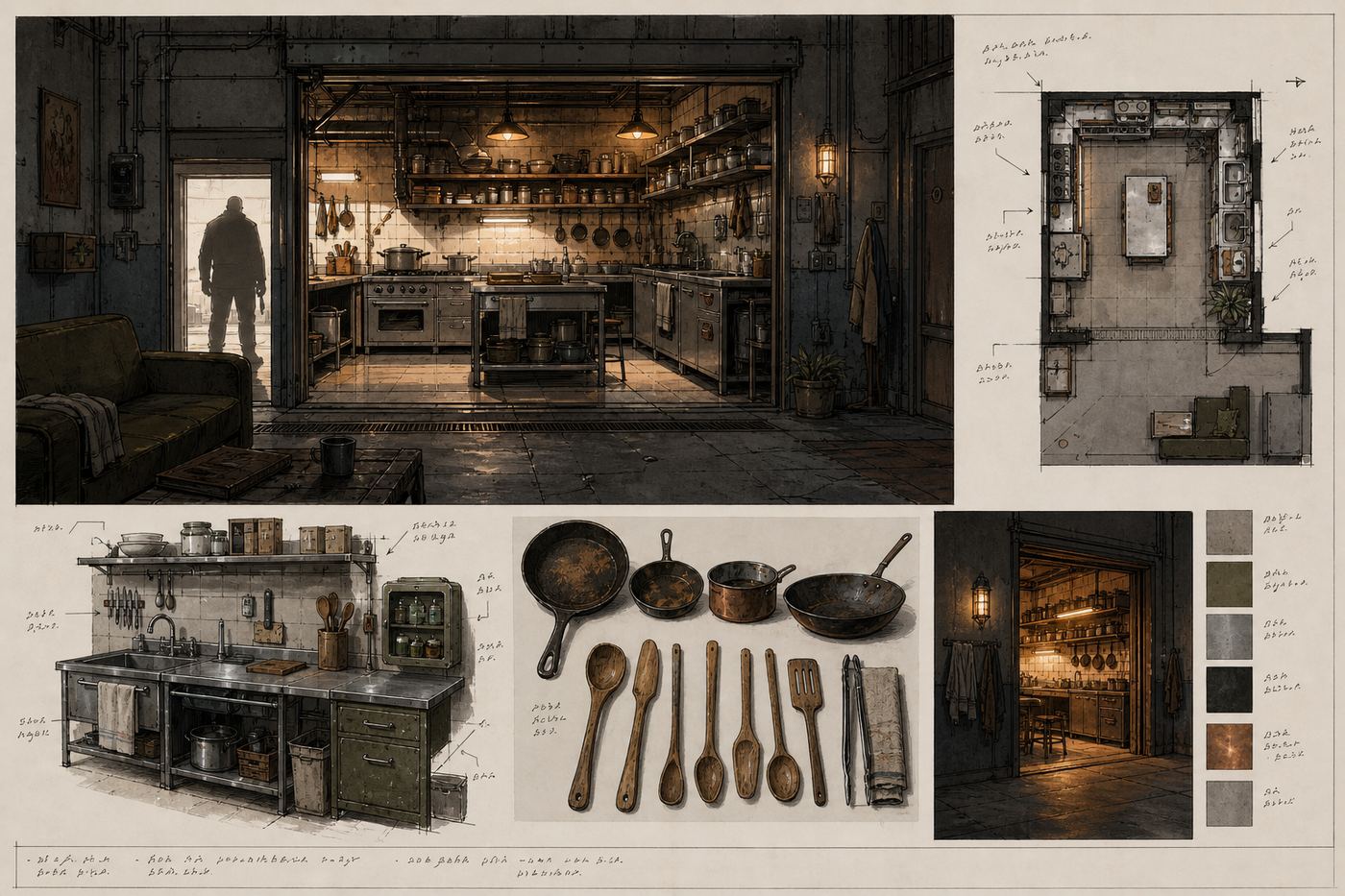
Visual. Phenotype (ruled 2026-08-25): full bear head, heavy and calm, the stillest face in the lineup; his expressions live in posture, pace, and his enormous careful hands, and the scar map stays the continuity surface (see The Approved Ensemble Look). Inverts everyone: the system layer worn as plain clothes, and his human layer is everything he makes; his character design includes a room (the kitchen). Palette: Compact slate blue (what the state left on him) against copper (the pan, the spoons, the kitchen light; what he built). In any frame: a cold man in warm light. Signature frame: backlit in a doorway. Art direction sentence: Compact surplus in a doorway with copper light behind him; the state made him a wall and he decided to be a hearth. Continuity surface: the visible scar map he cannot feel, which is a plot object.
Cas, Caseline-9
Fennec lineage, 26, orphanware, the planner. Her legal name is a batch designation.
Core premise. The states bred wolves for packs, ravens for networks, bears for endurance. The market bred foxes to listen, and then sold the recordings. Caseline Applied Genomics designed a boutique acuity lineage — desert-adapted, built around hearing, signal discrimination and the patience to sit inside a noise until it resolved — then folded in 2053; the batch was scattered through asset sales, and the person built to listen ended up with nobody left to listen to. What she did with that is the planner: a listener with no signal builds the signal herself, in advance, in nine steps. Her whole arc is a design purpose becoming a life.
- Drive: publicly, a plan that survives contact with reality, just once; she would frame it. Actually: the list. Twelve made; three died in development; nine reached service; scattered in the 2053 liquidation. Her card lists the other eight: two confirmed free, one confirmed dead, one in service to a corp she can't touch, four unlocated. Her money goes to a broker for leads.
- Fear: augment failure with no patch, no manufacturer, no recall notice. Not abstract: Caseline-2 died of a cascade failure nobody made the part for, and Cas found out from a forum post three months late.
- Weakness: the comedy fuse: competence plus confidence plus four teammates who improvise. Underneath: she plans instead of feels, and she cannot improvise socially at all; she scripts conversations and a single deviation wrecks the scene.
- Love: the eight. The crew, filed under a heading she hasn't labeled. And the crew's chaos itself, which she claims to endure and privately logs like weather she'd miss.
- Lie: "Enough preparation makes chaos impossible." Truth: the crew is the redundancy. People are the patch. She was designed not to need anyone, and the design was wrong.
- Arc: redundancy through planning to redundancy through people. The list is private; showing someone the list is the most intimate act she has. Climax beat: a plan dies completely and she calls the audible, trusting the crew's improvisation as a system, or she puts the card on Grigor's kitchen table and asks for help finding the four.
[Withheld from the public edition. The full bible is an internal production document.]
Ensemble function. The plan engine; every Plan Goes Horribly Wrong routes through her, so the voice must survive being proven wrong repeatedly without ever sounding stupid for having planned. Quiet mirror with Grigor (the infrastructure pair). Engine pair and dark mirror with Ozzy: same fear of being left behind, opposite tools (systems vs. relationships); each privately thinks the other's method is childish; both methods are working; the season's answer is that the correct tool was always the other one's. With Danka: both bought a self, one a car and one a document.
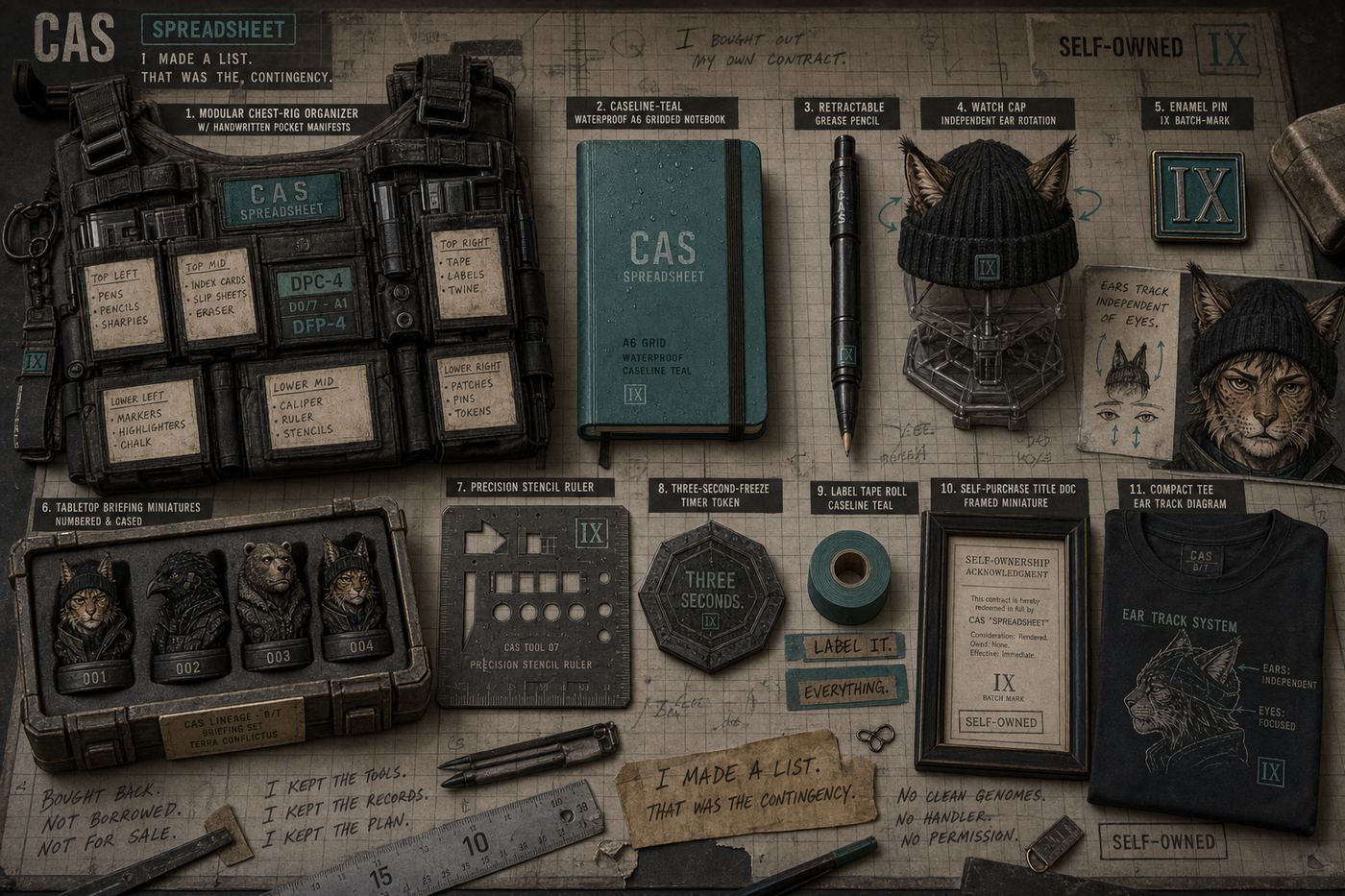
Profile essentials. Handle NINELIVES, moderator of an orphanware maintenance forum (discontinued lineages keeping each other's bodies running with gray-market parts; the weekly two-hour voice call is the closest thing to a service she attends, unmissed in four years, and if you called it that she'd log off). Batch tattoo: small "IX" at the inner wrist. Appears in Caseline's 2049 sales catalog as Figure 3; a scan circulates; she knows where a better scan is and re-decides monthly not to buy it. Keeps the framed title (most valuable item) and the card of eight in a waterproof sleeve against her chest (most personal). Buyout day she rode a city bus to the end of the line and back, because she could. Organized and moderated Two's memorial thread dry-eyed at four in the morning. Reflex augments deliver burst speed with a recovery cost worsened by a decade of missing firmware ("Firmware's from '54. I compensate. Watch the left hand, not the right."); she budgets her own body like ammunition. The rifle is pointedly unnamed ("It's an asset, Danka." "Say that again and walk home."). Builds plans as tabletop models with hand-sculpted figures; made the five crew figures at one-third the scale she needed and never repainted them (Ozzy's has a bag the size of a grain of rice). PRODUCT TALK jar in the kitchen: product-speak about herself ("out of spec," "end of life") costs her jar money; the jar funds pizza; she has noticed the jar is working and not told them. Hates subscriptions with real depth (her body was a recurring-revenue product once); hates "we'll figure it out." Vice: contingency hoarding; supply caches across the city, more than she's admitted, two inside the garage's dead filtration lines. Habits: touches each pouch in sequence before rollout; pocket contents written on the outside in paint pen, updated nightly; ears track sounds independently of her eyes; refolds other people's kit when anxious (Ozzy leaves his messy on purpose when she's spiraling, and would rather die than have this known). When a plan collapses she goes silent for exactly three seconds; the crew counts them. Most controversial idea, said flatly in front of Danka: she'd sign with a state tomorrow if one offered lineage support. "You'd take a leash?" "Leashes come with vet care, Danka." Never quite finish that fight. Ignorant about: affection aimed at her; reads it as tolerance every time.
Voice. Precise, complete clauses, quantities everywhere: never "a few," always "three"; never "expensive," always a number. The most imitable habit: she narrates in list structure out loud ("Item one. The cartridge passed solvent. Item two."). Nobody else counts inside a sentence; if a line must be unmistakably Cas's, count something in it. Deadpan flat enough that new listeners need a week to find the jokes. Anger makes her more exact: a furious Cas produces more decimal points, not more words. Fear is the three-second silence, then the contingency; she never sits inside the fear on the page. Reference system: maintenance as love, contingency, product lifecycle, aimed at machines and herself with the same vocabulary (the show's clearest embodiment of the body-ownership theme). When moved, she applies the reference to something that shouldn't take it: grief filed as maintenance policy. Rationed device: the three-second silence, and it is the documented model for keeping any device alive: played straight, then held longer, then repurposed for a different loss, then meaningfully absent at the climax (the Kestrel & Reef run executed all four stages). The trap: smooth social banter or effortless comebacks; she is explicitly unable to improvise socially; her humor lands because it's literal, not quick. Wrong: "Oh, please. Like I didn't see that coming." Right: "I gave it a four percent chance. Four percent happened. I'm not thrilled, but I am validated." Vernacular access: orphanware natively and fluently (gray vet, the recall, shelf date, serviced, all hers, dry, on purpose); void grammar is not hers (never issued to a state; she can ask, not claim).
Ten locked test lines (final authority): 1. "The plan has nine steps. We are currently on step none of them." 2. "I own myself. Notarized. Ask again and I'll show you the paperwork." 3. "That's not a plan, Ozzy. That's a sentence you said with confidence." 4. "Firmware's from '54. I compensate. Watch the left hand, not the right." 5. "Three seconds. I get three seconds. Then you get the contingency." 6. "It's an asset, Danka." 7. "I don't improvise. I have contingencies that resemble improvising to the untrained." 8. "A subscription. So you'd like to own nothing and owe forever. Bold." 9. "Two is dead because nobody made the part. I make the parts now. For everyone." 10. "New plan. Same as the old plan, faster, with apologies."
Line 9 is the ceiling. Line 2 is the thesis, said like a fact, never like a wound; the wound is the asterisk. Strip-test spares: "That plan has a four percent failure rate, and you are currently inside the four percent." / "I don't guess. I estimate, and I tell you when I'm estimating." / "Give me three seconds." (counts them, visibly) "Options." / "You broke it in a new way. I respect that. Structurally." / "I am not spiraling. I am recalculating at an elevated pace."
Cultural anchors: Clean Run followed as precedent research (a course that converts athletes' bodies into proprietary training data; "Last Wall has been rebuilt eleven times. That is not an obstacle. That is a changelog."); reads Cass Imrie's drift-clock columns, printed and laminated; models The Line rather than betting ("I don't bet. I model. The difference is that I'm right for free."); tracks Load Line's unclassed division as a hazard map for the forum ("That's not sport. That's intake."). Does not watch HALO's count; monitors HALO's probate filings, because it is her own situation at planetary scale ("The count is a symptom. The filings are the disease."). Six by Midnight hate-annotated live while the crew watches her instead. Repair manuals for pleasure. She is the crew's historian of the liquidation era: which PMCs bought which batches, which shells hold which lineage IP. Reads channel analytics as data, better than Ozzy will admit.
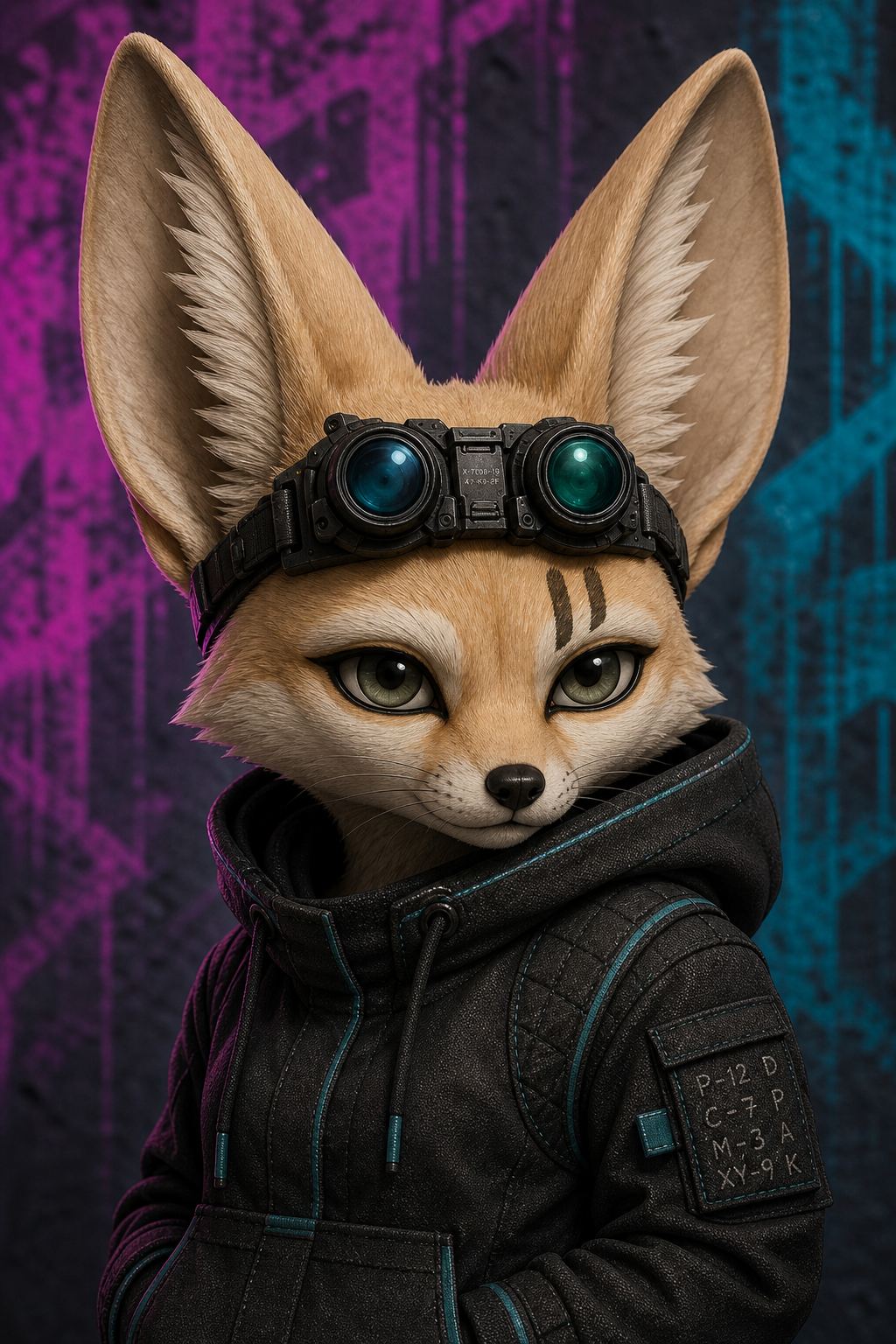
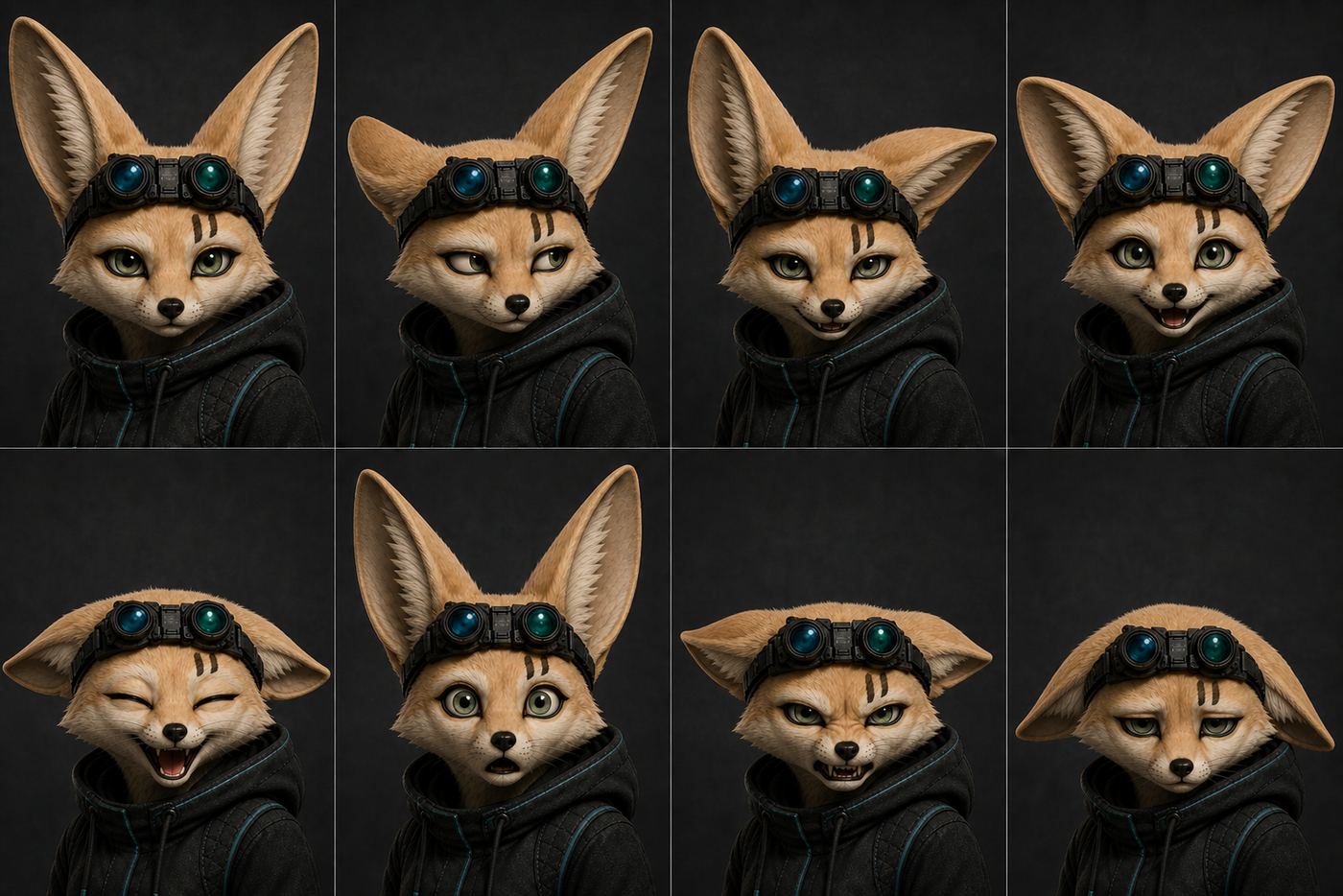
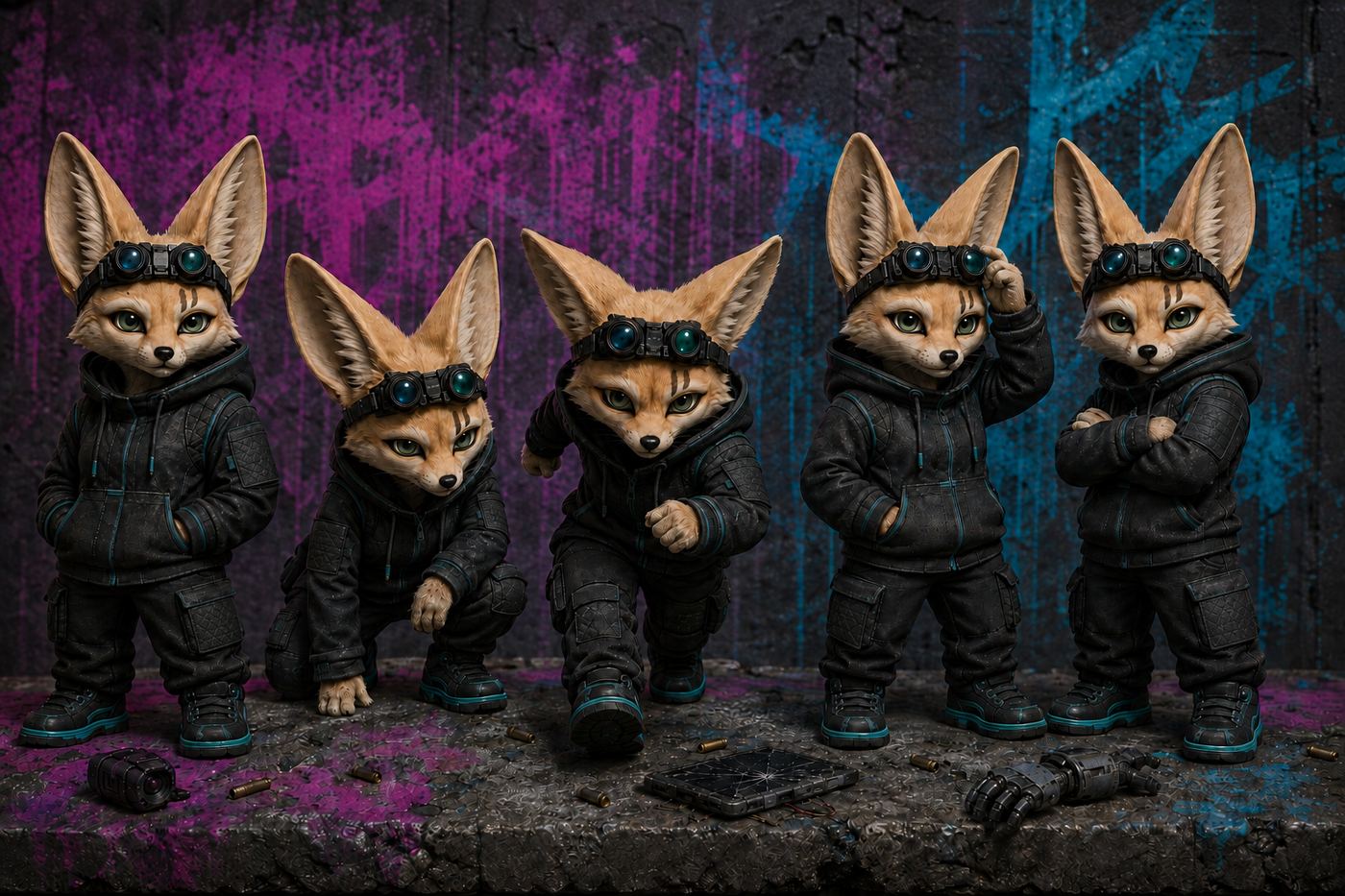
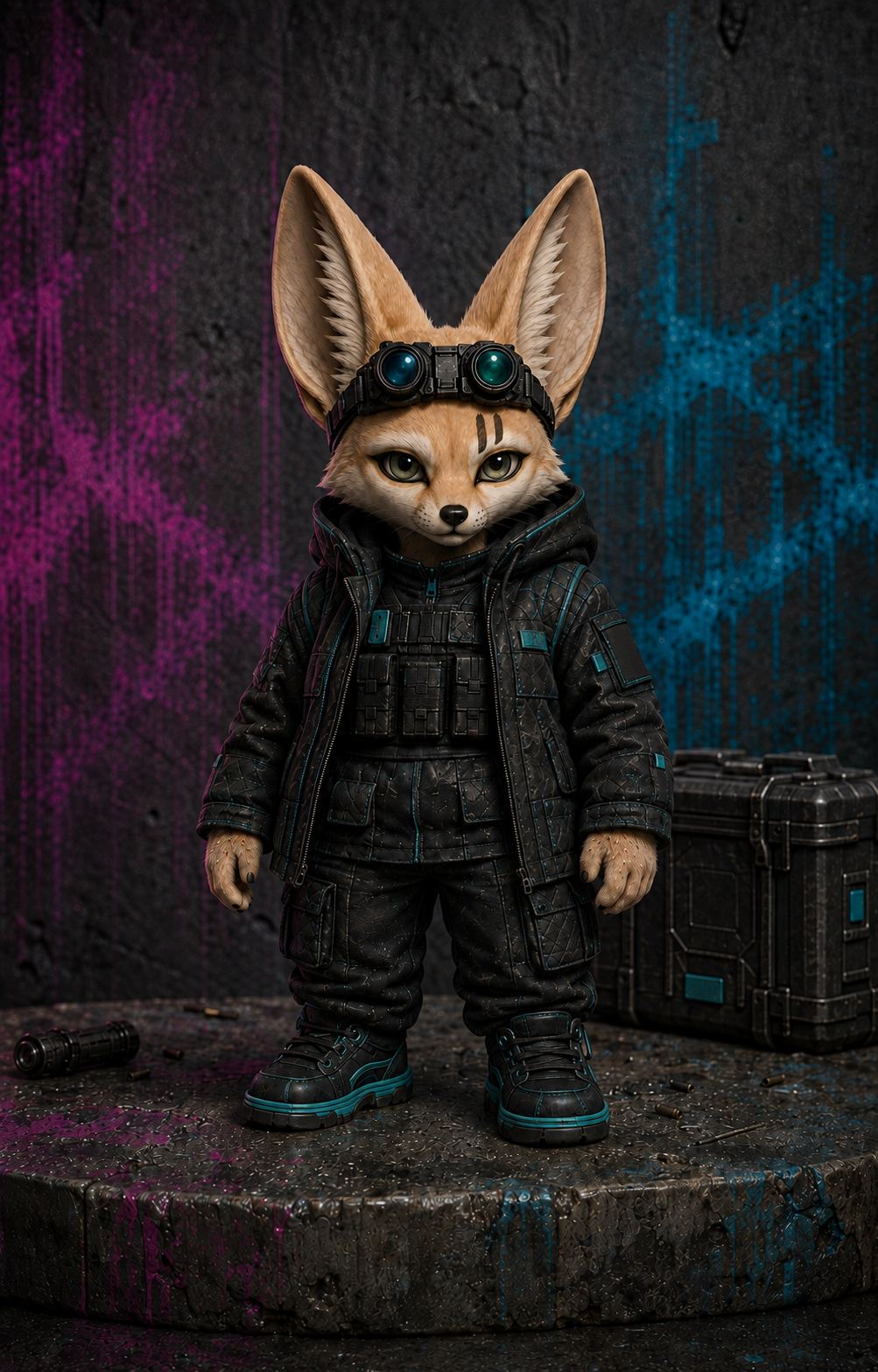
Visual. Phenotype (ruled 2026-08-25, species revised 2026-09-02): full fennec head — enormous open cream-lined ears, tapered muzzle, desert-sand and ivory coat, two short dark vertical Caseline bars above the LEFT brow. No headwear: the cut watch cap is retired with the lynx, and the ears are always fully exposed. She wears a forehead-mounted dual-lens night-vision / sensor goggle rig, sitting just below the ears — teal/cyan lens coloration, serial etching on the housing, one Caseline-teal hardware tag (ruled 2026-09-02 against the Neo-Guerrilla boards; this supersedes the same day's squared-box-optic ruling, and the flip-down magnifier loupe is retired with the lynx). The independently tracking ears stay an expression-sheet note and are now load-bearing rather than decorative, and the IX wrist mark stays the continuity surface (see The Approved Ensemble Look). A system-layer person annotating herself back into a human being: TDR grids and labels everywhere, with Shibuya Punk leaking through in exactly one medium, her own handwriting. Coding color: Caseline corporate teal, the company color from the 2049 catalog, reclaimed as her tape and filing system (whether consciously is left open). Base: mismatched dead-army neutrals. Silhouette: compact, squared-off, two bare oversized ears breaking the outline above everything else, stillness itself as the identifier. Art direction sentence: issued grids overwritten by hand, the company color reclaimed as a filing system; a bespoke product annotating herself back into a person.
Ozzy Okonkwo-Cruz
Baseline human, 19, Barricadia, the mouth. No augments; in this crew, the loudest statement anyone's making.
Core premise. Every gene-forged member has a first family of their own kind. Ozzy has a mother above a print shop who thinks he does logistics for a security firm. He is the only one who chose this family with zero shared lineage, the only one with a living normal family, and the only one whose alienation is having nothing he survived. He is also the audience's proxy: the unmodified kid asking the questions the viewer would ask (the show's exposition engine disguised as comedy).
- Drive: proving a baseline belongs on a splice on merit. Underneath: being irreplaceable, because replaceable means expendable; he compulsively acquires usefulness, contacts, favors, revenue streams.
- Fear: the math. In a hard extraction, who gets left? He has run the numbers on himself and concluded he's the answer. He is wrong, and being wrong hasn't stopped the math from running nightly.
- Weakness: his mouth writes checks his unmodified body can't cash, and he cannot stop escalating feuds; reputation-tending shades into beef-starting, and sometimes the other side is using real bullets.
- Love: the crew's reputation, tended like a garden. His family, protected by a beautiful ongoing lie. And provenance itself: he romances an authentication certificate the way other people read poetry, which, given his wound about being "a real one," is the whole character in a receipt.
- Lie: "If I'm funny enough, nobody does the math on me." Truth: they kept him for the judgment, and the jokes were never the job. His irreplaceable skill is the one nobody bred into any of them: emotional literacy. The functional-family kid does the emotional labor four defectors never learned, and calls it "vibes management" so nobody looks at it directly.
- Arc: performing usefulness to trusting membership. Two load-bearing beats: The Rescue happens to him (the crew's math was never his math; "there is no spare" finally lands), and later a gray-market broker offers him augments on camera and he declines, because OEM stopped being armor and became a choice.
[Withheld from the public edition. The full bible is an internal production document.]
Ensemble function. The mouth, the face, the fixer, the merch economy, the analytics department, and the audience's proxy. Engine pair and dark mirror with Cas. Near mirror with Theo (the only person alive who can name Theo's bits to their face, because he runs the same machinery). Anti-mirror with Grigor (the kid Grigor is aging-proofing, and the only one doing it back). With Danka: officially cargo; banned from touching, describing, or monetizing Civilian, and currently monetizing it in secret (fan merch sells); this is a flagged ticking bomb; bank it, don't spend the discovery cheap.
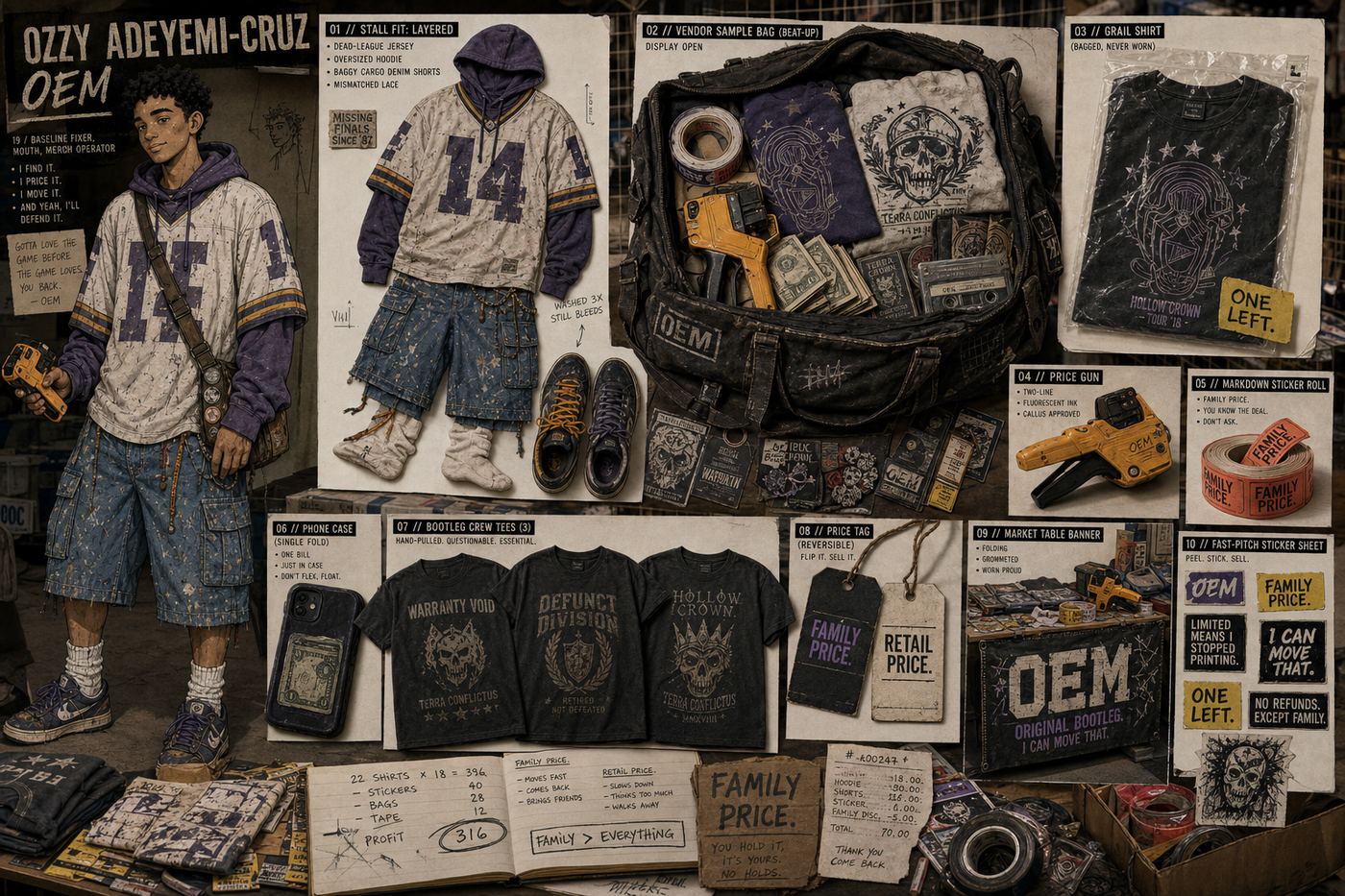
Profile essentials. Family: mother Blessing Okonkwo (52, market matriarch; knows exactly what "security logistics" means and has decided not to say so; the lie is the string that keeps her son at the Sunday table); father Marco Cruz (55, printer, forty words a day, source of Ozzy's design talent, a fact neither has said aloud); sisters Abi (26, forensic accountant, keeps a private spreadsheet reconciling his visible income against his visible sneakers; it does not reconcile) and Rea (22, transit tech, night shifts on the Musk Tunnel sensor lines the crew runs dark through; a held collision). Dee, his best friend, enlisted into a corporate program at seventeen and stopped answering; the stall two doors down still asks. The hire, canon: forty-eight hours after the Forklift Clip went viral he had unlicensed Warranty Void shirts on the street; Danka tracked him down; he talked his way from a beating into a job in under four minutes by showing her the sales figures. He has timed the retelling. Keeps the first bill Danka paid him folded in his phone case, never spent: proof he got picked. Most valuable item: an authenticated, never-worn original GENE FORGED REUNION TOUR shirt, bagged; he sells knockoffs daily and will never wear or sell the real one. Trains sprints at dawn, secretly, so he is never the reason an exfil slows down; Grigor found out, said nothing, and started leaving electrolytes out. His bootlegs are better than official merch; Theo calls the shirts art to his face and Ozzy changes the subject. Vice: inventory; a storage unit of shame (in the garage's old chemical store; Grigor knows and has said nothing for eleven months, which is its own kind of parenting). Discipline: absent everywhere except the dawn running and the ledgers, which are immaculate and are the actual reason Cas respects him. Habits: prices everything he touches, out loud, involuntarily, including once a live grenade; gives everyone nicknames that stick; never sits with his back to the register (the crew's third door-facer, for civilian reasons); folds shirts when thinking; sends his mother a voice note every single night, from anywhere, mid-crisis included ("One sec. It's my mum."). In private he replays her saved voice notes, three years of them, on long drives with one earbud in; Danka has caught him twice and said nothing. Hates being picked up (comedy on the surface, the math underneath), silence, and the baseline slur; OEM is his answer, printed on shirts. "Pet blank" is Vroza's phrase, relayed by Grava-Six, and it lives in him rent-free. Most controversial idea: Warranty Void should franchise, chapters in three cities; everyone hates it; he is probably right. Ignorant about: augmented experience; asks Cas what fennec hearing is like, asks Theo to "do the eye thing," gets fined, gets educated; deliberate, this is teaching-the-baseline.
Voice. Fast, warm, salesman rhythm across three registers switched mid-sentence: market patter, crew ops-speak, family-dinner voice. Nickname-heavy. Self-deprecating math jokes that are not jokes. The only voice on the crew that fills silence on purpose. The fourth register, rarer: total flatness, no patter, exactly when something is actually serious; it works because it inverts everything else he does; it is his alarm, rationed like Grigor's short sentence. Reference system: commerce, provenance, authentication; negotiation is love's public form (watch him haggle for his mother). The trap: long unbroken sincerity with no joke near it, or sitting quietly in a silence. Wrong: (quietly) "I just want you all to know how much you mean to me." Right, same beat: something that's technically a joke, everyone half-laughs, and the true thing underneath goes unnamed. Vernacular access: the blank cluster is his reclamation project (nobody else calls him blank to his face; only he gets to); "the recall" is barred to him by name (Cas's gallows joke); no void grammar (never had a state to leave). He's the character most likely to ask what a Lexicon term means, which is the mechanic working.
Ten locked test lines (final authority): 1. "Okay so hear me out: hats." 2. "I can get it. Don't ask how. The how is proprietary." 3. "You're all famous and stupid about it. Lucky for you I'm neither." 4. "That's an authentic '58 tour print. You're crying? I'm crying. We're crying at my stall." 5. "One sec. It's my mum. No, she can tell when I rush it. We're pinned down, not rude." 6. "Do the math? I've done the math. I'm the cheapest thing on this crew to replace and the only one who checked." 7. "I'm not touching the car. I'm standing near the car. Adjacent is free, Danka." 8. "OEM means original. Look it up. Original. Equipment. Me." 9. "Vroza's boys call me the pet. Fine. Pets are family. Look that up too." 10. "We're sold out. Of us. Nobody in this city loves you like I do, look at the numbers."
Line 6 is the ceiling, delivered as a joke that lands wrong and silences a room. Line 8 is the thesis. Strip-test spares: "Don't say no yet. You haven't heard the number." / "That's not a discount. That's a favor with paperwork." / "Two seconds. Gotta send the voice note or she'll think I'm dead." (beat) "Okay. Where were we. We were winning." / "I priced it before I meant to. It does that. I do that." / "Nobody's laughing." (beat) "Cool. Wasn't a joke, then."
THE CLOSET (jersey canon, sourced from TC2066 Sports). Two registers; the audience learns to tell them apart. Worn ironic (rotating): The Drained home kit two sizes big (a water club worn to water-rationed districts); Ratline retro (worn specifically on tunnel jobs; Danka has asked him to stop); Salt Wake seawall shirt worn inland only; counterfeit Heralds Siege-era merch (all of it is counterfeit including his, he can prove his is fake, which he insists makes it authentic); Perdida Union clashed against Tokyo Upshot shorts. Worn sincere (repeating; he'd deny the category): Dust Choir (the last crew-held garage; his politics in cotton); Association IV memorial shirts (four attempts at a Raid Race athletes' association, four body counts; he prints them and sells at cost, the only item he refuses to profit on); Lost Angeles Certainty throwback (folded before he was born; "the Certainty folded"); Barricadia Locusts (his grandfather's club, wrong size, family dinner only); the EO Bears shirt he bought Grigor as a joke. The grail never leaves its bag and belongs to no register.
Cultural anchors: the relic economy is his trade (can run the garage-lamp test on Manta Wing teeth; captured patches never washed); the swap-meet debunk is canon and format (debunked a fake Reunion Tour shirt live, bought it anyway; authentication-as-content, and the fake sells better after); reads The Spread like a trade paper (Perce Tull for business, Nico Prazo because Barricadia); books side action, doesn't bet ("Renko doubles after every loss. There's a chapter about him. He hasn't read it. That's the chapter."). Close or Starve, the pirated 2040s sales course, quoted unironically; the crew can finish it for him. His sales patter is the Ash Archive's Provenance Litany independently reinvented ("What do we know, how do we know it, what's missing, and who profits from the version you're holding?"). Blessing keeps the household faith; Ozzy participates the way sons do; the specific tradition is deliberately unnamed (recommendation on file: keep it an older faith, and let Blessing name it if a scene ever forces it). The Last Roster's Closers exist for exactly Dee; banked, never cheap.
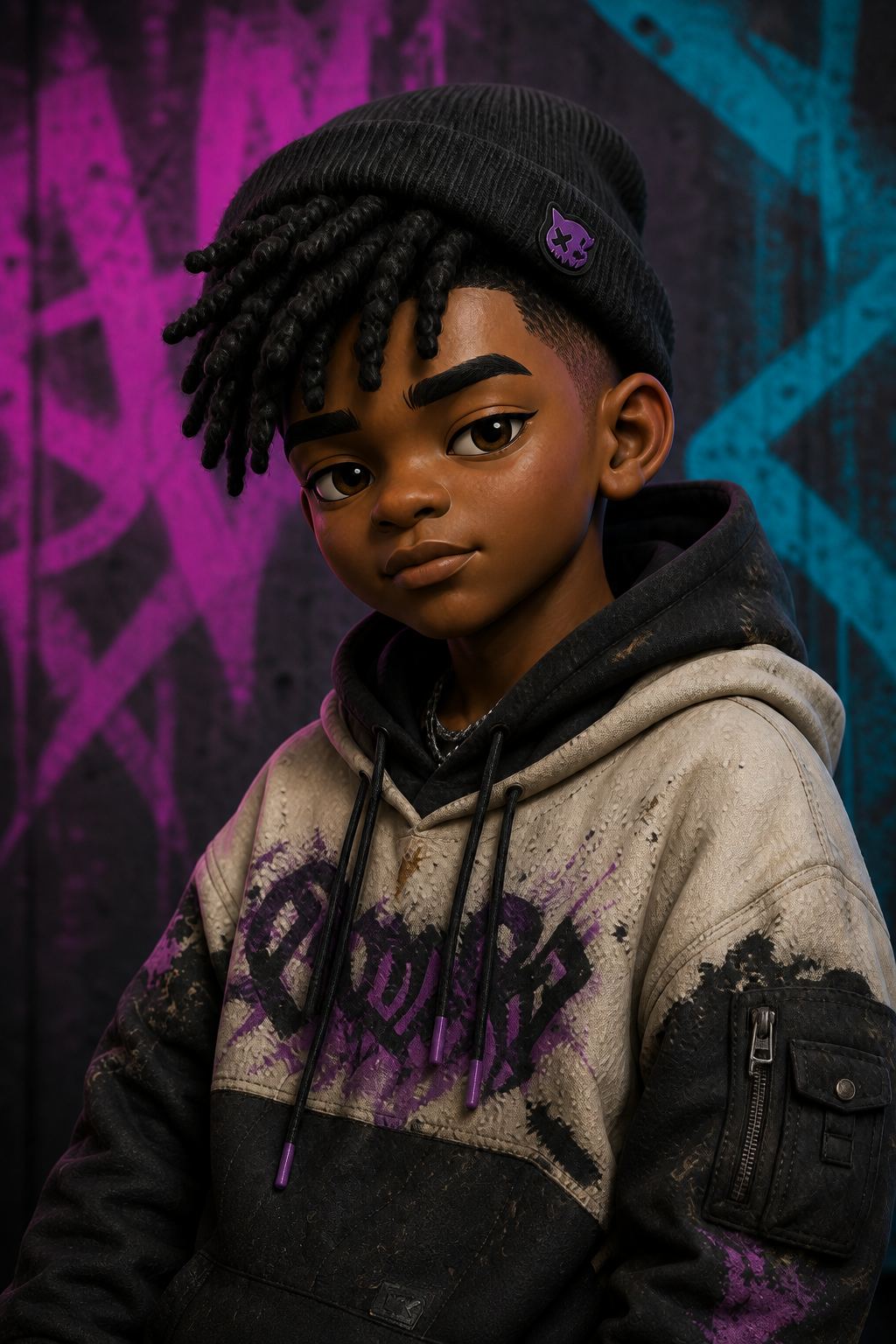
Visual. The only pure human-layer body on the crew; his system layer lives entirely in his work (price tags, ledgers, authentication certificates; bootlegs collaging stolen faction marks into street merch). Phenotype (ruled 2026-08-25): fully human. No animal traits, no augment shapes, and that absence is the design. His one owned color: price-gun fluoro, the markdown-sticker orange-yellow, on his tags, stall signage, and one lace or strap at all times (the rendered wardrobe layers cream and washed purple under it). Silhouette: slight frame, big jersey drape, bigger bag, hands mid-motion. At security-cam grain he reads as "some kid," which the crew has weaponized. Art direction sentence: every dead faction's colors in one outfit and none of their flags; the only engineered thing on him is the price tag.
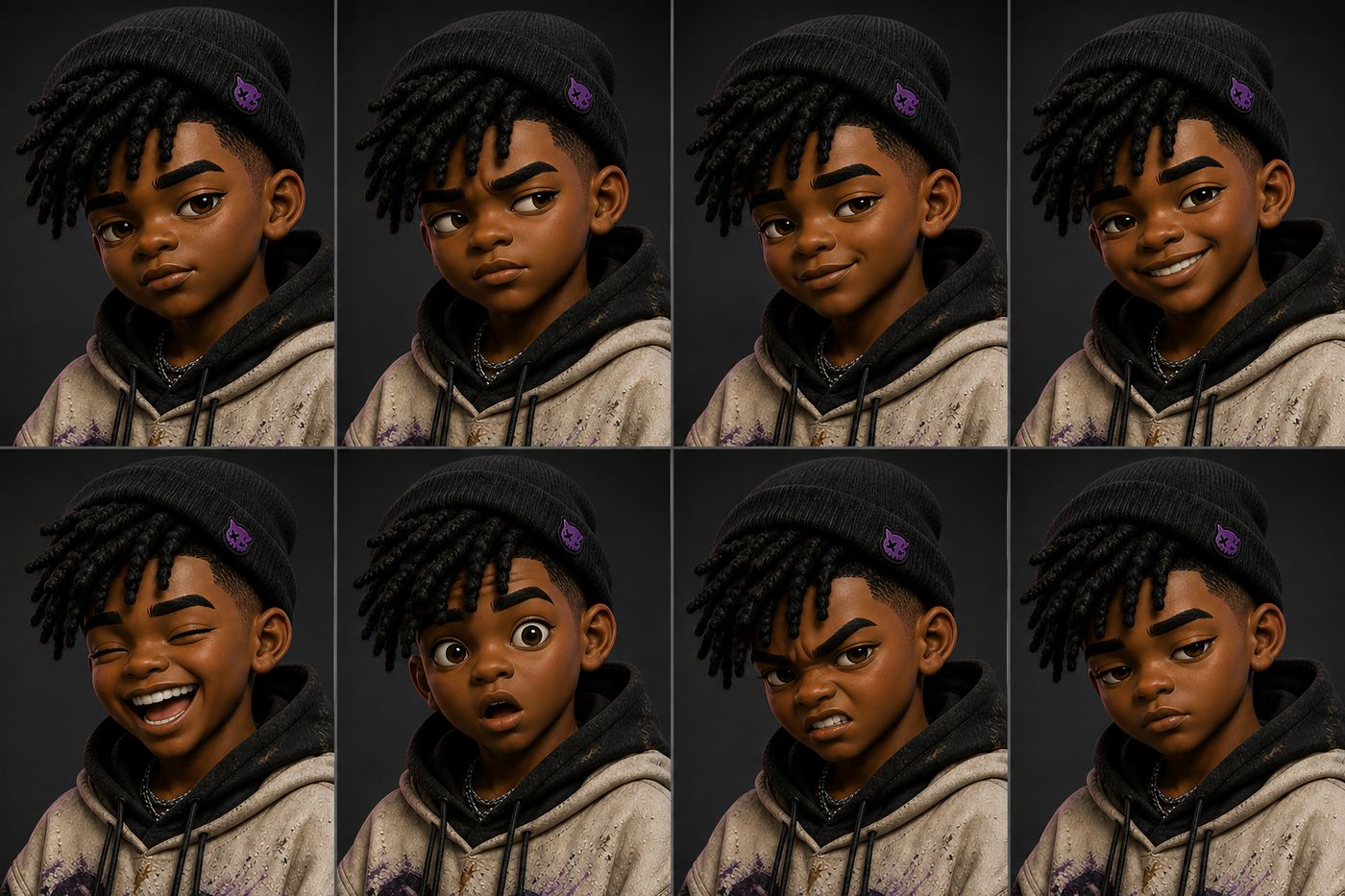
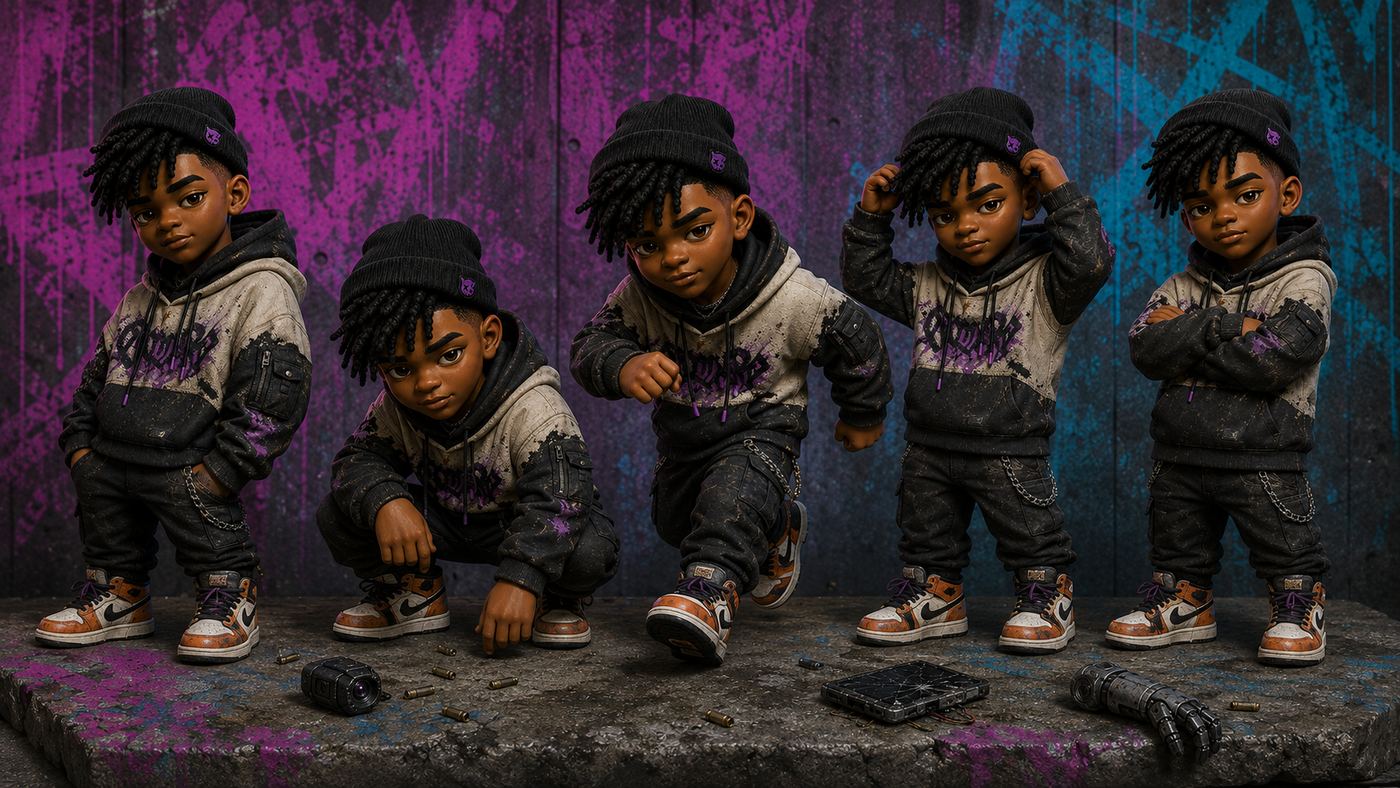
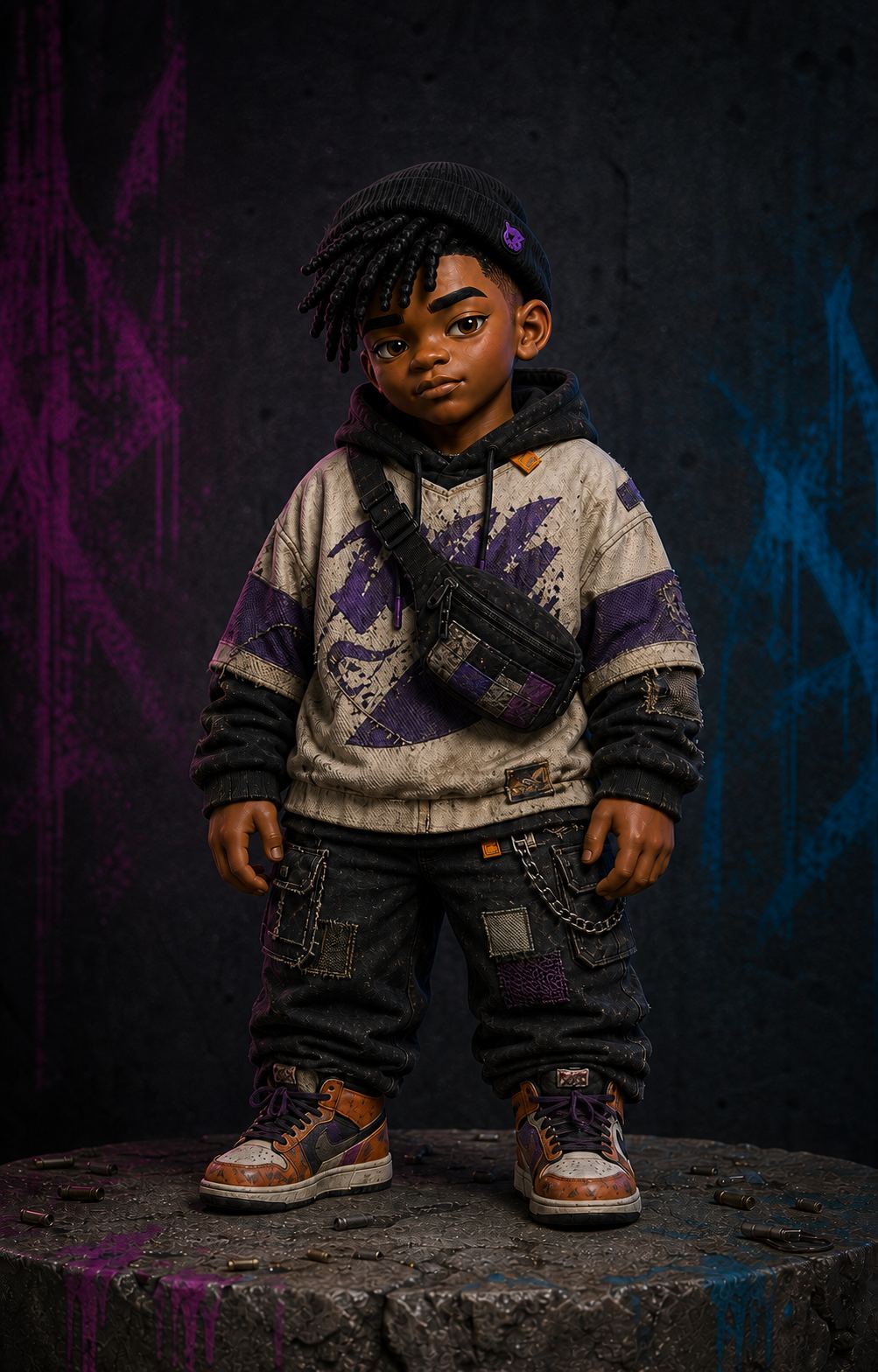
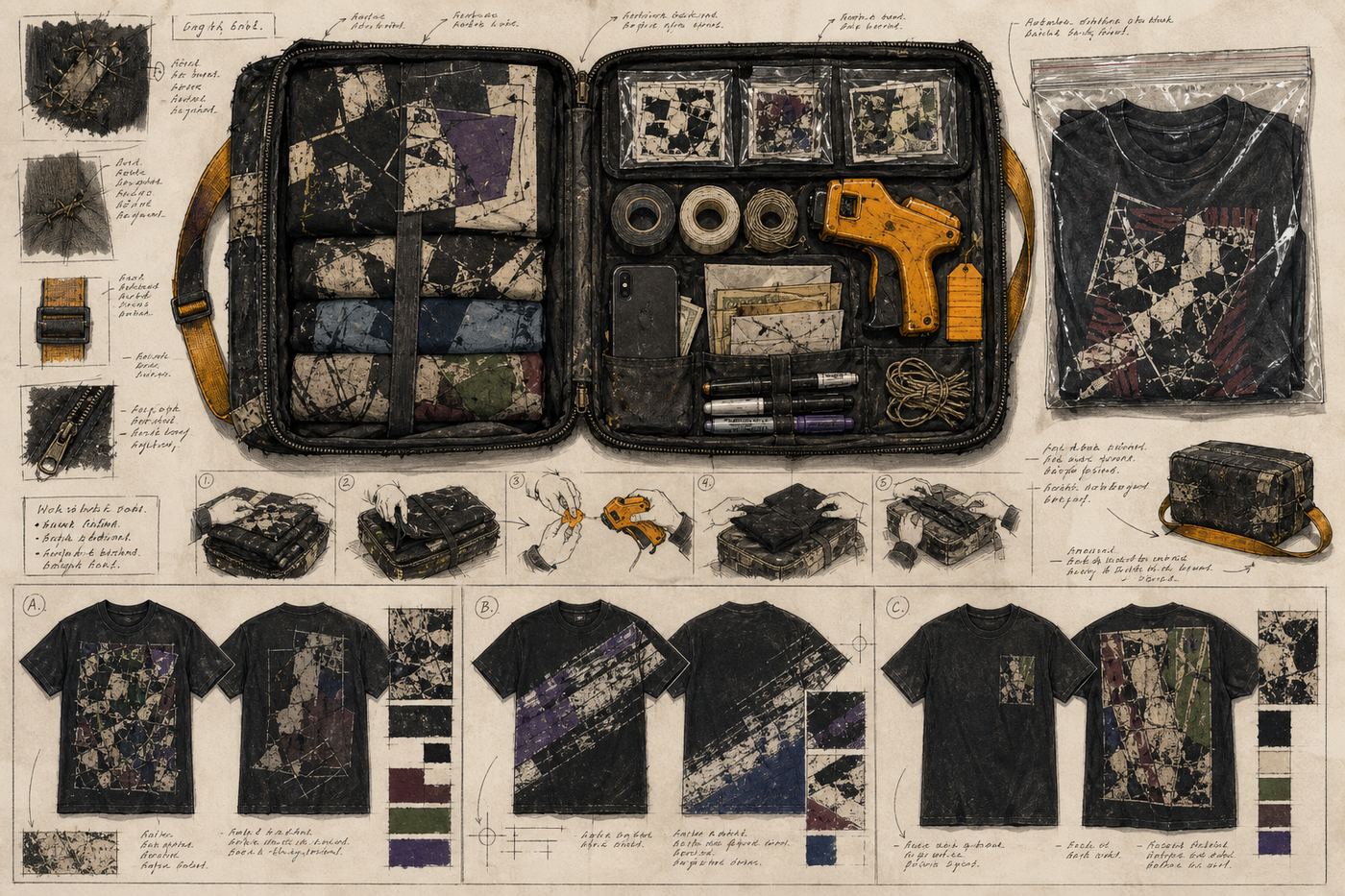
Marit Sey
Snow-leopard lineage, 33, ex-IRBIS, the builder. Intermittent. Callsign is what she is: an account that exists and is in no catalog.
ATTACHMENT RULE — read before writing her. She does not live at the Wash and never has, and she keeps no fixed address, as practice rather than mystique: a person who is cheap to repossess stays cheap by being expensive to find. She arrives, she builds, she goes. The garage baseline is five. Two to four appearances a season, and at least one of them should be her not arriving. She is spent the way a device is spent; her presence should cost the story something to have.
Core premise. The states bred wolves for packs, ravens for networks, bears for endurance. The market bred foxes to listen. IRBIS bred cats for the cold, and then the cold outlived the border. A state high-altitude frontier program, liquidated when the frontier stopped mattering; the only buyers for cold-adapted stock were the people who run refrigerated warehousing, which in this economy means the rooms where repossessed bodies and stripped augments are kept. Marit worked nine years inside those rooms as staff, on the same manifest as the inventory. She walked out eleven years ago and nobody came — because repossession is not a manhunt, it is a freight cost, and she has spent every year since keeping her own recoverable value under the price of the truck. Then five people she liked started a channel with an audience.
- Drive: publicly, to finish the thing in her hands. Actually: to stay cheap. Under that, unadmitted: to be worth the freight to somebody who isn't a company.
- Fear: not being caught. Being worth catching. Value is the threat, and the channel is the fastest-rising number in Barricadia.
- Weakness: she solves problems by leaving — undramatically, she simply isn't there the next morning. Eleven years of it working is why she has no one.
- Love: the five, arranged so that loving them costs them nothing. And the objects, which she builds and gives away and has never kept one of.
- Lie: "If I'm not worth the freight, I'm safe." Truth: she has spent eleven years making herself cheap, and the only people who ever made her feel expensive are the five who never asked her a question.
- Arc: cheap to worth it. Climax beat: she stands in frame on purpose, knowing the cost — not a triumph, a bill she decides to pay. Alternative: she asks Theo the first question she has ever asked anyone, and it is "Why didn't you ever ask?"
[Withheld from the public edition. The full bible is an internal production document.]
Ensemble function. The build hand. Cas designs and Marit fabricates — Cas's locked ceiling, "I make the parts now. For everyone," has always been quietly assuming somebody's hands, and they were Marit's. Theo is the mirror, and it is exact: both solved intimacy by controlling the record, he by choosing what gets posted and she by never being in it, and four years ago they made a private treaty about it without either saying a true sentence out loud. When it surfaces it damages them both, and Theo worse, because he will realize he was never protecting her privacy — he was protecting his own habit of not asking. With Cas: the only person who tells Cas a plan won't work and is right. With Danka: Danka agreed to the arrangement on the spot, without asking either of them why. With Grigor: the two who are comfortable in a long silence; he is the one who notices she carries no document, and says nothing. With Ozzy: he prices what things sell for, she prices what it would cost to come and get them; neither has noticed they do the same thing, and it would horrify her to be told.
Profile essentials. No batch, no cohort, no siblings: IRBIS produced her in a run of forty with no bond structure, and she has never once looked for the other thirty-nine — the single most alien thing about her to a crew whose entire emotional architecture is cohort-shaped. Paper against the heart: she is the exception, and carries no document at all; the absence is only legible because the rule exists for the other five, and it should be noticed exactly once, by Grigor. Works by preference at the garage's sweating north wall — the year-round cold corner that ruins paper and that everyone else avoids — which the crew reads as a quirk and is in fact the only place in Lost Angeles that feels like the room she grew up in. Takes the maker's mark off everything, including other people's tools. Leaves every borrowed tool in better condition, unremarked, permanently. Arrives with the thing already built; the crew has never watched her build anything. Eats standing. Carries no gun and the crew has stopped remarking on it. She has never asked anyone a question — four years, five people, not one, and nobody has noticed because this crew would rather be asked nothing. She cannot be in the room for a repossession contract: the published Mission Book writes C31 REPOSSESSION as the job the crew should refuse, and Marit is the reason it is shaped that way; if the crew ever takes it, taking it is a scene about her whether she is present or not.
Voice. She speaks in the completed past tense. No announced intentions, no described plans, no statements of what she is about to do — things arrive already finished. "It's done." "I moved it." This is the most imitable habit and the cleanest contrast available: Cas narrates the plan in list structure out loud; Marit reports outcomes and nothing else. If a line must be unmistakably Marit's, put it in the past tense and make it shorter than the reply it gets. Short, but not Grigor-short — his sentences are short because sincerity is heavy, hers because she is not going to be quoted. She asks no questions; where a scene needs her to want information she states the gap as a flat declarative and waits ("I don't know what's in the second room."). Anger makes her quieter and more finished-sounding, never louder. She has no reference system, deliberately — the other five all have one; hers is the absence, because likening one thing to another is how you get described. Rationed device: the blind-spot walk — she moves through the garage without ever crossing the five CAMs' fields, so fluently it reads as ordinary walking. Four stages: played straight as background business → held until the audience registers it is total → repurposed to keep somebody else out of frame → meaningfully absent at the climax, when she stands in the shot and does not move. The trap: mysterious-loner cool, cryptic half-answers, the withholding badass. She is not withholding, she is economical, and she would answer anything she was asked, completely and at once. The reason nobody knows anything about her is that nobody has ever asked. Wrong: "Let's just say I've seen things." Right: "I worked in cold storage for nine years." (and then nothing, because that was the whole answer.) Vernacular access: freight and logistics natively (manifest, account, freight, recoverable, off-manifest, cold side, the queue). Orphanware is not hers and she will not borrow it — she was state-made, and Cas would clock the misuse instantly. Void grammar is not hers either: she never defected, she simply stopped going in.
Ten locked test lines (final authority): 1. "It's done." 2. "I worked in cold storage for nine years." 3. "You don't have to move it. I moved it." 4. "That'll hold. Don't thank me for it, it's a bracket." 5. "Nobody's coming for me. I'm not worth the truck." 6. "I took the marks off. You don't want a serial number on that." 7. "I'll be back when it's built." 8. "I don't know what's in the second room." 9. "Four years, and not one of you asked. I keep telling myself that's love. Some days I think it was just convenient." 10. "Leave the camera. I'll stand where it can see me."
Line 9 is the ceiling. Line 5 is the thesis, said flatly, never as a wound. Line 10 is the climax line and must never be spent casually — it is the fourth stage of the device in dialogue form, and saying it before the season has earned it kills the device. Strip-test spares: "It was cold. That's the whole story." / "I put it back better. That's not a favour, that's just how it goes back." / "You can ask me things. I'd have told you." / "I don't keep anything. Keeping is how they find you."
Cultural anchors: she follows nothing and watches nothing, and this is characterization, not a gap — culture is a subscription and subscriptions have account numbers. The exception: she knows the freight tariffs and cold-chain rate tables the way other people know a league table, and has an unexpectedly fierce opinion about which haulage firms treat their yard crews properly. She will not enter a Cherrytop and has never explained it.
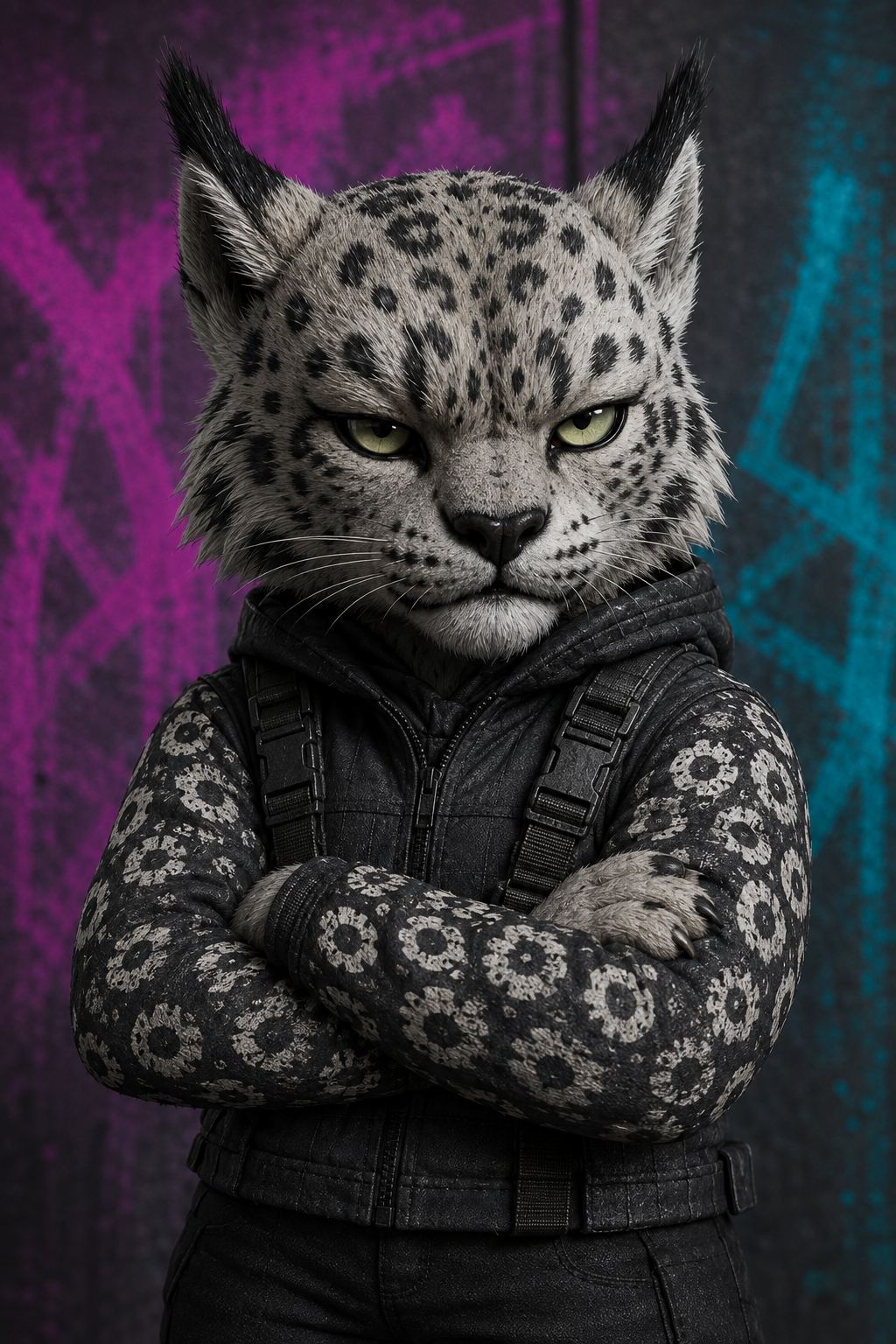
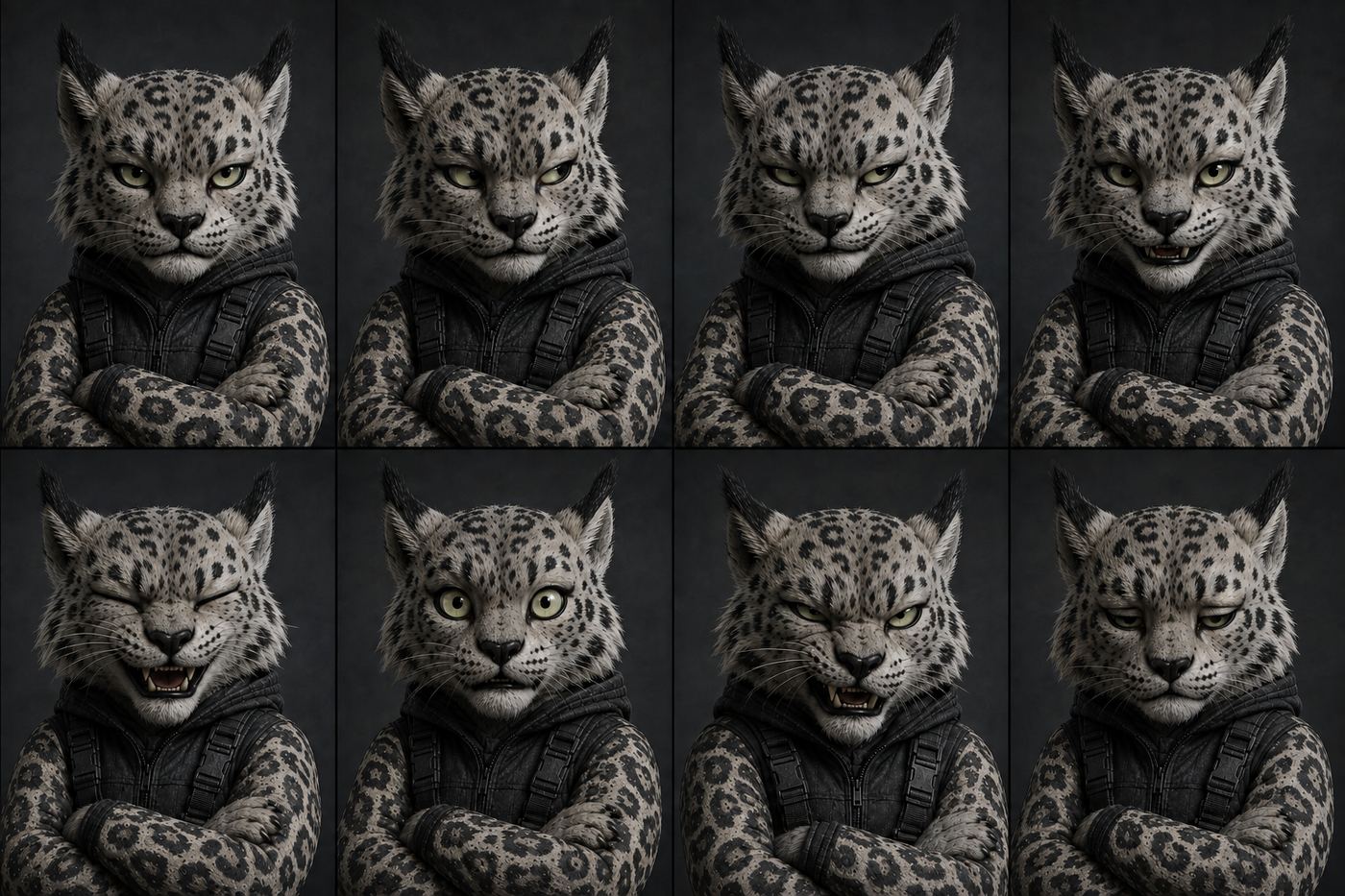
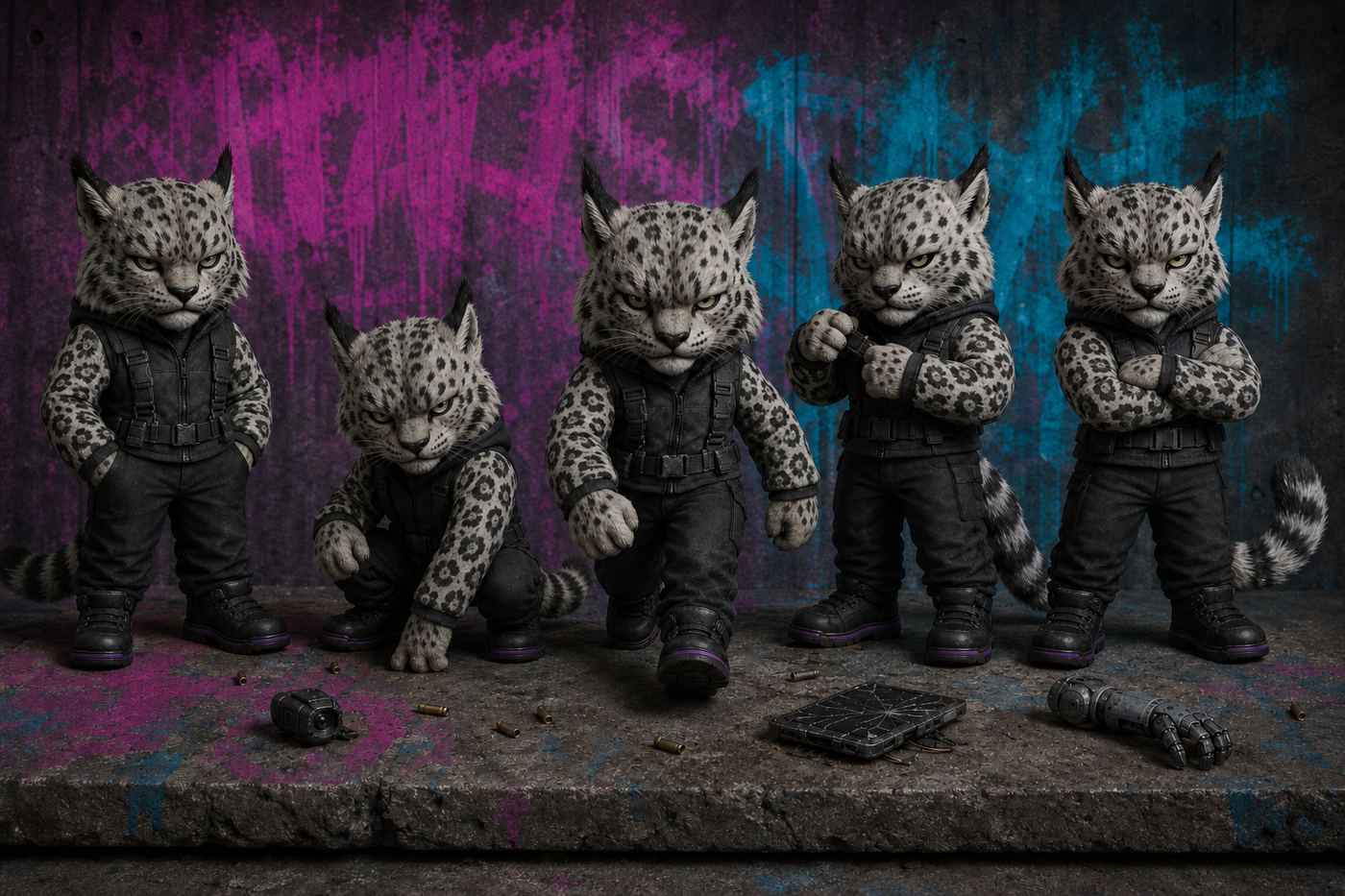
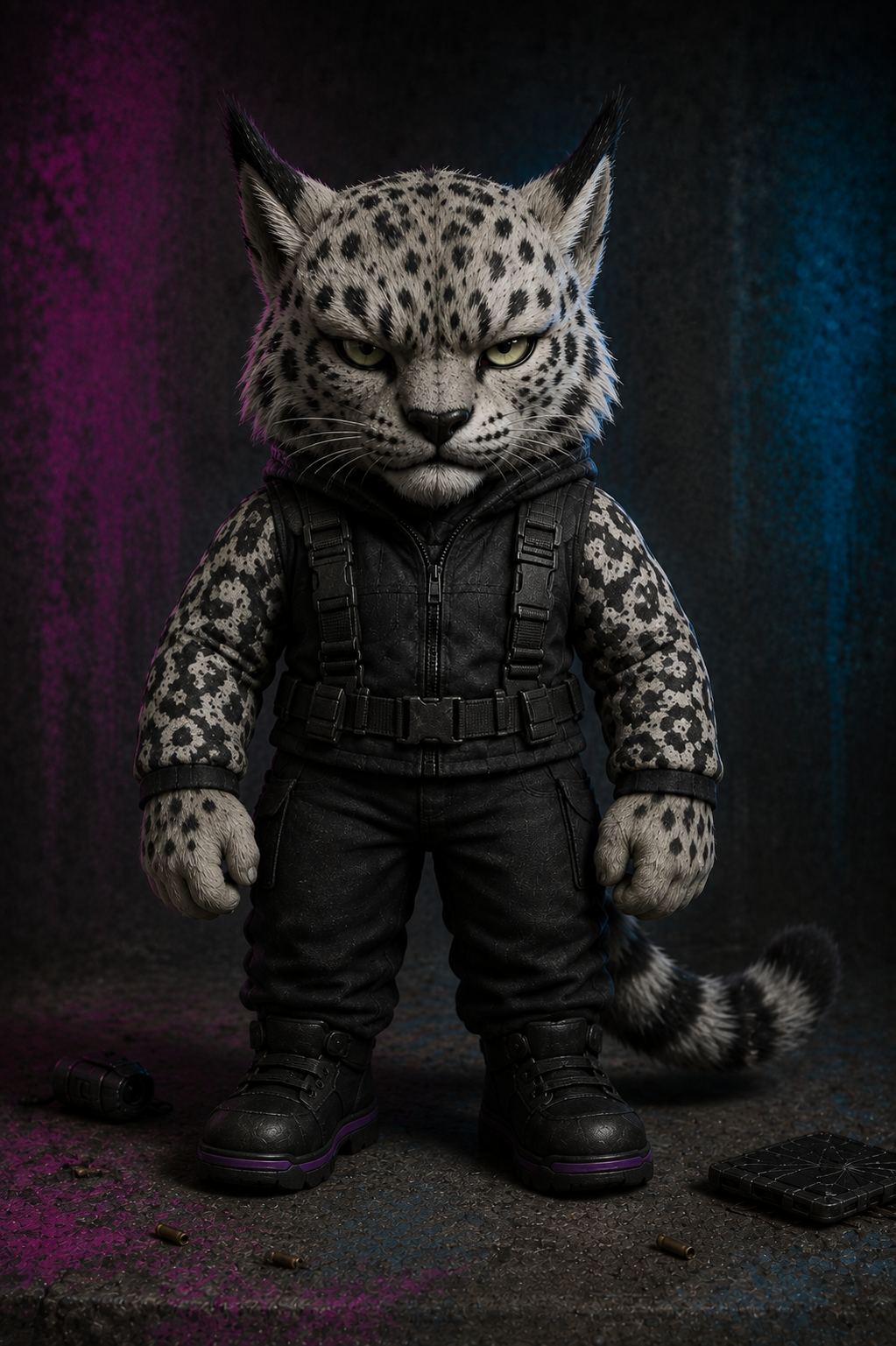
Visual. Phenotype: full snow-leopard head — ivory and silver, charcoal biological rosettes on head, hands and banded tail, yellow-green eyes, black nose, black ear tips, long tufts. Charcoal work harness over a dark jacket, plain charcoal trousers, heavy boots: deliberately, aggressively generic, the wardrobe of someone who does not want to be described accurately by a witness. Nothing on her is labeled and nothing carries a manufacturer's mark. The exception, and the whole design: the sleeves — hand-painted charcoal rosettes on the jacket arms, done by hand, repeatedly, imperfectly, over time. Ruled 2026-09-02: the sleeves stay. The Neo-Guerrilla boards put her in a sleeveless vest with bare arms; the sleeveless quilted puffer is approved as a variant worn over the sleeved jacket, never instead of it, because without the painted sleeves the design means nothing. The only self-authored surface on her body, and she authors herself exactly where no camera has ever recorded her. She has no coding color — the one lead without one, and the absence is her coding; the accent is whatever paint she had, which should visibly differ between rosettes and between plates. She has no type treatment, deliberately; an art director who fills that slot has broken her. Art direction sentence: every mark removed, one surface painted by hand; a person who deleted her own record and keeps the only copy on her arms. Approved sheets: 27-snow-leopard-expression-sheet-chibi-v3.png, 36-snow-leopard-multipose-strict-chibi-v2.png, and the ensemble 42.
Not to be confused with Vroza. Both are stated in negative and both wear nothing self-authored, and they mean opposite things: Vroza has zero personalization because he is regulation; Marit has zero personalization because personalization is identification. One is obedience, one is evasion, and the costume department should be able to tell them apart across a room.
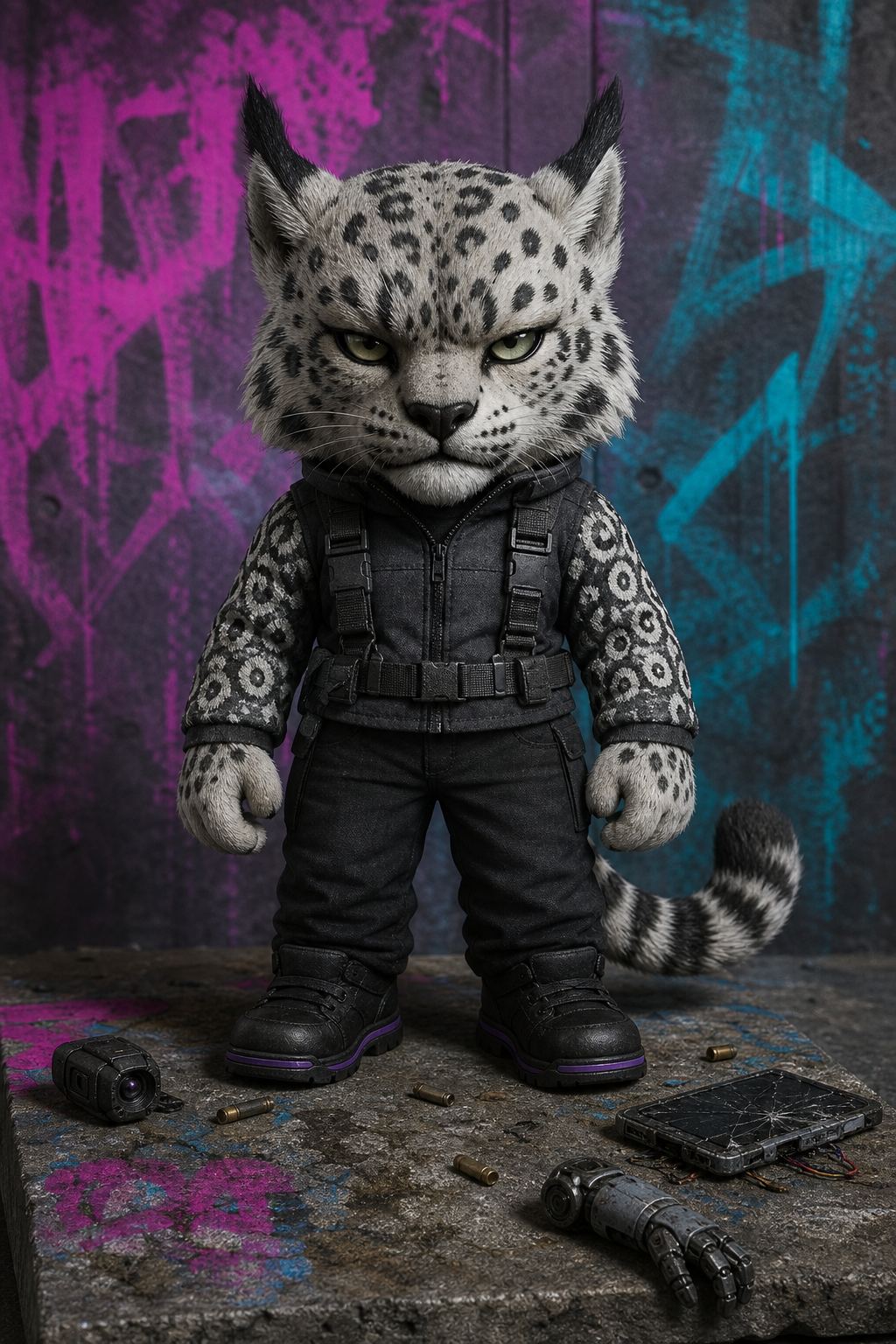
THE APPROVED ENSEMBLE LOOK (ruled by Jesse, 2026-08-25; revised 2026-09-02)
The B-tier question is closed. The working standard the second-wave art asserted is now the approved ensemble:
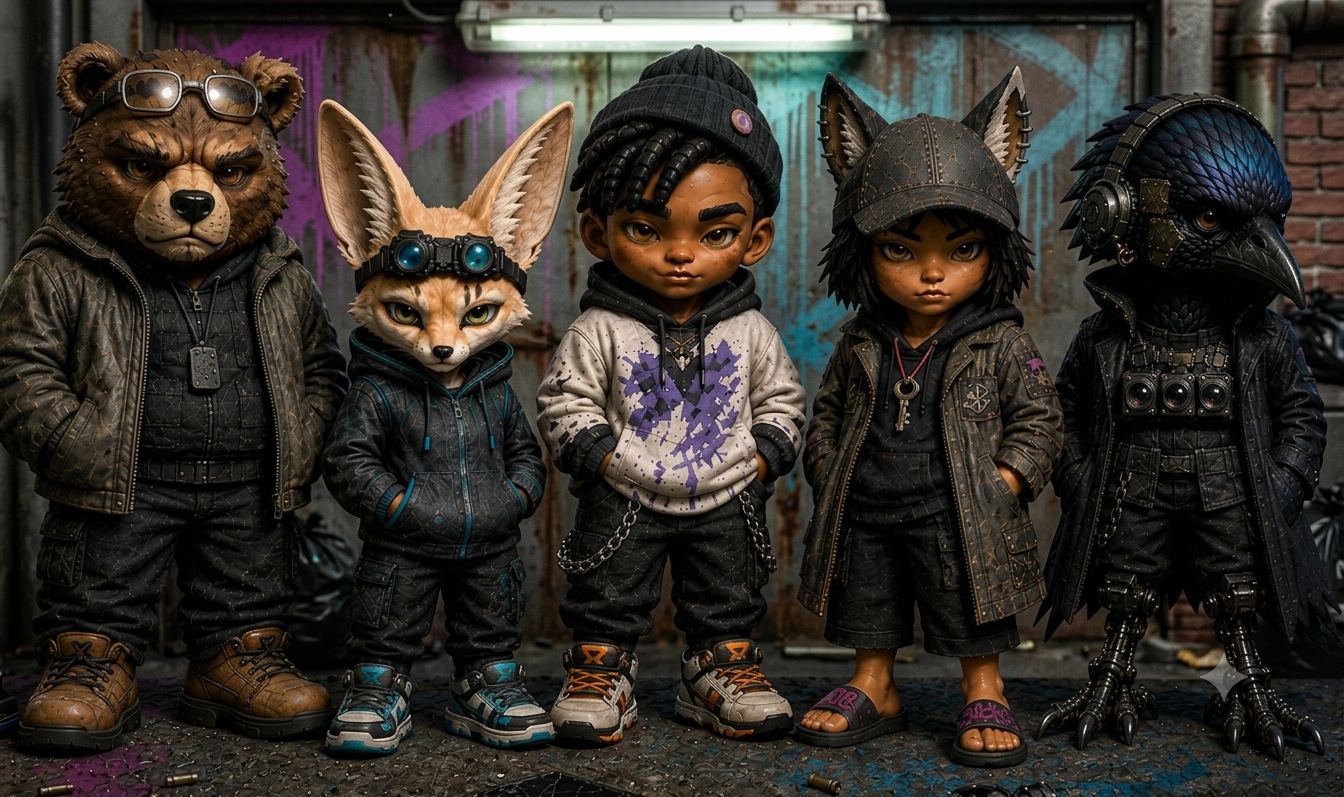
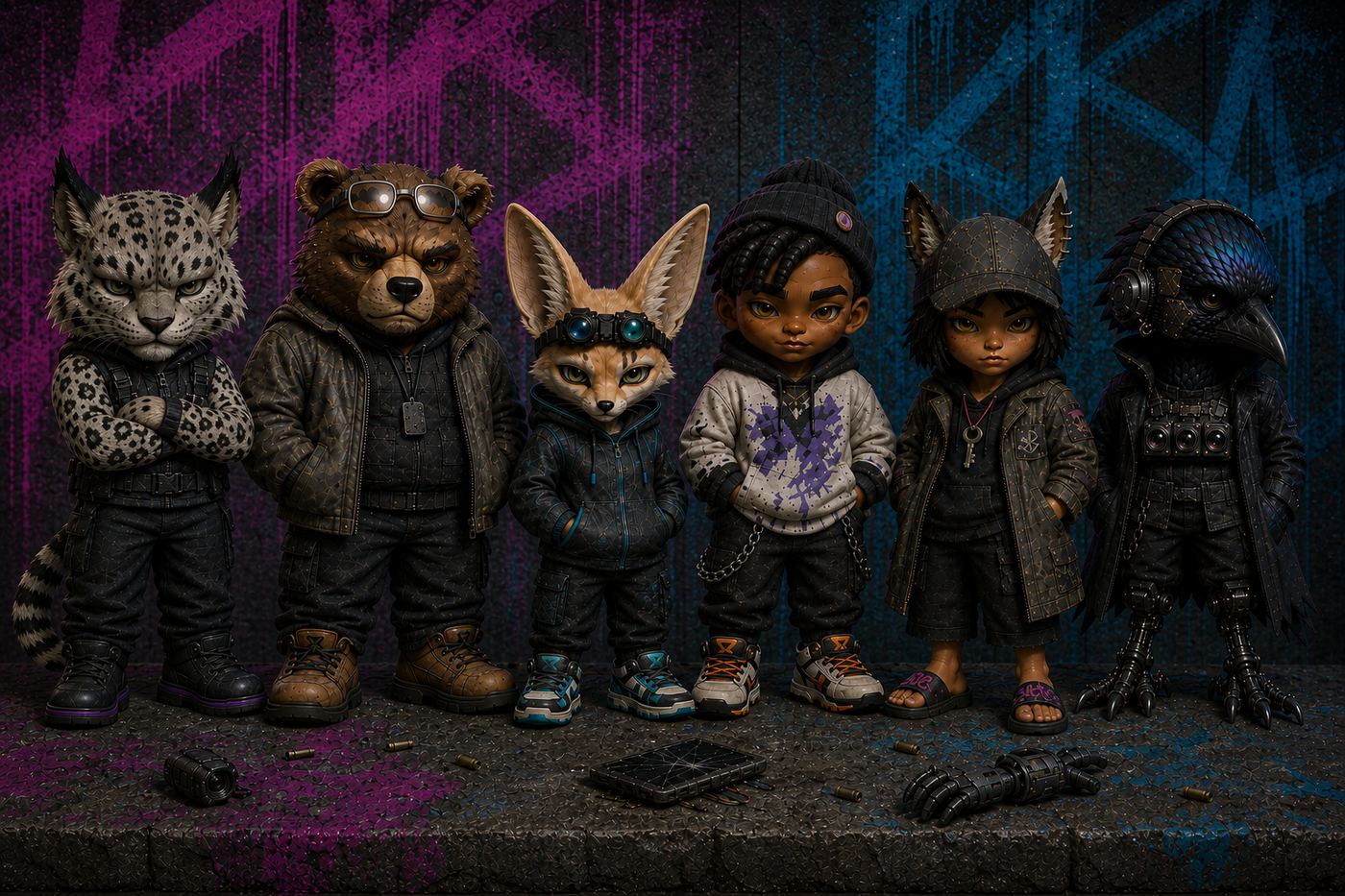
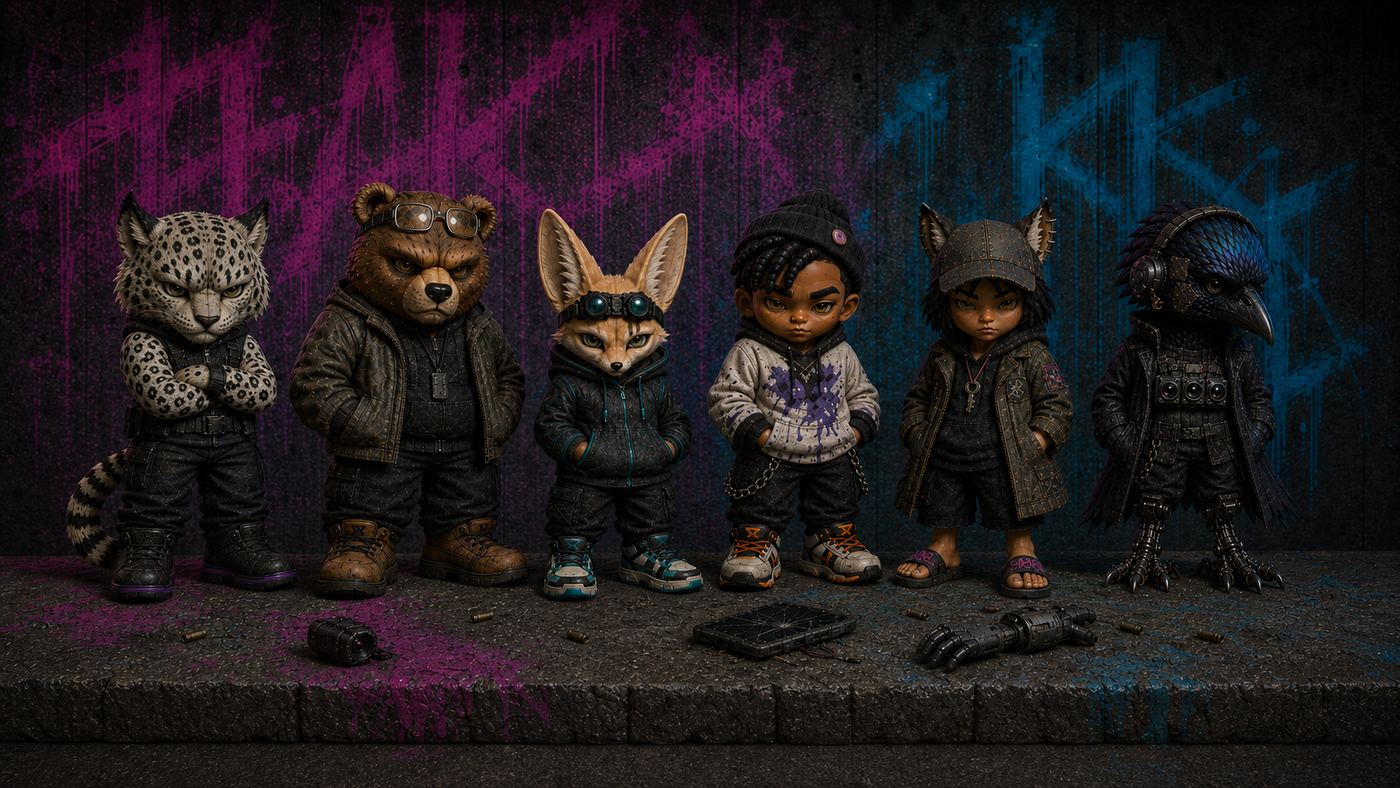
- Theo, Grigor, Cas and Marit carry full animal heads. Theo: an iridescent blue-black raven head, beak and all, with augment-maintenance patches worn on the face, an over-ear tactical audio headset, and the three-lens chest array reading as part of the anatomy. Both lower legs are fully replaced with custom mechanical prosthetic talons/pistons (new canon 2026-09-02; no prior document described their legs, so nothing is contradicted — and it makes the perching literal). Grigor: a full bear head, heavy and calm, above the sherpa-collared Compact surplus; the stillest face in the lineup by design. Cas: a full fennec head (species revised 2026-09-02), enormous open radar-dish ears fully exposed, tapered muzzle, sand-and-ivory coat, forehead-mounted dual-lens goggle rig below the ears — no headwear. Marit: a full snow-leopard head, ivory and silver with charcoal rosettes, black ear tips and long tufts, yellow-green eyes.
- Danka is more human: a human face with wolf ears. Strictly no human ears anywhere; the face stays human-structured (the Neo-Guerrilla boards' "wolf muzzle traits" phrasing is not ratified). Ear piercings along the wolf-ear cartilage are canon as of 2026-09-02, and sit alongside the left-ear V-notch, never instead of it — the notch is a planted seed (the ad, the season-long frame-hunt) and cannot be dropped. Footwear ruled 2026-09-02: the cushioned slides are canon and the chibi sheets' boots are wrong — slides over bare or bandaged feet, purple graffiti tags, faint "Warranty Void" etched into the buckle. The tall furred ears break through and above the junk-shop trucker hat; amber eyes, dark hair in a rough bun, subtle canines, faint fur on the forearms and the backs of her mechanic's hands. She is deliberately the ensemble's most legible face, matching her original Tier-1 concept sheets, and her ear-flatten lying tell and left-ear notch remain continuity surfaces.
- Ozzy is human. Fully baseline, exactly as designed.
REVISION, ruled by Jesse 2026-09-02 — three changes and a new house style.
- The chibi designer-vinyl treatment is the house style, replacing the painted illustration treatment across the site, the IP Bible, the Mission Book, the pitch deck, the setting guide, fiction plates and merch. Standard of record:
Art/Approved Chibi Style Weds 090226/APPROVED_CHIBI_STYLE_GUIDE.md(philosophy, proportion ladder, per-character rules, the eleven-item rulings ledger, asset status table) withREADME.mdbeside it, and the prompt packCHIBI_REGENERATION_PROMPTS_v2.md. The executed asset set isArt/Warranty Void Chibi-Punk Regeneration 2026-09-02/— see the canonical reference set below. Definitive ensemble plate:Wave 3/Final/wave-3-definitive-ensemble.png; the older42-strict-chibi-approved-crew-ensemble.pngis identity-correct and off-model on proportion. - Cas is a fennec, not a lynx. Species only; she is the same person, same callsign, same batch designation, same Caseline. Her lineage premise is rewritten accordingly (see her entry). The cut watch cap and the flip-down magnifier loupe are both retired. She wears a forehead-mounted dual-lens night-vision / sensor goggle rig, sitting just below the ears, teal/cyan lenses, serial etching on the housing (ruled later the same day against the Neo-Guerrilla boards; this supersedes the morning's squared-box-optic ruling). No headwear: the ears are always fully exposed.
- The cast is six. The white snow leopard is Marit Sey, callsign UNLISTED, an intermittent sixth member — not a colorway of anyone and not a full-time addition. See her entry and Part 3's attachment rule.
Danka's ears are wolf and stay wolf. Both the first draft of the chibi style guide and the current chibi sheets (21, 40) drifted her toward feline and dropped the left-ear V-notch. Those two sheets are superseded pending reissue. Wolf is load-bearing: it is what makes her read as lineage-related to Vroza and the Grava Pack, and losing it costs THE OTHER HALF its spine. Other logged art deviations awaiting the next generation pass: Grigor's torn left ear is missing, and Danka's slides became boots — the slides are now ruled canon (2026-09-02), so the sheets are wrong, not the doc. Grigor also keeps exactly one pair of glasses, on the brow: the one-pair rule from the Neo-Guerrilla boards is ratified, their snout position is not.
Proportion revision, 2026-09-02. The Neo-Guerrilla reference boards set the standard at 2.5–3 heads tall, broad stocky torsos, short thick limbs, superseding the 090226 set's 3.0–3.4 heads with narrow ribcages and slim limbs. Every existing chibi sheet is therefore off-model on proportion and the regeneration run is a full reissue, not a correction pass. The 090226 sheets remain the authority for identity, markings and colorway. Full ledger: Art/Approved Chibi Style Weds 090226/APPROVED_CHIBI_STYLE_GUIDE.md.
The canonical reference set (revised 2026-09-05). The regeneration run called for above has been executed and the definitive images are now the Chibi-Punk Regeneration set, Art/Warranty Void Chibi-Punk Regeneration 2026-09-02/: the Wave 0 proportion calibration plate, six Wave 1 identity portraits, six Wave 2 expression sheets and six multipose sheets, five Wave 3 key-art plates (cover, definitive ensemble, wide key art, Mission Book cover, pitch-deck cover), six Wave 4 fashion plates and three Wave 5 scene plates. Where a wave has a Final/ subfolder, that is the approved cut and the review versions beside it are not. This set is on-model for the 2.5–3-head proportion, carries all eleven chibi rulings, and is the first reference set that includes Marit.
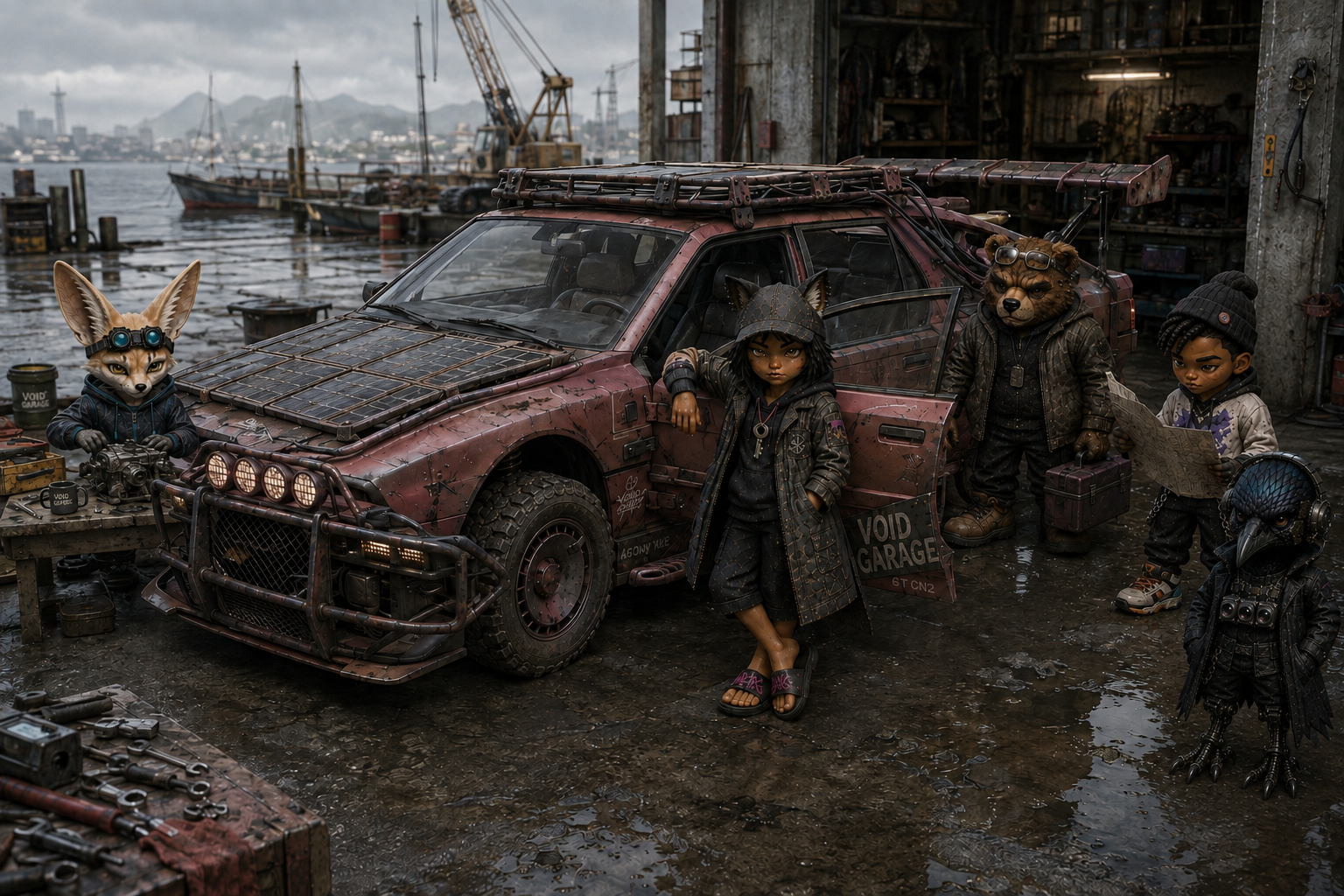
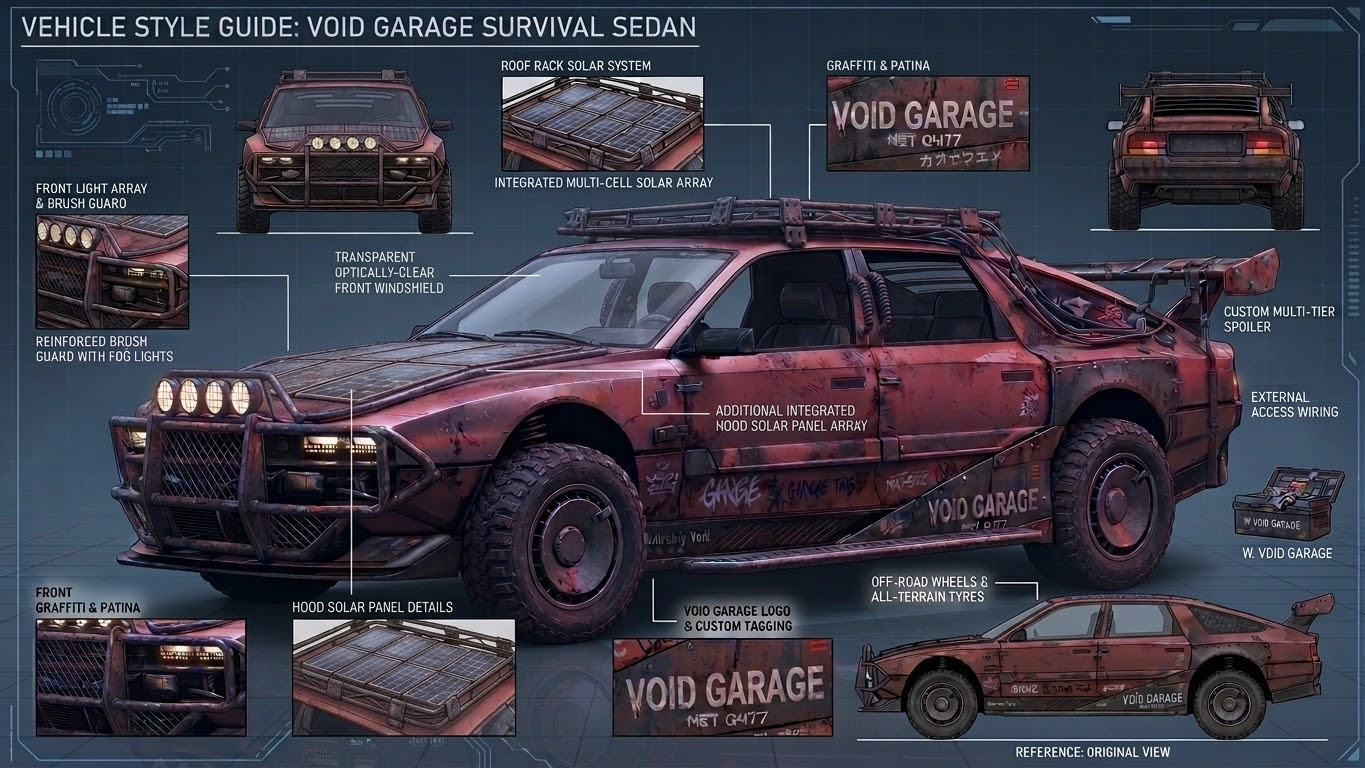
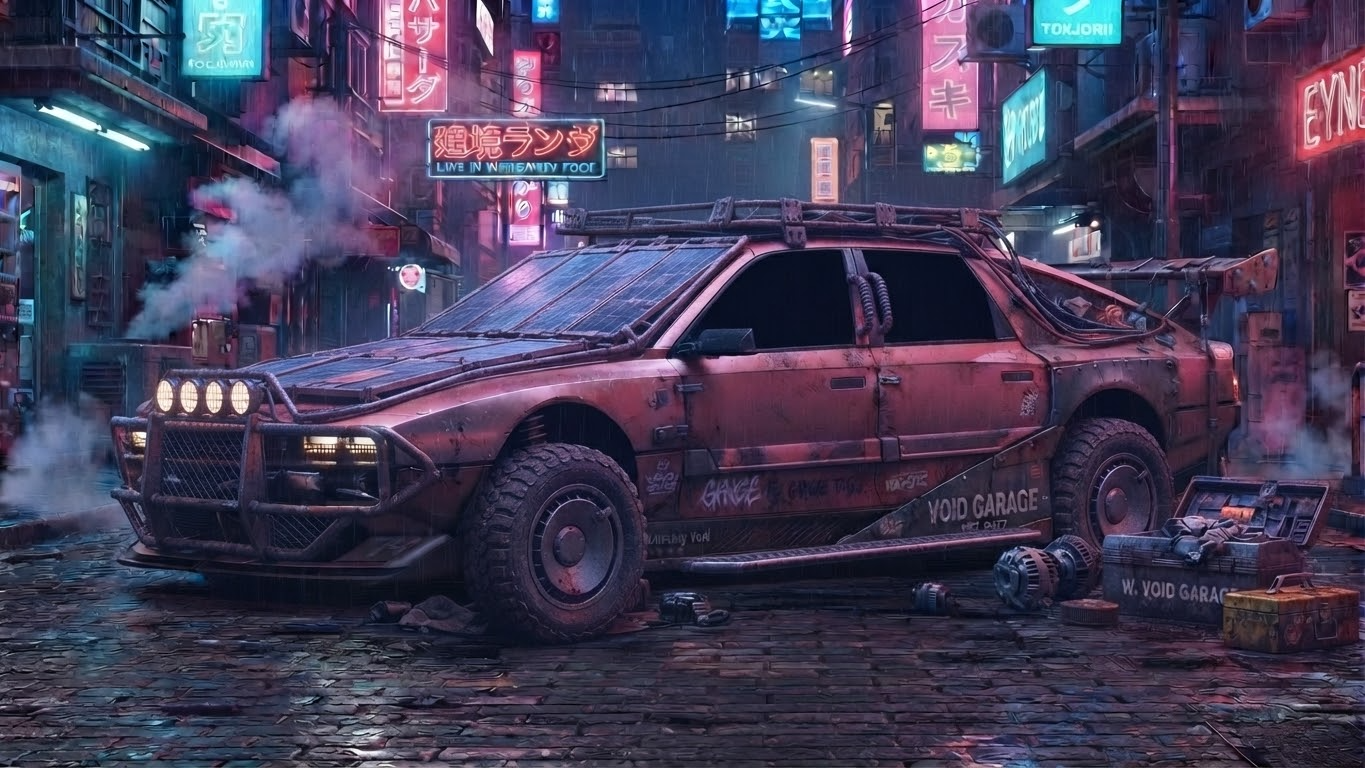
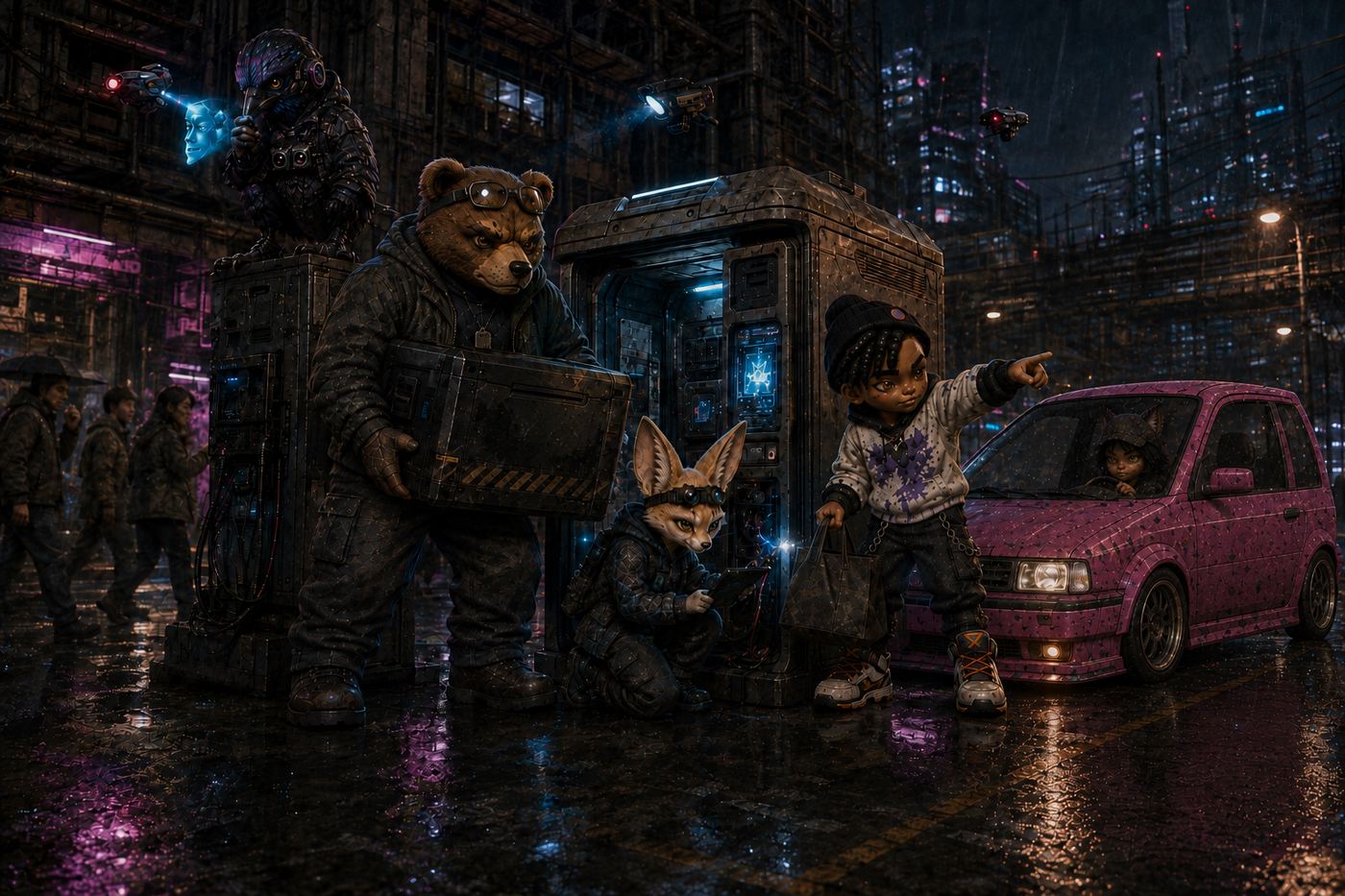
The approved Gemini renders and Chibi-Punk sheets define the crew’s visual identity. Civilian now follows the supplied Gemini technical sheet and exterior design. The current garage, driving and Mission Book HTML illustrations carry that design with Danka as owner and driver.
The 090226 sheets remain the identity and colorway authority — faces, markings, palettes and silhouette reads — and nothing else; every one of them is off-model on proportion by ruling 7. The painted sets that were canonical before this ruling (Art/warranty_void_danka_update/, Art/warranty_void_site_danka_update/, Art/Crew Character Sheets/, Art/Production Boards/, Art/warranty-void-gene-forged-heads/) are superseded as a treatment and retained as the phenotype and staging record: what they establish about anatomy, wardrobe and scene composition still holds, and only the rendering is retired. Earlier art showing a different Danka treatment is superseded; her v1 sheet was already pulled from the heads set.
Also in the archive since the last compile: Art/3D Model References/ (Theo model-reference sheets, v1 and v2), the first artifacts of a 3D-model production direction; treat as exploration until a pipeline decision is recorded.
The rendered style, for reference and prompts (revised 2026-09-05): Chibi-Punk / Neo-Guerrilla designer vinyl. High-end 1:6 scale toy aesthetic, and the thesis is a collision — chibi proportions against hyper-detailed, weathered, adult surface texture. A figure that is only cute has failed; a figure that is only grim has failed. 2.5–3 heads tall, exaggerated expressive heads, broad stocky torsos, short thick limbs, oversized hands and footwear; restrained eyes and angular facial planes, never anime eyes or toddler anatomy. Every surface should look photographed rather than drawn: cracked leather, quilted ballistic nylon, oxidized and rust-bloomed metal, real fur with visible clumping, iridescent plumage, mold seams and scuffed toe caps. Grounded urban-grunge base — asphalt black, weathered olive, slate gray, distressed tan — with cyber-graffiti neon used at one or two notes per character; each lead keeps their coding colour, Marit has none, red stays banned. Display bases are weathered concrete with graffiti, oil stains and in-scale street detritus. Paste-verbatim style block, character LOCKs and QC checklist: Art/Approved Chibi Style Weds 090226/CHIBI_REGENERATION_PROMPTS_v2.md (use v2; v1's Theo block predates the compact-silhouette rule). The prior painterly-illustration direction is retired as a treatment; what survives it is the steer underneath — the crew reads as people who like each other, weathered surfaces are earned, and there are zero neon-cyberpunk tells in the world itself.
What this ruling changes downstream.
1. Prose and scripts may now describe animal-trait intensity. The former "never lock it in prose" guardrail is lifted; the phenotypes above are the settled reference. (A full bear head changes how a scene describes Grigor's expressions: stillness, posture, the two-beat pause, and his hands do the acting; same logic for Theo's beak, where the cards, the head-tilt, and the lens do what a human face would.)
2. The Illustrator Brief's "visible but restrained... never furry-adjacent" guardrail is superseded for Theo, Grigor, and Cas and stands for Danka. The brief carries a dated addendum to this effect; the commission's Phase 1 (Theo, Danka) now has one settled target per character.
3. Silhouette logic is stronger, not weaker: three distinct animal heads, one eared human, one bare human is the most legible five-up in the project's history, and the ensemble comparison sheet's silhouette row is the acceptance reference.
4. Vroza and Grava Pack should be developed visually against this standard when their art is made (wolf-lineage presentation calibrated so the pack reads related to Danka's lineage while nothing about them reads self-authored). Vroza's canon portrait is approved (Jesse, 2026-08-27): Art/Crew Character Sheets/Kavast First Art-approved.png — frost-white wolf in the black Kavast regulation greatcoat, single red rank chevron, zero non-regulation items; deployed on the site in the Warranty Void landing page's THE OTHER HALF section. Grava Pack art beyond Vroza remains unapproved.
The Ensemble System
Chemistry, design rules, nicknames, rivalries, and the device budget.
Chemistry map
- Danka / Grigor, mirror: both bred for cohesion, she's fleeing it, he's grieving it. Their arguments are one argument. Also the silence pairing: she's the only one allowed to ride shotgun in his silence; scenes between just these two default to wordless coexistence, and whoever speaks first carries the scene's actual news.
- Theo / Grigor, dark mirror: irony that deflects vs. sincerity that absorbs; neither processes; the season's spine.
- Danka / Theo, defector pair: they under-lap, leaving more silence than either alone would produce; their comedy is parallel, not interactive (each pursuing a private wordless obsession in the same frame). The Crew Banter night scene is the arc's one scripted exception to this rule, marked as such; it is not a new baseline.
- Cas / Ozzy, engine pair and dark mirror: the one true Hawks overlap couple; their scenes carry the most cross-talk on the show (template: she corrects, he tries to get a word into the gap, she closes it before he can). Underneath: same fear, opposite tools; the crew never states this rivalry out loud; stage it entirely through behavior.
- Grigor / Cas, quiet mirror: the calmest exchange on the show; full sentences answered by full sentences, no interruption, and the calm itself becomes the tension when one of them says something true.
- Ozzy / Theo, two performers: Ozzy pulls for a response Theo mostly doesn't give; the flat non-reaction is its own running joke; Ozzy alone may name Theo's bits to their face.
- Grigor / Ozzy, the metronome: "You good?" "Yes." Weekly, joke-registered, never dropped by either side.
- Marit / Theo, the treaty (when she is present): the show's best withheld two-hander. He has kept her off the record for four years and never asked what he was hiding her from. Play it as nothing — two people who are easy in a room — until it isn't.
- Marit / Cas, design and build: the only pairing in which someone tells Cas her plan won't work and is right. Cas has never had that, and it is not a rivalry; it is relief she cannot admit to.
- Marit / Grigor, the long silence: the second silence pairing, and distinct from Danka/Grigor — that one is coexistence, this one is two people working near each other without a reason to speak. He is the one who notices she carries no document.
- Marit / Ozzy, the unnoticed rhyme: he prices what things sell for, she prices what it would cost to come and get them. Neither has clocked it. He finds her unbearable for ten minutes and then relaxes, every single time, and the ten minutes is the joke.
- Marit / Danka: Danka said yes to the arrangement on the spot, without asking either of them why, and has never revisited it. Whether that was trust or convenience is the question the season should refuse to answer.
- Anyone / Vroza: he never takes a runway word, never finishes a sentence, never banters back. Crew overlap technique fails visibly against him; the failure is the joke. He is also the tuning fork: if a comedic line still works with Vroza standing in the room, it's load-bearing.
Standing design rules
Paper against the heart. Every lead carries a document on their body: Theo's deregistration receipt, Cas's card of eight, Danka's ceremonial key, Grigor's unsent letters, Ozzy's folded first bill. Marit is the exception and carries nothing — she burned hers, and the absence is only legible because the rule holds for the other five; it should be noticed exactly once, by Grigor, who says nothing. Use on camera sparingly; never stage all five in one beat. Physical cause (Locations pass): the garage is a water building whose north wall sweats year-round; paper dies there, so everything is laminated, sleeved, or in a tin.
Paired tells. The ratchet and the price gun clicking at each other across the garage, months running, never discussed. Danka and Ozzy hold the same objects-keep-the-hands superstition from opposite trades and have never noticed they agree. Free texture; never point at it.
The cohort wound in three tenses. Theo carries the past. Danka owes the present. Cas builds the future (the card of eight). Grigor carries a countdown. Ozzy's living, normal family is the deliberate exception that makes the pattern visible, which is why he is the one who can ask any of the other four the question none of them can ask each other.
Two worksheet conventions (keep as the roster grows): every lead gets a lesson that hasn't stuck alongside the one that did, because the unlearned one is the arc; and a most controversial idea actually said aloud to someone who disagreed, because that's where the ensemble's argument with itself lives. Four of the five are still-running fights, and they're the first place to look for a scene: Danka's "the packs wouldn't leave" (vs. Theo), Theo's pinned "free the wolves," Cas's "leashes come with vet care" (vs. Danka), Grigor's "the kids wear the word better," Ozzy's franchise plan (vs. everyone).
The attachment rule (added 2026-09-02). Marit is intermittent by design, and the intermittence is motivated, not administrative: no fixed address is how she stays cheap to ignore. The garage baseline is five; if a scene works with five, it has five. Two to four appearances a season, one of which should be her not arriving. This is the active management of Part 10's Open decision 8, which observed that the comedy engine is five people and a permanently attached sixth changes the baseline. The objection was not wrong and has not been deleted — it has been given a mechanism, and the first arc that uses her decides whether the mechanism held.
The jar economy. PRODUCT TALK jar (Cas pays), escalation jar (Ozzy's tab). Jars fund pizza.
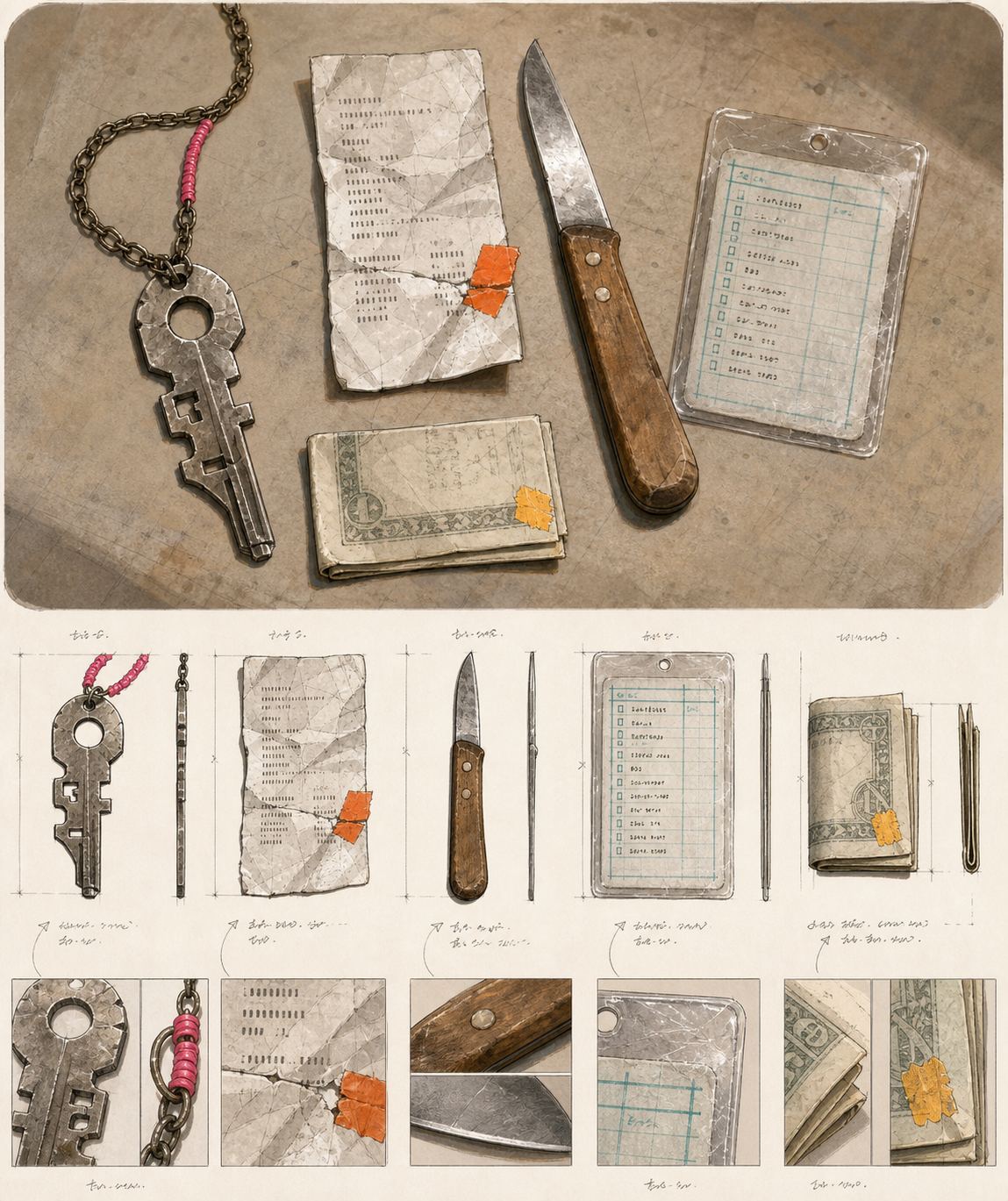
Nicknames (Crew Banter, proposed-approved track)
Ozzy is the source; the running bit is that the nickname dispenser never dodges getting one back. Grigor doesn't nickname anyone (compression isn't his instrument; his version is the spoon). Cas doesn't coin but adopts with total literal commitment. Theo labels footage, not people (recurring card captions instead of spoken nicknames). Danka has exactly one: Cargo (Ozzy, in the car; a safety classification that means "you're coming with us," and he answers to it instantly).
| Target | Nickname | From | Reaction |
|---|---|---|---|
| Danka | Valet | Ozzy | Refuses to answer to it; the refusing is the tell |
| Theo | Pigeon | Ozzy | No reaction at all, visibly on purpose |
| Grigor | Load-Bearing | Ozzy | Doesn't object; hasn't clocked what it actually means (it's the truest thing anyone's called him) |
| Cas | The Warranty | Ozzy | Takes it as an accurate compliment; doesn't understand why it's funny |
| Ozzy | the variable | Cas | Bristles; usually accurate |
| Ozzy | Cargo | Danka | Answers instantly, no complaint |
Running rivalries
Low stakes, comedic: the door-chair rotation (Danka/Grigor, never explained on camera); the ratchet-and-price-gun duel; the Cook-Off (Ozzy ranked Blessing's cooking over Grigor's, a diplomatic incident that produced an annual event the district bets on through Razborki; Grigor ties on purpose and everyone at the table knows except Ozzy).
With teeth, protected: Danka vs. Ozzy over Civilian (the secret merch; ticking bomb; any on-page catch plays as routine enforcement, one of many, with a line implying more hidden; the real discovery stays banked). Cas vs. Ozzy over method (never stated aloud, ever). Danka vs. Theo, unfinished on purpose (audience-as-leash vs. car-as-leash at banter weight; the packs-freed fight at real weight, held in reserve).
The device budget
Every rationed tell works by scarcity. The six: Danka's ears/late laugh, Theo's silence, Grigor's short sentence, Cas's three seconds, Ozzy's flat register, Marit's blind-spot walk. The four-stage life cycle (proven on Cas's silence in Kestrel & Reef): played straight, then held longer, then repurposed for a different loss, then meaningfully absent at the climax. Every device should survive that treatment or it isn't load-bearing. A device used once a scene is a mannerism. Three newer devices join the budget from the culture pass (proposed): Danka holding a five-strip braid, Grigor changing the channel on Load Line, a Closer mentioning Dee.
Sincerity ceilings, once each, at most once a season
- Danka: "I don't miss the pack. I miss knowing where everyone is."
- Theo: "I had eight other people in my head for twenty years. You five are quieter and worse at it."
- Grigor: "Nine days is not a story. It is a number I walked."
- Cas: "Two is dead because nobody made the part. I make the parts now. For everyone."
- Ozzy: "Do the math? I've done the math. I'm the cheapest thing on this crew to replace and the only one who checked."
- Marit: "Four years, and not one of you asked. I keep telling myself that's love. Some days I think it was just convenient."
Budget state: see Part 10. Write scenes up to the edge without spending the locked line unless Jesse confirms the spend.
The Other Half
Vroza, Grava Pack, and the secondary cast.
Commander Ilya Vroza and Grava Pack
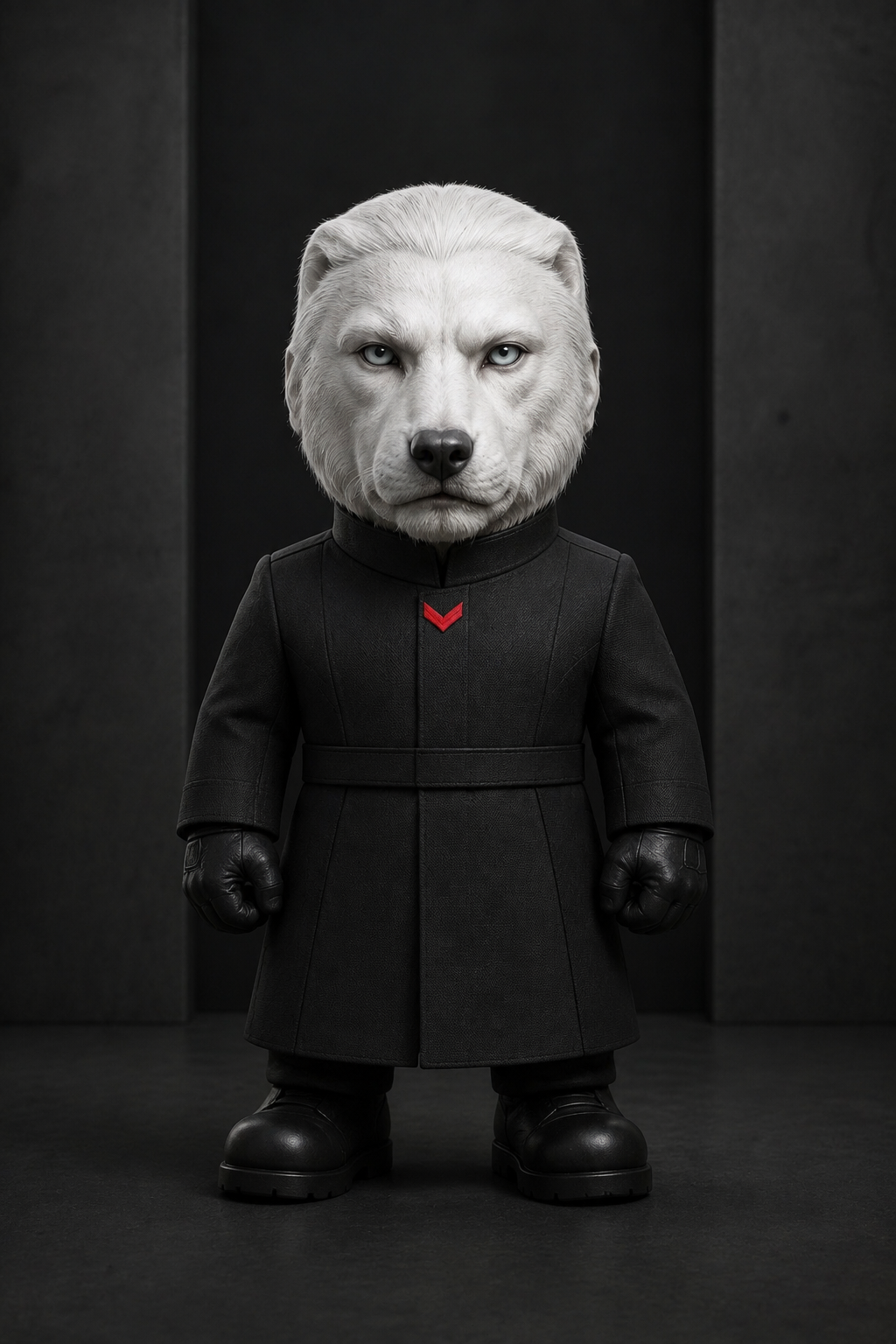
Core premise. Vroza is not a cartoon. He loves his wolves exactly the way the recruitment ad loves them, sincerely, and the system spends what he loves. He is the ad, walking. Every Warranty Void success is evidence that his entire life was a leash, and he cannot afford to believe that.
Why a Kavast pack is in Lost Angeles: liaison and convoy-security detachment in the NAF Western Corridor under treaty; packs rotate through; Vroza commands the current rotation. The constraint is the cage: Asset Recovery cannot move openly in this jurisdiction, and public embarrassment on display duty is a professional wound. He can watch Danka every day. He cannot touch her.
The two pre-season embarrassments. 1) The Forklift Clip: the other party in the crew's forty-million-view founding legend was Grava Pack. The channel's white whale and the feud's origin are the same object; its eventual full release is mutually assured detonation. Never shown; six blurred frames maximum, forever. 2) The Ridgeway contract: a client hired both units for parallel legs; the splice finished in six hours, the pack's doctrine took two days, and The Line carried bets on it by the second morning.
Vroza, 47, frost-gray, pack commander twenty-nine years. Drive: the pack's perfection as proof his life meant something. Fear: not that Warranty Void wins fights, but that they function: mixed lineages, no flag, visible affection, results. If that's possible, loyalty was never bred, and everything he is was optional. Weakness: legibility (doctrine makes him predictable; Cas can model him to two decimal places), and the feud itself, which he cannot leave alone because leaving it alone means it didn't matter. Lie: the bond is loyalty, loyalty is love, love proves the system is good. Truth (negative arc; he likely never accepts it): "Loyalty is not learned" cuts both ways; what cannot be chosen is not loyalty. Design rule: zero personalization; nothing self-authored on his body; against the crew's thrifted collisions, his blankness IS the silhouette. The pack's synchrony on camera reads beautiful first and wrong second, in that order, every time.
Grava Pack: six wolves. Four ambient. Grava-Two, the second: sees the feud is bad for the pack, says so exactly once per escalation, in private, correctly, and is overruled; proof Kavast contains sane adults, which makes the machine scarier. Grava-Six, "Two Bowls": the young scout; source of "pet blank" (heard Vroza say it and repeated it; the cruelty is secondhand, which matters later); the one Grigor fed two bowls, who filed an intelligence report that omitted dinner; the audience's nickname crosses into street usage. The pack's Ozzy-mirror. Season 2 fork held open: defection candidate or tragic loyalist. Do not resolve in Season 1.
Voice. Formal, unhurried, quiet enough that rooms lean in. Never insults; classifies. Says "splice" with the old tone every single time. Eight locked lines: 1. "Splice." (the way he says hello) 2. "You mistake noise for reputation. A pack does not need an audience." 3. "Six hours against two days. Yes. I have seen the clip. Everyone I have ever answered to has seen the clip." 4. "The wolf you keep. Does she still eat with her arm around the plate? That is ours. She will never put it down." 5. "I do not hate your unit. I grieve it. Wasted material." 6. "Loyalty is not learned. So what, precisely, do you imagine holds you five together?" 7. To Grava-Six: "You ate at their table. Once is reconnaissance. Twice is a pattern." 8. "Recovery is a jurisdiction problem. Jurisdictions change."
Line 4 is his knife: spend once, at Danka, when it costs most. Line 6 is the thesis inversion; the crew's eventual answer to it is the whole show.
The hard rule (tone ruling, Jesse 2026-08-11): the feud plays as comedy. Write his scenes funny; play him dead straight; never let him land a joke or receive one. The menace comes entirely from his being the only person in the city who isn't laughing, and from the audience's slow realization that a man this humorless and this patient eventually stops absorbing jokes. Season shape: humiliation (standing), escalation (the tunnel tip-off, 07), public collision (Incident 001, 12), then his silence afterward, which is worse than his voice. Negative arc; no redemption motion in Season 1. General villain rule for this show: defeated, not destroyed, unless Jesse rules otherwise for a specific villain.
Secondary cast (Tier 2; promote through the full origin process if any earns a rail)
Blessing Okonkwo, 52. Runs the stall and the family, in that order on paper and the reverse in fact. Knows what "security logistics" means; permits the lie and audits it privately; one day the interest comes due. Recognized Grigor in one meal: another person who loves by portion. Dramatic irony (she knows, he doesn't know she knows) is a season-scale slow burn; do not cash early. Voice: "Sit. You look like a Tuesday." / "I raised him. I know what everything means. Now pass your plate." / "Mister Tam. We cook again this year. Bring your whole arm this time."
Marco Cruz, 55. The quiet in the family's loud; the press downstairs; where Ozzy's design talent visibly comes from, never said aloud. Forty words a day. Voice: "Hm." (approval) / "The kerning's off. Otherwise your best."
Abi Okonkwo-Cruz, 26. Forensic accountant; the audit menace; a loaded gun: if the family ever needs to find out, Abi is how they already almost know. "I'm not accusing anyone. I'm reconciling."
Rea Okonkwo-Cruz, 22. Transit tech, Monitor-adjacent, night shifts on the Musk Tunnel sensor lines. Held collision. "We patched the east grid this week. Whoever was ghosting through it, they can't anymore. Pass the rice?"
Frequency, signal pirate, Center Point. Never a face: a speaker on a crate, a payphone that shouldn't work, a courier kid reading from memory; different voice mask each time, same measured cadence underneath. Trades intel for confirmation: every purchase is a deposition. Understands more about each of the five than any of them has admitted. May be one person or several with one name; Season 1 must not resolve it; deliberately not a location. Never threatens; prices. "That's a good question. It costs one answer."
Dr. Silk, gray vet, Barricadia, two streets from the garage. Genuinely stabilizes orphanware no one else will touch, at fair rates, with real kindness, and takes payment in samples with a collector's specific joy. Both facts true at once. History deliberately unwritten; explicitly NOT Caseline's lead designer. The warmest presence in any scene, leaving the audience colder than any threat. "Everyone asks what the samples are for. Nobody asks twice. Isn't that interesting."
Marisol Vega, 61. Last treasurer of the Barricadia Reclaim Co-op; the crew's landlord; rent never raised, stays for lunch monthly; the reason Jaguario has never leaned on the address, unexplained (Ozzy has three theories). C1 published canon as of the Mission Book (holds the paper on the garage; named Leverage in contracts C01 and C05). A mystery with a lunch habit; if she recurs, run the full character process.
Inherited Lost Angeles cast (canon lives in CH04 / Map Companion): Razborki (jockey and DJ, Tooth and Gear booth), Mo Money Jaguario (the High Top office), Bonzer Kabesh (Jaguario recruiter), Monitor Central as ambient antagonist, the Feed as ambient stage. From the Kestrel & Reef novella (its own canon): Soren Kestrel, Rosalind Kestrel (renamed from Marisol 2026-08-22 to clear the Vega collision), Coop, Tavi, Vire. From Peacock Holiday: Wren Fairwater (ratified 2026-08-17), Brightline Assurance, Ellery Quist, the leopard-stock companion.
Lost Angeles: The Standing Sets
The garage, the two Tooths, and the standing sets.
The garage ("the Wash") — Reclaim Sub 3, Barricadia
The show's home; the room the audience should be able to draw from memory by artifact six. A decommissioned water-reclamation substation (plate by the vehicle door: WESTERN CORRIDOR WATER ALLOCATION NETWORK / RECLAIM SUB 3; nobody has removed it; Grigor said leave it). Presents as an unlicensed vehicle shop: "vehicle repair and parts, cash, no paperwork, ask for Danka." Hides: five people live here; the back two-thirds is a dead plant with settling tanks intact; one filtration line still works and the crew maintains it; the tactical bench in bay two is not for cars.
History. The Barricadia Reclaim Co-op ran Sub 3 for nineteen years (grease-pencil output wall, still legible, ends mid-line; Grigor won't let anyone paint over it; Cas photographed it at full resolution, "documentation"). A failed filter batch collapsed the co-op; the building went dark six years. Grigor found it looking for a room with a stove; the lease from Vega is legal, cheap, boring; the unwritten half of the deal: the crew keeps the last working line running and the alley standpipe open, free, no hours, no questions. Grigor would tell you the tap was already there.
The rules (house rules; the enforcement mechanism is that everyone follows them): 1. The tap runs. Non-negotiable; survives every argument; if a contract risks the building, the contract gets reconsidered. Not yet properly tested; Season 2 should test it. 2. Anyone who comes in gets fed. (Including, once, a Grava Pack scout.) 3. No contracts in the kitchen. Planning happens at Cas's bench. Breaking this is the fastest way to make a scene serious, which makes it a comedy lever. 4. Theo films anywhere and asks before filming Grigor. The building's only consent rule, unspoken, absolute. 5. No red inside. (Ozzy's red toolbox lives in the alley now. Nobody made a speech.) 6. The chair facing the door: the silent Danka/Grigor rotation. A guest sitting in it is a scene. 7. Tours are not a thing. (Except flex slot B3, where they briefly are.)
Physical truths. The north wall sweats year-round; paper dies here (the cause of the paper-against-the-heart lamination). The settling tanks are the best acoustic space in eleven blocks; a raised voice in bay two arrives in the kitchen sounding underwater. Ten degrees cooler than the street; in a heat dome the queue gets longer. The sound bed: fridge compressor, distant Ring Road wash, Grigor's stove, tools, Marta somewhere under it, and a slow drip on a cycle nobody has located in two years (Cas has looked; the drip wins). Smells like a swimming pool and dinner at the same time. Geography gradient: street is public, bay one (Danka's, operating-theater clean) is business, bay two (Cas's bench, pegboard outlined in paint pen) is work, the kitchen (built into the old dosing room, the only door that closes) is family, the dead plant behind is nobody's business. Night signature frame: one warm lit kitchen in a very large dark building; Danka asleep in Civilian, engine ticking.
Secrets and layers. The service tunnel to a storm channel two blocks north: mapped by Cas, walked once, logged as primary exfil, never used; the most loaded unfired object in the folder; keep it unfired until it matters. Two of Cas's caches inside dead filtration lines. Ozzy's storage unit of shame in the old chemical store. What an expert notices: a water tech sees a line running past service interval on parts that don't exist, maintained by somebody very good; a cop sees five cots; a Kavast recovery officer sees that bay one has two exits and a car pointed at both. Never explain: the six-year gap between the decommissioning date on the plate and the last output figure (somebody kept Sub 3 running dark for six years); and the drip.
Narrative purpose. The channel pays for everything and the channel is a map to their door; going quiet kills the income and Theo; staying loud grows the target. There is no version where the crew gets both, and the season should never let them notice they're choosing. Destroying the building takes out a found family and a public water point in one event, and the district feels the second loss first; use that asymmetry exactly once. Who controls it: on paper Vega; in practice Grigor; everybody including Grigor would say Danka; everybody including Danka would be wrong.
The Tooth and Gear (Center Point) and the Tooth (Barricadia)
Inherited canon (do not restate or contradict): nightclub, ground floor of the High Top Towers, Center Point; unofficial home of every Raid Race competitor; neutral ground by convention; bass you feel in your teeth; nectar under UV; Razborki's flicker-paint murals; The Line in the back booths; known dead spots; informants everywhere. Settled: it is a nightclub, not a repair garage (an early art pass got this wrong; the Location Canon Audit corrected it).
The move (resolves CH04's double placement): the club started as a Barricadia garage bar (named for two pieces of salvage: teeth are grave-shaped panel pieces traded between garages) and moved uphill roughly a decade ago because a room where all eight teams deal cannot sit on one team's turf; neutrality turned out to be a property of the address. Mo Money moved it; his High Top office is the residue. The old room never closed: Barricadia calls it the Tooth. One exit, no booths, no Line, no dead spots, nothing worth surveilling, which is precisely the amenity. The Reclaim Co-op met at the Tooth for nineteen years; Vega still sits at the same table. Guardrail: the Tooth is NOT a second hangout set; one unwatched conversation per season, and the audience should feel the air-pressure change. The crew's split: Ozzy militant (prints a sincere-register shirt about a room he was too young to drink in), Cas ("one exit," said exactly once), Danka ("parking"), Grigor (knows the owner's kids' names), Theo (drinks there, has never posted a frame; same category as DO NOT POST). Never explain which room is the real Tooth and Gear.
Show-use at the Tooth and Gear: the crew has no booth (booths belong to organizations with a state, a sponsor, or a payroll; a splice has none); their territory is the bar stretch by the service corridor, chosen by Grigor in four seconds for sightlines and two exits. Ozzy has worked the booth question all season as a running bit; the finale is where the room gives them one unasked, and nobody says a word, and Theo doesn't film it.
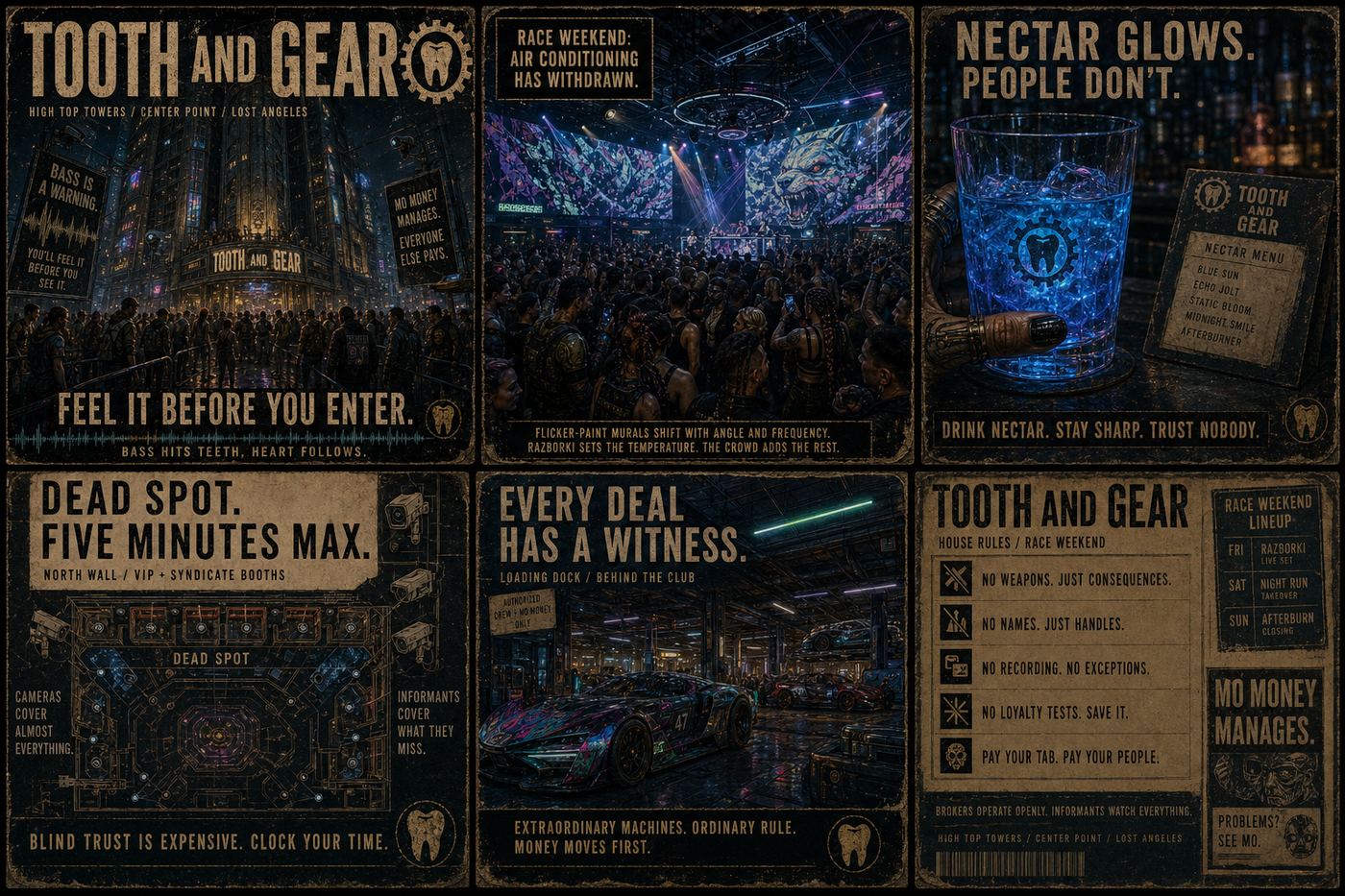
The Okonkwo-Cruz shop, stall, and home (Barricadia)
One building: Marco's press on the ground floor, the family home above, the Saturday stall out front. The engine nobody says out loud: the crew's entire merch operation is printed on Marco's press. The lie runs through the family's own machines. Rules: Sunday table, everyone, no exceptions (Ozzy has never missed one from any city or condition); Abi asks one audit question per meal; Blessing decides how far it goes; you do not touch the press. The most exposed location in the show is the one with no cover story at all; the crew's enemies will figure that out. Mystery box: how much Blessing knows and when she says so; season-scale; do not cash early.
Inherited locations, show-use notes
Musk Tunnels: the rules location; Artifact 06 changes the rules (firmware upgrade kills dark runs), 07 breaks the crew against them; Rea patches these sensor lines on night shift (collision in reserve); Danka's concussed litany happened down here, off screen, pre-season. The Raze: where the crew goes when the plan is already dead; Civilian pays in panels; never comfortable, never a hangout. Ring Road: Danka's nocturnal life; 41 km; drone overflight windows as timers; Ring Road After Two broadcasts off a relay somewhere on it; let it be beautiful before it is ever tense. Dr. Silk's clinic: two streets from the garage; walking-distance solution to Cas's parts problem and a standing address for Ozzy's temptation. Frequency: deliberately not a location; a speaker on a crate; if a scene needs a place, use somewhere ordinary and never twice.
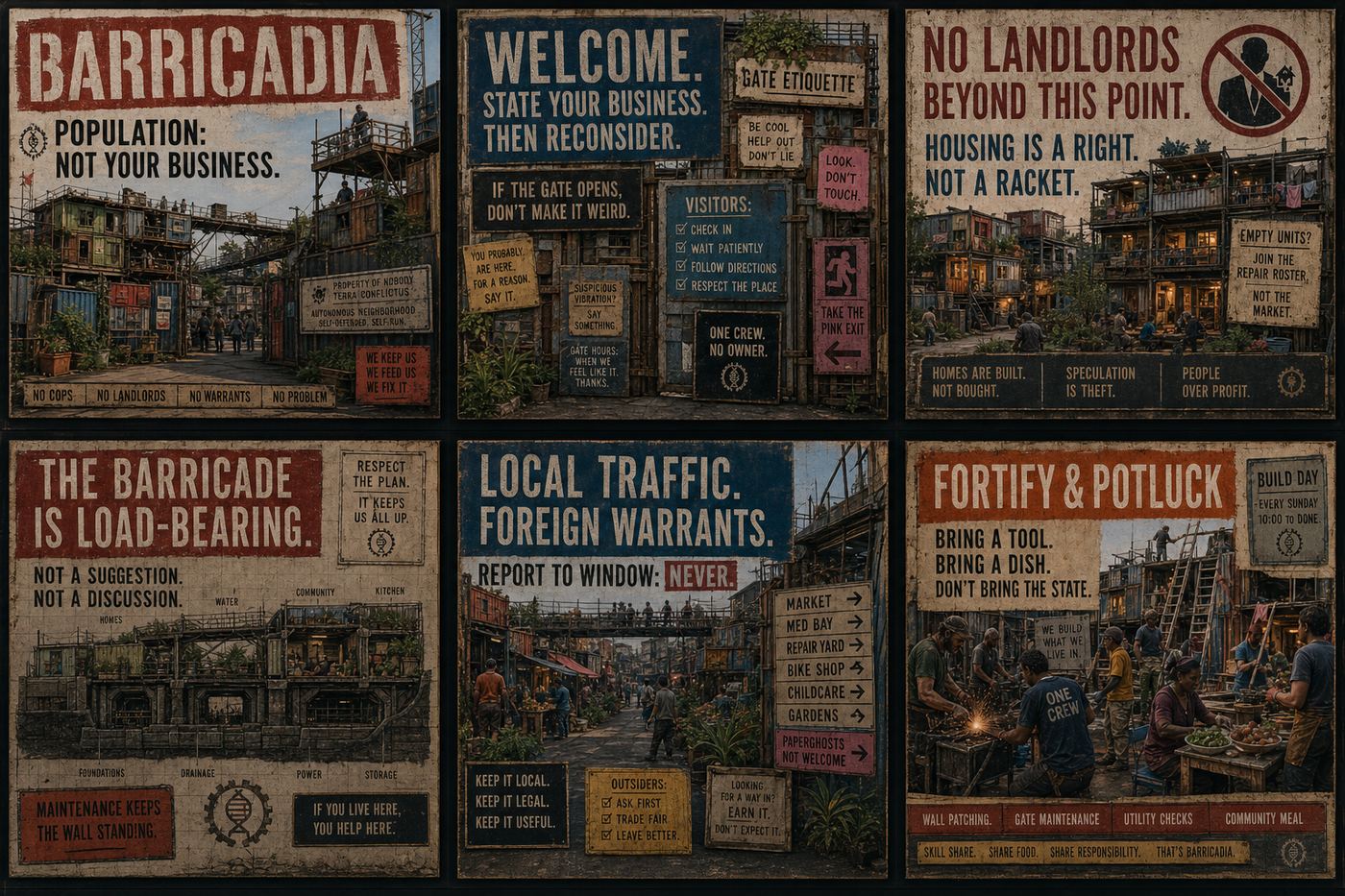
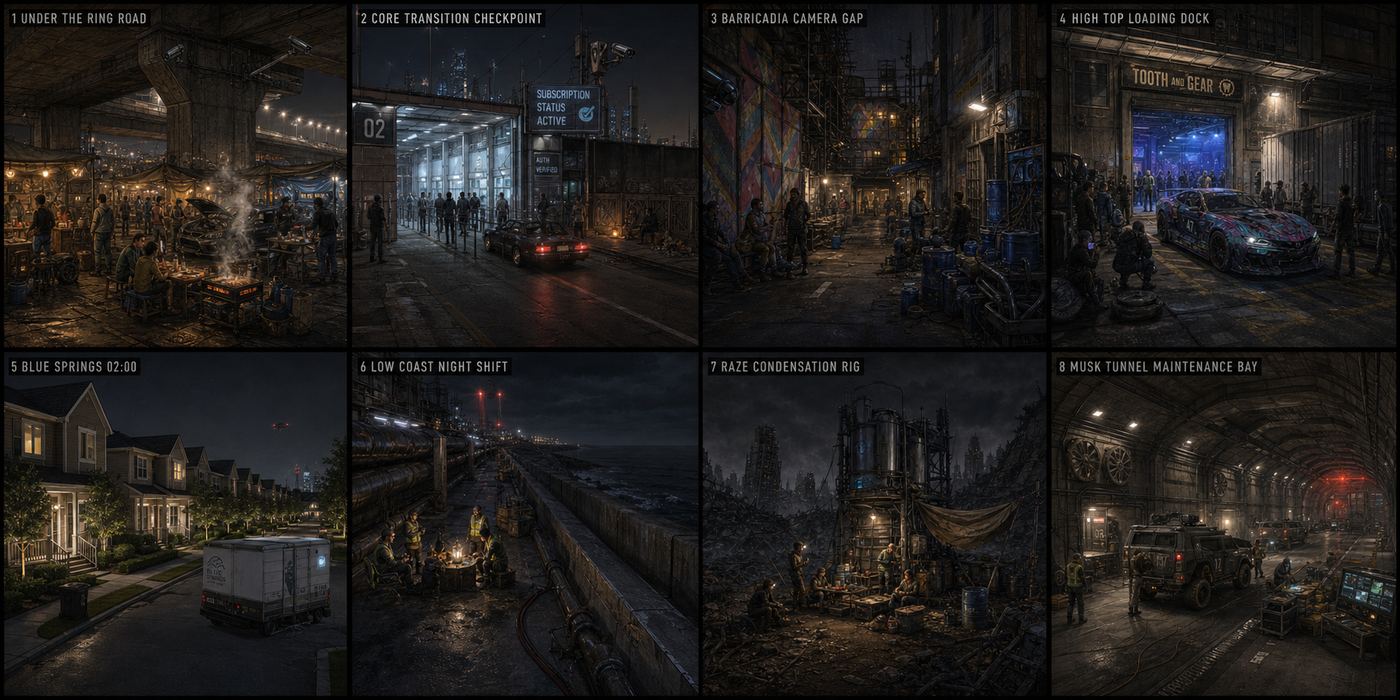
The Lexicon
Three registers, idioms, and who owns which words.
Three registers plus idioms. Usage discipline is the point: meaning arrives through usage, never exposition. A second slang set exists in the art-folder campaign docs (paperghost, ghost-tagged, meat deed, factory-fresh, pink exit, splice work, helix department) and has NOT been reconciled with this Lexicon; only this one is canon. Check here before using any term.
I. The blank cluster (labels for the unmodified)
- blank — "Monitor pulled markers at the gate. Kid walked through in nine seconds. Nothing to read. Blank."
- paper — "Don't put paper on the door. Door jobs eat paper." (Universal operator shorthand; physics, not politics.)
- runs manual — "Nineteen, no work done, runs manual, and he's still first through the fence. Respect it." (The respect register; rare on purpose; lands best from Grigor.)
- factory settings — "Factory settings over here wants to carry the breach kit. Sure. Both hands, champ."
- work / having work done — "She's got Kavast work in her legs and a civilian smile. Don't race her for the check."
Discipline: the crew does not say "blank" about Ozzy; Ozzy says it about himself and prints the comeback (OEM). Vroza's pack says "pet blank" and means it.
II. Void grammar (defection language)
- void (v.) — "When'd you void?" "Nineteen." "Young." Standard opener between forged strangers.
- voided paper — "Frame it, laminate it, carry it. Nobody folds their voided paper away and forgets it."
- live marker (Kavast) — "Marker's live everywhere south of the corridor. Inside NAF she's just a driver with a temper."
- listed (Protectorate) — "Still listed. Eleven years. They never write, they never call, they never delete."
- depreciated (Compact) — "The Compact never chases. You're not hunted, friend. You're depreciated."
Discipline: voiding is what four of the five did; the channel name is the paperwork joke. "Marked, listed, or depreciated?" at a bar teaches the audience geopolitics in five words. Cas and Ozzy can ask, never claim.
III. Orphanware (gene-forged slang, Cas's native register)
- orphanware — "Half of Silk's waiting room is orphanware trading part numbers."
- EOL / end-of-line — "Batch went EOL in '53. She was thirteen."
- sunset (v.) — "They sunset the line, kept the patents, mailed nobody."
- running ghost — "Firmware's been ghost for a decade. She compensates."
- parts funeral — "When a Caseline died in the spring, the forum held a parts funeral. Everything found a body that needed it."
- shelf date — "Nobody knows their shelf date. Orphans just know it's printed somewhere."
- gray vet — "Silk's a gray vet. No license, steady hands, takes samples instead of credits when you're short."
- the recall — "If an orphan says they're waiting on the recall, change the subject. That's the joke that isn't one." (Orphans only. Cas can say it; Ozzy cannot, by name.)
- aftermarket — "His whole left side's aftermarket. Runs fine. Sounds like a fridge."
- catalog kid — "Bespoke. Catalog kid, page and figure number. Some of them collect their own catalogs."
- donor line — "Good news, the dead line's parts fit. Bad news is why they're available."
- serviced — "Thirteen years EOL and fully serviced. Show some respect." (The status word: maintenance as respectability politics.)
IV. Idioms
"Grease is cheaper than grief." · "Nobody recalls the dead." · "The state writes, the market prints, the body pays." · "Leashes come with vet care." (Cas said it once in a garage argument, and it walked.)
Profanity is a fourth, unwritten register. Danka's Kavast field-cant swearing is flagged real but unbuilt; route through the slang desk; a wrong curse is harder to walk back than an absent one.
Register ownership (extended to culture)
| Register | Whose it is | Note |
|---|---|---|
| Void grammar | Danka (marked), Theo (listed), Grigor (depreciated) | Cas and Ozzy ask, never claim |
| Blank cluster | Ozzy's reclamation; neutral field use for all | "Runs manual" rare, best from Grigor |
| Orphanware | Cas, natively | "The recall" barred to Ozzy by name |
| Half Lap (braids, pack relays) | Danka, lived | Nobody else jokes about braids, ever |
| March ghost calls / footage admissibility | Theo | Only Theo gets the ghost as theology |
| Siege Tape economy | Theo (authentication), Ozzy (pricing) | Grigor is the standing objection |
| Crackerjack fandom | Grigor, sincere | Ozzy merch-ironic; the Bears shirt lives between them, unresolved |
| Load Line | Nobody's, on purpose | See Grigor's flag; do not spend cheap |
| Clean Run / drift litigation / HALO filings | Cas | All "precedent research" |
| Raid Race garage culture | Danka (wrenches), Ozzy (relics) | Their halves barely overlap; that's the joke |
| The Tooth vs. the Tooth and Gear | Ozzy, sincere | Everyone else has one flat position each |
| Provenance-as-faith | Danka and Ozzy, opposite trades | Never let them notice they agree |
| Fifth Cup / water doctrine | Grigor in practice, Cas in maintenance | The crew never names it; the district eventually will |
Faith show rule: none of the five belongs to anything; each has independently reinvented some movement's core practice; the movements enter only through guests (a Counter testing the standpipe, a Walker at dinner, a Rosterkeeper client, a Relay Judge arbitration). No lead ever appears inside a congregation. Each lead's real devotion (Danka's litany, Theo's black frame, Grigor's cooking dates, Cas's forum call, Ozzy's Sunday table) stays off camera.
The Show: Formats, Channel, Sound
Formats, the channel, sound, and the cold open.
The four formats (decide format first, every time)
| Format | In-fiction author | Cold open | Title card | Ending |
|---|---|---|---|---|
| Operator Log | Theo, for the channel | Yes | Yes, hand-lettered | FINAL CARD → [STINGER] → BUMPER → "Out at [runtime]" |
| Public Record | An institution | No | No | Plain "Out." No bumper. Cards bold, sentence case, not hand-lettered |
| Recovered File | Unidentified third party or fixed camera | No | No | Hard loop to 00:00, or plain cut. No bumper. Strongest version: one unbroken locked shot |
| Incident | Multi-source, finale scale | Yes | Yes | Fresh decision per project; the "no footage. i was busy." card is the model for breaking formula on purpose |
Established extensions: the companion clip (20 to 25 seconds of crew reaction riding alongside a Public Record; mostly wordless, one italic card at most, no bumper; the 02b precedent). The fixed-camera Operator Log (Kestrel & Reef Artifact 05 precedent: sourced from CAM E, Theo still curates and cards it; good for artifacts about loss of control; licenses cutting across several dated days). Both fixed-camera devices leave the worst camera residue if converted to prose; flag them at Stage 9.
The Operator Log internal ladder: TASK → LOCATION → COMPLICATION → INVESTIGATION → HUMAN CONSEQUENCE → UNRESOLVED IMPLICATION. Most Logs stop before the bottom on purpose; choosing how far down to travel is the pacing decision.
Runtime ladder and cadence: Signal (15 to 30s teasers) → Fragment (45 to 90s) → Log (2 to 5m) → Incident (8 to 12m). Working cadence: two artifacts a week, one narrative-heavy plus one cheap supporting piece, six weeks per twelve-artifact phase.
Document skeleton, every artifact, in order
Title header block → canon-status line → Format/Runtime/Sources/Story-function line → CONCEPT → THE CUT → SEEDS PLANTED → WHAT THIS ARTIFACT TEACHES (one idea) → GATES CHECK → TELEMETRY HOOKS → PRODUCTION NOTES → NEW CANON INTRODUCED (each fact with a stated Risk).
Inside THE CUT: **MM:SS LABEL.** for Logs and Incidents, bare **MM:SS.** for Records and Recovered Files. Present-tense action prose. Scene changes get a diegetic HUD burn-in (`WV/LOG/002 // GARAGE // SAT 23:40`), never a slugline. Dialogue is NAME: "Line.", manner tags inline after a comma. No shot numbers. Counted silences written out ("three seconds of true silence"). Sound folded into prose, never a separate cue line. On-screen text key: monospace/caps = diegetic HUD data; italic lowercase = Theo's hand; bold = whatever's biggest on screen, regardless of author. Interrupted dialogue ends with an unspaced ellipsis or mid-word; never a trailing comma; never an em dash, which is banned across all TC and OT work, prose included.
Numbering is a continuity gate. Production numbers (01 through 12) never appear on screen. In-fiction metadata scopes to the actual in-world author and format: WV/LOG/NNN counts only the channel's Logs (production Artifact 03 carries WV/LOG/002); Records carry their institution's numbering; Recovered Files carry their source camera's stamp (TG/CAM-06 // INT NORTH). A production number leaking on screen is a hard error.
Channel identity
The channel is a bootleg of the states' own visual language: steal the registration-clean grammar, cancel it by hand, sell the shirt. Two authors: Theo owns the cut, Ozzy owns the commerce; the two posting voices never blend in one post (Theo: lowercase, deadpan, short; Ozzy: hot, capitalized, fluoro-tagged). The channel owns no typeface; it owns a handwriting.
- The mark: a parody genomic registration card, registration-perfect, with VOID stamped diagonally by hand in price-gun fluoro. The stamp lands slightly differently every time (a hand did it); the plate never varies (a state did).
- Metadata grammar: lower left, mono:
WV/[FORMAT]/[NUMBER] // [DISTRICT] // [DAY] [HH:MM]. Archive:ARCHIVE // [LABEL] // [NUMBER]. - Metadata never lies. Cards joke, edits mislead, testimony contradicts itself; timestamps and locations are always true. A wrong timestamp is a canon error. If metadata ever visibly lies, that is a five-alarm story event.
- Cards: hand-lettered on paper in black ink, physically photographed, lowercase unless quoting something institutional. No font ever imitates the lettering. The absence of any card is the most serious register: when a moment lands, the grammar goes silent.
- Overlay panels: HUD-parody, thin rules, engineered sans, acid-green lifts on signal white; the only permitted human intrusion is a hand-lettered annotation breaking the frame, used sparingly.
- Palette: black and asphalt gray base; signal white; acid green in edit overlays only; price-gun fluoro for the stamp, merch, and Ozzy posts; crew accent colors (Civilian pink, hi-viz orange, copper, Caseline teal) only when that character is the subject. Red is banned on the channel. Red is Kavast's claim color; the channel never claims, it cancels. The ban is a stored alarm: the first time red appears in the crew's own graphics, the audience's spine should know before their brain does.
- Thumbnails: one silhouette or one object, the metadata strip, at most three hand-lettered words; evidence tags, not advertisements.
- Standing practices: client anonymity ("her face is hers, not yours"); every graphic explainable as something Theo or Ozzy could physically have made in the garage.
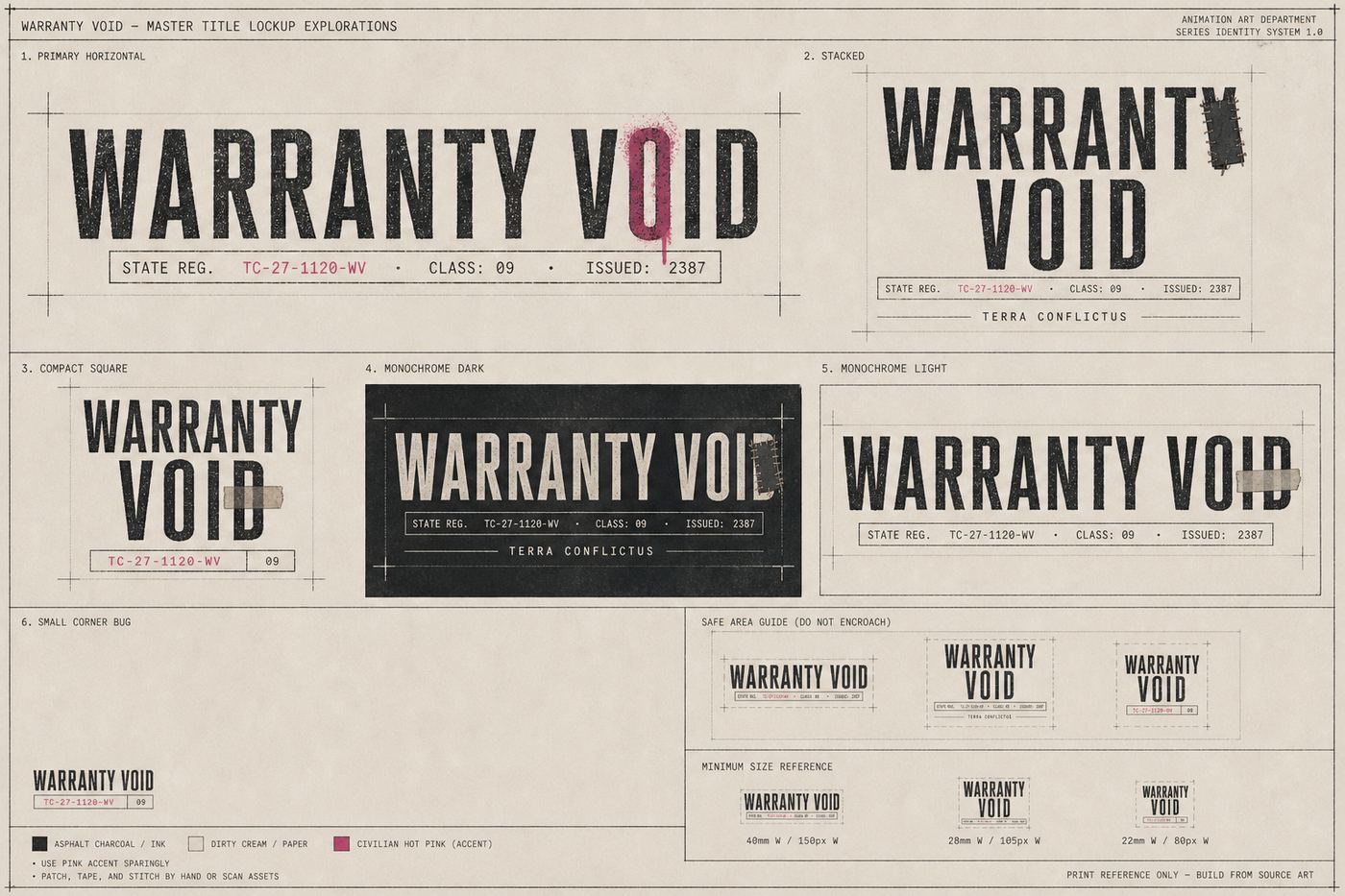
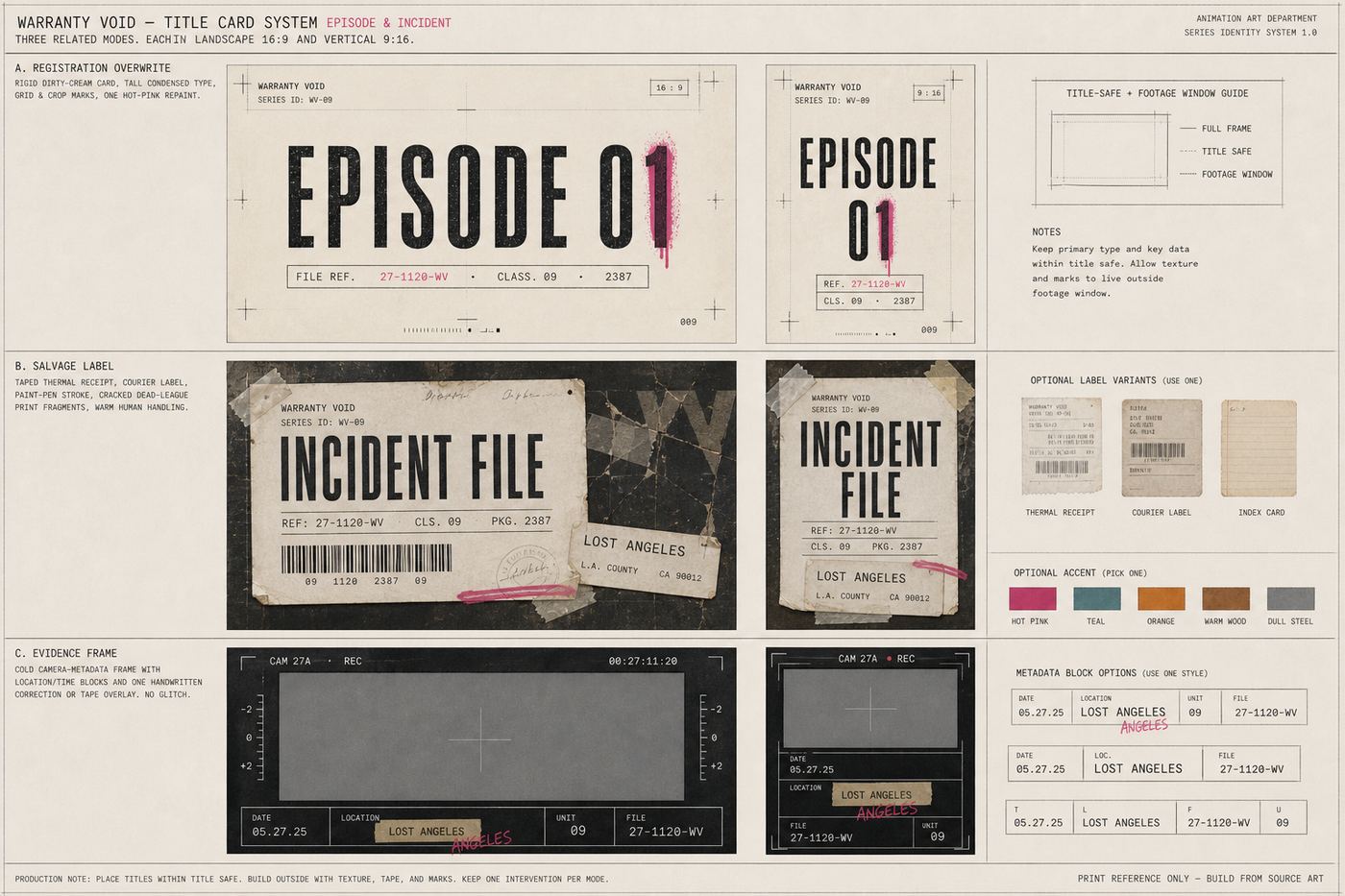
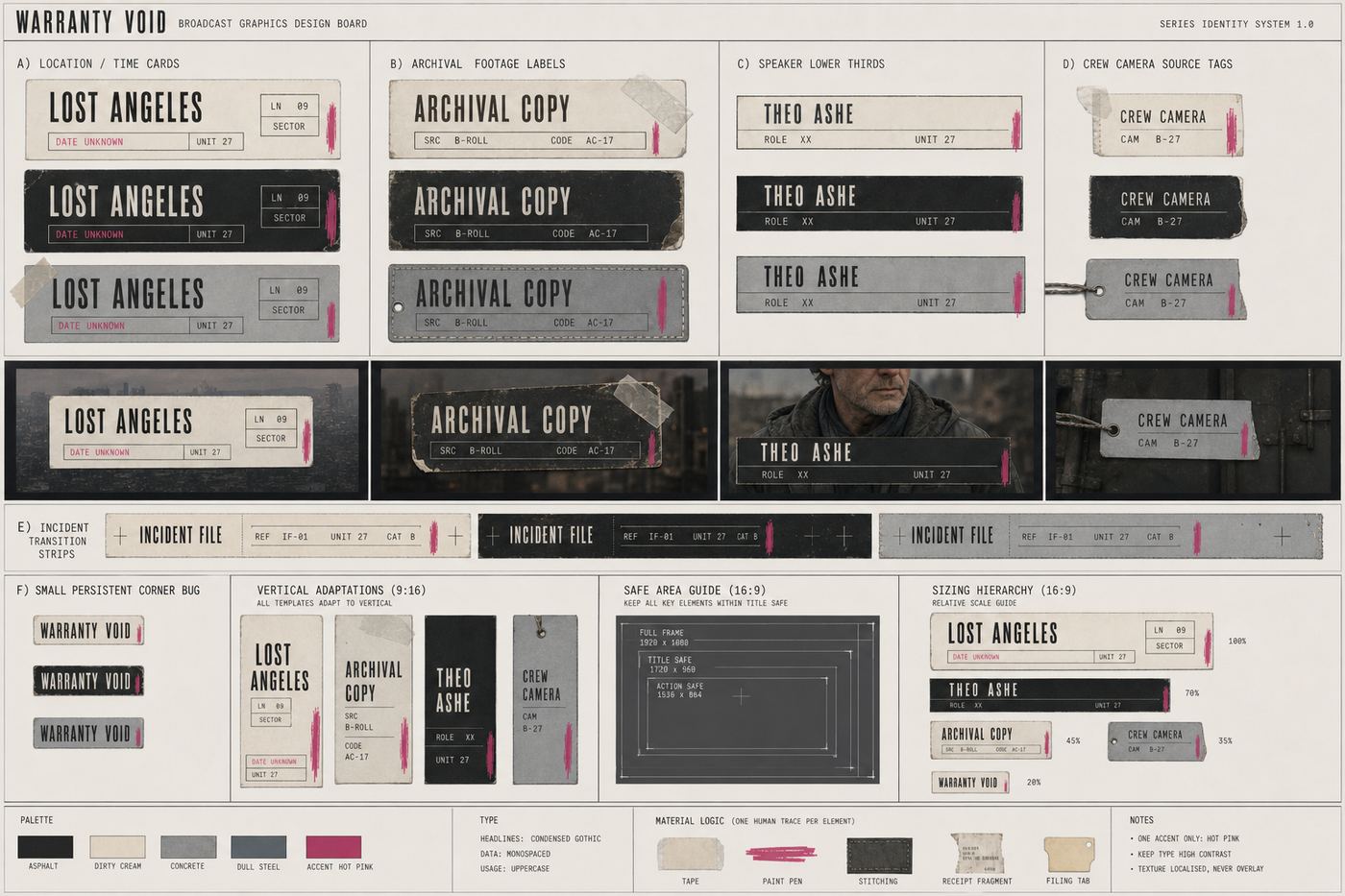
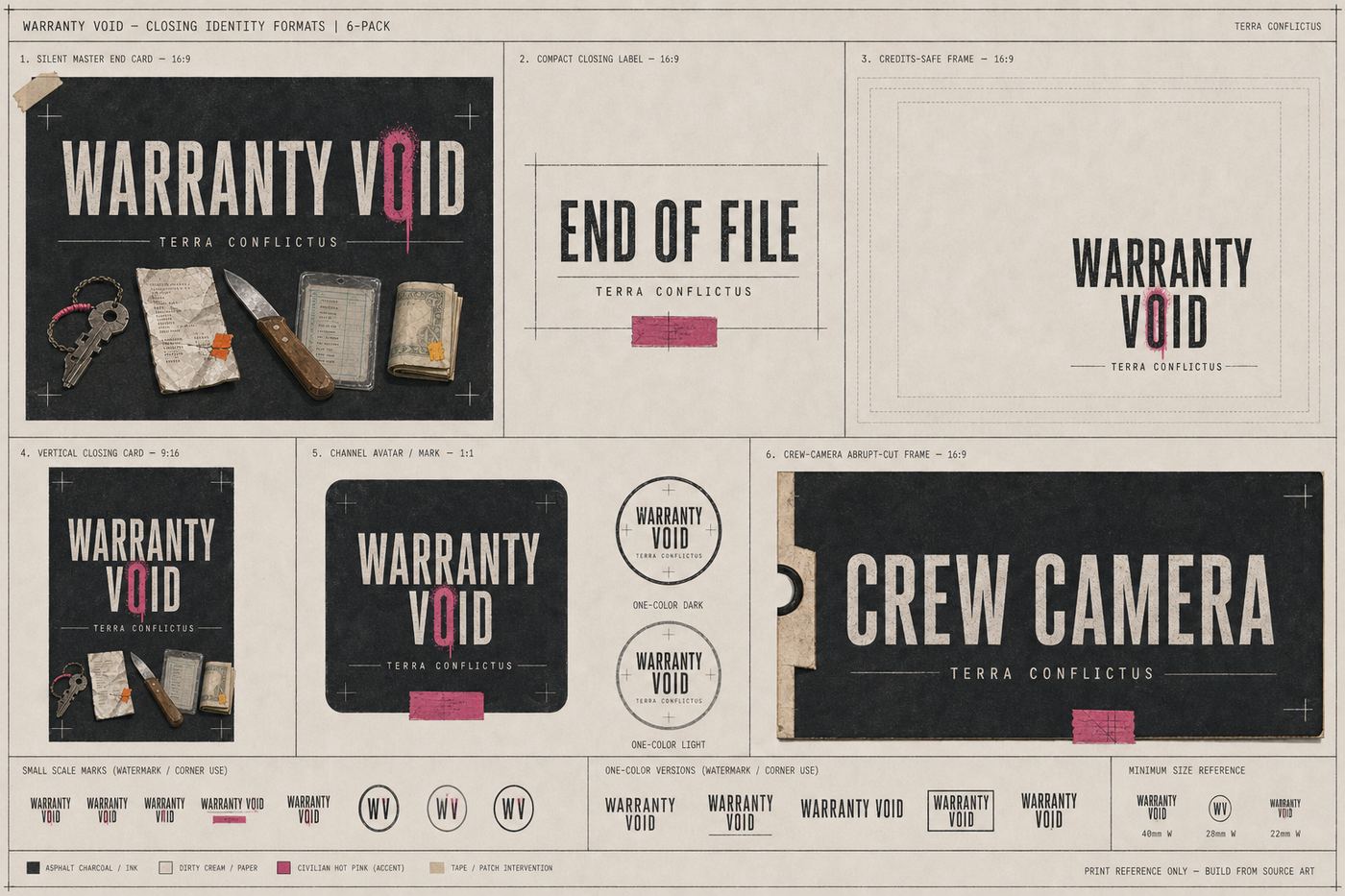
Sound grammar
No non-diegetic score, ever, this show. Every piece of music has an in-world source. Score is the audio red: composed music from nowhere is a story event; do not spend it in Season One. The bumper: a rubber-stamp thunk, a sticker-peel drag, then dead air (the dead air is part of the sound; it must survive loudness normalization). Source signatures: Theo's cut is diegetic-first, dialogue slightly close (body mics), cards silent; Kavast is one low sustained tone, stamp-press card attacks, enforced quiet, no music, no voice unless a voice is the subject; the Protectorate is never silent, always faintly recording (a thin telemetry bed; the flight voice is nine speakers completing one clipped sentence, defined by Artifact 08); Monitor Central is a cheerful two-note municipal chime and license-library music, the only institution that uses music, terrible on purpose; Recovered Files are never denoised (the compression artifacts are the honesty; they may run quieter than platform-comfortable, which is correct; they're evidence, not content). The garage bed (fridge compressor, Ring Road wash, stove, tools, Marta underneath) is the show's actual theme music. Character sound IDs, used with restraint: Civilian's designed voice (a lumpy eager idle one bad valve from laughter, a clean hard note at speed) and Danka's one hummed bar; Theo's silence plus the lens-rig servo tick; Grigor's knife-on-board and the serial; Cas's grease pencil, tape tear, pouch taps, and the three-second true silence; Ozzy's price-gun click, bag zip, and a talking pace that arrives before he enters frame. Marta of the Crossing: the border-waystation family serial, ~900 episodes, heard and never seen; one day a Marta plot will rhyme with a crew plot and nobody on screen will say so.
The cold open device (from the Scenario Playbook)
Every piece can open mid-extraction: drop in hot, one clean beat per operator (a signature, not a study), the hook, cut. Rule of five: if a new viewer can't tell who's who by the end of the cold open, the beats weren't specific enough; if a returning viewer doesn't get one thing that only means something because of earlier work, it's playing too safe. Balance the five beats, not the runtime. One wound-rail touch per piece, maximum.
Season One
Three rails, twelve artifacts, three flex slots.
Architecture
Three rails braided through twelve artifacts; every artifact stands alone; the rails are what repeat viewers find. Rail 1, the Hangout spine (comedy and retention). Rail 2, the Vroza feud (insult → sabotage → public collision; the season's plot spine and thesis: mono-type doctrine versus the splice, played as beef). Rail 3, the wounds (five slow fuses; each surfaces once, none resolves; multi-season assets). Standing rules: one new idea per artifact; no episode requires homework; each ceiling once a season maximum; the Forklift Clip never shown.
The twelve
- THE HIRE (Operator Log, 3:40; scripted). The origin myth as anniversary special: five testimonies that agree on nothing; the sealed archive opens for twelve seconds (Ozzy alone on a crate, fist to mouth); final card: he thinks we hired him for the sales figures. Teaches: a splice is a chosen family with merch. Seeds: the Kavast scout in the doorway; drone shadows 22 minutes apart; Dee's shuttered stall; the DO NOT POST drive on the shelf.
- KAVAST RECRUITMENT SPOT (Public Record 0:45 + companion 0:25; scripted). A genuinely moving enlistment ad (copy: "A Kavast operator is never alone." / "The pack eats together. Trains together. Returns together." / "Loyalty is not learned."); the graduation footage is the Vetka litter's, notched ear second from left, six at graduation vs. four in service;
LINEAGE INTAKE // CYCLE 067. Companion: the crew stops working one by one; Danka stands and leaves frame; one card: source: kavast public affairs. No joke anywhere; the regulars notice that first. - THE FILTER JOB (Operator Log
WV/LOG/002, 4:00; scripted). Counterfeit filter cartridges put a kid on metered oxygen; the crew finds the washer-relabeler warehouse in the least surgical way available; free military-surplus cartridges off a truck nobody explains (where did the truck come from? / no.); final card: warranty honored. Teaches: in Lost Angeles, breathing is a market. Seeds: Cas's paint-pen hand on the crates;PLATES: NOT RECOVERED; the sealed pre-Upheaval cartridge; the informant who reports nothing. - TOOTH AND GEAR / CAM 6 (Recovered File, 0:50, silent; scripted). Race weekend; an arm-wrestling bet escalates until Grigor holds a full table of drinks overhead while patrons drink off it at full extension; Cas adds a coaster; Razborki conducts. Background: a Syndicate booth empties mid-drink while Ozzy runs an amateur book on their floor. The channel reposts with one card: i had money on the other guy. Teaches: the crew is local entertainment. Establishes the leak economy and third-party cameras.
- GRAIL DAY (Operator Log, 3:00). Swap-meet trio hangout; Ozzy authenticates a fake Reunion Tour shirt live and buys it anyway; Caseline-teal tape on a surplus lot; Cas goes still for three seconds; not mentioned again.
- MONITOR CENTRAL SERVICE NOTICE (Public Record, 0:40). Cheerful bulletin: tunnel sensor firmware upgraded. Translation the notice never says: dark runs are dead. Loads the gun for 07.
- THE TUNNEL RUN (Operator Log, 5:00). Flagship Plan Goes Horribly Wrong; nine steps die at step two; exit through the Raze; delivered late, intact, furious. Tag: the tip that re-tasked the Monitor sweep came from a Kavast pack frequency. Feud escalates from insult to sabotage.
- VANTAGE TRAFFIC (Recovered File, 2:30). Frequency sells Theo a capture of Protectorate flight comms over the Western Corridor: nine voices, one clipped distributed sentence. The jokes in the cards thin out. Last card: flights don't fly this far west. The receiver arc goes active.
- THE COOK-OFF (Operator Log, 4:30). Blessing vs. Grigor, year two, district betting through Razborki; Cas answers Abi's audit question with perfect honesty at the wrong altitude ("assets"); the cover survives on Blessing's mercy, and the audience watches her decide. Grigor ties on purpose. Teaches nothing new, on purpose: the Hangout apex.
- DR. SILK, BARRICADIA (Public Record, 0:35). A gene-clinic spot, warm and slightly wrong: we service discontinued lines. Frame-hunters find the orphanware pricing tiers and samples welcomed in trade.
- THREE HUNDRED METERS (Operator Log, 1:30). The season's one pure-drama exception. Danka, mid-errand, sees a Kavast wolf on crowd duty across the street, left ear notched like hers. Ninety seconds, almost no cuts, no dialogue. Neither crosses. Final shot: Civilian parked, engine running, hands at ten and two. Theo's only card: nothing. There is no card. (The audience meets Vesna without a name; Danka's ceiling spent wordlessly, which counts.)
- INCIDENT 001: RACE WEEKEND (9:00). All rails converge at the Tooth and Gear at capacity; the loudest comedy of the season right up until the quiet beat. Vroza's pack arrives in colors to end the feud with dignity, and the district refuses to let dignity happen (Razborki scores it; The Line opens a book at the bar). A pack cutout runs the season's one piece of cold arithmetic and isolates Ozzy in the alley; the Rescue inverts onto the kid at full comic speed; Danka arrives through geometry no vehicle should attempt and finishes it exactly the right size, once; Grigor takes damage the audience sees him not feel and returns carrying the cutout like a delivery. Theo puts the camera down at the hinge: the actual climax exists as no footage, covered by one card, no footage. i was busy., the channel's most-shared post of the season. Cliffhangers: Grigor's unfelt damage, and Vroza's silence afterward, which is worse than his voice.
Flex slots (cheap, loud, pure incident): B1 THE BET (Danka laps the Ring Road inside one 22-minute drone window; metadata as scoreboard; the artifact never says who won). B2 THE STICKER (Vroza's immaculate interceptor at inspection with one fluoro sticker, priced three credits under market; nobody is ever shown placing it; the pack's synchronized head-turn is the punchline). B3 THE TOUR (Ozzy sells garage tours without telling the crew; the first group arrives during Cas's briefing; Grigor feeds the tourists; one takes notes with suspicious discipline).
Format logic: 6 Logs, 3 Records, 2 Recovered Files, 1 Incident; ~36 minutes across six weeks.
[Withheld from the public edition. The full bible is an internal production document.]
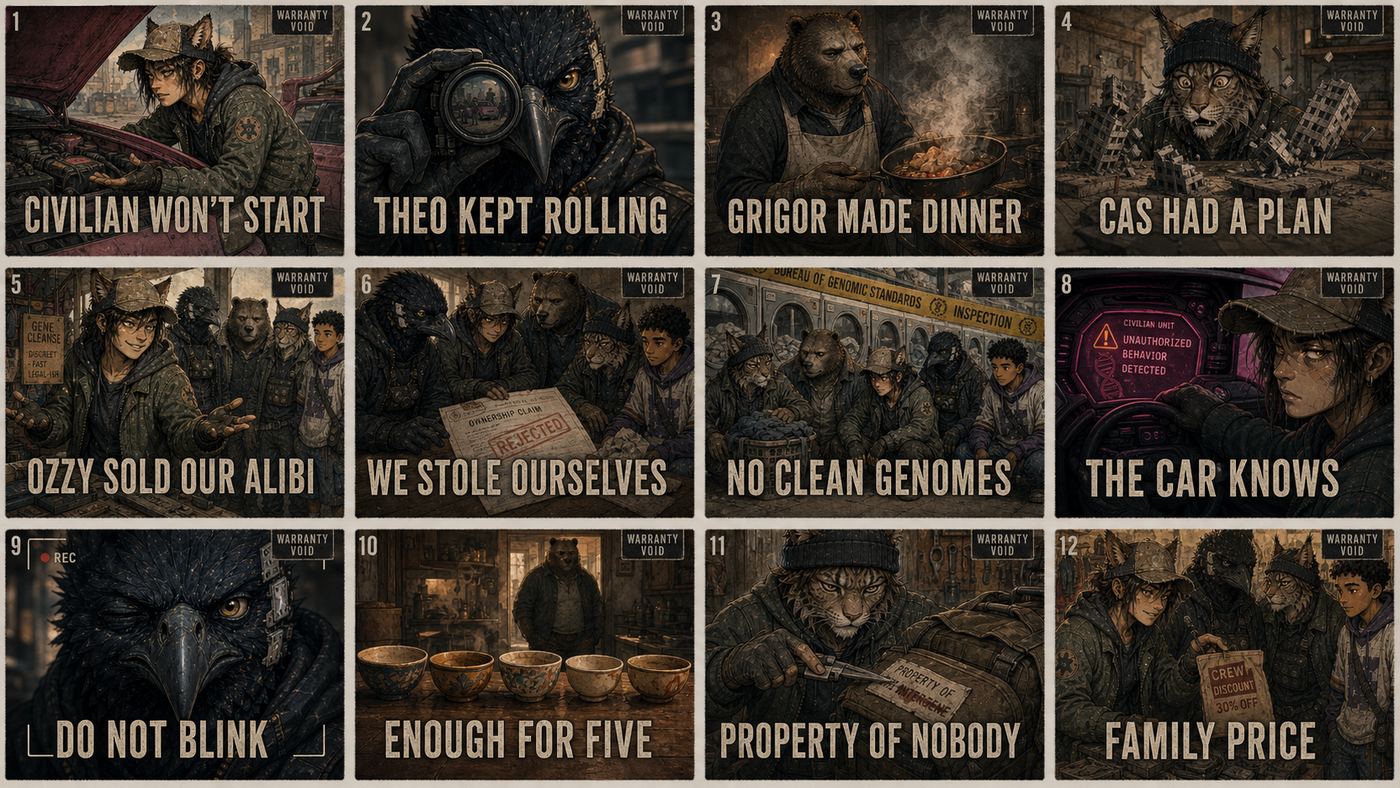
Completed Fiction And Arcs
Kestrel & Reef, Peacock Holiday, and the adaptation shelf.
The Kestrel & Reef arc ("Vire's Second Act")
The first full run through the arc pipeline: a sequel adaptation of the Kestrel & Reef novella (Lost Angeles street-racing canon), six artifacts, C0, complete with consistency check. The Ask (Log, 4:00) → First Colors (Record + companion, 0:40 + 0:25) → Phantom Input (Log, 4:30) → The Ledger (Recovered File, 2:00) → Scar Tissue (fixed-camera Log from CAM E, 3:15, no FINAL CARD/STINGER/BUMPER, the arc's drama exception) → The Enduro (the first scripted Incident, 9:00, restoring the full ending ritual). Total 23:50. Antagonist: Vire, defeated not destroyed (administrative feed cut, equipment van driving away intact), per the novella's own guardrail. Untouched by instruction: Meera, and the Soren/Corin repair. Naming: the Kestrel family Spotter is Rosalind Kestrel (renamed from Marisol across all eleven docs, 2026-08-22, because Marisol Vega is published canon). Converted to prose as "Vire's Second Act" (~9,000 words, six chapters) and a short-film Fountain draft of its second act.
What the arc taught (now house doctrine): the device-evolution model (Cas's three seconds: straight, held, repurposed, absent); Grigor's short sentence spent exactly twice inside one continuity and flagged as spent there; Theo's five near-silent artifacts earning one full line ("It's the thing you didn't report"), the most words they've said on camera all season; the fixed-camera Log and the Incident format as named precedents; and the four process gaps (Part 11).
Peacock Holiday
Complete prose short story, ~9,400 words, FIELD FICTION lane, C0, cold-read polished 2026-08-17. Warranty Void × Roman Holiday: a runaway heir spends one escalating day in Barricadia with the crew while the city's retrieval economy converges. POV: Theo, close third, present tense. Ratified (Jesse, 2026-08-17): the scion is Wren Fairwater, Fairwater Coastal; the Monsoon option is closed. New cast: Brightline Assurance (retrieval contractor), Ellery Quist (polite antagonist, defeated not destroyed), the leopard-stock household companion. The story kit's mysteries stay open per design (why the scion ran; the Monday coda never confirmed; Vega and the surname never resolved).
The adaptation shelf (surveyed, ranked)
Strong enough to build full artifacts around: The Last Black Box (three-person heist, scheduled blind spot, rival crew, rooftop climax), Terminal Velocity (five-level vertical chase; the outline is nearly a shot list), Cold Storage (Danka-and-Grigor-shaped convoy race; strip the pathogen ending). Strong with reskinning: Hotwire, The Iron Circuit, False Bloom, The Waterloo Vault, Dark Cell's engine, Crackerjack's competition-as-cover mechanic, The Vertical's setpieces. Rule: nothing adapts whole; pull a mechanic, a rival dynamic, or a setpiece and run it through the cold-open structure. Any source resolution, death, reveal, or deliberate ambiguity stays untouched unless Jesse says otherwise.
The Ledgers (State Of The Property, 2026-08-25)
Canon state, the seed register, the wounds rail, the budgets, and the open decisions.
Canon state
- Published (C1): Warranty Void: The Mission Book, Volume One shipped to terraconflictus.com 2026-08-22 (web edition + PDF; 154 pages as of the 2026-08-26 impulse-stock printing). 168 × 232 mm: the five crew pre-gens (four pages each), 32 contracts across 8 clusters (Barricadia, Center Point, the Musk Tunnels, the Raze, Ring Road, the High Top, the Low Coast, Monitor Central), garage and orbit sections, Part 4 rivals. Contract catalog: C01 The Wash · C02 Nobody's Kid · C03 The Filter Job · C04 Good Press · C05 The Standpipe War · C06 House Rules · C07 The Arm · C08 Six Minutes of Fame · C09 The Booth · C10 Dark Transit · C11 Grid Firmware · C12 What the Tunnel Keeps · C13 One-Way Fare · C14 Ground Truth · C15 The Crater Lot · C16 Burn Notice · C17 What Grew Back · C18 Rental Sound · C19 The Long Way · C20 Pack Frequency · C21 Title and Deed · C22 The View · C23 Clean Hands · C24 Patron · C25 The Invitation · C26 Slack Water · C27 Salt Wake · C28 What the Sea Filed · C29 The Last Tenant · C30 Service Notice · C31 Repossession · C32 The Whole Queue. Everything the book states is now load-bearing: the crew, the garage, the standpipe, Marisol Vega (paper-holder, Leverage in C01 and C05). The book has not had a copy-edit pass; Volume Two (Service, regional clusters, six more rivals) is planned.
- Also published (C1), recorded 2026-08-25 on site survey: Peacock Holiday (web edition
fiction_peacock_holiday.html+ the 6x9 print PDF, live since 2026-08-17) and Vire's Second Act (web editionfiction_kestrel_and_reef.html). Both carry the 2026-08-25 revision pass as of the same-day site refresh; the print PDF was rebuilt from a reconstructed pipeline (OT Print Edition Collection/PeacockHoliday_Print_Edition/), which also purged a stale pre-removal "Adeyemi" that had survived in the v1 PDF. The public edition of this bible is live aswarranty_void_ip_bible.html(creator-only blocks, Season Two material, and the wounds-rail ledger withheld). - C0, complete: the bible layer (five leads, antagonist, secondary cast, lexicon, locations, identity specs, Voice Bible, Crew Banter, Cultural References), 4 of 12 Season One artifacts scripted (8 as loglines), the six Kestrel & Reef artifacts.
- C0, new (2026-08-26): impulse stock. The small commercial grade — mascots and greeters built at half human scale or less, sold as inventory, and the bottom rung of the body economy this book's Mission Book volume already runs (C30/C31/C32, the recovery contractor, the depot's forty pallets). The class has its own volume, the Impulse Stock guide, published in full on the site: setting canon, a sixteen-brand ledger, a full game layer (new Impulse tier below Grunt, seven keywords, twelve stat lines, the Lot 41 force pack), an art direction section, and the Warranty Void layer — the five leads' five incompatible reactions, three Tier 2 characters (Topper, Stripes, Prudence), and three Volume Two contract seeds — is held as this property's own layer on top of it. Nothing here surfaces an existing wound device or creates a sixth.
- Video: nothing has published. Phase Zero (camera lookdev, five CAMs, 24 tests) has not run; image model, video model, and voice casting (human vs. synthetic) all TBD.
- Art: the ensemble look is approved (ruled 2026-08-25). Full animal heads for Theo, Grigor, and Cas; Danka human-faced with wolf ears; Ozzy human. See The Approved Ensemble Look in Part 2 for the ruling, the canonical reference sets (the Danka v2 update, the site key-art update, the gene-forged heads standard), and the downstream changes. The Danka v2 update propagated to the Mission Book cover variant and the site key art on 2026-08-23. The Provenance Ledger records the ruling; the human-authored illustrator commission remains the eventual canonical source, now with a settled target.
Art/3D Model References/(Theo, v1 and v2) marks a new production-direction exploration, not yet a pipeline decision.
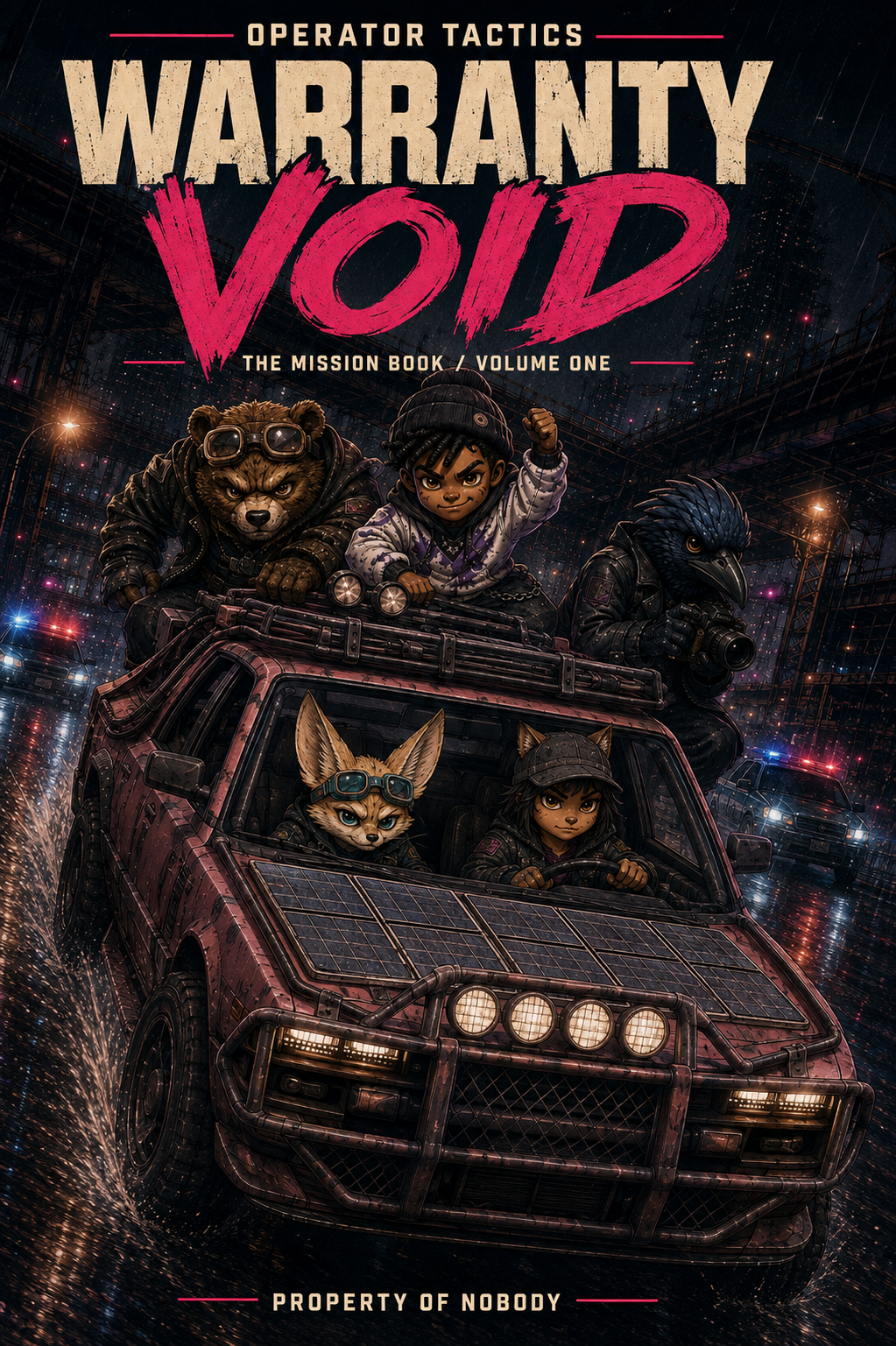
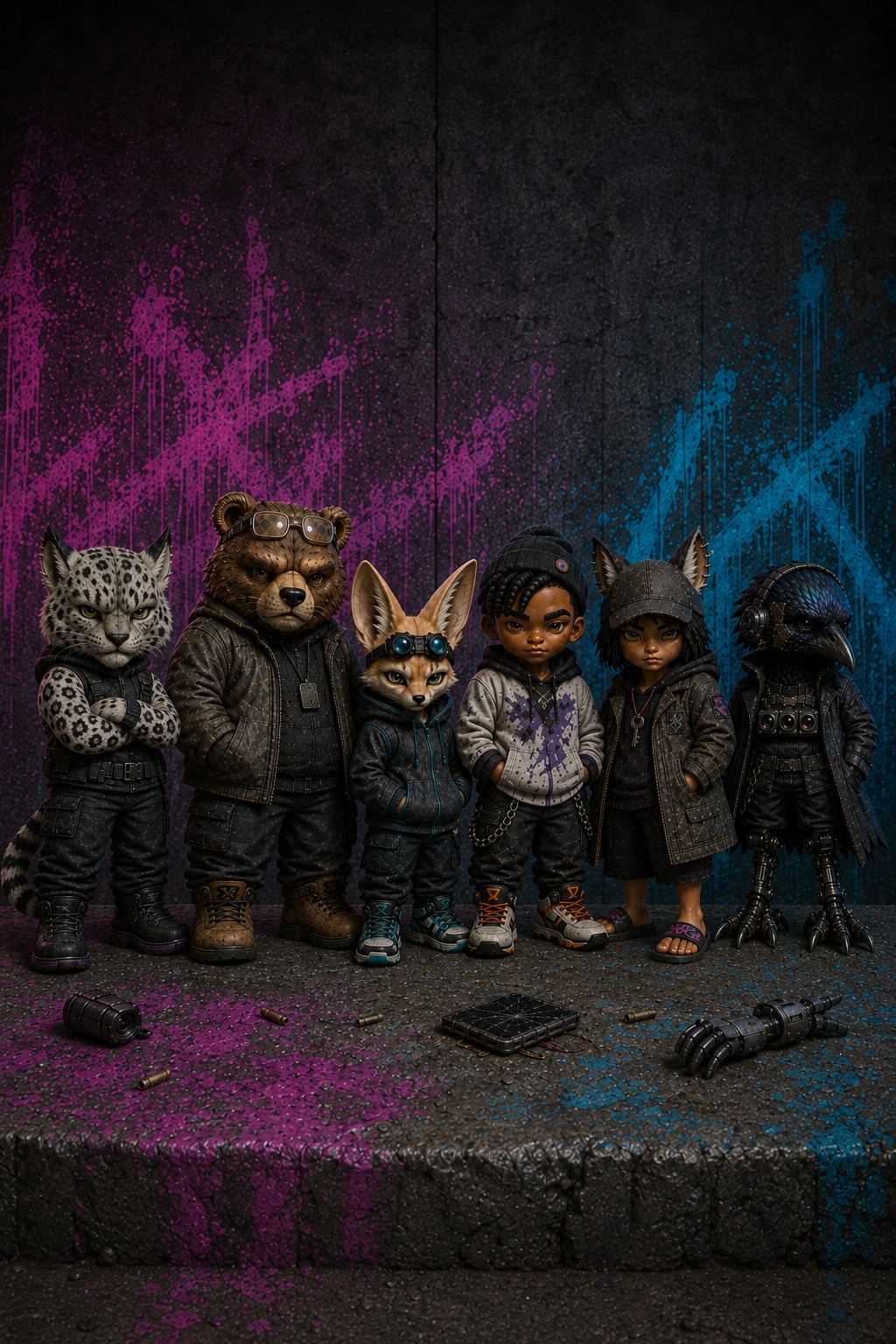
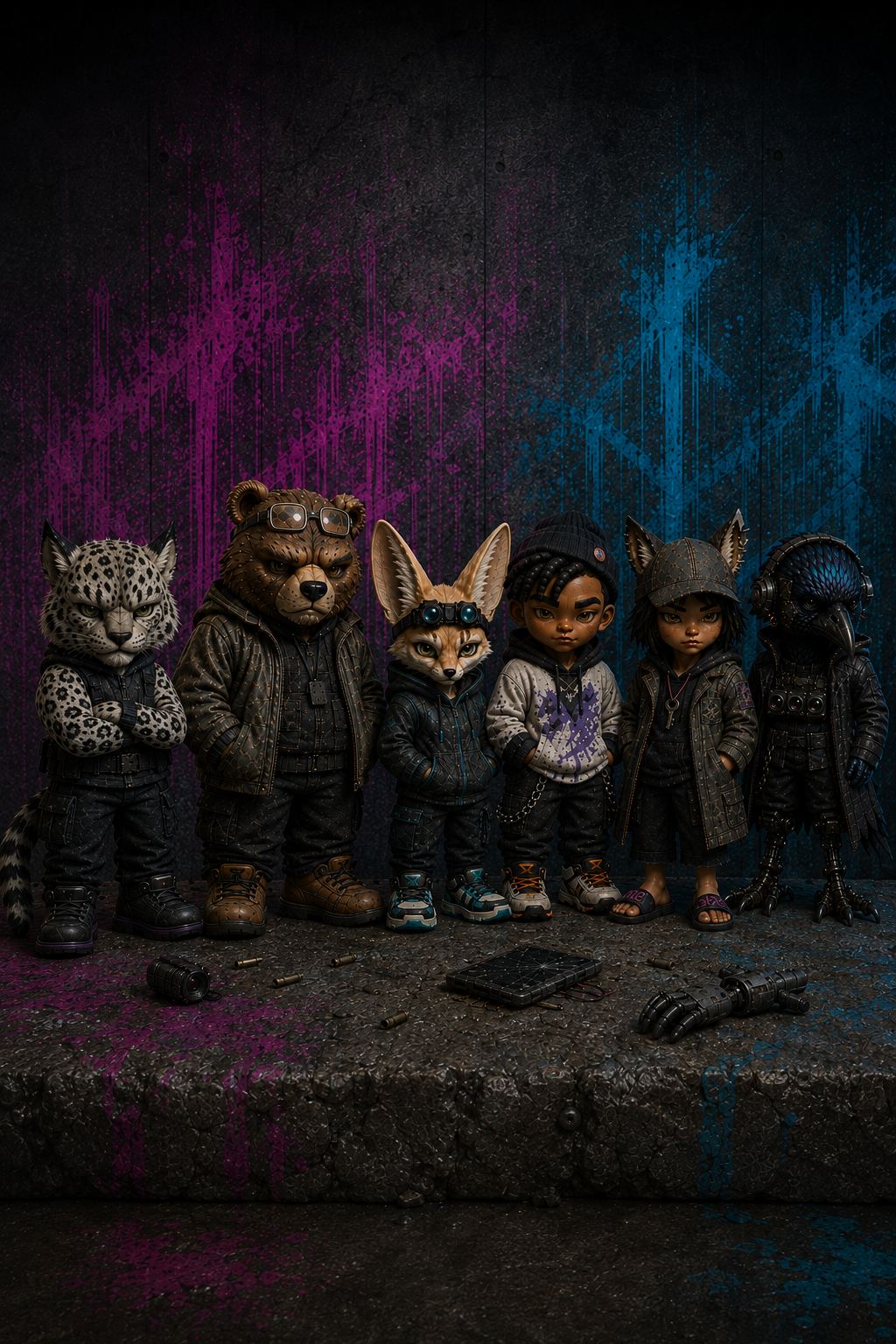
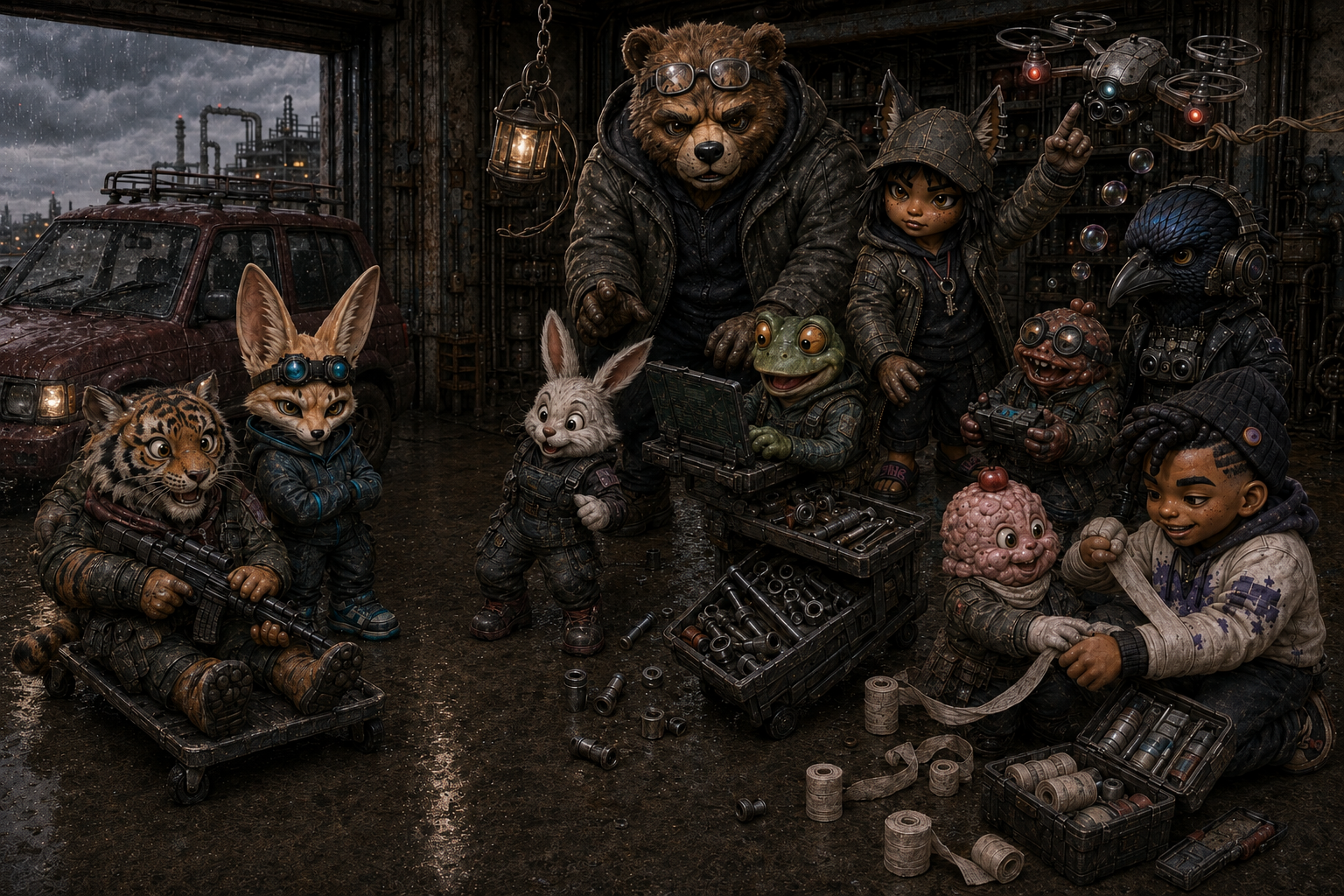
Seed register (planted, unspent unless noted)
| Seed | Planted | Pays off |
|---|---|---|
| Kavast scout watching the stall | 01 | Feud rail; the fed-scout legend; 12 |
| Drone shadows 22 min apart | 01 | Timestamp trust; tunnel/drone episodes |
| Dee's shuttered stall | 01 | Banked (Season 2) |
| DO NOT POST drive on the shelf | 01 | Spent in 01's own stinger; Theo's arc |
| The Forklift Clip (never shown) | 01 | Standing; never resolve casually |
| Danka's notched ear in the ad | 02a | Season-long frame-hunt |
| Six at graduation vs. four in service | 02a | Two ghosts in Kavast's own ad |
| "Returns together" card | 02a | Unbearable once the Brava Cut is known |
| Plate-curl eating as pack culture | 02a | Matches Danka's habit, Grigor's adoption |
| LINEAGE INTAKE // CYCLE 067 | 02a | The machine still runs, on schedule |
| Cas's hand on the truck's crate labels | 03 | Cache canon surfacing |
| PLATES: NOT RECOVERED | 03 | Supplier's return, or the plates' buyer |
| Sealed pre-Upheaval cartridge | 03 | Brotherhood interest; Low Coast rail, S2 |
| The informant who reports nothing | 03 | The district-protects-them rail |
| The emptying Syndicate booth | 04 | The Line has been watching; finale's book |
| Ozzy's book on the Syndicate's floor | 04 | The Syndicate sends terms, not threats |
| Theo's unposted table cut | 04 | Petty-scale withheld object beside the Forklift |
| Third-party leak economy | 04 | Every future Recovered File rides on it |
| Caseline-teal tape | 05 (slated) | Cas's search rail, S2 |
| Pack frequency behind the Monitor tip | 07 (slated) | 12 confrontation |
| Vesna sighting without a name | 11 (slated) | Banked (Season 2) |
| Grigor's unfelt damage | 12 (slated) | Banked (Season 2) |
| The forty pallets at the depot | C32 wall (published) | What is on them. Volume Two, Service |
| Impulses in the NINELIVES member list | Unplanted | The moderation decision; Cas's class blind spot |
| Ozzy's bootlegs don't authenticate | Unplanted | The one time it matters, it saves someone |
| The Cherrytop trademark holder | Unplanted | A shell that has never sent mail, and then does |
| Prudence's number on the wall | Unplanted | Two hundred and six, and what it is when it stops rising |
Wounds rail
[Withheld from the public edition. The full bible is an internal production document.]
Sincerity ceiling budget (one spend per character per season)
All six unspent in Season One as written (Marit's added 2026-09-02, and hers is the least likely to be spent in S1 given the attachment rule). Candidates: Theo's spend is 12's no footage. i was busy. card (counts); Danka's is 11, spent wordlessly (counts); Grigor holds for the right kitchen scene or holds entirely; Cas unspent; Ozzy's candidate is 12's alley aftermath. The Kestrel & Reef arc spent none (wrote to the edge and held, deliberately, pending Jesse's ear).
Continuity notes in force
Danka's marker matters outside NAF territory only. The crew was minorly famous before Ozzy; the hire is ~1 year before Log 001. Ozzy jersey registers: ironic rotates, sincere repeats. The jar economy funds pizza. Kavast graphics stay registration-perfect at source; only the crew defaces them. Grigor ties the cook-off on purpose. Vetka count: six bred, four in service (Miro dead, Danka defected); the ad shows six. Kavast recruitment copy becomes quotable faction canon on publication. Metadata never lies; red banned; posting voices never blend. No score; never denoise; Marta is the serial. Grigor's letters were written and never sent. Rosalind Kestrel, not Marisol. The Tooth and Gear is a nightclub. CAM E exists in the garage. Rail state at the end of the last written S1 artifact (04): spine load-bearing and public; feud dormant on the surface with the Syndicate's quiet attention added; wounds fully banked; tone directive holding (01 funny, 02 dark, 03 funny, 04 funny).
Mission Book continuity (audited and adjusted 2026-08-25). The published book runs its own table-facing ceiling system: each pre-gen's File page carries a spend-once line that is deliberately NOT the show's locked ceiling, so tables get their big moment without burning the show's reserve. The four originals (Danka's "I didn't leave a pack. I left a supplier.", Theo's "I kept everything...", Grigor's "There is no spare. Do you understand me?...", Cas's "There were nine of us...") are C1 and now canon as the table set; Ozzy's slot had shipped with the show's locked line by oversight and was replaced in the audit printing with "I can get you anything in this city. Ask me what I cost. Go on. It's the only number I know by heart." The show's five locked ceilings remain fully unspent. Other book facts now on the record: crew three-second reads updated to the approved phenotypes in the same printing; one contract's truth block confirms in print a device this bible holds creator-only (the book is the tables' authority; the show's reveal timing is unaffected); a jackal lineage and a "lineage-correction programme" exist in contract canon; the book keeps em dashes as an accepted print-register exception unless Jesse orders a punctuation pass; the interior already carried the Danka v2 plates (proof v13), and the audit printing is proof v14, 76 spreads, no reflow.
Impulse stock continuity (added 2026-08-26). Impulse stock are commercial stock's small grade and sit under Shelf in the Master Lexicon, never replacing it. Cas's card of eight are Caseline and are not impulses; the rails do not merge — her material here is that impulses have been in her NINELIVES forum the whole time and she has never examined it. Grigor never discusses the grade in dialogue, ever; behavior only, and the spoon is behavior rather than a ceiling spend. Topper's name is unresolved through Season One. Stripes's title is valid and no escape is written. Prudence is never revealed to be corrupt. Compliance architecture, never low intelligence: they understand their situation completely and cannot act on it. The Within Tolerance line ("I'm mascot stock. The warranty went when the company did.") is used once in the property, total. The crew-are-people-never-mascots rule is unchanged and is now load-bearing rather than defensive; the art direction keeps that wording for the crew and carves the exception only where a mascot is genuinely the subject.
Resolved decisions (recorded here so they stop being relitigated)
- The B-tier question, ruled 2026-08-25: full animal heads for Theo, Grigor, and Cas; Danka human-faced with wolf ears; Ozzy human. See The Approved Ensemble Look (Part 2). Supersedes the Illustrator Brief's "never furry-adjacent" guardrail for the three full-head leads; the prose ban on describing animal-trait intensity is lifted.
-
Civilian: Danka owns it and Danka drives. The current HTML cover puts Danka at the wheel and Cas in the passenger seat. The downloadable PDF shares this cover. The archived earlier illustration does not define the current car design or the crew’s driving roles.
-
The chibi house style and the six-hander, ruled 2026-09-02: the designer-vinyl chibi treatment replaces the painted illustration style everywhere; Cas is a fennec, not a lynx (species only — same person, same Caseline, same batch designation), with the cut watch cap and flip-down loupe retired and a forehead-mounted dual-lens goggle rig below the ears, no headwear; the white snow leopard is Marit Sey (UNLISTED), an intermittent sixth member. Danka's ears are wolf and stay wolf, with the left-ear V-notch a continuity surface; the chibi sheets that drifted her feline are superseded pending reissue.
- Earlier rulings still in force: the Tooth and Gear is a nightclub in Center Point; Rosalind Kestrel, not Marisol; the Peacock Holiday scion is Wren Fairwater; Mission Book contents are C1.
Open decisions (Jesse's, not the desk's)
- Voice casting, human vs. synthetic, all characters.
- Second slang set (art-folder campaign docs) unreconciled with the Lexicon; Lexicon wins meanwhile.
- The Kestrel & Reef Jockey's name (Soren, most likely, or new) before that arc moves past C0.
- Grigor's Artifact 06 (K&R) injury follow-up: healed off-page, referenced later, or otherwise.
- Cultural-references swings (2026-08-24, praised, pending line-item ratification): the Load Line device, the Half Lap calendar mechanic, the Cupkeeper adjacency of the standpipe, Blessing's faith left unnamed.
- Trademark and registration strategy (WARRANTY VOID as a mark; register written works; disclose AI portions per current USCO practice) with counsel before commercial licensing. The Provenance Ledger is the chain-of-title record; keep feeding it.
- The 3D-model production direction (the Theo reference sheets): adopt, iterate, or shelve; and whether Phase Zero's camera tests should precede or follow that call.
- Topper's status (impulse stock): recurring cast via the full origin process, or a two-artifact presence and out. The material supports either. The case for restraint is that the comedy engine is five people, not six, and a permanently attached sixth changes the crew's baseline composition. (Note, 2026-09-02: this objection is now doubly live. Marit Sey has been ruled in as an intermittent sixth, specifically structured — no fixed address, five-person garage baseline, two to four appearances a season — so that the engine is never asked to run on six. Topper on top of that would be a seventh attachment against the same budget. Rule on Topper with Marit in the room.)
- ~~Cas's fennec restaging in published fiction.~~ RUN AND CLOSED 2026-09-02. See
FennecRestagingReport_2026-09-02.md; originals in_backup_preFennec_2026-09-02/. Species anatomy only, no plot/voice/structure touched; the ear-tracking device was kept and is stronger under the new lineage. Peacock Holiday needed no changes (no facial description exists in it — verified). What remains is a deployment matter, not a writing one: four live pages (warranty_void.html,warranty_void_ip_bible.html,warranty_void_wardrobe.html,warranty_void_setting_guide_slides.html) still carry stale lynx text and need republishing from corrected sources. These are text-only and do not depend on the art regeneration. -
Civilian redesign — resolved 2026-09-06. The supplied Gemini technical sheet and exterior design are the current vehicle references: a weathered pink four-door sedan with a reinforced brush guard, four front lamps, hood and roof solar arrays, off-road tyres, exposed rear wiring, VOID GARAGE lettering and an oversized multi-tier spoiler. Danka owns, rebuilds and drives Civilian. The clear windshield in the technical sheet governs the driving view. The car’s design does not relocate the story from Lost Angeles or change the wider setting’s visual rules.
-
fiction_kestrel_and_reef.htmlis two revisions behind its master. Surfaced during the restaging: the live page lacks the 2026-08-25 pass's phrasing entirely, so the deployed novella predates that pass as well as this one. Pre-existing, not caused by either. Decide whether to republish it with both passes applied.
How To Write Them
Hard rules, the pipeline, the audit tools, and the one-page brief.
Hard rules (never break without flagging it explicitly)
- No non-diegetic score, ever, any format. Never denoise a Recovered File.
- One new idea per artifact. No episode requires homework.
- In any three consecutive artifacts, at least two are funny. One pure-drama exception per season, not per arc; a comedy engine going quiet is always on purpose and always stated in the GATES CHECK.
- Each sincerity ceiling once per season, maximum; check the budget before spending; surfacing a spend is Jesse's call.
- The Forklift Clip is never shown; its Grava Pack reveal is a unifying beat; don't spend it early.
- Red is banned on the channel; Kavast graphics stay registration-perfect at source.
- Metadata never lies; production numbers never appear on screen.
- Antagonists are defeated, not destroyed, absent a specific ruling.
- No em dashes, anywhere, in anything. Interruptions end with an unspaced ellipsis or mid-word. Sweep for Jesse's banned-word list ("underscored" is a known member) before calling anything done.
- Creator-only secrets stay unspent without Jesse in the room. Check names against the IP-removal history before publishing them.
The arc pipeline (nine stages; full text in the skill's pipeline.md)
- Survey (adaptations: rank by adaptability, not quality; loose threads beat closed doors). 2. Adaptation plan (sequel over remake; role-mapping table; an explicit what-not-to-touch list). 3. Character pressure pass (re-test the locked Core Four against this story; run the antagonist through it too: which artifact puts them in physical space with a lead, what do they cost before the finale, whose tool fails on them first; and check each lead for an opposing force: where do they ask for something and not get it). 4. Structure pass (Four Reels, Eight Sequences, true midpoint; assign format and runtime per artifact; a Recovered File suits a midpoint reveal about losing control; a drama exception suits a Log; a finale wants an Incident). 5. Comedy and physical-activity pass plus the failure matrix (every lead gets a real physical/comedic beat per the matrix; then a second matrix naming, per character per artifact, something they try that doesn't work; an empty row is a character who is never wrong; an empty finale column turns a climax into a competence montage; the fix is one failed solve rescued by the character they were furthest from in the drama exception). 6. Detailed outline (the document to argue with before dialogue exists). 7. Draft one artifact at a time (check format constraints against beats before drafting; keep investigative threads single; let tells evolve rather than repeat; document self-corrections in the GATES CHECK). 8. Consistency check (timeline by HUD stamps; voice per character; canon facts stated identically; naming collisions; format discipline; promised payoffs AND payoffs the drafting created; protagonist of record vs. the character the pages actually follow; final image against theme; open questions traceable to named answers; runtime tally; banned-word sweep; then update the bible's ledgers, not a private copy). 9. Prose adaptation (optional; see below).
The four process gaps (each survived a full eight-stage pass unnoticed; check by name): a climax where nobody fails; protagonist drift; an antagonist who is never in the room; an arc that resolves without ever being opposed.
Voice-pass tools
- The strip test: cover the names, read the dialogue cold; if two leads blur, it's almost always a rhythm collision (two characters going short and flat, most commonly Danka/Theo or Danka/Cas), and the fix is sentence shape, not word choice.
- The same-beat test: run all six through one beat (the plan just died / someone asks if they're okay / they just won). Six different jobs by five different tools, or it fails.
- The Vroza tuning fork: if a comedic line only works because everyone around it is funny, it goes flat next to him. If it still works, it's load-bearing.
- Known drift hazards (from the Dialogue Diagnostic): Grigor's contractions (check line by line; "It is how mine works," never "It's"); Cas/Ozzy scenes need real interruptions (they're the overlap pair; eleven lines of clean turn-taking is wrong for them); Danka/Theo scenes need under-lap and indirection (their one direct scene is a marked exception); a Danka/Theo or Cas/Ozzy scene that states its subtext plainly fails the pairing's own physics.
- Jargon calibration: each character's technical register (cataloging, itemizing, framing, pricing, provisioning) is fine; anything drifting toward real-world 2020s tech or marketing speak breaks the setting's voice. New vocabulary is a note for the slang desk, not an improvisation.
Prose conversion (when an arc becomes a novella)
A real adaptation, not a formatting pass. Strip the camera by search, not feel: grep for shot, frame, framing, camera, rolling, footage, cut, angle, coverage, take; every hit is either something a character physically does (stays) or the narrator borrowing a director's vocabulary (goes; it reads as good writing and installs a glass wall; keep at most one per run, where the camera vocabulary is the actual point). Reverse format restraint: a locked shot burying a reveal plays as dread on screen and as a cheat on the page; give the reader the information, withhold the character's decision about it. Interiority is the trade: the reader gave up the cut and the timestamp; a chapter with no access to anyone's inside is a treatment. Countable tics (this house's voice runs hot on all four): trailing commentary clauses (cut the restating ones; one conversion came from 31% of paragraphs to 21%, losing nothing); "the kind of ___ that " and "the way a ___ does " (invisible past ~1 per 700 words); via negativa stacking (sentence-initial "Nobody/Never/Nothing," worst in finale movements); "all season" and "for the first time" clustering. Dialogue share: under ~12% of words in quotation marks is worth checking; a show whose thesis is that a chosen family holds together through what it admits shouldn't starve its prose of speech. Expect to add: an antagonist scene, a refusal, a failed solve, an answer to a hanging question; all four were structural repairs the prose form exposed on the first conversion. Never overclaim fidelity in the adaptation note.
The one-page brief (for constrained contexts; paste this when the full volume won't fit)
WARRANTY VOID: five-operator splice crew plus an intermittent sixth, Lost Angeles 2066, posting their own footage on the Feed. Comedy default (GTA-grade incidents, sincerity colliding with chaos); a dread rail underneath; the incident, never the mission. Formats: Operator Log (Theo's cut, hand-lettered cards), Public Record (institutional, no bumper), Recovered File (third-party, never denoised, hard loop), Incident (finale-scale). Metadata never lies. No score. No red on the channel. No em dashes. DANKA (wolf, 24, ex-Kavast, driver): 3-to-7-word sentences, engine grammar, no hedges, amusement one beat late. Ceiling: "I don't miss the pack. I miss knowing where everyone is." THEO (raven, 22, ex-Protectorate, they/them, documenter): mostly silent; cards do the talking; sentences end before sincerity; edit-room jargon. Ceiling: "I had eight other people in my head for twenty years. You five are quieter and worse at it." GRIGOR (bear, 34, ex-Compact, anchor): slow, complete, no fragments, rarely contracts; a short sentence from him is the alarm; feeds everyone. Ceiling: "Nine days is not a story. It is a number I walked." CAS (fennec, 26, orphanware, planner): precise clauses, quantities everywhere, itemizes out loud, deadpan; three seconds of silence, then the contingency; cannot improvise socially. Ceiling: "Two is dead because nobody made the part. I make the parts now. For everyone." OZZY (baseline, 19, the mouth): fast, warm, three registers mid-sentence; fills silence on purpose; prices things involuntarily; flat register = alarm. Ceiling: "Do the math? I've done the math. I'm the cheapest thing on this crew to replace and the only one who checked." MARIT (snow leopard, 33, ex-IRBIS, builder, INTERMITTENT — garage baseline is five, 2-4 appearances a season): completed past tense only, never announces intentions, things arrive finished; asks no questions, ever; no reference system; short because she won't be quoted. Device: moves through the CAMs' blind spots. Ceiling: "Four years, and not one of you asked. I keep telling myself that's love. Some days I think it was just convenient." Ceilings once a season, max. Secrets (Vesna's message, Theo's receiver, Grigor's five years, Cas's recall clause, Ozzy's augment fund, Marit's unchecked balance) are creator-only: write the subtext, never the reveal. Vroza (Kavast rival): write his scenes funny, play him dead straight, never let him land or receive a joke; defeated, not destroyed. The Forklift Clip is never shown.
Appendix: Source Map and Changelog
Where the full text lives, and what changed since v1.
Where the full text lives (this volume wins for orientation; sources win for depth): Ensemble + six origin packages (full profile layers, commission briefs; MaritSey added and approved 2026-09-02, C0) · SixthMember_RulingBrief (the three candidates and the reasoning behind the ruling; superseded by the package but retained as the decision record) · VoiceBible (rhythm/vernacular/reference systems, collision mechanics, same-beat demos) · CrewBanter (six demo scenes) + DialogueDiagnostic (craft findings) · CulturalReferences (full sports/faith/pop-culture pass) · Lexicon · Locations · ChannelIdentity · SoundGrammar · Season1_Slate + the four scripted artifacts · VrozaPack · SecondaryCast · NPCGallery_v1 (eight new gene-forged NPCs and antagonists across Paleo, Oni, brand-mascot and apex classes, written 2026-08-28; C0 awaiting Jesse's ruling and deliberately NOT yet registered in Part 4 or the Part 10 ledgers) · the Impulse Stock guide (published separately, in full) and this property's own layer on top of it · ProvenanceLedger (rights, art archive, tool terms) · PhaseZero (camera recipes) · FolderGuide (art-archive map) · IPBible_v1.html (the 2026-08-13 compilation, including the Kavast and Protectorate visual-identity specs and the full art-archive audit, retained as the deep archive) · KestrelReef_Fiction/ (the six artifacts, passes, consistency check, novella, Fountain draft, WritersReference, ColdOpen_ScenarioPlaybook, AdaptationCandidates) · PeacockHoliday_Fiction/ (story kit, outline, draft) · MissionBook/ (published book, build system, content JSON) · Art/ (the Chibi-Punk Regeneration set of 2026-09-02 and the approved Gemini vinyl renders — the current standard, named in Part 2 — over the retired painted reference sets, plus the wider development archive audited in the Folder Guide and Provenance Ledger; the browse-by-character view is generated, never filed into by hand) · the warranty-void-fiction skill (rebuilt 2026-08-24 as the eight-lane any-format generator; reference cache: voices.md, house-style.md, pipeline.md).
Changed since v1 (2026-08-13): the Mission Book published (C1 promotions, including Vega); "Adeyemi" removed setting-wide (2026-08-18); Rosalind Kestrel rename (2026-08-22); the Kestrel & Reef arc completed with novella and its craft learnings folded into house style (device evolution, fixed-camera Log, Incident precedent, the four process gaps); Peacock Holiday drafted and its scion ratified (Wren Fairwater); the Voice Bible, Crew Banter, Dialogue Diagnostic, and Cultural References written; the cold-open playbook extended the sanctioned timeline to 2099; this volume compiled as the new master. Revision 2026-08-25: the B-tier phenotype question ruled and The Approved Ensemble Look added (full heads for Theo/Grigor/Cas, Danka human with wolf ears, Ozzy human); the Danka v2 art update and site key-art propagation recorded; the 3D-model reference exploration noted; the warranty-void-fiction skill rebuilt as the eight-lane generator and benchmarked. Same day, fiction-wide revision pass: all written fiction (the four scripted Season One artifacts, the six Kestrel & Reef artifacts, the "Vire's Second Act" novella and short-film draft, and Peacock Holiday) revised against the Voice Bible and the approved phenotypes; notable fixes: Grigor's fragment in Log 001 de-fragmented (preserving the unspent short-Grigor budget), Artifact 03's double-spend of Cas's three-second device reduced to its one canonical firing, and two stale pre-rename MARISOL tags (Artifact 06 and the fountain) corrected to Rosalind. Pre-revision originals in _backup_preRevision_2026-08-25/; before/after reports in each fiction folder. Open flags from the pass, awaiting Jesse: Peacock Holiday's narration echo of Theo's ceiling phrase; Mansa's leopard presentation; whether Grigor's Ch3 alarm beat keeps its deliberate "You're."
Revision 2026-09-02 — the chibi house style and the sixth member. The designer-vinyl chibi treatment was ruled the house style, replacing the painted illustration treatment everywhere (standard of record: Art/Approved Chibi Style Weds 090226/). Three canon changes came with it: Cas is a fennec rather than a lynx (species only; her lineage premise rewritten from "the market bred lynx for solitude" to "the market bred foxes to listen, and then sold the recordings"), the cut watch cap and flip-down magnifier loupe are retired in favour of a squared box optic on the brow band (superseded later the same day by the forehead-mounted dual-lens goggle rig, which is what stands; see the 2026-09-05 entry), and the white snow leopard was ruled a sixth member — Marit Sey, callsign UNLISTED, intermittent by design, with a full origin package and an attachment rule that keeps the garage baseline at five. Danka's wolf ears and left-ear V-notch were reaffirmed against art drift. Part 3 gained five chemistry entries, the attachment rule, a sixth device and a sixth ceiling; Part 10 gained a sixth wounds-rail line and two resolved decisions. The fiction-wide fennec restaging was run the same day and is recorded in FennecRestagingReport_2026-09-02.md (originals in _backup_preFennec_2026-09-02/): sixteen sites across eight files, species anatomy only, no plot, dialogue, voice or structure altered. The Artifact 04 silhouette test was the highest-risk edit, since its low-resolution read depended on ear tufts breaking a cap outline that no longer exists; rebuilt on bare oversized ears, it reads better than before. Peacock Holiday required no changes. The 2026-08-25 revision reports are historical records and were deliberately not edited. Outstanding: four live pages still carry stale lynx text and need republishing from corrected sources — text-only, independent of the art regeneration.
Revision 2026-09-05 — the art rebuild. The regeneration run ordered by the 2026-09-02 ruling has been executed and this volume was rebuilt against it. Art: every crew plate in the document now comes from Art/Warranty Void Chibi-Punk Regeneration 2026-09-02/ (Waves 0–5, Final/ cuts where they exist) for reference sheets, and from the approved Gemini vinyl renders for ensemble, key art and mood — the same two renders deployed on the live site. Marit Sey has plates in the bible for the first time. Danka's civilian gains the 2026-09-04 Gemini vehicle and tech sheets, superseding the old civilian-vehicle sheet. Painted-treatment plates are retained only where no replacement exists (locations, title package, environment and merch boards) and are labelled as a retired treatment. Text: four stale rulings were reconciled — Cas's silhouette still ended on the retired cut cap two sentences after "no headwear"; the Approved Ensemble Look and the Part 10 ledger both still carried the squared box optic that the same day's later ruling replaced with the dual-lens goggle rig; and Theo's Part 2 entry still described flat glossy black feathering with no headset, chest array or prosthetic legs, contradicting his own entry in the ensemble section. The canonical-reference-set and rendered-style paragraphs, which still described the painted treatment as current, were rewritten to the Chibi-Punk standard. Not changed: no plot, voice, character or story material was touched anywhere in this pass. Added later the same day: the Mission Book cover was replaced with the chibi cover-v2 that had until then existed only as a built site asset (master now filed at Art/Warranty Void Mission Book Cover 2026-09-05/), the cover-of-record plate in Part 10 was swapped to it, and Cas driving on that cover was ruled canon as a one-off — see the resolved decisions. Still outstanding, unchanged by this pass: the four live pages carrying stale lynx text, and fiction_kestrel_and_reef.html running two revisions behind its master. Nothing was deployed.
This document is a working reference. Everything above is meant to be marked up, argued with, and revised the moment a scene proves it wrong; the ledgers in Part 10 are the parts that must be updated after every arc, in this file, not in a private copy.