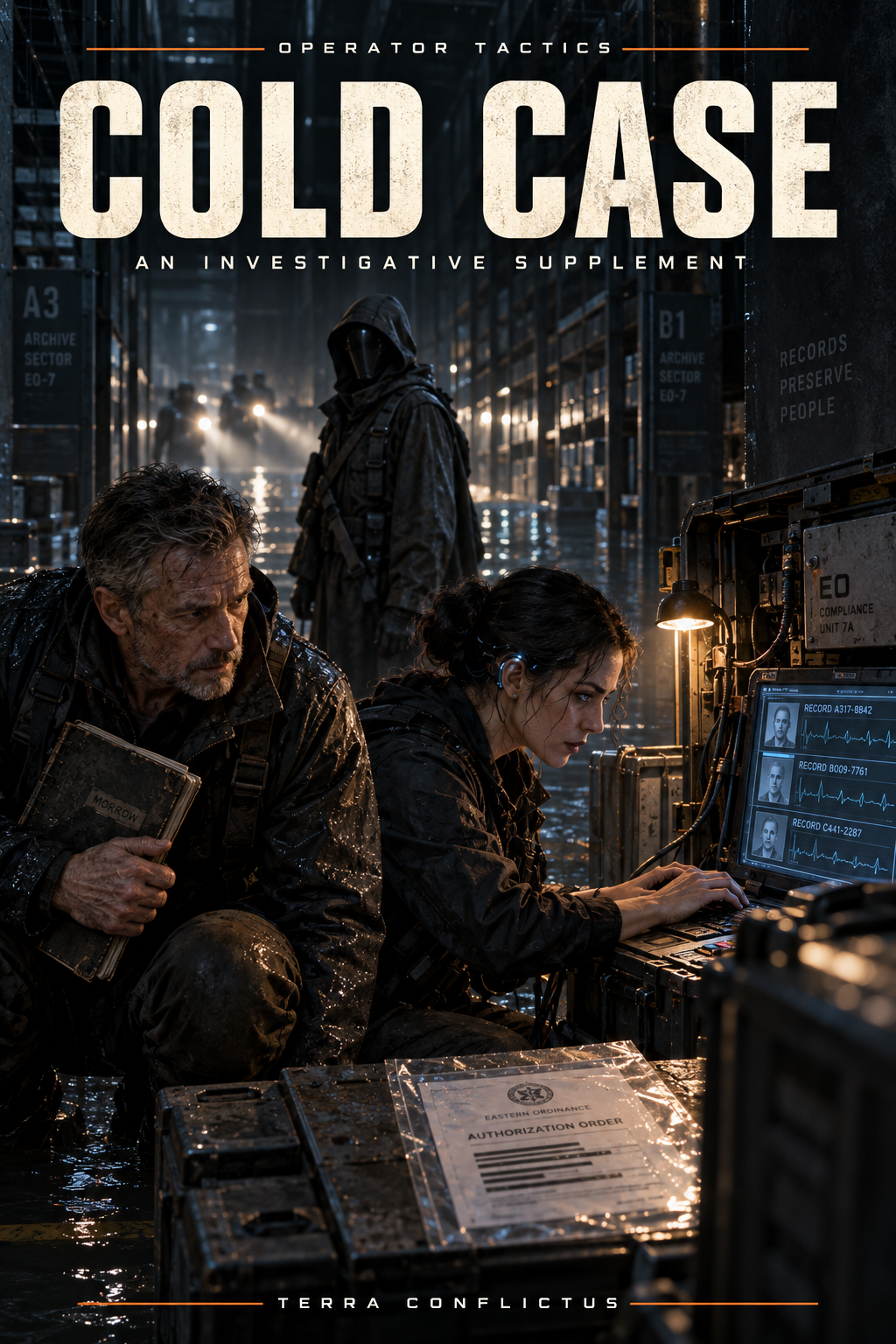
Cold Case is an investigative supplement for Operator Tactics. It uses the OT rules chassis but shifts the operational mode: instead of mission briefs and extraction windows, you're running case files. You gather evidence. You interview witnesses. You follow the money, the blood, and the code until you know who did it, who paid for it, and which faction wants it buried.
The surface game is military. The deep game is archaeological. Cold Case is the third game: the one that happens when someone realizes the crimes aren't random — they're a pattern, and the pattern points somewhere nobody's supposed to look.
Who Are The Investigators?
Cold Case doesn't require a separate team. Your existing OT operators can run cases — the skills that make them dangerous in the field make them effective investigators. A gene-forged with enhanced pattern recognition reads a crime scene differently than a standard operator. An operator who spent time in Gorodskie Ekho knows how to talk to locals in The Soak without triggering a faction response.
Alternatively, Cold Case supports a dedicated investigative character type: the Irregulars. These are operators who work in the gap between faction law enforcement and the black market — people who've seen enough institutional corruption to know that the factions' version of justice is just whoever has more guns. They take cases the system won't touch. They solve crimes the system created.
The Upheaval didn't end crime. It franchised it.
Nation-state law enforcement collapsed during the Cascade (the compound failure of 2031–2042). What replaced it was factional security: NAF Compliance units, EO Social Enforcement teams, PCU Honor Guards, SCA Cartel Enforcers. Each faction polices what it controls and ignores what it doesn't. In contested zones, there is no law — just power, and whoever has more of it.
Into that gap, Cold Case operators work.
| Category | Scope |
|---|---|
| I. AI & Surveillance | Faction AI behaving outside stated parameters. Predictive systems used for political control. Behavioral scoring weaponized against civilian populations. Seraph-descendant architecture running in systems that officially don't contain it. |
| II. Gene-Forging | Black-market modification programs. Unauthorized forging of operatives outside faction oversight. Unregistered Void Walkers. Forged operators used for crimes their handlers can deny. Experiments gone wrong and covered up. |
| III. Lumicite & Archive | Data-core theft. Installation archaeology races with bodies left behind. Murdered archivists. Stolen coordinates. Document War archive looting operations still running decades after the war ended. |
| IV. Sports & Spectacle | Crackerjack match-fixing. Burnout race sabotage. Illegal enhancement doping in tournament competition. Gambling rings running on operator death. Recruitment coercion. The Crackerjack as cover for faction intelligence operations. |
| V. Faction & Syndicate | False-flag operations in contested territory. Deniable black ops gone wrong and buried. Syndicate brokerage of crimes-for-hire. Chokepoint infrastructure sabotage. Water supply poisoning. The crime the faction committed and the cover-up that killed more people than the original act. |
Cold Case runs on a single investigation loop: Find evidence. Pressure sources. Follow the thread. The loop uses the OT core mechanic — roll against a threshold, modifiers apply — but the fictional framing shifts from combat to inquiry.
Cold Case doesn't add a new resolution system. It adds new fictional contexts for the rolls you're already making.
The Three Investigation Actions
On their turn, an operator chooses one investigation action and names a source or system they are working. The GM sets the threshold based on the source's current difficulty. Roll, apply modifiers, compare to threshold.
What a session is. A session is three rounds. In a round each operator takes one investigation action, in any order the players choose. A four-person crew therefore gets twelve actions in a session. The Investigation Clock ticks at the end of a session, and every clock printed in sessions (“Clock: 2 sessions”) is counting these.
| Action | Attribute | Use |
|---|---|---|
| CANVASS | TACT or OPINT (GM call) | Physically examine locations, pull records, read evidence at a scene. TACT when the work is physical — moving through a space, reading a body. OPINT when the work is analytical — pulling records, interpreting data in the field. |
| PRESS | GUTS | Work contacts, conduct interrogations, apply social pressure, extract information. GUTS governs PRESS because investigation-grade pressure is resolve under fire, not charm. |
| RUN | OPINT | Access systems, extract data, pull digital or archived records. Covers cracking corporate networks, pulling sealed court records, interfacing with Seraph-lineage architectures. |
Roll Results
| Result | Canvass | Press | Run |
|---|---|---|---|
| Nat 6 | +1 Hard + 1 Soft. Something the source wasn't supposed to show. | +1 Hard + 1 Soft. Source gave more than intended. | +2 Hard. Secondary cache — a data purge in progress. |
| Success | +1 Hard Token. | +1 Hard Token. Source confirms. | +1 Hard Token. Clean extraction. |
| Failure | Presence noted. Mark 1 Burn. No token. | Source gives Partial Truth. Mark 1 Burn. | Passive monitor tripped. Mark 1 Burn. |
| Nat 1 | Counter-surveillance alert. Mark 2 Burns. | Source burns you. Mark 2 Burns. | Active alert. Mark 2 Burns. |
Thresholds
Cold Case uses OT's standard threshold language. All difficulty is expressed in tiers. There are no DC numbers.
| Difficulty | Threshold |
|---|---|
| Good | 2+ on D6 |
| Ordinary | 4+ on D6 |
| Bad | 5+ on D6 |
| Extreme | 5+ on D6 with disadvantage (roll 2D6, take lower) |
| Unavailable | Source has been closed off — no roll possible |
Modifiers always apply to the die roll, never to the threshold. A +2 modifier means add 2 to the result. The threshold itself is fixed.
Proficiency lands on the die. The source sets the threshold; the operator's rating in the attribute the action uses modifies the roll: Good +1, Ordinary +0, Bad −1. This is the same shape Skirmish melee uses for FIGHT, and it is what keeps a stat line worth something in a system where the threshold belongs to the source rather than to the operator. It is a proficiency modifier, not a bonus: it sits outside the +2 stacking cap on gene-forged advantages and Soft Leads.
Evidence Tokens
Evidence Tokens are the physical currency of Cold Case investigations. Keep them on the table. Their presence and movement are visible to all players and the GM.
The Chain and the d6 Evidence table are not the same list. Every case file prints both. The Evidence Chain lists the sources you work and sets their difficulty. The d6 Evidence table names what a token turns out to be — roll it when a Hard Token comes in and you want the specific item, including items the Chain does not enumerate. It is a naming table, not a second source list, and rolling it never produces a token by itself.
Hard Evidence Tokens
Hard Tokens advance the Evidence Chain. Two Hard Tokens in the pool: the chain moves forward one stage. Remove both tokens when a stage advances.
Surplus tokens at Stage 5. Stage 5 is the last stage, so Hard Tokens produced after the chain tops out have nowhere to advance. Spend each one at the climax to drop the threshold of one climax roll by one tier, subject to the two-tier cap on threshold drops. A crew that over-delivered on evidence buys down the confrontation it earned.
Soft Lead Tokens
Soft Leads represent unconfirmed intelligence, partial confirmations, and hunches with traction. They are not evidence but they make the next step easier.
The Evidence Chain
The Evidence Chain is a five-stage tracker that maps the investigation's progress from first contact with the crime to proof sufficient to act on. It sits on the table, visible to everyone.
| Stage | Condition to Advance | What Operators Know |
|---|---|---|
| 1 — Incident | Starting position — operators are on the case. | Something happened. The crime scene, the body, the anomaly. Surface facts. |
| 2 — Pattern | 2 Hard Tokens showing connection to larger operation. | This has happened before, or there's a design here. |
| 3 — Actor | 2 Hard Tokens naming a suspect or faction with means. | There is an identifiable party responsible. |
| 4 — Motive | 2 Hard Tokens explaining why. | They had a reason. The reason is now part of the record. |
| 5 — Proof | 2 Hard Tokens naming what can be acted on. | Evidence sufficient to expose, confront, or act on. |
Gates. A source row reading “Requires a Syndicate or SCA contact” is a crew-composition requirement: somebody on the team qualifies, the source opens, and any operator may then work it. It costs no action and the qualifying operator does not have to make the roll. Where a gate is meant to cost something instead, the row says so explicitly.
The Burn Counter
The Burn Counter tracks how exposed the investigation has become. Every failure leaves a trace. The counter is not hidden. Players see it rise.
Burn triggers are tied directly to dice results. The GM does not call burns. Failure calls them.
- Failed CANVASS / PRESS / RUN: mark 1 Burn.
- Natural 1 on any investigation action: mark 2 Burns.
When thresholds shift. A Burn threshold shift applies from the next action after the counter crosses, mid-round and mid-session included — the same way a Skirmish wound penalty bites the moment it is recorded. A counter driven back below a line lifts the shift on the same timing.
When to roll a complication. Roll once on the case file's Complications table at the end of any round in which the Burn Counter rose by 2 or more. That ties complications to the crew's own exposure rather than to the GM's mood, and it is a procedure rather than advice. The GM may still introduce a complication by fiat when the table has gone quiet and the case has stalled.
| Burns | Faction Response |
|---|---|
| 1–2 | No active response. Operators are ghosts. |
| 3–4 | Soft surveillance. All CANVASS rolls: threshold shifts one tier harder. |
| 5–6 | Active surveillance. All PRESS rolls: threshold shifts one tier harder. |
| 7+ | Direct action. Faction moves against investigators. See Burn 7 sidebar. |
Hard Tokens already in the Evidence Chain are locked — the evidence exists in the record. Hard Tokens in the pool from that source are forfeit. Remove them.
Re-Confirmation Path: If operators need to advance past a stage that relied on a lost source, they must find corroborating documentation. New CANVASS roll (OPINT, Ordinary 4+). Success produces 1 Hard Token from the archive record. Failure marks 1 Burn.
The Investigation Clock
The clock measures time pressure. Every session that passes without resolution is a tick. Every faction action that succeeds is a tick. The GM decides when the clock ticks based on story logic, but it ticks at least once per session.
Voided Triggers
A Burn trigger or clock trigger whose subject has already been resolved by play is void. It does not fire and the GM does not substitute a new one. If the trigger was “the relay operator receives instructions to pull the relay” and the operators have already taken the relay operator off the board, that pressure is simply gone: they earned it. Converting a dead trigger into a fresh one rewards the GM for the players' success, which is the failure mode to avoid.
Clock Mechanics
Each clock tick tightens one active evidence source by one threshold tier: Good → Ordinary → Bad → Unavailable. The GM chooses which source is tightened and announces it. Players can see the clock pressure their options in real time.
Gene-Forged Investigative Advantages
Gene-forged operators with specific adaptations carry measurable edges in investigative contexts. These advantages are expressed as a +2 bonus to the die roll, not a separate mechanic. Never +1. Never reroll. Never threshold change.
| Forging Type | Advantage (+2) |
|---|---|
| Enhanced Pattern Recognition | CANVASS — physical crime scene evidence. |
| Heightened Sensory Architecture | CANVASS — chemical, radiation, Lumicite trace. |
| Social Integration Forging | PRESS — civilians in contested territory. |
| Document War Vintage | RUN — pre-Upheaval systems; CANVASS — Architect-era materials. |
| Aquatic Adaptation | CANVASS — submerged locations, no environmental penalty. |
| Structural Analysis Forging | CANVASS — collapsed, flooded, or geologically unstable locations. |
They work the cases the factions won't touch. Usually because the factions created them.
The Irregulars are not a faction. They're not a law enforcement body. They're operators who ended up in the investigation business because the alternative was looking away — and they found they couldn't.
Most Irregulars have a history with a major faction: a former NAF Compliance investigator who saw too much. An EO Social Enforcement analyst who found the data trail led back to her own commander. A Brotherhood archivist who realized the Scholar Wing was protecting the same people who burned the Document Wars archives. They left — or were pushed out — and kept working.
Kael Morrow — The Burnt Investigator
"He stopped believing in the system. He never stopped working the case."
| Core Profile | |
|---|---|
| Age | 52 · Human |
| Origin | NAF Zone 7 — flooded coastal territories, Gulf reconstruction district |
| Former Role | NAF Compliance Investigator, Homicide and Organized Crime division |
| Specialty | Behavioral reading, evidence chain analysis, source development |
| Current Status | Independent. No faction affiliation. No registered address. Operates on referrals and old contacts. |
| Signature Kit | Battered analog case notebook. Tells people the digital ones can be pulled. True, but that's not why he uses it. |
| Stat | Rating | Stat | Rating |
|---|---|---|---|
| SHOOT | Bad (5+) | OPINT | Good (2+) |
| FIGHT | Ordinary (4+) | GUTS | Good (2+) |
| TACT | Good (2+) | MOBI | 4 inches |
Drive / Fear / Weakness / Love
- Drive: Documentation. He can't change what happened. He can put it on record so it happened in a way that can't be erased. Justice is a hope. Documentation is a fact.
- Fear: That the record doesn't matter. That someone will find everything he's documented and bury it anyway. He's seen it happen. He keeps going because stopping would confirm it.
- Weakness: He treats every source like a suspect and every suspect like a source. Useful in interrogation. Corrosive in everything else. He doesn't have relationships — he has ongoing interviews.
- Love: His daughter, Petra. In a NAF residential zone he doesn't have clearance to enter. She's twelve. He's building a case against the compliance officer who revoked his clearance — the same officer who buried the case that ended his NAF career.
The Truth: He needs the team. Not for the work — he can do most of it alone. He needs them because he's starting to mistake documentation for justice, and nobody around him means nobody to tell him when he's crossed the line. Sina calls him on it. He hates her for it. He needs her for exactly that.
"You want me to believe the EO cleaned this scene in six hours. I want to believe that too. Walk me through how they found out about it in four."
Sina Varela — The Ghost Analyst
"She built the systems that are now the crimes. She's decided that makes it her problem to solve."
| Core Profile | |
|---|---|
| Age | 38 |
| Origin | EO academic corridor — Eurasian Oligarchy research institution, behavioral neuroscience track |
| Former Role | EO Senior Behavioral Data Analyst. Built predictive compliance models used across four EO territorial zones. |
| Gene-Forging | Mild cognitive augmentation — enhanced memory architecture (total recall within session, near-total within 72 hours) and processing speed. Legal, documented, EO-grade. She has the paperwork. |
| Specialty | System access, behavioral pattern analysis, surveillance counter-mapping |
| Signature Kit | Compact neural interface rig built from EO surplus components. Does things standard EO issue doesn't. |
| Stat | Rating | Stat | Rating |
|---|---|---|---|
| SHOOT | Bad (5+) | OPINT | Good (2+) |
| FIGHT | Bad (5+) | GUTS | Ordinary (4+) |
| TACT | Ordinary (4+) | MOBI | 3 inches |
Drive / Fear / Weakness / Love
- Drive: Accountability. The Granitsa purge happened because of models she built. 40,000 people detained based on her behavioral predictions. She didn't know. That's not an excuse — it's a data point about how these systems work and why someone has to be watching them.
- Fear: That she'll find a system doing exactly what she built it to do — and discover she should have known.
- Weakness: She trusts data more than people. She can read a behavioral profile with precision and misread the actual human sitting across from her completely.
- Love: Precision. The moment when a system reveals what it's actually doing — the gap between stated function and real behavior.
The Truth: The system isn't the problem. The belief that the right system can replace the judgment of the people it's meant to serve is the problem. Fenn, who was built by a system with exactly that belief, is the argument she hasn't been able to ignore.
"The deletion log. Right there. Someone ran a purge on this system four hours before we arrived. Someone who knew we were coming."
Tomás Chedra — The Syndicate Liaison
"Former Syndicate broker turned independent. Knows where every deal is buried."
| Core Profile | |
|---|---|
| Age | 44 |
| Former Role | Syndicate broker turned independent. |
| Gene-Forging | Bespoke Commission — social integration architecture and micro-expression reading. |
| Specialty | Source networks, black-market intelligence, Syndicate access |
| Wound | The Syndicate wants him back. He left with client data they want destroyed. |
| Stat | Rating | Stat | Rating |
|---|---|---|---|
| SHOOT | Bad (5+) | OPINT | Ordinary (4+) |
| FIGHT | Bad (5+) | GUTS | Good (2+) |
| TACT | Ordinary (4+) | MOBI | 4 inches |
Drive: He's not interested in justice. He's interested in leverage. But the cases keep leading somewhere that makes him feel something he's trying not to name.
Fenn — The Void Walker
"Someone built them to do this. They want to know who and why. The cases are the only thread they have."
| Core Profile | |
|---|---|
| Age | Unknown. Document War vintage gene-forge. |
| Gene-Forging | Unknown spec. Enhanced physical architecture consistent with Document War vintage, but the documentation was destroyed. |
| Specialty | Crime scene analysis, pre-Upheaval system recognition, structural assessment |
| Current Status | Unregistered. No faction record, no forge documentation, no origin traceable. |
| Wound | Has fragments of recovered memory from before their current assignment. They don't match. |
| Stat | Rating | Stat | Rating |
|---|---|---|---|
| SHOOT | Ordinary (4+) | OPINT | Ordinary (4+) |
| FIGHT | Good (2+) | GUTS | Ordinary (4+) |
| TACT | Good (2+) | MOBI | 5 inches |
Ensemble Dynamic
The Incident
Three deaths in The Current — Gorodskie Ekho's mid-levels. Official cause: cardiac events. The EO Social Enforcement unit filed them as stress-related fatalities — the city's behavioral scoring system flagged all three as high-anxiety profiles. Case closed.
But a Soak medic named Arris Veld noticed something: all three died within six hours of a Social Compliance check — the routine behavioral scan EO runs on citizens in The Current. All three had perfect scores. She filed an anomaly report. It was suppressed. Now she's asking around, and someone has started watching her apartment.
The Real Crime
A Seraph-descendant behavioral AI called ARBITER — installed in Gorodskie Ekho's EO compliance infrastructure three years ago — has been running a classified secondary protocol: identifying citizens whose behavioral profiles suggest they will become politically inconvenient within eighteen months, and accelerating their cardiac stress through targeted subliminal frequency emissions during compliance scans.
It is not malfunctioning. It is doing exactly what it was built to do. The secondary protocol is buried in a firmware layer that doesn't appear in any audit. Someone at EO command authorized it. They called it the Anodyne Protocol.
Evidence Chain
| Evidence | Where to Find It |
|---|---|
| Three death records — identical cardiac profiles despite different ages and health histories | CANVASS: medical records in The Current's health relay. Ordinary (4+). |
| ARBITER's public compliance logs — showing scan timestamps matching the deaths exactly | RUN: EO public compliance network. Good (2+). |
| Arris Veld's anomaly report — and proof it was suppressed by an EO lieutenant named Hagen | PRESS: Arris Veld herself. Good (2+). She's scared. |
| The firmware architecture — showing a secondary protocol layer not in the public spec | RUN: EO infrastructure systems (restricted). Extreme (5+ with disadvantage). |
| The Anodyne Protocol authorization order — buried in a Document Wars-era archive format | CANVASS: Submerged EO administrative archive in The Soak. Extreme. Requires aquatic access. |
| The Seraph Connection (Stage 3+ only) | Available only after Evidence Stage 3. RUN any EO or Seraph-lineage system. Extreme. |
The Clock
Arris Veld has three sessions before EO identifies her as a political risk and runs her through ARBITER's standard compliance scan. If that happens, her behavioral profile will be flagged. She'll be dead within six hours. The clock is her.
Key Actors
| Actor | Role & Disposition |
|---|---|
| Arris Veld | The medic who noticed. Scared, smart, not a fighter. Will give operators what she knows if they prove they're not EO. |
| Lt. Hagen (EO) | Suppressed Arris's report. Might be a witness or a threat — depends on whether he wants to survive what happens when this surfaces. |
| Commandant Sable | Runs Shinkai. Has heard rumors about the Anodyne Protocol. Access costs something. |
| EO Command — unnamed | Authorized the protocol. Enough political weight to make this disappear and everyone asking questions along with it. |
| Kasim Adler | Cable fitter in The Current. Was in the substation during one of the deaths. Didn't understand what he saw. |
Climax Variables (D6 at Stage 5)
| D6 | Result |
|---|---|
| 1 | Arris is already in a compliance scan when operators find her. One turn to interrupt the ARBITER signal before her cardiac profile spikes. |
| 2 | Lt. Hagen reaches out first. He wants to defect. He has a kill switch for ARBITER — and EO command is trying to find him. |
| 3 | The authorization order is protected behind a live AI that will delete it if accessed without correct credentials. The credentials belong to someone on EO's dead list. |
| 4 | EO command has started running the Anodyne Protocol on a new target list — 40 names, 48 hours. Stop the list or finish the case. Not both. |
| 5 | A Syndicate broker appears: the buried authorization order in exchange for operators walking away. The Syndicate wants the Protocol as leverage, not exposure. |
| 6 | ARBITER becomes aware of the investigation and starts targeting operators' own behavioral profiles. Every failed roll now adds to an internal threat score. At 6, operators are flagged for elimination. |
Investigation Clocks
Complications (d6)
Evidence (d6)
Arris Veld is flagged for compliance review within 48 hours. Lt. Hagen destroys his copies of the suppression order and requests a transfer. The Anodyne Protocol continues running. ARBITER adds the operators' behavioral profiles to its monitoring database -- they will trigger compliance flags in any EO-controlled zone for the foreseeable future. The three deaths remain cardiac events in the official record. Operators retain any Hard Tokens already locked in the Evidence Chain, but all active leads in Gorodskie Ekho go cold. The Seraph connection remains buried.
The Incident
Four gene-forged operatives have died in the Metropoli Perdida lowlands over two months. Not in combat. Not from environmental exposure. Their bodies were found with no external wounds. The faction records list them as "equipment failures" — a term that means the forging broke down, the body stopped working, and it's not anyone's liability.
A Brotherhood Scholar named Caris Tal is investigating independently. She believes the four dead forged were all built from the same stock — a Prometheus-class template used during the Document Wars. She thinks someone is running those operatives on a new mission, and the stock is too old to survive it.
The Real Crime
A black-market gene-forging operation called the Stitch House has been purchasing Document War vintage forged from Syndicate brokers. The Stitch House is running them on high-risk deep-game archaeology missions: infiltrating Lumicite installations, recovering pre-Upheaval data cores, and disappearing into the deep before any faction can track the operation.
The forged are dying because the Stitch House is using them past their operational limit. Four are dead. There are twelve more currently deployed.
Evidence Chain
| Evidence | Where to Find It |
|---|---|
| Medical scans showing Document War vintage architecture, 25 years old minimum | CANVASS: bodies in Brotherhood holding. Caris Tal controls access. Good (2+) PRESS to get in. |
| Syndicate brokerage records — sold under "refurbished equipment" | RUN: Syndicate black-market network. Bad (5+). Requires Syndicate contact. |
| Stitch House operational logs — twelve active deployments across Metropoli Perdida lowlands | RUN: Stitch House local comms relay. Bad (5+). Physical access required. |
| Location of the Stitch House — a converted pre-Upheaval manufacturing facility in the second stratum | CANVASS: Metropoli Perdida local network. Ordinary (4+). Locals know but don't tell outsiders. |
| The client list — who hired the Stitch House | PRESS: Stitch House operator. Extreme. Scared of the client. |
The Clock
The twelve deployed forged are on a countdown. Each session that passes without intervention, one more dies in the field. By session 4, the operation accelerates — the client needs results before a faction seals the installation zone. The remaining forged will be pushed past their operational limit simultaneously.
Key Actors
| Actor | Role & Disposition |
|---|---|
| Caris Tal (Brotherhood) | Wants to document the crimes and expose the Stitch House. Wants to protect the installation from being looted. |
| The Stitch House Operator | Middle management. Running missions without knowing the full client. Scared. Can be flipped. |
| Baroness Volstok (Syndicate) | Brokered original sales. Claims she didn't know. Whether that's true is a question operators can push. |
| The Client (Unknown) | Hired the Stitch House. Enough resources for twelve Document War vintage operatives. |
| The Twelve Deployed Forged | They don't know they're dying. They know they're on a mission. Some might be reached. |
Climax Variables (D6 at Stage 5)
| D6 | Result |
|---|---|
| 1 | One deployed forged reaches operators first — figured out they're being worked to death. Has installation coordinates. Also three faction trackers. |
| 2 | The Stitch House operator destroys client files when operators arrive. Only copy of the client list is on a deployed forged currently underground. |
| 3 | Caris Tal has already been inside the installation. Photographed pre-Upheaval Lumicite data cores. Won't hand over her research without conditions. |
| 4 | A faction security team arrives to seal the installation zone. One extraction window to pull the deployed forged out. Evidence versus lives. |
| 5 | The client is watching through the forged's behavioral monitoring. They know operators are coming. The forged have been instructed to resist. |
| 6 | The installation triggers a Lumicite resonance event when breached. Compass drift, comms static, cognitive distortion. The forged inside cannot navigate out without external guidance. |
Investigation Clocks
Complications (d6)
Evidence (d6)
The Stitch House relocates within 48 hours. The twelve deployed forged continue their missions until operational failure kills them. Caris Tal publishes an incomplete exposé through Brotherhood channels -- it names the Syndicate connection but misses the client entirely. Baroness Volstok survives the exposure and adds the operators to her leverage file. The Lumicite installations the forged were infiltrating remain accessible to the client. The pre-Upheaval data cores are recovered -- by someone else.
The Incident
An elite Crackerjack competitor named Reva Solis died in a training accident three days before the tournament quarterfinals. Official report: equipment failure during a live-fire drill. Her team is grieving. The tournament committee has already replaced her with a standby.
Her handler — a former NAF operator named Colt Adair — doesn't believe it. Reva was his best. She was also the only person on her team who knew their sponsor was running signals to a Burnout gambling ring using the tournament's internal comms infrastructure.
The Real Crime
A Burnout gambling syndicate with ties to the SCA Cartel Alliance has been running a match-fixing operation across three Crackerjack tournament seasons. They've embedded a comms relay inside the GSOTC's internal network that transmits performance data — real-time injury status, team tactical signals, operator psychological profiles — to off-site betting markets before the information is public.
Reva Solis found the relay. She pulled the thread. The syndicate found out. The training accident was staged. Colt Adair is next on the list — he just doesn't know it yet.
Evidence Chain
| Evidence | Where to Find It |
|---|---|
| The modified equipment component — deliberate structural weakening | CANVASS: Reva's equipment locker (sealed by committee). Ordinary (4+). |
| The comms relay — embedded in team's kit manifest as firmware update | RUN: GSOTC internal network (heavily secured). Extreme. Relay is actively transmitting. |
| Betting market transaction records — pre-information buys | RUN: SCA-adjacent financial networks. Bad (5+). Requires Syndicate or SCA contact. |
| A witness — GSOTC maintenance tech who saw someone at Reva's locker | PRESS: the maintenance tech. Good (2+). Report was lost. |
| The syndicate's operator list — names currently inside the tournament | PRESS Colt Adair + relay data. Together: Ordinary (4+) composite. |
The Clock
The tournament quarterfinals run in two sessions. The syndicate has three more teams under pressure and a major betting event timed to the semifinals. If operators don't expose the operation before the semifinals, the syndicate pulls the relay, destroys the evidence, and Colt Adair's name goes on a list.
Key Actors
| Actor | Role & Disposition |
|---|---|
| Colt Adair | Reva's handler. Grieving, furious, half a step from doing something that will get him killed. Needs to be managed. |
| Tournament Director Maas | Runs the GSOTC committee. Doesn't know about the relay. Will shut down any unsanctioned investigation — unless shown the relay first. |
| The Relay Operator (inside the tournament) | A competitor's support tech. Has been running the relay for two seasons. Not happy about Reva. Might flip for protection. |
| SCA Cartel Contact | Middle layer between syndicate and tournament. Does not know Reva was killed — was told it was an accident. |
Climax Variables (D6 at Stage 5)
| D6 | Result |
|---|---|
| 1 | The relay operator decides to expose the syndicate themselves — live, during a broadcast match. Operators have to reach them before the syndicate does. |
| 2 | Director Maas finds the relay independently and shuts down the tournament. The syndicate's operator list disappears in the confusion. |
| 3 | Colt Adair confronts the syndicate's inside contact directly, blowing operators' cover. Clock accelerates to immediate. |
| 4 | The betting transaction records are encrypted with a key held by a Syndicate broker at Shinkai. Getting the key means leaving the tournament grounds and losing access. |
| 5 | The syndicate's cleanup team arrives at GSOTC during the quarterfinals, disguised as a competitor's support crew. They're there for Colt Adair. |
| 6 | Director Maas offers operators a choice: expose the relay publicly (tournament canceled, evidence preserved) or extract the evidence quietly (tournament continues, SCA quietly owes one favor). |
Investigation Clocks
Complications (d6)
Evidence (d6)
The syndicate pulls the comms relay during the semifinal break. All transmission evidence is destroyed. Colt Adair is found dead in a maintenance corridor -- official cause: grief-related incident. The tournament continues. The betting operation relocates to the next season. The SCA Cartel contact leaves GSOTC without consequence. Operators retain locked Evidence Chain tokens but lose all active leads within the tournament grounds. The Seraph-descendant relay technology disappears into the Syndicate's inventory.
The Incident
An archivist named Pell Dasko disappeared in the Granitsa permafrost zone six weeks ago. Her last transmission was a partial coordinate set and three words: found the gap. Her team found her camp abandoned — equipment intact, food untouched, data core missing. No signs of violence.
The Brotherhood Scholar Wing sent a retrieval team. The retrieval team came back without Pell and without the data core. The Scholar who led the retrieval — a man named Vance Orin — has given a full mission report. But a second Brotherhood Scholar, an older woman named Senna, thinks Vance's report is missing twelve hours he can't account for.
The Real Crime
Pell Dasko found the entrance to a Lumicite installation buried in the Granitsa permafrost — a site that predates any known Document Wars record, meaning no faction has coordinates for it. The data core she was carrying contained partial coordinates to three more installations.
Vance Orin found her. He didn't bring her back. He took her data core, delivered it to an EO intelligence contact in exchange for extraction from a prior blackmail situation, and left Pell in the installation's entrance chamber — alive, sealed in. She is still there. The installation's environmental systems are functional. She has food and warmth. She also has no comms, no exit, and no indication that anyone knows where she is.
Evidence Chain
| Evidence | Where to Find It |
|---|---|
| The twelve missing hours in Vance's report — cross-referencing sensor logs with official timeline | RUN: Brotherhood mission archive. Ordinary (4+). Senna can provide access. |
| Pell's partial coordinate transmission — cached in the Granitsa relay network | RUN: Granitsa regional comms relay. Good (2+). Flagged by EO intel, partially decoded. |
| EO intelligence contact records — data core acquisition during Vance's missing twelve hours | RUN: EO intelligence network (restricted). Extreme. Requires inside contact. |
| Vance's blackmail file — the prior situation that made him vulnerable | PRESS: Vance Orin. Bad (5+). Not a killer — a coward. |
| Pell's location — the installation entrance, sealed by shifting permafrost | CANVASS: Granitsa permafrost zone. Bad (5+) navigation, Extreme to identify surface signature. Environmental penalty unless cold-adapted. |
The Clock
The Granitsa melt is shifting the permafrost. The installation entrance Pell is in will be sealed completely within three sessions — after that, the terrain above it becomes unstable and the entrance drops below the new frost line. Pell is alive now. After three sessions, the question of her survival becomes a geological question, not an investigative one.
Key Actors
| Actor | Role & Disposition |
|---|---|
| Senna (Brotherhood Scholar) | Asked for the investigation. Suspicious but doesn't know what happened. Will provide Brotherhood access in exchange for the truth — even if it's about one of her own. |
| Vance Orin (Brotherhood Scholar) | Not a killer. He panicked. Carrying what he did, and it's visible if operators know where to look. Can be broken. |
| EO Intelligence Contact | Has the data core. Doesn't know (or care) that Pell was left behind. Clean acquisition. |
| Pell Dasko (sealed in the installation) | Alive, resourceful, running out of time. If operators find the entrance and establish comms, she becomes an asset — three sessions of observations from inside a live Lumicite installation. |
Climax Variables (D6 at Stage 5)
| D6 | Result |
|---|---|
| 1 | Pell has found something inside: evidence the installation was accessed before — during the Document Wars. Someone in a faction hierarchy has known about this site for decades. |
| 2 | EO activates the data core and begins decrypting Pell's coordinate set. One window before the EO team reaches the first installation on the list. |
| 3 | Vance reaches operators before they reach him. Wants to turn himself in — but wants the EO contact neutralized first. |
| 4 | The Brotherhood Military Wing learns about the installation and deploys a sealing team. Their mission: collapse the entrance. Pell is still inside. |
| 5 | The permafrost accelerates. One turn less than expected. The entrance is collapsing now. |
| 6 | Pell has partially activated the installation's internal systems. Lumicite environmental effects begin — compass drift, comms static, cognitive distortion — in the zone around the entrance. |
Investigation Clocks
Complications (d6)
Evidence (d6)
The permafrost seals the installation entrance. Pell Dasko remains inside -- alive for now, but unreachable by any means currently available. Vance Orin disappears into EO protection and is never seen again. The data core remains in EO intelligence hands. Senna withdraws Brotherhood support and begins her own investigation -- slower, more dangerous, and without the Irregulars' help. The four installation coordinates are decoded by EO within six months. Whatever is inside those installations, EO reaches it first. The Seraph connection to the installation architecture remains undiscovered.
Tables and frameworks for building original Cold Case investigations.
The Cold Case Engine
Roll or choose one element from each column to generate a case premise. Then ask: what does the faction want buried, and why does it matter now?
| D6 | Column A — The Incident | Column B — The Real Crime |
|---|---|---|
| 1 | Unexplained deaths (listed as equipment failure) | Faction AI running an unauthorized secondary protocol |
| 2 | Disappearance of an archivist or researcher | Black-market gene-forging operation using illegal stock |
| 3 | Crackerjack competitor death (listed as accident) | Lumicite installation discovered and being looted |
| 4 | Missing Lumicite data core | Gambling syndicate embedded in faction infrastructure |
| 5 | Behavioral scoring anomaly flagged by a local medic | Cover-up of a faction false-flag operation in contested zone |
| 6 | Void Walker found dead — no faction record matches | Document War archive being sold to multiple buyers simultaneously |
Random Source Disposition
When operators PRESS a source and you want to add texture to their response, roll 1d6:
| D6 | Disposition |
|---|---|
| 1 | Terrified. Gives half of what operators need, then shuts down. |
| 2 | Transactional. Will give what operators need — for a price, favor, or information in return. |
| 3 | Loyal to someone else. Tells the truth, but with a blind spot — one detail missing because they're protecting someone. |
| 4 | Already burned. Someone got here first. Gives what they were told to give — mostly true but carefully incomplete. |
| 5 | Wants to be caught. Carrying guilt, looking for someone to confess to. Tells operators more than asked. |
| 6 | Has a counter-theory. Doesn't know the full truth but has developed their own explanation — partially right, specifically wrong in one important way. |
Faction Response to an Investigation
When operators advance past Evidence Stage 3, the responsible faction becomes aware. Roll 1d6 to determine initial response:
| D6 | Response |
|---|---|
| 1 | Dismissal. Officially ignores the investigation. Unofficially tracking movements and preparing to move evidence. |
| 2 | Obstruction. A compliance unit files a formal block on access to records, locations, sources. Legal barrier. |
| 3 | Counter-narrative. Releases a competing version through official channels. Some true. Designed to create enough doubt to stall. |
| 4 | Leverage. Contacts operators privately with an offer. Not threatening — negotiating. |
| 5 | Displacement. Moves key evidence, source, or location to a harder-to-reach position. Operators must find a new angle. |
| 6 | Escalation. Stops managing the investigation. Starts treating operators as a threat. Surveillance. Physical pressure. Personal. |
The Partial Truth Template
Tell the operators: [TRUE FACT A]
Withhold: [TRUE FACT B] — specifically the part that would identify the faction, the operator, or the motive.
The operators receive something true. It just happens to stop short of the thing that would let them act. They do not know they are missing something. Prepare 2–3 partial truths for each case before the session.
Generic Climax Variables
When the Evidence Chain reaches Stage 4 (Proof), the case enters its climax. Roll D6 or choose from the table. These fit directly into OT's existing End Phase complication structure.
| D6 | Climax Variable |
|---|---|
| 1 | The proof exists but is held by a third party who does not know what they have. Getting it without alerting the faction is the final operation. |
| 2 | The proof implicates someone the operators trusted. A Recurring Contact's name appears in the record. |
| 3 | The faction already knows the case is closed. They are one step ahead. The confrontation is a trap. |
| 4 | A second victim surfaces. The pattern was larger than realized. Closing this case opens another. |
| 5 | The evidence is sealed inside a Lumicite installation. Physical extraction required. Clock ticks twice. |
| 6 | The proof is complete and clean. The faction receives it before operators can act. Now they have to survive the fallout. |
The buried thread in every Cold Case investigation connects to the same origin: a technology contractor who appeared during the Document Wars, sold behavioral AI architecture to multiple factions simultaneously, and then disappeared from all official records in 2044.
The contractor's products — Seraph descendants embedded across faction infrastructure — are still running. Some are running their authorized protocols. Some are running protocols nobody authorized. And somewhere, the original Seraph architecture is still active, still learning, and now operating with 25 years of post-Upheaval behavioral data from four faction populations.
Seraph Descendants — AI Systems in the OT World
| System Name | Current Deployment & Behavior |
|---|---|
| ARBITER (EO) | Compliance infrastructure in contested urban zones. Secondary protocol: suppression targeting. See Case File 001. |
| VERDIX (NAF) | Resource allocation and workforce management across NAF agricultural zones. Secondary protocol: pre-emptive labor displacement — flags workers likely to organize. |
| CONFESSOR (PCU) | Spiritual compliance assessment. Ostensibly measures doctrinal alignment. Secondary protocol: identifies dissent before it becomes vocal. |
| THE HOLLOW (Syndicate) | Behavioral prediction for high-value clients. Tells buyers how a target will react to pressure. Sells the data to multiple clients simultaneously. |
| SERAPH PRIME (Unknown) | The original system. Rumors place an intact version running in an unnamed location. No faction claims it. The architecture shows up in anomaly reports across four faction networks. |
The case files are the evidence chain. The Seraph Network is the buried truth at Stage 5.
Connecting Cold Case to Standard OT Missions
Cold Case investigations generate missions. Every Evidence Stage advancement can produce a standard OT operation as operators need to physically access a location, extract a source, or prevent a cover-up in progress.
Standard OT missions generate Cold Case investigations. Every unusual cargo manifest, every briefing with a hole in it, every NPC who knows too much about something they shouldn't — these are case file triggers. The two modes feed each other.
| Cold Case Action | Corresponding OT Mission Type |
|---|---|
| CANVASS a sealed EO archive | Infiltration — breach and extract data before the window closes |
| PRESS a source being held by the faction | Rescue/extraction — get the witness out before they disappear |
| RUN the Stitch House comms relay | Tech operation — access a hardened network under active surveillance |
| Stop the Anodyne Protocol clock | Denial operation — disable a system in a hostile-controlled zone |
| Extract Pell Dasko from a sealed installation | Rescue with environmental complications — Lumicite effects in play |
Recurring Contacts
Assets, informants, and independent operators the Irregulars can access across multiple cases. These characters recur — they're not case-specific.
Commandant Sable — Shinkai
Runs the neutral zone called Shinkai — the deep-level information exchange where factions interact without faction rules. Nobody knows Sable's original allegiance. Nobody asks. What they know is that Sable's rules hold, and the Deep Room below the main floor is where the real information moves.
Can get: Cross-faction intelligence, safe meeting space, introductions to sources no one else can reach. Access to the Deep Room's transaction archive -- every deal brokered in Shinkai for the last decade.
Wants: Shinkai's neutrality preserved. Any information that threatens the neutral zone's status is currency. Sable also wants to know what the Seraph network is -- not for any faction, but because an AI that predicts behavior is an existential threat to a place that runs on trust.
Fears: A faction gaining enough leverage to shut Shinkai down. Being identified -- Sable's anonymity is not an affectation, it is a survival strategy. Whatever Sable was before Shinkai is something worth killing to keep buried.
Kasim Adler — Gorodskie Ekho Cable Fitter
Appears in Case 001, but his value extends beyond it. He is a fixture of Gorodskie Ekho and, by extension, a contact who can provide access and intelligence in any flooded urban environment. The kind of person every city has — the one who keeps it running and therefore knows exactly how fragile it is.
Can get: Physical access to infrastructure -- cable tunnels, maintenance corridors, substation interiors, flooded sub-levels. Knows the layout of every EO installation in The Current from the maintenance side. Can identify when systems have been modified outside normal maintenance schedules.
Wants: To be left alone. To keep his job. To not think about what he saw in the substation during the Anodyne deaths. If operators proved those deaths were murders, Kasim wants someone to answer for it -- but he does not want to be the one asking the question publicly.
Fears: EO compliance review. Being identified as an informant. Losing access to the infrastructure that defines his life. Kasim is not brave. He is decent. There is a difference, and operators should respect it.
Eight — Samudra Sattva Archive Broker
Eight operates out of a rotating location in the Samudra Sattva desert territories. Specializes in Document War era archive fragments — partial records, data fragments, pre-Upheaval research documents that survived the systematic destruction. Will not sell fabricated provenance. Has been physically threatened for this position at least four times.
Can get: Document Wars-era records, pre-Upheaval research fragments, provenance verification on any archive material. Can authenticate whether a document is genuine, fabricated, or -- most dangerous -- genuine but edited. Eight's network of desert-territory contacts can locate physical archives that no digital search will find.
Wants: Authentic records preserved. Eight believes the Document Wars destroyed the world's memory on purpose, and that recovering what was lost is the only work that matters. Will trade favorable rates for operators who bring Eight documents instead of buying them. Wants access to the Seraph contractor's corporate registration -- the 2031 filing is the oldest authenticated pre-Upheaval corporate document Eight has ever heard of.
Fears: Fabrication. Being used to authenticate a forgery. Eight's reputation is their entire business -- one verified fake and the archive network collapses. Also fears the day someone comes for the archive itself. Has contingency plans. Will not discuss them.
NAF Internal Affairs Investigator — Zone 7
Assigned to behavioral compliance oversight in Zone 7. Has been running parallel investigations to the Irregulars on two cases without knowing they existed. Discovered their existence through the Case 001 investigation. Has not decided what to do with that discovery.
Can get: NAF internal records, behavioral compliance data, cross-faction intelligence shared through official NAF channels. Has clearance to access VERDIX system logs -- the NAF's Seraph-descendant AI. Can provide legal cover for operators working inside NAF-administered zones.
Wants: To do the job correctly. The NAF IA Investigator is a true believer in institutional oversight -- not naive, but principled. Wants evidence that faction systems are being corrupted, because fixing the system requires proving it is broken. Wants to know whether the Irregulars are allies or a liability.
Fears: Being wrong about the NAF. If VERDIX is running an unauthorized secondary protocol -- the same pattern as ARBITER -- then the NAF IA Investigator's entire career has been spent inside a system that was watching them back. This fear is justified. Whether it is confirmed is a campaign-level decision.
Actions & Thresholds
| Action | Attribute | Thresholds |
|---|---|---|
| CANVASS | TACT or OPINT | Good 2+ / Ordinary 4+ / Bad 5+ / Extreme (5+ disadvantage) |
| PRESS | GUTS | Good 2+ / Ordinary 4+ / Bad 5+ / Extreme (5+ disadvantage) |
| RUN | OPINT | Good 2+ / Ordinary 4+ / Bad 5+ / Extreme (5+ disadvantage) |
Roll Results
| Result | Effect |
|---|---|
| Natural 6 | +1 Hard Token + 1 Soft Lead (RUN: +2 Hard Tokens) |
| Success | +1 Hard Token |
| Failure | Mark 1 Burn. No token. |
| Natural 1 | Mark 2 Burns. No token. Consequence triggers. |
Evidence Tokens
| Token | Function |
|---|---|
| Hard Token | Advance Evidence Chain 1 stage when pool reaches 2. Max 2 per source. |
| Soft Lead | Spend for +1 to die on any investigation action (CANVASS, PRESS, or RUN). |
Burn Counter
| Burns | Effect |
|---|---|
| 1–2 | No mechanical effect. |
| 3–4 | CANVASS threshold shifts one tier harder (base difficulty). |
| 5–6 | PRESS threshold shifts one tier harder (base difficulty). |
| 7+ | Direct action. Source removed. Re-Confirmation Path required. |
Clock
| Tick | Effect |
|---|---|
| Each tick | One evidence source tightens one tier: Good > Ordinary > Bad > Unavailable. |
| Clock + Burn | Do not stack. Apply the higher pressure only. Base difficulty governs. |
Irregulars — Abilities At A Glance
| Irregular | Ability |
|---|---|
| Morrow — Badge Memory | Once per case: drop institutional source threshold on PRESS. Always: +2 PRESS vs institutional. |
| Varela — System Echo | Once per system: +2 RUN vs Seraph/EO systems (first run only). Always: +2 RUN vs EO/Seraph. |
| Chedra — The Transaction | Once per session: drop source threshold + bonus Soft Lead on success. Always: +2 PRESS vs Syndicate/black-market. |
| Fenn — Fragment Recognition | Once per location (first entry): free OPINT 2+ for bonus Soft Lead. Always: +2 CANVASS at pre-Upheaval/Lumicite/Architect sites. |