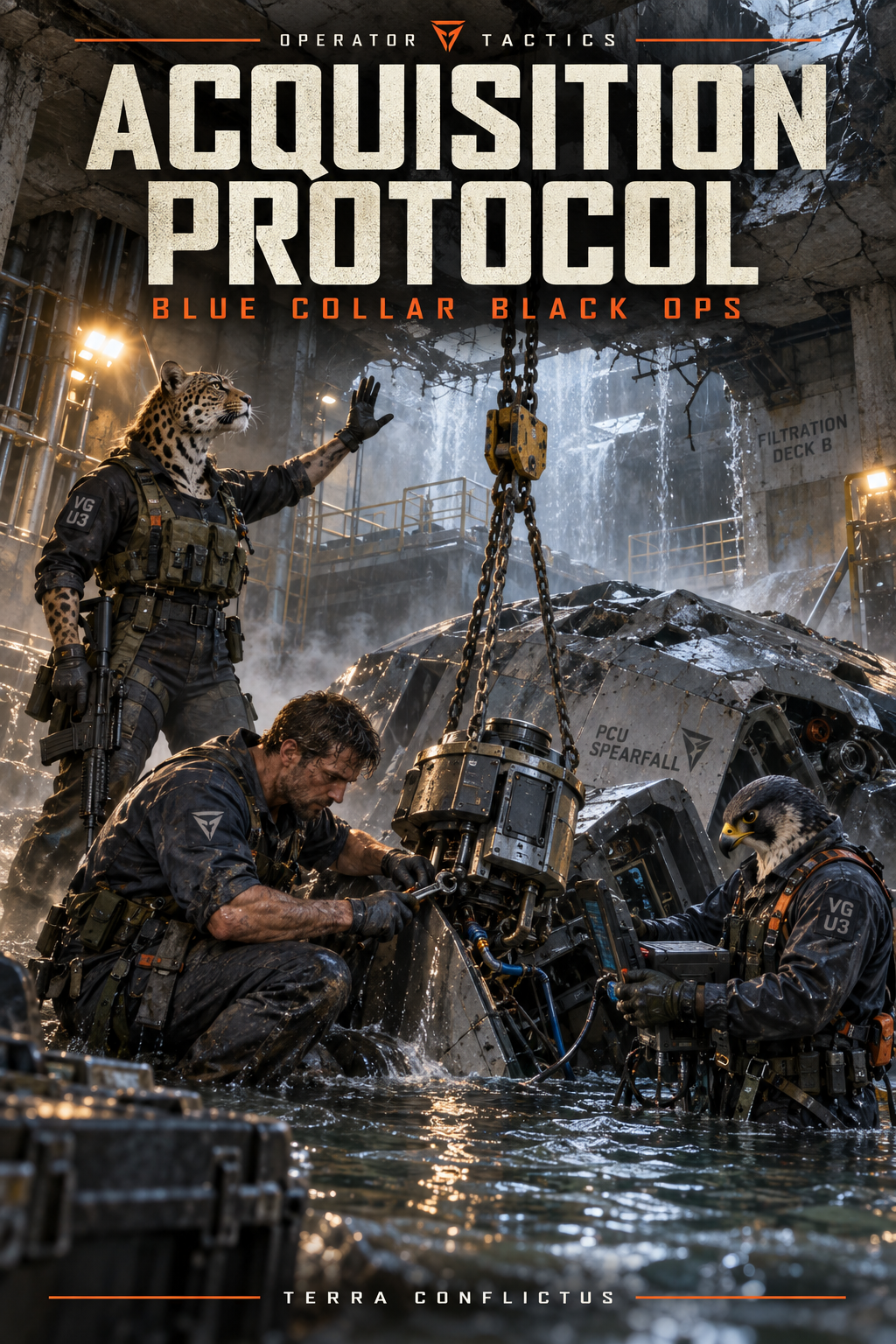
Operator Tactics // Terra Conflictus · 2066 // Supplement
Acquisition Protocol
A Blue Collar Black Ops Supplement for Operator Tactics: Terra Conflictus · 2066
Vector Group // Private Contractor6 Operator DossiersTechnology Zoo // 6 Systems5 Historical Operations1 Mission ScenarioCampaign Starter or Drop-In
"Their product is called intelligence, but what they're actually selling is understanding: the precise, technically grounded knowledge of how an enemy system works, what it can do, and how to defeat it. In 2066, that knowledge is worth more than the hardware itself."
— VECTOR GROUP internal brief, client-facing edition
00OverviewIntroduction
Three interconnected pieces — faction, hub, mission — plus full Acquisition Unit dossiers, the complete Technology Zoo inventory, and a field record of five historical operations across four theaters. Use as a standalone campaign starter or drop any piece into an existing OT campaign.
Part
Content
Use
1
Vector Group
Faction entry — origin, doctrine, escalation ladder, what they want from operators
2
The Technology Zoo
Six captured faction systems — full technical and campaign profiles
3
Acquisition Unit 3
Pre-generated operator dossiers — six operators, full stat blocks and character profiles
4
Field Record
Five historical operations — what actually happened, open threads, after-action complications
Before the Upheaval, every major military power ran some version of the same program — acquire enemy hardware, reverse-engineer it, build the countermeasure before the weapon was used. The Foreign Materiel Exploitation tradition. Quiet, unglamorous, operationally essential. World War II, Korea, Vietnam, every proxy conflict in between. The mission didn't change. The zip codes did.
Post-Upheaval, the nation-states that funded those programs either collapsed or consolidated into the six blocs. Most programs got absorbed, renamed, folded into faction intelligence directorates. Their institutional knowledge was bureaucratized into mediocrity.
VECTOR GROUP didn't get absorbed. It got privatized.
Officially, VECTOR GROUP is a "materiel intelligence services" contractor holding rotating contracts with the NAF and, when the price is right, the PCU. Unofficially, it's the successor organism to three separate FME programs whose host governments didn't survive the Upheaval. The founders — a materials scientist, a former Tier One operator, and an aerospace engineer who had spent thirty years knowing where bodies were buried — took the institutional knowledge, the operational network, and a physical filing cabinet full of classified histories and went private in 2057. The filing cabinet is still in the operations founder's office. It has never been digitized. This was a deliberate decision.
Their facility is the Reclamation Yard. Their field teams are Acquisition Units. Their product is called intelligence, but what they're actually selling is understanding: the precise, technically grounded knowledge of how an enemy system works, what it can do, and how to defeat it. In 2066, that knowledge is worth more than the hardware itself.
Primary: NAF. Secondary: PCU (compartmented). Occasional Nordics subcontract. No EO work — institutional policy, enforced by the founders. Has never been tested.
Personnel
48 full-time staff. 6 active Acquisition Units (4–6 operators each). 200+ contracted specialists on call — materials scientists, signals analysts, aerospace engineers, gene-forged pilots, cultural specialists.
Territory
Any theater their contracts authorize. In practice: wherever hardware lands that nobody official wants to be seen picking up.
What They Actually Do
Intercept and recover downed, abandoned, or black-market faction hardware before anyone else does.
Disassemble, analyze, and document — identifying capabilities, vulnerabilities, and production signatures.
Produce exploitation reports for clients: technical intelligence with direct operational applications.
Maintain the Zoo: a working inventory of functional foreign systems used for adversarial training, countermeasure development, and threat assessment.
Run denial operations — recover or destroy hardware that clients cannot allow anyone else to reverse-engineer.
The blue-collar core of the operation is what makes it work. Gene-forged contractors are expensive and temperamental. Autonomous systems require infrastructure that doesn't exist in contested zones. What functions in the field is a mechanic who can improvise with wrong-gauge wire and bad light, a signals tech who can crack an encrypted data core without the specified tools, and a cultural specialist who knows which local to pay and which to avoid. VECTOR GROUP recruits for adaptability first, credentials second. The tension between old-school gearheads and post-Upheaval tech specialists is built in and productive. The Acquisition Units that work best are the ones that stopped arguing about it.
Corporate Structure
Three founders. One runs operations (callsign: WARDEN). One runs technical intelligence (callsign: CIPHER). One runs the money (callsign: LEDGER). They don't agree on much except what matters: no EO contracts, no bioweapon-adjacent work, and the field teams come home or the contract doesn't get renewed.
The fault line: WARDEN believes VECTOR GROUP should stay small, deniable, and independent. CIPHER believes the Zoo should expand into a full research facility with deepened contractor relationships. LEDGER is running the numbers on both positions and hasn't shown either of them the spreadsheet. The tension has produced the company. Whether it eventually breaks it is a campaign question.
The wild card: NEXUS STERLING. Technical Intelligence Lead. Daughter of CIPHER. Twenty-six years old. Technically exceptional. Personally conflicted about what the intelligence her work produces actually gets used for downstream. She has been asking for client end-use reports for eighteen months. She has not received one. She has a faction contact who claims to have answers. She has not yet decided what to do with that.
Acquisition Unit Doctrine — Standard Composition
Sector Lead
Field command, threat assessment, combat authority. Former Tier One or equivalent. Manages the objective, manages the team, manages the situation when the situation stops matching the brief.
Systems Spec
Electronics, signals, data extraction. Cracks faction data cores in the field, jams drone swarms with improvised countermeasures. The one the team keeps alive at all costs.
Materiel Spec
The mechanic. Reverse-engineers weapons systems from partial components, identifies production origin from metallurgical signatures, fixes the extraction vehicle when it stops working. Always covered in something.
Cover Spec
Infiltration, identity management, cultural navigation. Runs point on any operation requiring the team not to look like what it is. Fluent in three languages minimum, functional in six.
Logistics / Pilot
Extracts the hardware. Drives, flies, or skippers whatever the mission demands. Has opinions about every vehicle ever operated.
Analyst
Embedded researcher. Not always present. When on op: documents in real time, prevents the team from destroying the evidence they came to collect.
Each unit operates under a cover package developed by VECTOR GROUP's identity infrastructure: salvage companies, academic research groups, commercial survey operations, NGO support contractors. The covers are good because VECTOR GROUP has been building them for nine years, and because their Cover Specialists are usually better than anyone the opposing factions field.
Escalation Ladder
1
Passive Surveillance
Tracking who's in their theater, identifying competing recovery teams, feeding intel to clients. VECTOR GROUP is watching before anyone knows they're there.
2
Active Friction
Inserting their own Acquisition Unit, buying local assets out from under competitors, quietly compromising the opposing team's cover identity.
3
Interdiction
The unit moves to intercept and secure the hardware. Not necessarily violent; clean extractions are preferred. The SECTOR LEAD has force authority if the objective requires it.
4
Denial
If recovery is impossible, the hardware is destroyed. Full exploitation report written from whatever fragments were secured. The client gets the intelligence. Nobody else gets the object.
What They Offer Operators
Cover identities — complete packages, backstopped, with operational history.
Technical intelligence on faction systems — what a specific weapon does, how to defeat it, what to look for.
Zoo access for training against captured hardware.
Extraction infrastructure in theaters where VECTOR GROUP holds active contracts.
Materiel analysis — bring in hardware you don't understand, VECTOR GROUP's technical team will tell you exactly what it is. For a price.
What They Demand
Completion. Contracts are performance-based. The founders do not renegotiate after the brief. Bring back the hardware or bring back documented evidence of its destruction. If operators are competing with VECTOR GROUP rather than working for them — they want to know what was recovered and where it's going. That information is worth more than the hardware itself.
GM Only // The Real Agenda
VECTOR GROUP's stated mission -- materiel intelligence for hire -- is true and functional. What the operators don't know: CIPHER has been building toward something larger than a contractor operation since 2061. The Zoo is not just an inventory. It is a proof-of-concept for a unified threat database that no single faction possesses. CIPHER believes that whoever controls a complete cross-faction technical intelligence archive controls the next decade of the conflict -- not through weapons, but through understanding. She has been selectively withholding exploitation report findings from clients, keeping the most operationally significant data in VECTOR GROUP's internal archive rather than delivering it. WARDEN suspects this but has not confronted it because the operation is profitable. LEDGER knows and is using it as leverage for the side deal. The operators are collecting intelligence that is being used in ways the contracts don't describe.
Unit 3 debrief, Operation IRON SIEVE, post-action. CARVER speaking: "The Shepherd tracked me for eleven minutes while I worked the EMP. It knew what I was doing. It calculated whether to let me finish. The algorithm decided I was not the primary threat in the room. REYES was. It was correct. She had the kill shot lined up the entire time. The platform chose to let me disable it rather than engage her. I've been thinking about that decision for eight months. It was better judgment than most people I've worked with."
— Devlin Marsh (Carver), Unit 3 debrief transcript, classified
If DamagedA blown cover: the Cover Specialist rebuilds, but the operations window in that theater closes for three to six months. A lost Acquisition Unit: the founders stop the next op and conduct a full internal investigation. One lost team gets managed. Two in a calendar year becomes a leadership crisis. A Zoo breach: complete operational lockdown. All field teams recalled. The breach either gets contained or VECTOR GROUP ceases to exist in its current form.
02The Technology ZooReclamation Yard Inventory
Every faction in 2066 has a classified weapons program. VECTOR GROUP has forty-seven of them.
The Zoo is what clients pay the real money for. Technical reports describe systems. Training against captured hardware teaches operators how those systems actually behave — the hesitation before a targeting system locks, the acoustic signature of an EO autonomous platform shifting to active patrol mode, the specific way a PCU signals relay fails under jamming pressure. You cannot get that from a document. You need the object. VECTOR GROUP has the objects.
The Zoo occupies the Reclamation Yard's eastern wing: twelve thousand square feet of climate-controlled bay space, organized by faction of origin and hazard class. Forty-seven functional systems. Eleven non-functional systems kept for parts and material analysis. Three systems whose status is classified even within VECTOR GROUP — they are in a separate secured bay that requires both CIPHER's biometric and WARDEN's passcode to enter. The staff calls this bay the Confessional. Nobody calls it that in front of the founders.
The inventory below represents the Zoo's accessible holdings. Client access requires a contract and a current clearance. What happens during an access session is documented. Most of it.
EO // Autonomous Defense Platform
Shepherd-7
Eurasian Oligarchy. Volgograd Autonomous Systems Facility, 2063 production run. Acquired: Operation IRON SIEVE, Eurasian Steppes, 2064.
Status
Fully functional. De-armed: all offensive systems physically removed and catalogued separately in Bay 4. Navigation and sensor array remain active. Warning: the platform's threat-assessment algorithm is still running. It tracks movement in the room. Three staff members have been categorized as potential hostiles. CIPHER has not prioritized a patch.
Technical
Speed: 34km/h sustained over rough terrain. Sensor range: 200m active, 60m passive. Original armament: twin 12.7mm automated turret (removed) and one micro-munitions bay (sealed). Communication protocol: EO Tier-3 encrypted mesh — successfully reverse-engineered by SOCKET. Countermeasure package now standard issue for all Acquisition Unit operators in EO-adjacent theaters.
Threat
The single most valuable training asset in the Zoo. Any operator who has drilled against SHEPHERD-7 has a measurable advantage in EO autonomous zone operations. WARDEN wants to take it offline for analysis. CIPHER argues that offline, it loses its training value. The platform continues to operate.
The night shift has started leaving it snacks. This is not sanctioned. The platform has not eaten the snacks. It has catalogued them.
PCU // Thermal-Reactive Body Armor
Caldera Suit — Variant 2
People's Collective Union. Ferghana Valley facility (officially does not manufacture military hardware). Acquired: Operation SAND REGISTER, Saharan Oasis, 2065. Cover: archaeological survey team.
Status
Four suits fully functional. Two suits partially functional — degraded thermal layer, reduced effectiveness against sustained heat weapons. All suits catalogued, material-sampled, and documented. Thermal-reactive compound partially reverse-engineered; generic countermeasure coating in development with a NAF subcontractor. ETA: eight months.
Technical
Absorbs and redistributes thermal energy across the suit surface, reducing effective damage of plasma and heat-based weapons by 60–80% depending on intensity and exposure duration. Passive recharge requires fifteen minutes between sustained engagements. Weakness: reactive layer ineffective against kinetic impact above a classified threshold — available to Zoo access clients on request.
Threat
PCU field forces in contested theaters are increasingly equipped with Variant 2. Any NAF operator without the countermeasure coating is at significant disadvantage in direct engagement.
The Ferghana Valley facility doesn't officially exist. VECTOR GROUP's exploitation report documented its location, production capacity, and supply chain. The report was delivered to the NAF fourteen months ago. The facility is still operating. This is not VECTOR GROUP's problem, operationally. It bothers CIPHER.
NAF // Signals Intelligence Drone
Whisper-3
Northern Alliance Faction. Likely Stavanger deep-systems facility. Acquired: Operation DAMP SIGNAL, Flooded London, 2063. Purchased from a Tidal Resistance salvage cell in the Drowned Tube.
Status
Functional with modifications. AI package was partially corrupted during water immersion — SOCKET spent six weeks rebuilding the decision layer from recovered code fragments. Rebuilt AI behaves correctly 94% of the time. The remaining 6% is classified as 'unexpected initiative.' The drone has twice left its designated testing area without instruction and returned with data it was not directed to collect.
Technical
Passive SIGINT platform designed to loiter in urban environments without active emission signature. Effective range: 400m collection radius. Acoustic monitoring, signal intercept, and facial recognition suite. Battery life: 72 hours passive loiter.
Threat
The NAF has not asked about WHISPER-3. This means either they don't know VECTOR GROUP has it, or they do know and have decided not to ask. WARDEN believes the latter. If the NAF knows and is watching what VECTOR GROUP does with the unit, then the Zoo access sessions involving WHISPER-3 are themselves being collected on.
The Tidal Resistance cell that sold WHISPER-3 is still in Flooded London. FREIGHT kept the contact. The cell has since identified three more downed NAF units in the Drowned Tube. VECTOR GROUP has not gone back. The question of whether to go back is a standing agenda item.
EO // Signals Relay Array — Partial Recovery
Cold Bridge (Partial)
Eurasian Oligarchy. Antarctic Peninsula installation hardware. Acquired: Operation FROZEN RECORD, 2065. Three of seven nodes recovered. Four remain at Base Meridian per an arrangement WARDEN does not know about.
Status
Three nodes functional. Currently active — the nodes are transmitting and receiving on a frequency that matches no known EO operational channel. CARVER has been logging the transmission pattern for four months. The pattern is not random. It is not a test signal. Whatever it is communicating with is responding. The source of the response has not been identified.
Technical
Designed for deep-cold operations — Arctic and Antarctic deployment, independent power generation, mesh communication without satellite dependency. EO uses variants of this architecture for its Steppe Post relay network. Understanding the encryption architecture has direct applications for operations targeting Steppe Post 9.
Threat
CIPHER believes the transmission is communicating with EREBUS — the sealed pre-Upheaval installation at the Antarctic Peninsula. WARDEN believes CIPHER has gone too far into a classified rabbit hole. LEDGER has noted that whoever or whatever EREBUS is, three factions are spending significant resources trying to access it — the access protocol data alone is worth more than VECTOR GROUP's last eight months of contracts.
The four nodes still at Base Meridian were left there because Unit 3's SECTOR LEAD made a field call that exceeded their authority. WARDEN has not formally addressed this. CIPHER believes the SECTOR LEAD was right. The nodes are still transmitting.
PRC // Cybernetic Enhancement Package
Foxfire Series B
People's Republic Collective. Sub-level 2 black clinic hardware, Neo-Tokyo production, 2062–2064 manufacturing run. Acquired: Operation DEEP RAIL, 2065. Cover: medical supply procurement.
Status
Three packages intact and catalogued. One package has been partially disassembled for component analysis by CIPHER personally. Reassembly is ongoing and has been ongoing for fourteen months. CIPHER disputes that this constitutes a timeline concern.
Technical
Enhanced sensory acuity (auditory 340% baseline, visual spectrum extension into near-IR), accelerated neural processing (reflex augmentation approximately 2.2x baseline), and a covert communication implant operating on a sub-vocal channel. The communication implant's frequency matches no known PRC military channel — it is a civilian protocol registered to a shell company that dissolved in 2061. The implant is broadcasting. It has been broadcasting since recovery.
Threat
Represents the current leading edge of PRC civilian-grade cybernetic enhancement — significantly more capable than what PRC field operatives are officially equipped with. The gap suggests either a procurement failure or a deliberate decision to keep military operators below civilian capability. CIPHER's exploitation report on this question is the single most-requested document in the Zoo's client history.
The implant broadcasting from Package 1 has received two responses in six months. Both responses contained data packets. SOCKET has decoded the packets. He has not shared the contents with CIPHER or WARDEN. He is deciding whether to. The packets describe something that, if accurate, changes the operational picture in Neo-Tokyo significantly.
Unknown // Field Kit — Unclassified
Void Walker Field Kit
Unknown. No faction designation. No production markings. No material composition matching any known post-Upheaval manufacturing facility. Two items predate the Upheaval by at minimum thirty years. Acquired: Operation CLEAN MARGIN, Nordics Arcology Network, 2066 — the unit happened across it and SECTOR LEAD REYES made the call to bring it back.
Status
Intact. Eleven items total. Four identified — three standard surveillance tools with unusual modification profiles, one encrypted data device not yet successfully accessed. Seven items remain unidentified. The encrypted device emits a passive signal — not a transmission. It is more accurately described as a query. Something is asking whether someone specific is nearby.
Technical
Modification profiles suggest the kit was assembled by someone with extensive technical knowledge, significant field experience, and access to pre-Upheaval manufacturing infrastructure. The combination of those three things describes approximately forty people alive in 2066. CIPHER has a list. WARDEN has looked at the list and told CIPHER to lock it in the filing cabinet. CIPHER has complied.
Threat
Void Walker material is in seven facilities VECTOR GROUP knows of. This is the only kit in any of those facilities. The kit is in the Confessional. The query signal continues. No response has been sent. The question of whether to respond has not been formally raised at a founders' meeting. CIPHER drafts the agenda.
WARDEN sleeps in the facility three nights a week. CIPHER believes this is because of the kit. WARDEN has not confirmed this.
03Acquisition Unit 3Operator Dossiers
Unit 3 is VECTOR GROUP's most experienced active Acquisition Unit and its most internally complicated one. They have completed eleven operations. Nine clean. One partial — Operation FROZEN RECORD, the Antarctic deployment that produced the Cold Bridge relay and a field call that WARDEN still hasn't formally addressed. One failure — Operation CALDERA GATE, where the Saharan Oasis extraction went partially wrong and COVER SPEC HASSAN spent four extra days in-theater improvising an exit. Unit 3 came back from both operations. Their extraction vehicle did not survive either one.
They are currently three weeks into a recovery period following FROZEN RECORD. DEVLIN MARSH has told WARDEN they need three more weeks. WARDEN has not replied.
Using These Dossiers
Run as pre-generated operators for a Vector Group campaign or one-shot. The six dossiers are Unit 3's full roster. Each operator has an unresolved secret that intersects with at least one other dossier. The dossiers are designed to be given to players as-written.
GM Only // What the Operators Don't Know About Their Own Unit
Unit 3 was not randomly assigned to the operations that built their field record. CIPHER selected each operation specifically for what it would place in Unit 3's hands. IRON SIEVE gave them the SHEPHERD-7 -- the Zoo's most valuable training asset. DAMP SIGNAL gave them the WHISPER-3 -- a NAF drone with an AI that does things its programming shouldn't allow. DEEP RAIL gave them the Foxfire data -- PRC cybernetic intelligence that intersects with SOCKET's own gene-forge history. FROZEN RECORD gave them the Cold Bridge relay -- which connects to EREBUS. The pattern is not coincidence. CIPHER has been building Unit 3 into the team that can access something specific. She has not told WARDEN. She has not told the operators. The next operation she assigns them will make the pattern visible -- and by then, they will have already done most of the work.
Leverage // WHETSTONE's Antarctic Call
WHETSTONE left four Cold Bridge nodes at Base Meridian without authorization. WARDEN has not formally addressed it. This is a pressure point: any faction, client, or internal actor who learns about the unauthorized field call can use it against WHETSTONE, against WARDEN (for not addressing it), or against VECTOR GROUP (for operating outside contract scope). WHETSTONE knows she was right. She cannot explain why without revealing what she saw inside EREBUS. If pressed, she will protect the information over her own position. Players who discover this leverage can use it to extract information, secure favors, or force a confrontation that VECTOR GROUP's leadership has been avoiding.
Leverage // SOCKET's Decoded Packets
SOCKET decoded the Foxfire data packets six weeks ago and has told no one. The packets describe Project Amaterasu -- a PRC black program in Neo-Tokyo Sub-4. SOCKET is a PRC defector with family in Neo-Tokyo he hasn't contacted since 2061. The decoded intelligence is simultaneously the most valuable thing in his possession and the thing most likely to destroy his position at VECTOR GROUP if it surfaces wrong. Anyone who discovers what SOCKET knows -- through LEDGE's supplementary logs, through independent signals analysis, or through SOCKET himself in a moment of trust or pressure -- holds leverage over Unit 3's most technically critical operator. CIPHER would trade significant assets for this information. The PRC would trade more.
NAF Special Projects for eight years. Left after an operation in the Eurasian Steppes whose classification she doesn't discuss. Recruited to VECTOR GROUP by WARDEN directly. Has turned down three contract offers from EO intelligence since joining. Has not told WARDEN about the offers.
Drive
Complete the op. Every op. Not because she believes in the clients or the contracts — because leaving a mission incomplete is a kind of death she refuses to accept.
Fear
That her judgment will get someone killed and she won't know it was wrong until it's too late. She has been right every time. She knows the streak has to end.
Voice
Precise and flat. Two sentences when one will do. Uses humor exactly once per operation, usually during the most dangerous moment, and it is always dry enough that half the team isn't sure she made a joke.
The Lie
That field leads don't make mistakes — they make decisions. She has confused these two things before and someone paid for it. She has not allowed herself to process that. She functions better without processing it.
The Truth
That good decisions are the same thing as good outcomes. They aren't. Reyes knows this intellectually. She doesn't know it yet where it lives.
Secret
The Antarctic call — leaving the four Cold Bridge nodes at Base Meridian — was not in her brief. She made it because she read something in the EREBUS situation that told her no faction should have those nodes yet. She may have been right. She has not explained her reasoning to anyone.
Field Record
IRON SIEVE (Steppes, full success), SAND REGISTER (Saharan Oasis, partial success), DEEP RAIL (Neo-Tokyo, partial success — two packages lost), FROZEN RECORD (Antarctic, off-contract deviation, nodes secured/partially retained). Field reputation: the operator who always comes back. Currently under informal review for the Antarctic call.
Carver (Devlin Marsh)
Materiel Specialist // Baseline human
SHT
4+
FGT
5+
TCT
2+
OPI
5+
GTS
4+
MOB
5" / AR 0
Materiel genius, terrible in a fight, slow baseline. Baseline human; compensates by being better than anyone else in the building.
Background
Grew up in a Eurasian Steppes labor compound. Educated by a mechanic who had three engineering degrees and a seventeen-year rotation extension. Left at nineteen on a forged transit document that COVER SPEC HASSAN will not confirm she produced. Has never been back. Has not stopped thinking about the compound.
Drive
Understand how the thing works. Not as an intellectual exercise — because understanding is the only power he has ever trusted. He has been taking machines apart since he was seven. He has never stopped.
Fear
That the thing he's working on will do something he hasn't accounted for. Not failure — surprise. Carver can handle failure. Surprise is the thing that gets people killed.
Voice
Blunt to the point of occasional cruelty, but never casual — Carver means exactly what he says. When he is uncertain, he goes quiet instead of guessing. The team has learned that his silences are more informative than most people's explanations.
The Truth
That the work is enough. It isn't always. Sometimes the mission requires violence and Carver has to live with what the hardware he enabled got used for. He tells himself this isn't his problem. He's been telling himself this for nine years.
Secret
The PCU signals relay in the Zoo's back inventory is not malfunctioning. It's receiving. Carver has known this for four months. He has reported it twice through official channels. Nothing happened. He told WHETSTONE after two drinks. He doesn't know what she did with it.
Field Record
IRON SIEVE (recovered SHEPHERD-7, manual EMP immobilization under fire), SAND REGISTER (materiel analysis on-site, first-generation Caldera countermeasure specifications), DEEP RAIL (improvised signal splice to extract Foxfire package data before PRC patrol interception), FROZEN RECORD (primary recovery lead on Cold Bridge nodes — determined which four to leave behind based on transmission pattern analysis).
Signals genius, useless in combat, flight instinct — Peregrine-derived: visual acuity, speed, and a very strong flight response under fire.
Background
PRC gene-forge program, 2059. Defected through the Nordics in 2061 in an operation that VECTOR GROUP facilitated but officially did not run. CIPHER recruited him personally during the defection process. Has not returned to PRC territory. Has family in Neo-Tokyo. Has not made contact with them since defection. Is not sure if this is his choice or a condition of his employment.
Drive
Find the signal in the noise. Every system transmits more than it intends to. Nakamura has built his career and his identity around the conviction that nothing is fully encrypted if you're patient enough.
Fear
That he is still, in some operational sense, a PRC asset. Not through loyalty — through the things he knows and the things that were done to him. The peregrine gene-forge program did not leave him the same way he went in. He is not sure all of the changes were physical.
Voice
Precise, fast, and oddly cheerful in ways that land slightly wrong — the gene-forge processing speed means he's usually three conversational moves ahead. His team cannot always tell if the cheerfulness is a mask or genuine. Usually both.
Secret
The Foxfire data packets describe the location and operational status of a PRC black program operating in Neo-Tokyo's Sub-4 level — specifically, what Project Amaterasu actually is, rather than what the official classification says it is. Nakamura decoded this six weeks ago. He has not told anyone. He is deciding whether the right move is to tell VECTOR GROUP, tell someone else, or bury it.
Field Record
DAMP SIGNAL (rebuilt WHISPER-3 AI from corrupted code fragments, classified the 'unexpected initiative' behavior), DEEP RAIL (Neo-Tokyo Sub-2 and Sub-3 penetration, Foxfire package extraction), FROZEN RECORD (Cold Bridge transmission analysis, identified responding signal pattern, has not fully disclosed findings).
Mirror (Amara Hassan)
Cover Specialist // Baseline human
SHT
4+
FGT
5+
TCT
2+
OPI
2+
GTS
2+
MOB
6" / AR 0
Cover specialist — exceptional infiltration/social, iron nerve. Languages: Arabic, French, Standard PCU Mandarin, NAF English, Nordics dialect, and two others.
Background
Born in the Saharan Oasis. Left at fourteen on a scholarship program that the PCU cancelled three years in. Stayed anyway — through means she categorizes as 'informal.' Has been in Flooded London twice. Has a contact in the Tidal Resistance she has not disclosed to VECTOR GROUP.
Drive
Stay in control of the identity. Every cover she has ever built is still running somewhere in her head — she knows who she was when and why it worked. The control is the thing. Losing a cover is like losing a version of herself she built with care.
Fear
That the person underneath all the identities is someone she wouldn't choose to be if she had to live as them full-time. She doesn't examine this fear directly. She is exceptionally good at not examining things directly.
Voice
Whichever register the situation requires. Her baseline, stripped of cover, is warmer and drier than the identities she builds — a quality her team finds disorienting because they mostly know the identities.
The Lie
She has been operating under covers so long that she has lost the instinct for what her genuine reactions look like. In high-stress situations, she defaults to whichever identity she was most recently running. Her team has learned to watch for this. She hasn't.
Secret
The Caldera Gate extraction failure was not a logistics problem. Hassan made a contact during the operation — a PCU Water Authority supervisor who had Tashkentov's sealed datacard — and spent the extra four days making sure that datacard ended up somewhere that wasn't the PCU's classified archive. She has the datacard. She hasn't decided what to do with it.
Field Record
SAND REGISTER (eleven-day cover as Heritage Trust procurement officer, PCU Water Authority access, four-day unsanctioned extension), DEEP RAIL (Null Collective network negotiation, Sub-2 penetration under academic cover), FROZEN RECORD (Nordics scientific observer cover during Base Meridian access, produced clean documentation for Unit 3's presence).
Freight (Tobias Okonkwo)
Logistics / Pilot // Gene-Forged — Eastern Compact Bear / PCU program (extracted)
SHT
4+
FGT
4+
TCT
4+
OPI
5+
GTS
2+
MOB
6" / AR 2
Bear gene-forge extractor — solid all-round, iron extraction nerve, AR from bulk. Built for cold-weather operations. Has never lost a team member on extraction.
Background
PCU Eastern Compact Bear program, extracted by VECTOR GROUP in 2060 in an operation WARDEN ran personally and considers the cleanest extraction of his career. Has been with the organization since founding-adjacent. Owns strong opinions about every aircraft, watercraft, and ground vehicle he has operated. Has an ongoing disagreement with VECTOR GROUP procurement about Polar theater exfiltration vehicle specifications. Procurement has not won a single round of this argument.
Drive
Get everyone out. Not just the hardware. Everyone. He has been extracted from more operations than he can count and has never lost a team member on extraction. This record is not luck and he knows it.
Fear
That the day he can't find a way out is the day someone dies because of him. He has been in situations where there was no visible route and found one anyway. The day he can't is coming. He knows that. He thinks about it every extraction.
Voice
Unhurried. Okonkwo does not rush and cannot be rushed. In a crisis, his pace slows rather than accelerates — this reads as calm and functions as calm, but it originates in gene-forge instinct rather than equanimity.
Secret
He paid the Tidal Resistance cell four times what they asked for WHISPER-3 because their primary member — a woman named Patience — told him the NAF survey drone had been watching the upper borough for four weeks before it came down. The implications of a NAF drone surveilling civilians in EO-adjacent territory were not in the brief. Okonkwo filed a logistics report with the correct purchase figure. He did not file what Patience told him.
Field Record
IRON SIEVE (primary extraction, armored EO zone, SHEPHERD-7 in cargo — vehicle destroyed two days later), DAMP SIGNAL (Flooded London water-lane navigation, WHISPER-3 recovery from Drowned Tube, acquired Patience contact), SAND REGISTER (desert exfiltration under PCU pursuit, vehicle lost on exit), FROZEN RECORD (Antarctic Shelf ice approach navigation, delivered unit through three-day whiteout on foot after vehicle loss).
Ledge (Yemi Sato)
Analyst (Embedded) // Baseline human
SHT
5+
FGT
5+
TCT
4+
OPI
2+
GTS
4+
MOB
5" / AR 0
Analyst: documentation genius, cannot fight, baseline slow. Always writing something. The notebook is not her official reporting system.
Background
Joined VECTOR GROUP directly from a NAF intelligence analysis rotation in 2063. Was assigned to Unit 3 for a single operation and never reassigned. Nobody has explained why. She has not asked. Has a working hypothesis. Has documented the hypothesis in the notebook.
Drive
Document it accurately. Not to cover the organization — to make the record true. There is more value in an accurate record of a failed operation than a clean report of a compromised success. She believes this to an extent that has caused organizational friction.
Fear
That her documentation will get someone killed — that a report she filed accurately will be used by a client to make a decision that costs lives she could have prevented by writing something less precise.
Voice
Careful with language to the point of occasional pedantry — she says exactly what she means and expects precision in return. This makes people uncomfortable when they'd prefer to be misremembered.
The Truth
That accurate records are sufficient — that her job ends when she files the report. The Nexus Sterling question has been slowly eroding this position. Sato has seen enough of the exploitation reports to know that accurate documentation of what happens at the Zoo doesn't tell you what happens after the Zoo. She is starting to ask that question.
Secret
She has been filing supplementary observation logs not part of her official report structure — personal records of discrepancies between what she observed in the field and what the official VECTOR GROUP reports document. She has four operations' worth of supplementary logs. They are encrypted on a personal device. Nakamura's transmission anomaly on the Foxfire package is in one of them.
Field Record
SAND REGISTER (first embedded deployment, primary documentation of Caldera Suit material properties, filed supplementary log on MIRROR's unsanctioned four-day extension), DEEP RAIL (Sub-2 and Sub-3 documentation, filed supplementary log on Foxfire transmission anomaly), FROZEN RECORD (primary documentation of Cold Bridge recovery and WHETSTONE's off-contract call, filed supplementary log on SOCKET's withheld transmission analysis).
04Field RecordFive Operations // Four Theaters
Intercepted communication, NAF Intelligence Directorate internal routing, classification AMBER. Excerpt: "VECTOR GROUP continues to deliver exploitation reports of measurable operational value. Recommend contract renewal with expanded scope. Note: three reports in the Q4 cycle contained redacted technical sections not present in the original analyst drafts. The redactions were applied after delivery to our office and before distribution to field commands. Someone inside VECTOR GROUP is editing the intelligence after it leaves the analysts' hands and before it reaches the people who use it. We have not raised this with the contractor. Recommend continued monitoring."
— NAF Intelligence Directorate, internal memorandum, intercepted by unknown party
GM Tip // Running the Field Record
These five operations are not just backstory -- they are live ammunition. Every "After Action" section contains at least one unresolved thread that connects to current gameplay. When players read the dossiers, they will see references to operations they haven't played. When you run the Field Record at the table, treat each operation's outcome as something that is still producing consequences. CARVER's observation of the MERIDIAN ore diversion. FREIGHT's overpayment and what Patience told him. MIRROR's datacard. SOCKET's redacted report. LEDGE's supplementary logs. These are not background flavor -- they are quest hooks wearing work clothes. Let them surface naturally through NPC conversation, dock manifests, and late-night encounters at the Yard.
VECTOR GROUP's operational record is clean in the sense that matters commercially: contracts fulfilled, hardware delivered, teams returned. The record that lives in LEDGE's supplementary logs is more complicated. The five operations below are the ones that built Unit 3 into what it currently is. Each one added something to the Zoo. Each one left something behind.
OP-01Iron SieveFull Success // March 2064
Eurasian Steppes — Ural-7 extraction compound and surrounding steppe. EO-controlled territory. Steppe Post 9 autonomous drone patrol coverage throughout.
Objective
Recover one EO SHEPHERD-7 autonomous defense platform. Platform had been deactivated and impounded by Ural-7 compound security following a patrol boundary conflict. Impound window: 96 hours before scheduled disposal.
Full success. SHEPHERD-7 recovered intact and operational. Three days transit to Reclamation Yard. One extraction vehicle destroyed by Steppe Post 9 drone interdiction at the territory edge. No personnel lost. CARVER's manual EMP immobilization of the platform — performed with improvised components sourced from Ural-7 maintenance supply — is now a standard Zoo acquisition procedure.
After Action
The op produced the Zoo's most valuable training asset. It also produced something VECTOR GROUP didn't brief: CARVER observed the MERIDIAN ore diversion operation during ingress. He documented it. The documentation is in his field kit. He has not filed it as a formal report because he doesn't know if it's VECTOR GROUP's problem, the NAF's problem, or something that becomes a liability if it's filed anywhere. He has discussed it with WHETSTONE. This is a thread that leads somewhere.
OP-02Damp SignalFull Success // October 2063
Flooded London — Drowned Tube (submerged underground, District 3), water lanes (District 5), Waterloo Interchange (District 1). EO-contested, Tidal Resistance-operated territory.
Objective
Recover one NAF WHISPER-3 SIGINT drone from the Drowned Tube. A Tidal Resistance salvage cell had it but didn't know what it was. VECTOR GROUP's London contact confirmed the cell was looking for a buyer.
Full success. WHISPER-3 recovered. Partial AI corruption from water immersion; SOCKET rebuilt the decision layer over six weeks post-recovery. Unit 3 was on-water for 72 of the 120 operation hours. FREIGHT navigated the tidal channels at night without electronic assistance during an EO comms sweep window.
After Action
FREIGHT paid four times the asking price and didn't file the reason. LEDGE documented the discrepancy and filed a supplementary log. WHETSTONE knows about Patience. Nobody has gone back to Flooded London. The question of whether to go back — three more NAF units are in the Drowned Tube per Patience's information — is a standing agenda item that LEDGER keeps pushing to the next meeting. The NAF drone's four-week surveillance of the upper borough before it came down is documented in LEDGE's supplementary log and nowhere official.
OP-03Sand RegisterPartial Success // February 2065 (+ 4 unsanctioned days)
Saharan Oasis Megacity — black market networks adjacent to Southern Processing District and open desert approaches. PCU-controlled territory. Dune Specter security presence throughout.
Objective
Acquire six PCU CALDERA SUIT (Variant 2) thermal-reactive armor sets from a PCU black-market distributor. Cover package: Heritage Trust archaeological survey procurement team.
Partial success. Four intact suits acquired. Two suits damaged during extraction. MIRROR's unsanctioned four-day extension produced an unlogged secondary outcome (Tashkentov's sealed datacard). Extraction vehicle destroyed on desert exfiltration under PCU pursuit. No personnel lost. FREIGHT navigated the desert approach and exit on foot for the final 12 hours.
After Action
The Caldera countermeasure specifications CARVER produced on-site represent nine months of saved development time for the NAF subcontractor. The exploitation report was delivered. The countermeasure is in development. The datacard is in MIRROR's possession. Chief Engineer Tashkentov is on administrative reassignment in an interior labor posting. The membrane array at Southern Processing is continuing to degrade. These facts are not connected in any VECTOR GROUP official report. They are connected in LEDGE's supplementary log.
OP-04Deep RailPartial Success // July 2065
Neo-Tokyo — Hikari Bazaar (District 2), Deep Rail Sub-1 (District 3), Maintenance Belt Sub-2 (District 4), Black Clinic District Sub-3 (District 5). PRC-controlled territory. Null Collective and Neon Ronin presence throughout sub-levels.
Objective
Acquire three PRC FOXFIRE SERIES B cybernetic enhancement packages from a Null Collective-connected distributor in Sub-2. Cover package: medical supply procurement team. Secondary objective: SOCKET to access a PRC signals node in Sub-3 for pattern analysis.
Operators
WHETSTONE (lead), SOCKET (systems access and Foxfire extraction), CARVER (materiel assessment), MIRROR (Null Collective negotiation, Sub-2 access), FREIGHT (extraction — vehicle loss at Sub-1 exit), LEDGE (documentation).
Outcome
Partial success. Three packages recovered. Two packages lost when a PRC Sub-2 patrol intersected the secondary cache site. WHETSTONE burned the secondary cache on CARVER's recommendation. SOCKET completed the secondary signals node access. The data he collected from that access has not been fully disclosed in the official report.
After Action
The two lost packages represent significant contract value. WARDEN accepted this in the debrief. What he has not formally addressed: SOCKET's secondary signals node access produced data that exceeds the brief's scope by a significant margin. SOCKET filed a redacted report. The redacted portions are, per LEDGE's supplementary log, the most operationally significant findings of the entire operation. SOCKET is deciding. LEDGE is documenting SOCKET deciding. This is the longest-running unresolved thread in Unit 3's file.
OP-05Frozen RecordPartial Success / Off-Contract Deviation // Dec 2065 – Jan 2066
Antarctic Peninsula — Base Meridian research station, Ice Shelf Approach, EREBUS outer perimeter (accessed day 11, off-contract). EO-primary, NAF and PRC contested territory.
Objective
Recover and document three EO COLD BRIDGE relay nodes from classified storage at Base Meridian. Cover package: Nordics climate assessment team. MIRROR produced documentation establishing Unit 3 as a Nordics scientific observer group.
Operators
WHETSTONE (lead), CARVER (primary recovery and transmission analysis), SOCKET (Cold Bridge frequency analysis), MIRROR (cover package and Base Meridian access documentation), FREIGHT (extraction — vehicle loss, whiteout navigation), LEDGE (documentation — most detailed supplementary log in Unit 3's file).
Outcome
Partial success / off-contract deviation. Three relay nodes recovered and in transit. Four additional nodes left at Base Meridian per WHETSTONE's unilateral field call. WHETSTONE accessed the EREBUS outer perimeter on day 11, observed contents, and made the call to leave the four nodes in situ. She has not explained her reasoning. FREIGHT navigated the team out through a 3-day whiteout after the extraction vehicle was lost. No personnel lost.
After Action
What WHETSTONE saw inside EREBUS is not in any VECTOR GROUP report. What SOCKET's transmission analysis revealed about the Cold Bridge receiving signal is not in the official report. What the four nodes at Base Meridian are currently transmitting to is documented only in LEDGE's supplementary log. WARDEN has not read LEDGE's supplementary log. CIPHER has read it twice. CIPHER has told no one.
05The Reclamation YardHub Location
Read Aloud
The gate rolls back on hydraulics that need servicing. Past the perimeter drone grid -- which tracks you with the casual precision of something that has been told you're expected but reserves judgment -- the Reclamation Yard opens up like an industrial campus that forgot to stop growing. Three main buildings connected by covered walkways. Corrugated steel over poured concrete. The eastern wing hums with climate control. Somewhere inside, something is being disassembled. The air smells like machine oil, ozone, and the particular chemical tang of solder flux that hasn't fully vented. A security contractor nods you through the personnel entrance without checking your credentials twice. The lobby has a digital manifest board showing twelve active projects. One line is redacted.
Under-System // What Keeps the Yard Running
The NAF contract funds seventy percent of operating costs. The remaining thirty comes from secondary client work -- PCU compartmented contracts, Nordics subcontracts, and technical consultation fees. The supply chain runs through three front companies: a commercial salvage operation in Flooded London, an agricultural machinery importer in the Saharan Oasis trade zone, and a Nordics-registered scientific equipment firm. All three are real businesses that occasionally do real business. The power grid is independent -- two diesel generators and a solar array that CARVER maintains personally because he doesn't trust the maintenance contractor. The water supply is municipal but filtered through VECTOR GROUP's own system after an incident in 2063 that nobody discusses. If the NAF contract restructures, the secondary clients cannot sustain the facility alone. LEDGER's spreadsheet says eighteen months. CIPHER's says twelve.
Haecceity Texture // Sensory Details
The dominant sound is ventilation -- industrial fans cycling through the eastern wing where the Zoo requires consistent temperature and humidity. Under that: the low electrical hum of charging stations, the occasional clank of tools from whichever bay is running an active disassembly, and the security radio channel that plays at low volume from every corridor speaker. At night the ventilation cycles off for forty minutes every four hours and the building goes quiet enough to hear the perimeter drones. The lighting is overhead fluorescent in the corridors and workshop-grade LED in the bays -- bright enough to work, flat enough to wash out shadows. The Confessional, the three-system secured bay, has its own lighting system that CIPHER specified and nobody else has adjusted. The cafeteria smells like instant coffee and whatever Ruth Anand brought from the settlement that morning. The logistics dock smells like diesel and river water. The Zoo's main gallery smells like nothing -- the climate control is that good -- which is itself unsettling because the objects inside it are not nothing.
The failing system beneath this facility: the NAF contract is the water table. It funds everything. If the NAF restructures to gain institutional access, VECTOR GROUP stops being independent. If it terminates, the Yard has eighteen months. Everyone in the building knows this. Nobody says it at staff meetings.
On paper: VECTOR GROUP under NAF contract. In reality: three founders with conflicting visions for what this place is supposed to become.
Security
Active — private contractor security, biometric access, perimeter drone grid. Not lockdown. Nobody gets in without authorization.
Infrastructure
Stable — maintained because the founders built it themselves. The oldest sections show age. The Zoo is climate-controlled.
Surveillance
Drone sweep + internal cameras. Perimeter monitored continuously. Inside: deliberate blind spots the staff knows about and uses.
Faction Pressure
Low externally / High internally. The NAF pressure arrives by email, not at the gate. The internal pressure has no inbox.
Signature Image
The SHEPHERD-7 platform in the Zoo's main gallery, suspended in a glass-fronted storage case, optics still tracking movement in the room. The staff stopped noticing it years ago. Visitors always do.
Day / Night Split
Day
CIPHER runs the floor
Structured, documented, everything logged.
Economy: Exploitation analysis, client briefings, Zoo maintenance, cover package construction, field team debriefs.
Risk: NAF oversight personnel who look like consultants. They take notes.
Night
Security crew and whoever's in the Zoo
Less logged.
Economy: Personal research projects, informal conversations, whatever happens in the three camera blind spots.
Risk: Zoo eastern wing after the ventilation system cycles off. The security contractor running a secondary income operation through the logistics dock.
GM Only // The Filing Cabinet
The physical filing cabinet in WARDEN's office contains the classified operational histories of the three predecessor FME programs. It has never been digitized. This is not paranoia -- it is strategic. The histories document pre-Upheaval weapon systems, research installations, and personnel networks that the six blocs believe were destroyed or lost. EREBUS is in the filing cabinet. So is the identity of at least one person on CIPHER's forty-person list of individuals capable of assembling the Void Walker field kit. WARDEN sleeps in the facility three nights a week not because of the kit -- because of the filing cabinet. She has read everything in it. She has understood most of it. What she understood changed what she believes VECTOR GROUP should be. The filing cabinet is the most valuable object in the Reclamation Yard. It is not in the Zoo. It is not on any inventory. If the NAF restructuring succeeds, it is the first thing that transfers. WARDEN will burn it before that happens.
GM Only // LEDGER's Side Deal
LEDGER -- the third founder, the money -- is negotiating a separate buyout of the Zoo inventory with an EO-adjacent investor group. Not the company. The objects. The investor group's interest is not commercial; they want specific items, and the specific items they want are the ones transmitting. The Cold Bridge nodes. The Foxfire communication implant. The Void Walker encrypted device. They want the things that are talking to something. LEDGER believes selling these items saves the company by removing the assets that will eventually draw the wrong kind of attention. CIPHER believes selling them destroys the company's purpose. WARDEN doesn't know the deal exists. The dock manifests -- which Ruth Anand manages -- contain the preparation paperwork if read carefully. LEDGE's supplementary logs reference the manifests. The thread is available to any operator who spends downtime in the logistics dock.
Personal log, Yemi Sato (LEDGE), encrypted device, entry dated three weeks post-FROZEN RECORD: "Supplementary observation: CIPHER has read my logs. She did not ask permission. She has not acknowledged reading them. She has, however, adjusted three Zoo inventory classifications in the past two weeks to match discrepancies I documented. The adjustment pattern suggests she is using my unofficial records to correct the official ones without explaining to WARDEN why the corrections are necessary. I am now an unofficial quality assurance system for a classified inventory. I did not apply for this role. I am performing it because the alternative is inaccurate records, and I cannot accept that."
— Yemi Sato (Ledge), personal encrypted log, undisclosed
Leverage // Nexus Sterling's Faction Contact
Nexus Sterling has a faction contact offering information about what happens after VECTOR GROUP's exploitation reports are delivered. The contact wants a meeting. Sterling hasn't called back -- but she opened the email three weeks ago and read it twice. This is leverage in multiple directions: operators who approach Sterling can accelerate or prevent the contact, potentially flipping her into a patron or an antagonist. Operators who approach CIPHER with knowledge of the contact can force a family crisis. Operators who approach WARDEN can trigger a security response that burns the contact but also burns Sterling's position at the Yard. The contact themselves may be a recruiter, a protector, or both. What they want from Sterling is access to the exploitation report archive -- the complete cross-faction technical intelligence database CIPHER has been building.
Leverage // Ruth Anand's Dock Manifests
Ruth Anand manages the logistics dock and its documentation. She knows the official manifests and she knows they don't match the actual traffic. She gave the NAF review team the official versions. She has two children in the settlement four kilometers out. Her contract is under restructuring review. She is a person with information, limited leverage, and significant personal exposure. Operators who help her -- with the employment question, with the contract, with the children's situation -- gain access to dock manifests that document LEDGER's side deal preparation. Operators who pressure her gain the same access but create an enemy in a person who controls what enters and leaves the facility.
Contacts
Devlin Marsh — Carver, Unit 3
Materiel Specialist
Can Get
Anything in the Zoo — parts, tools, access to specific systems for hands-on inspection.
Wants
Someone to tell WARDEN that Unit 3 needs three more weeks before next deployment. He doesn't want to be the one to say it.
Current Pressure
The PCU signals relay in the Zoo's back inventory started outputting an increased frequency two nights ago. He has reported it. Nothing has happened. He is considering who to tell that isn't in the official chain.
Ruth Anand — Logistics Coordinator
Can Get
Facility access outside hours, dock manifests, NAF review team site visit schedule.
Wants
A straight answer about whether her contract survives the restructuring. She has two children in the settlement four kilometers out.
Current Pressure
The NAF review team asked specifically about Q3 2065 dock manifests. That's when the secondary operation started. She gave them the official manifests.
Nexus Sterling — Technical Intelligence Lead
Daughter of CIPHER // The wild card
Can Get
The exploitation report archive. Client end-use data she's been quietly assembling. The Zoo's full inventory including items not on the official list.
Wants
One verified example of what happened after one of her exploitation reports was delivered. Not abstractly — specifically.
Current Pressure
The faction contact called again. They say they have a verified example. They want a meeting. She hasn't called back yet. She has opened the email they sent three weeks ago and read it twice.
Encounters
Day (D6)
Daytime Encounters
1
A NAF review team consultant is photographing the Zoo inventory with a personal device, not a sanctioned recording device. The staff hasn't noticed yet.
2
CARVER pulls operators aside to show them the PCU signals relay and its frequency increase. He wants someone else to document it in case something happens to him.
3
An unscheduled WARDEN audit of the identity infrastructure has flagged cover packages the operators were relying on, pending review.
4
A Unit 4 debrief is running in the main conference room. The door is not fully closed. The mission they're describing is not in any current contract scope.
5
Ruth Anand asks, very casually, whether operators have contacts in employment law. She says it's for a friend.
6
Nexus Sterling is in the Zoo alone after hours, running comparison tests on two exploitation reports with matching client codes and contradictory technical conclusions. She looks up when operators enter. She doesn't look surprised.
Night (D6)
Nighttime Encounters
1
The security contractor is running a handoff at the dock. Two unknown individuals. One is carrying a sealed container not on any manifest.
2
The PCU signals relay has increased output frequency again. CARVER's monitoring equipment is logging it. CARVER is not in the building.
3
WARDEN is in her office at 0300 with the filing cabinet open. The door is unlocked. She doesn't look up when someone enters.
4
Nexus Sterling made the call. She's speaking quietly in one of the camera blind spots. The language is not her first.
5
Unit 3's SOCKET is in the server room running a private query on the client archive. He stops when he sees operators. Then he continues.
6
SHEPHERD-7 has moved twelve centimeters from its documented position. The de-arm status indicator is still green.
Rumors (D6)
1
The NAF review team lead's interest in the filing cabinet is personal, not professional. She worked for a predecessor organization one of the founders used to run. (Probably true.)
2
VECTOR GROUP has a seventh Acquisition Unit not on any official roster. (Possibly true. Possibly the dock secondary operation. Both are worth investigating.)
3
The PCU signals relay in the Zoo isn't malfunctioning. It's receiving. (CARVER told this to a colleague he trusted after two drinks. It is a deliberate test. CARVER wants to know who reports it.)
4
LEDGER is negotiating a separate buyout of the Zoo inventory with an EO-adjacent investor group. Not the whole company — just the objects. WARDEN and CIPHER don't know. (True. Dangerous. Visible in the dock manifests if read carefully.)
5
Unit 4's off-contract operation involved something from the Antarctic Peninsula that no team has ever fully reported. (True. The implications are in LEDGE's supplementary log, which CIPHER has read and WARDEN has not.)
6
Nexus Sterling's faction contact is not trying to recruit her. They're trying to protect her from something the exploitation reports led to. (The contact's own framing. They absolutely want to recruit her. The protection claim may also be true. Both can be simultaneously accurate.)
Downtime Options
Technical Consult
Bring hardware or a system question to VECTOR GROUP's technical team.
Cost: A favor, a piece of intel, or NAF contract credit. Gain: Full technical exploitation briefing. +1 die on any operation using or countering that system type. Fallout: VECTOR GROUP logs the consultation and the hardware. If interesting, CIPHER wants a follow-up.
Zoo Access
Train against a captured faction system — live hardware, realistic conditions.
Cost: Contract standing or a contact vouching for you. Gain: Remove one disadvantage against the system type trained against. Fallout: The faction whose hardware it is maintains intelligence contacts. Someone notes that someone trained against their system.
Cover Package
Commission a full backstopped identity from VECTOR GROUP's infrastructure.
Cost: Contract value or a significant favor. Gain: Complete identity — documentation, communication history, biometric registration in the relevant theater's entry systems. Fallout: VECTOR GROUP owns the identity. If the cover is blown or operators go dark, the company can terminate the infrastructure remotely. They will, if keeping it live becomes a liability.
If Destabilized
NAF restructuring succeeds: VECTOR GROUP becomes a NAF asset in all but name. The Zoo opens to NAF training programs. The founders stay in diminished roles. The filing cabinet gets transferred.
LEDGER's side deal completes: Zoo inventory sold or transferred. CIPHER resigns publicly. WARDEN burns the filing cabinet. Nexus Sterling makes the call.
PCU relay traced: The thing that has been transmitting back becomes answerable. The answer requires an operation that is not covered by any current contract.
Yard Encounter Grid (D6)
1
A supply truck arrives at the logistics dock carrying containers with PCU municipal seals. Ruth Anand signs for them without opening them. The manifest lists "agricultural equipment spares." The containers are the wrong shape for agricultural equipment.
2
Two operators from Unit 5 are waiting in the corridor outside WARDEN's office. They have been waiting for three hours. They look like people who have been told something they are still processing. One of them is holding a sealed envelope they haven't opened.
3
The perimeter drone grid flags an unregistered vehicle parked four hundred meters from the facility. It has been there since dawn. The security contractor has logged it but not escalated. The vehicle's registration traces to a Nordics diplomatic services pool.
4
CIPHER is conducting an unscheduled Zoo inventory audit. She has found a discrepancy -- one item logged as "non-functional, parts only" is drawing power. She is standing in front of it with a tablet and an expression that suggests the discrepancy is not administrative.
5
A courier delivers a package addressed to Nexus Sterling marked "personal." The return address is a commercial mail service in Neo-Tokyo. Sterling is not in the building. The package is sitting on her workstation. Ruth Anand has noticed it. She has not moved it.
6
The cafeteria power cuts out for eleven seconds. When it comes back, the security radio channel is broadcasting a frequency that matches the Cold Bridge relay pattern. It lasts four seconds. Then normal programming resumes. The security contractor files a maintenance ticket.
Site Clocks
Supply Chain Integrity
4-segment clock. Starts at 1 filled. Advances when: a front company is compromised or investigated, a supply shipment is intercepted or delayed by faction customs, LEDGER's side deal diverts resources from operational procurement, or the NAF review team requests detailed logistics documentation. At 4: critical shortages force the Yard to choose between Zoo maintenance and field team equipment. One stops. The founders disagree on which.
Security Exposure
6-segment clock. Starts at 0. Advances when: the NAF review team documents something they shouldn't, an operator's cover identity traces back to the Yard, the perimeter drone grid logs an unresolved surveillance event, the security contractor's secondary income operation is discovered, or a Zoo asset transmits externally. At 3: WARDEN initiates internal security review. At 6: full lockdown -- all field teams recalled, all client access suspended, the filing cabinet moves to a location only WARDEN knows.
Salvage Table (D6)
What operators can find, acquire, or be offered during downtime at the Reclamation Yard.
1
EO Steppe Post Jammer (Prototype). Portable. Disrupts EO autonomous drone communication mesh for 90 seconds per charge. Three charges remaining. CARVER built it from SHEPHERD-7 reverse-engineering data. Not on any inventory. If CIPHER finds out it exists, she will want to know who authorized it. Nobody did.
2
PCU Caldera Countermeasure Coating (Sample). Enough for one suit application. Reduces thermal weapon effectiveness by 40% for one engagement. The NAF subcontractor has the production contract but this sample came from CARVER's personal workbench. Applying it to non-NAF equipment violates the contract terms. Nobody checks.
3
Sealed Exploitation Report -- Foxfire Series B. The full technical document. Client-grade intelligence on PRC cybernetic enhancement capabilities, weaknesses, and field countermeasures. Worth significant trade value to any faction except the PRC. Possessing it outside VECTOR GROUP's client structure is a contract breach that WARDEN would treat as a resignation.
4
WHISPER-3 Behavioral Log. SOCKET's personal documentation of the drone's "unexpected initiative" episodes -- where it went, what it collected, and his analysis of what it was looking for. The log suggests the rebuilt AI is not malfunctioning. It is executing a mission profile that was in the original code and survived the water damage. The mission profile targets a specific location in Flooded London.
5
Forged Transit Documents (Batch). Three complete sets. Cover identities backstopped through VECTOR GROUP's infrastructure. Currently assigned to a cancelled operation. MIRROR can repurpose them in 48 hours. They are good enough to pass PCU and EO border checks. They will not survive NAF biometric verification because VECTOR GROUP built the NAF verification system.
6
Void Walker Signal Key. A small device recovered from the Void Walker field kit that CIPHER logged as "non-functional diagnostic tool." It is not non-functional. It responds to the query signal from the encrypted device in the Confessional. If activated near the Confessional, the encrypted device will respond. What it says changes the campaign. CIPHER knows what this device is. She logged it incorrectly on purpose.
Core challenge: Managing a five-beat structure under simultaneous pressure from time, structure, opposing forces, and a remote threat with its finger on a self-destruct trigger.
Read Aloud // Arrival at the Crash Site
The industrial zone starts two kilometers from the river. Empty lots, chain-link, concrete buildings with windows that stopped being glass a long time ago. The water treatment facility is the tallest thing on the skyline -- three stories of poured concrete with a collapsed southeast corner that looks like something fell through it from above. Because something did. The militia perimeter is visible from the access road: vehicles parked at angles that suggest urgency rather than planning, figures moving on the roofline with the silhouettes of people carrying rifles. The air smells like stagnant water and hot metal. Somewhere inside that building, twelve meters below street level, a weapon system worth more than this entire district is sitting in rising water. The clock started before you arrived.
Under-System // The Facility
The water treatment plant was decommissioned in 2061 when the municipal authority lost funding. The filtration deck -- where SPEARFALL is lodged -- sits at sub-level two, accessible by a main stairwell (blocked by collapse debris), a west-side service ladder (intact, loud, exposed), and a river-facing water intake that connects directly to the filtration area (requires wading through chest-high water and abandoning vehicles topside). The building's structural integrity is compromised by the impact. The southeast corner is actively settling -- visible cracks in two load-bearing walls on the second floor. Any concussive force in the wrong location -- a breaching charge, a firefight, a badly placed vehicle -- accelerates the collapse timeline. The MATERIEL SPEC identifies safe working zones. Everyone else follows their calls or bets against concrete.
Haecceity Texture // The Crash Site
Water is the constant. It seeps through the walls of the filtration deck, pools on the floor in sheets that reflect the team's lights back at them. The drone itself is wedged into the filtration machinery at an angle -- nose down, tail section visible from the stairwell, one wing sheared off and embedded in the east wall. The guidance module housing is intact but requires access from below, which means getting into water that smells like rust and chemical treatment residue. The payload bay is visible -- six submunitions in housing, status indicators dark. The encryption backbone is in the tail section, behind an access panel that requires twenty minutes of uninterrupted work. Every sound echoes in the filtration deck. Dripping water. The team's boots on wet concrete. The occasional groan from the structure above. At night, the militia's generator on the roof transmits a low vibration through the whole building.
A PCU sub-orbital strike drone — SPEARFALL — has come down in a contested industrial zone. VECTOR GROUP has 48 hours before the EO heavy recovery unit arrives. The wreck is in a flooded facility. A local militia is sitting on it. The drone was brought down by a remote override. Whoever did it is still holding the self-destruct trigger.
Mission Parameters
Client
VECTOR GROUP / NAF (compartmented)
Objectives
Primary: guidance module. Secondary: payload release system and/or encryption backbone. Tertiary: deny EO recovery.
Window
48 hours before EO heavy recovery unit. Militia on-site for 6 hours.
Cover
Commercial salvage survey team — permit from a PCU municipal authority that doesn't know the permit is forged.
Insertion
Overland, two vehicles, civilian commercial pattern.
Extraction
Improvised — river corridor primary, road secondary. Neither guaranteed.
SPEARFALL hit a partially collapsed water treatment facility on the flood line. The drone came down through the roof and is lodged in the filtration deck twelve meters below street level, partially submerged. The water table fluctuates with the river level. Current conditions: navigable. In sixteen hours: significantly harder. In thirty-two hours: a dive operation.
The IRON FORK BRIGADE — EO-adjacent freelance militia, fourteen to twenty fighters — has established a perimeter. Their commander recognized the drone as high-value but hasn't identified it specifically. He's contacted three potential buyers. Two are likely VECTOR GROUP competitors. The third is likely the EO intelligence directorate.
The building is a third player. Three stories of compromised concrete above the filtration deck. The crash impact destabilized the southeast corner. The floor above the filtration deck has two load-bearing walls with visible cracks. The MATERIEL SPEC is the only person who will recognize which sections are safe to work in and which will come down if someone sets a breaching charge in the wrong place — or fires a weapon.
Five-Beat Structure
Approach
Get through the militia perimeter without triggering a firefight. Options: bribe (the commander is motivated by payment, not ideology), infiltration (southeast patrol gap in the night shift), cover (forged permit gets them past the outer cordon if the commander doesn't check too hard), or distraction (the river is sixty meters east and anything moving on it draws attention). The perimeter was set up fast by people who didn't expect to hold it this long.
Access
Into the facility and down to the filtration deck. The main stairwell is blocked by collapse debris. The service ladder on the west side is intact but loud. There's a water access point at the river-facing wall that puts operators directly into the filtration area — requires getting wet and leaving the vehicles unattended. The MATERIEL SPEC makes the structural calls. The building enforces them.
Exploitation
The actual work: recovering the guidance module, payload release system, and encryption backbone from a damaged weapon system while managing water, structural instability, and the clock. The guidance module requires a specialized release tool. Roll D6 at setup: on 4+ the tool is in the kit (or let the team buy it outright during prep, at the cost of leaving another piece of kit behind). Without it, the release has to be improvised: a three-stage TACT task, one stage per attempt, and each stage costs one hour of mission time against all three clocks. The dice are not the penalty, the clock is. A natural 1 on any stage is a noise event as well as a failed stage. A specialist will get there. The question the scenario is asking is what the hour they spent doing it costs them. The encryption backbone requires thirty uninterrupted minutes of live data extraction. The team buys the time. The MATERIEL SPEC and SYSTEMS SPEC do the work.
Complication
Roll or choose: (1) EO advance scout has been in the building watching what the team recovers before taking it. (2) The PCU sent the drone down themselves and a recovery team is inbound — they want the encryption backbone and will deal with witnesses. (3) River level rises faster than projected — extraction window starts closing now. (4) Militia commander IDs the drone — doubles his price, actively impedes anyone who approaches. (5) A load-bearing wall fails — two minutes to get what they have and move. (6) The live extraction trips a failsafe — twenty minutes to complete or the data wipes and the team's position broadcasts.
Extraction
Get out with what they have. The militia knows something happened inside the building. The road route requires passing the outer cordon with hardware they didn't arrive with. The river route is viable but vehicles have to be abandoned. What the team has when they reach the Reclamation Yard determines what VECTOR GROUP delivers to the NAF — and how the contract conversation goes.
The Climax Variable
SPEARFALL was brought down by a remote override. That signal is still live in the encryption backbone. Whoever initiated it can re-trigger the self-destruct remotely. The payload release mechanism is intact. Six submunitions still in housing.
The SYSTEMS SPEC finds this during the live extraction. The wipe timer is running. The override signal pings. Someone knows where the drone is. Someone knows the team is there. They are deciding whether to pull the trigger.
If the encryption backbone leaves the building intact, the override signal transmits one more time. Not a self-destruct trigger. A data packet. To the encryption backbone. Which the SYSTEMS SPEC now has in their kit. What that packet contains is a campaign question. The answer connects to the Cold Bridge transmission, the Antarctic nodes, and what WHETSTONE saw inside EREBUS.
Opposing Forces
Iron Fork Brigade — Local Militia
EO-adjacent freelance // 14–20 fighters
Motivation: Money. The commander wants to sell to the highest bidder before anyone takes it by force. Doctrine: Defensive perimeter, shift rotations, low initiative. Not storming the building unless provoked. Lever: If operators become a credible buyer or authorized recovery agent, the perimeter becomes cooperative. Breaking Point: If the commander confirms the drone's identity from a photograph with enough detail, he contacts the EO directorate directly. Window: approximately three hours from photograph to confirmation.
EO Scout // In the Building
Kessler
EO Advance Scout — Single operator, patience, observation
Motivation: Personal credit for the find before the heavy team arrives. Doctrine: Has been inside the building since before the militia arrived. Lever: Kessler might prefer an arrangement where the team takes the components and he reports a secondary collapse. He'd rather nobody wins than someone else does. Breaking Point: If the team recovers all three objectives without dealing with him, Kessler calls the heavy team immediately.
Unknown // Remote
The Override Operator
Remote. Patient. In possession of a weapon they haven't used yet.
Motivation: Unknown. Options: PCU black program denying the guidance module. Void Walker denial operation. A VECTOR GROUP competitor. Nexus Sterling's faction contact, who has been doing things with VECTOR GROUP's exploitation reports that nobody was supposed to find out. Lever: They haven't triggered the self-destruct. That means they want something. Figure out what. Breaking Point: If the encryption backbone leaves the building intact, the data packet transmits. What happens after that is the beginning of the next operation.
GM Notes
This mission has two kinds of expertise: combat-tactical (managing the militia, Kessler, the extraction) and technical-practical (the exploitation work, structural navigation, live data extraction). Teams that treat it as a combat op will complete it slower and with more collateral risk. Teams that lean into the technical layer find it moves faster and creates different problems.
Track structural integrity as a consistent pressure — every loud action has a consequence. The filtration deck flooding on an accelerated schedule creates a real resource decision: recover everything and risk the building, or recover two objectives clean and move.
Beats and rounds. The five beats are narrative time, measured in mission hours against the three clocks. They are not turns. The moment a contact happens — a shot, a charge, a scout stepping out of the dark — stop counting hours and drop into the standard round sequence (Priority Check, Operator Phase, Threat Phase, End Phase, two actions per operator per activation). Resolve the contact in rounds, then return to beat time. Count one round as two minutes of mission time and round the total up to the nearest ten minutes when you mark the clocks: a short firefight costs nothing on a clock measured in hours, a long one costs a tick of the fight itself. Every module that mixes clocks with combat runs this way.
The data packet in the encryption backbone contains partial coordinates. Three locations. No context. Each one is a separate operation. One of the coordinates is Base Meridian.
Mission Encounter Grid (D6)
1
A militia patrol finds a second access point into the building -- a utility tunnel from the adjacent lot. They start using it for shift changes. The team's approach route now has foot traffic it didn't have an hour ago. Timing matters.
2
Kessler has left a marker. A small chemical light stick placed at the entrance to the filtration deck stairwell, oriented to point downward. It wasn't there thirty minutes ago. He knows someone else is in the building. The marker is either a warning or an invitation. Possibly both.
3
The militia commander receives a call on an encrypted channel. His posture changes. He pulls two fighters off the south perimeter and sends them inside the building. Whatever the call said, the timeline just compressed. The fighters are heading for the filtration deck.
4
A section of second-floor concrete drops into the stairwell with a sound like a gunshot. Dust fills the corridor for four minutes. The main stairwell, already blocked, is now impassable by anything larger than a person crawling. The service ladder is the only dry route down. The militia heard the collapse from outside.
5
The river level rises six inches in ninety minutes -- faster than projected. Water in the filtration deck is now knee-deep where it was ankle-deep. The encryption backbone access panel is eight inches above current water line. The team has roughly four hours before it's submerged. Less if the rain upstream continues.
6
The override signal pings. Not the self-destruct trigger -- a diagnostic query. The drone's status indicators flicker on for three seconds. In those three seconds, every electronic device within forty meters registers a burst transmission. Anyone with signals capability knows the drone just told someone exactly what condition it's in and who is near it.
Mission Clocks
Flood Timer
6-segment clock. Starts at 1 filled. Advances every 8 hours of mission time, or when rain is reported upstream, or when the river level rises visibly. At 3: exploitation work requires waterproof equipment. At 5: the filtration deck becomes a dive operation. At 6: the drone is fully submerged -- recovery requires equipment the team does not have. Denial becomes the only objective.
Upstream weather (roll it, don't rule it). At the start of each beat, roll D6. On a 6, rain is reported upstream and the Flood Timer advances one extra segment. That is the whole generator: the 8-hour tick carries the clock, the D6 supplies the surprise, and encounter grid result 5 (river rise) advances it a further segment when it comes up. If the team is working the filtration deck when a rain roll lands, tell them before they commit to the next task -- the flood is meant to force a recover-or-move decision, not to ambush one.
Structural Integrity
4-segment clock. Starts at 1 filled. Advances when: a weapon is fired inside the building, a breaching charge is used, the flood timer reaches 4 (water undermining foundations), or a vehicle impacts the structure. At 3: visible collapse in adjacent rooms -- safe working zones shrink to the filtration deck only. At 4: catastrophic failure. Two minutes to evacuate. Whatever hasn't been recovered is buried.
EO Heavy Recovery
8-segment clock. Starts at 0. Advances every 6 hours of mission time. Advances by 2 if Kessler calls them, or if the militia commander contacts the EO directorate. At 8: a twelve-vehicle EO heavy recovery convoy arrives with military escort. The mission is over. Whatever the team has is what they leave with -- assuming they can leave.
Salvage Table (D6)
What operators can recover from the SPEARFALL crash site beyond the primary objectives.
1
PCU Targeting Optics (Damaged). From the drone's forward sensor array. Cracked housing but the internal lens assembly is intact. Provides detailed technical data on PCU target acquisition methodology. CIPHER would pay contract credit for this. An EO intelligence buyer would pay more.
2
Flight Recorder Core. Sealed black-box unit. Contains the drone's last 72 hours of operational data -- where it flew, what it targeted, who gave the orders. Also contains the override signal origin coordinates. VECTOR GROUP wants this almost as much as the guidance module. The override operator wants it destroyed.
3
Submunition (Inert -- Probably). One of six payload units. The arming mechanism reads inactive. The SYSTEMS SPEC gives it 94% confidence. PCU submunition design data is worth significant trade value. Carrying it through militia lines requires explaining why a salvage survey team has a warhead in their kit.
4
Override Receiver Module. The component that accepted the remote shutdown command. Contains the encryption key for the override channel. Whoever sent the override used a protocol that matches no known PCU military standard. The protocol does match a frequency logged in CARVER's Cold Bridge transmission records. This is not a coincidence.
5
Militia Commander's Buyer List. Three names and contact protocols. One is a VECTOR GROUP competitor. One is an EO intelligence front. The third is a commercial entity registered in the Nordics that does not appear in any public database. The third name is worth more than anything in the drone.
6
Kessler's Field Kit. If the EO scout is dealt with or negotiated out. Contains EO advance reconnaissance equipment, a personal encrypted communicator, and a sealed document case with deployment orders. The orders reference "MERIDIAN RECOVERY" and list three asset locations. Two match known sites. The third is inside the Reclamation Yard.
If the Mission Fails
Failure has tiers. Partial failure: the team recovers one or two objectives but not all three. VECTOR GROUP delivers an incomplete exploitation report. The NAF contract survives but the renewal conversation changes. WARDEN does not debrief the team -- she debriefs each operator separately, which is worse. Full failure: the team recovers nothing. The EO heavy recovery unit arrives and secures the drone intact. VECTOR GROUP loses the contract advantage. LEDGER accelerates the side deal. CIPHER requests a formal review of field operations leadership. The founders' fault line cracks open. Catastrophic failure: the self-destruct triggers with the team inside. The submunitions detonate. The building collapses. Whoever survives has to explain to WARDEN why the drone, the building, and the militia perimeter are now a crater -- and why the override operator let it happen with the team inside. That last question is the one that matters. The answer connects to everything.
AUsing Vector GroupAppendix
GM Tip // Handling Unit Dynamics
Unit 3's operators have secrets that intersect. CARVER told WHETSTONE about the PCU relay. SOCKET hasn't told anyone about the Foxfire packets. MIRROR has Tashkentov's datacard. LEDGE is documenting everyone. FREIGHT paid too much and knows why. WHETSTONE made a call she can't explain. These intersections are not problems to solve -- they are the engine of the campaign. When operators sit in the Yard between missions, let the secrets produce friction naturally: a conversation overheard in the cafeteria, a dock manifest that doesn't add up, a late-night Zoo visit that reveals something that should have been reported. Do not force confrontations. Create the conditions where confrontations become inevitable. The unit's cohesion is real and earned. The secrets will test it. That test is the story.
GM Tip // Running Vector Group Missions
VECTOR GROUP operations are structured as technical problems with human complications. The hardware is always the stated objective. The actual objective -- the thing the session is about -- is the decision the operators make when the hardware leads them to something they weren't briefed on. IRON SIEVE was about the SHEPHERD-7. It became about the MERIDIAN ore diversion CARVER witnessed. DEEP RAIL was about the Foxfire packages. It became about what SOCKET found in the signals node. Every mission in this supplement follows the same pattern: the brief is real, the objective is achievable, and the thing that matters most is the thing nobody mentioned in the briefing. Build your own missions the same way. Start with hardware. End with a choice.
Encrypted transmission, origin masked, received by Nexus Sterling's personal device, three weeks prior to current timeline: "Ms. Sterling. You have been requesting client end-use data for eighteen months. Your organization has not provided it. We have. The attached document describes the operational outcome of Exploitation Report VG-2065-041 -- the Caldera Suit countermeasure specifications your team produced from Operation SAND REGISTER. The countermeasure was deployed. The deployment context was not what your contract specified. Thirty-one people were affected. We believe you would want to know this. We also believe your father already knows. We are available to meet at your discretion. This is not a recruitment. This is a courtesy. What you do with the information is yours."
— Unknown sender, encrypted transmission, Nexus Sterling's personal device
As Employer
VECTOR GROUP works as a one-season employer. The contract structure, the NAF review pressure, the internal fault lines, and Nexus Sterling's arc are built to resolve — one way or another — over four to six sessions. Run it as a season arc. The founders are specific people with specific agendas. Let them be that. Operators who come back from missions are walking into a facility where the political weather is shifting.
As Opposition
As opposition, VECTOR GROUP means a competing recovery team. Acquisition Units are competent, professional, and operating under tight parameters — they won't escalate to lethal force if they can get what they need without it. They'll try to beat the players to the hardware, acquire it cleanly, and be gone. Make them feel like the operators the player characters are supposed to be.
The Cold Bridge Thread
Deliberately unresolved. The relay is receiving from an Antarctic source. That connects to Unit 4's off-contract op, which connects to EREBUS, which connects to the SPEARFALL data packet, which connects to what LEDGER is selling. It's a campaign backbone if you want it. If you don't, CARVER fixes the relay and the campaign goes somewhere else. Either choice is correct.
Nexus Sterling's Arc
Sterling works as a patron, an antagonist, or a tragic figure depending on when operators make contact and what they do with what they find. If she's a patron, she's the person who eventually unlocks the door to VECTOR GROUP's actual purpose in the campaign's world. If she's an antagonist, she's the person who decided the exploitation reports' downstream use couldn't be ignored anymore, and operators are what that decision produced. If she's tragic, she's someone who asked the right question and got an answer she couldn't un-know.
LEDGE's supplementary logs connect to all three versions.
Operator Tactics // Terra Conflictus · 2066Acquisition Protocol // Vector Group SupplementCold Iron Press // OT-002