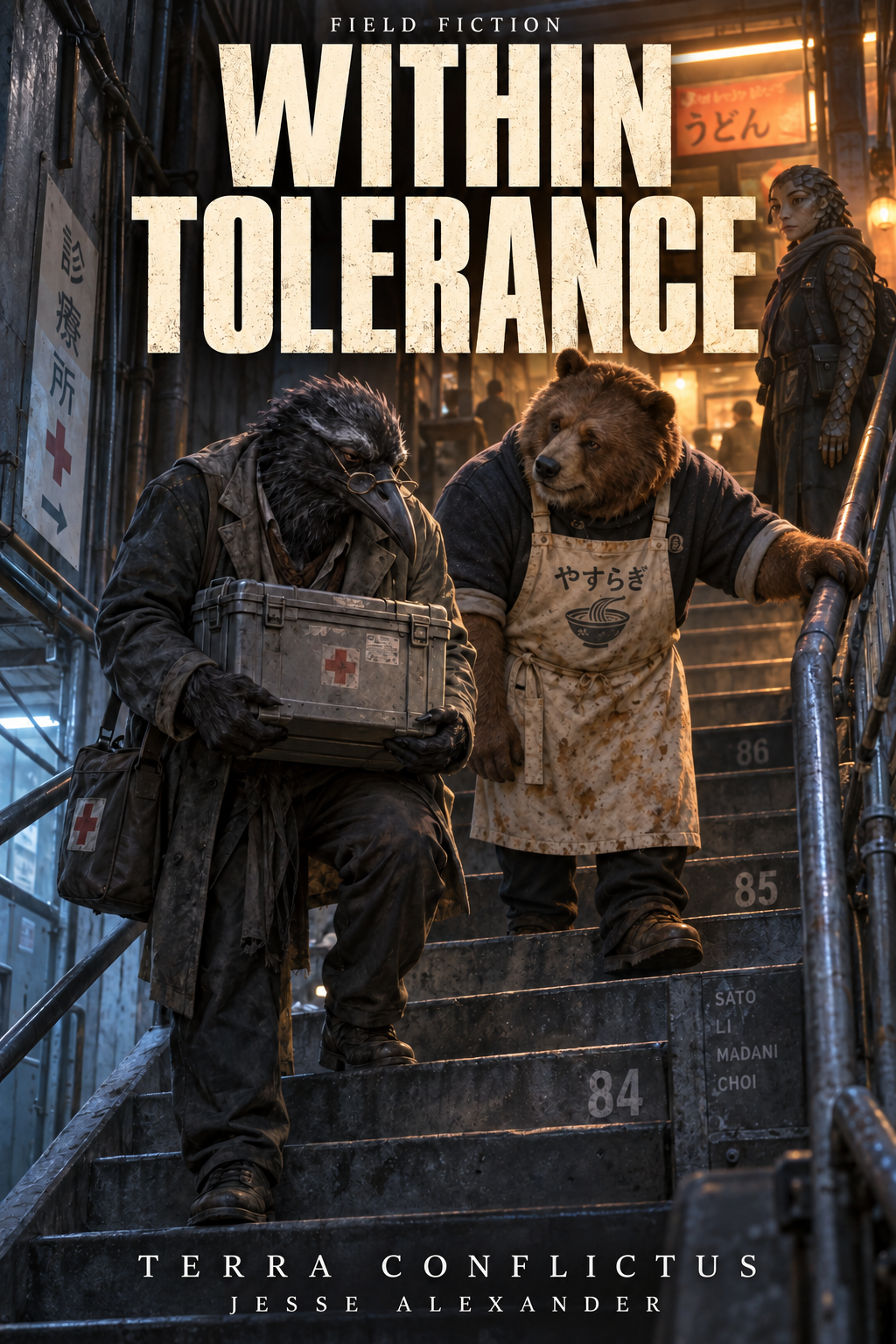
The stairwell between Sub-2 and Sub-1 had ninety-one steps and no lift a stranger could use, and Emeka Nwosu had come up forty of them when the woman with the lamp decided to sit down and watch.
She was maybe sixty, baseline, in a GHOST KIT jacket three sizes past hers, and she sat on the landing with the lamp between her knees and her chin on her fist like somebody settling in for the second half of a broadcast. She did not offer to help. He would not have accepted, and she seemed to know that, so the two of them had arrived at an understanding without spending a word on it.
The case weighed eleven kilos. It was the size of a fist inside a great deal of padding, and the padding was the point, because a reference standard that has been knocked about is a rock.
Somebody had numbered the steps in white paint a long time ago, and somebody else had kept it up. Beside some of the numbers there were names. Not many. Twenty or so in ninety-one steps, in more than one hand.
"You want to put that down," she said.
"Not on this surface."
"It's a stair."
"It's a stair with a temperature gradient." He took the forty-first. "Four degrees between here and the gallery. The case is rated for two."
She thought about it. "Then it's a stupid case."
"It's an excellent case. It's a stupid stairwell."
She laughed, and the laugh went up the shaft ahead of him, and somewhere above, a door opened to hear it and did not close.
Six days earlier, in the house above the tide line, Kimiya had put a scanner log on the table and said nothing for long enough that everyone stopped what they were doing.
"Belt cohort," she said. "Twelve. Flagged variance-positive on a district audit, Sub-2, eleven days ago. The recall paperwork is on its second signature."
Grigor did not look up from the harness he was rebuilding. "And."
"And the ambient at the time of the audit was four degrees. The instrument is specified for fifteen to thirty." She adjusted her glasses on their cord. "They ran a warm-room scanner in a cold gallery for six hours and flagged everybody who walked past it."
"So the flag is wrong," Idris said.
"The flag is wrong. The paperwork is correct." She looked at Duarte. "Which is the problem, because correct paperwork moves."
Emeka had the log turned around and was reading it upside down, the way he read everything on that table, and he had already found the part that mattered and was giving himself a moment before he said it out loud.
The auditor's signature block sat at the bottom of page one. Certification number, posting, name.
"Something," Kimiya said.
"No."
"You went somewhere."
"I'm reading."
"You stopped reading four lines ago. Your head does a thing." She tapped her own temple. "It goes over about six degrees. Halla says that's you filing."
"Halla says a lot of things in a very nice voice," Grigor said, from the harness.
Duarte had not spoken. She was looking at Emeka with the expression she used on people who were about to make her rearrange a week, and after a moment she said, "Who ran the audit."
There was no version of the next hour that did not begin with him answering, so he answered.
"My daughter."
Ifeoma had called on a Tuesday, four weeks before that, and led with the weather in Neo-Tokyo, which was how she opened when she had something and wanted him to work for it.
"You're stalling," he said.
"I'm being social. You should try it."
"I'm sixty-two. I've tried it."
"I took a posting." Pause. Down the encryption, her breath came a half-beat late. "HELIX STANDARD. Variance audit, northern desk. I start on the ninth."
He had been standing at the counter with a cloth in his hand and he had gone on holding the cloth.
"That's a good desk," he said.
"That's not an opinion."
"It's a fact. I'm allowed facts."
"Dad." She let it sit. "You've got about four seconds before I decide what your silence meant, so you should probably use them."
He used them badly. He said the verification side had a better progression structure, and she heard the whole of him in it, the way she had been hearing the whole of him since she was nine, and she said, "That's not what I asked," and he changed the subject to her flat, and she let him, and he understood that she had filed the deflection rather than argued with it.
She had his instincts. He had never once been able to decide what to do about that.
Kimiya ran the approach in the seam between two Node 7 reroutes.
"Ninety seconds," she said. "From the Deep Rail service door to the Standards Wing loading bay. The patrol pattern is fourteen months stale and I can predict it."
"How confident," Duarte said.
"Ninety-one percent."
"That's not a number you use."
"It's the number I have." Kimiya's grain came out of the horn on her collar flat and unhurried, and the gap between her face moving and the sound arriving was the same forty milliseconds it had been for a decade, and she knew everybody in the room measured it, and she had stopped caring about that around the time she stopped being able to stop it. "I'd like a second pass. There isn't one. Node 7 does something twice a shift the pattern doesn't explain, and I can't model it in the time we have, and if I wait for the model the paperwork clears its third signature."
"Then we take ninety-one," Grigor said.
"You're not the one taking it."
"No," he said. "That's why it's easy for me to say."
Idris had the Belt route already. He had drawn it in the notebook in the cipher and then drawn it again in plain lines for the others, and the plain version had a red mark at the Sub-2 gallery stair.
"There's a crew on that stair," he said. "The Ghosted run clinic supply through it. Six of them, seven if the woman with the lamp counts, and she does. They won't fight us."
"You sound certain," Duarte said.
"They'll make us an offer. That's worse." He looked at Emeka. "It's going to be a reasonable one."
The Standards Wing was the least interesting building on the Keiretsu Strip, which was the entire security architecture. Nobody breaks into metrology. There is nothing in a calibration lab that a market will pay for, unless you happen to know what the calibration is used for, and the people who knew that were mostly the people who did it.
Emeka went in behind Kimiya because the lab required a hand that could work at that scale and a body that could stand in a doorway and look like maintenance. The primary variance reference lived in a temperature-stabilised cabinet in a room with two cameras and a floor scale, and the floor scale was the good one, because the cabinet had been designed by somebody who understood that the threat model for a reference standard is not theft. It is a technician being clumsy.
Kimiya took the block out with both hands and held it a moment.
"Heavier than it looks," she said.
"Everything in this world is."
"That's a terrible line."
"I'm tired."
She put it in the case and closed the case and the lock did what a good lock does, which is nothing you can hear.
Eighty-one seconds later they were in the Deep Rail service corridor with the door shut behind them, and at eighty-eight a patrol went past the junction they had crossed at forty, and Kimiya stood in the dark with her hand flat on the wall for three seconds longer than she needed to.
"Ninety-one," Emeka said.
"Don't."
"I wasn't going to say anything."
"You were going to say it in that voice."
He had, in fairness, been going to say it in that voice.
His voice was the thing people took longest to get past. Corvid stock kept the syrinx, and a syrinx will do an extraordinary impression of human speech, close enough that a listener's ear accepts it for about four sentences and then starts hunting for the seam. He had never fitted a bridge. Two fitters had recommended it. He had declined both times, and told himself it was because the surgery would cost him field weeks, and knew that the real answer was that the sound coming out of him was the last thing about his body that had not been specified by somebody else.
The Ghosted crew leader was a pangolin, forty-ish, scale plate worn matte at the shoulders where a pack rode, and she waited on the Sub-2 gallery landing at step fifty-eight with her hands where he could see them.
"Riko," she said.
"Emeka."
"I know." She nodded at the case. "That's the primary."
"It's a case."
"It's the primary. You came up the Belt stair with it. You didn't want the Strip lifts. So the Strip doesn't know it's gone yet." She had a way of laying facts down like cards she did not need to win with. "I'll give you two weeks of clinic supply for it. Holders, and the consumables to run a bench. Two hundred doses. That's the whole Belt not drifting for a fortnight."
"For a block of certified alloy."
"For the stamp. You know what a clinic can charge for a within-tolerance stamp down here? A forged with a clean cert can take a surface contract. Can put a kid in a school that logs attendance." She shrugged, and the plate moved. "I'm not stealing anything. It goes back in a month with a paper trail nobody can pull apart. You get your fortnight. Everybody up this stair gets a year."
Behind her, on the third gallery, the noodle counter was open. A big commercial-stock build in an apron the size of a tarpaulin was working the pass, ursine, grey right through the muzzle, moving with the exact economy of somebody whose knees had opinions. He had been built for a theme district. Emeka had known him nine minutes and had already read the whole file off the way he transferred weight at the counter.
He was one of the twelve. Kimiya had the list.
"What's his name," Emeka said.
Riko did not look around. "Sadao."
"He's on the flag."
"Whole gallery's outside. That's what a district audit is for. Every few years they find a new thing wrong with us, and it's never the same thing twice." She let that sit. "So you understand my offer."
"I understand it."
"And?"
"You're right about all of it," Emeka said. "And if I hand you this, the audit stands, and the twelve go into recall with a clean stamp bought off a stolen standard, and the first person who checks the provenance takes the whole gallery down instead of twelve. You'd be trading a fortnight for the Belt."
"That's a maybe."
"It's a probability. You know the difference. You're just betting the other way, and you've got better reasons than I have."
Riko looked at him for a while.
"Old corvid," she said. "You always this cheerful."
"I'm rationing."
She stepped aside. She did not help with the case, and she watched him take the next flight, all of it, one step at a time, and she made everybody else watch too, and Emeka understood by step seventy that she had turned it into something for the gallery to see, and that whether she meant it as respect or as a lesson depended on things about her he did not have time to learn.
At step eighty-four, Sadao came down with a stool.
"Sit," he said.
"I'm fine."
"You're not, and I've got a queue, so sit." He set the stool down. "I'm mascot stock. The warranty went when the company did. I know what a hip sounds like from four steps up."
He sat. Sadao went back up with the stool under his arm, and did not say anything else, and Emeka took the last seven steps four minutes later with the case in both hands and his hip doing the thing it had been doing since the Shatter Belt, which was reporting late and inaccurately, like a subordinate protecting himself.
Two hours after, in a rented room off the Hikari Bazaar with a BURNER crate for a table, Kimiya had the block on a cradle and three instruments around it and an expression Emeka had seen twice before, both times on people looking at an autopsy that had gone wrong in an interesting way.
"It's fine," she said.
"Define fine."
"It's within one part in ten to the seventh of its certificate. It has never been out of tolerance. It has not drifted, it has not been swapped, it has not been tampered with." She sat back. "It's the best-behaved object in this city."
"Then the scanner."
"The scanner was cold. That explains twelve people, in one gallery, on one day." She turned the display. "It does not explain this."
The plot was a rate. Variance-positive flags on that cohort profile, hemisphere-wide, by year. It went up. It went up in steps.
"Eleven years," she said. "Same profile. Same population. In warm rooms, in cold rooms, in the Nordics, in the Metroplex, on instruments that were calibrated last week and instruments that were calibrated in 2059. Rate climbs." She put a finger on the display, on a riser. "There. And there. And there. And there."
"Four."
"Four."
Emeka took his glasses off and put them back on, which he had stopped noticing he did.
"You'll tell me the population changed."
"The population did not change. The bodies are the same bodies." She pulled the second document up. "The band changed."
It was a committee record. Genomic Tolerance Working Group, standing subcommittee of a standards body whose name had been three different things since 2049. Revision history, four entries.
2055. 2058. 2061. 2064.
Each one narrowed the acceptable variance band. None of them by much. The 2055 revision took eleven percent off the upper bound and cited instrument improvement, which was true. The 2058 revision harmonised two regional bands into one and took the tighter of the two, which was standard practice. The 2061 revision responded to a consultation in which four member bodies requested a conservative posture, and the paper said so, and named them. The 2064 revision corrected a rounding convention.
Four different chairs. Four different drafting secretaries. Eleven pages of minutes between them, all of it reasonable, all of it reviewed, all of it approved by people who would have been able to defend their reasoning at any point in the following decade to anybody who asked.
Nobody had asked.
"Forty thousand," Kimiya said. "That's the reclassification. People who were inside the band in 2055 and are outside it now, without one cell of them changing."
"In the Belt?"
"In the world. The Belt is eleven hundred." She took her glasses off. "Emeka. There is nobody at the bottom of this."
"I know."
"There's no operation. There's no directive. I went looking for the memo and there is no memo, because nobody ever needed to write one. It's four sensible decisions taken years apart by people who never met each other and every single one of them is correct on its own paper." Her voice had gone quiet, and the room went with it. "I have spent thirty years being told I am difficult because I am correct. This is the first thing I have ever found where being correct four times in a row is how it happened."
Emeka looked at the block on the cradle.
Eleven kilos. Ninety-one steps. A woman with a lamp on a landing and a stool at step eighty-four.
"It's a paperweight," he said.
"It's a very good paperweight."
"Kimiya."
"Yes. It's a paperweight. The number is in a document. You could put that block in the Thames and the band would still be the band on Monday." She rubbed her eyes with the heels of her hands. "I'd like to say I'd have got there faster twenty years ago."
"You wouldn't have. You'd have got here at the same speed and been ruder about it."
She laughed, once, and it caught her off guard, and it was the first time in three months that he had heard it.
The vote happened over the net at 0400 London, which meant Duarte had been awake for it and Grigor had been awake anyway.
Publish it themselves, and a stateless corvid with an unresolvable build and no institutional standing makes a claim against a standards body. The claim would be right. It would be dismissed inside a month, and it would take with it the credibility of anyone whose name touched it.
Or hand the finding to somebody with standing.
There was one auditor in the northern hemisphere whose signature was already on a variance flag traceable to a cold instrument, who had already filed a request for review of her own audit eleven days into the job, and who would be believed.
"You know what you're asking her to carry," Duarte said.
"Yes."
"For the rest of her career."
"Yes."
"And you've considered that you might be doing this because you cannot put it down yourself and she is a way to hand it to somebody."
Somewhere in the house a floorboard took her weight and gave it back. Emeka let the question stand as long as it deserved.
"I've considered it," he said. "I can't rule it out. That's the honest answer and it's the only one I have."
Idris said, on the open channel, "It's her file already. She flagged her own audit before we knew any of this existed. She was going to get to the scanner. She wasn't going to get to the band."
"She'd have got to the band," Emeka said.
"In four years."
"In four years."
Halla had not spoken for eleven minutes. When she did, it came out in that warm expensive grain, and it was the cruellest thing anybody said that night.
"You are going to tell her the truth about the number," she said. "Are you going to tell her the truth about you."
Nobody filled the silence after it. That was the courtesy.
He met Ifeoma at seven in a room off the Keiretsu Strip that RELAY HOUSE kept for people who wanted four walls and no record. She came in with her coat still on and stopped when she saw the case on the table.
"That's a metrology case."
"It is."
"That's the metrology case." She sat down slowly. "Dad."
"It's going back this afternoon. It hasn't been opened and it hasn't been out of spec and there's a courier docket that will survive an audit, because the man who wrote it has been writing them for thirty years and is better at it than the people who check them."
"That's not the part I'm worried about."
"I know." He turned the display toward her. "This is."
She read the rate plot first, which he had known she would, and she read it the way he read a body, going straight to the risers and reading backward from them for cause. She did not ask a question for six minutes. He watched her not ask.
At the fourth riser she stopped and put her thumb on the year.
"2064 is a rounding convention," she said.
"Yes."
"A rounding convention did that."
"It did about nine hundred of it. The other three did the rest."
She went to the committee record. She read all eleven pages of minutes, and she took a pen out of her coat, an actual pen, and started making notes in the margin of a printed sheet he had put there because he had known she would want to write on something. Her notation was small and even and ran up the right-hand margin when it ran out of room at the bottom, and it was his, exactly his, and he had not taught it to her, and he sat with that for a while.
"The 2061 consultation," she said. "Four member bodies requested a conservative posture. Which four."
"Page nine."
She found it. "None of them are gene-forging programs."
"No."
"They're instrument manufacturers." She looked up. "They asked for a tighter band because a tighter band sells instruments. That's not even corruption, that's just what you'd say if somebody asked you what your industry needed."
"That's the whole of it," Emeka said. "There's nothing under it. I looked. Kimiya looked, and she's better than I am."
"Somebody has to have noticed."
"Somebody noticed each revision. Every one of them was consulted on, and published, and open for comment for ninety days, and there are comment records, and they're thoughtful." He let that sit. "Nobody has ever put the four of them on the same page. There was no reason to. They're eleven years apart and they're in four different documents and the population they moved doesn't get consulted on anything."
She sat back. The coat was still on.
"You want me to file it."
"I want you to decide whether to file it."
"That's the same sentence with better manners."
"It isn't," he said. "But I understand why it sounds like it from where you are."
She looked at him, and he was aware of being read, and of being read well, and of the specific discomfort of that after forty years of doing it to other people at a rate they could not match.
"If I file this," she said, "I am the auditor who filed against her own standards body in her first three months. I will be right, and it will be verifiable, and it will follow me into every room I am ever in."
"Yes."
"And if I don't file it, I know it, and I audit against that band on Monday."
"Yes."
"And you'd have filed it yourself if there were any version where it worked."
"There isn't. I'm a build that doesn't resolve. I'd be the reason they didn't have to read it."
She turned the printed sheet over and wrote something on the back that he could not see from where he was sitting, and then she said, without looking up:
"Why did you tell me pediatrics."
He had been ready for a great many questions. Not that one, and not in that order, and there was a period afterward where the room contained the ventilation and nothing else.
"Because I wrote an assessment in 2061," he said. "In good faith. It was accurate. Eight months later somebody used it as the authorising document for a cohort recall I was never told about, and I have spent five years being unable to decide whether that makes me the instrument or the hand." He kept his own hands still on the table, which took some doing. "And when you told me the posting, what I heard was that you were going to spend your life writing documents that other people would use, and that you would find out what they had been used for afterward, the way I did. So I told you the pay structure was better on the verification side, because that was a sentence I could get out."
Ifeoma put the pen down.
"That's the worst piece of career advice anybody has ever given me," she said.
"Yes."
"By a considerable margin."
"Yes."
"You could have said that in four seconds. On the call. In August." Her voice did not rise. That was the family style and he had never been so aware of having taught it to somebody. "I would have taken the job anyway. I'd have taken it knowing what you knew."
"I understand that now."
"Do you."
"I'm learning it at the speed I learn things," Emeka said. "Which is slower than you'd like and slower than it used to be."
She picked the pen back up. She turned to the second page of the minutes, and found the 2058 harmonisation, and made a note, and asked him a question about the tighter of the two regional bands, and he answered it as a medic and not as her father, because that was the only door that was open and both of them could see it.
They worked for two hours. Twice she asked him something he could not answer and he said so, and both times she wrote down the question rather than the gap, which was a thing he had never seen anybody else do.
At nine the surface grid came up, and the light through the window went from the colour of the Belt to the colour of the Strip, and Ifeoma stopped and looked at the case on the table.
"It's really fine," she said. "The block."
"It's the best-behaved object in this city. Kimiya's words."
"Is that a joke?"
"It's a measurement." He got up, and got up badly, and did not disguise it, which was new. "The joke is that we carried it up ninety-one steps."
His daughter laughed. It went on slightly too long, the way laughter does when it has been holding a door shut, and then she got her coat off at last and hung it on the back of the chair and sat down again with the pen.
"Right," she said. "Show me the rounding convention."
Sadao's counter opened at eleven.
Emeka took a seat at the end where the gallery draught came through, because the draught was four degrees and he wanted to sit in the thing that had flagged eleven hundred people, and Sadao put a bowl down in front of him without being asked and stood there with the cloth over his shoulder.
"You're the one with the case," he said.
"I was."
"Riko says you turned her down."
"I did."
Sadao considered this. He had a face built in a laboratory to be delightful to children and it had aged into something you could not read at all, which was its own kind of joke and nobody in this world was going to laugh at it.
"Any good for me?" he said. "The turning down."
"Not this month."
"Next?"
"I don't know."
Sadao nodded, like a man receiving the only answer that had ever been worth anything.
"Better than the last three who came through here," he said, and went back to the pass.
Above them, on the surface, the city was running perfectly. It had all the numbers it needed. Every one of them was inside the band.