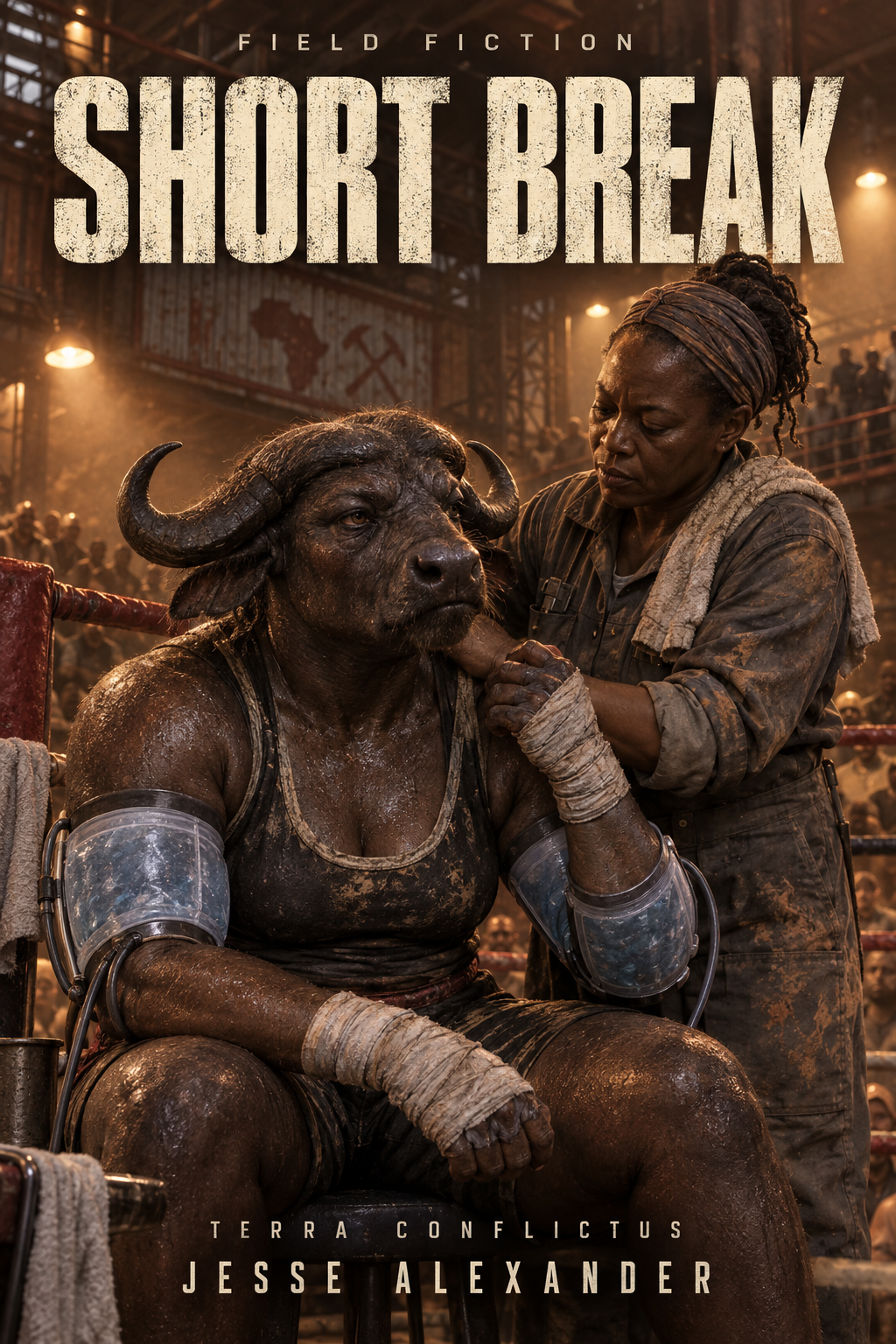
They billed me as MBOGO, which is what the Copper Quarter calls anything with a horn boss and no reverse gear, and they printed the purse in months.
Not francs. Not scrip. Months. Fourteen of them for a main event win, struck off a Copperbelt contract term by a clerk at a manifest window who stamps the chit exactly the way she stamps a cargo certification, because it is the same window and the same stamp. That is the joke at the bottom of Kalemie. Meridian East moves eighteen percent of the Copperbelt out the back door on paper the ACU has never once looked at hard, and a woman who wants a year of her life back has to get hit in the head in front of four hundred people to get a slip off the same printer.
I signed for six fights. I was three in when the promoter started shortening the break.
The shed used to roast ore. They pulled the furnaces out in the fifties and left the floor, iron plate laid over a heat well that has not been cold since before the Drought, and in the wet season the whole building sweats like a lung. Lubunga hung the ring lamps low so the crowd could see sweat and blood in color. He understood that men who spend eleven hours a day breathing acid drainage in a copper adit will pay to watch two engineered bodies find out which one the room was built to kill.
The room was built to kill me. I want that clear up front, because everything after depends on it.
ACU wrote me for a riot line. The section language is crowd denial asset, which is a beautiful phrase for a thing that stands in a doorway and does not move while four hundred people decide whether they want the doorway more than they want their ribs. Cape buffalo stock. Fused cervical plate from the base of the skull down through the shoulders, dermal boss across the forehead thick enough that a baton comes off it like rain off a hood, mass laid low and dense so that shoving me is a project you have to schedule. I have been hit by a truck. The truck came off worse in the paperwork.
Here is what the section language does not say. A body that size in a basin that humid cannot lose heat. I have almost no skin surface for the volume I am carrying, my sweat is thin and useless, and under load my core climbs like a bad debt. Four minutes of real work and I am eating myself. Six and my vision goes white at the edges, and then the white comes in, and then I am a very large animal standing in a room full of light with no idea what the light is for.
So the ACU issued me a water truck.
That is not a metaphor. Riot sections in the Corridor rolled with a bowser and a cooling crew, three baselines with hoses and ice sleeves and a chilled saline line, and the spec called them integral. Integral. We were one machine with two payrolls. I held the doorway and they held my temperature, and the day the Wardens decided a line of horned women in visors looked worse than forty years of community relationship, they dissolved the sections. The crews went to civilian contract. I went to whatever I could find.
They built me half a machine and gave the other half to somebody else. Then they took her away and told me I was surplus.
Her name was Mwadi Kabeya. She ran the bowser behind my section for six years. She had a way of coming in from behind on the count, hand flat on the back of my neck at the exact spot where the plate ends and the blood runs shallow, so that the cold went straight up into my skull and the white went out of my eyes, and she never once said anything encouraging, which I have always considered the greatest professional courtesy I have ever received.
When the section dissolved she took a works contract in the Copperbelt. Eighty-one months. She was forty-four and she signed it because outside the works there is no water registration, and without water registration there is no clinic, no ration, no transit paper, and the Mombasa Road at night. The ACU has a word for that, and it is not a punishment, because the ACU never punishes anybody. They withdraw everything that makes staying possible and let you notice.
Sixty-two months left when I signed for the card. Fourteen a win. I could do the arithmetic on my fingers, and I have very few good fingers.
The first two fights were shelf stock the promoter bought cheap out of the Mombasa Road contractor pool, and I ended both the way I end things, which is one collision and a conversation with the floor. A fight that lasts nineteen seconds does not sell drink. That made me a problem.
He came to the bench after. Faustin Lubunga, sixty, soft in the middle, with the specific gentleness of a man who has never had to raise his voice in his life.
"Beautiful," he said. "Terrible business. What do I sell at nineteen seconds? Four hundred men rode a truck ninety minutes and now they are angry at me."
"Then match me properly."
He looked genuinely delighted. I have thought about that look many times since.
"That," he said, "is exactly what I intend to do."
Her name was Nsenga and they billed her as RELAY. Wild dog stock, ACU pack template, the pursuit build. Fifty kilos wet. Ears like sails, and the lean frame the Wardens use to run a man down across nine kilometers of scrub and still have breath to read him his transit status at the end of it.
A dog like that cannot hurt me. She knows it. Everyone in the shed knows it. She has no mass and no leverage, and if she stands still inside my arms for a quarter second she goes out of the building on a door.
She has no intention of standing still.
The rules were three rounds of five, decision on the judges, one judge being Lubunga's brother-in-law. Break of ninety seconds. That number came out of an ACU medical annex written for gene-forged contact events. It is barely adequate, and it is the only reason a body like mine can be in a ring at all. Ninety seconds is a chilled sleeve on each arm, a saline line, and a hand on the neck.
The corner crews were loaned out of the works infirmary, because Lubunga is not paying for medics when the Copperbelt has medics on contract and a welfare office that likes the card. They come in coveralls and dust hoods, because the shed's air is full of copper fines that will take the skin off your throat, and they do not talk. By the time the bell goes for the break my eyes are white and my ears are packed with my own pulse, so what a corner is to me is not people. It is hands. Cold on the arms, cold on the neck, a thumb pushing my chin up so somebody can look at my pupils.
I never once looked at their faces. I had ninety seconds, then sixty, then forty-five, and in that time the entire content of my consciousness was the temperature of my own blood.
Round one taught me the fight in about forty seconds.
She did not engage. She circled left, always left, into my bad eye, and when I closed she was not there, and when I turned she had already crossed behind me and touched my kidney with a hand I barely felt. Nothing she threw was designed to hurt. Everything she threw was designed to make me turn. Turning is expensive. Turning a body like mine is a whole industrial process, hips and plate and mass, and she was billing me for it four times a minute and paying nothing herself.
I got her once. Late in the round I read the left and cut the ring instead of following her, and I got a forearm across her chest and drove her into the corner post hard enough that the ring frame rang like a dropped pan. The shed came up off its feet. She went down. She was up before the count started.
That was the exchange that taught me. Not because I hit her. Because of what she did after, which was nothing. She did not clinch and she did not stall. She resumed circling left at the same rate, and I saw her ears come up and dump heat into the room, and I understood that she was running a schedule and I was on it.
The bell went. I sat. The cold came onto my arms and then a flat cold palm went up the back of my neck under the plate and the white went out of my eyes and I could see the ceiling.
At sixty seconds somebody hit the bell.
I got up because that is what the bell does to me. Then I sat back down, which is not a thing I do, and I said, loud, into a room I could not see properly, "That is thirty seconds short."
Lubunga was at the ropes. Not shouting. He never shouts.
"House rule," he said. "Posted at the door."
"It was ninety in the first two."
"It was ninety when you were ending fights in nineteen seconds." He leaned on the ropes, and he was not cruel about it, which was the worst part. He was explaining. "The annex is ACU. Nobody sanctions this card." He nodded at the crowd like a man showing you his farm. "Ninety seconds is four hundred men in a hot shed with nothing happening. I cannot sell nothing happening. I am not doing this to you. I am doing this to the evening."
I have fought men who wanted me dead. That is easier. A man who wants you dead wants something, and anything a person wants is a handle. Lubunga wanted a room that stayed loud between rounds, and my temperature was a cost that fell on the part of the balance sheet where I live.
Round two was the worst four and a half minutes of my professional life, and I have stood in a doorway in Lubunga's own district while eleven hundred people who had every right to be angry tried to come through it.
Thirty seconds of missing cooling does not sound like much. It is not thirty seconds. It is the difference between starting a round at a temperature your body can climb from and starting it already climbing. I came out at a deficit and never got it back. By the middle of the round the shed had gone gold and grainy at the edges and my legs were doing arithmetic they had not been asked to do.
She knew the exact minute. That is when RELAY came inside, and it turned out she could hurt me after all, because she was not aiming at anything armored. Soft line under the arm, back of the knee, hinge of the jaw. Small fast damage, the kind that does not end a fight and does not stop accumulating either.
I put her down again. I do not remember doing it. There is a gap in the round on my side, and I am told that in it I caught her coming in and threw her into the ropes and then stood over her swaying, hands at my sides, unable to see her.
The bell went and I found the stool by memory.
Ice on the arms. Saline. And the hand, flat and cold, coming up the neck from behind and finding the spot under the plate without hunting for it, first try, in the dark, the way you find a light switch in your own house.
I noticed it and did nothing, because I was busy being a temperature.
At forty-five seconds they hit the bell.
Here is what I did in round three, and it is the only thing I have ever done in a ring that I am proud of.
I stopped chasing.
I planted on the cold seam at the center of the ring, the one plate in that building the heat well does not run under, the plate the roasting crews used to eat lunch on. I did not move off it. Not one step. Whatever she did on my left, whatever she touched, whatever she said, and she did say things, I did not turn.
I had four minutes of life left in me and I spent none of it turning.
She circled. The crowd started to boo, and Lubunga came off his chair, because a buffalo standing still in the middle of a ring is exactly the nothing happening he had told me he could not sell. Good. I was not selling. I was cooling. Standing still I produced almost no heat and RELAY produced all of hers, and out on the perimeter her big ears were dumping it into a room already at forty-one degrees and packed with four hundred bodies. Her build assumes open ground and moving air. There was no air in that shed. There had not been any since 1958.
She had to come in. The judges were Lubunga's and a decision on points goes to the fighter who was working. Around three minutes she committed.
She came low on the left, for the knee, which was correct, and I did not turn to meet her because turning was the thing I had spent the whole round refusing to pay for. I dropped. I let my whole mass go down and forward onto the leg she was reaching for, and the boss of my skull came through the space her head was arriving in, and I felt the short crack that a fused cervical plate transmits straight into your teeth.
The floor took her. I stayed down on one knee because I could not have stood up if the building had caught fire.
I did not hear the count. I heard my own blood, and a long tone, and somewhere far off a room coming apart.
Then the cold came onto the back of my neck, and this time I caught the wrist.
I do not know why. I was not thinking. I have gone over it a hundred times and the only answer is that a body remembers what kept it alive before the mind gets a vote. My hand went up and closed on that wrist and it was the wrist, the thin one, the left one, with the ridge of scar where a bowser coupling took the tendon in a bad year, and the two smallest fingers that never sat right afterward.
I turned around on the stool.
She had the hood down by then. Copper dust in the creases of her face, works coveralls, an infirmary band on the sleeve with a contract number I could have read at four hundred meters on a good day and could barely resolve at forty centimeters with my eyes full of white.
"Sit down," Mwadi said. "You have fifteen seconds."
The medic bay was a shipping container behind the shed with a bench, a lamp, and two crates of saline that came up the Mombasa Road in somebody's off-manifest cargo. I sat with sleeves on both arms and made her show me.
She did not argue. She has never argued. She pulled the slate out of her coverall and turned it around.
Contract renewal. Sixty months, Copperbelt works, medical grade. Her thumbprint. The date was eleven weeks and two days back.
I signed Lubunga's card on a Tuesday. She renewed on the Thursday. My first fight was the following Saturday.
"Why," I said.
"Because the card takes its corner staff off the infirmary loan list," she said. "You have to be contracted to be on the loan list. My term was ending in the spring." She put the slate away. "The spring is after your six fights."
"Sixty months."
"Sixty months."
"I have been fighting to buy out sixty-two."
"I know what you have been doing." She started unwrapping my left hand, quickly and slightly too hard, the way she does everything. "You were going to fight that card whether I was in the building or not. So the only question in front of me was whether the hand on your neck belonged to a nineteen year old from the works who has never touched riot stock and does not know where the plate ends."
"You could have told me."
"You would have quit."
"Yes."
"There it is."
I sat in a container behind a roasting shed with fourteen months in my glove and the woman I had been buying them for holding my wrist. Nobody had lied to me. Lubunga told me exactly what he was doing to my temperature and why. The works told her what sixty months cost. The ACU wrote the pair of us, dissolved the section that made us function, and left us to find each other through a window that charges rent on the search.
I had thought I was pulling her out. She had been on my neck the whole time.
The manifest window opens at 0530, the same hour as the Dawn Water Quality Broadcast, so you queue in the dark listening to a woman with a very calm voice read out numbers about a lake that glows amber for reasons nobody at Marine Sciences will put in writing. Accurate numbers. Wrong numbers to be reading.
I put the fourteen months on Mwadi Kabeya's term. The clerk stamped it without looking up. It changes nothing about where she sleeps or who she works for or whether she is in that container tomorrow. It takes fourteen months off the far end of a term that ends in 2071, a year I am not confident either of us will see. I did it anyway. There was nothing else to do with a number like that.
Then I signed for six more fights.
Lubunga cut the break to forty seconds for the new card. He posted it at the door, and he came by the bench to tell me himself, gently, the way he does, so that I would not hear it first from the bell.
I sat on the stool at the end of round one of the seventh fight with my eyes gone to white and the shed roaring and my blood climbing, and I felt the cold flat palm come up the back of my neck out of the dark and find the spot under the plate on the first try.
I put my hand over it and held it there until the bell.