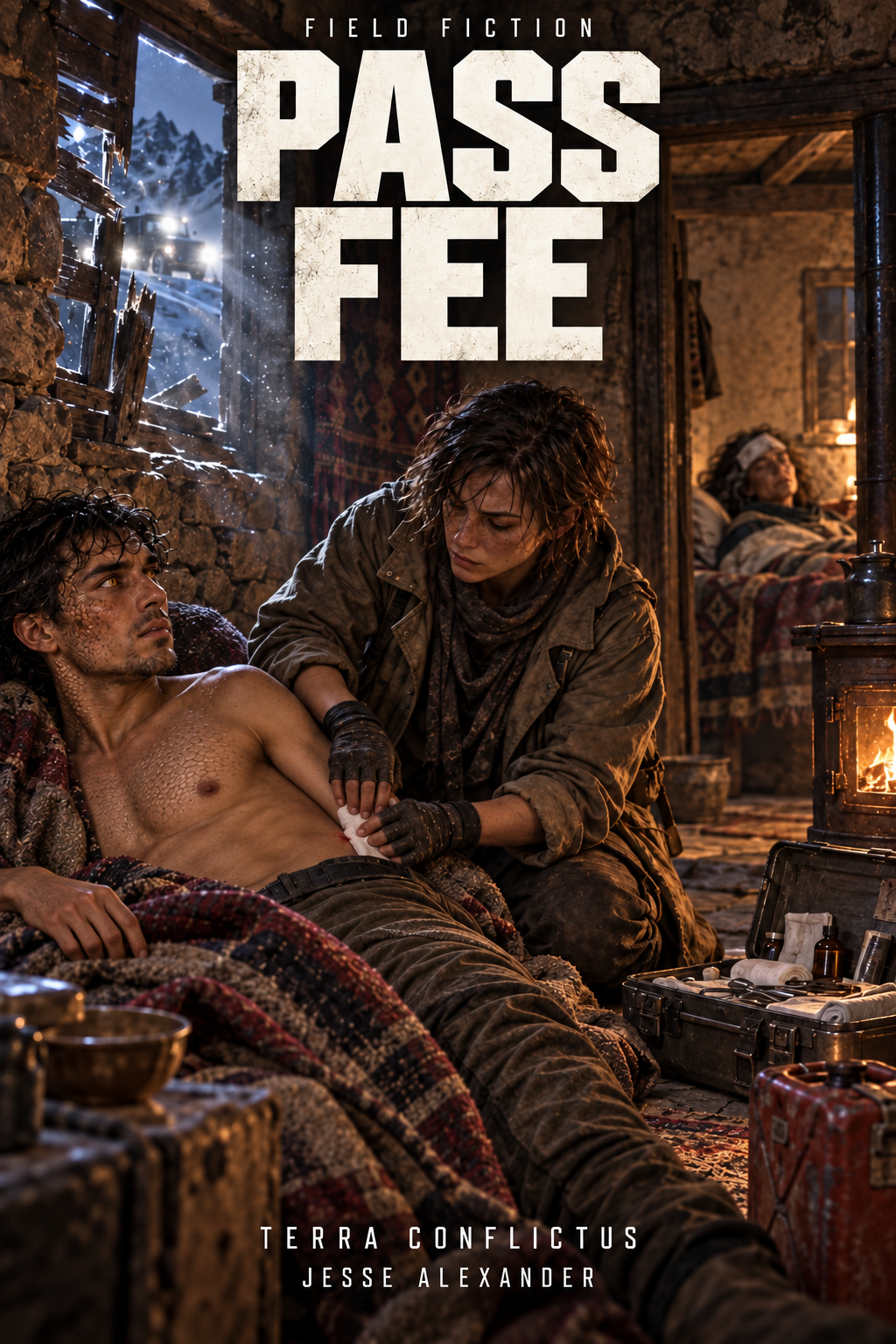
There is no faction on this planet that will pay a baseline to keep a gene-forged alive. That is the whole of my trade, stated as an absence. The programs build them and the programs bury them, and between those two events they issue a suppression script and a stability window and a form you sign that says you understand what you are. Repair is not in the budget line. Repair was never in the budget line, because a body with a shelf life is not a patient, it is inventory with a date on it, and you do not send inventory to a doctor. So the work fell to people like me. Baseline, unlicensed, carrying a case of compounds that no faction pharmacologist will admit exist, going up and down the dark roads to put forged bodies back together for cash, because the alternative is that the bodies come apart in front of people who love them.
I am not sentimental about it. I charge four hundred a day and expenses, and the expenses are the part that hurts.
I was two and a half thousand meters up the western Zagros in the first week of October, in a village called Sarıkaya, because Elder Yildiz had sent word down the mountain that she wanted a healer with forged medicine in her hands and no faction stamp on her paper. That second condition is why she got me instead of somebody better. The pass communities have watched outside help arrive for three thousand years and they have learned exactly what it costs. Every time they take a hand, an obligation comes in behind it, wearing the same coat. A baseline freelancer with a case and no letterhead is the cheapest hand they can accept. I understood that I was being hired for what I could not do to them later. It is not a flattering way to get work. It is honest, which is rarer.
The patient was Leyla Demirel and she was fifty-eight years old and she was one of two people left alive who could keep a winter route open through the Zagros.
You should understand what that means, because it is a piece of infrastructure that does not look like infrastructure. The passes close in November. Everyone knows this. What everyone does not know is that three of them never used to, because three families spent centuries learning how to read a slope and cut a drift and move a route ten meters east in a season when the mountain asked for it. No manuals. No survey. Knowledge that lives in hands and gets handed sideways from a mother to a daughter over thirty years of walking the same stone. One of those families ran out of daughters in 2059 and that route is gone. It did not fail. Nobody blew it up. There was simply no one left who knew, and a road that nobody knows is just a shape in the rock. Leyla had the second route. Her daughter Nesrin went to Istanbul six years ago to work in a Compact records office and has not come back, which is a reasonable decision that I would have made myself, and which happens to be the load-bearing fact of everything that followed.
The illness was resonance. That is the polite way the Zagros communities say that the mountain is doing something to a person. There is a Lumicite formation under the range, the communities have known about it for longer than any faction has known the word, and the people who spend their lives up on the high stone at altitude take a dose of something the rest of us do not. Fever. Weight loss. Perceptual events. Leyla could tell me where the ice was thin on a slope she had not seen in four months, and she could not tell me what day it was, and both of those are the same symptom.
I had been in her house nine hours when the trucks came up the approach.
Two vehicles, running dark, which on that road at night means either professionals or the dead. They stopped forty meters below the house and the headlights came on together, which is a thing you do when you want the people inside to know how the evening is going to be organized.
The house was stone, two rooms, a fuel stove, a shuttered window on the valley side and a slot window on the mountain side and a hatch in the back wall where they load kerosene into the store. Leyla was on the cot in the back room with a core temperature of forty point one and a wet cloth on her. And in the front room, because Elder Yildiz had put him there four days earlier when she closed the pass and stranded him, was a Sons of the Serpent courier named Tarik Nesin.
Sand viper stock. You can tell without asking. The pits under the eyes, the way the pupil sits, the utter stillness of a person who does not fidget because the build does not see the point. He was twenty-six and he was carrying a case of black zone antibiotics that were three weeks late and dying in the cold, and he had spent four days being extremely polite to an old woman who would not let him through, because the Sons have a standing order about the pass communities that amounts to: they own the mountain, we are guests, do not ever forget it.
Tarik went to the shutter and looked and came back and said, "Six. Two of them have gone left, uphill." Then he drew a pistol I had not known he had.
I want to be exact about the next twenty seconds because I have been over them more times than is good for me. He opened the shutter to get an angle. Somebody outside saw the movement. There was a burst of fire that took the shutter apart and put a round through the meat of Tarik's left side above the hip, and he went down on the flags and I was on him before he stopped sliding, and that is how the night began: with me holding a wound closed with the heel of my hand and thinking, professionally, this is a good bleed but not a fatal one, and thinking underneath that, in the part of the mind that keeps the real ledger, that we had just gone from a negotiation to a siege because a twenty-six-year-old opened a window.
Then a man outside called up the slope, in Turkish first and then in very careful English, and asked whether anyone in the house was hurt, and said that he was sorry, and that he was coming no closer, and that his name was Hadi Serez.
Serez talked to me through a hole in a shutter for five hours and he never once raised his voice.
That is the part that gets under the skin. I have dealt with warlords and with the specific breed of PCU line officer who thinks a medic is a kind of tool, and I would take twenty of them over one polite man with a contract. He told me who he was in the first minute. Collection agent, contracted through a broker in Kirkuk, working an acquisition for PCU Northern Command medical, a program officer named Yusra Behnam whose name he offered up unprompted because he wanted me to understand that this was documented work and not banditry. He wanted Leyla Demirel. He said the word patient. He said transport. He said that his people had a physician in Basra and a course of treatment for exactly what she had, which was probably true, because the PCU medical directorate has been trying to buy Zagros pharmacology for nine years and knows more about resonance exposure than anyone in this house did.
I told him he could have her when the mountain fell on him.
He said, "That is a reasonable position. I have until four." And then he explained the four, which is the thing I keep coming back to. There was a truck at the pass head, a scheduled recovery run down to the black zone, and it logged its route at four in the morning, and after four his contract was closed and his crew stopped being paid and he could not promise what men who had stopped being paid would do about a house they had already shot at. He did not say it as a threat. He said it as a scheduling problem, the way a man tells you the last ferry goes at six. That is the machine you are actually inside of out here. Nobody in this world will kill you because they hate you. They will kill you because the paperwork closes and the alternative is an unrecoverable expense.
I went to work, because working is the only thing I know how to do with fear.
Here is the arithmetic I was running, and I ran it out loud to nobody for five hours. One patient at forty point one with a fever I could break if I had fluid, and I had two liters. One patient bleeding, forged, sand viper stock, which means his baseline body temperature sits low and his metabolism is built for a desert night and not for a stone house at two and a half thousand meters in October. One stove. Eleven liters of kerosene in the back store, which is on the far side of a hatch that opens outward into a yard that two men were watching from uphill. Heat is the resource. Heat was always going to be the resource. Cooling one patient and warming the other out of the same eleven liters is not medicine, it is allocation, and allocation is the oldest and ugliest thing my profession does. Everything else we call ethics is decoration on top of who gets the fuel.
At half past midnight Tarik put his hand flat on the wall and said, "Two."
"Two what."
"Two of them out there. Warm." He kept his hand on the stone. The pits do not read through a meter of mountain rock, but they read a stove flue and a wall that has been leaned against, and he had been sitting in the dark long enough to be a very good instrument. "There were six. Now there are two, and there have been two since about eleven."
I told him he was concussed and cold and to stop talking. That was the correct clinical read and the wrong answer, and I would like it on the record that he did not argue with me, because he was raised by people who taught him to defer to a healer, and I was wrong, and it cost us.
At one in the morning I went out the fuel hatch for the second med case.
I had left it on the mule, in the shed, thirty meters across a frozen yard, because when I arrived at four in the afternoon this had been a house call. It is not a heroic thirty meters. It is a crawl on scree with a case strap in your teeth, in the dark, on a slope that wants to send every stone you touch downhill to announce you, and I had no build for it. No night eyes, no pits, no reflex package. Just a baseline body and the knowledge that a person can move very slowly for a long time if the alternative is unacceptable. They put four rounds into the shed wall when I was coming back. Not at me. Above me. I did not understand that until much later either.
The second case had a liter of chelating agent and it broke Leyla's fever at ten past three.
She came up out of it the way they do, in pieces. First the eyes tracking. Then the hands. Then she asked me, in English, who I was, and I told her, and she said, "Good, you came," and closed her eyes again, and something in my chest went sideways, because I had come at the request of Elder Yildiz and nobody in this house had told me otherwise for eleven hours.
I went through her chest for the community's own medicines, because I wanted to know what she had already been given.
It was on top of the folded shirts, in a tin, and it was a transit chit and a folded contract paper and a receipt from a broker house in Kirkuk. The chit was a pass fee, paid down, one adult passenger, western approach to the black zone road, dated for that night. The contract was an acquisition instrument for consultancy, medical care, and instruction, with a stipend clause naming Nesrin Demirel of Istanbul as the recipient, signed in a shaking hand that had still been careful about the loops. And clipped behind it, on the same broker's letterhead, in the same clerk's handwriting, was the engagement that had hired me. Four hundred a day and expenses. A baseline medic with forged pharmacology, to travel to Sarıkaya, and to attend the descent.
She had bought me too. I was the second half of her plan. She was not being taken off this mountain, she was leaving it, and she had hired a doctor for the road down the way you would hire a car.
I stood in a stone room holding the paper that proved I had spent the night defending a woman from her own arrangement, and out through the ruined shutter I could see two sets of headlights sitting patiently in the cold, and I finally heard what Tarik had told me two hours before. Two men. Since eleven. Four rounds into a shed wall and none into me. Nobody had been besieging this house. Six men had come up a road expecting to collect a passenger who had paid her fee, a courier with a pistol had opened a window on them, and after the shooting stopped, four of them had walked back to the trucks to wait, because there was nothing to storm. The only thing standing between Hadi Serez and his scheduled departure was a foreign doctor with a case and an opinion.
The old woman never got to explain it. She had been at forty point one for two days. And every time she surfaced far enough to try, I had put her back under, competently, correctly, for her own good, because that is what I am for. My hands did that. The build I do not have could not have done it better.
I opened the door at twenty to four and Hadi Serez took his hat off, which I could have done without.
I told him he could have her. I told him the price was eleven liters of kerosene replaced out of his truck and one of his men carrying the Sons courier's antibiotic case down to the black zone road on his own fuel, and he said yes to both before I finished the sentence, because it cost him nothing and he had a schedule. That is what my night was worth on the open market. A tank of fuel and a delivery. I have thought about invoicing the broker for the difference.
Leyla walked out on her own feet for the first four steps and I carried her the rest. She weighed nothing. At the tailgate she got a hand into my collar and pulled my ear down to her mouth and told me where the winter road runs when the north face loads up, which is not where the summer route runs, and which stone you put your weight on at the third turn, and how you know the day. Thirty years of it, compressed into about forty seconds, delivered to the only person standing there. I am a baseline trauma tech from a city on the wrong side of the mountains. I do not know this range. I have no idea what to do with what she gave me and she knew that when she gave it to me, and she gave it to me anyway, because the alternative was that it went down the road in a truck with her and stopped.
Elder Yildiz was at the approach when they drove out. She did not say anything to me and she has not since. She was reading the sky, the way she does, the way her mother did, and I think she had known about the chit for a week and had closed the pass in the hope that the mountain would settle the matter for her. The mountain does not take sides. That is the one thing everyone up here agrees on and the one thing they all keep testing.
I went back inside and burned four liters of Hadi Serez's kerosene on a sand viper who had gone torpid on my floor with his core down at thirty-two and his hands curled up like a dry leaf. He came back. It took until nine. The first thing he said was that he had told me there were two of them, and the second thing he said was nothing at all, for about an hour, which was decent of him.
Just before dawn, while the stove was still coming up, I sat with my back against the cold wall and watched the ridge through the hole in the shutter, and there was a light out on it. Amber, low, moving slow along a line where there is no trail and never has been. The communities have been logging it for two years. Yildiz watches it without alarm and will not discuss it. I watched it cross the whole north face while the fuel burned, and it never hurried, and it never came down, and it did not want a single thing from me, which by then made it the only thing on that mountain I could stand to look at.