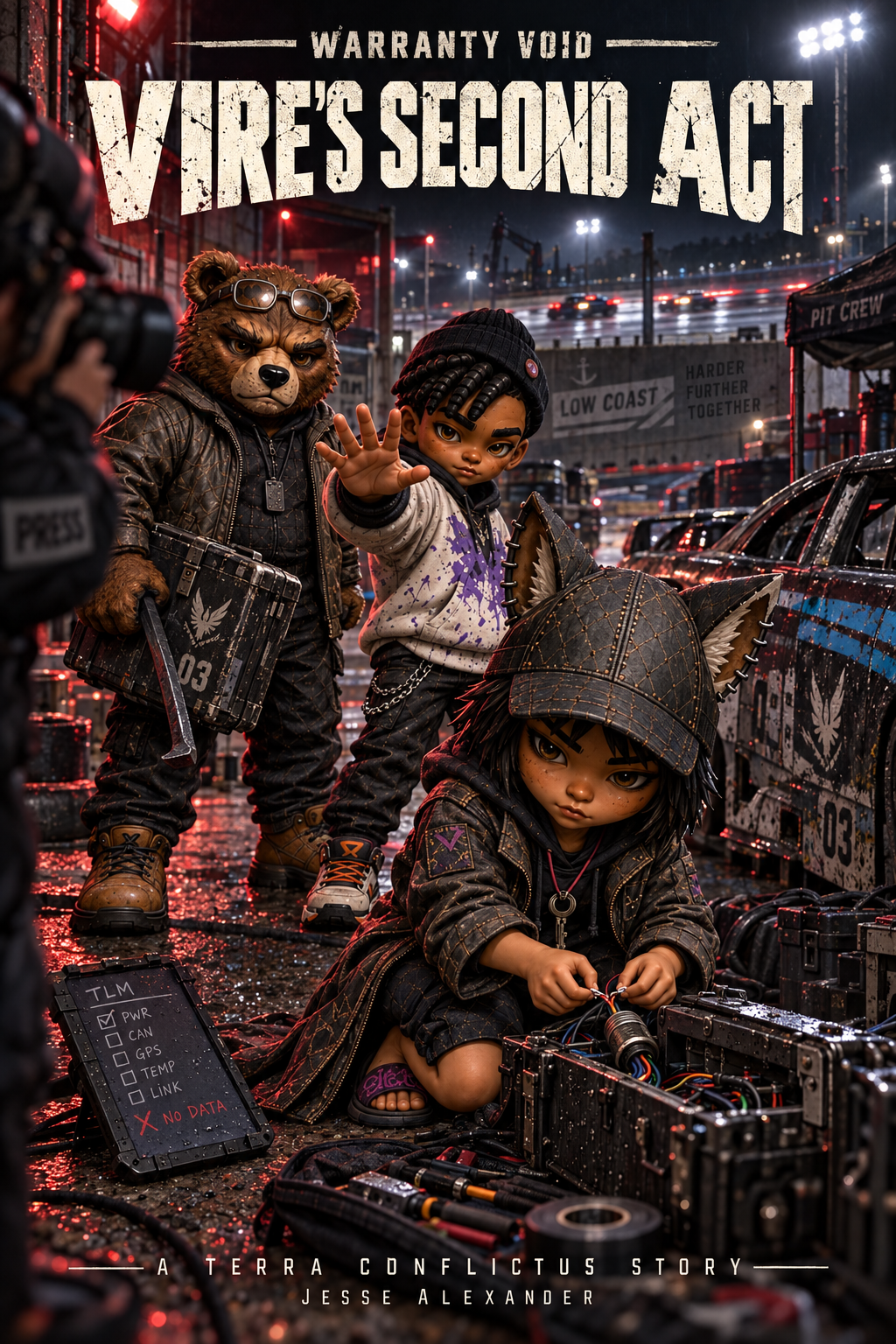
Lost Angeles, 2069.
“Every line, understood.” — Vire Dynamics, broadcast affairs
CHAPTER ONE: THE ASK
nobody said yes yet.
Kestrel Motorworks smelled like brake cleaner and old coffee, the particular blend of a shop that scrubbed its floors every night and still couldn't scrub out what forty years of engines had put into the concrete. Ozzy Okonkwo-Cruz had already used up three sentences before the man behind the desk got a chance to say no.
"So the number you're picturing, respectfully, forget it." Ozzy's hands moved like he was conducting something only he could hear. "That number gets you a driver for an afternoon. This is the whole crew. This is applied logistics. This is..."
"This is a company, Mr. Okonkwo-Cruz." Corin didn't look up from his ledger, a real paper one, corners gone soft from handling. "Not a..."
"A blessing? I get that a lot."
Nobody behind Ozzy had been introduced yet, and nobody needed to be. Danka Ivel had already walked the building's perimeter once, hands in her jacket, and now stood very still in the doorway doing math nobody had asked her to do. Theo Ashe had a shot half framed on Ozzy's hands, pure reflex, and murmured cutaway to nobody in particular, the habit older than any job they'd ever held. Cas read the room the way she read a manifest, eyes moving in straight lines, top to bottom, left to right, cataloguing exits and inventory and the particular silence of a business that was better than it looked and worse off than it wanted anyone to know. Somewhere behind Corin's desk, Grigor Tam was already doing something with his hands that wasn't anyone's business yet, unhurried, like the day had all the time in it he needed.
Corin set the ledger down and actually explained it. Kestrel Motorworks needed Jumper and Spotter support, plus somebody who could read their own systems better than their own bench could, for a demanding stretch of the season. Real money, more than the office looked like it could spare. He didn't say how thin the roster actually was. He didn't have to. The office said it for him. Good bones. Nothing spare. A ledger a man kept by hand because he trusted his own columns more than any system he hadn't built himself.
"It's legitimate work," Corin said. "I want to be clear about that before anyone gets excited."
"We're always excited," Ozzy said. "It's a baseline setting."
Filed under: not a real job title. It was about to become one.
The garage floor was brushed steel gray, a hairline of Kestrel blue on every surface, everything over-maintained in the specific way people over-maintain what they're afraid of losing. A case of parts shifted on a high shelf behind Corin as he talked, the kind of settle that happens in old buildings and means nothing until it means everything. Grigor's hand came up without him looking, caught it mid-fall, set it down soundless. He never stopped nodding along to Corin the entire time. Corin never noticed. A Kestrel mechanic on a stool near the bench, older, gray at the temples, had been watching the whole exchange, and he absolutely noticed. He said nothing. Just filed it.
"Your reverse-in spots are graded wrong," Danka said, to Corin, unprompted. "Half a degree. It's why your rookie clips the post."
"I don't know how to respond to that," Corin said.
The mechanic on the stool, who had clearly been waiting years for somebody to say this out loud, was already smiling.
Cas had found Kestrel's parts-inventory system by then and was torn between two feelings at once, one per ear, because it was, by any real standard, excellent, and excellence in someone else's system always did something complicated to her. "This is the best civilian system I've seen outside a state contract," she told a staffer who hadn't asked. "You've got your torque specs cross-referenced by supplier lot. That's correct, and it's rare. Your consumables threshold is wrong by about six percent. Here. And here." She said it like a fact she was relieved to finally have somewhere to put, not like an accusation.
"Nobody's ever caught that," the staffer said.
"Somebody should have."
Back at the desk, Ozzy negotiated the rate up once, watching Corin's face the whole time, then up again, watching for the exact second discomfort turned into respect. He got it. Then he gave something away for free, on purpose, because that was the actual sale.
"And we'll throw in vibes management," he said. "No charge. You'll need it more than the parts."
Corin wrote it down anyway. Vibes management. Underlined, like it was a real line item. By the time the ink dried, it was one.
The roles landed plain, no ceremony. Grigor: Jumper. Cas: systems, starting with Kestrel's own, moving on from there, an assignment that would come to mean more than anyone standing at that desk understood yet. Theo: Spotter, and Corin read the no-content clause straight at them, the way a man reads a rule at the one person in the room he suspects will need it repeated. Theo nodded, agreed, and kept the frame running through the entire agreement while they did it. No content. Understood. This wasn't content. This was a receipt.
And then, plainly, no ceremony landing on it either: Danka was hired. Not to drive.
"We've got Jockeys," Corin said. "What we're short is everything around them."
"Understood," Danka said.
Nobody moved to soften it. The room let it sit a second too long, and Danka let it sit with them, and didn't do anything with her face at all. She'd been wanted for everything except the one thing she actually was often enough to know the shape of this particular silence on sight. It didn't need her help to finish landing. She wasn't about to give it any, either, not here, not in front of a stranger's ledger, not on the first day.
Corin mentioned the season's sponsor almost in passing.
"Season's backed by Vire Dynamics this year. Cassian Vire personally." He cleared his throat. "It's, ah. It's the reason any of this is possible."
His relief showed half a beat longer than the sentence needed. Nobody in the room said anything about it. Cas noted it and filed it somewhere she wouldn't look at again until she had a reason to.
Outside, alone, waiting for the others, Cas said the true thing to nobody. Not quite to herself.
"Clean work is the kind that worries me."
No one answered. The market noise from the street filled the rest of the beat for her.
Five people. One contract. Not one of them had done this before.
That evening, in the lot, Danka was already crouched by the lift with a roll of hazard tape and a level, re-marking the reverse-in spots herself, on a job that hadn't technically started yet. Nobody had asked her to. Nobody was surprised.
CHAPTER TWO: FIRST COLORS
source: vire dynamics broadcast affairs.
The spot opened on clean gray dawn light over the Ring Road, empty of traffic for once, the asphalt still holding the night's cold the way it would for another hour yet. A single car, matte silver, took a corner at speed with no visible driver input, no correction, no drama, the tires finding the exact line a good driver spends years learning to find. The camera held static, tripod-patient, unhurried, the kind of shot that costs money precisely by refusing to show you it cost money. No music. No voiceover.
Every line, understood.
A sequence of hands, not faces. A technician's gloved hands seating a component with the specific care of someone who'd done it a thousand times and still didn't trust the thousand-and-first. A driver's bare hand resting on a wheel that was doing the work for them, knuckles loose, no white in them anywhere. A child's hand pressed to glass, watching a car pass without flinching, because the car had never once given anyone in that family a reason to flinch. Each cut held a beat longer than it needed to, the patience itself a kind of argument.
Vire Dynamics is proud to support Lost Angeles Raid Race, Season 2069.
Cassian Vire himself, at last, seated, unhurried, speaking directly out of the frame like a man addressing one person rather than a broadcast. Warm. Not a pitch. A man who believed what he was saying, or had practiced believing it long enough that the difference didn't show anymore.
"Racing used to mean trusting your instincts," Vire said. "I'd rather trust the data. Instincts get people killed. Data just tells the truth a little earlier."
Vire Dynamics.
Back in the garage that Wednesday evening, the spot played on the corner monitor, small, sound bleeding faintly across the room over the ordinary noise of a shop closing down for the night. Nobody in the foreground was watching it. The foreground had other business.
"The parts van. Center Point. Bet I beat it," Danka said, low, to Coop, who was stacking crates nearby without looking up. "Surface streets. No shortcuts that void anything."
Coop said yes before he'd even set the last crate down. Thirty years of professional discipline, lost in under two seconds to something he'd wanted a lot longer than that.
Across the floor, Theo sat cross-legged, screen propped against a toolbox, showing Cas something. It was, unmistakably, thirty-one pieces of equipment shot and cut like a heist crew's gear reveal, slow pans, hard light, music that existed only in Theo's head. Gorgeous. Useless as an inventory. Cas's ears didn't so much as flick. She pointed, once, at the actual spreadsheet, still empty in the corner of the same screen, and let the silence do the correcting.
Elsewhere in the same wide room, Cas handed Kestrel's logistics staffer a folded napkin covered in her handwriting, dense, small, three lines to the inch. He unfolded it, read three lines, and looked up at her like she'd said something rude at a funeral.
Ozzy stood alone at the monitor now, watching Vire's card sequence for the third time, arms crossed, nodding slowly. The exact posture of a man pricing a rival, running the number in his head and not liking what it came to.
Vire Dynamics came through the Kestrel floor the next morning. Two technicians, a case, and Cassian Vire himself, which nobody had been told to expect.
Ozzy got to him first. He got to everyone first.
"Mr. Vire. Ozzy Okonkwo-Cruz, Warranty Void. We're the reason your support car got where it was going last week, and about forty percent of the reason it got there on time."
"Sixty-one percent," Vire said.
The next sentence was already loaded, so Ozzy fired it. "See, now you're just flattering me."
"I'm not." Warm. Unhurried. The same register as the spot, running live in a room instead of on a monitor. "I ran it. Your crew accounted for sixty-one percent of the handling variance on the Low Coast package. It's a good number. I wanted to see the people it belonged to."
Behind him the two technicians had a Kestrel support car up on the lift, working in full light with two Kestrel mechanics standing right there watching them do it, seating something into the chassis that hadn't come off any Kestrel shelf.
Ozzy reached for the next tool. "Come stand in the lane sometime. Bring a jacket. It's louder than the commercial."
"I've seen you work." He said it kindly, and he meant the data. "That's the part people keep getting backwards. They think watching is what you do when you can't be there. It's the other way around."
He put a hand out. Ozzy shook it. It was a good handshake and it ended at the exact moment Vire had decided it would.
"Your closer is very good," Vire said, already moving past him. "The thing you give away for free at the end. Vibes management. Corin wrote it into the ledger."
Then he was down the floor with his technicians, and Ozzy was standing there with the rest of the pitch still in his mouth and nowhere to put it, running the whole exchange back twice and finding no seam in it anywhere.
The monitor played on, unwatched again, its light the only thing moving in that corner of the room. On the tag, a single still frame held: a complaint notice on Corin's desk, read into the record in the flat voice of a form built to have no opinion about anything. Civilian vehicle, unverified, behavior flagged near the Center Point off-ramp.
"Does anyone know anything about this?" Corin asked, baffled, to the room.
Danka said nothing. Her ears went flat, and stayed that way a moment longer than the question deserved, the only part of her that had never learned to lie.
CHAPTER THREE: PHANTOM INPUT
the numbers didn't ask permission.
Night at Low Coast turned the staging field the color of an old photograph, floodlights flattening everything into hard white and harder shadow, the kind of light that made distances lie to you if you trusted your eyes over the numbers on a comms channel. The raid package contest was already three minutes old by the time anyone had a clean read on it. A target vehicle, boxed in by two others, running the gap between them like it was still an option, the whole field a slow-motion argument about who actually controlled that stretch of asphalt.
Theo had the comms first, voice flat and fast, the register they used for nothing else. "Two cars closing your six. Gap's on the left, ninety meters."
A beat. The gap held. Something in the field shifted wrong, the kind of wrong that lived in the count more than in anything visible yet.
"Gap's closing," Theo said, exactly as precise as the first call. "Take it now or lose it."
It was taken. It worked. For a moment the whole night ran the way it was supposed to.
The crack came on the third call. The pressure was different this time, the boxing car closing faster than the first two had, and Theo felt the correction rising, the exact shape of the call they needed to make, and felt, for half a second, something else get there first. Not fear exactly. Something closer to delight at a shape in the chaos, a half beat of watching instead of calling.
"Oh, that's so bad, that's incredible, hold on..." The real call landed a half beat after the window that needed it. "Left, now, LEFT!"
Grigor took the hit meant for open air. Metal on metal, not catastrophic, but real, the kind of impact that lives in a shoulder for a week afterward whether anyone mentions it or not. He righted the vehicle himself, on foot, one hand flat against the door like he was steadying a table that had never once needed steadying, his whole body absorbing what the car didn't have to.
"You're welcome to react on your own time," Grigor said over comms, not raising his voice at all, which was worse than if he had. "Not mine."
sorry. Theo held the word two full seconds. Longer than anything else that night, longer than the words they usually let themselves spend on anything.
Forty minutes later, timestamp ticking forward without anybody watching it, it happened again. The same half second of watching before calling, the same late correction. Theo apologized with the exact same sincerity, and meant it exactly as much the second time, which was somehow worse than meaning it less. Nobody said anything about the pattern out loud. Somebody should have.
The contest went sideways at the handoff point. A locked case, no clean approach, the kind of obstacle built by someone who'd never had to solve it themselves. Grigor didn't wait for a plan. He breached it himself, a crowbar and his own weight, a job built for two people done by one in under ten seconds. He walked it back to the truck like a delivery, like the whole thing had cost him nothing at all.
"That's supposed to take a team," Coop said, meeting him halfway, impressed despite himself.
"I had a crowbar," Grigor said.
If anyone had been rolling, the shot would have held on his shoulder a half second longer than the joke needed. He rolled it once himself, privately, before anyone was looking, testing the range of it, cataloguing exactly how much it had cost him. He filed the answer away and kept walking, and the joke stayed a joke.
Cas's telemetry handoff plan died in real time, a connector reading dead that had no business reading dead, the exact kind of failure that shouldn't have existed on paper and existed anyway, which was the whole reason paper wasn't enough. Three seconds of silence, exact, counted by everyone on comms without meaning to, the crew's own private metronome for how bad a given problem actually was.
Then she was already on her knees in the gravel, hands moving before the plan had finished forming behind them. "New plan," she said. "Same as the old plan. Faster. With apologies." She rewired it by hand, reciting the revised sequence out loud to nobody, fixing the problem before she'd finished explaining it to herself, the gravel biting into her knees in a way she'd only notice later, if at all.
"She always like this?" Coop asked.
"Yes," Grigor said, before Cas could answer. Warm. Like it was the correct answer to a question he'd been asked a hundred times and never once gotten tired of answering.
A stringer with a long lens crowded the pit wall mid-crisis, angling for the wreck, the kind of shot that sells regardless of who it costs. Ozzy was between him and the shot before anyone called for it, one hand light on the guy's shoulder, walking him backward, running two conversations at once, neither of which was the one actually happening in front of him.
"Not a great angle from here, my friend, let me walk you to a better one..." and in the same breath, into a separate channel, flat, ops-speak: "...copy, gap's closed, moving to secondary..."
He never broke stride on either sentence, never let either register bleed into the other. The photographer ended up forty feet away, thanking him, no idea he'd just been managed.
Kestrel's rookie came off the field shaking about twenty minutes after Grigor took the hit, and the car still had one package run left on it.
Danka was standing right there. She had been standing right there all night.
"I can take it."
Level, and once, and Coop understood a beat too late what it had cost her to say at all.
"Can't," he said. "Sanction only covers listed Jockeys. It's not me. It's the paper."
"The paper's wrong."
"The paper's wrong," Coop agreed, and didn't move, because agreeing was free and moving wasn't.
Danka nodded. She didn't ask twice. She went back to the support vehicles, which were hers, and which nobody had to sign anything for.
The package delivered. Late by nothing that mattered. For one night, five outsiders and a thin roster looked like they'd always worked together.
After, Cas sat alone at a monitor, running the audit she'd actually been hired for. Not the rival cars. Kestrel's own. Its own telemetry, nothing external, the kind of quiet, unglamorous pass that never made anyone's highlight reel and caught things highlight reels never could. A pattern she couldn't file anywhere she recognized. Zero hesitation on a blind entry. No fatigue variance across the whole run. A body that didn't get tired, reading like the body that had been driving it all night, and bodies, in her experience, always got tired eventually. That was the whole point of having one.
"That's not a driver having a good night," she said to herself, flat.
She didn't finish the thought out loud. She wrote three words in her own notebook and closed it, the paper cover already worn soft at one corner, though the season had barely started.
good night. wrong kind of good.
Elsewhere in the same field, past the last of the floodlights, Rosalind Kestrel opened a fresh page in a paper notebook she'd kept for years, the kind of habit that outlasted whatever job she'd originally started it for, and wrote a single line at the top. Nobody else on that field would have thought to write it down. She did.
CHAPTER FOUR: THE LEDGER
The garage held everyone at once that evening, the way a single wide shot holds a room, high and slightly off-angle, the kind of vantage nobody thinks about until they need the footage. Nothing chosen. Nothing emphasized. Just what happened to be there when the overhead lights dropped to half and the day's noise thinned out toward whatever the night was going to be instead.
Grigor crossed the floor early, counting heads under his breath, a habit as old as the job itself. He stopped. Recounted. Went still, the whole head at once. Left the frame on the right-hand side. Twenty seconds later he crossed back the other way, still counting, and got a different number the second time.
Danka came in alone and repositioned a Kestrel support vehicle four inches to the left, checked the angle from three points around it on foot, adjusted it back two inches, and left it exactly where it had started. She never once looked like she was wasting time, because she wasn't. Some people needed a reason to move. She needed a reason to stop.
Near the front, out of focus at this distance, Ozzy paced a tight six-foot line with a phone at his ear, one call, three postures, transferred twice without ever hanging up, his free hand cutting shapes in the air for an audience that couldn't see it and wouldn't have understood it if they could.
Grigor crossed again, a third time, gave up on the headcount mid-stride, and started silently counting the food containers on the kitchen shelf instead, a smaller number, an easier one. He was visibly calmer within a few seconds of switching targets. It was never really about the number. It was about having one that came out the same way twice.
Cas came in last, alone, in a borrowed Kestrel jacket that wasn't hers, the sleeves half an inch short. She reached to touch her pouches in sequence, the small ritual she ran before every rollout, muscle memory older than the jacket she was wearing it against, and found nothing there. The jacket had no pouches at all. She did the motion anyway, against bare fabric, and didn't seem to notice she'd done it, her hand already moving to the next empty place before the first one had finished registering as empty.
She crossed toward the rear office, small and lit by one working lamp, and sat down at a desk that wasn't hers either. From where anyone else stood, that was all there was to it. A woman at a terminal, working late. Background information, easy to miss if you didn't already know to look for it.
Rosalind passed through on her own business and noticed something near a support column the light didn't quite reach, a shape crouched low, a lens catching a stray gleam once and going dark again. She walked over, unhurried. Whatever passed between her and it wasn't words. Somebody recognized by somebody else, a small transaction complete in under a second. She moved on without telling anyone in the room what she'd seen, saving it for whenever later turned out to be.
The floor emptied out slowly, the day's business winding down around everyone but her. In the back office, small, at the edge of anyone's attention, Cas went still.
The stillness held. It held past three seconds, past whatever her own body usually allowed her, past the point where anyone who'd been counting would have run out of count and started wondering if the recording had simply stopped.
What was on the screen wasn't Vire's. It had come in sideways off the telemetry audit, a cross-reference that should have led somewhere else and led here instead. A municipal service record, six years old and still accruing. Reclamation Substation 3, Barricadia. Decommissioned on paper. Drawing power, filtering water, serving eleven blocks that appeared on nobody's list of who got served.
The station was Grigor's. It had been his before the crew was the crew, and it had gone on being his for six years after he walked away from it, on a private arrangement carrying exactly one signature. The signature wasn't his.
She read it again. She didn't move to tell anyone in the room what she'd found, didn't reach for a phone or a comms channel or anyone's name. She closed the terminal and sat with it in the lamp's small circle of light, doing the only part of this she was sure of, which was nothing.
By the time the last of the floor's noise settled, she was the only one left. Distant. Alone. At a desk that wasn't hers, in a jacket that wasn't hers either, holding something that was now, whether she'd wanted it or not, entirely hers to carry, with nowhere in the frame left to set it down.
CHAPTER FIVE: SCAR TISSUE
it isn't that it stopped hurting.
The garage floor was down to half light by the time Grigor got to the onions. Most of the crew was gone for the night, the building settling into the particular quiet of a place built for noise. He wasn't cooking for anyone in particular. He was just doing it, because it was the one job his hands had never once asked him a question they didn't already have an answer for. The knife went down, came up, went down.
Eleven seconds passed before anything else in the room moved. Grigor didn't count them. He was never the one who counted things.
The week behind it.
Thursday night, most of the floor already dark, Cas sat alone at the back terminal, the screen the only light in that half of the building. She typed a header. FINDINGS: PERSONNEL. Two words that had never once been wrong. She looked at it for four seconds, and felt something she didn't have a clean word for and didn't go looking for one. Then she deleted it, and closed the file without saving, and sat with her hands still on the keys for a moment after the screen had already gone back to being empty.
Friday evening, Ozzy caught her in the kitchen doorway on his way out, and there wasn't a bit anywhere in his voice when he said it. "Your ears have been pinned for two days. Everything reading clean?"
"Running a variance I can't close yet," Cas said. Which was true. He read it as the Vire audit. Which was also true. Just not the part keeping her up. He didn't push. He'd gotten better all season at knowing when not to, and it cost him something to practice it here, on the one person he'd usually have made a joke to loosen up.
Monday, before lunch, Cas crossed the floor toward Grigor twice. The first time, Coop was on the phone with Corin about a parts order, and she peeled off before she reached him. The second time, Grigor was mid-conversation with a Kestrel mechanic about a lift schedule, and she stood at the edge of it for six seconds, said nothing, and left. Neither approach needed a witness. Neither got one.
Monday, evening again.
Cas crossed into the kitchen with her hands empty. No tablet. No printout. For her, that was its own kind of statement, the loudest thing about her that whole walk across the floor.
"Sub-3," she said. "Six years past decommission. Eleven blocks it was never supposed to be serving."
Grigor's knife didn't stop.
"Water is not meant to wait behind a signature," he said, warm, unhurried, the register he used for things he'd already made peace with a long time ago. "Sub-3 never learned it was decommissioned. It just kept doing the job it already knew how to do."
"That's a good answer for the machine. I didn't ask about the machine."
"Sit. Eat something. You have been at a screen since Thursday."
"No." Flat. Immediate. No clause after it, which was its own tell. "Six years. One name on the arrangement. If Vega's own people ever ask, she's the only one who answers for it. You did the math on that already. You do the math on everything. You just didn't do it out loud, where four other people could carry some of the number with you."
Something under the warmth shifted, though his hands still didn't stop, the knife finding the same rhythm it had found a minute ago even while everything above it changed. "She never asked me to share it."
A beat.
"Neither did I." Shorter now. Harder. The alarm in a voice that was never short, the sound of a man hearing his own reasoning come back at him from somewhere he hadn't checked yet.
"I'm not filing this," Cas said. "I thought about filing it. I know exactly how. I had the header written. You can ask the terminal what time I deleted it. I didn't send it because you don't need an audit, Grigor. You need one more name on the arrangement. So here I am. That's not oversight. That's me, choosing to be your redundancy instead of your paper trail."
Three seconds of silence. Her own tell, the one that usually meant a plan had just died in her hands, offered up this time for something that wasn't a plan at all, something closer to a person, which she had considerably less practice with.
"Nobody's asking about the six years," she said. "They're already spent. I'm asking what happens to the next one."
The knife stopped. First time all night his hands went still, the onions half finished under a blade that had suddenly forgotten what it was for.
"I do not know how to say this so it does not sound like I did not trust the four of you," Grigor said.
"Say it exactly the way you just said it to me. That's the whole trick."
A held beat, longer than anything else in the room, long enough that the refrigerator's hum became the loudest thing in the kitchen.
"...Okay."
He didn't move toward the door. He called out, and the register was wrong for how he usually called anyone, gentle where he was usually just present, the difference small enough that only someone who'd spent a season learning his voice would have caught it at all. "Everyone. Come to the floor, if you have a minute."
Danka was already close, mid-circuit of the lot with a level and a roll of tape she hadn't used yet that night. Ozzy drifted in off a call he ended without his usual sign-off, the unfinished courtesy the first sign that he'd heard something in Grigor's voice too. Theo arrived last, three steps into the room before they clocked it, camera strap already sliding off one shoulder, hand already halfway up. The same reflex that had opened everything this season, running ahead of whatever judgment might have stopped it.
"Sub-3 was mine," Grigor said. Plain. No run-up, the sentences short and complete both at once, each one landing before the next one started. "It was my water reclaim station, before this crew. It stayed live six years past its decommission, on a private arrangement with Vega, and I never told any of you it existed. Cas found it doing the Vire audit. She came to me first, tonight, instead of to the three of you. I am the one deciding to tell you now, not her."
"Six years." Danka's voice had none of its usual amusement anywhere in it, scraped clean of the thing that usually lived underneath everything she said. A beat. "Who else."
It wasn't really a question.
"No one else knew. It was her, and now it is the three of you."
Danka didn't answer that. She looked at him a beat too long, no warmth in the look at all, and then looked away first, which she never did. Not once, all season, not through any of it, and the wrongness of her looking away first said more than anything she could have put into words.
The old reflex kicked in before Ozzy could stop it, the tool reaching for the job it had always done, the one that had talked Corin into a rate and a photographer off a wreck and half a season of tension into something survivable. "Okay, well, for what it's worth, out of everyone's secret history, quietly kept a water station alive for people who needed it is a pretty good one to..."
He stopped himself mid-word. Nobody was laughing. Not even a courtesy exhale, the smallest currency in the room and nobody willing to spend it. For the first time all season he clocked it in real time, not after, felt the joke go wrong in his own mouth before it finished leaving it, and he just stopped, instead of pushing through to the end of the sentence the way he always had, with Corin, with Vire's spot, with anyone who'd ever needed managing. Leaving it unfinished cost him something you could see move across his face, a tool he'd trusted his whole life suddenly refusing to do the one job he needed from it.
Theo's hand was still halfway up. They saw Danka's face. The hand stopped climbing, dropped, the camera settling back against their shoulder, unraised, heavier somehow for not being lifted. No line. First time all season they chose not to shoot something already happening in front of them.
Nobody moved toward Grigor. Nobody moved toward each other. Danka turned and walked the length of the floor toward the lot doors, not fast, not dramatic, just gone, the level and the tape still in her hand, unused, swinging faintly at her side with every step. Ozzy stayed where he'd stopped talking, arms doing nothing at all, which for him was its own kind of collapse, a man built entirely out of motion finding himself with none left to make. Cas stood apart from all four, closer to the terminal than to any person in the room, the one who'd already known, watching the other three learn it in real time and finding there was nothing left for her to do about it now, no plan, no rewire, no three seconds that would fix this one. Theo stayed in the doorway, camera down, filming nothing, letting the room hold all of them at whatever distance they'd actually chosen to stand from each other, for once, honestly. It was the frame they'd never shoot, and it would have been the truest one of the whole season.
Grigor was alone again at the counter. The knife where he'd set it down. The onions going soft in front of him, unfinished, the smell of them the only thing in the room still doing what it was supposed to do.
The quiet went on longer than it usually did, and nobody came back to end it.
CHAPTER SIX: THE ENDURO
forty-one kilometers. nobody's coming to get you.
Dawn came flat and gray over Low Coast, the kind of light that hadn't decided yet what the day was going to be. Forty cars sat in staggered formation across a starting grid built into the old flood channel, engines idling low, the Ring Road's forty-one closed kilometers waiting past the marker ahead of them like a fact nobody in the pit needed restated.
The PA voice was distorted, procedural, the kind of announcement everybody in the pit had heard so many times they'd stopped hearing it, the words worn smooth from repetition the way a stair gets worn smooth from footsteps. Once the field committed past the Low Coast marker, extraction protocol was suspended for the duration of the lap. Two hundred forty kilometers an hour was the floor, not the ceiling. If you stopped out there, you got yourself to a marshal point. Nobody was coming to get you.
Nobody in the pit reacted. Everybody's body already knew, the way a body knows the temperature of water it's about to step into.
The front half ran fast and light. The pit lane worked clean, professional, good at this now in a way it hadn't been on the first morning at Kestrel's office, and something in how the crew handed each other tools had gone half a degree more careful than it used to be. Nobody quite met an eye a beat longer than a handoff required. Nobody said anything about it. It had been there for weeks now, since a kitchen and a set of onions nobody talked about, the same way it had been there when nothing was wrong at all. Except now something was.
Three support vehicles needed repositioning before the first pit cycle. Danka did it in one uninterrupted run, reversing each one at a speed that shouldn't have been safe and stopping dead inside taped lines without a single correction, her hands already fluent in the wheel in a way nobody had thought to hire her for. A knot of grid spectators had gathered by the fourth vehicle, phones already up. She did that one for them too, still without a hand signal, because she'd never needed one. It was the first time all season anyone had clapped for something she'd done with a wheel, and she didn't let herself enjoy it for longer than it took to park.
"That's the whole reason we hired her," Coop said, to no one in particular, delighted, "and it's not even the reason we hired her."
Grigor fed the first pit cycle's Kestrel mechanics from a cooler he'd packed himself, out of habit, sandwiches wrapped the way his hands wrapped everything, tight and unhurried both at once, and got a real laugh out of a Kestrel tech for the first time all season. It should have felt like a good sign. It did, right up until it stopped mattering.
Ozzy was on his fourth headset conversation of the morning, one of them with Vire Dynamics' own press liaison, warm, professional, giving away nothing, learning everything, his voice never once betraying how carefully he was listening underneath the pleasantries.
Cas sat with three monitors and Kestrel's live telemetry, watching a grid-wide broadcast overlay light up for the first time all season. VIRE DYNAMICS SENTINEL NETWORK. LIVE FOR RACE WEEKEND. Underneath, small, the same clean institutional register from the spot months back. Every line, understood.
"That's new," Cas said, flat, to the screen. Not to anyone.
A wall of drones lifted off the marshal towers in formation, clean, impressive, exactly the kind of thing a sponsor wanted broadcast, the morning light catching their hulls in a way that looked, for a moment, genuinely beautiful. Vire's voice came over the grid feed, warm, unhurried, the same register as always. "Every driver on this track is safer today than they were yesterday. That's not a slogan. That's forty-one kilometers of live coverage, biometric and visual both, reacting faster than any human marshal ever could."
For six seconds it looked exactly like what he was describing.
Then, small, cascading, one after another across Cas's monitor: sentry units losing link. Six. Eleven. Fourteen. Each one a number she'd have bet against an hour ago.
Cas was already standing, already moving, the chair rolling back behind her and hitting the wall without her noticing. "That's not a dropout. That's every unit losing our link at once and finding a different one."
The drone wall didn't fall. It re-formed, tighter, drifting off its marshal positions toward the inside of the loop, toward the grandstand built into the channel's second bend, the formation's new heading obvious to anyone watching the overlay and invisible to everyone watching the sky. On the overlay, unchanged, oblivious, still lit: Every line, understood.
Comms went from professional to something rawer in under a second. This was the exact coordination that had broken five weeks ago, in a kitchen, over a set of onions, and there was no time left to find out whether it had actually been repaired. There was only time to find out live, in front of everyone watching, whether five people who hadn't fully looked at each other in weeks could still move like one.
"Cas, talk to me," Grigor said over comms, no warmth spared for the greeting.
"Relay shed, second marshal post. I can cut their shared link from there if I get to it in the next ninety seconds. The Jockey's car is stopped dead across the access road. I can't get past it."
"Whose car," Danka said, flat, already moving toward the pit wall.
"Ours," Coop said. "It clipped something avoiding the drones. Driver's down, car's still live in the lane, nobody's stopping traffic for it."
Grigor was already crossing live track before anyone finished the sentence, timing three lanes of cars still running the 240 floor by feel, not by any gap he could actually see, his whole body doing math his mind didn't have time to check. He reached the stopped car as a low pass of drones clipped its own roofline, and a strut, or a piece of the drone itself, came apart and caught him across the shoulder and ribs on the way down. The impact registered a half second before the pain did. He'd never had reason to learn that order on his own body before now. It knocked him sideways. He didn't stop. He got the Jockey's harness free with one hand, the other arm not doing what he asked of it anymore, refusing him for the first time all season, and carried them clear the way he'd carried everything else this year, except this time the cost stayed visible instead of getting absorbed somewhere nobody had to look at it. He was breathing wrong by the time he was off the track, short and shallow in a way that had nothing to do with effort, and he sat down hard once he'd cleared it, not because he chose to, his legs simply declining to hold him upright any longer than the job had required.
"Ivel," Corin said over comms, no time left for tact. "We need that car moved, now, there's no one else."
Danka didn't answer him. She didn't say the thing she'd been entitled to say since Low Coast, either. She looked at Grigor once, on the ground, two Kestrel medics already reaching for him, held it half a second, long enough to confirm he was breathing and short enough not to cost anyone anything, and said nothing. Then she was in the seat, belted, moving, and the car came off the access road clean, controlled, exactly the kind of driving this whole stretch of the season had insisted she was better at than anyone currently getting paid to do it. She didn't take it back to the pit. She parked it exactly where Cas needed the road clear, dead center of the lane, engine off, and got out running, already three steps into the next thing before the door had finished swinging shut behind her.
The relay shed held a server rack older than Cas was, no schematic loaded, no plan she'd had time to write down anywhere but inside her own hands. She was inside the housing with her bare hands in under ten seconds, tracing a shared trunk line by feel the way she'd rewired a connector in the gravel weeks back, except there was no one to recite the revised plan to now and no time to say it out loud even if there were, no Coop asking if she was always like this, no Grigor answering for her before she could. A drone drifted low outside the shed's open panel, its optics swinging toward the movement of her hands, close enough that she could hear the small motors correcting for the angle. She didn't flinch from it. She finished the cut, physical, decisive, wire against wire against her own bare skin.
Nothing dropped.
The overlay held. Every unit still lit, still drifting, the formation tightening another degree over the second bend while her hands sat useless inside a housing she had just been completely right about. The trunk was cut. The trunk had never been all of it. A second feed ran off the mast outside, forty meters into open ground, directly under the drift, and the housing in front of her would seal itself back the moment she let go of it.
She could do one. She could not do both.
Three seconds of silence would have been useful there. She didn't take them. She put it on the open channel instead, and saying it cost her more than the wire had.
"I need somebody at the mast. I can't leave the housing."
Two seconds. Long enough to hear the drift.
"Moving." Danka, already running before the word was finished. "Talk me through it."
So Cas talked her through it, plain and slow and out loud, no shorthand, no assuming, every step spoken to somebody instead of to herself. Danka pulled the mast feed on the third instruction. Every unit on the overlay dropped to standby in the same half second.
The whole thing had run nineteen seconds past what her own plan allowed for. Four of those had been her, deciding to ask. Some distant part of her, the part that still kept a notebook, filed that number and set it aside for later.
The second-bend grandstand was packed, and the drone wall's drift had put it directly in the flight path before Cas's cut could land. Ozzy was already moving people, using the exact rhythm he'd used all season for smaller stakes, warm, directive, impossible to argue with, his hands doing half the work his voice was doing. "Down the east stair, that's it, you're not going to want to look at your seats again, they'll be fine without you, down and to the right." He caught himself mid-sentence and added it anyway, entirely on reflex, entirely against his own will, the tool refusing to stay quiet even now. "Those were good seats, honestly, someone's going to want a refund conversation later." He kept moving people the whole time he said it, mouth and body running two different jobs at once, same as it had been all season, and neither job slowed down for the other. The section cleared eleven seconds before Cas's cut landed. Nobody in the stands ever found out how close that number actually was.
Elsewhere, close to the pit wall, Theo had a decision to make and made it without raising the camera at all, the choice arriving in their hands before it had fully arrived in their head. Weeks of quiet, unposted footage lived on that archive, including one particular angle from the Kestrel garage floor the night Rosalind had clocked them and said nothing: two Vire Dynamics technicians installing hardware into a support car that never appeared on any sanctioned equipment manifest. Theo found Rosalind at the broadcast truck and handed her the drive. No explanation needed. She was already three steps ahead of the question.
"This the thing I didn't report," she said, flat, already moving toward the feed console.
"It's the thing you didn't report." It was the most words Theo had said on camera all season, and they said them like a receipt changing hands, which was exactly what it was.
She had it patched into the grid's live overlay in under a minute, cut directly against Cas's own telemetry data, already queued from the relay shed the second her cut had landed. Two different kinds of proof, a picture and a number, arriving on the same feed at the same time, from the two people on that crew who had spent the whole season sitting on what they knew.
The five of them found each other near the pit wall for the first time since the drones went dark, converging into a loose half circle without anyone calling a meeting, the way water finds the low ground without being told to. Danka's hand went to Grigor's good shoulder as he was helped up, steadying, gone again after a second, no comment, the gesture saying what neither of them had the words for yet. Cas checked Ozzy's hands, unprompted, the systems instinct overriding everything else, found nothing wrong, and kept checking anyway, running her thumbs over his knuckles like a diagnostic that didn't officially exist. Theo, camera still down, stood close enough to Danka that their shoulders touched, which was new. It wasn't fixed. Nobody said it was fixed. It was closer than it had been an hour ago, and that was allowed, for now, to be the whole statement.
Vire's voice came over an open channel, live, the practiced warmth reaching for its usual gear and not finding it, the gap between what his voice was trying to do and what it was actually doing audible for the first time all season. "What you're seeing is a system encountering its own edge case, live, which is exactly how you build a safer one. I'd rather show you that than hide it..."
Ozzy stepped into the broadcast truck's frame before anyone stopped him. No bit anywhere in his voice. Flat. Plain, the register the whole season had been saving for exactly this. "You told me watching was better than being there. Forty-one kilometers of live track, and you let a system you hadn't finished teaching decide who gets extracted and who doesn't. That's not an edge case. That's a decision, and you made it before anyone signed off on it. A man walked out into that traffic on foot this morning to do the job your system was supposed to be doing. You watched that too."
Nobody in the truck laughed. It landed anyway.
The overlay behind him still read Every line, understood, while Rosalind's feed ran the garage footage underneath it, unbroken, undeniable, two technicians and a support car telling a story the tagline had never once had to answer for. For the first time all season, Vire's timing was a half second late.
"That footage is, ah..." He didn't finish the sentence. Nobody ever heard how he was going to.
The feed cut from him. Not dramatically. Just the way a broadcast cuts away from anything that's stopped being useful to show, the same administrative silence that had ended a thousand other things nobody remembered afterward.
They were confirmed alive, all of them, patched up in the pit lane through the race's last, quiet hour, the adrenaline draining out of the morning. Grigor, one arm already in a sling, started a headcount out of pure habit before anyone had asked him to. He got it right on the first try, Kestrel and Warranty Void both, no recount necessary, and held still a beat longer than the count needed, a man surprised by his own relief. Nobody said anything about it. That was still the whole style, working exactly as it was built to.
Cas sat down on the wall beside him and didn't say anything for a while.
"Year seven," she said.
"It is." He didn't ask what she meant. He'd been carrying the same sentence since the kitchen and had gotten no further with it than she had. "Vega's name comes off. Mine goes on. I can do that inside a week."
"And then one name on the arrangement is still one name."
"Yes."
"So put four more on it."
He looked at her. Not surprised. Something slower than surprised.
"That is not how the paperwork goes."
"Then it's bad paperwork," Cas said. "I'll fix it. Fixing it is the entire thing I'm for."
He laughed, once. It hurt his ribs. He did it anyway.
Coop wandered past with two cups of something hot, entirely too casual. "So who actually won that van race back in the spring."
Danka said nothing. Her ears did the thing.
Nobody ever found out. That was still the rule, and some rules, it turned out, could survive almost anything.
If anyone had asked Theo later why there was no footage of the last hour, the answer would have been four words long. No footage. I was busy.
The five of them sat closer together than they had all season, late morning light flat and ordinary across the pit lane, the kind of light that doesn't care what it's falling on. Small, unhurried, nobody performing anything for a camera that wasn't running. Theo's hand checked a folded deregistration slip in a jacket pocket, out of habit, for no reason the moment explained. Cas's fingers found the edge of a card of eight, worn soft at the corners, and put it back. Danka turned a small key over once between two fingers, ceremonial, not for any lock in this pit lane. Grigor, one armed, still managed to check that two folded letters in his good pocket hadn't shifted. Ozzy's hand went to a single folded bill he'd carried since before any of this was his job, and stayed there a moment longer than the others.
Nobody explained any of it. That was the old arrangement. It had held for a season and it would have held for another one.
Grigor broke it.
"I carry letters," he said. Not to anyone. To all four of them. "There are two. I wrote them. I never sent them. One of them is to Vega."
Nobody asked him for more. Nobody made it a thing. Danka looked at the letters, and then at him, and this time she didn't look away first.
Four objects still unexplained. One fewer than an hour ago. That was the entire distance the day had covered.
Off in the far edge of the same wide morning, small, easy to miss on a first look: a Vire Dynamics equipment van, undamaged, already loaded, pulled out of the lot well ahead of anyone else's cleanup.
Nobody in the foreground looked at it.
It went anyway. On schedule. For anyone paying attention.