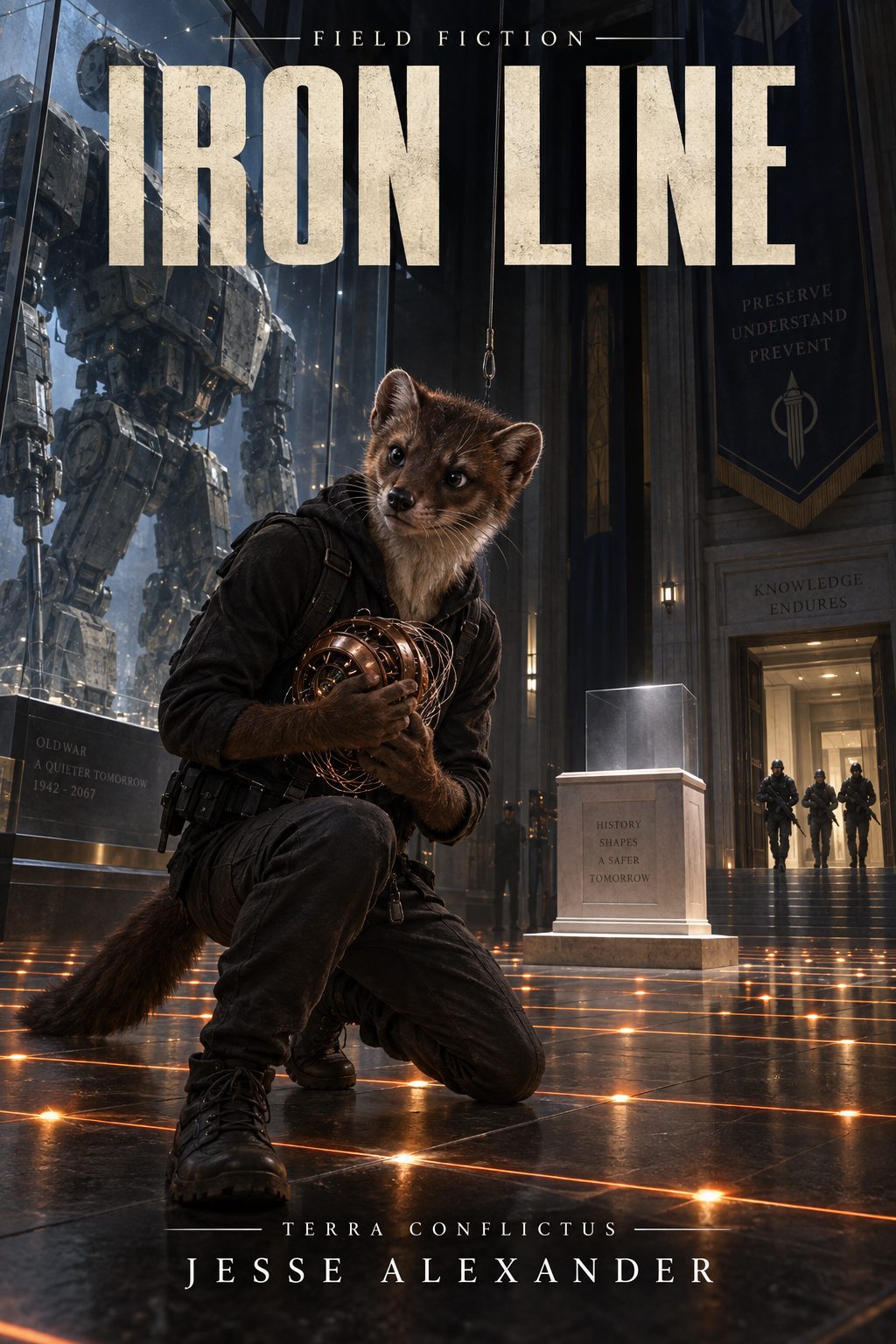
PART ONE — THE CALL
The Thief
The vault was not breathing.
Ethan Karr crouched in the service crawl above the Heritage Floor of the Accords Disarmament Archive and read the room the way the forge had taught him, by what it was not doing. The climate system on this level cycled every ninety seconds. He had timed it from the cafe across the plaza for three afternoons, counting the small shudder in the building's skin. The Archive was a cathedral built to keep air still, and a building that careful about its breathing has a rhythm you can set a watch by. Up here, now, there was no shudder. They had cut the cycle. A person only decides the air in a gallery should hold still when they are watching it for the wrong kind of movement.
So they knew someone was coming. They did not know it was him, and they did not know he was already inside.
He lay flat and let the knowledge settle into his hands. Gene-forged, built off a marten template his family had paid a great deal for and then paid more to pretend was about reflexes and not about something they could not name, Ethan had a body that loved the dark. The long bones light, the grip patient, the eyes that opened wide in the black like a shutter held too long. His own heartbeat he could find or lose at will, and right now he lost it, until the only loud thing in the crawl was the absence of the building's breath. Built not born, the saying went, and the people who said it down their noses meant it as the worst thing they could call you, and Ethan had spent his whole life deciding to take it as a fact instead. Whatever else he had failed at, and the list was long and his father kept it, the dark had never once turned him away.
Below him, on a pillar of cooled light, sat the thing he had come for. A harness coupler from the Walker War, a piece of dead technology the size of a man's two fists, copper-skinned and laced with filament he did not understand, the neural interface that had once let a pilot put his mind into forty tons of war-machine. The Accords would never let one come to market, which meant there was no number on it at all. Ethan called it the hardest locked object in the capital, which was the only quality that had ever interested him in anything.
He did not need it. He had a name that opened any door in the capital, a father who could have bought the gallery and donated the coupler back with a smile for the cameras, and not one single thing in the whole comfortable world that he needed. So he went looking for the one thing nobody would let him have, because wanting it was the only hunger he could still feel, and the moment of taking it was the only moment anyone in his life ever looked up and saw him.
He came down on a monofilament line thin enough to vanish against the dark, hand over hand. The line he had off a rigger who thought he was a thrill-climber, the floor plan off a contractor who thought he was a bored student, the maintenance window off a duty roster he had lifted clean from a man whose pocket never knew it. The climb felt like flying and was the easy part. The craft was the three weeks of small patient thefts beforehand that nobody noticed at all.
The floor sensors below were laid in a grid he had mapped off the contractor's plans, forty centimeters of safe stone between each live tile. Ethan set his weight down between them the way you set a full glass on a crowded table, and moved through the dead air toward the pillar of light with a smile starting, the half second before a thing that cannot be done is done, and there was nothing in the clean inherited world to touch it.
Here was the strange part, the part he had never told anyone. When he got close to the coupler, his teeth ached.
Not pain. A pressure, high and thin, behind his back molars, the feeling of a sound he could almost hear and could not, worse the nearer he came. He had felt it once before, years ago, standing too long in front of a piloted Walker in a sealed museum case on a school trip, rooted to the glass with the hair up on his arms while his class moved on without him, and he had been sick in the cloakroom afterward and told no one why. He told himself now it was nerves. He was good at telling himself things. The smile was gone. He had come the last three meters slower than was safe, and did not let himself notice that some animal part of him under the marten and under the craft wanted to be closer to the not-quite-sound.
He lifted the coupler off its light. The pressure spiked, white, and for half a second he heard it, a single sustained note under everything, the way you hear your own blood when you press a shell to your ear, except this was not his blood and it had been waiting. It was not a sound a dead thing should be able to make. The coupler was inert, its core pulled forty years ago, nothing left alive in it, and it was singing to him anyway, low and patient and aimed, and he stood there with the dead heart of a war-machine cupped in his two hands and forgot, for one whole second, that he was a thief in the middle of a job.
Then the floor lit up around him like a struck match, every tile alive at once, and the gallery doors opened on three Commission marshals with their weapons already up.
He had stepped on nothing. He was certain of that. He had read the grid clean.
They had changed the grid. The whole job had been a trap dressed as a vault, the live tiles re-laid since the contractor's plans were drawn, and the only thing he had read correctly all night was the air that had stopped breathing, and that had told him plainly to run before he came down the line. He had come down anyway, because the thing on the pillar of light had a sound in it that he wanted to hear again. The smartest boy in any room, caught in a vault he had been warned out of twice, once by the air and once by the ache in his own jaw, and he had listened to neither.
He put the coupler down very gently, because even now, caught, he did not want to be the man who dropped it.
His father saved him without ever raising his voice.
That was the part Ethan could have told anyone in advance. He had grown up inside the soft enormous comfort of the Accords elite, in a city the peace had built so thoroughly it had forgotten there was ever anything to keep the peace from. He was the son of Cale Karr, the face of the disarmament, the man who walked into the angry rooms of armed factions with empty hands and walked out having talked the weapons down, treaty after treaty, until the whole of human space called it a miracle and called Cale the man who worked it. And Cale was never home. The son of the miracle had learned by the age of nine that the only attention he could reliably get in that bright empty house was the kind he stole, and that getting caught was the point, and he had never quite forgiven himself for understanding it.
He sat now in a holding suite nicer than most apartments and watched through the one-way glass as Cale Karr did the thing he was famous across human space for doing. He talked. Quiet, unhurried, patient as weather. Ethan could not hear the words and did not need to. He watched the marshals' shoulders come down one by one, the duty officer who had wanted to make an example of the thief stop wanting it, the whole thing unmade in real time by a man who had never once turned that voice on his own son. Thirty years of the peace, spent tonight to make a problem disappear, and the problem was Ethan, and he understood that he should feel grateful and instead felt the old cold thing, that even now his father was working the room and not looking at him.
When Cale finally came into the suite, the warmth he had worn for the marshals was gone, folded away like a coat at a door.
"Sit," Cale said, though Ethan was already sitting.
His mother came in behind him. Naomi Karr, who had lived her whole life in the middle of the two of them and worn a groove there. She did not sit. She stood by the door with her arms crossed and her eyes wet and furious, and that was worse than anything Cale could say, because Cale was disappointed and disappointment Ethan knew how to wear. His mother's fear he did not.
"You understand what you nearly cost," Cale said. Not a question. "Not yourself. I can absorb yourself. I have been absorbing yourself for nineteen years. You nearly cost the office. The man who negotiates the disarmament, his son caught lifting a war relic out of the Heritage Floor in the dark. They have wanted a crack in me for thirty years, a way to say the disarmers are soft and their own houses are rotten, and tonight you nearly handed it to them with a ribbon on it. Do you know how many people are alive right now because I am trusted. Do you know how many of them die the day I stop being."
"It wasn't even worth anything to me," Ethan said, which was the truth, and the moment it left his mouth he understood it was the worst thing he could have said.
Something passed over Cale's face. Not anger. Tiredness so deep it had a floor to it. "No," Cale said. "Of course it wasn't." And he looked at his son then, really looked, for the first time all night, and what was in his face was a question he had clearly asked himself many times and never solved. What is wrong with a boy who has everything and steals the one thing that means nothing. Ethan had no answer for it either. He had spent his whole life on the far side of that same glass.
Cale went to the window and looked out at the capital, the clean towers, the soft river of light. When he spoke again it was not to Ethan.
"He's going to your mother's mother," Cale said.
Naomi's arms came uncrossed. "Cale. No. Not like this. Not as a punishment."
"It is not a punishment." He did not turn around. "It is the one place in the settled worlds where the press cannot follow him and the name cannot help him. He'll be off the board. Cold and useless and far away, and maybe, since I have plainly failed at it, she will make something of him that I could not." He turned then, and his eyes when they landed on Ethan were a stranger's, careful and far off, across a distance that had nothing to do with the room. "You're going to Tamarack. The Boreal Bloom, up in the northern forests. My mother runs a cutting camp there."
The word landed wrong. Ethan turned it over and it stayed wrong. "You don't have a mother," he said. It was the only thing he knew about her, that she did not exist. His whole life she had been a closed door at the end of a hall, never a holiday, never a call, never a photograph, never her name said out loud in a house where everything else was said for the cameras. "You've never had a mother."
"No," Cale agreed. "I've never had a mother." And the way he said it, flat and final, with forty years of something pressed down hard underneath it, was the first time in Ethan's whole life that he understood his father was also somebody's son, that the most measured man in human space had a place inside him where the measure broke, and that somewhere behind that closed door there was a wound so old the whole family had quietly built a house around it and agreed never to name the room.
They sent him north alone, which was its own kind of message.
No escort, no last conversation. A travel authority on his band, a single crate of clothes that would prove useless within a day, and a seat on a transport that grew emptier and rougher at every transfer, the soft fast liners of the core giving way to the slow battered haulers of the frontier rotation, until on the last leg he was the only one awake. He did not sleep. Three days ago he had been the smartest boy in the capital. Now he was freight, addressed to a woman who did not exist, on a route that ended where the maps gave up.
The frontier came up under the descent like a wound that had healed wrong.
He had his face against the cold port glass for the last hour, watching the managed cities give way to the unmanaged forest, the Boreal Bloom, the great northern woods the NAF managed badly and funded worse, a green so dark it read as black, climbing over the curve of the world without a single light in it. He had never seen a thing so large that human beings had simply lost. In the capital every meter was lit and named and owned. Here the dark went on and on and nobody owned any of it, and the size of that began to frighten him in a way the marshals had not. Then Tamarack. A hundred thousand people pressed into a grid of prefab and timber under tall pines, the mill smoke standing dead straight in air too cold to move it, the whole town looking less built than dropped. And beyond it, in the tree line, shapes.
He thought they were dead trees at first. Then the scale resolved and the bottom dropped out of it, because they were too big to be trees, and they stood in the forest the way nothing alive stands, and some had the shape of a thing built to walk on two legs that had not walked in a very long time. One of them, on a far ridge, had what could only be a head, a great low domed skull turned half toward the town as though it had died mid-step in the act of looking back.
He did not know the word for them yet. The placards in the capital had called the small ones platforms, the autonomous things that fought the managed wars far away where no one had to watch. These were not platforms. The capital had no word for these, because the capital had agreed a long time ago to stop saying it.
The town read him before his boots were off the ramp.
The cold hit him first, a cold with intent, that found the seams of the expensive coat in under a minute and went looking for the warm parts of him on purpose. Then the people. A knot of kids near the freight dock, clan and settlement by their layered patched work-gear and the cold-burn high on their cheeks, went quiet and watchful the moment he came down, the way a yard of working dogs goes quiet when a strange one is let in. He saw himself through their eyes for one cold second. The soft coat. The clean uncalloused hands. A parcel nobody had ordered, set down in the middle of their winter.
A girl at the front, maybe his age, a dark braid pulled through the back of a battered cap, looked him over once, head to boots and back, and dismissed him so completely it was almost a courtesy. She did not sneer. A sneer would have meant he was worth the effort. She found nothing in the column that mattered up here, closed the book, and turned back to the cable she was coiling. The rest took the cue from her, and just like that he was alone on the dock with his one useless crate.
Ethan had been dismissed by experts his whole life. It had never once landed like this. In the capital, being dismissed meant being left to entertain yourself. Here it meant being left to freeze, and the difference, standing on the dock with the cold getting into his chest, was the first true thing the frontier taught him.
A man came for him eventually, when the dock had emptied and the dark had come down for real and Ethan had begun, quietly, to understand that nobody else was going to.
The cutting camp was forty minutes out of town on a hauler that smelled of resin and hot metal and old coffee, an open-cab rig that climbed up out of Tamarack on a logging road of frozen ruts under trees that closed over the top like a roof. The man driving it talked the entire way.
His name was Ozz. Old, broad, with hands like tool rolls and a face that had been outdoors for sixty years, a salvage hand by trade and by the look of his rig, which was held together with field-welds and profanity and a deep refusal to lie down and die. He talked about timber prices and the NAF cutting the frontier subsidy again, and he did not once ask Ethan a single question about himself. No why are you here, no what did you do. He talked the way you talk to a spooked animal, steady and about nothing, and it took Ethan most of the forty minutes to understand the talk was a kindness, the old man giving the shivering city kid forty minutes of not having to be a problem, the most generous thing anyone had done for him in longer than a year.
"You'll meet her at supper," Ozz said, when the camp lights finally came up yellow out of the trees ahead. "Word of advice, from a man who's took plenty of her advice over forty years and ignored most of it to his cost. Don't tell her who you are. She already knows. She's known since the camp manifest came through with your name on it, and she's had a week to decide how she feels, and you will not improve that decision by opening your mouth. You walk in, you say nothing about your father, nothing about why. You let her get the first clean look at you. You do that, you might get a winter out of her." He worked the wheel around a rut. "You come in swinging your name like it means something up here, you'll be on the next hauler back to the dock, and I'll be driving it, and I hate that road in the dark."
"What did she do," Ethan said. It was the first thing he had said since the dock. "To my father. That he won't say her name. That nobody ever said her name my whole life."
Ozz did not answer for a while. The hauler's lights swung across the camp as the road opened out, across the long low sheds and the bunkhouses with smoke at their stacks, across the stacks of cut timber taller than houses, and there, at the far edge of the clearing, across a shape that was none of those things. A shape hunched under a tarp the size of a barn, lashed down hard against the weather over something that had legs. Folded legs. Ethan's eye went to it and stuck the way it had stuck to the glass on the school trip, the way it had stuck to the coupler on its pillar of light, and he did not look away.
"That's not my story to tell," Ozz said at last, and his voice had changed, lost the easy roll. "But I'll give you this for free, since you asked it straight." He tipped his head at the tarp without turning to look at it, as if he had long ago trained himself not to. "There are machines in these woods that could put your father's whole clean city under ash in an afternoon. Built to do exactly that, and very good at it. Most folk born up here see firewood. Farm rigs, saws, lifters. They've never once asked what the rigs were before, because the answer's right there in the tree line and nobody wants it. You learn not to ask what a thing was before." The hauler rolled to a stop in the yard. Ozz set the brake and let the engine tick down into the cold quiet. "You're standing in a graveyard, city boy. The biggest one there is. And nobody up here will tell you whose. Eat your supper. Keep your name in your mouth. And don't go poking around under that tarp."
He swung down out of the cab and went toward the lights.
Ethan sat one more moment alone in the dark of the rig, and out past the dirty windscreen the shape held perfectly still under its lashings, and the cold came in, and from somewhere out there in the black between the camp and the tree line, from the thing under the tarp or the dead giants beyond it or no place at all, a pressure rose, high and thin and patient, behind his back teeth, a sound he could almost hear and could not, and for no reason on the world he could have named, Ethan's jaw began, very quietly, to ache.
The Graveyard
He did not keep his name in his mouth, but he did not have to.
Mara Karr was already at the table when Ethan came in out of the cold, and she did not get up, and she did not introduce herself, and she looked at him over the rim of a tin cup the way Ozz looked at a bearing about to seize. She was old. Grey, the kind of grey that had been some other color once and given up on it. Hard through the shoulders in a way that had nothing to do with age. The supper shed had gone a fraction quieter when he came in, and Ethan understood the quiet was not about him. It was about her, and about him standing in front of her, and about whatever the room knew and he did not.
She had a stillness on her, and that was the thing he could not stop reading. He had learned young to tell the men who held a room by making noise from the rare ones who held it by making none, and she was the second kind, all the way down. The whole camp deferred to that stillness the way the cold deferred to the stove. The capital had nothing like her, and his father, who could quiet a room of armed men with his voice, had learned the trick somewhere, and Ethan was probably looking at where. Whatever she had spent the week deciding, she did not show him. She did not see her son in him, or if she did she put it away before it reached her face.
"You'll work," she said. That was the whole of the welcome. "Ozz'll find you something you can't break, if there is such a thing. Supper's there. We're up before light." She set the cup down. "Tamarack doesn't keep what it can't feed. You'll feed yourself by spring or you'll go home, and I won't have an opinion about which." And that was all. She went back to her cup, and the room came back up to its murmur around him, and a place had been made for the city boy the way a place is made for a tool you are not yet sure you need.
That was the first night. The next two weeks were the cold teaching him the things his father's house had spent nineteen years keeping him from learning.
The clan kids let him fail in front of them for nine days before they let him in.
He could not work. His body, built across two generations and a great deal of his family's money for dark vaults and high lines and the patient theft of small precious things, was no use against a frozen world that asked you to lift and haul and split green wood until the light went. He dropped a coil of cable in the mud the first morning and a settlement man laughed at him so easily, so without malice, that it was worse than cruelty. He let a winch line run when he should have snubbed it, and the loose end whipped back across the yard and nearly took the leg off a boy named Teo. Teo did not laugh. Teo looked at him the long flat way you look at a thing that is going to get someone killed if it keeps being near the work, and that look followed Ethan for days.
The girl with the dark braid, whose name he learned by listening was Brin, watched all of it and said nothing. She ran the kids without ever seeming to. No title on it, but the crew moved around her decisions the way water moves around a stone, and she had decided about Ethan on the dock and saw no reason yet to decide again. Her silence was a verdict he could not appeal, and the worst part was that it was correct. For the first time in his life there was a thing the room wanted that he genuinely could not do, and no amount of being the smartest boy present was going to lift a single log.
On the tenth day he stopped trying to be useful in their way and went back to being good in his.
The camp commissary ran on a chit-locker, an old biometric strongbox where the foreman kept the bonus tokens the kids earned over quota and traded for town time. The foreman was a sour man named Hask, and he shorted the clan kids and pocketed the difference, a few off every tally, never enough for any one of them to be sure. Everyone knew it. No one could prove it, because the locker logged every open against a name, and Hask's name was the only one it would take. Ethan recognized the theft the way you recognize your own handwriting. A man stealing not because he needed it but because he could, and because no one could touch him for it.
He opened the locker in under a minute without ever putting a hand near the lock, by reading the box itself, the tiny shudder in its housing as the bolt seated and the seam the machine had forgotten it had. He had felt out a hundred better than this one in the capital for sport. He did not take a thing. He counted the chits against the kids' true tallies, which he had memorized over nine days of listening to them complain, and put the stolen ones back where they belonged, every kid balanced to exactly what the work owed them, and reset the log so the open never happened. Let Hask find his own quiet theft quietly undone. Let him count it twice and doubt himself.
He did it alone in the dark before supper, and he would have told no one, because the best work is the work nobody knows was done. But Brin had followed him, because Brin followed everything that did not add up, and she stood in the doorway and watched a soft city thief give back what a hard man had stolen and ask for nothing, and not even want to be seen doing it. And something in her face moved. The first thing he had seen move in it.
"You're still useless on a line," she said.
"I know."
She looked at the locker, balanced and clean and lying about itself, and then back at him, and he watched her make a decision the way he had watched the marshals' shoulders come down behind the glass, a thing changing while you looked at it. "But you can do that." It was not praise. It was an inventory. She kept a running tally of what every person around her was worth to the crew, in the cold, when it counted, and she had just found a line for him. "Hask's a thief and a coward and he'll deserve worse someday. But you don't show him you can do that. You don't show anybody. Nobody but us." She turned to go, then stopped at the door without turning around. "Supper's better in the kids' shed than out here with the men. You can sit at the end of the table. The cold end. But you can sit."
The cold end of the table was the first place on the whole frontier that anyone had offered him for free. He took it, and he did not let her see how much it was.
Ozz took him to the graveyard on a grey still morning a few days later, when the weather had shut the cutting down and the camp had no work for either of them.
They went out on foot, deep into the cutting country where the oldest timber stood, and within twenty minutes Ethan understood that the shapes he had seen from the transport were everywhere, once you knew the trick of seeing them. A shoulder of armor mistaken for a boulder under moss. A gun-arm gone green across a creek, mistaken for a deadfall. A standing torso between two living pines so wrapped in forty years of growth that the trees had begun to take it back. They were not statues. Statues are made on purpose to be looked at. These had died where they stood and the forest had kept growing through the wreck of them, and to walk among them was to walk through the morning after something the size of the world.
They were Walkers. Ozz said the word the way you say a name in a sickroom, low, with care. War-machines, the heaviest tier of ground war there had ever been, built to carry one single human mind into battle and nothing else. There were two kinds. Siege Walkers stood on four legs, low and broad, eight meters of armored platform built to carry a gun big enough to open a city wall. Assault Walkers stood on two, taller, built to close the distance and break a line with their hands. They had walked here in the last great war, the Walker War, and fallen here, all of them, on this ridge and the slopes under it. This country was not near where the war ended. This country was where it ended. Ethan was walking through the last battlefield of the last great war, the snow coming down soft between the dead giants, and nobody had told him, because nobody up here ever told anybody.
Now they cut timber.
That was the thing that cracked his head open. Half were dead, rusted where they had dropped, gun-arms in the moss and skull-faces tipped to the sky. The other half worked. Ozz and three generations of salvage hands had cut the war out of the dead ones and bolted the timber economy in. They passed a Siege frame, the four-legged platform that had carried a particle cannon, the cannon gone and a saw-head the size of a barn door in its place, a clan boy no older than Brin in the cockpit a war-pilot used to die in, walking the great machine slow along a cutting line. They passed an Assault frame, its skull dome scarred with a single forty-year-old hit that had nearly killed it and had not, stacking whole logs with the delicacy of a man stacking kindling. The most fearsome objects the species had ever built, doing the camp's chores. A child driving the thing that had ended a generation, because up here a thing that can lift a hundred tons is too useful to leave lying down, whatever it used to be.
It should have been absurd. It was the saddest thing Ethan had ever seen, and his teeth would not stop aching the whole time he walked among them, a low patient pressure rising and falling, always worst near the ones still whole.
"They scare you," Ozz said. Not a question. He had been watching Ethan's face the way he watched a bearing.
"They make my teeth hurt," Ethan said, before he could stop the words, and the moment they were out he wished them back, because Ozz went very still, the exact stillness he had gone in the hauler cab, a stillness that was its own kind of answer. The old man looked at him a beat too long. Whatever he was thinking, he closed it down. He started walking again, deeper, and Ethan followed, and did not ask.
Ozz led him to one machine that did not work and had never been touched.
It stood apart and deeper in, in a clearing the cutting had been kept out of, an Assault frame half again the size of any of the others, a true giant, skull-faced, both arms still on it and both guns still in the arms. No saw. No claw. Nothing of the camp's hand on it at all. Forty years of moss and snow and nothing else. Someone had left this one whole and let the forest keep it, and it stood in its clearing like the last word of a sentence the world had stopped saying out loud.
"That's a Goliath," Ozz said quietly. "Apex Assault class. The heaviest thing that ever walked. Maybe forty of them ever built, and most went into the ground right here, on this ridge, in three days." He went to it and put one hand flat on a cold steel toe taller than he was, the way you put a hand on a stone you have been visiting for a long time. "Nobody retrofits a Goliath. Not for any saw, not for any money. Out of respect, and because there isn't a salvage hand on this frontier who'd dare put a torch to one." He looked at Ethan across the snow. "You wanted to know what your grandmother did. What your father spent your whole life refusing to say. I'm tired of the silence, kid. Somebody in your family ought to know, and it isn't going to be either of them that tells you."
Ethan said nothing. He had learned that much, at least, up here.
"She piloted one of these," Ozz said. "Not just piloted. She was the best there ever was inside a harness, either side, the whole war. And on the last day of it, right here, when both lines had broken and the snow was full of dying machines and every sane soul still alive was walking off this ridge, your grandmother turned hers around and held it. Near enough alone, at the end, long enough for what was left of her side to get clear. They had a name for her by then, the same name on both sides, because both sides were afraid of the same woman." He took his hand off the steel. "The Grey Widow. There are children on three continents still told to mind, or the Grey Widow will come for them in the dark. A bedtime threat, forty years on. That sour old woman who told you you'd feed yourself by spring or go home. That's her. That is who held the Iron Line."
Ethan looked at the Goliath, up the long ruin of it into the blind skull face turned to the falling snow, and then back toward the woman with the tin cup and the stillness the whole place bent around. He tried to make the legend fit the woman and it would not fit. A hundred-ton war-god and an old logger with a cup of tea. And then, between one breath and the next, it went together, the stillness, the deference no one had to be told to give, the way her bare presence was the only law the camp needed. He had read her right on the first night and not known what he was holding.
"Then why," Ethan said. His voice did not sound like his own out in the cold. "If she held the last ridge of the last war. Why did my father spend my entire life pretending she was a door at the end of a hall that nobody ever walked through."
Ozz looked at the Goliath a long time before he answered, and when he did his voice had gone careful.
"Her husband died on this ridge," he said. "On the last day. Tomas Karr. Your father's father, the grandfather you never had either, gone into the ground here same as the rest." He let that sit. "Your father was a boy when it happened, back in the safe country, waiting. And his father walked into a war-machine on this frontier and never walked out of one, and a boy that age needs the why to land somewhere he can put his hands on. He can't carry it if it's nobody's fault. So it landed on the soldier. On her. Cale decided his mother's soldiering killed his father, that if she'd been a wife instead of an ace the man would have come home, and he built his whole life on it. Thirty years of treaties, the face of making sure no living soul ever pilots one of these again. And he never once let her near you, his own boy, because to a man like your father she is the thing the line was drawn against. The war itself, wearing his mother's face." Ozz turned and started back through the falling snow. "He's not wrong that the war took his father. But he's wrong about what happened on this ridge that last day, wrong about her, wrong about all of it. And the true thing, the why under the why, she's never told one living person in forty years, not even me, and I've stopped asking, because some graves you leave whole." He nodded back at the Goliath. "Like that one. Come on, city boy. You've got a wall in your own family taller than that machine and twice as old, and there's not a thing you can do about it tonight but eat your supper at the cold end of the table."
Ethan went. But he looked back once, at the Goliath standing alone in its clearing with the snow filling its dead shoulders, and his jaw ached, and somewhere far under the ache, so faint he could tell himself it was the wind, the single patient note was waiting again.
The news came three nights later, the way the worst things come, in the dark, with no warning, while everyone slept.
Ethan was asleep in the kids' shed at the cold end of the row Brin had given him, warm for the first time in a week under blankets that smelled of resin and other people, when the relay alert woke the camp. A hard climbing tone that meant emergency override, every screen in the place coming alive at once on a capital broadcast that had reached out and seized them all whether they wanted it or not. He came up out of sleep already moving and went out into the yard in his boots and his under-shirt because the alert was the kind of sound that does not wait for a coat. The clan kids were already there. Ozz. Loggers in their long underwear with their breath smoking. And at the back of all of them, apart, motionless, her grey hair down, Mara. They stood in the snow in the blue light of the screens and watched the same thing.
His mother's face. His father's face.
Cale Karr and Naomi Karr, murdered in the Accords capital. The disarmament authority and his wife, killed in their own home in the night. The broadcast was already calling it a terror attack, one of a wave of them across the Accords worlds, an insurgency striking at the faces of the peace, and it ran the official portrait of his father, the careful warm public face the whole of human space trusted, and under the portrait it said the word, and the word was murdered.
Ethan stood in the snow and the floor of the world lit up under him the way the gallery floor had. All at once. Every tile. No clean stone left to stand on. He heard the kids make small sounds, heard Brin say his name once, low, a thing he would remember later. He heard none of it. His father, who had saved him with a quiet voice and exiled him with a quieter one and never once in nineteen years looked at him long enough. His mother, who had stood in the doorway with her eyes wet and furious the last time he saw her and said don't, not like this, and he had not even answered her. He had not said goodbye to either of them. He had been freight, sulking in the cold a thousand miles away while someone walked into their house.
He did not cry. He went looking for his own heartbeat the way he did on a job and could not find it. He had slowed it to nothing in the last minute, the old trick, and now he could not get it back, and he stood there not breathing right with the whole camp around him and was, for the first time in his life, completely alone in a way the capital had never managed.
Then the broadcast stuttered.
It cut, mid-sentence, to a data overlay the analyst clearly had not meant to show. A single tight-beam probe, logged launching out of the Karr residence at the recorded moment of death. Source-tagged to Cale Karr's personal authority. Destination field empty, unencoded, the launch vector flung outward into the dark with no address on it at all, a last transmission fired blind off the edge of the world a breath before the end of the man who fired it. The analyst frowned at it. Called it an anomaly in the forensic record. Said the investigation was ongoing. Moved on.
Ethan did not move on. Ethan understood it down to the ground.
His father, dying, with a killer in the house, had thrown something into the night. Not a call for help, there was no time for help and nowhere to call. A receipt. The last act of a man who had talked for his entire life, who knew better than anyone that the one thing they could never take from you was a thing you had already said out loud and aimed at the dark. Ethan did not know what was in it. He knew, standing there, that it had been sent to him, the way you know a thing is yours before anyone hands it to you.
And then, before the analyst could finish the next sentence, the screens died.
Not one screen. Every screen, everywhere, at the same instant. The alert tone climbed and cracked and fell off into nothing, and the long-range grid went with it, the VEKTORA relays that tied the frontier to the rest of human space, gone all at once, the way the air in the gallery had stopped breathing the night they were waiting for him. The yard's little local lights flickered and held, small and yellow and suddenly very far from anywhere. Tamarack and its hundred thousand and the camp and the dead war-machines in the snow, cut off, gone dark, a frontier shouting into a galaxy that could no longer hear a word of it.
The silence after was enormous. The kids stared at the dead blue screens going to black frost. Somewhere a generator hummed. Ozz did not look at the screens. Ozz turned and looked at Mara, and there was a question in the look, an old one, and Ethan saw it and filed it without understanding it.
Mara Karr looked at Ethan.
She looked at the grandson she had been kept from for the whole of his life, standing orphaned in her snow with no breath in him, and she did not go to him. She did not put a hand out. She did not say her son's name, did not say sorry, did not say anything a grandmother says, and the wall between them, forty years high, did not so much as crack. But she did not look away. She held his eyes across the dark yard, and behind her stillness something was working that he could not read. She had not been looking at a grieving boy at all, he thought later. She had been looking at a shape she recognized. The grid going black. A killer in the dark and a long silence settling down to cover what came next. She had seen this exact thing once before, forty years ago, from inside a harness, and she already knew what came behind it, and she put it away behind her face the way she had been putting things away for forty years.
"Inside," she said to the camp. Quiet. The only law the place needed. "Nothing to see out here. Cold's coming."
She turned and went in, and the camp, after a moment, obeyed her the way it always did, the kids drifting back to the sheds in twos with their heads down, Ozz last, a hand on Ethan's shoulder in passing that the boy barely felt.
Ethan stood alone in the dark a while longer after they had all gone. The snow came down. His jaw ached for no reason he could name, the patient note rising up under it again, very faint, very far. And out past the dead relays, falling through the long cold dark toward a frontier that had just gone silent around him, his father's last words were still coming, and would be a while yet, and he did not know it. He stood in the snow and waited for a heartbeat to come back and listened, without knowing he was listening, for the thing that was already on its way.
PART TWO — THE TRIALS
The Savior
The relay grid had been dark for three days when the gunships came over the Iron Line.
Ethan heard them before he saw them, which was wrong. On a frontier this quiet you saw weather coming for an hour before it arrived, and the only sound was the saws in the camps and the wind through the tall pines and the long animal creak of a logging Walker shifting its weight in the cold. He had learned to read that quiet the way he used to read a gallery before a job. The frontier did not make noise unless something was about to happen.
These made noise. Three of them, low and heavy, dropping out of the grey over the ridge and the museum and the frozen river, and the town came out into the road to watch the way people watch a thing they have decided in advance to be saved by.
He stood at the edge of the cutting yard with his hands jammed in a borrowed coat that did not fit him and watched the gunships settle onto the field below the town. Commission grey. The clean institutional grey of the men who enforced the ban on the machines in the woods, the men his father worked for, the men whose buildings Ethan had spent a childhood stealing from for sport. He knew that grey better than he knew his grandmother's face. He had been raised inside it.
Down the slope the town was already gathering. A hundred thousand people did not live in Tamarack but it felt that morning like all of them had walked out into the cold to see, the loggers and the clan families down from the camps and the museum staff in their thin official coats, and somewhere a child's voice carried up the hill bright and unafraid, asking who it was, asking if it was soldiers.
It was soldiers. Ethan could see that even from here. The figures coming down the ramps moved in a way the loggers did not move, economical and unhurried and aware of every angle of the field, and the build did not forget how to read a build. He had grown up among the soft enormous comfort of the Accords elite and he had never once seen anyone in that comfort move the way these men moved. These were made for something. The genome was the citizenship and theirs said war.
"That's not protection," he said, to no one.
Ozz had come up beside him without his hearing it, which the old salvage hand did the way he did everything, slow and total. He had a wrench in one fist that he was not using for anything. He was watching the field.
"No," Ozz said. "But it'll wear the word."
They had set up the address for noon in the square below the museum, and the whole town had folded itself into it.
Ethan went down because staying away would have looked like something, and because Brin went, and where Brin went the outcasts went, and he had spent enough of the last weeks earning a sliver of their attention that he did not want to spend it on being the one who hid. So he stood at the back of the crowd in his coat that did not fit, between Brin with her clan braids and her flat unimpressed mouth and the younger ones, Del and the two cousins, and he watched a man he had met twice in his life walk out onto the museum steps and tell the frontier it was going to be all right.
Commissioner Aldric Sarn did not raise his voice. That was the first thing Ethan noticed, with the part of him that read rooms. A weak man raised his voice. Sarn spoke at the volume of a man who had never once in his life needed to be louder than he was, and the square went quiet around the low even sound of it the way water goes still.
He told them about the attacks. He named cities Ethan had lived in. He described, plainly, without spectacle, the bombings across the Accords worlds, the men and women dead in transit hubs and disarmament offices, the children. He said the word terror the way you would say a weather front, a thing that was simply true and simply coming, and Ethan watched the town's fear find a shape it could hold. He told them the attacks were the work of an insurgency that wanted the old machines to walk again, a cult of the war the line had ended, people who looked at the dead Walkers in the woods and saw not a grave but a promise.
He told them he had come to the Iron Line because the Iron Line was where the line was drawn, and a frightened world needed to be reminded that the line still held, and that he would hold it.
It was, Ethan thought, the cleanest job he had ever watched anyone run. He had stolen from museums by making the guards believe the alarm was already handled. This was that, at the scale of a hundred thousand people. Sarn had walked into a frightened town with the very thing it was afraid of and handed it back to them as safety, and they took it, and Ethan watched the take happen on their faces, the loosening, the relief, the awful grateful softening of people who have been told the strong man is on their side.
Beside him Brin had not softened. Her people remembered the woods.
A girl stood at Sarn's shoulder through all of it. Younger than Ethan, in the same clean grey, and she watched the crowd the way her father watched the field, except that where the commissioner watched for angles she watched for faith, and where she found it her face eased. She believed every word. Ethan could see it. She stood beside the most dangerous man on the frontier and what she saw was her father keeping people safe, and the certainty in her was a whole and unbroken thing, and he hated, obscurely, that he envied it.
Later he would learn her name was Maya. That morning she was only the girl who believed, and when her eyes crossed the back of the crowd and found him and the outcasts, the city kid out of place and the clan kids who would not soften, he watched her file them away. Not as people. As a shape that matched the shape her father had described. The build doesn't forget, and neither did the believer. She had been taught what the enemy looked like, and she had just seen it.
The probe found him that night.
He was alone in the cold loft over the cutting shed where they had put him, because no one had decided yet what to do with a murdered diplomat's orphan and the grandmother who would not speak about it. Three days of silence between them. Mara Karr ran her camp and split her wood and walked past him like he was a tool left out in the weather, and he had stopped trying, because trying cost something and got nothing back, and a thief learns fast what does not pay.
So he was alone when the thing came down out of the dark, and he almost missed it.
It came in under the blackout. That was the design of it, he understood later. His father had built it to fall through a dead grid, a hardened little courier no wider than his hand, riding the last open band before Sarn cut the relays, and it had been three days falling through the cold toward the one biometric it was keyed to. Ethan's. The build was on record. The probe knew his blood.
It found him through the loft window, a soft mechanical knock against the glass, and he opened it thinking weather, thinking bird, and the thing dropped into his palm warm from its own fall and read him and woke.
His father's voice came out of it.
Ethan sat down on the cold floor very slowly, the way you sit when your legs have stopped consulting you.
"Ethan." A pause that was not a recording's pause. A man's pause, a tired man, a man who knew the clock did not care. "If this reached you it means the worst of it is true, and I am sorry, because it means I am already gone, and it means your mother is too, and there was no way to send this that did not also tell you that. I am sorry. I have been sorry about a great many things where you are concerned and I never found the time, and now the time is this."
Ethan did not move.
His father told him the shape of it in the flat careful voice of a man giving a deposition, because that was the only voice Cale Karr had ever had, the diplomat's voice, the one that had filled rooms Ethan was not in. He laid it out like a brief. The attacks were not an insurgency. The attacks were Sarn. The bombings, the dead, the cult of the broken line, all of it manufactured, a fear engineered to a purpose, and the purpose was the oldest one. Sarn had decided the peace had rotted the species. He had decided the line was a mistake. He meant to break it, and to break it he needed a symbol, and there was only one symbol left whole on any of the Accords worlds.
"REDOUBT," his father said. "The Goliath in the museum at the Iron Line. The last whole one. He means to wake it. He needs the harness key to do it, and the key was mine to keep, which is why I am telling this to a courier in the dark instead of to your face. He will take the key. He may already have it. And he will go to Tamarack, because Tamarack is the stage. He will go as the savior of the very thing he is doing, and the town will thank him, and when the Goliath walks he will say it was the terrorists, and there will be no one to say otherwise. Except you. You are where the key is going. You are who I had left to tell."
A silence. The probe was warm in his hand and the loft was very cold.
"I sent you to her because I had run out of every other thing," his father said, lower now, off the brief, the deposition voice finally cracking somewhere down its length. "I told myself it was punishment. It was not. I think I hoped she would give you the thing I never managed to. I blamed her for forty years for what happened to my father on that ridge, and I built my whole life on never forgiving her, and I am about to die in the middle of the thing she always knew was coming and I refused to hear. Ask her. Ask her what the line really is. She will not want to tell you. Make her." The voice steadied one last time, hauled itself back into the brief, the public man composing his final public sentence. "Stop the Walker, Ethan. I could not. You are the only one near enough. I am sorry it has to be you. I am sorry it took this for me to know that it could be."
The probe went quiet.
Ethan sat on the floor of the loft for a long time with his dead father warm in his hand, and somewhere under the grief, under the part of him that had gone very still and very cold, something he had no name for had begun, for the first time in his life, to point in a single direction.
He had a mission. It was not about him. It had never once in his life been about anything but him, and now it was about a whole frightened town and a machine in a museum and a thing his grandmother knew that no one had told him, and the strangeness of it was that it did not feel like weight. It felt like a floor under his feet where there had never been one.
She was awake when he came down. She was always awake. He had learned that much.
Mara Karr sat at the plank table in the main shed with a mug of something gone cold and a lamp turned low, and she did not look up when he came in, and he stood there with the probe in his fist and made himself say it.
"He's dead. They both are." His voice did not do what he wanted. "And he sent me this. And it says you know what the line really is. So." He put the probe on the table between them. "Tell me."
She looked at the little courier for a long moment. Something moved in her face and was put away. When she finally raised her eyes to him they were not unkind, which was somehow worse than if they had been.
"I know what it says," she said. "I knew what it said before it fell. I've been waiting forty years for a version of this knock."
"Then you'll help."
"No."
He had not expected the flat speed of it. "He says Sarn's going to wake REDOUBT. A Goliath. In a town that's never seen one walk. You held that line. You're the only person alive who's ever fought one of those things and walked off, and you're telling me no."
"I'm telling you that you don't know what you're asking, and I am not going to teach you tonight." She wrapped both hands around the cold mug. Her hands were a logger's hands now, scarred and broad, and he tried and failed to put them inside a war-machine. "You think waking a Goliath is a battle. A battle is the smallest part of it. There's a reason they didn't just ban the machines, boy. There's a reason they drew a line and gave it a name and turned the whole peace into a wall around it. Waking that thing does more than put a gun in a man's hands. And I have spent forty years making very sure I am the last person who ever has to know what."
"Then I'll do it without you."
"I know you will." She said it like a fact about the weather. "That's the part I can't stop. Go on, then. Go be your father's son and your grandfather's grandson and break your heart on it. I buried everything I had on that ridge. I am not digging it up for a town that turned a horror into a statue and a commissioner into a saint in one morning."
The wall was still there. He had come down the stairs thinking the dead might bring it down, and it had not come down, it had only shown him how thick it was. He picked the probe back up off the table. His father's voice was inside it. Make her, his father had said, and Ethan understood now that his father had not been able to either, that the wall was older than him and would outlast this night.
"Fine," he said.
He went out into the cold to find Brin.
They came together in the salvage barn near midnight, the outcasts, because it was the one place in Tamarack the Commission would not yet be watching, and because it was Brin's.
He had thought it would be hard to make them believe him. It was not hard. That was the thing about clan kids the city had taught him wrong about. They had grown up under the dead machines. They had played in the rusted feet of Walkers their grandparents had died fighting, and not one of them had ever been told the war was over so much as told to stop asking about it. When Ethan played them the probe, his father's flat voice laying out the design in the dark of the barn, they did not flinch from it. They had been waiting their whole lives to be told the woods were not lying to them.
"He's going to wake it," Ethan said, when the probe went quiet. "REDOUBT. The one behind the glass. Sennen brings the key, the key goes in, and that thing walks down the hill into a town that thinks war is a statue." He looked at them, the clan girl with the braids, the cousins, the younger ones, Del at the back with his too-big jaw and his too-young eyes. "We stop it before the key gets here. We go into the museum and we kill the machine while it's still asleep. That's the whole job."
Brin looked at him a long moment. He had spent weeks failing to read her and he could not read her now.
"You're a thief," she said. "City thief. We've all watched you palm things off tables to feel clever." A pause. "Can you actually do this. Or is this another thing you do to be seen."
It was the truest question anyone had ever asked him, and the strange new floor was still under his feet, and he found, for the first time in his life, that the answer was easy.
"I can get us in," he said. "I can get us to it. I've broken into harder places than a frontier museum for worse reasons than this. The only thing I need to know is whether you'll come, because the machine I can handle, and the men with guns I cannot, and I'm not going in there with people who'll run."
Del, at the back, the youngest of them, the one with the eyes too young for the jaw, said, "We don't run." He said it like it cost him nothing, because he was young and did not yet know what it could cost. "It's our woods."
Brin held Ethan's eye one beat longer. Then she nodded, once, the clan way, the nod that closed a thing.
"It's our woods," she agreed. "Tell us about the building."
Outside, on the field below the town, the Commission gunships sat in the dark with their running lights cold, and up at the museum, behind the glass, the last Goliath stood where it had stood for forty years, skull-faced and patient and asleep, and the key that would wake it was already on the frontier, riding down out of the dark toward the Iron Line, and the clock did not care that the boy had only just learned how to count it.
The Museum
The museum at the Iron Line was built to make you stop being afraid of the thing it held, and that, Ethan thought, crouched in the tree line in the hour before dawn, was the flaw he was going to walk through.
He had cased it for two days. A thief cases the way other people pray, completely and without faith that it will save him, and he had walked the public floors with the loggers and read the building the way he read every building, for the lie it told about itself. The Iron Line museum told a comfortable lie. It was built so that a family could come on a cold afternoon and stand in front of REDOUBT and feel the war safely behind glass, a finished thing, a monument, and everything about the architecture worked to make the Goliath into furniture. Soft light. A railing at a respectful distance. A recorded voice that called it a relic of an age we have left behind. The whole building was an argument that the machine was asleep forever, and a building that believes its own argument does not guard against the thing it has decided cannot happen.
That was the door. Not a lock. A belief.
"Service spine runs under the east hall," he said, low, into the dark, to the five of them packed into the trees beside him. "Climate control for the exhibits, big enough to move a man, never alarmed past the outer grate because nobody who isn't staff knows it's there. We come up inside the cordon, behind the rail, on the blind side of the machine." He looked at Brin. "Your people built half this town. Your uncle ran cable in this building. You said he told you where the spine comes up."
"Under the old turbine," Brin said. "By the feet."
"By the feet." Ethan let out a breath he could see. "Good. We get to the feet, Ozz gets to the core."
Because that was the other half of it, the half he could not do alone. He could get them in. He could not kill a Walker. But Ozz could, Ozz who had spent forty years making dead war-frames walk could just as surely make a sleeping one never walk again, and Ozz had not said yes so much as looked at Ethan for a long while and then started loading a bag, and Mara had not stopped him, and Ethan had decided not to ask what that silence between the two old people meant. The salvage hand crouched at the back of the group now with his bag of tools and his unlit face, the only adult in a job made of children, and he had said one thing on the walk down through the trees.
"If we do this clean," Ozz had said, "nobody ever knows it almost happened. That's the win. The win is that it stays a statue." A pause, the wind in the pines. "I want you ready for the other thing too. Jobs go wrong. When they do, you run, and you don't carry anybody, and you don't come back for the bag. You hear me, city. You run."
"It won't go wrong," Ethan had said, because he was nineteen and had a floor under his feet for the first time.
It went wrong.
The spine was exactly where Brin's uncle had left it in her memory, and the outer grate gave to Ethan's hands in under a minute, and they went up into the dark of the service run one at a time, the cousins, then Del, then Brin, then Ozz with the bag, and Ethan last, sealing the grate behind them so it read shut to anyone who glanced.
He had been right about all of it. That was the thing he would turn over later, in the woods, with the smoke. He had been right. The building did not guard against the impossible thing. They came up under the old turbine housing exactly at the feet of the Goliath, behind the rail, on the blind side, inside the cordon, and for one whole minute the job was perfect.
REDOUBT stood over them in the dark.
Nothing Ethan had read about the machine had prepared his body for the machine. On the public floor, in the soft light, behind the rail, it had been an exhibit, a tall sad sculpture of a war he had been raised to think of as history. Here, beneath it, in the dark, with his hand flat against the cold ceramic of its foot, it was not history. It was a held breath. The build read it before his mind did, some gene-forged sense he did not have a name for going taut all down his spine, and what it read was that the machine was not dead. Dead was the lie the building told. The machine was asleep, and asleep is a thing that ends. His palm was on the foot of a Goliath and somewhere up in the dark of it, behind the skull face, there was a harness, and the harness was cold and empty and waiting, and for one half second, with his hand on the metal, Ethan felt the empty harness as a kind of pressure against the inside of his skull, a silence shaped like a question, and he took his hand off the machine fast, and did not understand what he had felt, and filed it under fear.
"Core access is up the spinal hatch," Ozz breathed, already moving, already the engineer, already at work. "Give me four minutes. Keep the floor."
Four minutes. They almost had it.
They were at three when the lights came up.
The cordon lit white and total, and the recorded comfort of the museum cut to a flat alarm tone, and Sennen walked in through the main doors with the harness key in his hand and the gunships' soldiers fanning out behind him, and Ethan understood in one cold instant that they had not broken into the museum. They had been let into it.
Maya had told her father about the city kid and the clan children. The believer had read the crew exactly as she had been taught to read it, and she had given her father a shape, and her father had not closed the museum, he had baited it, because a commissioner about to wake an illegal war-machine in front of a frightened town wanted nothing in the world so much as a terrorist to blame it on, and here they were, six of them, caught behind the rail of the very machine he was about to walk, with a thief's tools and a salvage engineer and a bag full of intent.
Sennen did not hurry. He moved the way the soldiers on the field had moved, economical, total, a gene-forged killer who had never needed to be faster than he was, and Ethan's build read his build and went cold, because Sennen read back. The two of them clocked each other across the white-lit floor in the half second before everything came apart, the old killer and the young thief, and Ethan saw the man see exactly what he was, harness-rated lineage and all, saw the flat professional interest of it, and did not understand it, and would.
"Down," Ozz roared, and the floor came apart.
It was not a battle. Ethan had thought, somewhere in the part of him that had been building this for two days, that it might be a battle, that his crew of clan kids who knew the woods might trade with the soldiers and get out. It was not a battle. It was soldiers and children, and the soldiers were built for exactly this and the children were built to cut timber, and it lasted under a minute and the whole geometry of it was wrong from the first shot. The cousins went down hard and did not get up clean. Brin had Del by the collar, hauling, screaming the run that Ozz had taught all of them in the trees, and Ethan was moving, the thief's body taking over, reading exits, reading angles, and behind them all Sennen walked through the chaos he had made toward the spinal hatch with the key, and did not even watch the children scatter, because the children did not matter. Only the machine mattered.
"The spine," Ethan got out, "go back down the spine," and Brin was already there, already shoving the smallest of them toward the dark of the service run, and Ozz was laying down something loud to buy it, and they poured back into the hole in the floor they had come up through, down into the dark, and Ethan was last again, and as he dropped through the grate the last thing he saw on the white-lit floor was Sennen reaching the spinal hatch of the Goliath and sliding the harness key home.
They were two hundred meters into the trees, in the grey of true dawn, when REDOUBT woke up.
Ethan felt it before he heard it. The same pressure against the inside of his skull he had felt with his hand on the foot, except now it was not a silence shaped like a question. Now something had answered. It came across the frozen ground and up through his boots and into the base of his head, a low standing note under the floor of the world that he had no organ to hear and heard anyway, and he stumbled, and Brin caught his arm and did not understand why he had stumbled, and he could not have told her, and then the sound the rest of them could hear arrived, and after that there was no need to explain anything.
The museum did not open for the Goliath. The Goliath opened the museum. There was a sound like the end of a building, a long structural scream of ceramic and steel and forty years of glass, and the wall of the Iron Line museum came off the front of it like a scab, and REDOUBT walked out into the grey dawn on legs the height of houses, and the snow came down off it in sheets, and it stood up to its full height under the cold sky for the first time in forty years, and the town below it began, slowly, to understand.
Ethan stood in the trees and watched a thing he had been raised to think of as a statue take a step.
He had seen the dead Walkers in the woods. He had stood in their feet. He had thought he knew the scale. He had not known the scale, because the dead ones did not move, and the scale of a Walker is not in its height, it is in the way the world has to get out of the way of it. REDOUBT took a step and the ground took it. A second step and a stand of old pines that had been there longer than the war simply was not there anymore. It was not fast. That was the horror Ethan had not been ready for, the patience of it, the way it came down off the ridge toward the town at the unhurried pace of a thing that had nowhere it needed to be by any time but its own. The autonomous platforms that fought the world's small managed wars moved like machines, because they were. This did not. This moved like a decision, because there was a man inside it, and the town could not get out of the way fast enough because the town did not know how, because the town had never once in two generations had to learn what a human being in a war-machine was.
The city learned in the next ten minutes.
He would not be able to hold all of it afterward. The mind does not keep that kind of thing whole. He kept pieces. He kept the sound the first structure made, a market hall, the way it did not so much fall as stop existing where the Goliath's foot found it. He kept the running, the small frantic human running of people who had stood in the square the day before and let a man tell them they were safe, scattering now under a thing the size of their certainty. He kept the way the gunships rose off the field and did not fire on the Walker, escorted it, herded the panic, because this was the show, this was the whole design, the savior's monster walking so the savior could stop it. He kept, most of all, the silence under the noise, the standing note in the base of his skull, getting louder, the thing he had no name for, the thing his grandmother knew the name of and would not say.
And he kept Del.
They had gone wrong in the trees in the dark and the run, the way crews go wrong, scattered across the slope above the town in twos and ones, and when Ethan got his head back from the size of the thing walking he could not find all of them, and the count came up short, and Brin was already running back down the slope toward the edge of the town with her face open in a way he had never seen it, screaming a name.
Del had gone the wrong way in the dark. Toward the town, not away from it. Toward home, because he was the youngest and home was down, and the youngest run toward the thing they know. He had come out of the trees at the edge of the first houses, the boy with the too-big jaw and the too-young eyes who had said it's our woods like it cost nothing, and he had run into the open exactly as the Goliath's escort came over the rooftops, and Ethan saw it from the slope and there was nothing in his thief's body that could read an exit out of it because there was no exit, there was just a boy in the open and the world getting out of the way of a machine, and the machine did not even mean it. That was the thing. Del was not a target. Del was not enough to be a target. He was just in the place the world had to leave.
Then he was not anywhere.
Brin reached the spot a half minute later and Ethan reached it a half minute after that and there was nothing to reach. Ozz came up behind them, grey, old, his bag gone, and he took one look and he put his hand on the back of Brin's neck the way you steady an animal, and Brin made a sound Ethan would hear for the rest of his life, and the Goliath walked on down into the town that had welcomed the savior, and did not look back, because it had never looked at Del at all.
Ozz got them moving. Ethan did not know how. The old man had buried people on this ground before and his hands knew the work the rest of them did not, and he peeled Brin off the empty place and pointed them up, into the woods, away, the run he had taught them in the trees, the run nobody had wanted to believe they would need. You run, and you don't carry anybody, and you don't come back. Except they were carrying somebody. They were all of them, now, carrying Del, in the way the dead get carried.
Behind them, down in Tamarack, a man's voice came up over the new emergency channels the blackout had left him sole master of, low and even and grieving, the volume of a man who had never needed to be louder than he was, and Commissioner Aldric Sarn told the frontier that the terrorists had done it. That the insurgency had broken into the Iron Line museum and desecrated the memorial and woken the horror the line was drawn to bury, and that he, who had warned them, who had come to protect them, would now do the terrible thing that had to be done and put the monster down, and that the people responsible, the city outsider and the clan children who had never belonged, would be found. He named them. He said the word terror over the bodies, and the town, frightened past the point where a frightened town can tell the savior from the cause, believed him, because believing him was the only warm thing left.
The lie closed over Tamarack like ice over a river. By noon the people who had nodded at Brin in the road would not meet her eye. By dark there were faces on the emergency boards, and one of them was Ethan's, the build on record, the biometric a receipt, the boy who had broken into the museum and let the horror out.
They went up into the Bloom in the dark, the survivors of a crew that had been six and was now four and a half, and the cold came down hard and clean and did not care.
Ethan walked at the back because that was where he belonged. He had led children into a war-machine's path. He had been right about the building and the spine and the blind side and the feet, right about every single thing except the one that mattered, which was that the door had been open because someone wanted them inside it, and a thief who only knows how to read the room he is in cannot read the man who built the room. He had had a floor under his feet for two days and now he understood what the floor was for. It was so you had somewhere to stand when you found out what your mission cost.
Brin walked ahead of him and did not speak and he did not try to make her. There was nothing in him that could carry her. There was barely enough to carry himself. Somewhere behind them the Goliath was loose in a city, and somewhere ahead of them was an old woman in a cutting camp who had said no, who had said you don't know what you're asking, who had been right, and who was the only person alive who had ever fought one of these things and walked away.
The adventure was over. He understood that with a clarity that had nothing triumphant in it. The thing he had told the outcasts in the barn, the clean job, the win that nobody ever knows about, the statue that stays a statue, all of it was gone, buried in the open place at the edge of town where Del had run the wrong way toward home. There was no clever way through this. There was no room to read, no exit to palm, no version of being the smartest person in the room that ended anywhere but where they were now, hunted and grieving and climbing into the dark with a town turned against them and a war-machine walking the streets they grew up on.
He had wanted, his whole life, to be needed for something real. He had it now. It had a name and the name was Del and it weighed more than anything he had ever stolen.
Ahead of him in the dark, Ozz stopped, and looked back the way they had come, down through the black trees toward the glow where the town was burning soft and orange under a thing the size of a building, and the old salvage hand said the only thing anyone said all night.
"Now we go and tell the Widow her war's not over," Ozz said. "She's going to hate that it took this."
They climbed.
The line was broken. The Goliath had walked. The city had learned what a war-machine is, and one boy had paid the whole tuition for all of them, and somewhere up in the cold the only pilot left alive was splitting wood in the dark and did not know yet that the dead had come for her too.
The war was here.
End of Reel Two.
PART THREE — THE CRISIS
The Grey Widow
They moved at night and slept in the cold parts of the day, and by the third morning Ethan had stopped counting how far they had come because the woods did not change. Cold tall pines, the same in every direction, the snow under them blue in the dark and grey when the light came up. He had read rooms his whole life. A room was a thing you could solve. The Boreal Bloom was not a room. It went on past the part of you that wanted it to stop.
He carried Del's coat. Nobody had asked him to. He had picked it up out of the museum dust when they ran, because leaving it felt like leaving the boy a second time, and now it was rolled under his arm and it stank of smoke and it was the only thing he had done in three days that he was sure about.
Brin walked point. She had not spoken much. She was clan-born and Tamarack-born and she read the woods the way Ethan read a lock, and when she put up a fist they all stopped and breathed through their mouths until she dropped it. There were six of them left moving. There had been nine in the museum. Two were taken. One was Del.
The relay was still black. Sarn's people had cut the long-range VEKTORA grid the day the Goliath woke, and the frontier was a held breath, a hundred thousand people who could not call out and a war-machine in the streets and a thief who had led children into its path. Ethan kept coming back to that. He had been good at the thing he was good at, and it had not mattered, because the lock he picked opened onto a gun.
Mara found him before dawn, second watch, sitting with his back to a fallen war-frame.
He had not heard her come. That was the part that unsettled him most about her, more than the rifle she carried like a tool and not a weapon, more than the way the clan kids went quiet around her. She was seventy-one years old and she moved through snow without sound, and his thief's ears, which were very good, gave him nothing until she was already there.
She looked at the coat under his arm. She did not say anything about it.
"You're running hot," she said.
"I'm fine."
"You're not. Your hands." She crouched, knees popping, and looked at them. He had not noticed they were shaking. "That's not cold. That's drift."
"I don't know what that means."
"No," she said. "You wouldn't."
She sat. Not close. She put her back to the same dead frame, a few feet off, and for a while she just watched the tree line lighten, and Ethan watched her not-watch him, which he had learned was a thing she did when she was deciding how much to say. The wall between them. He had been on the wrong side of it since the day he stepped off the lifter into her cold yard and she looked at his soft hands and his good coat and turned around and went back to work.
"He was fifteen," Ethan said. "Del."
"I know."
"I keep thinking if I'd cased it better. If I'd given it another night."
"It wouldn't have changed anything." She said it flat, no comfort in it, and somehow the flatness was the only thing anyone had said in three days that landed as true. "The machine was always going to wake. You moved a day early and a boy died. You move a day late and the Goliath's already in the streets and ten boys die. The clock doesn't care what you did, Ethan. That's the first thing the harness teaches you and it never stops teaching it."
He turned his head. "The harness."
She had said it the way you say a word you have not said in a long time, careful, like reaching into water you know is cold. She heard herself say it too. He watched her hear it.
"Ozz told me what you were," he said. "At the graveyard. The Grey Widow. I didn't believe him."
"Smart boy."
"He wasn't lying."
"No." She looked at her own hands now. Big knuckles, scarred, a logger's hands for forty years. "He wasn't lying."
She made them stop walking at midday, which she never did, and that was how they knew something had changed.
There was a cutting camp gone to ruin in a fold of the hills, a place Ozz knew, three long sheds and a fuel shack and a salvage yard where the saw-Walkers came to die. Ozz had taken them there because it had walls and because it had machines, and he was already inside one of them when they arrived, swearing, both arms in the chest cavity of a logging rig up to the shoulder.
"She's seized," he announced, to no one. "Forty years she sat in the wet and the idiot who parked her drained the coolant and now she's seized. The build doesn't forget, you know that? You treat a machine wrong, it remembers. It waits. It seizes on you when you need her." He pulled his head out and saw Mara and his whole face changed. "You walked them here."
"I walked them here."
"And?"
Mara stood in the doorway of the shed with the cold coming in behind her, and she looked at the six kids who were left, and the dead Walker hanging in its chains, and the coat under Ethan's arm. Ozz had known her before. He was the only one who had. He had spent forty years pretending he did not know what she was, out of love and out of respect for the wall, and Ethan watched the old engineer watch her decide, and he understood that whatever was about to happen had been forty years coming and Ozz had been waiting for it the whole time.
"Get them in here," Mara said. "All of them. I'm only saying it once."
She did not stand up to say it. She sat on an upturned fuel drum with her rifle across her knees and the kids ranged around her on the cold floor, and she told them in a voice that did not rise.
"They called me the Grey Widow. Most of you have heard that. You think it's a story. It's a record. It's a receipt." She looked at Brin when she said it, because Brin was the one who decided things for the others, and Brin held her eyes. "There was a war before the line. The Walker War. Men and women in machines this size and bigger, and they walked into the contested zones and the zones did not survive it. I was a pilot. One of the good ones, which means one of the ones who killed the most and lived. I held a ridge on the last day. The Iron Line. Forty years ago this winter."
Nobody moved. The dead Walker creaked in its chains.
"After that they drew the line. No human goes back in a war-machine. The platforms go first. They named the doctrine after the ridge so nobody would forget, and then everybody forgot anyway, because a thing you make into a museum is a thing you've decided is over." She turned her head and looked at the wall, and Ethan saw her go somewhere for a second, somewhere none of them could follow, and come back. "I walked off that ridge when almost no one did. And I spent forty years not talking about why. And the why has a sound, and I have been hearing it get louder for ten years, and I told myself it was an old woman's ears. It isn't."
"Mara," Ozz said, quiet.
"I know what I'm saying."
She stood up then. It took her a moment. When she was up she was not large but the room got smaller around her, and Ethan understood for the first time, in his body and not his head, that the woman in the cold yard had once been the most feared thing on a battlefield, and the body remembered how to be that, the way the seized Walker remembered being parked wrong.
"Sarn woke a Goliath," she said. "He's going to take it to the capital and tell the worlds the line was a mistake and put people back in the machines. I have spent forty years making sure that never happened. I failed. So now I do the other thing." She looked at all of them, and last at Ethan, and the wall was still there but there was a door in it now, narrow, and open. "I'm going to fight. It's going to cost. It's not going to feel good, and we are not going to win the way you want to win. I need to know who's standing up."
Brin stood first. Of course she did. The others came up after her, one and two at a time, the way kids do, looking at each other for permission. Ethan stood up last and he did not know why he was last, except that standing up meant he was sure, and being sure was the thing he had spent his whole life avoiding because being sure was how you got needed, and being needed was how you got hurt.
He stood up anyway. He was holding Del's coat when he did it.
"Good," Mara said. It was not triumphant. She said it the way you say a thing is now too late to undo. "Ozz. Show them the yard."
The retrofit took eleven days and Ethan learned more in it than in seventeen years of being the smartest person in the room.
Ozz ran it like a man who had done it under fire, which he had. The principle was simple and Ozz said it forty times a day. Every dead war-frame in the Bloom had been built to do one thing, and the loggers had spent two generations teaching them to do another, saws and claws and lifters bolted onto chassis that used to carry guns, and all you had to do was remember what the frame was before the loggers got to it. A saw-Walker was a war-Walker with its memory wiped. You could write the war back in.
"This one carried a rotary cannon," Ozz said, slapping the shoulder of a tall biped with a forty-foot felling saw where its right arm should be. "Same mount. Same servos. The saw's heavier than the gun was, so she runs hot when you swing her, you have to give her time to bleed off or she'll cook her own actuators. But she'll cut a salvage rig in half and she'll cut a military frame too if you get close, and getting close is the only thing we've got, so. We learn to get close."
The kids learned to pilot. Not in harnesses, the saw-Walkers were hand-flown from a cage, levers and pedals and a mind-numbing amount of practice, and it was loud and cold and they were bad at it and then less bad. Brin was a natural. She flew the saw-Walker the way she walked point, reading the ground, never overcommitting. A clan boy named Teo had the lifter, a four-legged salvage frame with hydraulic claws that could pick up a building, and he was gentle with it and the others teased him for being gentle and Ozz told them the gentle ones lived longest.
Ethan was not good at the cage. His hands were thief's hands, made for small precise things, and the saw-Walkers wanted big committed motion. He kept overcorrecting. He kept running them hot. The first time he swung a felling saw it bit a snowbank and the actuator screamed and Ozz cut the power before he cooked it and looked at him for a long second.
"You're fighting it," Ozz said.
"It won't do what I want."
"It's doing exactly what you want. That's the problem. You don't want a saw, you want a scalpel. You're trying to pick the machine's pocket." Ozz wiped his hands. "These aren't your kind of machine, kid. I know it and you know it. There's one machine on this whole frontier built for your kind of hands, and Mara buried it, and she's going to have to dig it up, and she would rather dig up almost anything else."
Ethan looked across the yard at where Mara stood, not piloting, not fixing, just watching the kids learn to fly the dead, with an expression he could not read.
"What did she bury," he said.
She told him at night, the two of them, because she did not want the kids to hear how much it cost her to say it.
"There were two of us who walked off the ridge in our own machines," she said. "Most of the pilots that day, their Walkers stayed up there. Some with the pilots still in them. I'm not going to explain that yet. I'm not ready and you're not ready." She was sharpening a tool she did not need to sharpen, a thing she did with her hands when her mouth was doing something hard. "My machine was a Goliath. Same class as the one Sarn woke. Mine was called WIDOW. That's where the name came from, not the other way around. They named me after the machine."
"You buried a Goliath."
"I buried it on the ridge, next to where they buried everything else. Took me and Ozz a winter to do it quiet. The Commission would have melted it. A whole Goliath, harness-rated, intact, that's the one thing the line could not be allowed to have left lying around, so I put it in the ground where the line was drawn and I let everyone think it was scrapped." The whetstone hissed. "And I buried the lance with it."
"The lance."
"A siege weapon. Lumicite-core. There were four of them made in the whole war and they unmade three after, and I kept the fourth because I am exactly the kind of fool who keeps the last unkillable thing in case the world needs killing again." She set the tool down. "A Goliath's armor will turn anything the frontier can field. Saws, claws, the salvaged guns, all of it. It'll turn artillery. The only thing on this planet that will go through a Goliath is the lance, because the lance was built to kill the thing I'm sitting next to in the ground. One shot. Maybe two before it's spent. It's the one weapon that can put down REDOUBT, and it's been forty feet under the Iron Line for forty years, and to get it I have to open that ridge back up."
Ethan was quiet. He had learned, slowly, that the quiet was when she said the real thing.
"Your grandfather is up there," she said. "Tomas. He stayed on the ridge. People say he didn't come back and they mean he died, and that's close enough to true that I let them say it." She looked at Ethan and for a second she was not the Grey Widow, she was a woman who had been alone with a thing for forty years. "I'm going to dig up the place where I left him, to get the gun that might save a town that turned us in. That's the cost. I want you to understand it before you watch me pay it, because you're the only one of these kids who's blood, and you should know what your family put in that ground."
He wanted to ask what she meant. Didn't come back from where. He could feel there was a second thing under the first thing, a sound under the sound, and his hands were shaking again, the drift, and he did not know yet that the shaking and the buried thing were the same thing reaching for the same boy.
"We need fuel," Mara said, standing, the door in the wall closing again for the night. "WIDOW won't wake on a dead cell and neither will the saws. There's no Walker fuel on this frontier that isn't in Sarn's depot. So before I open that ridge, you and I are going to rob the man who murdered your father." She almost smiled. It was the worst smile he had ever seen. "You're a thief. Time to do the one thing you're good at for a reason that counts."
That night Ethan sat with Del's coat and the shaking in his hands and listened to the woods, and under the wind and the creak of the dead Walkers in the yard he heard, or thought he heard, very low, a sound like a held note, a carrier under everything, the kind of thing you only notice when you stop trying to.
It was probably nothing. He told himself it was the wind.
He did not believe himself, and somewhere forty feet under a ridge to the north, in the cold ground where the line was drawn, the same note was getting one degree louder, the way it had been getting louder for ten years, patient as a machine that does not forget.
The Fuel Raid
Sarn's depot sat on the old rail spur south of Tamarack, a fenced yard of fuel-cell racks and prefab and floodlights, garrisoned by Commission security and two military salvage frames Sarn had brought to keep the loggers in line. It had been a logging depot before the occupation. Ozz had helped build it. He drew it from memory in the dirt of the shed floor, every gate and every rack, and Ethan read the drawing the way he read everything, looking for the way in that the people who built it had stopped seeing.
"There," Ethan said. He put his finger on the fuel shack's north wall. "They built the racks against the old coolant trench. Nobody fences a trench because nobody walks a trench. You can't drive a Walker down it. But you can walk a person down it, right up to the racks, inside the wire."
Ozz looked at the drawing a long time. "Forty years I've known that trench was there."
"You stopped seeing it. Everybody stops seeing the way in. That's the whole job." Ethan sat back. "I go down the trench with two of the kids and we pop the racks and load cells onto a lifter Teo brings up under the lights when the alarm's already going. The saws hit the front gate loud so every eye in that yard is looking the wrong way. We're gone before they work out the cells walked out the back."
"And if they work it out fast," Brin said.
"Then we run, and the saws cover us, and it gets ugly." Ethan looked at Mara. "It's a paper-thin plan. The whole thing is one good guess about a trench."
"Most of them are," Mara said. "Go."
The trench was everything he had wanted it to be, which frightened him, because in his experience the things that went exactly right were the things that had not started going wrong yet.
He went down it with Brin and a quiet clan boy named Sef, the three of them low in the old coolant channel with the floodlights washing white over the lip of it a body-length above their heads. He could hear the Commission security on the catwalks, bored, their boots, a man laughing at something. He could hear the fuel cells in the racks too, a low electric hum, dozens of them, more fuel than the resistance could carry. He pulled the access panel on the first rack the way he had pulled a hundred locks in the capital, by feel, by patience, by the certainty in his hands that the panel wanted to open and only needed permission.
It opened. Sef started loading cells into the carry-frames. Brin watched the lip of the trench.
It was going perfectly, and Ethan's hands were shaking, and it was not fear, it was the other thing, the drift, worse here than it had ever been, and he understood with a cold drop in his stomach that the depot was full of Walker fuel and Walker fuel was Lumicite-core and the standing wave came off Lumicite the way heat comes off a stove. He was sitting in a pool of the signal. It was writing on him. He could almost, almost, make out the shape of it, a low held note bending toward something that was nearly a word, and he wanted to lean into it the way you lean toward sleep, and Brin grabbed his collar and hauled him flat.
"Floodlight," she breathed. A beam swept the trench lip and moved on. "You went somewhere. Your eyes."
"I'm here. I'm here." He was not sure he was.
They got eleven cells out before the front gate woke up.
That part was supposed to happen. The saws hit the gate on Mara's signal, two felling-saw bipeds out of the tree line into the floodlights, and the yard erupted, the security scrambling, the two military frames pivoting toward the noise, and under all of it Teo brought the lifter up the access road with its claws open and its lights off, and Ethan and Brin and Sef heaved the carry-frames up out of the trench and ran them to it, eleven cells, enough to wake WIDOW and run the saws.
It went wrong the way Ethan had known it would, fast and from a direction nobody drew in the dirt.
One of the military frames did not pivot to the gate. Its pilot was better than Ozz had bet on, and it came around the fuel shack low and saw the lifter and the cells and the three figures in the trench, and it opened up with a salvaged auto-cannon, and the night came apart.
Sef was the first one hit. He was loading a cell when the rounds came through the rack and he did not so much fall as stop, all at once, the way Del had stopped in the museum, and Ethan had time to think no, not again, and no time to do anything about it. Brin was already firing, useless small rounds against a war-frame, buying seconds. Teo swung the lifter's claw into the military frame's leg and it staggered and the auto-cannon walked across the yard and chewed the prefab to splinters.
"Move," Mara's voice, in his ear, in the comm. "Move, move, you have the cells, get them out, the cells are the mission."
He got Brin onto the lifter. He could not get Sef. He went back for the boy and Brin screamed at him and he got a hand on Sef's coat and the boy was already gone, fifteen and gone, and Ethan let go because the cells were the mission and the clock did not care, and he hated her for being right and he climbed onto the lifter with eleven fuel cells and ten kids who had started with twelve and ran for the trees.
The saws covered them. One of them, the one Ethan had cooked the actuator on, swung its felling saw into the lead military frame as it gave chase and bit clean through a hydraulic line, and the frame went down on one knee in a gout of fluid, and then the saw-Walker ran hot the way Ozz said it would, its own actuators screaming, smoke off the shoulder mount, and the pilot, a clan girl named Wessa, had to stop and let it bleed off heat or lose it, stop in the open with a war-frame fifty yards away.
She did not make it back. The kneeling frame got its cannon up before her machine cooled.
They counted in the trees, after. Eleven cells. Ten kids and Mara and Ozz and Ethan. They had started the night with twelve kids. Sef and Wessa. Ethan made himself say the names out loud because saying them was the only thing he could do for them now, and Brin would not look at him, and the lifter's claws still held the cells, and it was, by every measure that mattered to the mission, a win.
It did not feel like a win. Mara had told him it would not.
Maya Sarn had not slept well since the Goliath walked.
This is the part Ethan would not learn for a long time, and it matters, because the worst thing that happened that week was done by someone trying to do right.
She was nineteen and she believed her father, and she was not stupid for believing him, because everything she could see confirmed it. There were terror attacks, real ones, she had seen the casualty reports. There was an insurgency, she had met the survivors of the things it did. And then a crew of them had broken into the Iron Line museum and woken the war-machine that killed people in the streets of a town that had never seen war, and her father had stood up in front of a frightened frontier and named them, and given them safety, and she had been proud of him in a way that ached.
She knew the frontier better than her father's security did. She had spent the occupation talking to loggers, to clan elders, to the people her father was protecting, because she thought that was what holding the line meant, and one of the things she had learned was the shape of the woods. So when a clan elder mentioned, carefully, not meaning anything by it, that the old cutting camp in the fold of the western hills had smoke coming off it again after years dead, Maya understood at once what it meant.
The terrorists were hiding in the western hills. She had found them.
She did not lead the soldiers there herself. She told her father, because he was the line, because telling him was the right thing, because the alternative was letting the people who woke the Goliath go free to wake the next one. She told him where the smoke was and she watched relief and something else move across his face, something she did not have a word for yet, and he thanked her, and he called Sennen.
She thought she had saved lives. She had the cause exactly right and the people exactly wrong, and there is no harder mistake to live down than the sincere one, and she would spend the rest of her life paying for the night she did the right thing for a man who was the wrong thing, and she did not know any of that yet. She slept well, that one night. The only night.
They came back to the camp in the grey before dawn with eleven fuel cells and their dead, and Sennen was already there.
He did not announce it. That was Sennen. The first the resistance knew was that the tree line on the high side of the camp was not empty, and then it opened up, military frames Sarn had moved into the woods in the dark, and the camp was a killing box and they had walked into the open mouth of it carrying fuel.
It was very fast. Ethan would never be able to put it in order afterward. The lifter took a round through the cage and Teo was thrown clear into the snow and did not get up at first and then did, dragging a leg. The shed they had slept in for eleven days came apart. Two of the kids who had stood up in that shed when Mara asked who would fight, Ramo and a girl whose name Ethan had only just learned, Pell, were caught in the open between the sheds and there was nowhere to put them, no trench, no woods, and the war-frames did what war-frames do to people in the open. Ethan saw it. He would always see it.
"Ozz," Mara was shouting, "Ozz, get them to the ridge, the ridge, now, go," and Ozz had a saw-Walker up and moving, the one that had not cooked itself, putting its bulk between the military frames and the kids, and Brin was hauling the wounded onto the lifter, and Mara grabbed Ethan by the front of his coat with a strength that did not belong to a seventy-one-year-old woman and put her face an inch from his.
"The cells are still on the lifter," she said. "We are not dying for fuel and then losing the fuel. You get it to the ridge. You and Brin. The ridge is the only thing now. Do you hear me. The only thing left is the ridge."
They lost two more in the running fight to the ridge and Ethan did not see how, and that was its own kind of horror, that you could lose people and not even be granted the witnessing of it.
The Iron Line was a long bald shoulder of rock above the tree line, snow-scoured, the place every map of the frontier was secretly organized around and nobody visited. There was a memorial stone. There was nothing else, just the wind and the long view and the cold, and the feeling, the moment Ethan came up over the lip of it, that the ground was listening. The drift in his hands became a roar. The held note was not under the wind here. It was the wind.
Mara stood on the ridge where her husband stayed and looked at the ground for one second, one, and then she was the Grey Widow and there was a job.
"Here," she said, and put her boot on a patch of scoured rock that looked like every other patch. "Ozz. Forty feet. We don't have a winter this time. We have an hour."
Ozz brought the lifter up, Teo's lifter, the four-legged salvage frame with the hydraulic claws that could pick up a building, and he set it tearing into the frozen ridge, and the others who were left, six of them now, six out of the twelve who had stood up, dug with whatever they had while the lifter did the heavy work. They dug into the place where the line was drawn. They dug into the grave of a war.
The claws found WIDOW's shoulder first. Ethan saw the armor come up out of the dark ground under the floodlights, skull-faced, the same skull as REDOUBT, the apex of a horror two generations had turned into a statue, and his whole body rang with it, the signal pouring off the buried machine and the buried Lumicite like heat off a stove, and he understood at last that the sound had a source and the source was here, had always been here, forty feet down in the cold where the pilots stayed.
WIDOW came up barely a machine. Forty years in the wet ground had done what forty years does. One leg actuator was dead and would not power. Half her armor was seized to her chassis. Her left arm hung. She came up out of her own grave like something exhumed and not revived, and Mara walked around her in the floodlight and her face did not change and Ethan understood that too, that the woman had buried this thing expecting never to need it and had always known that if she did it would not be enough.
The lance came up whole. That was the one mercy. The Lumicite-core siege weapon in its long cradle, intact, the one thing on the frontier that could put REDOUBT down, dug out of the same ground that had taken Sef and Wessa and Ramo and Pell and two more whose deaths nobody saw. One shot. Maybe two.
Ozz climbed down out of WIDOW's cracked-open cockpit and would not meet Mara's eyes, and that was how they all knew before he said it.
"She'll wake," he said. "On the fuel we bled for. She'll wake. But she'll walk on one leg and a prayer, Mara. Half a machine. You take her onto this ridge against a whole Goliath and the math is the math."
"I know the math," Mara said.
They sat in the wreckage at the top of the world as the light came up, and it was the lowest Ethan had ever been.
He counted what they had. A resistance built and broken in two weeks. Six kids left of the twelve who stood up, and the names of the others he made himself keep saying. A salvage yard burned. A betrayal he did not yet know was a betrayal, only the result of one, that Sennen had been waiting for them, that someone had told. A Goliath half dug out of a grave, one-legged, exhumed, a machine that should not be asked to walk. The lance, whole, in its cradle, the only good thing, and an old woman who would have to climb into a corpse and take that lance against the last whole Goliath in human space.
And down on the spaceport plain, where the long-range VEKTORA relay would come back the moment Sarn allowed it, REDOUBT stood whole and waiting, and Commissioner Sarn was loading it for the capital, to leave the frontier behind and cross human space and crown the new age in the seat of the peace he was breaking. Ethan understood the shape of it now. If Sarn left with the Goliath, it was over everywhere. The relay would come back and the worlds would see a savior with a war-machine and a story about terrorists, and there would be no one to say otherwise, because the only people who knew the truth were six clan kids and a thief and an old woman with half a machine on a frozen ridge.
Which meant the ridge was the last place. The war had started here, on this line, forty years ago, and it was going to end here or not end at all.
Mara sat against WIDOW's cold dead foot with her rifle across her knees and looked north, the way she had looked at the wall in the shed, somewhere none of them could follow. Ethan sat beside her, not close, the way she sat, and he held Del's coat, which he had carried all this way, through two more burnings and four more dead, and he did not say anything because there was nothing that was not a lie.
The wind came over the ridge with the note inside it, low and patient and louder than it had ever been, and Ethan's hands shook, and forty feet of opened grave breathed out the cold of forty years, and somewhere under all of it, under the loss and the half-machine and the names, the thing the line was drawn to stop turned over in its long sleep and listened back.
PART FOUR — THE RISE
The Ridge
The Commission had brought lights to the spaceport, and from the tree line three kilometers out the lights looked like a city that had landed in the wrong place.
Ethan lay in the snow with Ozz's old field glasses and counted. Two heavy lifters on the apron, their engines already breathing. A column of cargo crawlers. And the cradle, the great steel cradle they had built across four days of welding under floodlight, big enough to take a Goliath lying down. REDOUBT was not in it yet. But the cradle was finished, and a finished cradle meant a man who intended to leave.
He had learned to read a room by what people left out of it. A thief's habit. The spaceport had no perimeter walkers facing the forest. Sarn was not afraid of the forest anymore. He had a town that loved him and a frontier that had stopped screaming, and the only thing left to do was carry the trophy home.
"He's loading the cradle tonight," Ethan said.
Beside him in the snow, Brin had her knife out and was using it to scrape rime off her glove, which was what she did with her hands when she was thinking. She was Tamarack-born, clan-raised, and she had decided about four weeks ago that the city brat was worth keeping, and she had not once said so out loud.
"Then we go tonight," she said.
"We're not ready."
"We're never ready. That's the frontier. You'll learn it or you'll die of waiting."
Ethan lowered the glasses. Down the slope, in the dead ground between two fallen pines, the resistance was a smudge of cold bodies and colder machines. Four saw-Walkers, retrofitted off war-frames that had rusted in these woods for forty years, their work-saws still mounted because there had been no time to take them off. Two lifters. A claw-rig. And one thing under a tarp at the back that was not a logging Walker at all, that Ozz would not let anyone near, that had come out of the ridge three nights ago barely able to stand.
WIDOW. Half a machine. A whole grave dug open to free it.
"How's the old woman," Ethan said.
Brin didn't answer right away. "Talking to it," she said. "The Walker. Like it can hear her."
Mara could not feel her left hand. She had stopped telling people that.
She sat in the open cockpit of WIDOW with the heater off, because the heater drained the one fuel cell Ozz had managed to seat, and she would not spend a watt of it on her own comfort. The cockpit smelled of forty years of buried air and the chemical sweetness of old harness gel. She had not been inside this machine since the winter she put it in the ground. WIDOW was hers. Her husband was up on the ridge still, in his own machine, where he had stayed on the last day and where she had never been able to make herself go, because you could bury your Walker and call it sense and you could not bury the grave you left a man in and call it anything at all.
The harness hung above her like a coat she had taken off in another life.
She had told herself for forty years that the war was over. She had told her son that, in the few hard sentences they still traded before they stopped trading any. She had told the kids who built this resistance that she was just a logger who had once been something else. Every version was a lie shaped like the truth, and the shape was this. The war had never ended. It had gone quiet. There is a difference, and only a pilot knows it, and she was the last pilot who did.
Ozz came up the access ladder with a sealed ration and his bad knee and the look he got when he was about to lie to her for her own good.
"Cell's holding," he said. "Barely. She'll walk. I won't promise she'll walk twice."
"She only has to walk once."
"Mara." He set the ration on the console. He had known her before. He was the only one left who had. "You don't have to be the one in the seat. The boy's harness-rated. Put him in WIDOW and you stay on the guns and you live to see whatever this is."
"He's not trained."
"You weren't trained the first time either. Somebody put a kid in a harness once and called it the war."
She looked at the harness. The standing wave was in the cockpit with them. It had been getting louder for ten years, and out here at the ridge, this close to the museum where REDOUBT was waking up, it was a pressure behind the teeth, a carrier frequency under everything, the sensation of being listened to by a thing with no face. The kids could not feel it. Ozz could not feel it. Only a receiver could feel it, and there were two receivers left alive on this frontier, and one of them was a forty-year-old wound in a museum and the other was a thief who did not know what he was.
"If I put Ethan in WIDOW," she said, "he hears it. Before he's ready. Before he knows what it costs to listen. And on the other ridge there is a man named Sennen who has been listening his whole life and using it, and that boy walks into that the way you walk into a current you can't see." She finally looked at Ozz. "I have heard it for forty years. I know how to keep my feet. Let me be the one who goes first."
Ozz didn't argue. That was how she knew he understood. He just put his hand on the harness frame, the way you touch a coffin, and went back down the ladder.
The truth reached Maya Sarn in her father's own forward post, in a voice she had grown up trusting, and it was not her father's voice.
It was the dead diplomat's.
She had been told the resistance was a propaganda machine, that the frontier was rich with forgeries, that the gene-forged thief had the skill to fake almost anything. She had believed it because the alternative was unthinkable, and because her father had looked at her across the floodlit apron two days ago and said, Maya, when this is over they will write that we held the line, and she had wanted, more than she had ever wanted anything, to be the daughter who held a line.
The file came to her through the relay tech she had flagged for disloyalty, a quiet man named Penha who had decided, in the end, that he would rather lose his post than carry this alone. He did not say anything. He put the playback in her hand and walked away, and she could have arrested him, and she did not, because the metadata said Accords Disarmament Authority and the voiceprint said Cale Karr and the timestamp said the hour before the murders.
She found a maintenance bay where no one would see her face.
Cale Karr was tired in the recording. Tired and certain, the way men get when they have run out of road. He named the terror attacks and named who ordered them. He named the death he expected within the hour, his own, and his wife's. He named the harness key and where it would go and what it would wake. And then he said a thing that was not for the galaxy. It was for one listener, recorded into a probe he must have known would reach the frontier, the place he had exiled his son.
If this reaches Tamarack, he said, then it reaches my mother, and I have wasted thirty years blaming her for a war she ended. Tell her I understand it now. And if my son is there, tell him the line was never about the machines. It was about who you become when you have the power to cross it.
Maya sat in the cold with the dead man's voice and understood that she had spent her whole life loving a man who had crossed it long ago.
She did not weep. She had been built sturdier than that, gene-forged off a working line, raised to be useful in a crisis. She wiped the recording to a clean drive, and she pulled up the spaceport's relay schematic, the one only command-tier access could see, and she found the lockout her father had placed on the long-range grid. The blackout. The thing that had kept a hundred thousand people from being heard.
She could not break it. But she knew the override sequence, because she was her father's daughter, and that was the one thing her father had never imagined would be a weapon.
She did not break it. Not yet. You did not waste a key like that. You held it until the door was the right door.
She powered down the playback, walked out of the maintenance bay, and went to find the resistance, carrying the one thing they could not get for themselves.
They moved on the spaceport at the dead hour, and the old battlefield woke up to watch.
Ethan felt it before he understood it, the way the forest changed when the Walkers stepped out of the tree line. The clan kids had cut their saw-Walkers' running lights and the machines came down the slope as black shapes against blacker pines, and the snow took the weight of them and remembered. This ground remembered. Forty years ago the same weight had come down this same slope and the ridge had drunk it. Now it was logging rigs with war-saws and a half-dead Goliath, and the ridge did not care what you called the machines. It only counted the feet.
"Spread," Brin said over the crew channel, and they spread, and the first floodlight on the apron swung toward the tree line and found nothing because they were already past where it was looking.
Ethan rode in the WIDOW's gunner sling, behind and below Mara's harness seat, because there was nowhere else for a harness-rated boy who had never piloted to be put. He could feel the machine through the frame. He had not told anyone that. The way you feel a held breath. Under the engine noise and the cold there was a sound that had no signal attached to it, a low even tone like a room gone silent because someone has come into it, and it was listening to him.
"You feel that," Mara said. Not a question. She had not turned around.
"What is it."
"Later," she said, "if there's a later." The WIDOW's bad leg dragged and caught and the whole machine lurched, and she rode it down and kept it walking. "Stay off the harness. No matter what happens down there. You hear me, Ethan. You do not climb into this seat."
"Why would I."
"Because you're going to want to. When it goes wrong." The apron lights were close now, the cradle gleaming, the heavy lifters breathing. "And it's going to go wrong. Promise me."
He did not promise her. He would remember that, after. That she asked, and he did not say the word, and she let it go because the floodlight had finally caught them and the spaceport began, all at once, to shoot.
The plan was simple because the simple plans were the only ones that survived contact.
Take the cradle. Cripple the lifters so REDOUBT could not be loaded and flown to the capital. Force Sarn to fight here, on the ridge, where the resistance knew every fallen tree, instead of leaving to crown his new age across human space from the seat of the peace he was breaking. If they could not kill REDOUBT, they could at least keep it. Pin the monster to the museum that made it.
It went well for ninety seconds.
The saw-Walkers took the apron's two perimeter platforms apart with a violence the kids did not have the experience to be afraid of, work-saws built to drop a hundred-year pine going through autonomous armor like it was wet bark. A lifter went down with its hydraulics cut. Brin's claw-rig got a grip on the cradle's release coupling and tore it, and the great steel arms sagged, useless, and for one bright second the night belonged to a band of logging kids who had decided the frontier was worth keeping.
Then the museum doors opened.
They were two hundred meters off, the museum, up the rise from the spaceport, and the doors had been built to let a Goliath out, and a Goliath came out. REDOUBT walked into the floodlight with the harness key already lit in its chest and Sennen already in the seat, and the boy in the WIDOW's gunner sling understood, looking at it, why the line had been drawn. Not the gun. The gun was just a gun. It was the way the thing moved, the skull-faced head turning, the deliberateness of it, the sense that it was not a machine being driven but a man who had become very large and very patient and was deciding, unhurried, where to begin.
It began with the saw-Walkers.
The first one died before the kid inside it knew the war had started. REDOUBT's main gun spoke once and the saw-Walker came apart at the waist and the top half went into the dark and did not come down where anyone could see. The crew channel filled with a kid's voice saying a name, over and over, the name of the kid in the dead machine, and then Brin's voice cutting through it, hard and flat, telling them to break and scatter and stop saying his name, there would be time to say his name later or there would not be time for anything.
This was the part the museum did not have a plaque for. This was the part the peace forgot.
"Ethan," Mara said, very calm, the calm of a woman who has been here before. "Hold on."
And the WIDOW, half a machine, dragging its dead leg, turned toward REDOUBT and began to climb the ridge to meet it.
She took the WIDOW up the slope at an angle, the way you take a wounded thing anywhere, and she did the math she had done forty years ago and hated that it still worked.
REDOUBT was whole and she was not. Sennen was rested and she was old. He had the better machine and the better position and the lance was strapped to WIDOW's spine still in its cradle because there had been no time to mount it for a moving fight, and the lance was the only thing in the world that could kill a Goliath, and she could not bring it to bear while she was running for her life up a hill.
So she would not run. She would make him come to her, on the ridge, where she knew the ground because she had bled into it. She would hold him here, in the duel he had wanted his whole career, two of the last pilots of a banned war, and she would keep him off the spaceport and off the kids and off the boy long enough for someone to do something she could not yet see.
The standing wave was a roar now. This close, this high, with another receiver four hundred meters away in the other Goliath, it was not a sensation anymore. It was a place. She could feel Sennen in it the way you feel another swimmer in dark water, the displacement of him, the listening shape of him, and she understood with a cold clarity that he had been living in this water for years and using it, that his reflexes were not a man's reflexes, that he heard the shots before they were fired the way she was hearing them now.
It made them even. That was all. It did not make her win.
They met on the crest where the museum's floodlight died and the burning forest's light began, because down the slope the saw-Walkers' wreckage had caught the pines and the ridge was lit orange now, the old battlefield burning the way it had burned the last time, and Mara Karr brought the WIDOW around and faced the last other pilot alive across forty years of silence, and she said, on the open band, because she wanted him to hear it and she wanted the boy to hear it, "You woke it up, Sennen. You and your commissioner. You woke up the thing the line was holding back, and you don't even know what you've done."
Sennen's voice came back amused and certain and very tired underneath, the way her own voice was tired underneath.
"I know exactly what I've done," he said. "I put pilots back in the machines. Someone had to." And REDOUBT raised its arm, and the duel began.
The Last Pilots
REDOUBT hit the WIDOW with everything in the first exchange, because Sennen was not a man who believed in second exchanges.
Mara took it on the bad side, because the bad side was already dead and you spend the dead first. The WIDOW's left arm sheared off at the shoulder and spun away burning and she let it go and brought the right arm across and got a fist of war-steel into REDOUBT's flank and felt the whole frame ring with it, and for a moment they were locked, two Goliaths leaning into each other on a burning ridge like two old men who had agreed to die standing.
In the gunner sling Ethan was being thrown against the harness of his straps hard enough to break things, and he was screaming something at his grandmother that the noise ate, and below them on the apron the battle had become a rout. He could see it in flashes between impacts. The saw-Walkers were dying. Brin's claw-rig was down on one knee with its arm gone. The kids who had decided the frontier was worth keeping were learning, all at once, in the worst possible classroom, what a war-machine was for.
And then the ridge crest behind the spaceport lit up, and something came over it that should not have been able to climb that grade, and Ethan heard a voice on the crew channel that he had been afraid he would never hear again.
"Sorry I'm late," Ozz said. "Knee."
He came over the crest in a salvage Walker that had no business walking.
Ozz had built it in four days out of the worst frame in the yard, a cargo hauler with a logging saw welded where an arm should be and a recovery winch where the other arm should be and a hull plated in scavenged armor that did not match itself, the ugliest machine on the frontier, and he had named it nothing because you did not name a thing you expected to lose.
He took it down the back of the ridge into the spaceport at a speed the bad knee in his actual leg could feel in sympathy, and he hit Sarn's line from behind, from the side it was not watching, the way Mara had taught him to hit a thing forty years ago without either of them ever saying out loud that she was teaching him. The winch arm caught a military platform around the legs and the cargo hauler simply did not stop, dragged it down, walked over it. The saw took the second one apart. He bought the kids ninety seconds and then another ninety, and Brin's voice came back onto the channel, alive, furious, rallying what was left, and the rout slowed, and held, and for the first time all night the resistance was not dying faster than it could fight.
It was not winning. Ozz knew the difference better than any of them. But it was holding, and holding was all anyone had asked the ridge to do for forty years, and he put the ugly machine between the kids and the guns and he held.
On the crest, the WIDOW was losing.
Mara had known she would. She had known it climbing the hill. You could be the better pilot and lose because the better machine does not get tired and the older pilot does, and she was tired now in the deep way, the way where her hands knew the moves and could no longer quite make them in time. Sennen was inside her timing. The standing wave gave him the half-second and the half-second was everything. She landed two hits she should not have been able to land, the receiver in her reading the receiver in him, and it was not enough, because he was reading her back.
REDOUBT got the WIDOW's remaining arm and bent it the wrong way and the WIDOW staggered and went down to one knee on the burning crest, and Mara, in the harness, in the roar of the standing wave, did the only thing left to a pilot who has lost the duel and still has to win the fight.
She stopped trying to win.
She drove the WIDOW forward off its knee, into REDOUBT, under its guns, too close to shoot, and she got the dead machine's whole weight against the live one and she held it there, pinned, grappled, the lance still strapped useless to her spine but the bigger machine fixed in place and unable to bring its main gun down, and she opened the band to the gunner sling and to the boy and she said, "Now. Whatever you're going to do. Do it now, because I can't hold him and I can't reach the lance, and somebody has to reach the lance."
And Sennen, four hundred meters of nothing away, hearing it the way receivers hear, made the choice that no pilot should make and that only a man who had stopped being only a pilot would make.
He blew the hatch on REDOUBT and came out of the seat with a breaching charge and a blade, onto the hull of his own Goliath, and across the locked arms of the two machines, to board the WIDOW and end the duel with his hands.
Mara felt him land on her hull the way she felt everything now, through the standing wave, the displacement of him crossing the gap.
She could not stop him. The WIDOW had no arms left to swat him off and she could not let go of REDOUBT or the main gun came down on all of them. She was pinned to her own victory. She had bought the boy his chance at the lance and the price of it was that she could not save herself, and she had known that climbing the hill too, and she had climbed it anyway, because some battles still have to be fought and she was the one who knew how.
She heard the breaching charge against the cockpit hull. She got the WIDOW's frame angled so the blast went where it would do the least harm to the boy in the sling. And then the cockpit opened to the burning night and the cold came in and the last other pilot alive came in with it, and Mara Karr, the Grey Widow, who had held the Iron Line on the last day and walked off it when no one else did, met Sennen face to face for the first and only time, and she was old and unarmed and out of the harness's reach, and he was not.
It was very fast. She made him pay for it. She had been built not born off a hard line and she did not die easy, and when the blade went in she got her good hand into his collar and held him there so he could not pull it free and use it again, so he had to stay and watch, and she said the only thing she had left to say to the man who had broken the line.
"You can hear it," she said. "Right now. You've always been able to hear it. And you put a pilot back in the machine anyway." Blood in it now. "You damned fool. You think you woke up a weapon. You woke up the warden's prisoner, and it heard you do it."
And Sennen, for the first time all night, looked afraid.
Ethan reached the cockpit thirty seconds too late.
He had gotten out of the gunner sling when the breaching charge blew, climbed the dead machine's spine through the fire with a thief's hands, the one set of skills his whole useless life had given him, up the back of WIDOW past the lance still strapped in its cradle, and he came over the lip of the broken cockpit and he saw his grandmother holding a man by the collar with the last of her strength, and he saw the blade, and he did the second thing the harness made him capable of, the thing he did not know he could do until he did it.
He read where Sennen would move before Sennen moved. The standing wave gave it to him, the half-second, the same half-second it had given Sennen all his life, and Ethan had it now too, untrained, raw, terrible, and he used it the way you use a thing you do not understand because there is no time to understand it. Sennen turned, fast, faster than a man, and Ethan was already where the turn ended, and the thief who had never killed anyone in his life killed Sennen with Sennen's own blade, in the broken cockpit of a buried Goliath, on the ridge where the line was drawn, and it was over in less time than it takes to decide to do it.
Then he was on his knees beside his grandmother in the cold and the firelight, and the standing wave was a scream now, this close, in the open harness, and he could not hear it because he could only hear her.
"Don't," she said. Her good hand found his sleeve. "Don't waste it. There isn't time for the part where you're sad."
"I'm going to get you down. Ozz can fix it, Ozz can."
"Ethan." Quiet. The quiet was worse than anything. "Listen to me the way you can listen. There's a man down there about to leave with REDOUBT and crown a war across every world there is. And there's a lance on this machine's spine. And there is exactly one person on this ridge who can put the second into the first." Her hand tightened. "It was always going to be you. The harness skipped your father and it landed in you and your family spent two generations not saying so, and I'm saying it. Get in the seat."
"I can't pilot. You said don't get in the seat."
"I lied. I lied to keep you out of the water one more hour. The hour's gone." She was fading, and she fought it, and she won one more sentence. "You're going to hear it when you do this. The thing the line was drawn to stop. The thing your grandfather heard right here and never came back from. Hear it. Then choose what to do about it, the way your father would have, and hold the line the way I would have, and be the thing this family never managed to be, both of them, in the same hands." Almost gone now. "I held it once. Your turn."
And the Grey Widow, who had carried the truth for forty years because she was the last one left who was inside a harness when it happened, let go of her grandson's sleeve, and was gone, and the standing wave came up over the place where she had been like water closing over a stone.
Ethan climbed into the harness his grandmother died to hand him, and the machine woke around him, and under the gunfire and the heat there was a sound that had no signal attached, and it was listening.
It was not like the gunner sling. In the sling he had felt the wave through the frame, a pressure, a rumor. In the harness he was the antenna. The WIDOW was not a machine he was driving. It was a body he had been poured into, and the standing wave was not under it now, it was through it, through him, a carrier frequency that had been rising for ten years finally reaching a high-fidelity receiver with nothing between it and the open air. He felt the ridge. He felt the dead machines in the ground, the forty-year graveyard, and under the graveyard he felt the thing the graveyard was on top of, vast and slow and patient, a standing wave that had been here long before the war and would be here long after, and it turned its attention toward the new receiver the way a sleeper turns toward a light, and the sensation of being listened to was so total that for one full second Ethan Karr forgot he had a war to fight.
His father's voice, then. Not real. Memory, or the wave wearing memory. The line was never about the machines. It was about who you become when you have the power to cross it.
He came back to himself.
He got the WIDOW up off its knee with REDOUBT still pinned against it, and he did the thief's part and the pilot's part in one motion, and he reached back with the dead machine's last working actuator and he took the lance off his own spine. The lance. The Lumicite-core siege weapon, the one thing in the world that could kill a Goliath, that his grandmother had buried beside her dead husband forty years ago because she could not dig two graves at once. He brought it around. REDOUBT, pilotless now, ran on its last command and tried to bring the main gun down, and Ethan was already in the half-second ahead of it, because the wave gave him the half-second now, because he was a receiver in a harness on the Iron Line and there had not been one of those in forty years.
He put the lance through REDOUBT's chest, through the harness key, through the skull-faced symbol of the last great war and the throne the commissioner had wanted, and the Lumicite core went off inside the Goliath like a small sun deciding to leave, and REDOUBT, the last whole Goliath, the one that held the ridge, came apart in white light on the ridge it had held, and the standing wave, at the moment of the kill, rose to a pitch Ethan felt in his back teeth and his grandmother's empty seat and the roots of the burning trees, and then fell silent.
Not gone. Silent. The way a thing goes silent when it has heard what it was waiting forty years to hear, and is satisfied, and is deciding what to do next.
He would not understand it. He would not forget it.
Down on the apron, Commissioner Aldric Sarn watched the white light go up over the ridge and understood that he had lost the physical war in a single afternoon, and began, immediately, calmly, to make sure he did not lose the rest of it.
He had built his whole design to survive this. The Walker was only ever the announcement. The age it announced did not need the Walker to exist, it only needed the fear, and the fear was already loose in a hundred worlds, and a commissioner who had nobly failed to protect a frontier from terrorists was a different and more useful man than a commissioner who had succeeded. He had a story for every outcome. This was simply the expensive outcome.
He walked to his command lifter without hurrying, because men who hurry are remembered hurrying, and he took the pilot's seat himself, and as the resistance turned its broken machines toward the apron and the kids realized whose lifter that was, Commissioner Sarn ejected the ground stage and put the lifter into the dark on a capital heading, and was gone before Brin's claw-rig could close the last hundred meters, leaving the ridge to the people who had won it and taking with him the only thing he had ever actually needed, which was the next thing he would say.
The physical threat died on the ridge. The political one flew home to the seat of the peace, to tell the galaxy his version first.
The grid came back at 04:40, and it came back because Maya Sarn decided the door was finally the right door.
She had held the override through the whole battle, in the cold of the forward post, watching her father's design come apart on the ridge, and she had not used it to save him and she had not used it to spite him. She had waited for the moment it would mean something, the way her father had taught her to wait, and the moment was now, with REDOUBT dead and Sarn fled and a hundred thousand people on a frontier still cut off from a galaxy that did not know any of this had happened.
She entered the sequence her father never imagined would be a weapon, and the long-range VEKTORA grid woke up across the Boreal Bloom, relay by relay, and the blackout that had held a frontier silent for a season lifted, and Tamarack could be heard again.
Then she sent the resistance one message, on a clean band, signed, no encryption, because she was done hiding inside her father's safety.
You have a window, it said. I won't get another. Whatever you're going to tell them, tell them now. And then a name, her own, attached to the truth on purpose, the believer's last act, the door the resistance could never have opened alone, opened.
Ethan broadcast his father's message from the ridge, out of the harness, standing in the smoke where his whole family's history was buried.
He had climbed down out of the WIDOW's cooling cockpit because he could not bear to send it from inside the seat his grandmother died in. Ozz had gotten him the relay patch off the salvage Walker, hands shaking, not saying the thing, and Brin stood at his shoulder with her friend's death and her people's dead all over her face and did not say it either, and the surviving kids gathered in the firelight, and Ethan keyed the grid that Maya Sarn had opened, and he put his father's voice out into the dark.
Cale Karr told a galaxy that had forgotten the cost of war exactly who had engineered the terror and why, named the commissioner, named the murders, named the design, the dead diplomat's last act of war reaching every world there was a breath too late to save him and exactly in time to ruin the man who killed him. The truth went out. It would not stop Sarn. Sarn had a head start and a story and the whole apparatus of the peace to hide inside. But it ended the version where no one knew. Forever, it ended that.
And then Ethan, who had not planned to, who had stolen things his whole life and never once given anything, added the part that was not in his father's recording.
He told them about the line. Not the metaphor. The ridge. He told them a war had ended here that the history books had lied about, that the machines had been banned for a reason under the reason, that there was a thing the line was drawn to hold back and that he had heard it tonight in a harness on the Iron Line the way his grandfather heard it forty years ago. He did not explain it. He could not. He only said it was real, and that the people who built the peace had known it was real and called it disarmament, and that he intended to find out the truth and tell that too.
The thief who had stolen for himself, his whole life, for attention he could not get any other way, stood in the smoke of the ridge and gave the galaxy the one thing nobody could steal back. And a hundred thousand people who had been silent all season, and an unknown number beyond them across the dark, heard a boy they had never heard of become the only person alive who could tell them what the line really was.
The harness cooled behind him while he talked, ticking as the metal gave up the heat, and it went on listening.
The sun came up grey over the Iron Line and showed them all of it. The burned forest. The dead machines, the new ones beside the old ones, forty years apart and indistinguishable now in the ash. The cradle, torn. The spaceport, taken. Brin counting her dead with her jaw set and Ozz sitting on the foot of his ugly salvage Walker with his bad knee out in front of him, not saying the thing, because there were no words for the woman they had lost that would not be smaller than she was.
Ethan stood where the WIDOW had gone down, where his grandmother was, where his grandfather had been for forty years, where the whole history of his family was buried in one ridge, and he was out of the harness and the harness was behind him cooling and he could still feel the standing wave, lower now, patient, not gone. Listening to him specifically. It knew where he was. It had always known, he understood, the way you understand a thing in the smoke after, it had been waiting forty years for someone to put a pilot back in the machine on this ridge and listen, and tonight someone had, and now it knew his name the way it had known his grandfather's.
The Surface war was won. Sarn was loose with a head start and a story. The frontier was free and the grid was back and the truth was out, who started it and why, and a band of logging kids and a salvage hand and an orphaned thief had held the last ridge of a forgotten war one more time.
And the Deep war had just opened its eyes.
Ethan Karr, who had his father's restraint and his grandmother's strength in the same hands at last, who had become in one night the warrior and the diplomat the family never managed to be, stood in the cold grey smoke with the torch passed to him and a war beginning around him, and behind him the harness ticked and cooled and did not stop listening, and somewhere under the ash of the Iron Line, the standing wave that had been getting louder for a decade got, very slightly, louder.
End of Reel Four. End of Season One.