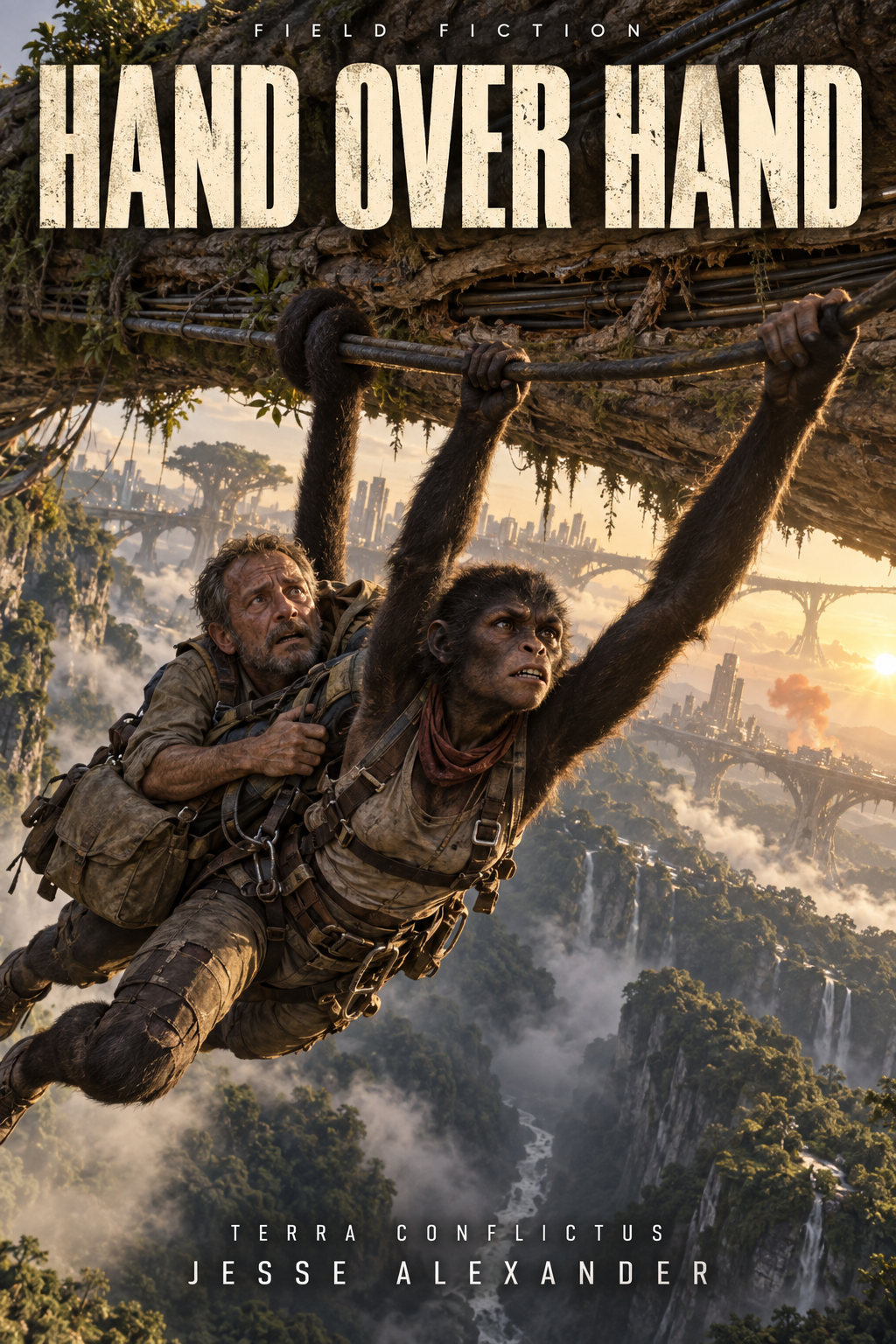
The city grows its own roads, and then one day it stops growing them, and the place where it stopped is where I work. Out past Sector 12 the graft-lines are still there, big living cables the thickness of a man, laid limb to limb through the upper canopy back when the Metroplex was pushing north and needed a way to move mass above the mud. Then the pushing finished. The Coalition drew its boundary at the agricultural line, filed everything past it as expansion overflow, and left four hundred kilometers of perfectly good road hanging ninety meters over the Overgrowth with nobody's name on it. The lines kept growing. Nobody told them to stop. That is this city in one sentence: everything here is alive and most of it has been left running with no hand on it.
I run the lines. I am the last of what they made to build them.
Haul stock, the catalog says. Spider monkey base, canopy program, lot seven, and the polite way to describe me is that my arms are longer than my legs and my tail is load-rated. The build is simple and it is beautiful and I will not pretend otherwise. Shoulders that rotate through a full circle without stopping to ask. A tail with a grip stronger than my hand and a nerve density that lets me read a cable's health through it, whether the graft is sound or whether it has gone hollow with rot inside a skin that still looks fine. A frame that comes in at forty-one kilos so the lines will take me and a hundred and twenty kilos of somebody else's cargo at the same time.
The catalog does not print the service life. Ten years is the number, and I have done fourteen, and the shoulder that rotates through a full circle rotates out of the socket about once a month now because that is what a joint built for range instead of retention eventually does. They made me to build a city. The city finished. There is no retraining program for a woman whose spine was written for a job that ended, so I move what other people cannot get across the boundary, and the settlements out in the Overgrowth call me Sete, after the lot, and pay me in food because that is what they have.
Batista came up to Nove Palmas himself, which told me the job was bad before he opened his mouth.
He is a root-mass harvester, sixty-odd, hands stained to the wrist with the black that never comes off, and he is a node on the quiet network that moves information through this city the way the fungus moves sugar under the floor of it. Nobody runs that network. It has no center to cut.
"There is a review," he said. "Boundary Variance. Three of our people filed on the nutrient profile past the line. Two withdrew. One did not."
"And he needs to be in a chair."
"He needs to be in a chair by the close of the Harvest Procession or the file goes unattended and unattended closes it forever." Batista put a cloth bundle on the platform between us. Ampoules, sugar paste, a spool of graft tape, and money the settlements did not look like they had. "The docket was Thursday. A clerk in the Division annex named Pinho moved it forward to Procession day. Six days early. He has the authority to do that and no reason to."
"He had a reason."
"He had a reason and none of us can read it." Batista looked out at the canopy going gold. "Elias Cordeiro. Greenhouse Spine, nutrient input, twenty-two years on the same node. He cannot come up through Sector 14 from the Overgrowth side without a movement stamp he will not get in time. There is no legal route. That is the point of there being no legal route."
"There is a road," I said. "It is just not a legal one."
"Sixty-one kilometers of it."
"Sixty-three. The Ribbon is out at kilometer nineteen and I have to go around under it."
He did not ask what going around under it meant. Batista is good that way.
Cordeiro was waiting at the Nove Palmas platform with his boots already laced wrong and a canvas satchel he would not put down. Fifties, small, thick through the chest the way people get who spend two decades lifting trays at a fixed height. He looked at the graft-line running off into the mist and did the arithmetic every passenger does.
"You carry me," he said.
"I carry you."
"How."
"On my back, mostly. There is a harness. You will want to look at the horizon and not at your feet and keep your arms inside the straps, because if you grab me at the wrong second we both find out how far down ninety meters is."
He nodded. He was frightened in the ordinary way, and I liked him for it, and I want that on the record before the rest of this. I liked him. He kept saying thank you and then apologizing for saying thank you.
The first leg is the good part of the job and I will not lie about how good it is. You go hand over hand along the underside of the line where the growth is thickest, tail wrapped and shifting, and the whole system takes your weight and gives it back, and the mist comes off the Overgrowth in the first hour like the world breathing out. Cargo makes it honest. A hundred and twenty rated, Cordeiro at seventy-four plus the satchel, my own forty-one, and every meter of it a negotiation with a joint that no longer closes properly. You feel the load in the tail first. Then the shoulders. Then a place under the left scapula that has been informing me for two years that it intends to be the thing that finally stops me.
We made twelve kilometers before the sun cleared the upper canopy. He asked about the lines. I told him about the lines. He listened like a man who genuinely wanted to know, which nobody has done in a while, and when I said the graft skin talks to the tail before it talks to the eye he said, "Like the trays. You can hear a bad tray before you can see it." So we understood each other for a couple of hours, up there in the gold light, two people from programs that had outlived their reason.
The Ribbon is at nineteen.
It is a span the city grew across a gap it should not have tried to cross, four hundred meters of graft-line laid over open air with nothing under it but the Overgrowth, and eleven years ago the mineral flow to that limb got rerouted and the Ribbon died standing up. What is left is the tension structure inside the skin. Six cables. The skin over them has gone to paper. You cannot go along the top because the top is paper. You go underneath, on the cables, and the cables are the width of two fingers.
"You are going to want to close your eyes," I said, and moved us over the lip.
Underneath, the world is a different animal. The wind comes up the gap in slabs. Every cable is singing a different note and my tail is reading all six of them and telling me which two are still worth trusting, and I went hand over hand with a man on my back and my feet doing nothing at all except being feet. That is the build working. That is the moment the whole ugly bargain of me makes sense, and I would be lying if I said there was no joy in it.
At two hundred meters out, a bird went off under us.
Not a bird. A grown thing the size of a bird, one of the old boundary telltales the Coalition seeded along the expansion line and forgot, and it broke cover eight meters below my hands and screamed straight up past Cordeiro's face. He grabbed. Of course he grabbed. Anyone would grab. He got both arms around my throat and his whole weight went off the harness and onto my right shoulder at an angle that shoulder has never once been rated for.
It came out.
There is no describing the sound from the inside. I kept the left hand and the tail and I hung there with a hundred and forty-five kilos of combined problem swinging under a dead cable, and my right arm was a thing attached to me with an opinion of its own. He was screaming. I got my knees up onto the lower cable, which is not a maneuver, it is just what my body did, and I said his name four or five times in a voice I did not recognize until he stopped screaming and got his arms back inside the straps.
Then I put the shoulder back in against the cable, which takes about four seconds and costs about four hours.
We finished the span. I want to be clear that I do not remember most of it.
We rested in a growth pocket at kilometer twenty-four, one of the hollows where two limbs fused wrong and left a room. I was shaking hard enough that I had trouble with the ampoule. Haul stock burn about six thousand a day working and I had brought sugar paste for four thousand, because you always think you will move faster than you do.
Cordeiro sat with his back to the wall and his satchel against his stomach and said, "I have a daughter."
Everyone says that. I have carried nineteen people across the boundary in six years and fourteen of them have said that in the first rest.
"Ana. She is eleven." He was looking at his hands. "Her lungs are wrong. Not from anything. Just wrong, from the start. Two years the allocation office told me the patch supply for a child under twelve in an overflow settlement is a discretionary line item."
"Discretionary."
"That was the word." He laughed without anything behind it. "I have twenty-two years on the same input node. I know what goes into that mineral flow to the gram. When the profile changed, I wrote it up, because I thought that was what the form was for."
"How many of you wrote it up?"
"Three." He rubbed his palm with his thumb. "Now one."
And I sat there in a hollow ninety meters over the Overgrowth with my arm hanging wrong and I thought: this is the good one. This is the one who does not withdraw. I have hauled contraband and cultures and once a dead man whose family wanted him buried inside the boundary, and this was the first time I had carried something that felt like it might move the machine a millimeter. I gave him half my sugar paste. I did that. I want that in here too.
The Sector 12 boundary is where the drift band sits, and Procession day put it live across our route at the exact hour we came to it.
Bloom-drift is the city exhaling. It comes off the canopy line in a slow orange-yellow front, and the forecast goes out every morning on the public channel with the same solemnity as weather, and you are supposed to have a current patch or you are supposed to be indoors, and the whole civic apparatus of this place is built around the idea that those two options exist for everybody. My patch was eleven months old, bought secondhand off a stall in the elevated market, painted over twice because that is the fashion and because paint hides the date stamp.
Under us on the ground, moving through the root gallery in a line, was a Phantom Viper patrol. Six of them. Jaguar stock, and they do not look up much, and I have built a career on that fact and never once relaxed about it.
We could have waited two hours for the front to pass. But Pinho had moved the docket to Procession day, and Procession day ends when the last yield cart is weighed at the Sector 14 scales, and a clerk I have never met had decided that the difference between a man being heard and a man being erased would fit inside two hours. That is the thing about this city that I cannot put down. It is a clerk with an authority he has no reason to use, using it, and the whole living four hundred miles of the place rearranging itself around his afternoon.
So we ran it.
Twenty-two minutes in the band, hand over hand, at a pace I have no business at with one shoulder half seated. The drift got into my mouth first, that sweet chemical taste like fruit going over, and then behind my eyes, and then my grip started making decisions two beats late, which up there is the same as no grip at all. I locked the tail every third rotation whether I needed to or not, because I could feel the part of me that decides things getting slow and I wanted a system in place for when it stopped deciding entirely. Under us the Vipers went through the gallery and out of sight. Above us the front slid across the sun and turned everything the color of a bruise.
Cordeiro did not cough once.
I noted it, the way the tail notes a hollow cable, and I filed it under lucky and kept moving. Some people just have quiet lungs.
We came out of the band at the Sector 14 boundary steps with fifty minutes on the Procession and my hands cramped into hooks.
His right hand was torn from the Ribbon and had been bleeding into his sleeve for six hours, and at the steps I sat him down to tape it before we went to the gantry, because a man who arrives at a Division annex dripping gets an escort instead of a chair. His satchel had gone under him when he sat. I moved it. The flap was rotten with sweat and it came open in my hand and the folio slid halfway out, and I saw the seal on it, and I did not stop looking, because by then the drift had my judgment and my judgment was not the part of me that reached.
It was not a variance statement.
It was a withdrawal. Division form, filed against his own report, signed by him in a good steady hand and countersigned by the annex clerk, and the date on the countersignature was four days old. Behind it, a housing transfer for a minor dependent, inner ring, respiratory allocation attached, effective on adjudication. And behind that, in a flat foil sleeve, three anti-spore patches with a calibration code I had never seen in eleven years of buying the things out of a market stall.
He watched me read all of it. He did not reach for the satchel. That is the part I keep coming back to.
"Unattended closes it," I said. My voice came out strange.
"Unattended gets appealed by somebody else in two years." He said it gently, like a man explaining a tray. "Withdrawn in writing gets questioned. Withdrawn in person, on the record, in front of the board, by the man who filed it, does not get anything. It just ends. They needed me in the chair, Sete. That was the only thing they ever needed."
"Batista paid me."
"Batista paid you honestly. Batista does not know." He looked at his taped hand. "Pinho moved the docket because they wanted it done before the next bloom cycle. I do not know why that matters to them. I stopped asking why things matter to them the day the allocation office used the word discretionary about my daughter."
And there it was, the whole machine, laid out on a customs step with fifty minutes left on it.
If I carried him up the gantry, he would sit in the chair and end it in the cleanest way it could be ended. If I dropped him on the step and walked, the file went unattended and ended anyway, and Ana lost the inner ring and the allocation, and the Division did not have to spend a single thing to get either outcome. Both doors opened into the same room. I was the only person in the whole arrangement who had been told a lie, and I had been told it because a lie was the cheapest way to buy a woman with a load rating.
I understood it completely. Standing there I could have drawn it for you. And there was not one single thing I could do with understanding it, because the machine does not have a lever on my side of it. That is what they built instead of a lever. They built a set of doors.
I carried him up.
Sixty-three kilometers and one shoulder and half a lung of drift, and I carried him the last forty meters of gantry stairs too, because his legs were gone by then and because if I was going to be the delivery I was going to be a good one, and I set him down outside the annex door and he said thank you and then apologized for saying it.
Before I let go of the satchel I took one patch out of the foil sleeve. One of three. He saw me do it and he turned his face away, which I think was the only honest thing either of us managed that whole day.
I went back out onto the span over the scales and sat with my feet hanging while the Harvest Procession finished underneath me, the yield carts coming in one after another and the crowd doing the cheer they do, four hundred miles of living city celebrating its own groceries. The last cart went on the scale. Somebody wrote a number down. Somewhere behind a wall a board adjourned, and a man I liked walked out of a room having ended the only true thing he ever put on paper, and his daughter got a bed in the inner ring with clean air coming out of the wall.
I peeled the patch and pressed it under my jaw. It went on cold and it sat wrong for a second and then it took.
It fit. It was calibrated for something the air out here has not started doing yet.
Down on the scales they were still cheering. I sat above them with a stranger's calibration against my throat, breathing an atmosphere that somebody had already decided I was not supposed to survive, and I looked north along the graft-lines going off into the mist, all that good road the city grew and then walked away from, still growing, with nobody's hand on it at all.