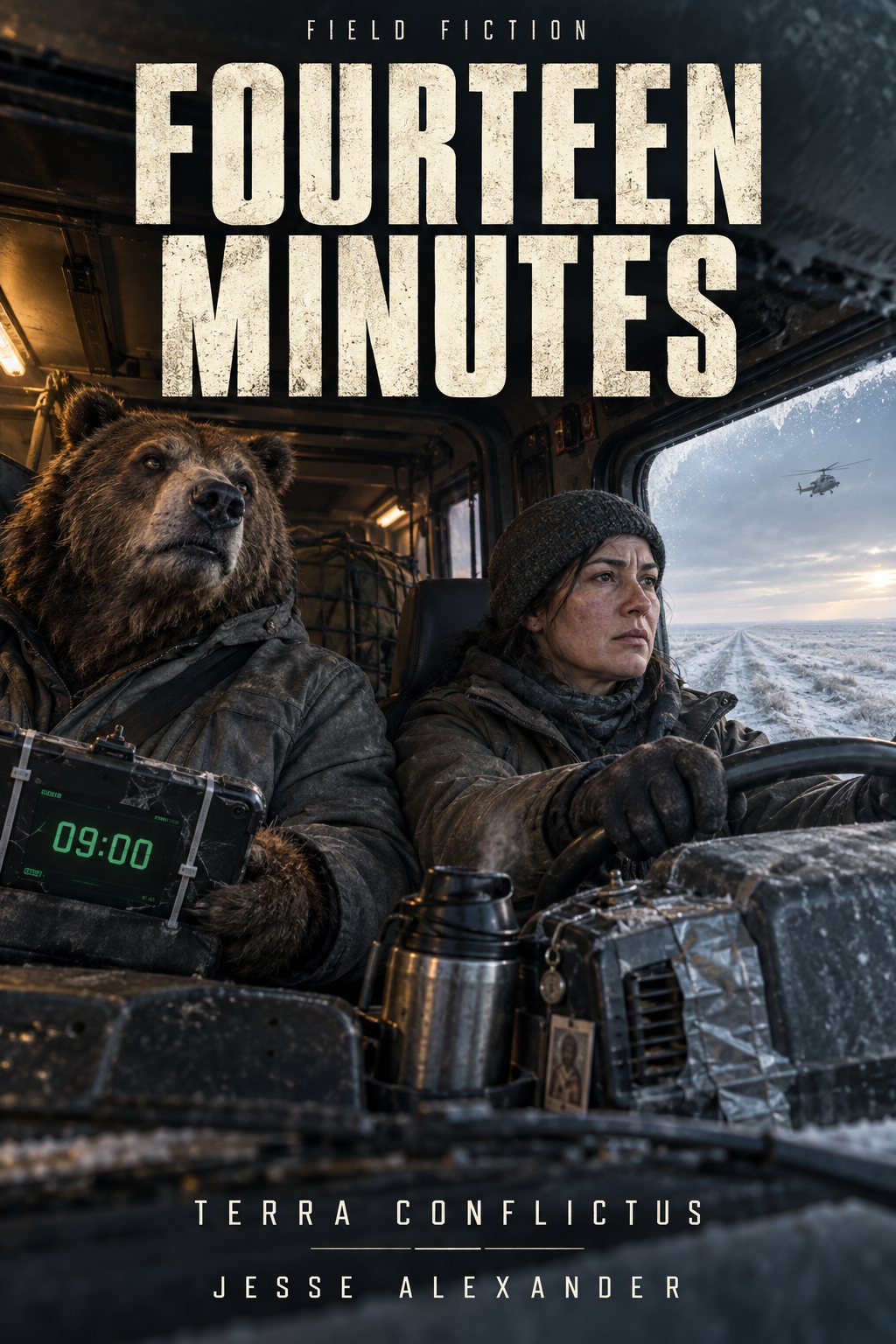
The load smelled like a lie.
I'd hauled enough freight for the Corridor to know what ore smells like through a tarp, which is to say almost nothing. A mineral flatness. Cold rock, and the machine oil they pack it in, and the rubber of the straps. For the first hour the load smelled like that and nothing else. In the second hour, underneath the rock and the oil, there was a third thing. Sweet at the edge. The kind of sweet that isn't a flower. My body filed it before my brain agreed to look, the way bear stock files everything, a half-second ahead of consent. The faction sheets call it enhanced threat assessment through scent signature profiling. What it means is I can't ride in a truck without knowing when the truck is carrying something that used to be alive.
"You're doing the nose thing," Nadia said. She didn't look over. Her eyes stayed on the white nothing of the steppe, the way a good driver's eyes go flat and far when the road is just distance. "Stop doing the nose thing. It makes me think we're going to die, and I'm trying to drive."
"It's the cargo."
"It's always the cargo. Watch the clock instead. You're better at the clock than the cargo."
The clock was a cracked tablet zip-tied to the dash, and on it a slow green bar that meant we had nine minutes before the next drone pass crossed our stretch of the Open Steppe. Fourteen minutes between passes, every time, a rhythm Steppe Post 9 had kept for three years without one missed beat. You learn to live inside the fourteen. You learn that the gap isn't safety. It's permission, granted by a machine that doesn't know it's granting anything, and can be pulled the moment the machine is told to look.
The heater vent was held together with a strip of silver tape gone gray at the folds. Nadia had a thermos wedged against it, the lid screwed on crooked, steam ghosting from the gap. Bad coffee, chicory and burnt grain, the smell of it warmer than the coffee would ever be. She poured a capful every twenty minutes and drank it in two swallows and screwed the lid back crooked, and the ritual of it was the only soft thing in the cab. I've learned to watch what people keep warm. It tells you what they've decided to survive.
I'm bear-forged, which in this theater means I'm useful for exactly two things and a liability for the rest. I can put a man through a wall and I don't come apart when the wall comes back. Subdermal density across the shoulders and the plate of the chest, a center of gravity built low and mean, a body the spec sheet describes as a denial asset and that I experience as the simple fact that you can move me but you can't get through me in the time it takes me to decide what to do about it. The rest of the time I'm too big to hide and I smell everything and I think slow on purpose, because thinking fast is how bears get shot. The EO put me in the Tempest Riders for the first thing. Major Volkov, who the unit called Valkyrie before they called her anything else, used me as the part of the conversation that happens after the talking. I was good at it. That's not a brag. It's a thing I'm trying to tell you honest, because the rest of this only works if you believe I was once a man who stood in doorways for her and didn't ask what the order was protecting.
I asked, eventually. That's why I was in Nadia's cab and not in the air with my old unit, marked clean on no roster, running NULLMARK quiet and BARE KIT gray so the recognition net would read me as freight and not as a face it had a file on.
"Cherkas is at the relay turnoff," Nadia said. "He flashed twice. You want to do this or not."
I didn't want to do this. I said yes anyway, because of the smell, and because of the marker.
The marker was a stone. We'd passed it forty kilometers back, set upright at a junction where no one sets stones, a flat gray slab the size of a grave's headboard, and someone had scratched a single word into it with a field tool. Not a name. A number. ELEVEN, in the blocky Cyrillic of a person who learned letters late and hard. I'd asked Nadia to slow, and she'd slowed, and neither of us said the thing we were both counting, which was that eleven workers had gone into voluntary extension out of the labor compounds in the last three years, and that voluntary extension is the kindest two words the EO owns.
Cherkas was waiting in the lee of a dead transformer station, a tall man made taller by the stoop he used to look shorter, Consortium captain's grays under a civilian coat that fooled no one. He had a documentarian's hands, always holding something he wanted you to read. Today it was a slate.
"You smelled it," he said, before hello. He had a way of skipping the front of every conversation, as if he'd already had it in his head and was bored of the part you both knew.
"I smelled something."
"Eight hundred and forty-seven somethings." He turned the slate. Columns of entries, each one stamped and grayed out, a long gentle waterfall of suppressed flags. "This is Post Nine's anomaly log. Every line is a thing the drone net saw, flagged, and then un-flagged. Standing Order Seven. The AI files the variance as nothing. Tonnage stays clean, output stays up, the men in Kazan who need the numbers to stay clean get to keep needing them." He let me read until the reading became unpleasant. "Line four-forty. Read line four-forty."
Line four-forty was a biological signature, logged at Ural-7's south medical post, and then a second timestamp where the same signature was filed as equipment contamination and dropped. The location stamp put it eighty kilometers south of a place the map didn't name.
"That's a permafrost organism," Cherkas said. "It came south in a man. The man had been on a voluntary extension rotation. The AI saw a plague walk into a mining town and it called the plague a dirty sensor, because a dirty sensor does not slow the ore." He almost smiled. It was the worst thing his face did. "We are not smuggling minerals, you understand. We never were. We are smuggling the reason no one is allowed to look at the place the minerals come from."
There's a moment in this work where the floor of a thing drops and you see how far down it actually goes, and the trick is to keep your face still while your stomach takes the fall without you. I kept my face still. Bear stock is good for that too. We look calm because moving costs us, and the look reads as wisdom when it's mostly mass.
"The site sixty east," I said. "Off the map."
"Off every map. Which is why they put the diversion there. Which is why they put the research there, forty years ago, when off the map meant safe." He tucked the slate away. "The thaw does not care what we decided to forget. The ground is opening, and the only system positioned to notice has been ordered, very specifically, three years ago, not to."
Nadia had come up behind me without sound, which baselines can do and which always unsettles me, because my body insists it should've heard her and my body is usually right. She was looking at the dead transformer, at the rust running down it in long tongues, the way water teaches a building where it's going to die. Reading rust. Asking the building. She did it without knowing the operator's name for it, which is how I knew she'd been doing it longer than any operator.
"So what's the job," she said. "Because right now the job sounds like a funeral with a clipboard."
"The job is the flag log reaches the right hands," Cherkas said. "Internal Security wants it. Kirova specifically."
"Kirova's net is rotten," I said. "She doesn't know it, but it's rotten. Zaslavskaya has half of it and Zaslavskaya will burn the whole theater to the dirt if you hand her a match this good. The compounds are in the theater. The compounds are people."
"I am aware of the people."
"Are you." I didn't raise my voice. Cold is louder anyway. "Twelve, seventeen, twenty-three. Those aren't grid squares. I moved some of them. When the extension orders came through I carried four men out of Compound Seventeen myself and told them it was a transfer, because that's what I was told, and I'm very strong and very calm and they believed the strong calm man." The plating held. It always holds. That's the thing they build into us and the thing that fails you exactly once, when you understand there's a kind of weight you can't stand under no matter how they built your spine, because it isn't on your back. It's on your conscience, which they forgot to reinforce. "So don't tell me you're aware of the people. Tell me the other option."
Cherkas was quiet. Far off, the drone hum changed, a half-tone drop my chest felt before my ears confirmed it, the subsonic the others never catch. The green bar on the dash had four minutes on it.
"The other option," he said slowly, "is the AI. You don't give the log to a person. You give it to Post Nine. You break Standing Order Seven at the source and the net un-blinds across four hundred kilometers, all at once, every suppressed flag firing at the same instant. The world finds out everything in ninety seconds."
"And the world's response to a plague site full of unregistered labor," I said, "is a cordon. A cordon out here isn't a fence. It's altitude and ordnance. Quarantine by the people who taught me what a doorway is for."
"Yes."
So those were the doors. Hand the truth to a rotten woman and let an ambitious one set the steppe on fire to get clean. Or hand the truth to the machine and let the machine's masters sterilize the evidence, and the eleven, and whoever was still breathing at a site the map had spent forty years pretending wasn't there. Document War rules, the old hands call it, when everyone in the theater wants the same object and no one will share it and the object turns out to be a body. I'd heard the phrase my whole career and thought it was about archives. It's never about archives.
"There's a third thing you're not saying," Nadia said. She had her arms crossed, and she was watching Cherkas's hands, the way I watch noses. "You came to a courier and a defector with a slate full of murder and you didn't bring it to your own people. Why."
"Because the FAA man, Osei, is forty minutes from walking a survey team into the site," Cherkas said. "Blind. He thinks he's chasing a thaw organism across an empty quarter. He doesn't know the quarter is occupied, or armed, or that the moment he transmits a finding, he trips Standing Order Seven himself, by accident, and brings the cordon down on his own head and theirs. Someone has to reach the site before he does. Someone has to be there when the net opens, to get the living out into the fourteen minutes before the fourteen minutes stop being a gift." He looked at me, then at her, and made the smallest motion with his documentarian's hands, offering us the thing he couldn't hold. "I can't drive it. I write things down. Turns out I'm only good at the part that happens after."
Which was my line. He knew it was my line. The bastard had read me as clean as I read him, and he'd built the whole conversation to end on it, and I respected it and hated it in the same breath.
Nadia uncrossed her arms. She walked to the cab and poured a capful from the crooked thermos and drank it in two swallows and screwed the lid back wrong, and I understood I was watching a person decide, and that the deciding looked exactly like the surviving, because for her they'd always been the same motion.
"Sixty kilometers," she said. "Four windows. The math doesn't close. We'd be on open ground inside a pass."
"The math doesn't close," I agreed.
"I know." She climbed up into the seat. "Get in. You're better at the clock than the cargo."
There's a name for what we were about to do, running a load through hostile air on a window that doesn't stretch far enough, going anyway because the alternative is a thing you can't live beside. The old units gave it a name years ago and the name is pulling a Valkyrie, after the woman who did it first and lived, and the joke the war never noticed it was making is that the woman is real and she was, at that exact moment, somewhere above the Permafrost Line with her unit, reading engine heat off the steppe, waiting for a reason to look. They named the brave thing after my old commander. I was about to do the brave thing to get out from under her. I've stopped expecting the world to arrange its ironies anywhere but on top of me.
We rolled at the bottom of the window, the green bar dead, the gray bar climbing, the hauler's frame shuddering as Nadia took it up past the speed the suspension had opinions about. The steppe went by the color of old bone. No cover for sixty kilometers, not a fold, not a tree, a flatness so complete it stopped being terrain and started being arithmetic, distance over time, us over the clock. Weapons frost at twenty below out here. I keep mine inside my coat against the plate of my chest so my own heat keeps the action alive, and I could feel the cold of the barrel through the layers like a second spine, and I thought about how the body keeps so many things warm without being asked. Coffee. Steel. The four men from Compound Seventeen, who'd been warm when I carried them.
"Talk to me," Nadia said. "You go quiet, I drive worse."
"Bears think slow."
"Then think out loud slow. What happens when we get there."
"We find Osei before he transmits. We find the living. We put them in the gap." I watched the bar. Eleven minutes. The number was an accident and it landed in the cab like a stone anyway. "And then someone breaks the order, and the net opens, and we've got one window, exactly one, to be over the horizon before the order's owners decide what a clean theater looks like."
"And you can't carry four hundred kilometers of people in one truck."
"No."
"So somebody chooses who rides."
"Yes."
She was quiet for a kilometer. The drone hum came back across the dash, the high edge of it now, the pass beginning somewhere east, and her hands didn't move on the wheel and that stillness cost her, I could smell the cost, the sharp clean adrenaline that comes off baselines when they've decided not to be afraid out loud.
"My father drove the Kazan line before it was the Corridor," she said. "Before the EO, before the orders. He used to say the road doesn't owe you the other end. You just owe it the driving." She poured the last of the coffee one-handed and didn't drink it, just held the cap, steam thinning between us. "He hummed this song when the weather turned. They banned it in the compounds, after. The Standing Order Blues. Stupid little tune. I've got it stuck in me like a splinter."
She hummed four notes. They were nothing, a scrap, the kind of melody a tired man makes to keep his mouth busy. Out here, in a stolen truck full of the reason the world had agreed not to look, with eleven scratched into a stone behind us and a machine ahead of us that had been ordered for three years to call the dying a dirty sensor, four flat notes from a banned song were the most dangerous thing in the cab, because they were the sound of a person who hadn't agreed.
The antenna mast came up over the curve of the world first, a thin gray needle, and then the low shapes under it that the map didn't have words for. The drone that had been circling the same four hundred meters for six days, the one even the AI couldn't explain, the one snagged on a thing it was forbidden to report, was a black fleck against the bleached sky. As we crossed the last rise it broke its pattern. It turned. It came around to face us, slow, almost curious, the way a creature turns when it's finally been allowed to look at the thing it's been not-looking at for so long that the not-looking became the whole of its life.
The green bar was dead. The gray bar said fourteen minutes, and the fourteen minutes had never once, in three years, been ours.
Nadia put the cap back on the thermos. Crooked. She didn't slow down.
"Math doesn't close," she said, and picked the road anyway, and behind us the stone kept its count, and somewhere under the thawing ground a sound that wasn't passive infrastructure went on getting louder, patient, almost warm, waiting for someone to finally come and hear it.