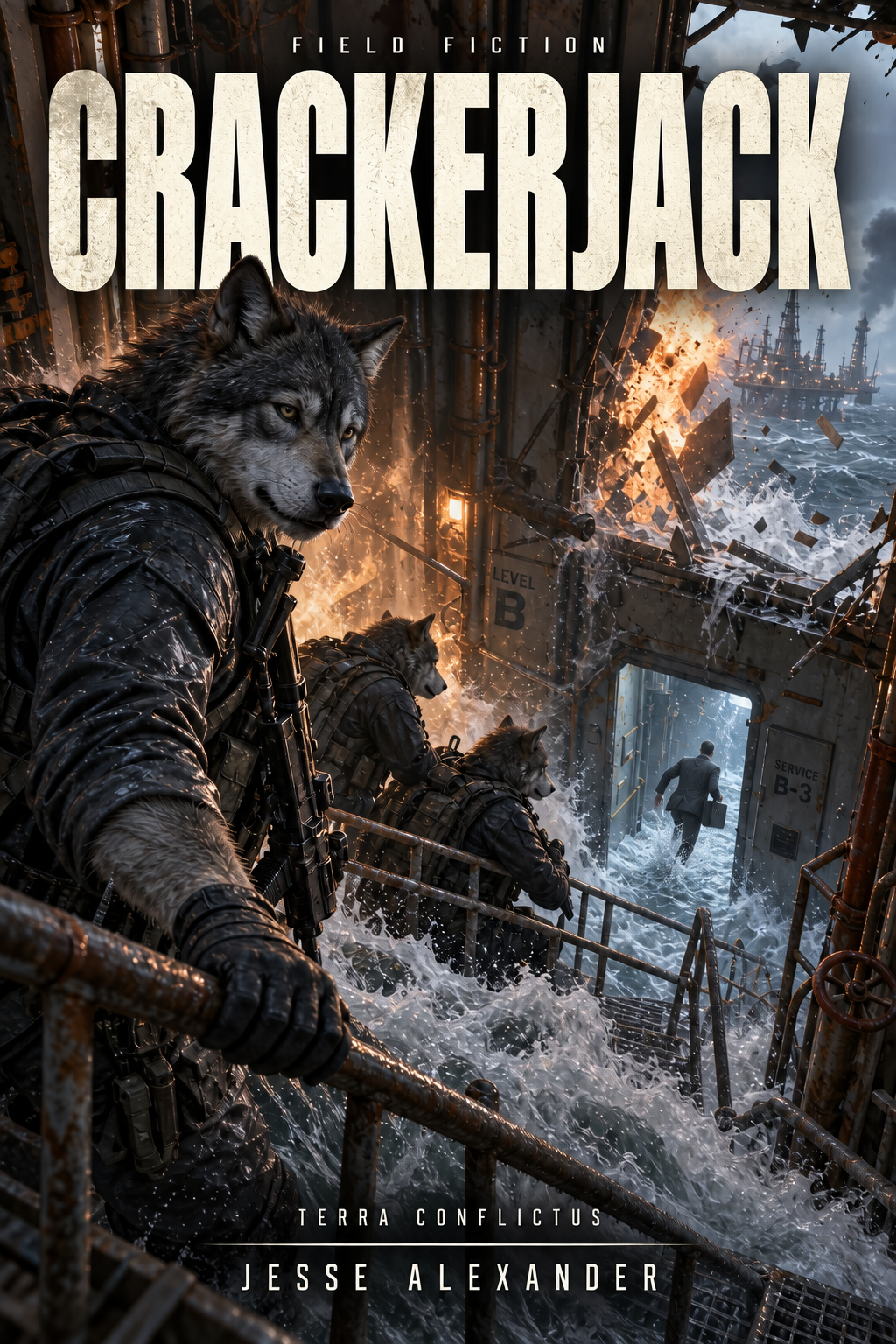
PART ONE — THE CALL TO ADVENTURE
Ghosts of the Scatter
The refinery sat half-drowned in the Java Scatter with its legs in black water and its head in a sky the color of an old bruise, and Eli Drake read it the way the gene-forge had taught him to read everything, by what it was not doing. It was not breathing. No pumps, no heat bleeding off a roof where heat should have been. The intel said the building was clear. The intel was a service somebody had paid for, and in nine minutes it would not matter what Eli knew.
He took his pack up the seaward flank in the dark part of the tide, six bodies moving like one body, the way a Dire Wolf line was supposed to move. Reyes on point. Sólveig reading thermal off the drone feed and calling it soft and quiet, all the way up. Eli held the line. He always held the line. It was the one thing he had ever been good for, and the pack-bred part of him that had never once been wrong about a room was wrong about this one.
They breached the service door clean. The air tasted of standing seawater and old catalyst, and the stairwell went up into the structure like a throat. Sólveig said clear. The drone said clear. Eli put his hand on the rail and asked the building the question you ask when the intel has become a story, and the building told him nothing, because it had been answered for.
The charges were in the walls. Not on the stairs. Behind the cladding, set to channel the blast down the throat of the stairwell so that whoever was inside it would be inside it.
The first one took Reyes off the point and put him through a railing two flights down. The second folded the stack. Eli was turning, already turning, the half second the Federation had grown into him doing exactly what it was grown to do and not nearly enough. The smoke came up the throat. The water came up after, and his pack was dying around him in the dark with the engineered patience of a thing that had been built, not aimed, to kill a pack in a stairwell and file it as an accident.
Through the smoke, down at the service door, a man walked out.
Unhurried. A satchel on one shoulder, the way a man carries his work. He did not run. Running was for people who had miscalculated, and the Surgeon had not miscalculated anything. He paused at the threshold and looked back up the throat at Eli pinned against the rail with his dead all around him, and there was nothing in the look. No triumph. A craftsman checking that the seam had taken.
Eli came off the rail to go after him and the third charge went, the one that was for him, and the world rang once like a struck bell and then went to a white smear at the edges that would never, in two years, fully come back. The blast put a piece of railing through the meat of his scalp and a fault line through something deeper. He went down into the rising water, and the last thing he saw before the dark took him was the service door, open, and the man already gone through it.
Two years later the salt was still in everything and the ringing had never left, and Eli told himself both were just the climate.
Lakefire ran on a ration clock and a gray-water economy and the kind of work that paid in chits a man could spend without anyone scanning the back of his neck. He ran a salvage rig in the drowned outskirts, hauling drowned copper up out of the streets that used to be a city, and he rode the dark part of the shift because that was where the work lived and the work was the only thing left in his life that had never once asked to see his papers. He had no papers. He had gone freelance after the Scatter, which in the Federation meant he had voided his registration, which meant the country that owned the cells of his body would not claim the rest of him. Stateless. Owned and disowned at once. A Dire Wolf with no pack and no flag and a kitchen-job clinic that kept his suppression meds coming as long as the chits held out.
He told the clinic it was for the headaches. The clinic did not care what it was for. That was the good thing about a kitchen job.
The drift had started the way no one ever believed until it was theirs. A morning he had reached for a cutting torch and his hand had closed on the memory of where the torch had been, and he had stood there in the gray water with his fist around nothing and felt the cold all the way up his arm. Running hot, the kids called it. Eli called it fatigue, because fatigue was a word he could hold, a word with no warranty on it, that did not mean the Federation's work in his body was finishing a sentence it had started twenty years ago.
He came up out of the drowned street at the end of the shift to find a man standing on the rig dock who did not belong to Lakefire.
The man wore the soft, careful clothes of someone who had not done physical work in a decade and had once done nothing but. He stood the way operators stood even after they stopped, reading the exits without looking like he was reading anything. Eli knew the stance before he knew the face. Then he knew the face.
"You're a hard man to find, LATCH," Rue Holloway said. "Which I take as a compliment, since I trained half the people who couldn't find you."
They sat in the rig shack with the ration clock ticking on the wall and a thermos of something almost coffee between them that Eli did not touch.
Holloway had been his pack-second once, three rotations and a lifetime ago, before he got out clean. Now there was a GCOA seat behind him and a Delegate's pin on the soft careful collar, and he talked the way men talked when they had learned to make every sentence land somewhere.
"The Free State's buying its way into the GCOA," Holloway said. "Pariah port, launders for the Syndicate, never met a sanction it couldn't reflag. Now it wants to be respectable, so it's hosting the Crackerjack. Full GSOTC commission, every bloc sending a team. And the Federation needs a captain for an underdog squad of operators nobody else wanted, on a denied island, for ten days."
"No," Eli said.
"You haven't heard the seat I'm offering."
"I heard arena floor. I heard camera zone and biometric on record and a betting gallery full of arms dealers watching kids bleed for a Ghost Medal." Eli turned the cold thermos a quarter turn and did not lift it. "I don't play games, Rue. I'm not getting up on a stage so the commission can sell my batch number to a contract buyer. I've got nothing left to give a team. You know that better than anybody."
"I was there for the part where you brought everybody home," Holloway said quietly. "Every time. Until once."
The ringing came up behind Eli's eyes. He held it.
Holloway leaned in, and the Delegate went out of his voice, and the pack-second came back. "The Crackerjack is cover," he said. "Monitor Central wants a Tier One unit on Maridia and can't put one there without a reason, so the reason is a sanctioned tournament. The team is real. The games are real. Underneath it there's a grab. A high-value target on that island building something, and they need a captain who can run a hunt inside a broadcast." He paused. "You want to guess who the target is."
Eli did not have to guess. He had spent two years not guessing and knowing anyway. The smear at the edge of his vision pulsed once, and somewhere behind it a service door stood open and a man walked unhurried into the dark.
"Where is he," Eli said.
"Maridia. We think. We're close to sure." Holloway watched him. "Tarek Khoury. The Surgeon. The man who built the thing that put your pack in that stairwell, and walked out the service door."
Eli was already standing. He did not remember deciding to. "I'm good," he said.
"You don't want to hear the rest of it?"
"What's left."
Holloway looked at him a moment longer, and something moved behind the Delegate's careful face, a catch he had decided to let Eli walk into rather than risk Eli walking away from. "Nothing that won't keep," he said. "We'll brief you on the island."
Holloway opened the Crackerjack feed on the shack's cracked screen and the trade show poured out into the room, and Eli felt the thing the gene-forge cannot grow out of you, the recognition of a machine that owns bodies like yours. The betting gallery tiered above an arena floor, men in good coats reading spreads the way other men read weather. The biometric overlay running live under every operator's image, drift quantified and broadcast and sold. The awards, and what they cost. Iron Operator. Ghost Medal. The Last Standing, which meant you were the only one of your pack still breathing, which the commission had made into a prize. And across a staging-area wall, in paint the commission would scrub by morning and the forged would write again by night, four words. BUILT NOT BORN. STILL HERE.
The commission treated it as maintenance. Eli read it as correspondence. He shut the feed off, and the smear was at the edge of the screen and the edge of his eye and he could no longer have said which.
He was walking back into a world that had a file on every cell of him, and he was going to do it on purpose, for a chance at a service door and the man who had walked out of it. He told himself he owed nobody on that island anything, which was true, and which was the kind of true a man tells himself right before the lie he will build a whole season on. He did not yet know there was a catch. The stand-down order was already written, somewhere in a Monitor Central station where a woman named Vex had read the same intel and reached a conclusion that had nothing to do with stopping anyone. He shouldered his go-bag, and the clock did not care that he didn't know, and he went to meet a pack he had already decided not to trust.
The Piggyback Protocol
The transport ran a high lane over the Scatter with five of them aboard when Eli came up the ramp, and he disliked all of them inside ninety seconds, which was not their fault and changed nothing.
The first thing he heard was praying. A woman sat against the bulkhead with a long-range rifle field-stripped across her knees, components laid out on a cloth in an order that was its own kind of devotion, talking past it, low and even. Raptor-stock, hollow-boned, eyes too large and too still. Sergeant Zoe Calhoun. HYMN. She did not pray for the target. She prayed for herself, the same handful of words, a contract that nothing in the world could reach her again. Her left leg below the knee was a forged limb that did not quite match the rest of her, a kitchen job she had paid for herself because the program that left her in a borough firefight would not. It ached in cold camera zones, and she did not mention it. She finished reassembling the rifle without looking at it, which made Eli trust her marginally less, because a sergeant who could do her job in the dark was a sergeant who did not need him.
Across the bay a man filmed himself. Lynx-stock, lean and bright and aware of every camera in a room including the ones not there yet, narrating into a lens clipped to his harness in the warm confiding voice of a man who had turned the broadcast into a business. Petty Officer Jace Mercer. HIGHLIGHT. He clocked Eli and the lens came around and Eli put a hand over it without breaking stride.
"Off," Eli said. "All of it. We're a denied unit on a denied island. You broadcast our breathing, you broadcast our cover."
"I am the cover," Mercer said, smiling, not turning it off. "Nobody looks at the guy on every screen. You want invisible, run famous."
It was the least stupid thing anyone said all day, though Eli would only understand that later. He held his hand over the lens until it went dark.
The big man by the loadmaster's station had not looked up. Baseline. Eli could see it in the absence of the small involuntary tells the forged never quite lost, and he could see the man wanted him to. Master Sergeant Myles Okonkwo. FOUNDRY. The last unmodified body on a forged team, the kind of operator who read BUILT NOT BORN and thought the second half was the insult. He had a daughter and a command commission he wanted more than air, the one path he could see to keep that daughter out of the forge programs and out of being a registered asset with a warranty and a batch number. He looked at Eli's collar where the registration tab should have been, and something passed over his face that was not contempt and was not far from it.
"Stateless," Okonkwo said. "They gave us a captain who isn't even property anymore. That supposed to make me feel better or worse."
"Worse," Eli said. "Keeps you sharp."
The fifth was not aboard. The fifth was a voice in the net, routed through a chair somewhere safe, the youngest by years. Lieutenant Kit Pell. PRISM. Recon-forge, a synesthete whose cross-wire let her read a data field like no baseline analyst could and tasted callsigns and saw numbers as color, and her voice came into Eli's ear bright and uncertain at once.
"LATCH," she said, and he heard her almost wince at it. "Sorry. Your callsign tastes like cold metal. I say it less when I'm nervous, which is, never, then." A breath. "Feed's green. I've got the whole bracket's published telemetry and about forty things they didn't mean to publish. I flagged them all."
"Send me the ones that matter," Eli said.
"That's the thing, I don't know which ones matter yet, so I sent all of them."
There it was. A sniper who worked in the dark, a baseline who resented him, a Lynx who would not turn off the camera, a rookie flooding the net because she could not yet tell signal from color. Eli stood in the middle of his cover unit with the ringing behind his eyes and a list already forming, every one of them a thing he would have to do himself, the Dire Wolf trying to hold a line out of people who had no intention of being held.
Calhoun watched him re-check her gear and said nothing. Okonkwo watched Calhoun not say anything, and something old and unpaid moved between them, and Eli caught the edge of it and filed it without understanding. Okonkwo had been in that contested borough the day the Raptor sergeant lost her leg, on the other end of a unit that walked away. That was a receipt. It was not paid. It sat between them in the cargo bay, and the transport ran toward the lights of the Crown Arcology, and not one of the six trusted any of the others, which the commission, had it known, would have priced as excellent broadcast.
The Crown Arcology came up out of the drowned town like a thing that had decided the rest of the world was optional.
The air inside the staging levels tasted filtered and sweet, scrubbed clean of the salt and the ash, and Eli distrusted it on principle. Down through the plasma walls you could see the salvage town in the gulf, gray-water streets and ration smoke, the people Maridia did not photograph for its GCOA application. Up here the rival teams crossed the staging concourse under banners, Tier One operators from every bloc reading each other on sight.
The Bears came the other way.
There were six of them, Bear-stock, EO, built broad and patient and certain, and at the front was a man Eli had last seen across a different disaster. Captain Grigor Volk. They had fought at the Scatter, on opposite sides of the same engineered stairwell, two men who had each lost most of what they brought into that building and walked out owing the other something neither could name. Volk stopped, the whole Bears line behind him. The two captains stood in the scrubbed sweet air with the betting gallery watching from the tiers above, the broadcast lattice pushing the heat between them live, and neither said a word for a long moment.
"LATCH," Volk said finally. Heavy accent, low. "They told me a stateless man was captaining the underdogs. I said, that one died at Black Reef."
"Half did," Eli said.
"Yes." Volk's eyes moved over Eli's collar, the missing tab, and read it differently. "The good half, I think." He let that land. "We play clean here. You and me. The games are the games." Then, lower, under the lattice pickup, "But you did not come for the games. And I did not. So. We are honest about that, at least."
He moved on, the Bears behind him, and Eli stood with the back of his neck cold and the understanding settling in that everyone on this island was doing two jobs.
The welcome was a spectacle in the grand gallery, and Sovereign Idris Khalsa held it the way an old crocodile holds a riverbank, ancient and ruthless and entertained by his own power, watching the foreign operators the way a man watches livestock he is proud of and intends to slaughter. Beside him stood the heir. Sana Khalsa was poised and luminous and said the right things about legitimacy and a new chapter and the GCOA, the public face of the free-state's whole bid, and she met Eli's eyes once across the gallery with a warmth so complete and so practiced that Eli, who trusted no one, found he wanted to trust her, and set it aside, because a thing that wants to be trusted that hard is a thing to watch. He did not know how right he was.
And there was the younger son, Tariq Khalsa, brittle as new ice, in the dress armor of the House Guard that would field as the Opposing Force. He looked at the foreign teams with a hunger that had nothing behind it but appetite, a boy who believed the tournament was his coronation, and when his father spoke he flinched, and when Sana spoke he hated her.
The first event was a charge race, and it nearly killed all of them, which Eli would later understand had been the point.
Plant breaching charges at three structural points across a derelict refinery sector the commission had rigged inside the arena complex, extract before the timed detonation, first team to the safe zone takes the round. NAF drawn against the Bears. Camera zones live, the gallery thick with spreads, BUILT NOT BORN scrubbed off the walls that morning and already back in the corners.
It went wrong the way Eli's own command always went wrong now, which was that he tried to run all of it himself.
He called Calhoun's overwatch lane and Calhoun had already chosen a better one. He routed Okonkwo to the second charge and Okonkwo, who had set more breaching charges by hand than Eli had years, ignored the routing and set it faster the patient baseline way. Mercer planted his charge and then ran Showboat across an open catwalk for the gallery and for Sana's box, drawing a cheer and three seconds of exposure nobody had budgeted. And in Eli's ear PRISM flooded the net, more data than any captain could hold, because she did not yet know that out here the price of too much was not a slow load.
"One at a time," Eli said, tighter than he meant. "PRISM, give me one thing. HYMN, hold your lane. FOUNDRY, confirm two."
"Two's hot," Okonkwo said, already past it. "Was hot before you asked. You want to run my hands too, Captain, or you want to win this."
Calhoun's voice came flat over the net from a roost Eli had not assigned. "Bears are short-cutting the exfil. They dropped something on the east stair."
They had. The Bears, not nearly as clean as Volk had promised in the concourse, had folded a structural section across the planned extraction route to bleed the NAF time, the kind of cheat the commission would call terrain and the gallery would call genius. The clock ran. The first charge timer crossed into the red. Eli's pack was strung across a refinery sector about to come down on whoever was still inside it, the only planned exit buried under EO steel, and the white smear came up at the edge of the world and he reached for the certainty the gene-forge had built into him and his hand closed on the memory of where it used to be.
A man does the job in front of him. He had told himself that for two years. He told himself now, and stopped trying to hold all of it. There was a window on the second story above the safe-zone wall, a long fall to a worse landing, the kind of out you call when the door is gone and you ask the building.
"Second-story window, north face, all of you, now," Eli said. "HIGHLIGHT first, you want the camera, here's your camera. HYMN covers the drop. FOUNDRY, the kid, then you. PRISM, talk Calhoun's angle, nothing else."
And they did it. Not because they trusted him. Because the clock did not care and the building was coming down, and there is a thing operators will do under a timer that they will not do over a beer, which is move as one body for as long as the timer runs. Mercer went out the window for the cameras and made it look like a stunt. Calhoun covered the drop, prayed her words, put two non-lethal rounds into a Bear who crowded the exit. Okonkwo went last off the sill the way the oldest man always does, and the NAF unit hit the safe zone as the charges blew the planned exfil into the gulf behind them.
By seconds. The gallery roared. The board read NAF.
Then the rest of the refinery sector went up, and it went up wrong.
The detonation was not on the board.
It came a full beat after the scored charges, deeper and harder, a real structural blast that dropped the safe-zone wall to dust and put every operator in the sector flat on the deck. Not a terrain effect. The charges had been live, all of them, scored breaching loads riding cover over real demolition, and the Bears' cheat on the exfil would have held all six of Eli's people inside a building rigged to actually come down.
On the high balcony, Tariq Khalsa stepped to a railing and smiled down at the operators wiping refinery dust from their eyes, a young man delighted by the size of what he had just shown them.
"This year," he said, and the lattice carried it everywhere, "the Crackerjack runs hot. Real terrain. Real teeth. The whole world wanted a games that meant something." He spread his hands. "Maridia obliges."
Okonkwo, flat on his back beside Eli in the dust, breathed out once, slow. "Crackerjack weather," he said. "They built us a games that kills." He turned his head and looked at Eli with the contempt gone out of it for the first time, replaced by something colder and more useful. "Your call on that window. That's a receipt, Captain. I'll pay it when I figure how."
It was the first thing any of them had given him. Eli took it and said nothing, because nothing was the most he could trust himself with.
That night the on-island handler briefed them in a stripped service room off the camera grid, the only unwatched square footage Eli had seen since the transport.
Silas Roan was somewhere past seventy and built like a thing the years had failed to wear out. Brotherhood of Shadows, the old denied service, a name in circles where names were not allowed, and he ran the brief the way a man runs a thing he intends to survive. He laid out the cover, the schedule, the contract floor where the real business of the trade show happened over the operators' heads, and did not waste a word.
"The target's on the island," Roan said. "I've had eyes on a pattern. Movement, materials, a clinic that isn't a clinic. Tonight I close on it." He looked at Eli, and only Eli, the way the old ones could pick the one person in a room they would deign to be understood by. "You run your games and keep this unit alive and in play, because a dead unit can't grab anybody. That's the job."
"I'm coming with you," Eli said.
"You're not." No heat in it. "I'm a ghost, and ghosts work alone. You'd get us both made inside an hour, walking like a man who's hunting." Roan shrugged into a coat the color of nothing. "I've been doing this since before your template had a serial number, LATCH. Hold your line. I'll bring you the door."
He went out alone, and Eli let him, and Eli would spend the rest of his life knowing he should not have.
The welcome gala filled the grand gallery with light and contracts and the soft predatory noise of a trade show pretending to be a celebration, and Eli used it as cover to slip his own leash. The Dire Wolf could not hold a line that had a ghost out beyond it alone in the dark, and he tracked Roan's last comms ping down into the service spine where the air went back to salt and machine oil and the honest stink of infrastructure.
He found Roan in a maintenance gallery between two desal trunks, on his back, the old coat thrown open and the work already done. A blade job, clean, professional. Standing over him, satchel on one shoulder, was the Surgeon.
He looked up at Eli the way he had looked up the throat of a stairwell two years before. No triumph. A seam checked. He had heard Eli coming, the half second the gene-forge had grown into both of them, and he had finished his work without hurry and waited long enough to be seen, because being seen by Eli Drake was also a message.
Eli went for him. The Surgeon went through a hatch into the spine, and then it was a chase through the arteries of the arcology, down service ladders and along desal trunks slick with condensate, the white smear coming up hard at the edges of Eli's vision, his drift choosing the worst moment to make the world late. He gained. He lost it. He gained again, close enough to hear the man breathing, and then a blast door cycled between them on a maintenance timer the Surgeon had known about and Eli had not. It sealed. The man was gone through a door for the second time in two years, unhurried, a service rendered.
Eli stood with his hands on the cold steel and his breath sawing and the ringing loud in the new silence, and then he went back to Roan.
He could not report it. If he called the death in, the commission would lock the island down, the cover would collapse, the unit would be pulled, and the Surgeon would walk out another door while the GSOTC processed paperwork. A dead handler was a closed op. So Eli made it not have happened yet. He moved Roan's body into a recess where the maintenance cycle would not find it before morning, took the slate off the inside of the coat, and walked back up into the scrubbed air of the gala with a dead legend's secrets in his vest and a thing in his chest that did not have a clean name.
Protect your medic. He had not. The clock had not cared.
Roan's slate gave it up an hour before dawn, in the old man's economical hand.
The thing the Surgeon was building had a name. The Choir. A transmissible drift-cascade agent, Roan's notes said, designed for populated areas, engineered to cascade the forged and flip the baselines, to take everything the programs had spent twenty years building and turn it loose at once. Roan had not had all of it. He had had enough. A lab on the island. A deployment in mind. A date near the end of the games, every bloc and every GCOA observer in one gallery.
Eli read it twice, and the smear at the edge of his vision pulsed once, because some part of his body already knew what the Choir was for, the way a receiver knows a frequency before the message resolves. He keyed the secure channel to Monitor Central and reported all of it, expecting the agency to sanction the hunt the cover had been built to hide.
The voice that answered was cold and even and belonged to Deputy Director Sloane Vex, and it did not give him a green light.
"Stand down, LATCH," Vex said. "Maintain cover. Do not pursue the target. Do not approach the lab. Abort the hunt and play out the tournament."
Eli understood three things at once, the way the worst understandings always arrive together. That the agency did not want the Surgeon stopped. That it wanted what the Surgeon had built. That this was the catch Holloway had decided not to tell him, the reason a denied unit had ever been put on a denied island. The stand-down was not a failure of the mission. The stand-down was the mission.
"Acknowledge the order," Vex said.
"Copy," Eli said, and cut the channel, and did not acknowledge anything.
He gathered them in the gray light, all five, and made the choice the whole season would rest its weight on. He told them the handler was killed in the line. True. He told them the target was real, building a weapon called the Choir meant for a populated arena. True. And then he told them the lie, flat and clean and the way an order is given, because a lie told like an order does not get questioned.
"Monitor Central has sanctioned the hunt," Eli said. "We run the games as cover and we take the Surgeon and we stop the Choir. It's green. Came down the channel an hour ago. We piggyback the op on the tournament. Every competitive move hides a covert one. Any of you have a problem running it, say so now."
None of them said so. Of course none of them said so. They were a denied unit on a denied island under what they believed were lawful orders. Calhoun bowed her head over her rifle. Okonkwo nodded the slow nod of a man who had decided to pay a receipt. Mercer said something light to cover how unlight he felt, and PRISM said copy, LATCH, in a voice that tasted, she did not say, faintly of cold metal. They agreed, because what choice did they have. They were under orders. Right.
Eli sent them to rack out, and the room emptied, and he stayed.
He stood alone with Roan's slate in his vest and a dead man hidden two levels down and a Deputy Director's abort order sitting unacknowledged in a channel he would have to keep lying to, and the gray dawn came up over the drowned salvage town, and the ringing was very loud, and the smear was at the edge of everything. He had told five strangers a lie to keep alive a hunt the people who owned his body had ordered dead. He had made himself the load-bearing beam of a thing that would break if it ever learned what he was. The work had been the only clean thing in his life, the one thing that had never once asked to see his papers, and he had just dirtied it himself, on purpose, with his own hand. He told himself it was for the Surgeon. He told himself it was for the pack he had not yet earned and did not yet trust. He told himself it was the only call left, the second-story window when the door is gone. And most days, going forward, he would even believe it.
PART TWO — THE FIRST TRIALS
The Broken Wrist
The urban-block protocol came up on the board at 0600 and PRISM read it out like a weather report, which was what it was. A block of false-front buildings stamped out on the arena floor, two stories, soft walls and load points and a sanctioned objective that did not matter to anyone in the tent.
"Plant the flag on the roof of the center structure. Eleven minutes. Camera zone the whole way, three biometric gates on the approach." She was in the remote chair, her eyes moving across the lattice of screens the way a baseline's eyes never moved, fast and sideways and tasting something. "There's a window at minute four. The Khalsa security detail runs a handoff in the southwest unit. Service corridor behind the false fronts. That's where they talk."
Eli let her finish. He had learned in two weeks not to step on her when the data was coming, because it came in colors she had no time to translate.
"How long does it hold," he said.
"Ninety seconds. Less if the handoff runs clean."
Ninety seconds to put ears on a meeting about the Surgeon while five gene-forged operators and a baseline ran a flag race over their heads. The match was real. The flag was real. Underneath it was the only thing that mattered, and the only thing nobody could know about.
He looked at the team. HYMN sat field-stripping the long rifle she would not be allowed to load with anything but training rounds, her lips moving, the prayer that was not for the target. FOUNDRY checked his gear the slow way, every strap, every clip, a man who does not trust a body that comes with a warranty and has decided to trust his hands instead. HIGHLIGHT had a lens out, framing himself against the tent wall, finding his light.
"Mercer," Eli said. "Put it away."
"Camera's the cover," HIGHLIGHT said, not putting it away. "I run loud, the gallery watches me, nobody watches the southwest unit. You want the diversion to sell, it sells because I'm selling it." He smiled at the lens. "Trust the brand."
It was not wrong. That was the trouble with Mercer. He was rarely wrong about the thing he was good at, and the thing he was good at was being watched.
"You and HYMN draw the floor," Eli said. "Make it ugly. Make it slow. Run Showboat if you have to, just keep eyes north. Okonkwo and I take the corridor." He looked at FOUNDRY. "Patient job. Hands."
"Forged kids skip the patient part," FOUNDRY said. With Myles Okonkwo it was never quite an insult, it just lived in the same neighborhood. "Good thing you brought one of us."
"Good thing," Eli said.
The horn went and the block came alive.
HYMN went up the east face of the first false front, because the protocol said the flag was on the roof and a Raptor went up. She did not need the rifle loaded to be the most dangerous thing in the arena. Hollow-boned, the climb cost her nothing, and she let the gallery see the kitchen-job leg that ached in cold camera zones and that she did not mention, because letting them see it was its own kind of misdirection. A Raptor woman on the wall, the broadcast loves it, the spread moves, every eye in the gallery on the climb.
Below her HIGHLIGHT was being a disaster on purpose. He overran the first objective and doubled back and made a show of it, calling his own line on the open net, the chatter that was for the replay, not the team. He went for a wall vault he did not need and stuck the landing for the cameras and threw a look up at the gallery where Sana Khalsa sat with her commission people, poised, watching everything, the legitimacy face of a free-state buying its way into the world.
"He's running for the cameras," HYMN said on the closed net. "Pay for it later."
"Let him." Eli and FOUNDRY were behind the false fronts.
The service corridor was a maintenance run where the protocol crew had left the cabling exposed, and it smelled of hot plastic and the ozone of a hundred broadcast relays. Eli moved through it the way the Dire Wolf moved, low and close, reading the building, because the intel only told you where the meeting was and the building told you whether you would live to hear it.
FOUNDRY had the ears.
That was the part the forged kids skipped. The plant was patient, human, a man with steady hands and forty-five years on him kneeling at a junction box, splicing a passive tap onto the line that carried the southwest unit's comms, no signal out, nothing to flag, a listening thing the size of a thumbnail riding a wire that everyone assumed was clean. He did it by feel. He did it slow. Eli held the corner and thought, not for the first time, that the last baseline on a forged team was the most useful man he had.
"Talk to me," Eli breathed.
"Almost." His hands did not hurry. "You rush a splice, you get noise. You get noise, they sweep. Patience is a weapon they took off the issue list when they started growing you."
The tap caught. PRISM's voice came up in both their ears, small and bright.
"I have them." A pause, the colors moving, her breath changing. "They're talking about him. The chemicals are inbound on the jungle run."
"Time," Eli said.
"Twenty seconds on the window."
"Pull it."
FOUNDRY's hands were already withdrawing. Clean, slow, the splice left behind and the man gone like he had never knelt there. They came out into the noise of the floor, into HIGHLIGHT throwing a flag onto a roof to a horn and a roar, and the NAF team won a race nobody on the team cared about, and the gallery loved it.
It worked exactly the way Eli had drawn it. That was the problem.
PRISM found it that night, in the chair, alone, the way she found everything.
"Captain." Her voice on the net had a flatness it did not usually have. "There's a flag on us. Commission surveillance. An anomaly in the southwest sector during the urban-block, a heat signature in the maintenance run the protocol crew didn't log."
Eli sat in the dark of the team's quarters, the lights of the Crown Arcology coming through the plasma wall, gold over the drowned salvage town, the city throwing its light across the water like it was settling a debt.
"How bad," he said.
"Flagged as a low-priority biometric exception. For now. But it's on record." The numbers were colors and the colors had a temperature and the temperature was wrong. "We were in a camera zone, Captain. We're always in a camera zone. If they pull the heat log and run it against our positions, FOUNDRY's signature is in that corridor."
Watched twice now. By the games, which watched everyone. And by whoever else on the island was doing two jobs at once and had reason to wonder why the underdog NAF team kept turning up where the quiet things happened.
"Bury it," he said.
"I can't bury an anomaly. I can only lose it inside a bigger one."
He understood her before she finished. He hated that he understood her.
"The jungle run," he said.
"The jungle run," she agreed. "If something loud happens out there, the commission's attention goes to the loud thing. The corridor flag goes stale in the queue."
The Choir's precursors were inbound on that run, riding the protocol the way everything on this island rode the protocol, the covert move tucked inside the sanctioned one. And there was only one way to recover something from a high-insertion race without anyone asking why a man left the formation. You give them a louder thing to look at.
The high-insertion race put them out a drop ramp at altitude over the green, and for a few seconds Eli was falling and the world was the kind of clean it only ever was when the only job was the job in front of him. Then the canopy and the jungle and the protocol clock, six operators on a nav course through terrain the commission swore was survivable and that smelled like extraction weather all the way down.
The objective was a beacon four klicks through the green. The covert objective was a cache the Surgeon's people had buried off the nav line, the precursors, and the man to get them was HIGHLIGHT, because the cameras followed him and a Lynx could move off-line and back faster than anyone could log it.
The plan was a faked injury. Twist an ankle, sell it, break formation to limp it off, recover the cache, rejoin. HIGHLIGHT had practiced the limp. He had, God help them all, practiced the wince in a lens.
He sold it at the two-klick mark, went down in a creek bed with a cry that was pitched for the broadcast, and the gallery's attention swung to him the way it always did, the Crowd Favorite hurt on the floor, the betting spread shuddering. He waved them off and limped sideways into the green and was gone toward the cache.
He came back with it. A heavy satchel, the precursors sealed in cold cases. He came back limping the same limp, and he was good, he was so good, and it would have held.
Except the commission sent a medic.
The medic was protocol. Commission gray, up the nav line on a quad with a scanner, because a Crowd Favorite going down live was a liability the commission insured against, and the insurance was a man whose job was to confirm the injury before the spread settled.
"Petty Officer Mercer. Hold still. I scan, I clear you, you're back in the bracket or you're out. Either way it's on record."
On record. The ankle would read fine, because the ankle was fine, and a faked injury on a man carrying the Surgeon's chemicals into a camera zone was the kind of anomaly that did not go stale in a queue. It was the kind that pulled the corridor flag right back to the top, that put a heat signature next to a biometric next to a baseline's hands on a junction box, and unraveled the whole thing back to a lie about a sanctioned hunt that was not sanctioned at all.
Eli came up the line and read it in one look. The medic, the scanner, the clock, the satchel HIGHLIGHT had set down in the brush a body-length away.
HIGHLIGHT read it too. The man ran for the cameras and he was not stupid, and he understood in the same second Eli did that the ankle would scan clean and there was no version of this where the scanner found a real injury. Unless there was one.
"Give him a minute," Eli said to the medic. "He's a bleeder for the lens. Let me talk him up, then you scan."
The medic shrugged and turned to log the time. Eli knelt by HIGHLIGHT in the creek bed, his back to the scanner, his voice under the green's noise.
"Wrist," he said.
HIGHLIGHT looked at him.
"Scanner reads a clean ankle and we're done. All of us. The plant, the tap, the whole hunt. It reads a real injury and the broadcast has a story and the corridor flag goes cold." Eli kept his voice flat. Doctrine, stated as personal law. "Your wrist. Now. While he's logging."
He watched it move across HIGHLIGHT's face. The brand. The merch and the Dead Channel slot and the betting-spread fame, all of it built on a body that worked, on a Lynx who landed the vault and stuck it and threw the look at the gallery. A broken wrist was visible damage, and visible damage on the broadcast was the Crowd Favorite arc cracking on a live feed, and Mercer knew exactly what that cost because he had spent his whole career building the thing it would cost.
"You're asking me to."
"I'm not asking."
The medic's quad ticked, cooling. HIGHLIGHT looked at the satchel, and at the green, and at Eli, and something Eli had not seen before came up under the brand and held still.
"Do it," HIGHLIGHT said. "Don't make me do it. I'll flinch. You do it."
Eli took the wrist. The Dire Wolf knew every joint, knew the close work the Vipers had bred into his hands and the exact angle that made a clean break instead of a bad one. He did not hesitate, because hesitation turned a clean break into a ruin, and he put it through.
HIGHLIGHT did not cry out. He had cried out for the cameras two klicks back over nothing. Now, over the real thing, he made no sound at all, just a long breath out through his teeth, and his eyes never left Eli's, and that was the transaction. The trust written on a teammate's body. HIGHLIGHT let him, and did not pull away.
"Medic," Eli called, standing. "He's not milking it. It's the wrist. He came down on it in the creek."
The scanner found a fresh fracture, displaced, real on record, and the medic logged it and cleared the story and called the Hot Extract, and the commission's attention went exactly where Eli had sent it, to the Crowd Favorite carried off with his arm in a field brace and the spread in freefall and the gallery on its feet.
Nobody looked at the corridor. Nobody looked at the satchel, riding out on the same Hot Extract under a med blanket. Nobody looked at the lie.
HIGHLIGHT looked at Eli once, on the way out, over the brace.
"That's a receipt," he said.
"I know it is," Eli said.
The Trade Show
HIGHLIGHT in the medical rack was a different animal than HIGHLIGHT on the floor. Quieter. He let the lens sit dark for a full day, which no one had seen him do, and HYMN noticed it the way she noticed everything, from a little distance, over the top of a field-stripped rifle.
She sat by FOUNDRY in the common space and did not say anything for a while, which was how she said things.
"You covered me," FOUNDRY said finally. "On the urban-block. When the kid drew north and I had my hands in a junction box, you put yourself between me and the gallery. I clocked it."
"I cover the team," she said.
"You covered the baseline." Myles Okonkwo did not give things away. "The one who thinks the program went soft when it started growing you. I've said it to your face. BUILT NOT BORN, and I think the second half is for people who needed a sticker to feel finished."
"I know what you think." HYMN looked at her hands. "You were in the borough."
She had not meant to say it there. It came up the way the leg ached in cold camera zones, without permission. FOUNDRY went still.
"I was in the borough," he said.
"The day my unit walked away and left me in the firefight that took my leg. You were in that borough." She said it without heat, which was worse than heat. "That's a receipt, Myles. Two years on the books. I don't know yet if you're going to pay it or if I just keep carrying it. But I covered you on the floor, because that's the work, and the work is the only thing in my life that never once asked to see my papers."
She got up and left him with it. FOUNDRY sat a long time in the gold light through the plasma wall, a baseline on a forged team, holding a debt he had not known was his.
The ocean-survival protocol came up on the board and PRISM read it out and then stopped reading, because she had seen what it meant before anyone else had.
"There's a subsea drone in the recovery zone," she said, careful. "Khalsa data mule. It runs the deep channel between the lab and Sana's commission people. If we pull it, we have everything. The shipments, the timeline, who else is hunting."
"Window," Eli said.
"The protocol drops a recovery package in the same zone at 0900. Open water, the cameras follow the package. While they're watching it, somebody goes deep and pulls the drone." She did not look up. "It has to be a person. In the water. A hundred and forty feet down in a current, and it won't surface on a remote ping, it's hardened against exactly that."
"HIGHLIGHT's the water man," Eli said, and then heard himself, and looked at the rack where HIGHLIGHT sat with his wrist in a cast and his face going the color of a man doing the math.
"HIGHLIGHT's the water man," PRISM agreed quietly. "HIGHLIGHT has a broken wrist. On record. In a brace. He goes in the water and the commission medic who set that fracture asks why a man with a displaced radius is free-diving a current at a hundred and forty feet."
The room understood it together. The brace they had paid for in HIGHLIGHT's bone was a wall now, and it ran right through the only diver they had.
"Then who," FOUNDRY said.
PRISM did not answer. She looked at the chair she was sitting in, where she had spent her whole forging never once doing the work with her own hands, where the price of a mistake was a reboot and not a body in a current. A cross-wire that read a data field the way no baseline could, and that had never had to read cold dark water and her own held breath.
"Me," she said. "I have to leave the chair."
She had been certified on the gear in a tank years ago, in the part of training the recon-forges did once and forgot. The open ocean off Maridia was nothing like the tank. It was dark and it had a will, the current, and it closed over her head and took the surface light and turned it to a smear, and the cross-wire that read numbers as color had nothing to read but the cold coming through the suit and the slow grind of her own pulse.
"Talk to me," she said into the comms, and her voice shook, and she hated that it shook.
HIGHLIGHT's voice came back from the medical rack, dry, steady, the chatter that was always for the broadcast now bent for the first time to one person who needed it.
"I've got you, PRISM. You're at forty feet. Equalize. Don't fight the current, ride the dark part of it, there's always a dark part where the water's slower. Find it." A breath. "You're a diver now. Welcome to the worst club on Earth."
"I can't see it."
"You don't see it. You feel the line." His voice did not hurry, the way FOUNDRY's hands did not hurry at the junction box, because he understood now what the patient job was and that you do not rush a person through fear. "Drone's on a tether. Find it with your hand, not your eyes. Hand out. There."
She found the tether.
"Got it," she breathed.
"Follow it down. You're at ninety. The pressure's going to talk to you, let it talk, don't answer. A hundred and ten. The current's going to try to roll you, that's fine, you roll, you come back. A hundred and forty." A pause that was the longest of her life. "Is it there."
It was there. A black wet shape in the smear, dead to a remote ping and alive to a hand. She got the recovery clamp on it and the clamp slipped and she got it again, and her air was a number she did not want to read, and the cross-wire found something to read and the number was red.
"Air," she said. "HIGHLIGHT. Air."
"I know. Listen to me. You clamp it, you inflate the lift bag, you let the bag pull you up and you breathe out the whole way, the whole way, you do not hold it. You hold it at this depth you die. Out the whole way." His voice was the only warm thing in the ocean. "Everything scares you right now. That's why you're going to live. Clamp it."
She clamped it. She inflated the bag and the dark let go of her, slow and then fast, and she breathed out the whole long way up the way he told her, emptying herself into the black so the rising would not tear her open, and the smear went gold, and the gold went to glare, and she came apart through the surface into air, the package recovery still running fifty meters off with the cameras all pointed the wrong way.
She lay on the swim step coughing and shaking with the drone clamped to a lift bag beside her, and HIGHLIGHT's voice said, very quietly, just to her, "Crowd went quiet, rookie. You did the impossible. Nobody saw it but me. That's the Ghost Medal. The realest one there is."
She had stepped off the chair and into the field and come back. Most of her. The water took something and did not give it back, and she would not understand what until later, and neither would they.
The drone's data came up on PRISM's screens that night, and the colors went a temperature she had not seen yet, and she said the thing that turned the whole island over.
"It's not just us." Eli came to the chair.
"The Surgeon's selling," she said. "Or somebody's buying without asking. The deep channel has touches on it that aren't Khalsa. EO signatures. PRC signatures." The cross-wire made them colors, and the colors were the colors of the men they fought on the floor. "The Bears are hunting the Choir, Captain. So are the Snow Leopards. Everyone on this island who can field a Tier One team is running a second job under the first one. We thought we were the only ones piggybacking. We're just the underdogs doing it."
Eli stood with that. Frenemies on the arena floor. Adversaries in the dark. The whole bracket running clean games over a dirty hunt, the trade show doing exactly what a trade show does, which is move product while everyone pretends to watch the demonstration.
He thought of Volk.
He saw Volk the next morning across the gallery, the way you see the one man in a crowd who survived the same stairwell you did.
Grigor Volk, EO Bear, captain of the Bears, broad as a door and quiet as a closed one. They had fought at the Black Reef on opposite sides of the same disaster and neither of them had been the same since. Across the betting floor, over the heads of the arms dealers and the gene-tech buyers and the commission people filing contracts under "technical observers," Volk found Eli's eyes and held them.
It was a recognition protocol the templates had no word for. Not the look between forged who shared a batch. The look between two men who had both read the data and both knew the other had read it. The Choir. The hunt. The thing under the thing.
Volk lifted his chin, a quarter inch. He knows that I know, Eli thought, and neither of us is going to say it on the floor, because on the floor we are athletes, and underneath it we are going to try to take the same weapon out of the same hands, and one of us is going to fail. Eli did not look away first. Then the horn went, and they were competitors again, and the gallery never saw a thing.
It came apart over the data.
PRISM had pulled everything off the drone, and she was good, she was the best read in the bracket, and she did the thing she was built to do, which was follow a channel all the way to the bottom. And at the bottom of the Khalsa deep channel, in the commission's own routing, she found the thing nobody was meant to find.
She found Monitor Central. The grid. The agency that had sent them. And she found nothing.
No mandate. No sanction. No tasking order for an NAF Tier One unit running a covert hunt on a denied island. No piggyback protocol on any books anywhere, no green light, no record that Monitor Central had authorized a single thing they had done since the night Roan died. She found Deputy Director Sloane Vex's stand-down order, logged, dated, clean. And she found it had never been rescinded, because nothing had ever rescinded it, because there had never been a sanctioned hunt at all.
She brought it to the team because she thought it was an error. She laid it out in the common space, the abort order, the absence where the mandate should have been, and said, "Captain, the records are wrong, Monitor Central shows we're aborted, can you raise Vex and have her correct it," and she watched Eli's face not move, and she understood, the way she understood everything, all at once and in a color she would never forget.
"You lied," PRISM said.
The room went the kind of quiet the crowd goes when it watches the impossible.
"There was never a sanction." She was very young in that moment and very far from the chair. "We've been off the books since Roan. We broke his wrist. I almost died in that water. For an op that doesn't exist. You told us we were under orders."
FOUNDRY came up out of his seat slow, and that was worse than fast.
"Say it," FOUNDRY said. "Say the word. Were we ever cleared. Any of it."
Eli could have built another lie. He was good at it now. He looked at HIGHLIGHT in the brace they had earned in his bone, and at HYMN with her hand already drifting toward nothing, at PRISM with the salt still in her hair, at the baseline asking the only question that mattered.
"No," Eli said. "We were aborted the night Roan died. I refused it. I told you it was sanctioned because you would not have stayed otherwise, and the truth is the Surgeon is real and the Choir is real and I could not let it walk out another door."
FOUNDRY hit him.
It was a baseline's punch, no template behind it, just forty-five years and a steel arcology and a man who checked every strap of his gear because he did not trust a body with a warranty and now found he could not trust the one man on the team who had no warranty left at all. It caught Eli on the jaw and put him into the wall, and Eli did not lift a hand to stop it, took it, the way HIGHLIGHT had taken the wrist, because some debts you stand still for.
Then HYMN was between them and HIGHLIGHT was up off the rack one-armed and the room was loud with all of it, two years of broken Tier One operators who could not make themselves be a pack coming out at once, the pack nearly breaking before it had finished forming. FOUNDRY shouting that he had spilled his blood on a lie. HYMN saying his name to hold him. PRISM apart with the data still glowing, the one who had gone into the water on the strength of an order that was never an order.
And Eli, against the wall, his lip split, not lifting a hand.
"You put us in a camera zone for nothing," FOUNDRY said. "You made me a liar in front of a commission scan. You broke that kid's arm. For an op that doesn't exist."
"It exists," Eli said. He wiped his mouth. "The agency doesn't sanction it. That's not the same as it not existing."
It sat in the room.
Because that was the reframe, and they all felt the floor turn over at once. The mandate was worth nothing. The orders they thought they were under were a thing one broken man had invented in the dark. And under the lie was the bigger truth the lie had been hiding all along, the one the island had been saying out loud since they landed.
The match was real. The tournament was real. But the Crackerjack was a trade show. And they were the merchandise.
Every covert move on this island hid inside a sanctioned one because the sanctioned ones were the cover and the covert ones were the deal, and the deal was the Choir, and everyone, the Bears, the Snow Leopards, Sana, the agency that had told them to walk away, wanted the weapon more than they wanted it stopped. The contracts filed under "technical observers" were the point. The forged kids bleeding on the arena floor were product on a demonstration table, batch numbers showing, biometrics on record, and the buyers in the gallery were not watching a sport. They were shopping.
HIGHLIGHT got it first, because HIGHLIGHT had monetized it, had built a brand inside it, had been the product longer than any of them and never once seen the table he was lying on.
"We're the demo," he said. He laughed, and it was not a sound he made for a lens. "All of it. The merch, the spread, the Crowd Favorite. I've been selling myself at a trade show my whole career and calling it a brand." He looked at his own braced wrist. "And the one time it meant something, the one real thing, nobody saw it but the rookie in the water."
FOUNDRY's hands were still fists, but they had stopped wanting to swing.
"So that's it," he said. "We're off the books, we're product, our captain's a liar, and the agency we work for would rather own the worst weapon on Earth than stop it." He looked around the room. The forged kids he did not trust. The Raptor who had covered him. The Lynx in the brace. The rookie who had nearly drowned. "One reason we don't walk."
Nobody answered for a moment. Then PRISM did, from where she stood apart with the cold data glowing.
"Because I saw it," she said. "In the channel. The Choir's real. It's not a contagion they're overselling to move contracts. It's worse. I saw the shape of it and I don't have a word for the color." She had stopped shaking, finally, somewhere between the water and now. "If we walk, it ships. To the Bears, the Snow Leopards, Sana, or the agency that wants it most. And nobody who's left will be looking at it. They'll all be looking at the demonstration."
It was quiet again. The good quiet, this time. The kind before a hard thing gets chosen.
"He lied to us," HYMN said, looking at Eli, not letting him off it. "He'll answer for it. There's a receipt now, Captain, and it's got all our names on it." She turned the rifle in her hands. "But I didn't forge out of Lakefire drought poverty and pay for my own leg to walk away from the one thing on this island worth doing. The agency can stand down. I'm not the agency."
FOUNDRY looked at her a long time. The receipt between them still unpaid, but something in it shifting.
"No," he said finally. "You're not." He flexed his hand and let it open. "Neither am I."
HIGHLIGHT lay back on the rack and set his good hand over his eyes. "I'm famous inside a trade show," he said. "Might as well be famous for blowing it up." He took his hand away and looked at the dark lens and did not pick it up. "I'm in. Not for the brand. First time in my life, not for the brand."
They were all looking at Eli now. The split lip, the wall at his back, the lie laid out on the floor where it would stay, a permanent crack in a thing that had only just started to hold.
"Not on orders," PRISM said. "There aren't any orders. We do this because the Choir's real and somebody has to. That's the only reason left."
"That's the only reason worth having," Eli said.
The reason to stay had stopped being a mandate and a lie and become a choice, made by five people who had every reason to leave and chose the work instead, because the work was the only clean thing and the trade show was the dirtiest thing any of them had ever stood inside of.
They stayed. Not for the agency. Not for him. By choice.
Outside the plasma wall the Crown Arcology threw its gold across the drowned town, settling a debt it never meant to pay in full, and somewhere below it the Surgeon was building the Choir, and the buyers were filing into the gallery, and the demonstration was almost ready.
PART THREE — THE CRISIS AND TRANSFORMATION
The Sovereign's Death
The team woke wounded and went to work anyway, because that was the only thing a wounded team knew how to do.
Eli watched them do it from the corner of the staging suite the commission had given the NAF underdogs, a room with one plasma wall that looked over the drowned salvage town and three that did not look anywhere at all. HYMN had her rifle in pieces on a cleaning cloth, the field strip she did every morning, her lips moving over the parts. FOUNDRY was taping his hands the slow way, baseline-slow, a man who did not trust a body that came with a warranty and so maintained the one he had like a rifle of his own. HIGHLIGHT sat with the broadcast feed running across his face, the wrist Eli had broken for him still in its black brace, and he was not filming. That was new. PRISM had her chair pulled into the far corner and her eyes half closed, tasting the data field, reading the island the way no baseline analyst could, and she had not said three words since the thing came out.
The thing was the lie. Eli had told them the agency sanctioned the hunt when the agency had ordered him to stand down, said the green light came down so they would keep going. They knew now. They had taken it out of him in a stairwell on the arena spine, fists and the truth at the same elevation, and then they had stayed. Not for him. He understood that. They stayed because the Choir was real and someone had to, and that was a better reason than any he had given them, and it left him standing outside a pack that had decided to keep working with the man who broke it.
Functioning wounded. He knew the phrase. He had used it about a bird with one engine that would still fly if you babied it home. He had never used it about people until now.
They had to find the lab. They could not find the lab. Those two facts sat in the room like a fourth wall that did not look anywhere.
"PRISM," he said. "Anything."
"Noise," she said, without opening her eyes. "The whole island is noise. Everybody's running a second job inside their first one. I can see the shape of it. I can't see the door."
"Keep looking."
"That's all I'm doing, Captain." She said Captain the way you say a word you have stopped believing in, and Eli took it, because he had earned it.
He went out onto the gallery to breathe filtered air and to be somewhere the team was not.
The receipt between Zoe and Myles came due in the armory, which was the wrong place for it and therefore exactly where it happened.
Myles was checking the seals on the breaching charges, the real ones, the live ones the Crackerjack handed out now like it was nothing, and Zoe was sitting on the bench with her forged leg out straight in front of her, the unlicensed limb, the kitchen job she had paid for herself because the program that left her would not. It ached in the cold camera zones. She did not mention it. She never mentioned it. She was rubbing the seam where the forged work met what was left of her, the way you rub a wound to remind it whose it is.
"You were there," Myles said.
He said it to the charge in his hands, not to her, which was the only way a man like Myles could start.
"I was where," Zoe said, though she knew where.
"The borough. The day your unit walked." He set the charge down with the care of a man setting down something that could end them both. "I was the relief element. We staged two klicks out and sat on a frequency we were told not to break and listened to it happen, and I told myself the forged would handle it, because that was easier than knowing what we sat on top of." He finally looked at her. "I prayed it wasn't you in there. When the leg came up on the casualty board I knew it was."
The armory hummed. Somewhere up the spine the gallery was placing its spreads on tomorrow's protocol, the betting clock running its slow red count.
Zoe stood. She did not favor the leg. She had spent four years learning to never favor the leg in front of a baseline, and she was not going to start now, not even for this.
"You want me to say it's all right," she said. "That you didn't leave me. That the order left me and you just sat in the truck." She took a step and the forged limb took her weight clean, the way she had paid for it to, in money the program owed her and never paid. "Here's the thing about a receipt, Myles. It doesn't care who signed it. The order left me. You sat in the truck. Both of those are true and both of them are yours."
"I know," he said.
"You think because you're the last baseline on a forged team you're the honest one in the room. That you didn't go soft like the Federation that grows its soldiers now instead of making them." She tapped the seam of the leg, once, a hard sound, forged on forged. "This is what your honest cost. Somebody grew this so I could keep working after honest men sat in a truck. I need you to look at the leg every time you don't trust the forge, and remember it's the only reason I'm still in the bracket with you."
Myles looked at the leg. He was a man who could not stand the thought of his estranged daughter's body becoming a registered national asset the way these kids' bodies were, and Zoe knew it, and she let the leg say the thing she would not, which was that the asset and the operator were the same person and he could not hate one without the other.
"That kid in the corner," Myles said after a while. PRISM. "She's forged worse than any of you. Cross-wired. Tastes your name when she says it."
"She does."
"She's the one I'd least have trusted." He picked the charge back up, because the clock did not care about receipts. "And she's the one I'd put my life on now. That's the part I can't square."
"You don't have to square it," Zoe said. "You just have to stop sitting in the truck."
She prayed before she left the armory, not over a shot, just over herself, the way she always did, that nothing in this world could reach her again. It was the only prayer she had ever owned and it had never once come true.
HIGHLIGHT found out how the trade show worked by watching it work.
He had the broadcast feed, all of it, the whole signal lattice the commission ran, because he had spent three years monetizing the Crackerjack and he knew the channels nobody else bothered with. The replay channels. The technical observer feeds. The ones that carried not the fight but the deals around the fight, contracts the commission filed under technical observation, which was the polite word for the trade.
He watched a gene-tech buyer from the PCU sign for a Raptor batch, second-gen, off a sheet that had three of the Nordics' biometrics on it. The Nordics had not signed anything. The Nordics were on the arena floor an hour ago bleeding for a Ghost Medal and somewhere in a gallery suite their bodies had been sold as a product line while they did it.
He watched a Syndicate broker move a contract over an EO Bear's head, the operator's drift curve attached like a spec sheet on a part, running hot, deadline noted, and the operator was still in the medical rack from the protocol that produced the data the broker was selling.
He watched, and the thing he had been famous inside of came apart in his hands like wet paper.
He had always known the line. Everybody knew the line. The match is real, the tournament is real, but the Crackerjack is a trade show. He had said it himself, on his Dead Channel slot, grinning, because saying the quiet part out loud was content and content was money. He had never once felt it land on him until he watched a contract get signed over an operator's head and understood that the operator was him. That the wrist Eli broke for the cover was a data point on a sheet somewhere. That his face, the most-watched face in the bracket, was inventory.
He killed the feed. His own broadcast overlay was still cued, the merch link, the betting affiliate, the slot where he ran Showboat for the gallery and the gallery loved him for it. He looked at it for a long time.
Then he opened the team net instead of the broadcast, a thing he had never done first in his life, and he said, "Captain. I've got something. Not for the cameras. Just for us."
The Sovereign died at a state dinner, in front of the whole assembled trade.
It was clean. That was the thing Eli kept coming back to, watching the feeds with the rest of them in the staging suite, the manner of it. Sovereign Idris Khalsa, aging and ruthless and eccentric, the man who had brought the Crackerjack to a pariah free-state to buy his way into the GCOA, stood to give his welcome and put a hand to his collar and sat back down and did not get up. No shot. No blade. No struggle the cameras could sell. The House Guard moved a half second too late and then far too hard, the feed cut to color bars, and when it came back the free-state of Maridia had no Sovereign and two heirs.
"That wasn't a kill," PRISM said. She was leaning toward the data now, all the way in, both eyes open for the first time in days. "Watch his hand. That's a delivery. Somebody dosed him slow and the dose finished at the dinner. That's surgical."
The word sat in the room.
"Surgical," FOUNDRY said.
"I'm not saying it's him." PRISM's jaw was tight. "I'm saying whoever did it builds the way he builds. Patient. Files like a duty roster."
On the gallery feeds the succession had already started. Sana Khalsa, the poised one, the legitimacy face, stood at a bank of cameras and spoke about continuity and grief and the bid that would go forward in her father's name, and she was very good, and Eli believed every word and hated that he did, because he had learned this season not to believe a thing because it was said well. Tariq Khalsa, the brittle younger son who commanded the House Guard that fielded as the Crackerjack Opposing Force, did not go to the cameras. He went to the Guard. By the next protocol the Guard had stopped being a sporting OPFOR and become the worst terrain on the island, hard men with live charges and a grievance and a claim to a throne, no longer pretending the games were a game.
"The legitimacy bid just turned into a succession war," Eli said. "With the tournament still running on top of it."
"And the lab's somewhere underneath all of it," HIGHLIGHT said. He had his find pulled up on the team net, the contract feeds, the technical-observer channels. "Here's what I've got. Somebody's been buying coolant. Industrial, cryo-grade, the kind you need to hold a transmissible agent stable. The buys are laundered through Syndicate blind channels and filed against three different competitor suites so no single team carries the line. But the delivery points cluster. Somebody's feeding a facility that isn't on any map the commission published."
It was good work, the best lead they had, and it was a wall of noise with a door somewhere in it, and Eli felt the old thing rise in him, the thing that had killed his pack, the certainty that he had to take the door himself, walk in first and read the room and never leave anyone in the field because leaving someone in the field was the one sin a Dire Wolf could not survive.
He had walked in first at the Black Reef. The intel said clear. It was not. His whole pack died in a stairwell while he was busy being the one who carried everything, and the man who built the ambush walked out a service door, and Eli had spent two years calling it a failure of his command when it was an engineered atrocity sold as a service.
He looked at the door in HIGHLIGHT's wall of noise and understood, finally, in his body and not just his head, that the reason he could not find it was that he was the only one looking.
He called it that night, in the suite, with all five of them.
"PRISM," he said. "You see the field better than I do. Better than anyone alive, probably. The lab approach is yours. Not run it past me. Yours. You find the door, you call the line, I'll be on the breach where you put me."
PRISM looked at him like he had spoken a callsign that tasted wrong.
"HYMN. Overwatch. You pick the perch. You decide what I can and can't see from the floor and you fill the gap and you don't ask me, you tell me." Zoe's chin came up a half degree. "FOUNDRY. The breach is yours. You're the one of us who knows how to ask a building when the intel's gone. You set the charges, you call the stack, I'm second man on your count, not mine."
The room had gone very still, the way a room goes when a thing changes that everyone had stopped expecting to change.
"HIGHLIGHT. The feed is the only ground we've got the rivals don't. You own it. You tell me when the gallery looks our way and I move when you say move."
"And you," FOUNDRY said. Not hostile. Testing the seal on it. "What do you do, Captain."
"I latch," Eli said. It was his callsign and it was the only honest answer he had. "I hold the line you build. I stop trying to be the line." He made himself say the rest, because they had earned the rest. "I put a pack in a stairwell because I had to carry all of it. I'm not doing it again. If we go in there it's because all five of you found the door, not because I did. I can't do this one alone." He let it land. "I don't want to."
Nobody said it was all right. It was not all right. The lie was a permanent crack and it would always be a permanent crack and a pack did not paper over a stairwell with one good speech. But PRISM pulled her chair around to face the data wall, and HYMN started talking perches with HIGHLIGHT, and FOUNDRY laid the live charges out on the cloth in the order he wanted them, and the noise in the field began to resolve, because five people were reading it now instead of one.
PRISM found the door at 0340.
"The coolant deliveries don't cluster at a building," she said, her voice high and certain in a way Eli had not heard from her before. "They cluster at a depth. It's under the salvage town. The drowned part. He built his lab inside the thing the Crown Arcology is standing on top of. The trade show is the cover for the games and the games are the cover for the lab and the lab is under the drowned town pretending to be a flooded substructure nobody surveys because surveying it costs money Maridia launders instead of spends." She turned around. She was shaking, a little, the way you shake when a cross-wire finally lines up and shows you the whole shape at once. "I see the door, Captain. I see it because you let me look."
"Then call the line," Eli said.
She called the line.
The Crowd Went Quiet
They went down at slack water, because PRISM said the substructure breathed with the tide and slack was the half hour it held its breath.
FOUNDRY set the breach the way he taped his hands, slow and baseline-sure, asking the drowned building what it would give him before he took anything by force. The lab was a refinery once, or part of one, the bones of the salvage town the Crown Arcology had been raised over like a crown set on a skull. Gray water stood in the lower decks. Suppression lights ran red along a spine of corridor that had not been built to be walked and was being walked anyway, and the whole place smelled of cryo coolant and old salt and the particular ozone of gene-work running, a smell Eli knew from the inside of his own meds.
HYMN was up and out, on a perch she had picked and not asked about, a gutted control room with a sightline down the main run, her rifle assembled from the pieces she prayed over every morning. HIGHLIGHT held the feed, every camera zone in reach folded into one picture in his head, calling the gallery's eyes the way he had once called his own replays. PRISM ran the approach from a half deck up, the field laid out in front of her in colors only she could taste, the door she had found held open in her sight.
Eli latched. He held the line they built. He went in second on FOUNDRY's count, not his own, and it was the hardest easy thing he had ever done.
The lab was real. That was the gut of it, the thing that made the next ten minutes worse instead of better. They breached on a working facility, racks of the agent in cryo cradles, the patient architecture of a man who filed atrocity like a duty roster, and for ninety seconds it went the way a good breach goes, clean and quiet and exactly to the line PRISM had called.
Then the gallery turned its eyes, because someone else had been hunting the same door.
"Movement," HIGHLIGHT said, flat, all the showboat gone out of him. "Not ours. Coming up the flooded run from the seaward side. They're already inside."
PRISM had them before HIGHLIGHT finished. "PRC. Snow Leopards, two, no, one and a support. Tiger-template. They came in wet, under the tide, they've been in the water this whole time waiting for somebody to open the door for them." Her voice climbed. "Captain, they're not here to stop it. They're here to take it. For the bloc. If nobody can have the Choir, the PRC will make sure it's them."
The recognition protocol fired across the run, that involuntary look between operators who had read each other in a gallery all week, frenemies on the arena floor and adversaries in the dark, and now the dark had come and the look was all teeth. The Tiger came through the cryo racks fast, surveillance-bloc fast, and did not slow to fight, because the bloc had not sent it to fight. It had a canister. It had pulled a single cradle and capped it and turned for the seaward run, and it ran, the way you run when the objective is in your hands and the fight is just terrain between you and the water.
FOUNDRY swung onto it and the Tiger put the support element between them, a body and a burst that drove FOUNDRY down behind a rack, and Eli moved to cut the angle and the run was already gone, the Tiger already past, already breaking for the exit with a canister of a transmissible drift-weapon that was never meant to leave a cradle.
"It breached," PRISM said. Her voice had gone strange. "Captain, the canister. It's hairlined. It's leaking. I can see it." A beat. "I'm the only one who can see it."
That was true and it was the worst true thing in the world. The cross-wire that made her good at the chair, that tasted callsigns and saw numbers as color, that made her an antenna for a signal nobody was meant to hear. It made her the only one in the run who could see the Choir come off the canister in a thread, a color with no name, drawn out behind the running Tiger like a wake.
"PRISM," Eli said. "Stay on the deck. Call it. Don't you come down here."
She came down.
She came off the half deck and into the field she had only stepped into this week, the rookie who had run the team from the chair her whole career because the price of a mistake there was a reboot and not a body. She came down into the seaward run between the Tiger and the water, and she did the one thing a recon synesthete was never built to do, which was put herself where the work is paid in blood.
She stepped in front of the runner.
The Tiger was bloc-fast and canister-heavy and surprised, and PRISM was none of those things, and it did not matter, because she was not there to win the fight. She was there to stop the door. She got both hands on the canister and the Tiger and drove the whole tangle into the bulkhead, and the hairline gave, and the thread PRISM could see and no one else could bloomed off the breach into the run.
The crowd went quiet.
There was no crowd. That was the thing. No gallery, no camera zone, no betting clock, just a drowned corridor and slack water and four operators who could not see what PRISM saw. But the phrase came up in Eli anyway, the tournament phrase, the one they said when an operator did the impossible and the whole arena went silent because there was nothing to say. The crowd went quiet. He understood it then in a way the Crackerjack had never taught him. It was not awe. It was the sound a thing makes when it is too much to carry and everyone carrying it stops at once.
The Choir took them both.
It did not cascade the way the briefings said, fast and loud, a contagion flipping bodies down a line. It was quieter than that and infinitely worse. PRISM and the Tiger went still inside the bloom, and then they moved, and the moving was the point, because they moved together. Synchrony. Two bodies that had been killing each other a half second ago turned in the same half second to face the same nothing, and their hands fell to their sides in the same arc, and they went quiet the way a crowd goes quiet, tuned to a frequency only PRISM had ever been able to hear, and now she was hearing it from the inside and she would never tell them what it sounded like.
"PRISM," Eli said, and her name came out of him wrong, broken in the middle.
She turned her head toward his voice. For one half second the cross-wire fought the tune and she was in there, the rookie, the kid who tasted their callsigns, and she looked at Eli with the last of herself and she did not say she was scared, though everything always scared her, that was why she was still alive, except now she wasn't going to be. She said the only thing the work had ever given her to say.
"I saw the door," she said. "I see it now."
And then she went quiet, all the way, in time with the thing across from her, and the two of them stood in the drowned run moving together to a signal that had been writing on the forged for twenty years and had finally found a hand patient enough to weaponize it.
HYMN's shot came from the perch. One shot, the kind she prayed over, and it took the canister and not the girl, because there was no shot that took the girl and HYMN would not pretend there was. The cryo cradle dumped and the bloom froze in the cold and the synchrony broke because there was nothing left to tune to, and PRISM and the Tiger both went down, not together now, just down, the way bodies go down when the thing that was holding them up lets go.
FOUNDRY reached her first. The baseline. The man who had trusted the forged kid least and would have put his life on her now. He went down into the gray water on his bad slow knees and gathered her up out of it, and there was no medic to protect, no extraction to count, nothing the clock cared about anymore.
"Protect your medic," he said, to no one, the oldest law there was, said over a kid who had never been the medic, who had been the eyes, who had stepped off the chair one week ago and given the team the one thing only she could give, which was sight, and paid for it with the antenna that made her able to give it.
The crowd went quiet. There was no crowd. It was the quietest the world had ever been.
They were still in the run when the House Guard came, and the House Guard did not come to fight either.
It came with cameras and an order. Tariq's men, hard now, no longer an OPFOR, holding the seaward exit with the canister recovered and frozen and the lab feed already cut, and at the center of them, on a screen, on every screen, on the broadcast lattice HIGHLIGHT had owned all season, was Sana Khalsa.
She did not gloat. That was the thing that hollowed it out. She was poised and she was grieving, still, for the father she had dosed slow so the dose would finish at the dinner, and she spoke about a foreign team that had breached a sovereign facility, that had brought violence and a contagion to a free-state in mourning, that had been expelled effective immediately, and she was very good, and the trade show believed her because the trade show wanted to.
"It was you," Eli said. He did not say it to the cameras. He said it to PRISM, who could not hear him, because PRISM had said it first in her own way and he had not understood. Patient. Files like a duty roster. Builds the way he builds. "You hired him. The Surgeon. You brought the Crackerjack here for the window and you brought him here for the weapon and you killed your father to clear the throne, and you're going to walk Maridia into the GCOA with a finger on a thing nobody can match."
On the screen Sana said something about continuity and grief.
She was not wrong about the world. That was the part that would keep Eli awake the rest of his life. Sana was not wrong about what the world did to the weak, to the stateless, to the free-states it let drown so the blocs could buy the salvage cheap. She had built a deterrent because she had watched the world and learned the only lesson the world taught. She was only wrong about what she had built. She thought she had a weapon. She had a receiver, and the Surgeon had already cut the cord, because a craftsman who sells a service sells it twice, and the second buyer was always himself.
PRISM's data resolved on HIGHLIGHT's stolen feed in the last second before the Guard cut it, a fragment she had pulled in the run and pushed to the net with the last of the chair-work she would ever do. Not coordinates. Not yet. Just a manifest line. A canister count, and a venue, and a time. The Surgeon had built more than one. He had never meant to hand the Choir to Sana at all. He meant to deploy it himself, at the closing ceremony, the moment every bloc and every GCOA observer was folded into one gallery, the trade show gathered in one room to be tuned all at once. He was going to betray the client the way he had betrayed everyone, the way he had sold Eli's pack a clear building that was not clear.
Then the Guard cut the feed, and that was the last gift PRISM gave them, and the men with the cameras put the NAF underdogs on a transport off the island with their dead and their lie and their expulsion filed under technical observation.
The transport climbed away from the Crown Arcology over the drowned salvage town, and each of them sat alone with the quiet.
HYMN had her rifle in her lap and she was not cleaning it. She had taken the only shot there was and it had not been the shot she wanted and there was no shot that was, and she did not pray, because the prayer had never once come true and she was done asking the thing that had never answered. She looked out at the gold the Crown threw across the black water like it was settling a debt it never meant to pay in full, and she let the leg ache, openly, in front of a baseline, for the first time in four years. Myles saw her let it. He did not say anything. He had stopped sitting in the truck. He reached over and put his taped baseline hand on the seam of the forged leg, just rested it there, the asset and the operator and the man who could not tell them apart anymore, and HYMN let him, and that was a receipt paid, in the wreckage, too late to matter and just in time to be true.
HIGHLIGHT had the feed off. All of it. The most-watched face in the bracket gone dark by choice. He had watched contracts get signed over operators' heads all season and called it content, and now he had watched the trade show file a dead kid as an expelled foreign threat, and the brand he had built was just the polished side of the thing that ate her. He was not famous anymore in any way he wanted to be. He found that he could breathe.
FOUNDRY had PRISM. The Guard had let them keep her, because a body off the island was tidier than a body on it, and he held her across his knees the whole flight, the kid he had trusted least, and he thought about a daughter he had kept out of the forge programs because he could not stand her body becoming a registered national asset, and he understood for the first time that he had been afraid of the wrong thing. The asset was not the horror. The horror was a world that would file this girl under observation and move on. He had wanted a command commission to protect his daughter from the forge. He wanted now to protect her from the trade show, and there was no commission for that.
Eli sat at the front with his back to all of them, because he could not look at the pack he had finally trusted, the trust that had cost the one of them he had finally trusted most. He had held everything alone and it killed his first pack in a stairwell. He had let go and it killed a girl in a drowned run. There was no lesson in it. He had wanted there to be a lesson and there was not, there was only the work and the cost of the work and the quiet after, and a man did the job in front of him because the job was the only thing that had never once asked to see his papers.
The transport leveled off and turned for the NAF mainland, off the island, off the mission, expelled, finished.
PRISM's last fragment sat on the dead net where HIGHLIGHT had caught it before the Guard cut the feed. A canister count. A venue. A time. The closing ceremony. The Surgeon loose with the Choir and a plan to tune the whole trade show at once, and a clock already running, the clock that did not care, the clock that never cared.
Eli looked at it for a long time.
Then he turned around in his seat and looked at the four of them, the wounded, the functioning wounded, the pack that had stayed by choice and lost the one who saw the door, and he did not give an order. He had learned that much. He laid the fragment on the team net where all of them could read it, and he let it say the thing without him having to say it, the canister count and the venue and the time.
"She found the door," Eli said. "She's still pointing at it."
The transport flew them off the island, away, with the seed of the turn already in them, four operators and a dead girl and a clock, each one alone with the quiet, and the quiet had a shape now, and the shape was a reason to turn the bird around.
PART FOUR — THE RISE FROM THE ASHES
The Long Way Back
The transport climbed out over the drowned salvage town and nobody said anything, because there was nothing left to say that the quiet had not already said better.
Eli sat with his back to the bulkhead and his hands open on his knees, and he looked at the empty seat. It was the loudest thing on the aircraft. PRISM's remote rig was still folded under it the way she folded it, her flight harness hanging slack because she had never once buckled in until the last second, because she had liked to feel the floor move first. He had told her a hundred things, all of them at her elbow, too close, and the one time she stepped into the field he had not been there, and now the harness swung when the transport banked.
Across the cabin HYMN had her rifle field-stripped on a cloth and she was not cleaning it. Her lips moved. She prayed before every shot, not for the target, for herself, and there was nothing here, and she prayed anyway because the leg ached and the prayer was the one thing the ache could not reach. FOUNDRY sat with his head down and did not say the thing he always said, that the kids ran for the cameras and paid for it later. He had nothing to say about a kid who had run into the field and paid for it now. HIGHLIGHT held his cracked broadcast slate face-down against his thigh like a man holding a wound closed.
They had been walked off the island with the quiet still ringing. The crowd had gone silent when the Choir took her, the whole gallery, fifty thousand people and the betting spreads and the contract men, all of it gone to nothing the way a crowd goes when it watches something it has no number for.
The match was real. The tournament was real. The Crackerjack was a trade show, and the merchandise was leaving.
The slate in HIGHLIGHT's hand lit up.
He had been not-looking at it for an hour, the dead channel. But it lit in a color he knew, a green that was not his green, and he turned it over.
It was PRISM's lattice. Her remote rig ran a dead-man cache she had built herself and never bragged about, scraping the broadcast grid and the Khalsa traffic and her own drone telemetry, decrypting on a clock she had set because she had not trusted any of them to remember to look. The clock had run out over the drowned town.
"Eli." HIGHLIGHT's voice did not sound like the broadcast voice. "You need to see this."
It came up as color first, numbers as hue and callsigns as taste, the way she saw, then resolved into a thing a baseline could read. The closing ceremony, day ten, every bloc in the gallery, the GCOA observers in the box of honor. And threaded into the arcology's environmental net, into the air that made the Crown smell of nothing, a deployment plan that was not Sana's.
Sana wanted the Choir as leverage. A finger on a weapon, Maridia into the GCOA from strength. PRISM's cache showed the Surgeon's hand laid over hers, quiet, the way he did everything, and his plan did not stop at leverage. It put the Choir into the ceremony air with every bloc and every observer breathing it. Not a demonstration. A deployment. The forged flipping and the baselines after, fifty thousand bodies tuned to one frequency in front of the world, all of it under Sana's name, so that when it was over there would be no client left to blame and no Surgeon left to find.
"He's going to betray her," FOUNDRY said, reading over HIGHLIGHT's shoulder, slow and patient, the way he read everything. "She built him a weapon to hold. He built her a grave to stand in."
Eli looked at the empty seat. The transport had leveled off, climbing for open water and the long flight home, away from the island, away from the clock.
She had seen it. The rookie he had never let off the chair until the chair was the only place left to put her, half-open cross-wire and drones in the air, and she had built the cache to tell them after she was gone, because some part of her had known she might not be there. Her last act had been to leave them the map.
"Turn the aircraft around," Eli said.
The crew chief came aft, a Maridian contract pilot in House colors, and said the thing about flight plans and the GCOA corridor with his hand near his sidearm, because he had been told to expect exactly this from exactly these people.
Eli did not take out the compliance tool. He looked at his pack instead. HYMN with the rifle she had reassembled without noticing. FOUNDRY who could fly anything with a yoke. HIGHLIGHT who knew every blind spot in the Crown because he had sold them.
"HYMN," Eli said. "The cockpit door."
"On it," she said, already moving, and she did not ask him to cover her, and that was the first thing.
They took the aircraft in ninety seconds and did not hurt the crew more than they had to. FOUNDRY put the contract pilot out of the seat with a baseline's patient leverage, no template tricks, just weight and angle and the kind of strength that comes from a steel arcology and forty-five years, and then he had the yoke and the transport came around hard over the black water, nose back at the lights of the Crown.
HIGHLIGHT killed the transponder and spoofed the corridor squawk with a tournament credential he was not supposed to still have. "Maybe nine minutes before the commission net flags us," he said. "After that we're a hostile inbound and the House Guard lights us up over the salvage town."
"Then we don't go to the Crown," Eli said. "Not first."
He had the cache open, the color of her looking, and he read it not for the answer but for the field. And the field had other teams in it. Six still on the island for the closing ceremony, six that had fought the NAF all week and bled them and been bled, six that had watched the crowd go quiet.
"Volk," Eli said.
"You hate Volk," FOUNDRY said from the cockpit.
"I fought him at the Black Reef," Eli said. "Both sides of the same stairwell. He came out of it the way I came out of it." He looked at the empty seat one more time and then he made himself stop looking at it. "He watched her too."
They put down hard on the salvage platform below the Crown, a wreck of stilted decking and corroded cranes and the rust-bloom of a hundred scuttled hulls, half of it underwater at high tide and all of it outside the camera zones, because nobody had ever bothered to put a betting spread on the place the Crown was built to forget.
Volk was already there.
He stood at the edge of the decking with the Bears behind him, eight EO operators in field gray, the heavy-chested patient mass of them, his head tilted the way a Bear tilts its head deciding whether the thing in front of it is food or weather. He and Eli had been frenemies in the games and adversaries in the dark, two men whose blocs both wanted the Choir.
"You turned your aircraft around," Volk said. His accent was the rough EO kind, the words built like the man. "I watched it on the corridor net before your pretty one killed the transponder. I thought, there is a man who does not know when he has lost."
"I came to win," Eli said.
"You came to die in a place with no cameras." Volk looked past him at the pack coming down off the ramp, counted them slow, and Eli watched him reach the number and watched it land. "Where is the small one. The one who saw."
"You know where she is."
The big Bear was quiet. Above them the Crown threw its light across the water like it was settling a debt it never meant to pay in full. Down in the dark part the water smelled of salt and rust and old fuel, every drowned thing the world had stopped pretending about.
"My intelligence told me the same as yours," Volk said. "Grab the Surgeon for the bloc, do not let the others have it. We ran the games clean and the hunt dirty, all of us." He spat into the black water. "And then a child stepped in front of the runner because she was the only one who could see, and the crowd went quiet, and I sat in my chair with my orders and did not move. Because she was not mine. I have a daughter her age. Forged because I signed the paper. I have been ashamed since, and I do not like to be ashamed, Drake. It is bad for the digestion."
"The Surgeon's going to deploy at the ceremony," Eli said. "Not a demonstration. The whole gallery. Every bloc, every observer. Under Sana's name, then he walks out a service door, because that's what he does while better people die in stairwells." He held out the slate, the color of her looking on Volk's heavy face. "She saw it before she died. She left us the map. I'm not asking the EO to help the NAF. I'm asking you to not let her be the last one who moved."
Volk looked at the slate for a long time.
"The Snow Leopards are already here," he said finally. "A surveillance bloc does not like a weapon that tunes the forged any more than I do, because the PRC understands better than anyone what it means to own a body at the genome." He lifted one heavy hand, and out of the rust-shadow of the scuttled hulls they came, the rest of the bracket. The Snow Leopards in gray digital, the Nordics all in white, the ACU out of Lakefire and Kalemie, the UKE out of flooded London with the salt still in their kit. They had all turned around, the way Eli had turned the aircraft around, because the quiet had reached every one of them.
"We have one hour," the Tiger captain said. She was small and still and her eyes did not stop moving, reading the platform, the sight lines, the count. "The ceremony opens the gallery at the top of the hour. After that the Crown seals for the broadcast. We go now or we do not go."
Eli looked at them all. Forty operators from six blocs that had spent ten days trying to break each other for a flag and a camera, standing on a rotten deck over a drowned town, aligned by the one thing none of them would let stand.
The old Eli would have taken the whole weight onto his own back. Made himself the single point of failure, run it from his own hands because his own hands were the only ones he trusted, and put a pack in a stairwell doing it. He did not do that.
"I'm not running this," Eli said, and he watched FOUNDRY's head come up, and HYMN's, and HIGHLIGHT's. "I can't. Six teams here, six things you each do better than anyone on Earth, and I don't know your tactics the way you know them. So I'm not going to stand at your elbow and call it. I'm going to tell you what she saw, and what has to happen, and then I'm going to trust you to run your piece."
He laid the slate on a rust-eaten capstan, the color of PRISM's looking, the deployment plan threaded through the clean air of the Crown.
"Three phases. We fight through the House Guard to the gallery. We stop the Choir going into the air, and I'll show you how she saw it so you all can. And I take the Surgeon. How we do each is yours. Volk, the Bears breach heavy, phase one. Snow Leopards own the eyes, find me the deployment node before we're in the room. Nordics move quiet and high, the spine is yours. ACU, UKE, you carry the flanks. HYMN runs overwatch from the salvage cranes because there is no one alive better at it. FOUNDRY breaches the inner door because the inner door is patient work and patient work is his. HIGHLIGHT moves us through the dark between cameras."
He stopped. The pack was looking at him. So were the blocs.
"And me, I take the man. That's all I take. I let go of the rest." He looked at his four, the empty seat they were carrying up the spine whether the body was there or not. "A Dire Wolf without a pack is a contradiction the body doesn't forgive. I had a pack and I held it so tight I broke it. I'm not doing that again. I'm letting go so it holds."
Volk looked at him a long moment, then did a thing Eli had never seen an EO operator do to a NAF one. He put his fist over his sternum, the old forged sign, built not born, still here, and held it there.
"Recognition protocol," Volk said quietly. "We came out of the same stairwell, you and I. Let us go put something better in it."
Then HIGHLIGHT saw the betrayal. He had pulled the commission's master credential log to map their route, and there was a name that moved everywhere, all access, every side, a technical observer credential that opened every door on the island.
"There's a man," HIGHLIGHT said, his broadcast voice gone entirely, "who's been walking across all of it. Commission inspector, filed neutral. Surgeon's sublevel four times this week, GCOA box twice, House Guard ready room every morning. Everyone thinks he's theirs. He's been moving the precursors and the deployment hardware through the camera zones in plain sight, because nobody searches an observer."
"The match is real," FOUNDRY said slowly. "The tournament is real."
"But the Crackerjack is a trade show," HIGHLIGHT finished, "and that man is the salesman."
The whole island ran on the certainty that the merchandise left when the show closed. Nobody had counted on the merchandise turning around.
"Then we use him," Eli said. "Snow Leopards. Find me that observer, take his credential. If it opens every door on the island, it opens ours."
The Tiger captain almost smiled. It did not reach her eyes, which never stopped moving, but it got close. "The PRC," she said, "is very good at being someone else's man."
Tier One
They went up the spine in the dark between cameras, HIGHLIGHT walking them through every blind spot he had ever sold, and for the first time in ten days the most-watched operator in the bracket was glad of every shadow he had ever mapped to dodge a hit on his ratings.
The Crown's spine was a single vertical artery, a kilometer of load-bearing column wrapped in service galleries and the great glass throat of the central atrium, the gallery at the top where the closing ceremony was opening its doors. Below it, threaded down to the salvage town, ran the gondola line, transit cars swinging out over the drowned terrain on a cable strung to the old harbor mast.
PRISM's cache had the deployment node, and the Snow Leopards had confirmed it with the stolen credential, walking into the sublevel as the man everyone believed was theirs. The Choir was going into the environmental net at the gallery's primary scrubber, and from there into fifty thousand sets of lungs in the time it took to say a closing benediction.
"Phase one," Volk said into the merged net, and the Bears went in heavy.
The House Guard met them at the gallery's lower concourse and the Bears broke them on it.
This was the thing the Bears did that no one else did, the heavy patient breach, eight operators moving as one mass through a chokepoint, soaking hits that would have folded a Lynx or a Raptor and not slowing, because the Bear is built to be the thing the wall hits and breaks against. They went through the House Guard's first line like the line was weather, and Tariq Khalsa's brittle pride, his coronation, his hardest terrain protocol on the island, came apart on the patience of men built to endure.
But the Guard was deep, and they bled.
A UKE operator went to ground in standing water where the Guard's optics smeared, came up behind the line and opened it from inside. The Nordics took the high rails, white on white against the atrium glass, and cut the Guard's reinforcement before it reached the floor. The ACU held the left flank in the drowned-arcology fighting they had been raised on, the Snow Leopards held the right, and in the center the Bears just kept walking.
Eli moved in the seam they made, the compliance tool the Vipers had stopped issuing because it did not kill, which was exactly why he kept it, dropping the Guardsmen between him and the spine and stepping over them, because he was here for the man.
"HYMN," he said into the net. "Talk to me."
"I see you," HYMN said.
She was prone on the rust-bloomed arm of a salvage crane over the drowned town, the kitchen-job leg folded under her aching in the cold, her telescopic eye laid down the length of the Raptor rifle and up the glass throat of the Crown. The angle no one had thought to defend, the long shot only a Raptor marksman with a black-market leg and a thing to prove would ever have taken. She breathed and let the prayer settle and watched her pack move.
"Two on your nine, upper gallery, setting up to enfilade the Bears." She breathed. "Permission to cover."
The old Eli would have told her to hold, to confirm, to let him see it first. To run it from his own hands.
"Your call, HYMN," Eli said. "You see it better than I do."
A beat of silence on the net, and then HYMN said, very quietly, "Copy," in a voice that had something in it the comm had never carried before, and the rifle spoke twice through the atrium glass, and the two operators went off the rail, and the Bears walked on.
She let herself be the cover. She had spent her whole career being the one who watched, who was never seen, because being seen was how you got left in a borough by a unit that walked away. And here at the end she called her own shots, her pack moving through the seam she held open, and she had never in her life felt less alone.
FOUNDRY breached the inner door.
It was patient work, a sealed pressure hatch, and the forged kids would have wanted to template their way through, to hit it hot and pay for it later. FOUNDRY did it the baseline way, reading the hinge and the seal and the maintenance panel, and had it open in the time the kids would have spent running hot and burning out.
The forged kid he trusted least in the world was at his shoulder, the showboat FOUNDRY had spent ten days reading BUILT NOT BORN and thinking the second half was the insult. Slate dark, hands steady, watching the angles a baseline could not, a half-second ahead of the world.
A Guardsman came around the bulkhead with a blade out, the kind of thing that kills a man bent over a hinge, and HIGHLIGHT took him off FOUNDRY before FOUNDRY ever knew he was there. Lynx-fast. No camera on it. No replay. Just a thing one operator did for another in the dark.
"Door," FOUNDRY said, and the hatch sighed open. He looked at the kid who had just kept him alive doing it quiet, the way FOUNDRY had thought only a baseline knew how to do. "That's a receipt."
"It's not," HIGHLIGHT said. "It's a pack."
FOUNDRY had kept his daughter out of the programs his whole life because he could not stand the thought of her body becoming a registered asset the way these kids' bodies were, owned, batch-numbered. He had read the forging as weakness, a body that came with a warranty. He had been wrong. The warranty did not make you less. It made you owned, and these kids were owned and still here, still walking into rooms for each other, BUILT NOT BORN, STILL HERE, and FOUNDRY had finally read the whole sentence.
"Go," FOUNDRY said. "I've got the door. You've got my back."
The scrubber gallery was full of clean air and the smell of nothing, the deployment node pulsing at the heart of it, and Eli could not see the Choir.
That was the trap of it. The Choir did not look like anything. Not a canister with a timer, not a vial a man could find and crush. A tuning, a frequency, an absence, and the only person who had ever been able to see it was dead in a gallery upstairs with the crowd gone quiet around her.
But she had left them how she saw.
She had known, that scared and brilliant kid, that none of them could see it the way she did, and she had spent her last hours teaching the lattice to show a baseline what a half-open cross-wire saw. HIGHLIGHT pushed it to the merged net, the Choir rendered in PRISM's hues, the deployment vector hanging in the clean air in the green that was hers.
"There," HIGHLIGHT said, and his voice broke on it, because he had talked her through the water once and now he was pushing her sight to forty operators and she was not on the comm to hear him. "That's how she saw it. That green is the Choir going into the air. Kill the green."
And they all saw it. Forty operators from six blocs, seeing the weapon the way the dead rookie had seen it, her sight passed hand to hand across every line that had ever divided them, and the pack reached up together and pulled the node before it breathed.
The Snow Leopards isolated the scrubber. The Nordics severed the intake. FOUNDRY held the door. And HIGHLIGHT crushed the precursor matrix with his bare Lynx hands, the thing the technical observer had walked through the camera zones in plain sight, and the green went out of the air, the clean nothing-smell just clean nothing again, the lungs upstairs breathing benediction instead of the thing that would have tuned them all to one frequency in front of the world.
The crowd in the gallery never knew. That was the strange mercy of it. The ceremony went on above them, the cameras and the betting spreads and the contract men, the trade show closing out its season, none of them knowing how close the air had come.
PRISM had seen it. PRISM had stopped it. The thing she could not do alive she did dead, by teaching them all to see.
The Surgeon ran for a service door.
Of course he did. It was what he had done at the Black Reef while Eli's pack died in the stairwell. Eli had hunted him for two years with one picture in his head, the man's back going through a door, and one promise, that the next time he saw it he would put a round in it.
The Surgeon got into a gondola car as it swung off the platform, and Eli got into it with him. The car swung free over the salvage town, the black water a hundred meters down, the cable humming. Just the two of them in a glass box over the drowned world. The Surgeon had a dead-man trigger in his hand, a craftsman's last sale, and he held it up so Eli could see it.
"There is a second node," the Surgeon said. He was calm. He was always calm. Not a zealot, a man who sold a service, and the service filed like a duty roster. "There is always a second node, Captain. You stopped the gallery. You did not stop me. Put down the toy you carry that does not kill, let me out at the harbor mast, and it never opens. Or do not, and we breathe the Choir together, a poetic place for a Dire Wolf to finally rejoin his pack."
There was no second node. PRISM's cache would have shown one. But the Surgeon did not know Eli knew, and that was the only edge in the glass box.
Two years of one promise. He could end it here, the stairwell answered, blood for blood. And then there would be no evidence. No client exposed, no agency caught. Just a dead craftsman and a dead rookie and the trade show rolling on to the next free-state, the next service to sell. Revenge was a thing a man did alone. He had done so many things alone.
"You killed my pack in a stairwell," Eli said. "On a job somebody bought. And the worst thing isn't that you did it. It's that it filed. It billed clean." He moved, and the Surgeon flinched toward the trigger, and Eli was on him before the thumb came down, Dire Wolf-close, took the trigger hand and did not break it. He put a knee in the man's back and pinned him, alive, breathing, the trigger spilling away, dead because there had never been a second node, the last sale a bluff a man eaten by revenge would never have called.
"I'm not going to kill you," Eli said into his ear. "I'm going to walk you off this gondola in front of every camera in the bracket. You're going to be the thing that hangs the people who bought you, every name on that roster, all the way up. You don't get to be a ghost. You don't get to walk out a service door. Biometric on record. The way she is."
The Surgeon went still under the knee, and for the first time in two years Eli had the man's back under his hand and did not put a round in it, and the thing he felt was not the clean second he had wanted. It was bigger, and it would last longer. A man who lost a pack, learning at the last to choose the harder thing the pack would have chosen. The gondola swung in toward the harbor mast, the cameras found them, and the crowd, watching the impossible, went quiet again. A different quiet this time.
The bitter part came after, in a comm channel, in a cold voice.
The deployment foiled, the Surgeon in custody, the gondola coming in, and Eli's earpiece crackled with the Monitor Central encryption. Deputy Director Sloane Vex, for the first time since she had ordered him to abort.
"You were told to stand down, Captain." No greeting. "I want it on the record that you were told to stand down."
"I heard you," Eli said. "I lied to my team and ran it anyway. Put that on the record."
"You misunderstand." A pause, and in it Eli understood before she said it, the whole shape of the season turning over in the dark. "We did not want him stopped, Captain. We wanted him acquired. The Choir was the asset. A weapon that tunes the forged owns every registered body on Earth at the genome, ours and theirs. Twenty years of programs and we never had control, only ownership on paper. The Choir was control. That is why you were told to stand down. You were standing in front of the acquisition. And you have made the architect evidence instead of an asset. Do you understand what you cost the Federation tonight."
Eli looked down at the Surgeon, alive under his hand. Up at the Crown, where fifty thousand people breathed clean air and never knew.
That was why he had been told to stand down. Not because the agency wanted the target stopped, but because it wanted the weapon, and Eli, in front of it, was the obstacle. The mission Vex sent him to run and the mission she wanted had pointed in opposite directions the whole time, and the gap between them was a stairwell, was a dead rookie, was two years of a man hating himself for a failure that had been a feature.
"I understand," Eli said. "I cost you the dream the whole surveillance state was built to chase. Good." He pulled the earpiece out and dropped it through a seam in the gondola floor and watched it fall into the black water, where everything went that the world had stopped pretending about.
It settled the way these things settle, in the cold light after.
Sana Khalsa was exposed. The Surgeon, alive, on record, hung her with his own roster, the client who had hired him, killed her father to clear the throne, meant to negotiate Maridia into the GCOA from strength with a finger on a weapon nobody could match. The GCOA observers who had nearly breathed the Choir did not look kindly on the free-state that had nearly fed it to them. Maridia's bid died on the gallery floor, the dynasty settling smaller and quieter, hosting nothing for a long while. The blocs went home with what they had actually come for, which had never been the flag. They had come to make sure no one held the Choir, and no one did, a kind of winning the betting spreads had no line for.
The teams scattered back to their corners of a broken world, and would go back to fighting each other on some other island, for some other flag, in front of some other camera. But they had turned around. All of them. Once, together, and the trade show would never be able to file that.
Volk found Eli on the platform before the Bears lifted off. He did not offer his hand, because Bears did not, but he stood close.
"My daughter. I am going to take her out of the program. It is a great deal of paper, and the paper does not like to be taken back. But I sat in a chair and did not move while a child stepped in front of a runner. I will not sit in another." He put his fist over his sternum. "Built not born. Still here. Tell your small one's empty seat that a Bear said it."
"She'd have tasted your callsign," Eli said. "She'd have told you what color it was."
Volk almost smiled, the way men who do not smile do it. Then he got onto his aircraft and the Bears lifted off into the dark over the drowned town, gone.
They flew home in the same transport with the same empty seat, and this time the cabin was not silent.
HYMN had the rifle stripped on the cloth and she was actually cleaning it now, and FOUNDRY sat beside her watching the patient work, the borough between them. He had been one of the ones who came back for her the day she lost the leg, and never said so because saying so felt like asking for credit, and she had never thanked him because thanking him felt like admitting she had needed it. And somewhere over the black water they got it said, sideways, in fragments.
HIGHLIGHT had his slate out, but it was not the broadcast. PRISM's cache, the color of her looking, archiving all of it, building her a record that would outlast the brand. He had chosen the pack over the brand, the product who spent ten days learning he was the product and one hour deciding to be a man who covered an old baseline's back at a hinge and never filed the replay.
And Eli looked at the empty seat, and for the first time it did not only hurt. It held. He had a pack again, four of them and a fifth seat they would carry forever, and he had made it by letting go instead of holding tight, the one thing the man who walked into the Black Reef stairwell could never have done.
Not Tier One Operators. The bracket was closed and there would be no Iron Operator medal and no Last Standing, no awards that were also sentences. They had done something the Crackerjack had no medal for.
Tier One human beings.
In the cold hours before landfall, Eli went back through Roan's recovered intel one last time, because there was a habit in him now of looking at the thing fully instead of the thing he wanted, a habit a dead rookie had taught him.
There was a line in it that had nothing to do with Maridia.
It came up on its own clock, the way PRISM's cache had, the dead leaving maps for the living. Not a deployment plan. Not a client. A string of installation coordinates, a dozen of them, scattered across the contested zones and the deep Scatter, and a single frequency, and a date.
The date was after the Black Reef.
And the hand. Eli knew the hand. He had spent his life learning to read the people in his pack, the slope, the pressure, and he knew this one because it had belonged to one of the six who died in the stairwell, one of the ones the recovery teams never brought out, presumed dead, written off, a name on a roster that billed clean.
It was writing. After the Black Reef. In a hand from the stairwell.
Eli looked at the coordinates and the frequency and the date for a long time, and outside the transport the gulf went black at its edges and gold in the middle where the home lights threw themselves across the water like a debt nobody meant to pay in full, and he understood that the Surface Game was won and the Deep Game had only just started.
COMING NEXT — SEASON TWO: THE CHOIR
They built it to be a weapon, and it was not a weapon.
The forged are receivers. The drift was never decay. It was reception, the signal writing on the body, a frequency twenty years of programs had been picking up without ever being told there was anything on the line. The Choir does not kill the forged. It tunes them. It opens the genome to the thing already transmitting, and the infected go quiet, and move together, the way a crowd goes quiet, and that synchrony is the message being received.
The Choir was never a weapon. It was a transmitter. And a transmitter is only ever one half of a thing.
Somewhere out past the contested zones, at coordinates dated after the Black Reef, on a single frequency in a hand from a stairwell, something has been transmitting since before any of them were grown. Eli has been drifting toward it the whole time. The ringing he called fatigue because fatigue was a word he could hold. The smear at the edge of the world. The half-open cross-wire that made PRISM the only one who could see.
She heard it first. She is just the first.
The crowd went quiet.
Listen.