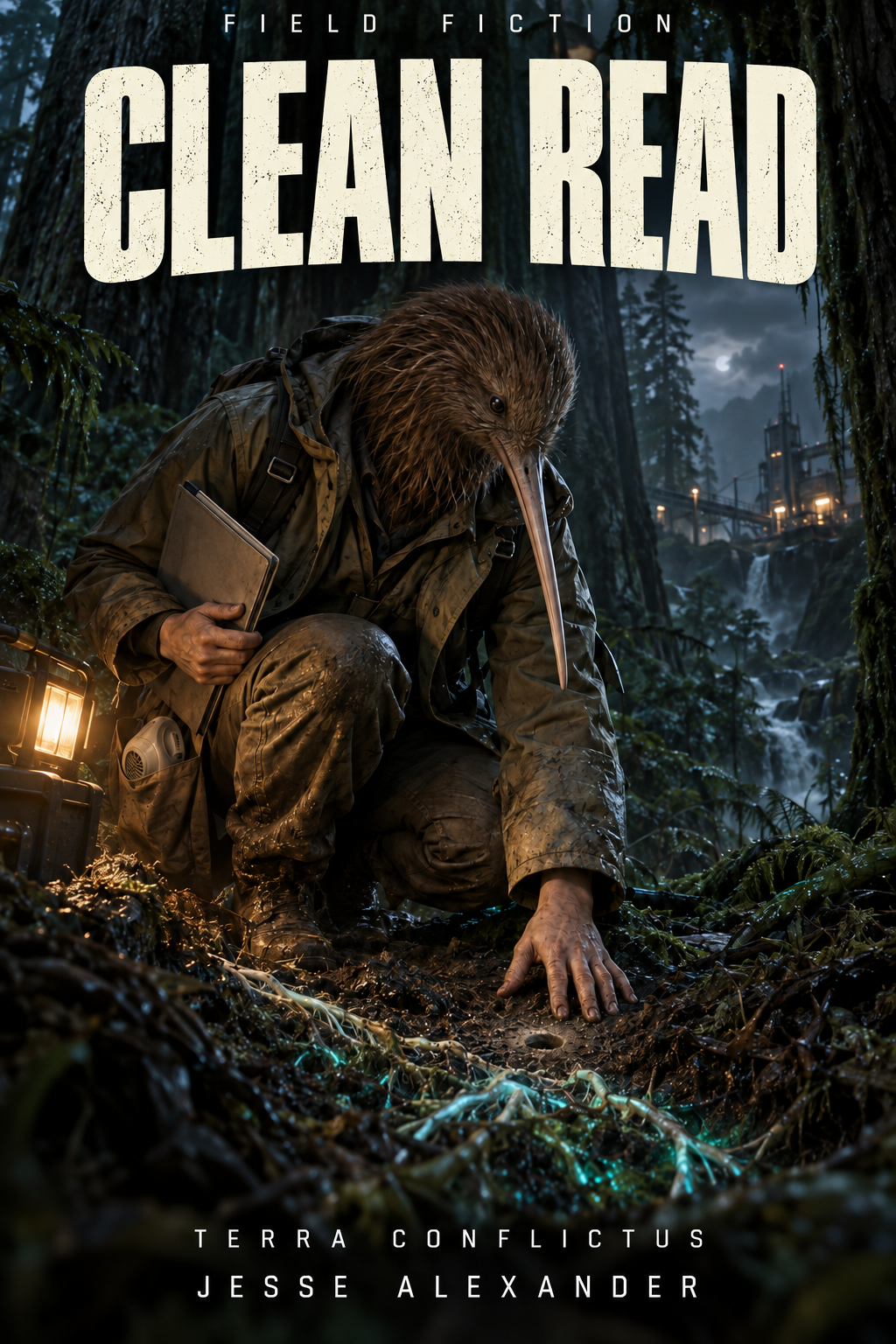
The lie was nine weeks old and healthy as a horse the morning Maren Lindberg asked me to look at her samples.
I want to be precise about what the lie was, because people hear con and think I was selling somebody a bridge. I wasn't. What I sold in Arcadia was a clean read. Every grower in Cedar Row with a hydroponic bay or a half hectare of berm crop needs a certified soil and water read four times a year, and the certification keeps their VERDANT shelter rating, and the rating keeps their subscription tier, and the tier is the difference between a house with cedar on the porch and a container in the Tide Flats with your kids in it. A grade three sensory calibrator walks your ground, files a report, signs it. That signature is worth eleven hundred NAF credits and a family's whole future, and there were four licensed calibrators for a district of thirty thousand people, and their waiting list ran past the harvest.
So I filed twenty-two reports in nine weeks and every single number in them was true. That is the joke of the thing and I need you to hold onto it. I never lied about the dirt. Not once. What I lied about was my right to smell it.
I am NAF soil survey stock. Kiwi line, which is a sentence that makes people laugh until they see the face, and then they stop. They took the one bird on the planet that gave up flying and doubled down on it. Heavy bones, marrow all the way through, legs like a bad decision. Nostrils at the tip of a long structure that isn't a nose the way yours is a nose, so I smell the ground I'm standing on before I smell the air I'm breathing. Sensory pits down the jaw. Eyes the size of a bird's, which on a face this size means near enough to useless, so I work at night and I hate the Canopy Core in daylight the way you would hate a hand held over your face. I run four degrees cold. I eat constantly, which is embarrassing at parties, and there are no parties.
They built me to walk a hectare of forest floor and tell you exactly what is in it, in parts per trillion, in the dark. The Northern Alliance Federation built about nine hundred of us for the restoration program in the forties and then the program got automated and we got filed. Not fired. Filed. A soil survey asset is not a resident, is not a citizen, does not hold a license, cannot certify anything. My reads have no legal standing at all, which is a strange thing to learn about your own nose. So I went down to Drift District and gave Kess most of a year's savings and came back up the hill with a grade three calibration license in the name of S. Ferreira, baseline, forty-one, with a nice photograph of a woman who does not exist.
Everybody who has never been to Arcadia has seen Arcadia. That's the point of it. Vertical gardens down the hillside to Puget Sound, tidal generation, the air smelling of cedar because they run cedar through the atmospheric handling on purpose, and VERDANT tuning all of it, fourteen thousand data points a second, the smartest ecosystem management system anybody ever built. The subscription list to move here is four years long. The Federation flies delegations in and walks them down through the Core at golden hour and says look, it can be done, and here is the proof of it with the light coming through the glass.
They are not lying either. That's the part nobody wants. Arcadia works. It is genuinely the most livable city on the continent and the water tastes like a mountain. It just runs on an idea about who is a person, and I was on the wrong side of that idea, and the wrong side is not a prison. It is a form.
Twenty-two clean reads. Three more and the Calderwood Foundation was going to move my bio-signature from CONTRACT ASSET to RESIDENT, expedited, because grade three calibrators are scarce and the Foundation likes to keep scarce things where it can find them. That was the whole score. Not money. A field in a database. A woman who exists.
Maren Lindberg was seventy-one and had been a soil chemist for forty of those years, and she lived at the eastern end of Cedar Row where the gardens stop and the old growth starts. She flagged me down over her back fence with a mug in her hand and asked me, since I was in the neighborhood, if I would look at something.
She had a chest freezer in her garage full of sample jars. Three months of them, twice a week, labeled in the small hard handwriting of a person who has filled out a lot of forms correctly.
"I keep getting a signature I can't identify," she said. "Chain length is wrong for anything native. It shows up in the runoff after rain and it's gone in six hours." She watched me pick up a jar. "You'll think I'm a crank."
I did not think she was a crank. I had the lid off and I was already four layers down into it and my legs had gone cold, which is what my legs do.
What was in her jar was a signaling compound. Mycorrhizal, engineered, with a marker chain hung off it that had no reason to be there, because a fungal network talking to itself does not need a return address. Somebody had built a thing to grow, and then built into the thing a way to be read from outside. I had smelled the family before. Everybody in soil survey has. It is the South American Coalition's whole architecture, root-network work, the stuff that makes the Amazonian Metroplex behave like one enormous quiet animal.
It was fifty meters from this woman's kitchen.
"Dr. Ferreira?" she said.
That is the moment I want to describe honestly, because it is the moment where a con either dies or gets much bigger. I could not tell her what it was. Telling her meant explaining how I knew, and how I knew was a body the Federation classified as equipment. Also, Arcadia's contamination disclosure statute gives you two hours from the moment of discovery, and the penalty for the two hours and one minute is arrest and quarantine, and the authority that handles all contamination investigations in this city is the Calderwood Foundation, and I had just worked out whose organism it was.
So I did what I do. I put the jar down and told her the truth in the wrong shape.
"It's biological and it isn't from here," I said. "Your chain length is right. Your instinct is right. I'd want a lab with mass spec on it and I'd want the person running the lab to have a license nobody can argue with."
"I have a license nobody can argue with," she said.
"Then you don't need me," I said, and she laughed and said that was the least professional thing a professional had ever told her, and gave me a bag of dried apricots because I had eaten four of hers without noticing.
On my way out I stopped at her back fence. Somebody had scratched marks into the post, a row of them, with dates.
"Twelve meters when I moved in," Maren said. "Eight now. I measure it on Sundays."
Two days later a Foundation car came up Cedar Row and Miranda Calderwood got out of it.
She is Director of Public Engagement, third generation, very good at her job, and her job is to make what the family does sound like weather. She had a folder and an offer. The Foundation wanted an independent sensory certification of the Watershed growth front, walked and signed by a grade three, confirming accelerated growth consistent with natural adaptation to warming trends.
"There's a quarterly address Saturday at eleven," she said. "All public channels. It would mean a great deal to have you stand up during it and hand me that certification in front of the room."
"You have your own labs."
"We have our own labs," she agreed, in the tone of a woman explaining why a magician does not simply tell you where the coin went. "We have no independent nose. Independence is the product."
The fee was the residency transfer. Expedited, she said, and put a small emphasis on it, the way you would set down a cup somebody had been reaching for. Signed by her personally Saturday afternoon.
Three days. One walk, one signature, and I was a person.
I went up on Thursday night, because I am no good in daylight and because the growth cycle runs hardest between one and four.
The Watershed is forty minutes above the Core on a road with two checkpoints, and past the ranger trails there is nothing. No VERDANT coverage past the last monitoring station. No cell. Just the old growth going up and back, Douglas fir six hundred years old with the moss hanging off them like drapery in a house nobody has been in for a while.
Foundation field protocol says filtered mask above station one. The chemical byproduct of the injection cycle gives baselines euphoria first and then disorientation, and there are stories about people who took a mask off up there and sat down and were found smiling in the morning nine hundred meters off the trail. I had a mask. I put it in my coat pocket, because a filter that strips organics is a filter that strips me down to a woman with bad eyes standing in a dark forest.
You cannot read the ground through a mask. That is the whole design of me. The thing I can do and the thing that will kill me come off the same page of the catalog, and anybody who tells you their splice works differently is selling something.
I found the first injection site at twenty past one, about a meter off the trail, a disc of disturbed duff the size of a dinner plate with a cored center. Fifty meters on, another one. Fifty meters on, another. Nature does a great many things and it has never once done anything at fifty meter intervals.
The gradient came up through my legs before it came up my throat. That is how it works on me. Cold ground, and then a warmth in the soil that has nothing to do with sun, decomposition heat, a whole forest floor running a low fever, and riding on top of it the marker chain out of Maren Lindberg's freezer at about forty times the concentration.
There was a fir near the third station with a root tendril coming out past its drip line, three meters clear of where a root has any business being, and it was the color of bone. Not brown. Bone. At about two in the morning it lit. Blue green, low, eleven or twelve seconds, and then out, and forty meters downslope another one answered it, and I stood in the dark in a national showcase of ecological restoration and watched a forest send a message.
And I have to tell you, because the euphoria was well into me by then and it makes you honest, that it was the most beautiful thing I have ever seen.
Station 2 was dark. The SCA exchange team keeps published hours and had gone down the hill. I went in for water and a heater, because I was four degrees cold before I started and had been out three hours, and my hands had that slow stupid quality that means the sugar is gone.
The field locker by the door was not locked. Nothing up there is locked. Who is going to steal from a forest.
Inside were certification folders. Foundation letterhead, the good paper. Pre-printed. Findings already typed, consistent with natural adaptation to regional warming trends, no evidence of introduced organisms, all of it, and at the bottom of every one a grade three license number.
Mine. The number Kess made up for me in a container in Drift District.
There were four folders. Q3 of this year, which was the one I was meant to hand Miranda on Saturday in front of all public channels, then Q4, then Q1 and Q2 of next year. My signature was on all four, reproduced well, better than I do it when I am tired.
Dated in the corner of the first one, in the small print where a clerk initials a receipt, was a date nine weeks back. The Tuesday I walked into the Foundation intake office with Kess's license in my hand and thought I had fooled a bored young man behind a desk.
They had known from the first hour. That was the read. They had known for nine weeks and they had let me file twenty-two certifications and they had counted every one, because what the Calderwood Foundation needed in the Arcadia Watershed was not a scientist.
A licensed calibrator's signature is defensible. It has a real body behind it and a real school and a professional board, and when the network hits critical mass in sixty days and the watershed hydrology goes sideways and three hundred thousand people find out what has been growing under their gardens, a real calibrator would stand up and say what she found and it would be true and it would stick to the family forever.
A forgery does not stick to anybody. A forgery is a hole in the ground you can pour the whole thing into. Fraudulent certifications by an unlicensed individual posing as a grade three calibrator, discovered, deeply regretted, thoroughly prosecuted.
And prosecution is the part that needs the residency. You cannot charge a contract asset with fraud. Equipment does not commit crimes, equipment gets recalled and deported and nobody ever hears about it. They were going to make me a person on Saturday afternoon because a person can be put in a courtroom, and a courtroom is a room where the Foundation gets to be the injured party.
I had been running the con. I had never once been running the con. I had been the con, from the Tuesday, and the beautiful part, the part I would admire if it had happened to somebody else, is that they never had to lie to me. They just let me lie to them and paid for it on time.
Getting down was the worst two hours of my working life.
The euphoria goes over into disorientation without any announcement. One moment I was walking and the next I was somewhere off trail with my palms flat on the ground and no memory of kneeling, and the thing that had gone wrong was that the compound was in my receptors, all of them, saturated, so my direction sense had become a wall of noise in every direction at once. Take a bat and fill the cave with sound. I had bad eyes, no light, no signal, a body that had burned every gram of sugar it had, and the one instrument I own reading full scale on nothing.
I went down on hands and knees and found the trail by the difference in compaction under my palms. Packed gravel on one side, duff on the other. I crawled the edge of it for a long time and stopped to eat all of Maren Lindberg's apricots.
Kaya Whitfield found me around four thirty. Twenty years a conservation ranger, headlamp, boots, the walk of a woman who has already found several people in this forest and did not enjoy any of it. She got me in the truck and turned the heater to a setting the Foundation would call wasteful.
Halfway down she said, not looking at me, "The holes are fifty meters apart."
"Yes."
"Twenty years and nothing in this forest has ever been fifty meters apart."
"No."
She let it sit. Then she said, "Are you going to be somebody who says so."
I sat in a warm truck with a stolen license in my coat and a residency three days out and the only honest answer I had was that I was going to be somebody who got paid.
At half past four on Saturday morning I went and knocked on Maren Lindberg's back gate instead.
She came out in a coat over pajamas and did not ask a single question, which is a thing I will think about for the rest of my life. I walked her east to where the gardens stop. I put her hand on the disturbed duff of an injection site, then walked her fifty meters and put her hand on the next one, then fifty more, in the dark, until she stopped needing me to lead.
"Take from the cored center, not the edge," I said. "Take at night, the concentration falls off after dawn. Take from nine of them and take a control from the ridge above the grade break. Then file it under your own name, with your own license, and say you found this yourself on your morning walks, because you did, you found it in your freezer in June and everything since is just where the walk went."
"That isn't true," she said.
"It's true enough to survive a lawyer," I said. "Doctor, listen to me. I am very good at exactly one thing and it is knowing which version of a true thing people will believe. This is my professional opinion. Take the credit. You are the only person in this district they cannot call a fake."
She looked at me for a while in the dark, and I do not know what she saw, and then she went and got her jars.
The quarterly address went out at eleven on all public channels. Miranda Calderwood spoke for nineteen minutes about continental restoration and there was a place in the middle of it where a woman was supposed to stand up.
I was not in the city by then. I was on the aquaculture pier at the Tide Flats with a bag and no paper, still an asset, still nobody, waiting on the freight that takes contract stock down the coast and does not look at faces.
At seven the Morning Hydration Briefing came on over the pier speakers, the way it does every day of the world, district by district, allocations for the day. Canopy Core, no change. Watershed, no change.
Then there was a pause.
Not a long one. A second and a half of a man in a broadcast booth deciding how to say a number. Everybody on that pier stopped moving, because everybody on that pier grew up in this city and knows what the pause is.
Then he said Cedar Row, and he said the number, and it was down three percent.