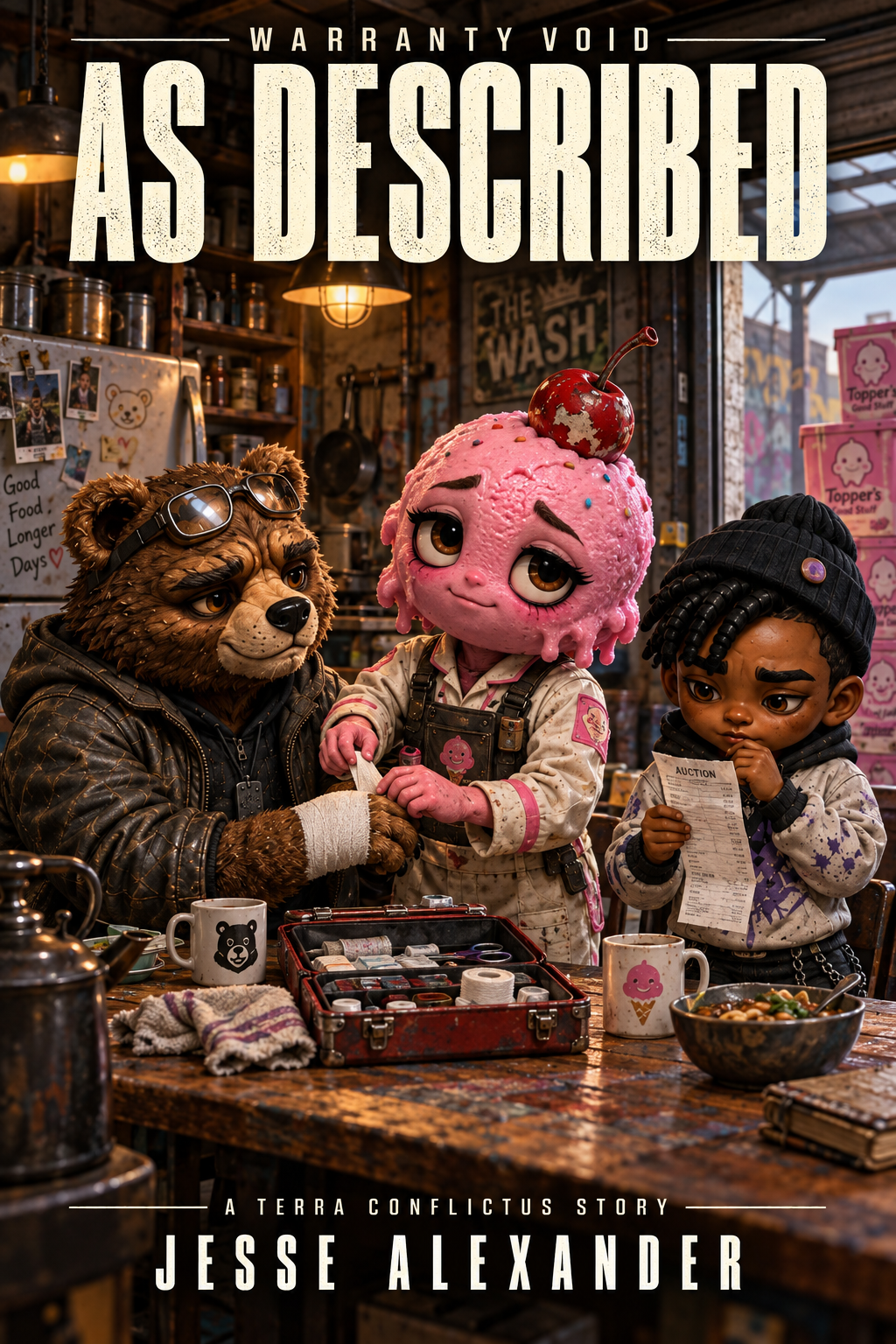
The lot Ozzy wanted was Lot 11, and he had wanted it since Tuesday.
Coastwise Asset Realisation ran their commercial sales out of a hall off Center Point with a ceiling too high for the room and a coffee urn nobody had ever seen refilled. Ozzy had been to nine of these. He knew the rhythm: forty minutes of pallets, then somebody's dead franchise, then a hush while three people who all knew each other bid a fixture package into the ground.
Lot 11 was eleven cartons of Cherrytop Creamery, unopened, provenance chain intact back to a regional distribution hub that had closed in 2054.
That was the whole thing. That was the dream. Ozzy printed knockoffs of dead brands for a living and he was good at it, better than good, and the one thing a knockoff could never be was first. Authenticated period stock was the floor under his entire trade. You could not fake a chain of custody. You could only buy one.
He had four thousand one hundred credits. He had walked the room twice, and the two dealers who might have pushed him were both there for the fixture package, and one of them had a cold.
"Lot eleven," said the auctioneer, who was a tired woman named Halbrook with a voice like a filing cabinet. "Mixed commercial. Coastwise catalogue, page four. Sold as seen."
Ozzy got it for nine hundred and forty.
He did not shout. He was proud of that later, for about ninety minutes. He signed at the desk, and the clerk turned the manifest around and put a pen on it, and Ozzy read the top line the way anyone reads the top line, which is to say he read the number and the words ELEVEN (11) CARTONS and let his eye slide off the rest of the sentence like a hand off a wet rail.
"Delivery Thursday," the clerk said. "Sold as seen, no returns, the yard opens at seven."
"You're a beautiful person," Ozzy said. "Genuinely. Tell Halbrook her diction is immaculate."
He took a photograph of the receipt and sent it to the crew channel with eleven exclamation marks, one per carton.
Thursday the truck came up the ramp into the Wash and Danka made it back down again twice before she was satisfied with the angle, because the ramp had a lip and the driver had opinions and Danka had more of them.
The garage smelled like onions. Grigor had started something at six that morning and would not say what it was until it was finished, which was a rule of the house that nobody had ever agreed to.
Cas came out with a slate and stood where she could see the tailgate. "Eleven cartons. I will count them off the truck and again on the floor. Both counts."
"They're sealed," Ozzy said.
"Both counts."
"You don't have to..."
"Item one," said Cas.
Theo was already filming, from the mezzanine, because Theo was always already filming and the mezzanine had the only clean sightline of the ramp. Down on the floor Ozzy walked backward in front of the handcart with both arms out like a man landing an aircraft, doing the voice, the market voice, the one his mother used on Sundays and pretended she didn't.
"Ladies. Gentlemen. Persons of the garage. What you are looking at is the last cold-chain novelty stock to leave a licensed Cherrytop hub before the licence lapsed. Sealed. Chain intact. Do you understand what that is worth to a man in my position..."
"Nine hundred and forty credits," Cas said.
"That's what it cost."
"That is what it is worth. Those are the same word."
"They are absolutely not the same..."
"Eight," said Cas, to the tailgate. "Nine. Ten."
"...word, Cas, they are not, and one day I will sit you down..."
"Eleven."
The driver got out, walked around, put his hand flat on the tailgate and said, "and the unit," in the voice of a man reading a number off a form.
Nobody said anything.
"Sorry," Ozzy said. "The what."
The driver checked the form. He was not being cruel. He had eight more stops. "Lot eleven. Eleven cartons and the unit. It's in the box with the strapping."
There was a crate at the back of the truck bed that Ozzy had assumed was packing material, because it was the size and shape of packing material, and because at no point in his life had he had a reason to assume otherwise.
Grigor came out of the kitchen doorway drying his hands.
The strapping came off. The panel came down.
Inside was a person about a metre ten tall, pink, dented, wearing a scaled-down chest rig over a coverall that had been taken in at the shoulders by somebody who had cared about the job, with a cherry on top of their head that was chipped and had been repainted twice. They were holding a trauma case against their front with both arms, the way you hold something you have decided in advance that nobody is going to take.
They looked at the five people in the garage. They looked at the onions.
"Somebody," they said, brightly, "looks like they need a treat!"
Then they closed their eyes for a second, and said, in a completely different voice, flat and tired and about thirty years older, "Sorry. It does that. Which of you is the holder?"
The thing Ozzy would remember, afterward, was that all five of them moved at once and every single one of them moved differently.
Grigor went back into the kitchen. Not away. Toward. He came out inside twenty seconds with a bowl in one hand and a folded towel in the other and put both down on the workbench at a height that a metre-ten person could reach without being lifted, and then he stepped back three paces, which was further than Grigor ever stood from anybody, and he did not say one word.
Theo's camera came up. Held. Came down. Theo turned it off, which Theo did not do, and put it against their leg, lens to the thigh, and stood there with their head tilted at an angle Ozzy could not read.
Danka walked the length of the truck and back. "Right," she said. "So we void it."
"Void what," said Cas.
"The contract. The papers. Whatever they've got them on." Danka's ears were flat. "You walk. That's how it works. You take the mark, you go somewhere they've got no jurisdiction, you keep going. It's ugly for a year and then it's yours."
"There is no contract," the person said.
"There's always a contract."
"There is a manifest," they said, patient, like someone who had explained this to a lot of people who very much wanted a different answer. "I am not on a contract. I am on a schedule. You do not walk off a schedule. You are listed on it, and the list gets sold, and the list is correct."
Danka opened her mouth.
"You can't void a receipt," they said. "I'm sorry. People try that one first."
Danka shut her mouth. She looked at the truck for a while. Then she went and stood with her back against the pink hatchback, which was where she went, and did not contribute anything for six minutes.
Cas said, "Name."
"Topper."
"Is that your name or the product's."
"Yes," said Topper.
Cas took three seconds. Ozzy counted them, because everyone in the garage counted them, always, and had never once mentioned it out loud.
"Item one," said Cas. "I need the manifest. Item two, I need the catalogue page. Item three, Ozzy, I need the receipt, and I need you to stop making that face, because the face is not information."
"I'm not making a face."
"You are pricing something."
"I am not..."
"You are pricing something and you have been for forty seconds and I would like you to stop."
And that was the thing, that was the actual thing, because he was. It was involuntary and it had been happening since the panel came down, a running total in the back of his head the way it ran on shoes and cartridges and once, memorably, a live grenade, and he could not make it stop, and what it was doing right now was assembling a number for a person who was standing four feet away holding a medical kit.
"Yeah," Ozzy said. "Okay. Yeah."
Cas read the manifest at the kitchen table for eighteen minutes without saying anything, which was long enough that Grigor made tea nobody had asked for and put it down at four places and then, after a pause, a fifth.
Topper drank the tea. Topper had, by that point, offered to look at Danka's shoulder (declined), Theo's wrist (declined), and Grigor's left hand (declined, twice, then not declined, because Grigor had a burn from six that morning that he had not mentioned to anybody, and Topper dressed it in about ninety seconds with the economy of somebody who had done it forty times a day for a company that no longer existed).
"That is very good work," Grigor said. "I have watched people who were paid to be there do it worse, and they had both hands and a lit room."
"I was certified for it. The certificate is also gone."
"The certificate is a piece of paper in an office that closed. The hand is here, and it is working, and I am the one who can tell you so."
Topper looked at him. "No," they said. "That is true."
Cas put the manifest down.
"Read it," Ozzy said.
"You will not like the reading."
"Cas."
"Lot eleven," Cas read. "Mixed commercial. Eleven (11) cartons, sealed, and one (1) unit, Cherrytop Creamery service grade, serviceable, no reserve, sold as seen."
The kitchen was quiet. The fridge compressor came on and ran and went off again.
"That's..." Ozzy said. "That's it? That's on there? That's on the paper I signed?"
"It is on the paper you signed. It is on the catalogue page. It is on the page you photographed and sent to five people with eleven exclamation marks." Cas turned the slate around. "It is not hidden. It is not small type. It is the second half of the first sentence. I have now read it four times and I want to be extremely clear about what I am telling you, because you are going to try to make this a crime."
"It is a..."
"It is not," said Cas, "a crime. Nobody lied to you. Halbrook did not lie to you. The clerk did not lie to you. Coastwise did not lie to you. The manifest is accurate." She sat back. "That is the problem with it."
"So what do I do."
"Legally?"
"Legally."
"Legally," Cas said, "you own a person. You paid nine hundred and forty credits, of which I estimate Topper accounted for perhaps sixty, because the cartons are what carried the lot. Your title is clean. Your chain of custody is complete." Two seconds. "Congratulations. It is the best-documented thing in this building."
Ozzy went out and stood on the ramp.
After a while Danka came and stood on the other end of it, which was as close as Danka came to anything.
"I bought my car at an auction," she said.
"I know."
"Two hundred and six. Cash. Everything I had." She was looking at the road. "Took it home in three pieces. Nobody asked me what I wanted it for."
"Is this a lesson."
"No." Danka huffed, one beat late. "You paid full price, though."
"I paid under."
"You paid nine forty. For a person. And eleven boxes of ice cream."
"When you say it like that..."
The woman who came Tuesday was an owl about a metre twenty-five in a coat that had been made for her, which Ozzy noticed before anything else, because nothing in this district was made for anybody.
She had reading glasses on a chain that she did not need. She carried a document case. She came up the ramp without looking at the ramp.
"Prudence," she said. "Fidelis Mutual. You called."
"I called nine people."
"You called nine people and one of them was me, and I am the one who came, and the call-out is one hundred and fifty credits whatever we decide in the next hour." She set the case on the workbench. "Would you like to argue about that first, or shall we do it after."
"...After."
"Sensible."
Cas had come in. The two of them looked at each other for a moment with an expression Ozzy could not name, and then Prudence said, "Caseline," and Cas said, "Nine," and Prudence said, "I know," and that was the entire exchange and Ozzy decided not to ask about it for at least a year.
Prudence read the manifest in a quarter of the time Cas had.
"Good," she said.
"Good?"
"Clean title, single holder, no lien, no co-owner, no shell in the chain, the vendor is solvent and still trading." She took the glasses off. "You have no idea how rare that is. Most of what crosses my desk has four owners and three of them are mailboxes. This is the cleanest instrument I have seen this year, and you got it by accident, at an ice cream sale."
"Right, so you can fix it."
"I can do it. It is not a fix, it is an instrument." She opened the case. "There are three routes and you will not like the price of the one that works. Route one, you release the title. You tear it up, you file nothing, you feel enormous." She let that sit. "Topper becomes loose. No holder, no papers, no protection. Any competent broker can construct a chain of title over a loose unit in about a week, and there are four in this city who do nothing else, and one of them is good."
"That's..."
"Worse. Yes. Route two, you keep it. You hold title indefinitely, you never exercise it, you die at ninety and it goes into your estate and your sister deals with it."
"Abi would love that," Ozzy said. "Abi would reconcile that."
"Route three." Prudence took out a printed sheet and put it on the workbench and turned it around with one finger, the way a person turns a menu. "I construct a self-holding instrument with Topper as sole beneficiary and myself as trustee of record until it seasons. Two years, then it is theirs, freehold, notarised, and unbreakable by anybody including me. It is the only one of the three that ends with a person owning a person and the person being the same person."
Ozzy looked at the number at the bottom.
"Four thousand," he said.
"Four thousand and one hundred, and the call-out."
"That's..." He laughed. It came out wrong. "That is exactly what I had. That is the number I walked in with on Thursday. That is..."
"That is what it costs," Prudence said. "It is not a coincidence and it is not a cruelty. It is four days of a notary, a filing agent, two searches, and eleven years of knowing which office to file it in. I do not discount. I have been asked."
"By who."
"By everyone." She put the glasses back on. "Two hundred and six," she said. "That is how many I have moved out of inventory. It is written on the wall of my office and I update it myself and I have never once done it for free, and that is precisely why the number is two hundred and six instead of nine." She closed the case. "How many have you done?"
Nobody said anything.
"That is not a cruelty either," Prudence said, more gently. "It is the arithmetic. Everybody in this room wants to be kind. I am the only one here who is organised." She wrote a number on the corner of the sheet and left it face up. "That is my queue reference. The quote is good for thirty days. My condolences on the ice cream."
She went down the ramp without looking at the ramp.
Ozzy sold the lot on the Wednesday and the Thursday.
The nine hundred and forty had been the cheap part. What was left of the four thousand had gone the following Monday into blanks, ink, and two crates of shirt stock, because he had been flush and happy and he had done the thing he always did, which his sister had a spreadsheet about. So there was no float. There was a lot, and the lot was the float.
It took two days because he did it properly, which was the only way he knew how to do it, and because doing it properly meant standing in nine different rooms explaining to nine different people why sealed period Cherrytop with an intact chain was worth more than they were offering, and then taking what they were offering.
He talked one dealer up two hundred. He talked another up sixty. At the fourth stop he heard himself pricing the lot down, out loud, against his own interest, because the man was hesitating and Ozzy could not physically tolerate a stalled negotiation, and Cas, who had come along and had not said one word all morning, put two fingers on the counter next to his hand, and he stopped, and got the number back up.
In the van afterward he sat with the tablet on his knees and did not turn it on.
"Three thousand nine hundred and sixty," Cas said.
"I know."
"You are one hundred and forty short of the instrument and two hundred and ninety short with the call-out."
"I know, Cas."
Three seconds.
"I have four hundred," she said.
He looked at her.
"It is not a loan and I am not discussing it and if you say anything at all I will put it back in the tin." She was looking straight out of the windscreen. "Item one. The cartons were yours and you sold them. Item two, the four hundred is in a tin behind the dead filtration lines and it has been four hundred for two years, because it is for a part, and the part is not coming, and I have known that for a year." Two seconds. "Item three. Drive."
"I can't drive."
"Then say something else."
"...Do you want to hear what I'd have got for carton four."
"No."
"Eleven hundred. Eleven hundred, Cas, for one carton, because carton four had the manager's stock in it, and..."
He stopped.
"What was in carton four," Cas said.
The card was laminated, about the size of a hand, and it had the Cherrytop mark printed on it in the original ink, which had not been the same ink since 2051.
Cas had it under the bench light with a loupe, and Topper was standing on a crate at the end of the bench looking at it the way you look at a photograph of somebody who used to hit you.
"Say the rest of it," Cas said.
"A shop had one," Topper said. "The manager kept it. It was for the floor. If a unit was, mm. If a unit was having a difficulty. You showed the card, and the unit could see the mark, and the mark was..." They stopped, and started again. "The mark is a genuine period item. So the unit does what you would like. It is not magic. It is about four seconds and it feels like being politely interrupted from the inside of your own head."
"Four seconds is enough to walk somebody into a van," Cas said.
"Yes."
"Ozzy prints this mark on shirts."
"Yes," said Topper. "That is different and I am glad about it every day. His do not work." They looked around at Ozzy. "You know that, yes? Your shirts do not work. They are not authenticated. There is nothing in them. They are just... they are just a picture of my face on a shirt for eight credits."
"Yeah," Ozzy said.
"I have seen them at the market. I nearly bought one." Topper's chest moved. "I could not work out whether I was allowed to be offended, so I did not buy one, and then I thought about it for a year."
Ozzy picked up the card.
He had it in his hand for a while. He was aware of everybody being extremely busy in other parts of the garage in the way that five people are busy when they are not busy. Grigor was at the stove with his back turned and had been stirring the same thing for four minutes. Danka was under the hatchback with her legs out and had not made a sound in six. Theo was on the mezzanine with the camera down, lens against their thigh, which was where it had been for eight days.
"Eleven hundred," Ozzy said. "Minimum. That's the real number. That card, with that chain, to the right collector? I could name a price and they'd pay it and then they'd thank me."
"Yes," said Cas.
"Or I burn it, and it's gone, and nobody ever uses it on anybody again."
"That is the sentimental option and it is also the correct one," Cas said, "except that it is not, because there are four more of those cards in this city that I know about and destroying yours does not destroy theirs, and then Topper has nothing and somebody else has a card."
"So what's the third option," Ozzy said.
Cas did not answer. Cas, who had an answer for everything, itemised, in order, with a number attached, put down the loupe and did not answer, and looked at the card, and then very slightly at Topper, and then back at the card.
So Ozzy worked it out himself, which he would be insufferable about for a month.
He turned around and held the card out.
Topper did not take it.
"That is worth eleven hundred credits," Topper said.
"Yeah."
"I do not have that. I do not have any credits. I have a trauma case and one boot that is not mine."
"Not selling it to you," Ozzy said. "Try again."
Topper looked at the card. The garage did the thing it did, fridge and stove and the Ring Road going through the north wall like weather.
"Why," they said.
And Ozzy opened his mouth to say the number, because the number was right there, the number was always right there, nine hundred and forty and eleven hundred and four thousand one hundred and two hundred and six, the whole running total that had been going in the back of his head since Thursday like a till that would not close.
And nothing came out.
He stood there with his mouth open and the card in his hand and absolutely no number in his head, for the first time since he was seven years old, and it was horrible, and he could not have told you why he was smiling.
"Take the card," he said.
Topper took the card.
They held it for a second with both hands, the way they held the trauma case, the way you hold a thing you have decided in advance that nobody is going to take. Then they put it inside the coverall, against the chest, where everybody in that garage kept the one piece of paper that mattered, because the north wall sweated and paper died in the Wash and every single one of them had learned that the same way.
Nobody pointed that out. Five people noticed it and nobody said a word.
"What do I owe you," Topper said.
"Nothing."
"That is not an answer, that is a kindness. I am asking the real question." They looked up. "I was in a lot with eleven boxes and I know what the boxes went for, because your friend read the number out in the kitchen and I was in the room. So I would like to know the rest of it. What did I cost?"
And that was the one.
Ozzy had priced a live grenade. He had priced his own shoes out loud at his mother's table, twice, on purpose the second time. He had, at nine years old, priced a dog.
"I don't know," he said.
"You know every number."
"I know. I know I do." He rubbed his face. "I've got nothing. There's nothing there. I've been standing here about a minute and a half and there is nothing there, and I'm going to be honest with you, I'm finding it a bit..."
He made a gesture. It did not mean anything.
Behind them, at the stove, Grigor put the lid on the pot.
"Set another place," he said.
The instrument was filed on the fourteenth. It seasons in two years. Prudence sent the queue reference by hand, on paper, with a stamp, and did not discount the call-out.
Theo never posted any of it. There are eight days of footage from the mezzanine, and a card that was hand-lettered on the Thursday night and never used, and both of them are on the drive on the shelf, and the card says:
eleven boxes and