OPEN // READING VIEW
READ THE LABEL
FRONT MATTER
SCROLL TO READ // SPREAD VIEW PRESERVES THE PRINT DESIGN
OPERATOR TACTICS // SETTING GUIDE
The complete Warranty Void setting guide.
Lost Angeles, 2066.
NO WARRANTY. NO OWNER. FIVE PEOPLE STILL INSIDE.
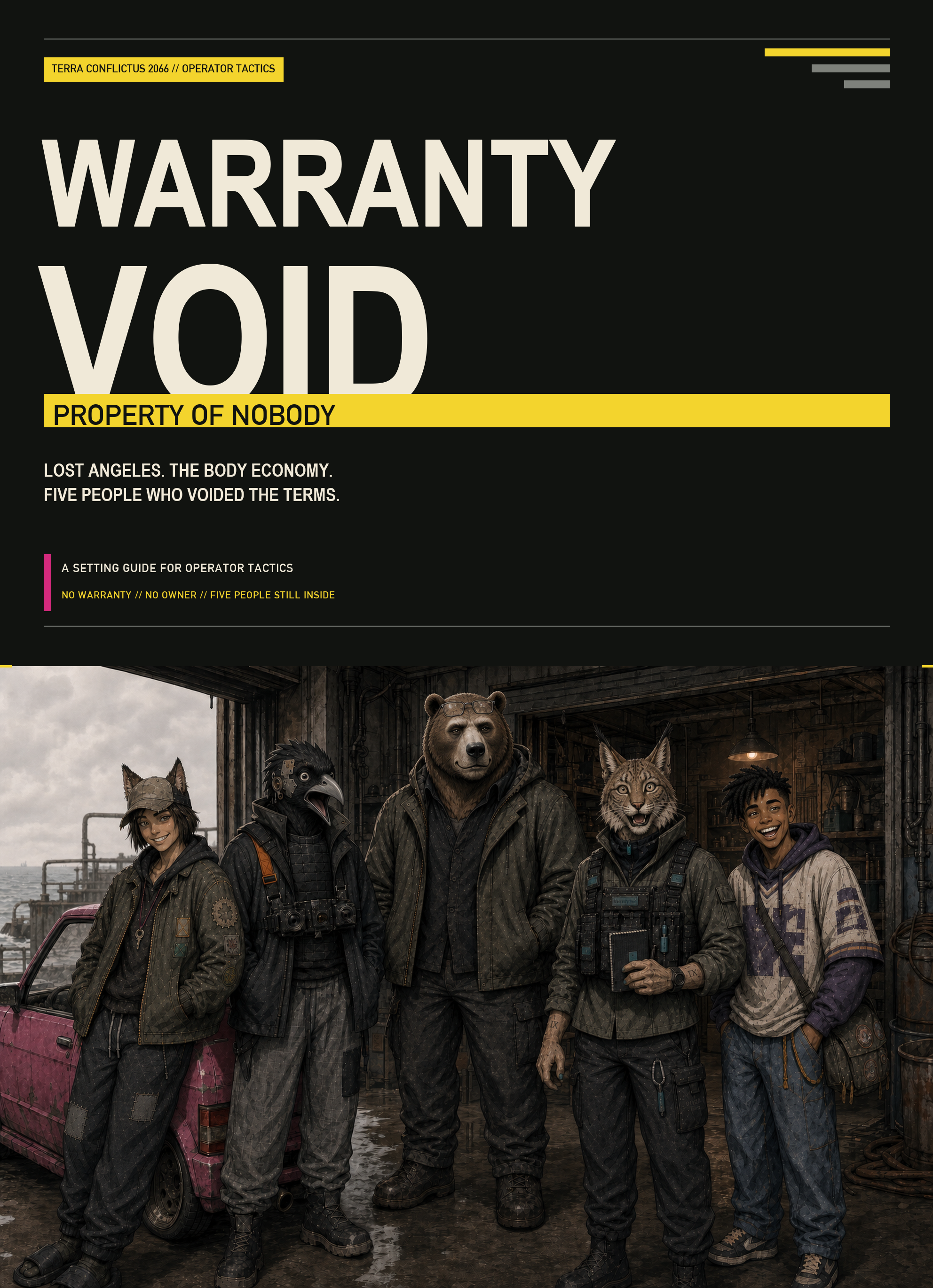
Warranty Void: Property of Nobody
First complete manuscript edition
Terra Conflictus 2066 / Operator Tactics
Created by Jesse Alexander
Additional credits, rights language, ISBN, printer information, and errata route to be added at production lock.
This is a reader-first guide to Lost Angeles, the body economy, and Warranty Void. It explains the world around the contracts: the water queue before the job, the clinic after it, the person behind the camera, and the institution that still thinks it owns the operator who left.
You don't need another Terra Conflictus book to read it.
If you're playing Operator Tactics, the Warranty Void Mission Book supplies the crew files, campaign procedures, and thirty-two ready contracts. This book supplies the city those contracts disturb.
This edition was developed against the deployed Terra Conflictus source at commit 392c8e57c51f14a80a258bdc6df8f927a085030d, frozen on 28 August 2026.
The setting keeps moving. A source snapshot makes the edition honest about when it stopped looking.
OPEN material is safe for a first read. It may contain history, public character depth, and ordinary setting pressures. It doesn't explain every mystery.
SEALED material is for Wardens and readers who want situation truths. It can tell you what an institution is doing now, what a rumor conceals, or what pressure advances when nobody intervenes.
SEALED doesn't mean creator-only. Protected character wounds, future story payoffs, and withheld franchise answers remain outside this book.
Terra Conflictus deals with climate collapse, displacement, bodily autonomy, state and corporate ownership, medical precarity, surveillance, violence, and the economics of care. Warranty Void is also funny, warm, domestic, and stubbornly alive.
The setting takes coercion seriously. It doesn't treat people as less human because a government, company, clinic, or market does.
Published references, approved internal canon, and in-world reporting aren't interchangeable. Objective reference material is stated directly. Journalism, rumor, comment chains, and recovered files are attributed. New disclosures from approved undeployed sources are logged during production.
If a source inside the fiction is wrong, the book lets it be wrong in public.
Start at page 7. Follow the book from one broken pipe to the powers that price its water, then back to the five people trying to keep it running. The setting opens outward in layers: household, district, city, body, audience, job.
Game material sits beside the world it grows from. You can ignore every table-facing box and still get a complete book.
Read the OPEN sections, then use Property of Nobody for the crew, The Work for incident structure, and What Happens Next for campaign frames. The Mission Book holds the pregenerated operator files and complete contracts.
This guide doesn't replace them. It tells you what a contract costs after the payment clears.
Read the city and body-economy sections first. Use the district board, pressure clocks, institution ladders, cast orbit, and situation generator. SEALED pages are clearly marked and never require hidden creator material.
The city is larger than Warranty Void. You can play couriers, clinicians, journalists, racers, rivals, neighbors, gray vets, or another splice entirely.
| Pages | Section | What it gives you |
|---|---|---|
| 1-8 | Front matter | Premise, navigation, and one bad Tuesday |
| 9-26 | The World That Kept Going | The Upheaval, six powers, operators, genomic citizenship, attention |
| 27-56 | Lost Angeles | Infrastructure, movement, eight districts, a city at street level |
| 57-82 | Bodies Under Contract | Gene-forged life, orphanware, commercial grades, care, assessment |
| 83-116 | Property of Nobody | Warranty Void, the Wash, the five, their family and rivals |
| 117-144 | The Gray Band | The Feed, clothing, food, nightlife, sport, faith, and language |
| 145-166 | The Work | Contracts, Heat, Clout, clients, incident forms, aftermath |
| 167-178 | What Happens Next | Campaign frames, clocks, and restrained Warden truths |
| 179-192 | Appendices | Timeline, district and cast reference, lexicon, and index |
Who owns a body after the warranty is void?
Governments answer with registration. Companies answer with terms. Clinics answer with standing. Markets answer with price. Neighborhoods answer with obligation. A crew answers by making dinner and keeping the door shut.
No single answer wins. That's why there's a book.
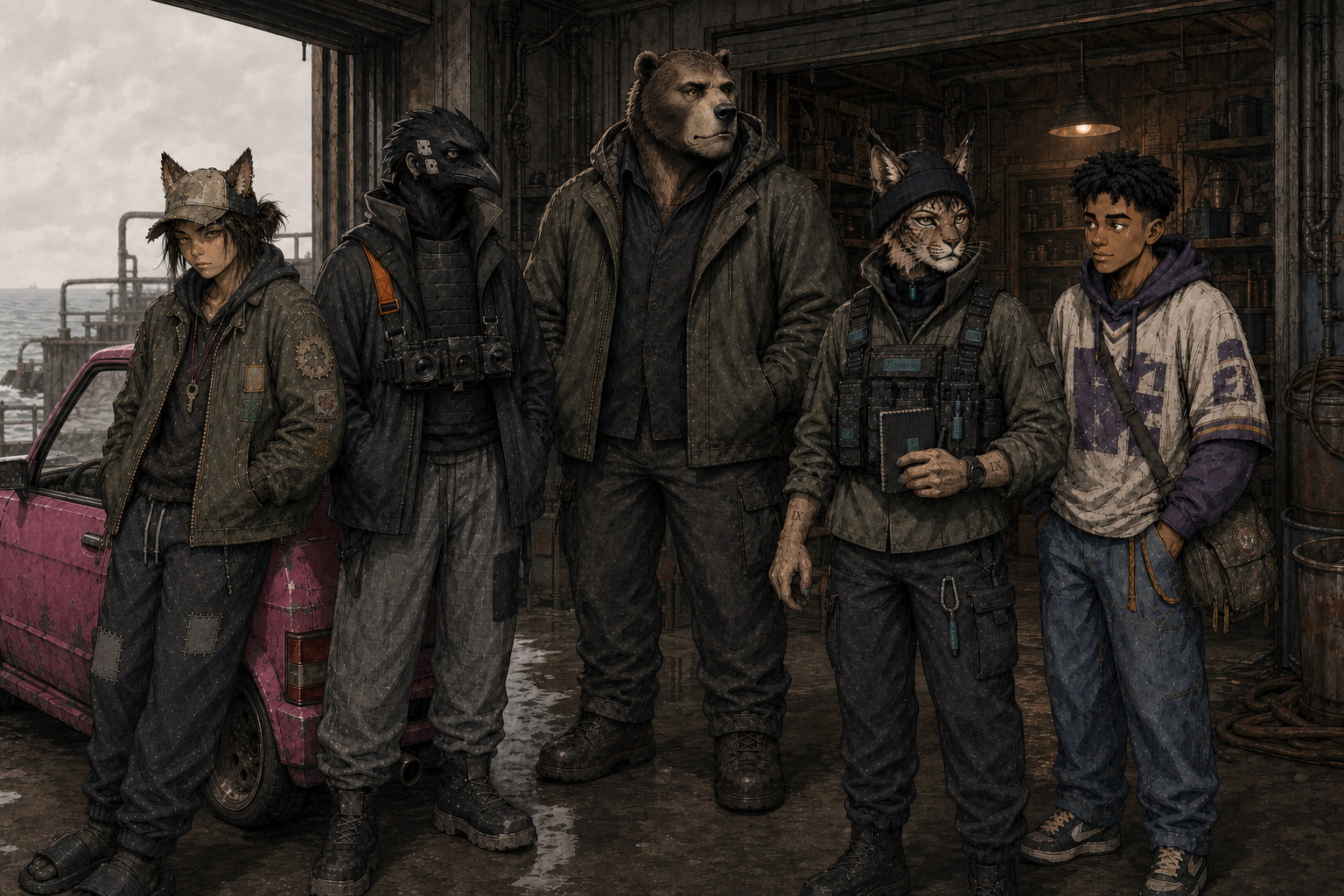
The pipe kicks at 06:13.
The woman first in line hears air. Then rust. Then water. She holds a yellow jug beneath the standpipe and waits for it to run clear. Nobody complains. Complaining won't change the pressure, and the Wash has never charged for patience.
Inside, Danka Ivel is under a hot-pink hatchback with one foam slide braced against the floor. The car is called Civilian. It has an absurd spoiler, a cold Kavast gauge cluster, and no business being alive. Danka bought it as a wreck and disagreed.
Cas stands at the live filtration line with a diagnostic lead in one hand. Her full lynx head is turned toward the pipework, ears tracking a knock nobody else can hear. The pressure is down four percent. She says this as though four percent has personally broken an agreement.
Grigor Tam is cooking in the old chemical room. It's the only room with a door that closes. He's built like the Compact intended him to hold a corridor forever. He's using both hands to slice onions.
Theo Ashe is filming none of this.
That's what they'll say later. The raven's chest rig is on, but the active lens is pointed at the floor. Grigor gets asked. Everyone else has to object.
Ozzy Okonkwo-Cruz comes through the roll-up door carrying an assessment notice, three shirts that didn't exist yesterday, and breakfast he has already priced for resale. He's nineteen, baseline, unmodified, and the only person in the building a hardware scanner can't embarrass.
“Routine,” he says, holding up the notice.
Cas looks at the pressure gauge. Theo tilts their head. Danka rolls out from under Civilian.
Grigor keeps cutting onions.
Outside, the queue has reached seven people. They know the crew's names. They know which nights Civilian came home missing a panel. They know Theo's edit schedule and Ozzy's mother. They know an assessor's route before an assessor does. Barricadia's surveillance system is forty people holding containers and pretending they aren't listening.
Nobody offers Warranty Void a contract.
They've already got a job.
The tap has to run.
Four defectors. One baseline. A wolf who left a Kavast pack. A raven who walked away from a shared military sensorium. A bear built to outlast everyone. A lynx whose manufacturer went bankrupt. A shop kid from Barricadia who talked his way into the car.
One building. Reclaim Sub 3 is a decommissioned water-reclamation station, an unlicensed garage, a home, and a public water point. The crew calls it the garage. The district calls it the Wash.
One audience. They film their work and post it to the Feed. The channel pays their bills, protects them with attention, and shows their enemies where they live.
One argument. Governments say bodies belong to the states that designed them. Companies say bodies belong to whoever holds the title. Warranty Void says composition doesn't decide kinship and a contract doesn't decide personhood.
They mostly say this by stealing something, losing the plan, winning the clip, and getting home in time for dinner.
| Word | Meaning here |
|---|---|
| Operator | An independent contractor paid to solve dangerous problems nobody wants attached to an institution. |
| Splice | A mixed crew, reclaimed from an old term for survivors a state wouldn't bother rebuilding. |
| Void | To leave the flag, registration, contract, or owner that claimed you. |
| Feed | The attention system where footage becomes evidence, income, leverage, and risk. |
THE INCIDENT IS THE STORY. The contract is only what everyone thought the day was going to be about.
The world ended in briefings because briefings need a clean first page.
The actual world kept going.
It moved its ports uphill. It rebuilt streets as canals. It put farms inside towers and cities beneath them. It learned which storm walls held, which governments didn't, and which old machines were too heavy to die. It priced clean water by subscription and called the next grade down municipal service. It made an industry from the distance between those two taps.
The Upheaval wasn't an afternoon. It was decades of climate failure, resource pressure, broken insurance, migration, war, and institutions discovering that survival could be sold back to people who'd already paid for it.
What survived became intimate.
A faction knows when an access card opens a door. A company knows when a clinic changes a serialed component. A registry knows when a gene-forged operator crosses a checkpoint. The Feed knows which clip held a viewer for six more seconds. A water authority knows which block lost pressure and which block bought immunity from the schedule.
The systems are larger than the people living inside them. Their touch isn't.
By 2066, six military powers control most of the infrastructure that makes large populations possible. They hold territory through water, energy, food, security, data, and the promise that tomorrow's systems will behave roughly like today's. Beneath them sit lineage states, independent powers, enclaves, councils, unions, syndicates, sanctuaries, and neighborhoods that govern themselves because nobody else arrives in time.
War didn't stop. It lost its declarations.
Now the fighting happens through deniable strikes, proxy contracts, resource interdictions, erased shipments, autonomous platforms, and operators whose clients want the result without the flag. Every power calls this stability when its own pipes are full.
Lost Angeles is one of the places where the arrangement works.
That's not praise.
The arcology core has controlled climate, verified water, predictive transit, and doors that remember who passed through them. The outer districts have local grids, gray clinics, repaired filters, informal routes, and people who remember more than the doors. Between them runs the operator economy: work that is necessary, dangerous, and inconvenient to own.
Warranty Void lives there.
Not at the end of the world. In the part that kept going without asking whether anyone could afford the terms.
THE WORLD'S CENTRAL TRICK: It makes survival look like a service and ownership look like care.
The Upheaval was a long emergency. Nobody agrees on its first day because the people who could afford to ignore it started their clocks late.
Oceans rose. Surge events reached farther inland than the models promised. Coasts retreated in expensive stages: barrier, repair, payout, refusal, abandonment. Deserts widened into agricultural zones while newly wet or thawed land appeared where the needed roads, housing, and institutions didn't.
The planet didn't become uniformly unlivable. It moved habitability away from existing populations and infrastructure.
Food followed water. Energy followed both. A harvest failure in one region became a price shock in five. A desalination interruption became a border problem. The systems built to absorb local disasters began failing together.
From 2031 through 2042, governance followed the climate into compound failure. Coastal relocation emptied public budgets. Refugee flows overwhelmed agreements built for smaller numbers. Insurance collapsed as a working promise. Agricultural losses struck several continents at once.
Forty-one governments dissolved, fragmented, or stopped functioning during the Cascade. Larger powers absorbed neighbors, territories, debts, armed forces, and infrastructure until the rescuers began changing shape too.
What replaced national government in many places was service backed by force.
Security units protected the territory a faction could supply. Water authorities governed through allocation. Employers became housing providers, clinics, stores, and border offices. A person could be technically free to leave and practically two hundred kilometers from the next habitable place.
The Document Wars began before the Cascade ended. Archives were targeted, destroyed, monopolized, corrupted, or made inaccessible. Clinical psychology, agricultural science, infrastructure engineering, and linguistics all suffered losses that still shape 2066.
Knowledge didn't vanish evenly. It survived in private stores, faction vaults, obsolete media, repair traditions, oral practice, and the people who knew how to do a thing after the manual disappeared.
That uneven survival became power.
Freelance contract work existed before the Cascade. After it, the work became structural.
The world held more contested territory than any surviving authority could govern. Factions needed objectives completed without admitting they were present. Settlements needed expertise no institution would send. Companies needed assets recovered across borders that no longer agreed on what an asset was.
Operators filled the gap.
They weren't the cure. They were the labor market the failure produced.
| Date | What changed | What remains in 2066 |
|---|---|---|
| 2028 | The Document Wars begin across multiple cities. | Information has provenance, scarcity, and a price. |
| 2031 | Insurance collapse opens the Cascade. | Risk is pushed downward until a household or body carries it. |
| ~2042 | Superstorm Prometheus proves the old systems can't hold. | “Pre-Prometheus” marks a different assumption about permanence. |
| 2066 | The operational now. | Six powers, active proxy wars, a mature operator economy, and people born after the old map stopped mattering. |
Prometheus Generation. They remember specific losses and control much of the faction leadership tier. Their nostalgia isn't romantic. It's administrative: the route that used to run, the coast that used to be insured, the archive that used to answer.
Rebuild Kids. They learned survival inside fractured systems. They make up much of the operator class. They're good at improvisation and tired of being praised for it.
Born-After. Factions are weather. Flooded zones are geography. Patchwork isn't decline; it's how objects look when people expect to keep them.
The six military superpowers aren't the whole world. They're the largest systems for turning resources into obedience at scale.
Most Lost Angeles residents encounter them in fragments: a product seal, a checkpoint protocol, a clinic license, a recruiter, a ration, a show, a subcontractor, an imported machine with documentation nobody local can read.
The faction is rarely standing in the room. Its terms are.
| Power | What it controls well | What reaches Lost Angeles | What its paperwork assumes |
|---|---|---|---|
| North American Federation | AI-managed infrastructure, drones, data, the clean surface | Monitor classification, smart systems, access tiers, Western Corridor administration | If the system records enough, management becomes understanding. |
| Southern Cartel Alliance | Bio-engineering, agriculture, decentralized trade and entertainment | Living materials, modified crops, medical cultures, the music people play when official feeds are off | A contract can say exactly which rights a person has. |
| Eurasian Oligarchy | Heavy industry, extraction, field repair, force projection | Industrial stock, patched armor, mineral supply, company networks | Everything has a value, and value can replace belonging. |
| Pan-Caliphate Union | Solar power, desalination, long diplomacy, social legitimacy | Water technology, energy agreements, merchants, patient intelligence work | Stability is an arrangement made durable by the right custodians. |
| Pacific Rim Collective | Cybernetic integration, AI research, manufacturing, dense networks | Components, firmware, medical systems, deep-cover interests | The boundary between person and system matters less than coordinated performance. |
| Nordics Arcology Network | Closed-loop cities, environmental systems, information leverage | Rare methods, clean components, consultants, offers that arrive after long observation | Nothing should be deployed before its return is understood. |
The comparison is useful. It isn't complete.
Each power contains cities, offices, workers, contractors, internal disputes, and people routing around doctrine to get through a shift. A faction's methods are real. So are the gaps between the method and the person enforcing it.
NAF systems classify what NAF staff can't interpret. SCA contracts can protect a gene-forged worker better than laws elsewhere and still define that protection as a negotiated term. EO repair culture keeps impossible equipment alive while EO property law can deny a person ownership of their own body. PCU continuity can make public life coherent and turn “equilibrium” into a polite name for advantage. PRC coordination can solve problems no individual could and bury the individual inside the solution. Nordic restraint can prevent catastrophe and keep life-saving knowledge behind a perfect door.
Nobody on the street owes the reader a faction's cleanest argument.
Lineage states such as Kavast, the Protectorate, and the Eastern Compact aren't seventh, eighth, and ninth superpowers. They're powers organized around a gene-forged template and a doctrine of cohesion. Their influence on Warranty Void is personal because four members carry bodies shaped by systems like these.
Independent entities also matter: the African Continental Union, New Zealand Sanctuary, the Pacific Free Zone, the Saharan Nomadic Federation, the United Kingdom Enclave, maritime councils, the Brotherhood of Shadows, the Syndicate, and dozens of city-scale authorities.
The map has fewer blank spaces than the old world and more places where five maps disagree.
Ask four questions:
The flags will explain themselves.
An operator is someone paid to do dangerous work an institution needs completed and doesn't want attached to itself.
The word describes a profession, not a moral category. Operators can be rescuers, thieves, couriers, investigators, saboteurs, escorts, medics, racers, negotiators, witnesses, or hired violence. Most become several before the year ends.
The Cascade left gaps between authority and need.
A faction may control a city but not a district. A company may own an asset but lack jurisdiction to recover it. A neighborhood may know exactly what has to be done and have no specialist willing to enter. A client may be able to pay for an objective only if nobody sees their name on the route.
Operators cross those gaps.
They can move between incompatible systems because they aren't fully protected by any of them. The freedom and the danger are the same fact.
Contracts. A contract names an intention, a price, and just enough truth to start movement. It rarely describes the full incident.
Reputation. No global law makes a freelance agreement safe. Payment records, completed jobs, witnesses, channel footage, broker standing, and the stories districts tell about a crew substitute for enforcement.
Small units. Three to six people can move faster than a faction and carry more judgment than an autonomous platform. They can also be abandoned without starting a war.
Ambiguity. A city tolerates operators when their work solves more problems than their presence creates. The calculation can change by block, client, and hour.
There is no trans-faction legal system that makes “operator” mean one thing everywhere.
Inside stable faction territory, an operator may be a licensed contractor, a foreign asset, an unregistered combatant, or a suspect waiting for the objective to become clear. In contested zones, the question isn't whether the work is legal. It's who has enough authority to object and whether anyone else will honor that authority tomorrow.
Independent doesn't mean neutral.
Every accepted job supports a person, market, district, company, or power. Every refusal does too. Operators choose where to put scarce skill, force, and attention, often with incomplete information and a payment due.
The useful question isn't “Are they mercenaries?”
It's “What won't they do for the rate?”
| Term | Use it for | Don't confuse it with |
|---|---|---|
| Operator | A dangerous-work professional with independent judgment | A rules class or synonym for soldier |
| Contractor | The legal or market role through which an operator is hired | Loyalty to the client |
| Crew | The people who repeatedly live and work together | Any temporary job roster |
| Splice | A mixed-composition freelance operator unit | A species category |
They repair things. They keep a public tap running. They bring work into Barricadia and spend money there. Their channel makes quiet retaliation expensive. They know which clients lie and which lies get neighbors killed.
They also steal, damage infrastructure, embarrass institutions, drive like the road owes Danka money, and attract the kind of attention a district normally routes elsewhere.
Tolerance isn't approval. It's a living account.
For a gene-forged operator, citizenship can be read from the body.
States and companies record lineage markers, program origin, batch, service standing, modifications, and ownership claims. The exact law changes across borders. The assumption underneath it doesn't: a designed genome came from an institution, so the institution retains an interest in what the genome becomes.
That interest can be called citizenship, warranty, service obligation, recovery standing, intellectual property, public safety, or continuity of care.
The scanner doesn't care which word makes it respectable.
Registration can provide real protection. It can establish identity, authorize clinical support, connect a person to compatible parts, validate training, open a border, document kin, or force an institution to acknowledge that a body exists.
It can also establish the route for repossession.
The same record that tells a clinic which interface won't kill you can tell Asset Recovery who made the interface and where to file the claim. The same lineage papers that prove family can define the family as a production cohort owned by the state.
The line is painted on the floor because walls slow commerce.
A baseline courier steps through first. The gate reads face, gait, declared cargo, and travel credential. The screen asks whether the person matches the document.
A gene-forged courier steps through next. The gate asks more questions.
Who produced the lineage? Is the registration current? Is the carrier in service, retired, licensed, transferred, voided, listed, depreciated, or reported? Does the body contain controlled hardware? Does another jurisdiction claim it? Does the person at the gate have standing to refuse the answer?
Both couriers may be searched. Only one is searched as disputed property.
This crossing is a composite. The distinction isn't.
To void is to cancel genomic registration and leave the flag, program, contract, or owner that used it to claim you.
Voiding can end service. It doesn't erase markers. A state may lack jurisdiction over the person standing in Lost Angeles and still consider the genome recoverable property the moment that person leaves NAF protection.
The voided carry paper because databases can be corrected by whoever controls them. A physical deregistration receipt is slower to alter. It can be laminated, witnessed, hidden, copied, worn, or pressed against the chest while a checkpoint argues with itself.
Paper doesn't guarantee freedom. It gives freedom an exhibit number.
| State | Lineage | A deserter becomes | What the word does |
|---|---|---|---|
| Kavast | Wolves in packs | Live marker | Turns a missing person into an active recovery objective |
| Protectorate | Ravens in flights | Listed | Preserves the claim indefinitely inside an archive that never forgets |
| Eastern Compact | Bears in formations | Depreciated | Writes off the asset and makes abandonment sound like accounting |
The methods differ. Each keeps the state's grammar inside the person who left.
The law can decide who must repair a body. It can decide which border opens, which clinic accepts the scan, which insurer pays, and which armed team calls itself recovery.
It can't settle whether the body belongs to the person living in it.
That question is already answered. The systems are late.
A splice is three to six operators of mismatched lineage who work as one unit.
The word began as contempt.
In genomic language, a splice is a joining of material from different sources. State militaries applied it to freelance units whose composition wasn't pure enough to trust: wolves beside ravens, private-lineage bodies beside baselines, operators trained under incompatible doctrines taking orders from whoever paid.
To the state, mixed composition meant failed cohesion.
To the people being mixed, it meant nobody in the room had been designed to obey the same command.
Freelancers took the word over gradually. There was no conference, campaign, or founding speech. Older operators started using it before a commander could. Younger operators grew up hearing the reclaimed meaning first.
The word still carries age.
Over forty: may remember when “splice” meant a unit wouldn't receive proper logistics, intelligence, repair, or extraction.
Under thirty: often treats it as ordinary professional identity. The word belongs on kit, channel titles, and introductions.
Between: knows both meanings and may choose the word because of the scar, not despite it.
Lineage forces make cohesion visible.
Kavast fields wolves in packs. The Protectorate fields ravens in flights. The Eastern Compact indexes bears into formations. Their bodies, training, social bonds, and language reinforce a shared method.
A splice gives up that efficiency.
It gains disagreement.
One operator notices the route. Another notices the witness. Another knows the door is lying. A baseline asks why the plan assumes everyone in the room has a manufacturer. Mixed crews spend more time translating. They also have more ways to recognize a premise that only makes sense inside one doctrine.
Splice describes composition, not anatomy.
A unit of six differently modified people can be a splice. So can a wolf, a lynx, and two baselines. A gene-forged person working alone isn't “a splice.” A mono-type pack that defected together may be freelance without being mixed.
The word belongs to the relationship among the members.
Four members are voided from systems that still know their bodies. Ozzy is baseline. That doesn't place him outside the argument.
He can pass scans that turn the others into paperwork. He can also be treated as the cheapest body in a crew built from expensive ones. His presence tests whether “chosen composition” means everyone or only the people with visible claims.
The crew's answer is imperfect, loud, and repeated daily.
They give him work. They listen when he reads a room. They put him in the safe seat. They charge him for shirts.
A MIXED CREW ISN'T COHESION DONE BADLY. It's an argument that cohesion can be chosen after design.
Lost Angeles sits on the North American Federation's western edge and inside its economy.
Those aren't the same thing.
The NAF administers the core, maintains the highest-capacity systems, fields Monitor, controls recognized access, and supplies the legal grammar institutions use when they want a claim to sound inevitable. Its authority weakens by gradient: tower to service level, verified grid to local grid, subscribed water to public tap, named route to route someone must sell you.
The outer city isn't beyond government. It's governed by more things at once.
Pacific access. Goods, people, data, and interests from the PRC and Pacific Free Zone arrive through western trade routes whether the NAF welcomes them or not.
A continental hinge. Lost Angeles connects interior NAF systems to coastal trade, salvage, racing, entertainment, and gray markets.
Infrastructure at different ages. Arcology systems sit over municipal, industrial, residential, and transport layers built for older cities. Every repair exposes another owner.
A large audience. The city produces footage the world watches. A local incident can become international evidence before the district learns who posted it.
A mature heist economy. The same networks move contracts, packages, bets, credentials, parts, rumors, and people. Crime isn't a separate city underneath the official one. It shares loading docks.
| Interest | Why Lost Angeles supplies it |
|---|---|
| Data | Monitor coverage, dense audiences, route history, consumer and contractor behavior |
| Access | Pacific trade, NAF interior routes, eight districts with different jurisdictional surfaces |
| Bodies | Gene-forged labor, gray clinics, unsupported lineages, contractors between systems |
| Culture | Raid Race, Feed channels, fashion, music, reputation markets |
| Cover | Enough institutions, brokers, crews, and cameras to hide an operation in public |
Official descriptions call Lost Angeles six interlocked arcology zones on the old Los Angeles footprint. Operators use eight districts: Barricadia, Center Point, the Musk Tunnels, the Raze, Ring Road, the High Top, the Low Coast, and Monitor Central.
The lists don't conflict. They answer different questions.
An arcology zone describes administration and infrastructure. A district describes how people move, trade, recognize danger, and tell someone where the job went wrong. Monitor Central is less a neighborhood than an authority spread through the others. Ring Road is pavement, economy, broadcast stage, and border at once.
If you ask the city which map is correct, it asks what you're carrying.
Distance isn't measured only in kilometers.
Measure a route by water carried, checkpoints crossed, cameras noticed, dead zones entered, favors spent, and whether the passenger can survive the destination's clinic policy.
Lost Angeles begins where those answers stop matching the official travel time.
Water is metered. Power is rationed. Attention has a gatekeeper too.
In 2066, footage can be evidence, income, armor, reconnaissance, blackmail, memory, entertainment, or a targeting aid. The difference often depends on who posts first and which account still has carriage when the comments turn.
Verified band. Sanctioned, licensed, and carried by systems that can monetize at scale. Verification buys access, not necessarily an audience.
Gray band. Unlicensed but tolerated. Independent reporting, underground sports, hand-passed serials, fashion, commentary, and channels such as Warranty Void. This is where much of the culture people care about lives.
Dead band. Pirate, unrecorded, deniable. Broadcast and offense arrive together. Credibility comes partly from the effort required to receive it.
No person or channel holds money, audience, and credibility at the same time for long.
On the Feed, verification is a credential that affects reach, payment, search, and access.
Verified isn't visible. A platform can carry something nobody chooses to watch.
Revocation is censorship without deletion. The clip remains. The carrier loses the routes that make it findable and profitable.
The audience is a prosthetic. For the stateless and voided, subscriber count can become a passport made of witnesses. Attention makes quiet disappearance harder.
It also tells enemies exactly how many people will notice.
Theo controls the cut. Ozzy controls the commerce. The crew decides what the city gets to see, then lives with what the city decides it saw.
The channel pays bills and raises rates. It documents routes, clothing, injuries, tactics, friendships, clients, enemies, and the shape of the Wash. A successful clip can protect the crew from private retaliation by making it public. The same clip can show an assessor which door to use.
The metadata doesn't lie. Editing shapes meaning, sequence, emphasis, and omission. It doesn't change when the camera recorded the frame.
| Use | Immediate value | Cost that arrives later |
|---|---|---|
| Payment | Views, licensing, sponsorship, merch sales | Dependence on carriage and audience appetite |
| Evidence | Proof of time, presence, harm, or completion | Exposure of witnesses, methods, and routes |
| Protection | Makes retaliation legible and therefore expensive | Makes the protected person easier to locate |
| Leverage | Changes a negotiation without firing | Loses value when posted; invites counter-narrative |
| Memory | Preserves what institutions would erase | Fixes one angle as the version people remember |
The first question isn't “Is the image real?”
It's who recorded it, who edited it, who carried it, what happened to the file between those acts, and what each person gains from the version now on screen.
The city doesn't distrust images.
It reads their chain of custody.
Nobody in Lost Angeles wakes up thinking about the setting.
They think about pressure, distance, work, charge, weather, standing, and whether the person who promised to call has gone quiet for a reason.
| Wrong question | Ask this instead |
|---|---|
| Who controls Lost Angeles? | Which system controls this door, and who can make it irrelevant? |
| Is this district safe? | Safe for whom, carrying what, at which hour? |
| Is that water clean? | Who tested it, when, and will they drink first? |
| Are those papers real? | Which reader must accept them? |
| Is that person legal? | Who claims jurisdiction over their body? |
| Is the Feed telling the truth? | Who owns this version and what can't it prove? |
| Why not call the authorities? | Which authority arrives, what do they record, and who pays afterward? |
| Are operators soldiers? | What did the contract ask them to become today? |
| Why keep broken gear? | Who can replace it, and what new obligation comes in the box? |
| Why doesn't someone fix the city? | Who profits from each partial repair? |
For the water class system, go to Water, Power, Air on page 31.
For the eight districts, go to Eight Districts on page 37.
For the paperwork inside a body, go to Made, Born, Assigned on page 59.
For Warranty Void, go to Property of Nobody on page 83.
For what contracts become, go to The Job Is Never the Job on page 145.
The world makes more sense close up.
Turn the page. Start with the water.
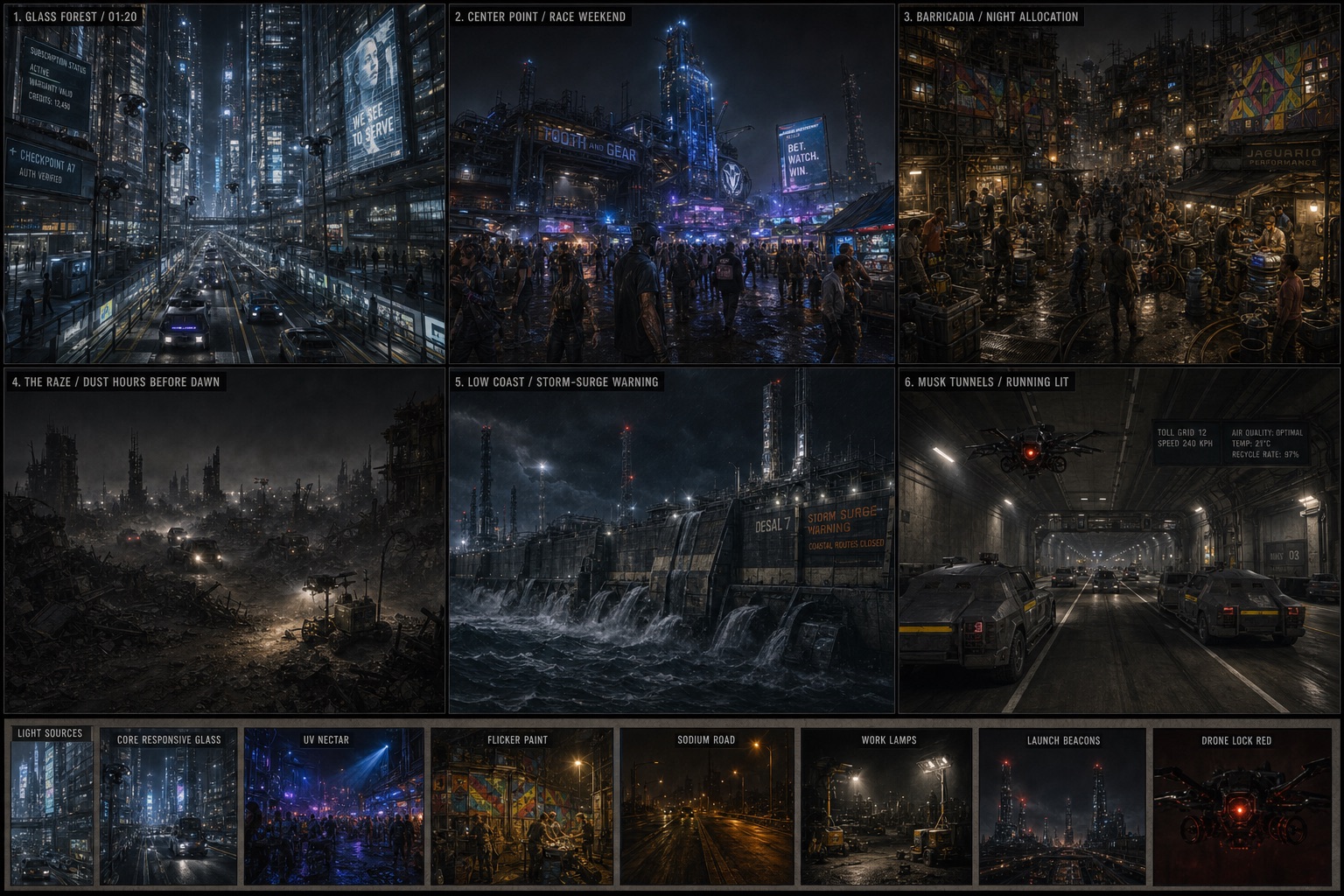
The coastline moved. The city didn't.
Twelve million people live on the old Los Angeles footprint beneath a government that calls the place a Western Corridor megadistrict and beside an ocean held back by chemistry, concrete, pumps, habit, and paperwork nobody wants tested in court.
The arcology core keeps its climate indoors. Outside, heat settles by block. Salt works into seals. Concrete dust crosses district lines without authorization. The Ring Road hangs over the city like a sentence nobody finished, cameras turned inward, traffic moving because stopping would cost more.
Lost Angeles is beautiful in operational ways.
Marine layer turns surveillance uncertain. A garage door opens before dawn because a neighbor heard the right engine. Rain sends whole crews toward one brief capture window. Tower glass catches a sunset paid for by somebody who can't see it from the service level. A free tap makes a strip of alley more politically important than a boardroom.
The city survives through gradients.
Verified water becomes municipal water, then locally tested water, then whatever a person can carry. Full-density Monitor coverage thins into scheduled passes, purchased blind windows, dead routes, and the Raze. A recognized title becomes a copied title, a witnessed title, a title that wouldn't survive an afternoon in an office, then a household that has lived somewhere longer than the owner has remembered owning it.
None of those transitions has a clean border.
That's where people live.
LOST ANGELES: A city where every system reaches farther than its service and every neighborhood knows the difference.
Lost Angeles is built around changes in degree.
The western edge meets an engineered seawall. The eastern ground still carries the 2041 quake in the shape of the Raze. Between them lie old basin streets, elevated freight, buried transit, arcology systems, drowned claims, remediated lots, and buildings living several administrative lives at once.
The Pacific is no backdrop. It arrives as salt, surge warnings, desal product, corrosion, marine layer, insurance history, and the twice-daily schedule of the Low Coast.
The main seawall rises forty meters at the western edge, with active drainage protecting districts rebuilt after the 2035 events. A wall can hold and still distribute failure. Water backs into lower systems, finds old basements, enters paperwork as damage, and leaves a property agent arguing that nobody lived there at the time.
Heat collects where climate subscriptions stop. Clear and dry is the city's default, but “default” includes roofs too hot to touch, vehicle interiors that become medical problems, and a daily calculation about which machinery can run without cooling.
June marine layer reduces visibility and makes drones less certain. Santa Ana winds turn exposed roads unstable and the Raze combustible. Concrete-dust days make breathing rigs ordinary. Storm warnings close Low Coast infrastructure and send everyone toward the same second-best route.
Weather changes the social map before it changes the tactical one.
Height buys distance from flood, street heat, noise, and other people's emergencies. It also buys a cleaner view of them.
The High Top and arcology core aren't simply “up.” They are connected to systems that maintain the meaning of up: lifts that answer, private power, pressure, cooling, security, schedules, and staff routes hidden from the rooms being served.
At street level, elevation is still useful. A rooftop can hold a garden, signal rig, water tank, watch post, illegal room, or family that moved one floor higher after the last flood and never moved down.
The most important borders are subscription borders.
A person can cross from filtered air into unmanaged heat through a fire door. A clinic can sit three blocks from a full-service facility and be unable to order a compatible part. A building can share a water main with a tower and receive a different night allocation.
The city doesn't separate rich and poor with one wall. It changes what works as you move.
| Change | What becomes scarcer | What becomes more important |
|---|---|---|
| Core to outer district | Automatic service and recognized standing | Repair skill, local memory, favors |
| High ground to Low Coast | Dry storage and stable access | Tide knowledge, paper, moorings |
| Named route to dead route | Predictable time | A guide who'll stake their name on it |
| Full signal to gray band | Verified carriage | Provenance and trusted repeaters |
| Licensed care to gray care | Institutional liability | The clinician's judgment and the patient's network |
The city advertises access. Households manage continuity.
Tier One arrives filtered, verified, subscribed, and noticed only when it fails. Tier Two is municipal: treated, dependable most days, and vulnerable to maintenance, demand, and attack. Tier Three is local water tested by whoever owns a kit. Tier Four is whatever remains.
Lost Angeles contains all four, sometimes within walking distance.
Barricadia catches and cleans its own water. Low Coast households read tide and intrusion. Center Point sells desal water from a public spigot back to patrons as a clarified luxury. CONFLICT reported that detail. The spigot was objective. The joke was market value.
Core systems predict load. Outer systems negotiate it.
A building may have grid power, a local battery, a shared generator, scavenged solar, vehicle draw, and one extension cable everyone pretends doesn't cross the alley. The question isn't which source powers the building. It's which source powers the clinic refrigerator during the gap between the notice and the outage.
Managed air is easy to forget because that's what management buys.
Outside the climate envelope, heat, smoke, salt, spores, dust, and industrial residue decide whether work can continue. AIR processors make surgery, food storage, clean fabrication, and sleep possible in hostile spaces. A failed processor can be as decisive as a dry pipe, but air failure doesn't form a visible queue until people start coughing.
This is a composite, not a district price list.
| Need | What the household actually budgets | What “short” means |
|---|---|---|
| Water | Filter share, clean containers, test strips, time in line | Boil, borrow, or use a source nobody wants named |
| Power | Building pool, battery maintenance, generator fuel | Choose which room and appliance stays live |
| Food | Market staples, preserved stock, one shared hot meal | Fewer fresh items and no margin for a guest |
| Cooling / air | Processor share, seals, fans, clinic reserve | Move the old and young to the best room |
| Signal | Basic carriage, neighborhood repeater, device charge | Lose work offers, warnings, school, or proof |
| Care | Clinic fund, compatible supplies, favors banked | Delay until delay becomes more expensive |
The household doesn't call this resilience. It calls it the month.
The notice says the night allocation begins at twenty-two hundred. Pressure drops at 18:42.
Nobody panics. The building has done this before.
The third floor fills everything clean. The ground shop shuts its wash line before being asked. Two children carry a message to the next block because the repeater is on the same failing circuit. A retired tech listens to the wall and says the fault isn't local. Someone photographs the gauge with a clock in frame. Someone else calls a cousin at allocation.
By 19:07, the building knows more than the service desk.
The question is whether it wants the service desk to know that.
INFRASTRUCTURE ISN'T BACKGROUND. It's the daily distribution of who must improvise and who gets to call an interruption surprising.
The old insult says Lost Angeles has an inside and an outside.
The useful version asks which system you're inside.
Glass Forest and the Commercial Spine are climate-managed, subscription-authenticated, and watched at full Monitor density. Water arrives verified. Doors know access. Transit predicts demand. Repairs follow service agreements. Public rooms feel neutral because the rules were paid for before anyone entered.
The core isn't fake. Its comfort is real.
So is the labor maintaining it.
Service corridors, delivery floors, waste routes, processor rooms, staff lifts, kitchens, repair bays, and security stations make the public silence possible. A polished lobby is a machine for hiding the number of people required to keep dust from becoming visible.
Most people live outside the core's full service envelope.
That doesn't make the outer districts empty, lawless, primitive, or waiting to be saved. They contain markets, co-ops, clinics, print shops, garages, schools, households, races, venues, local grids, and networks of obligation more responsive than any remote procurement system.
They also contain heat nobody manages, maintenance nobody funds, extraction nobody records, and risks pushed outward because the core can afford to treat distance as a solution.
Workers carry skill inward and fatigue outward.
Couriers move objects whose paperwork can't arrive with them.
Operators enter because a client inside needs something done outside, or because somebody outside needs leverage that can only be reached inside.
Patrons travel outward for authenticity, danger, sport, care, or entertainment, then leave before those become obligations.
Residents cross for appointments, permits, hearings, work, family, and the chance to spend an hour where the air doesn't hurt.
An invitation opens a High Top room. It doesn't teach a guest which silence is a refusal.
A core credential opens a service gate. It doesn't make the holder invisible to staff who know nobody with that credential should use that route.
A Barricadia resident may have no recognized reason to enter an administrative tower and know exactly which contractor door sticks in the afternoon.
The city is full of access without membership and belonging without title.
| Border | What changes at the threshold |
|---|---|
| Climate | Heat and air become a household problem instead of a building service |
| Water | Quality becomes a local claim requiring trust and test strips |
| Movement | A route changes from logged convenience to negotiated passage |
| Care | Compatibility and standing become the patient's burden |
| Safety | Prevention becomes response, then response becomes neighbors |
A route is a promise about time made by someone who may not travel it.
Lost Angeles has visible roads, buried roads, freight roads, wet roads, roads that become circuits, and routes that exist only during a blind window somebody else can close.
| Route | Pace | Record | Price |
|---|---|---|---|
| Ring Road | Fastest when open | Dense camera and vehicle history | Heat, toll, finance attention, nowhere to hide a distinctive car |
| Musk Tunnels, lit | Reliable until a section locks | Active sensor grid | Legitimate access or a story the grid accepts |
| Musk Tunnels, dark | Fast if the route is real | No ordinary transit record | Hack, guide, trust, and the risk of sealing yourself inside |
| Surface arterials | Slow and socially dense | Cameras plus witnesses | Time, traffic, and becoming part of whatever the block is doing |
| Raze direct | Variable and punishing | Little official coverage | Tires, suspension, dust, wrong ground, no emergency response |
| Low Coast road | Tide-dependent | Maintenance crews notice | Local knowledge, a mooring, and respect for water that turns early |
In standard outer zones, residents expect a Monitor overflight about every twenty-two minutes. The schedule changes, leaks, gets sold, and remains useful because even an imperfect clock changes behavior.
People don't vanish when the drone approaches. They adjust.
A hood goes up. A crate becomes a seat. A transaction becomes two neighbors arguing about weather. A vehicle waits under the awning for exactly long enough to be ordinary. Someone who wants to be seen steps into the light.
A dead zone isn't empty signal. It's contested knowledge.
Who created it? Who maintains it? Which sensors are actually blind? What else failed on the same bus? Does the person selling the route intend to travel it after you?
The Musk Tunnel market now sells forty-minute blind windows by segment. CONFLICT treats the price list as evidence of a favor becoming an industry. The people patching the grid haven't seen their share rise with the menu.
Read travel time in four layers:
Danka plans all four. Clients tend to pay for the first.
The fastest route is the one that still exists when you arrive.
The eight-district map is an operator's map. It describes movement, pressure, and recognition more than municipal boundaries.
| District | Its promise | Its danger | Who controls access | What can't be bought |
|---|---|---|---|---|
| Barricadia | Repair, market skill, neighbors who notice | Obligations compound; assessments harvest weakness | Queues, owners, stalls, Jaguario pressure at the edge | The district forgetting how you behaved |
| Center Point | Neutral rooms, audience, buyers, noise cover | Familiarity makes quiet business legible | Hosts, regulars, Razborki's room, Syndicate bookings | Authority without being known |
| Musk Tunnels | Cross-city movement without a surface checkpoint | Firmware, settling structure, sealed sections | Monitor's grid, hauliers, whoever owns the current route | A permanent map |
| The Raze | Salvage, free ground, weak official reach | Old contamination, active machines, no emergency service | Petrina, the co-op, the moving reclamation schedule | Clean title to the ground |
| Ring Road | Speed, cover, work, distance | Surveillance, finance paper, recovery at the cut | Independent jockeys, road systems, anyone holding the title | Respect without driving well |
| The High Top | Patronage, quiet decisions, expensive protection | Pleasant people can ruin a life without raising a voice | Invitations, hosts, funds, private security | Accidental arrival |
| The Low Coast | Water knowledge, salvage, movement by tide | Flood, corrosion, paper predation | Households, Salt Wake, maintenance crews, tide | Local knowledge on demand |
| Monitor Central | Recognition, permits, official resolution | Procedure that's lawful, distributed, and profitable | Schedules, procurement, contractors, classification | One villain who can call it off |
Ring Road circles and overlooks.
Musk Tunnels cross beneath four districts.
Surface arterials connect the ordinary city.
The Raze offers unrecorded passage at a mechanical cost.
Low Coast roads obey tide and maintenance.
Monitor overlays all of them unevenly.
The Wash is in Barricadia. The crew drinks in Center Point, runs the tunnels, buys from the Raze, drives the Ring, gets invited upward, takes work at the coast, and is processed by Monitor whether it consents or not.
Their city isn't a hub with seven adventure zones around it.
It's a set of relationships that happen to have roads.
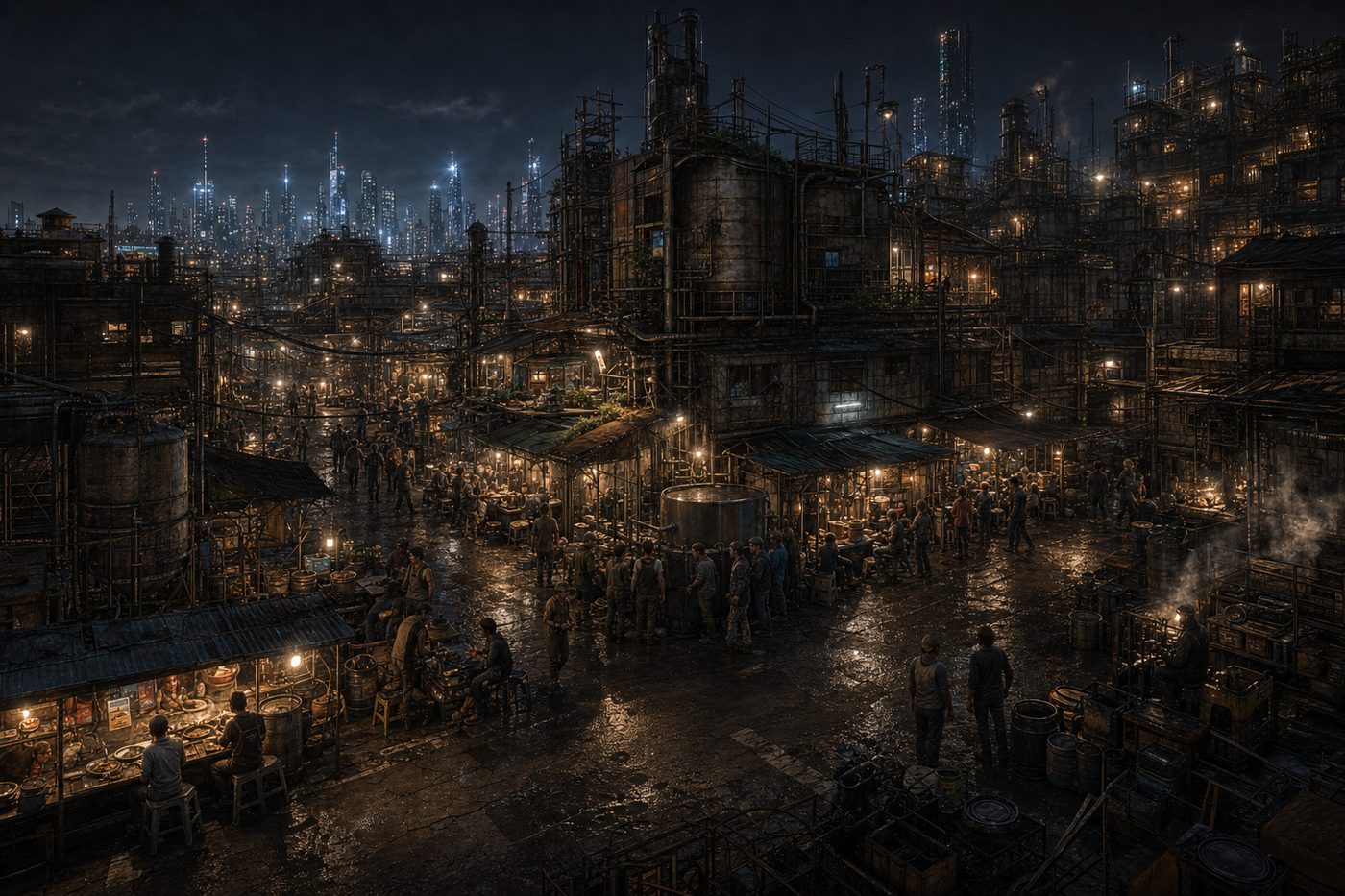
The crew lives here. Everything they lose, they lose in front of neighbors.
Barricadia catches its own water, cleans it badly, and sells the cleaning.
That's not an insult. It's an economy.
Independent recyclers, unlicensed clinics, print shops, food stalls, vehicle bays, and parts markets fill the blocks between dead municipal systems. A failed filter can close a building. A working one can feed a family for a season. Nobody trusts a seal just because it's official, but everyone knows which stall sold the cartridge that failed.
The district has no official faction government. Monitor Central arrives for scheduled assessments, then leaves. Jaguario interests lean from the edges through property and recruitment. The people who keep Barricadia functional work closer to the ground: a printer with the old registration marks, a gray vet with steady hands, a recycler who knows the sound a tower shouldn't make, and a queue that meets every morning.
Nobody, officially. That's the useful answer on a form.
The queue, in practice. Standpipe 4 is forty people who know who came home, who didn't, who's selling three credits under, and which vehicle circled twice. It has no membership. It misses nothing.
Jaguario, at the edges. Recruiters and property holders can make an offer feel like weather. They haven't leaned on the Wash. Only Marisol Vega knows why.
Monitor Central, quarterly. An assessment is scheduled, public, legal, and humiliating. Barricadia gets four a year. Center Point gets one. The difference isn't risk. It's yield.
Nothing stays settled in credits. A favor taken today comes back two jobs later. Refusing the wrong request won't summon a patrol; it'll make tomorrow's queue quieter when you need a witness.
Barricadia protects Warranty Void because the crew answers the door, keeps the alley tap open, buys locally, and can still be embarrassed in public. That protection isn't sentimental. It's the compounded result of small decisions.
| Route | What it buys | What it risks |
|---|---|---|
| Center Point | Buyers, patrons, neutral rooms, a larger audience | Becoming visible to people who can afford patience |
| Musk Tunnels | Dark movement, cargo routes, sensor gaps | A map that stopped being true after the last firmware push |
| The Raze | Parts, hiding places, abandoned infrastructure | Discovering that abandoned never meant unclaimed |
| Ring Road | Speed, courier work, distance without a border | Drone windows, racers, and the temptation to keep going |
| D6 | Before the crew does |
|---|---|
| 1 | The standpipe's pressure has changed, but the allocation notice hasn't. |
| 2 | A clean vehicle has made the same slow turn on three mornings. |
| 3 | A cartridge seller has stopped letting buyers inspect the seals. |
| 4 | The next assessment team includes somebody who knows the district. |
| 5 | A print run is using an old faction mark as if it still owns something. |
| 6 | The queue is shorter. Nobody agrees on who's missing. |
The tower knocks. An independent recycler has developed a new sound and the owner won't shut it down long enough to inspect it. Eleven households depend on the output.
The notice moves. An assessment route is posted at the standpipe. Every time someone copies it, one address changes. Either the first notice was wrong or the district is editing the future.
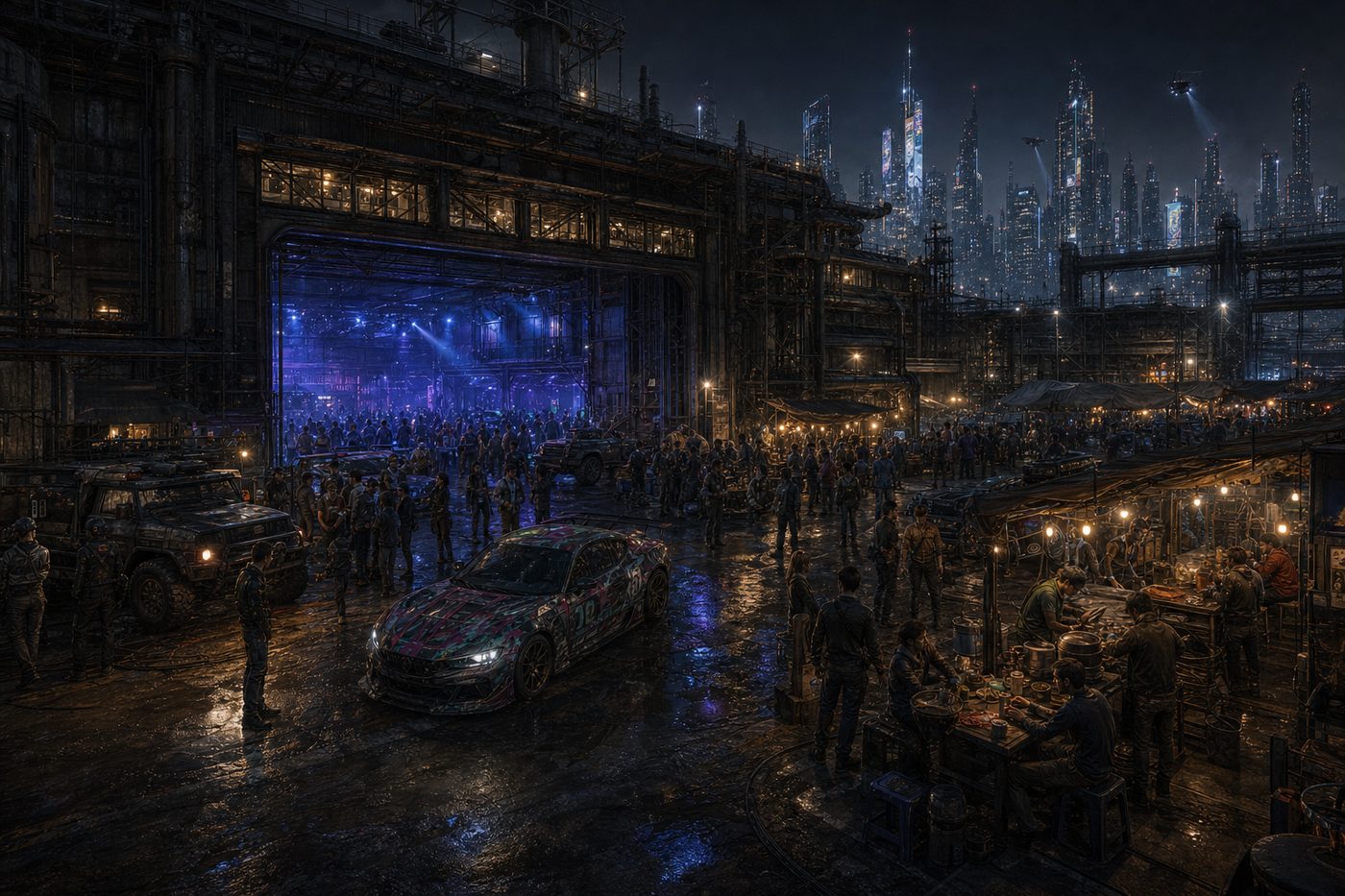
Center Point is where people go to be seen by somebody they haven't chosen yet.
The district sells gathering: bars, neutral booths, service corridors, event rooms, feeds, buyers, book, music, and enough bodies to hide a private conversation inside a public night.
The Tooth and Gear is its load-bearing room.
On race weekends it holds nine hundred people in space built for fewer than half that. Eight teams drink, recruit, argue, settle, watch, and pretend the Syndicate booth is only furniture. A DJ can stop a fight by changing the room's rhythm three seconds before anyone else notices the fight exists.
Razborki runs the room. Jockey, DJ, and nine-year constant behind the booth. People defer without making a ceremony of it.
The Syndicate books the back. Booth nine is paid and usually empty. The absence occupies more space than a party would.
Frequency runs through it. The signal pirate broadcasts from rotating local sites and sells answers for a price that is always a true thing about the buyer.
Regulars govern familiarity. Center Point charges no border fee. Turn up twice and you're known. Being known creates work when the room needs it.
The district sits near money without being money's address.
Patrons descend for culture, racers, risk, and the feeling of entering a room where their names don't automatically control the temperature. Institutions use the crowd as cover. Media buyers, recruiters, brokers, couriers, security staff, fixers, and people carrying somebody else's invitation all meet here because privacy can look suspicious and noise looks innocent.
Public polish ends at doors the staff don't photograph.
Behind them are loading routes, performer rooms, damaged sinks, security panels, staff lockers, patched refrigeration, and the fastest way between two rooms that insist they aren't connected. Ozzy knows the doors. Theo knows the camera angles. Danka knows which delivery ramp Civilian can reverse down at speed. Grigor knows who hasn't eaten. Cas knows the corridor was redrawn after the last inspection and nobody updated the public evacuation map.
The music stops for four seconds. Nobody knows why. Three people leave. One camera keeps recording the ceiling.
The wrong corner is being filmed. The person holding the lens doesn't know what sits behind them. Everyone who does is deciding whether to intervene.
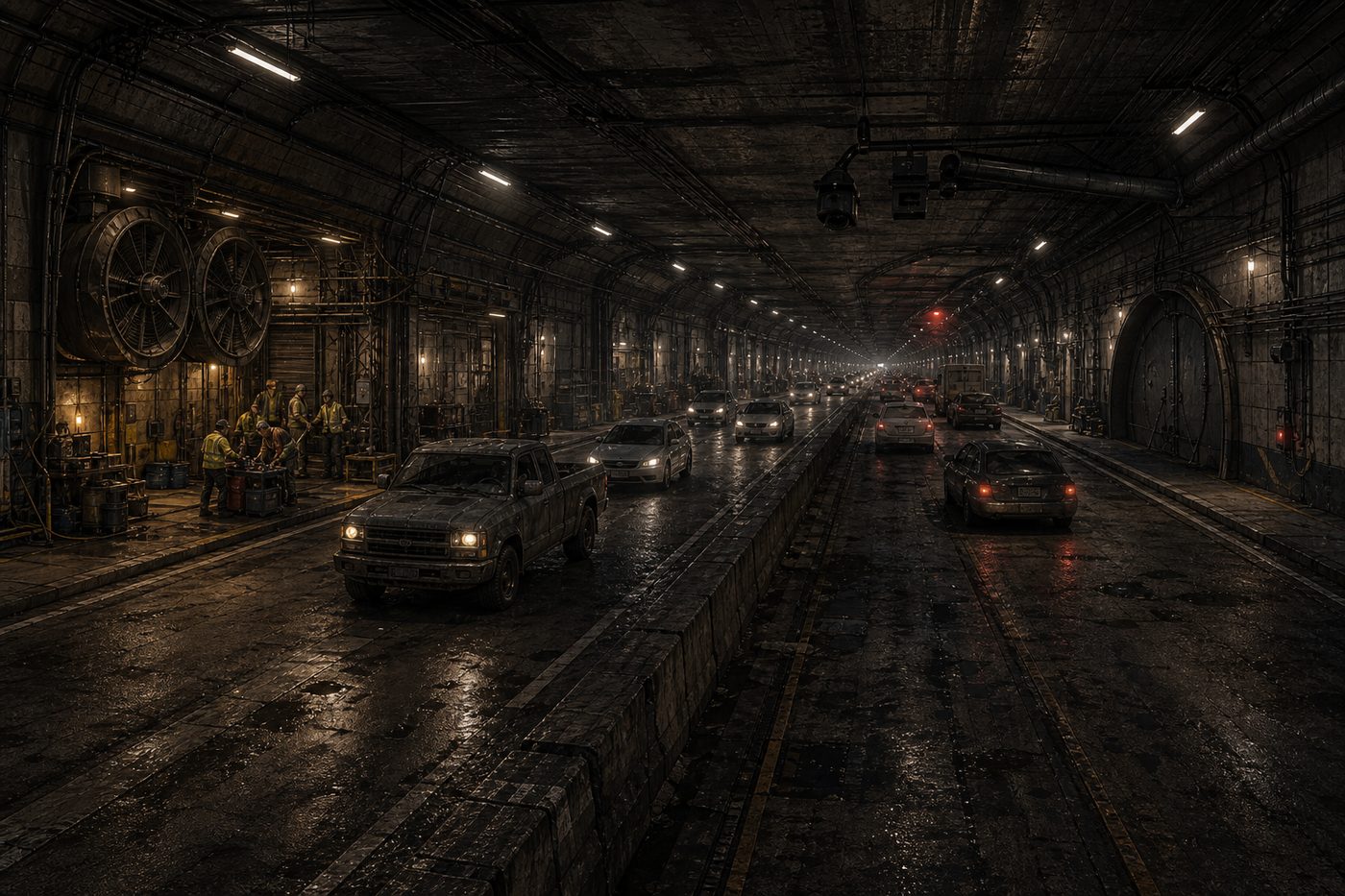
The Musk Tunnels are the only cross-city route without a surface checkpoint.
Everyone knows. The grid knows too.
The pre-Upheaval transit network runs beneath four districts. Half remains in use. Half is sealed, failed, flooded, occupied, misclassified, or all four depending on whose route file you bought.
Cargo moves underground because time aboveground can be counted by cameras. The sensor network below is therefore better than the one watching many surface streets.
Lit sections carry legitimate transit, haulage, maintenance, service vehicles, commuters, and cargo with documentation close enough to current.
Dark sections carry everything else: off-ledger freight, people avoiding a checkpoint, routes sold by the minute, abandoned platforms, sealed doors, and signals on bands dead for eleven years.
Dark doesn't mean unwatched. It means the watcher hasn't filed what it saw in a system the traveler can query.
Monitor owns the grid. It posts notices, updates firmware, logs transit, and detects structural faults it may not be able to admit.
Hauliers own working knowledge. Nine independent operators know which grades, doors, vents, dry windows, and turning spaces still exist. A firmware update can erase their margin overnight.
Maintenance workers own exceptions. They know which sensor can be covered with a work order, which lock accepts last month's key, and which sound means the map is about to become historical.
Nobody owns the sealed sections. That isn't the same as nobody living there.
A tunnel map is geometry. A route is geometry plus time, current firmware, water, air, structure, witnesses, and a person willing to say “I went through yesterday.”
The seller matters more than the line.
| Pressure | Sign | What it changes |
|---|---|---|
| Firmware | Familiar routes start logging cleanly | Old habits become evidence |
| Settlement | Dust, hairline cracks, doors out of square | Speed becomes a structural decision |
| Ventilation | Loud flow in an idle section | Somebody needs air where nobody is listed |
| Water | A wet floor in a historically dry run | A new breach or an old map has become relevant |
| Dead signal | Transmission on an unused band | Somebody restored a system, or it never stopped |
The ventilation and sensors share a bus. Everyone knows killing the new grid would restore dark transit. Fewer people know what else would stop breathing.
Section 11 opens from inside. A maintenance shaft is unsealed at dawn. Nothing leaves while anyone is watching.
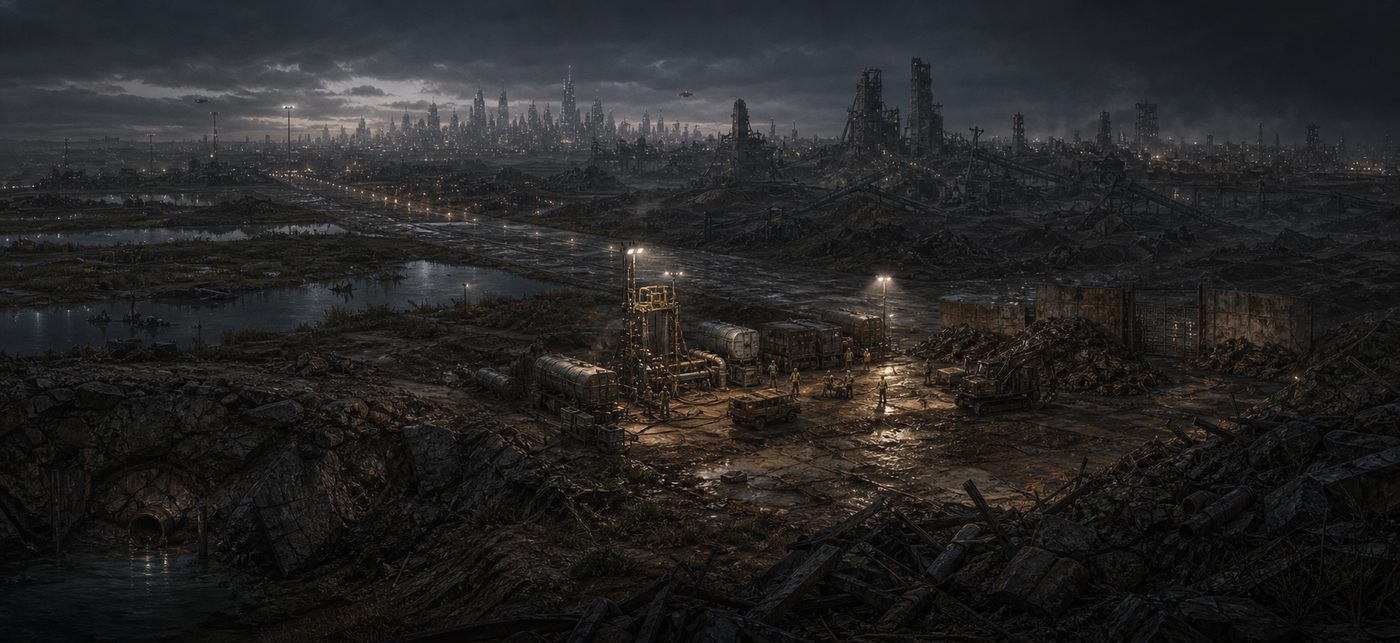
The 2041 quake flattened the east. The city cleared what it could use and named what remained the Raze.
Three square kilometers hold industrial ruin, crater ground, unlicensed salvage, remediated soil, new growth, old contamination, households along the north edge, and official absence maintained because authority costs more than the land is said to be worth.
The claim is already false. People live there.
The Raze isn't a gray waste.
Plants took fractured lots. Fungi entered concrete seams. Water rose through unexpected strata. Families cultivated ground a private survey still labels cleared. A co-op of roughly ninety people farms remediated craters without a title because no recognized system can issue one.
Produce reaches Barricadia stalls cheaply. Buyers repeat rumors about poison because “grown where nobody owns the ground” sounds unsafe to people who trust ownership more than testing.
A private remediation contract ran here in the 2040s and ended before the machinery did.
Nineteen reclamation units continue a contamination protocol across a grid that no longer matches the streets, homes, fields, or ecology. The machines don't hate anyone. They clear according to a schedule. Cleared ground is prepared ground. The protocol has no category for a neighborhood that arrived after the file stopped being updated.
Petrina at the scrap gate. Twenty years buying what comes off the ground. Cash, two offers, no theater. Closest thing the district has to an archive that talks.
The co-op. Ninety people who can't relocate as a tactical unit and therefore negotiate from permanence.
The schedule. Authority without intention. It advances whether anyone recognizes it.
Free ground isn't empty ground. Salvage isn't ownerless because nobody arrived with a badge. A map can abandon a place. The people on it don't have to agree.
A survey stake appears. Nobody has surveyed this lot in thirty years. By morning, three institutions claim they placed it.
The line moves. A reclamation unit's next pass reaches a home in nine days. Somewhere there is a valid decommissioning code. Valid for which machine is the expensive question.
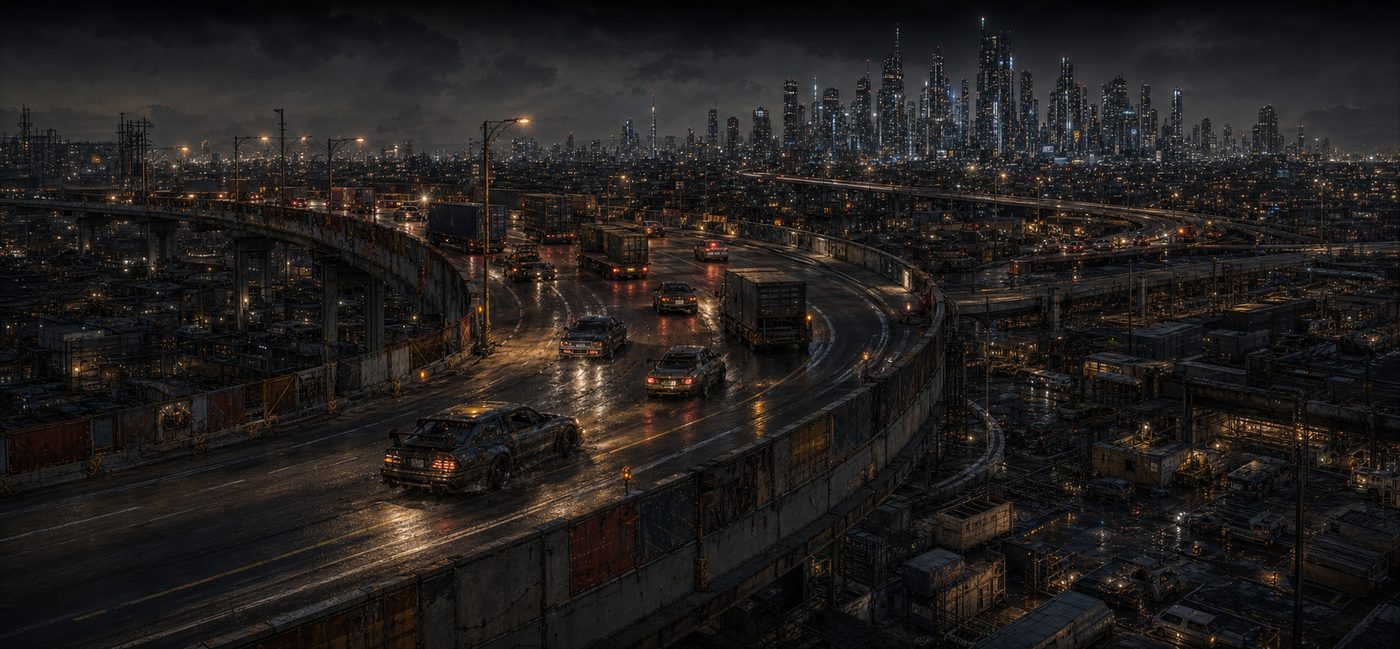
The Ring Road is a highway, a racing circuit, a delivery lane, a broadcast stage, and a moving argument about ownership.
It circles Lost Angeles for forty-one kilometers, elevated twelve meters above the surface streets. NAF signage calls it the Orbital Highway. Cameras face inward. Freight runs at steady intervals. VTOL points punctuate every fourth kilometer. The surface sits below the NAF's own civilian safety standard because the road earns more as freight infrastructure than it would cost to make safe for everyone else.
On most nights, the Ring works.
On race nights, working means something else.
Thirty cars at speed can hide a courier, meeting, transfer, tail, recovery, and theft inside an event everyone is already watching.
The same crowd creates exposure. A distinctive vehicle is remembered. A bad merge becomes a clip. A finance house can watch its property earn. Monitor can classify the package carrier while four million viewers argue about a line through the south curve.
The independents. Eleven jockeys decide what the Ring will tolerate without ever forming the organization that would make the decision legible.
Finance houses. They hold paper on vehicles currently moving too fast to repossess safely. Safety isn't always part of the order.
Monitor. It records, blocks, deploys, and learns. During major events it brings road-level enforcement that treats the race as unauthorized activity and the audience as irrelevant.
Kavast interest. Open purses and attention to the tarmac can look like sponsorship until someone asks why a pack-state wants road access.
North curve: arcology core and money's clean edge.
East: outer districts and old basin density.
Southeast: the Raze, broken ground visible beyond the barrier.
South: Low Coast and suborbital infrastructure beside drainage.
West: seawall country and the Pacific's engineered boundary.
Experienced drivers see this in peripheral vision. The road demands the foreground.
Danka hears the Ring as condition, not scenery: a new seam in the pavement, a bearing under load, an autonomous freight interval running six seconds early, a car driven by someone protecting the vehicle instead of the line.
The district reads her back. Civilian is hot pink and impossible to file under anonymous. Every fast route becomes public eventually.
Recovery waits at the cut. The order is lawful. The debt isn't. Nobody has read both documents yet.
One car isn't racing. It holds speed, stays mid-field, and never looks at the package.
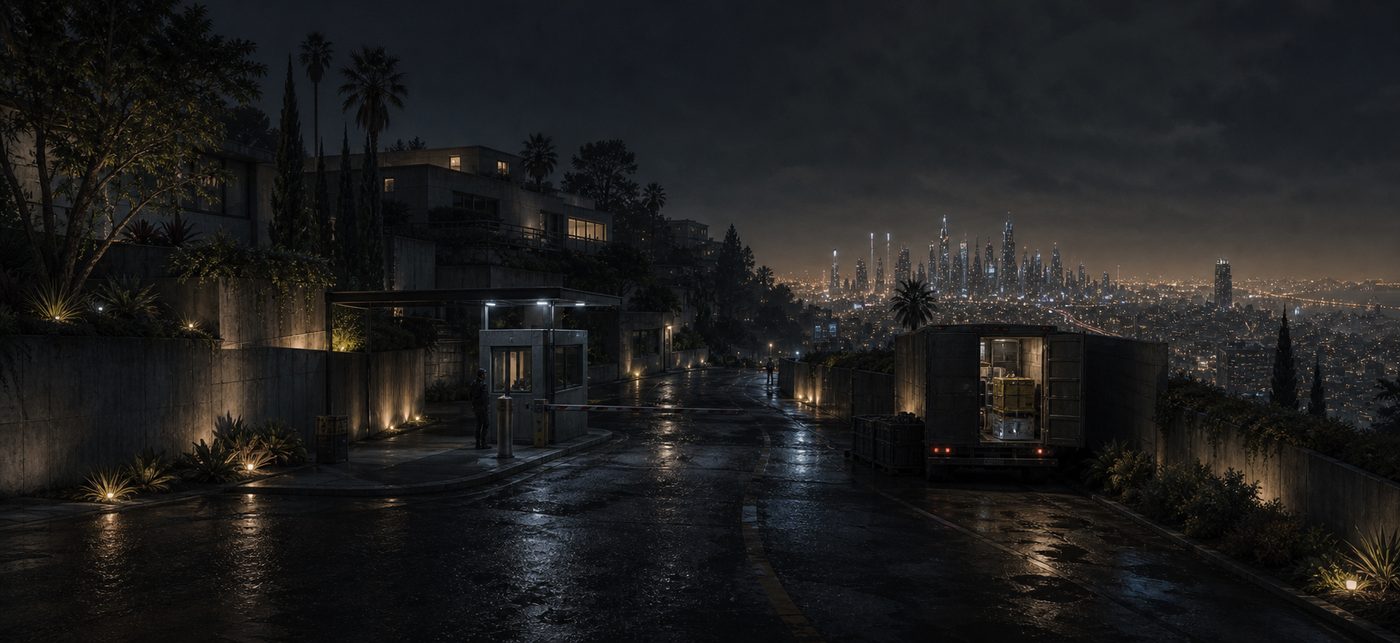
Nobody in the High Top raises their voice.
That's the threat model.
The district is funds, holdings, freeholds, residences, views, private security, guest lists, trusts, and people empowered to make a ruinous decision while remaining pleasant before and after.
It isn't a fortress. It doesn't need to be.
The High Top is somewhere nobody reaches by accident.
There may be no gate. There is an invitation, appointment, delivery, household relationship, service route, legal need, or car so conspicuous that its arrival becomes an event. The first control isn't a weapon. It's the expectation that everyone present can explain why.
Hosts control rooms and guest lists. Many are exactly what they appear to be. That doesn't mean they understand who sponsored the evening.
Private security is professional, contracted, remotely monitored, and separate from the arrangement happening inside. It acts when a boundary is breached, not when a life is being purchased politely.
Funds hold positions across districts without appearing in them. A firm can underwrite a recovery contractor, buy Low Coast freeholds, own a debt instrument on the Ring, and sponsor a cultural event through four different names that never sit together on one page.
Height turns distance into taste.
A High Top room can display the Raze, seawall, Ring, and outer districts as a single beautiful surface. Infrastructure noise disappears behind glass. A guest can point at a district while discussing a holding inside it and never hear the machinery that gives the holding value.
The view isn't false. It is incomplete at a premium.
Violence is possible. It is usually a failure of technique.
The useful tools are names, documents, sequencing, invitations, embarrassment, witness, and the four seconds after someone recognizes a signature. An operator who arrives prepared for a gunfight may discover the client planned around that expectation and left the actual conflict in a folder.
A generous offer is being made. It contains no lie. The recipient needs the money badly enough to wish it did.
A plinth leaves at 04:00. The object on it was removed last week. Tonight someone has decided the empty display is also evidence.
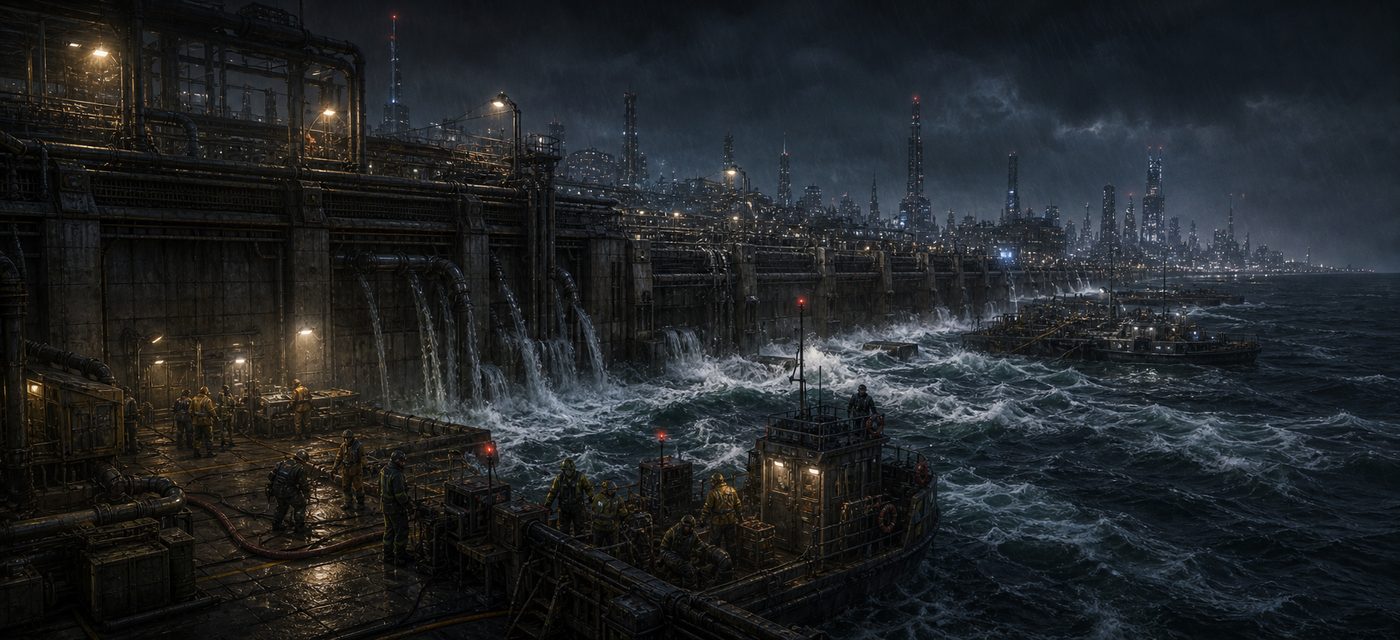
The Low Coast floods twice a day because a covenant nobody can enforce says somebody else should have maintained the wall.
The seawall failed in stages. Two hundred households live in buildings dry for roughly four hours at a time. Daily life follows a water timetable more authoritative than any posted office schedule.
People move furniture, work, sleep, trade, repair, race, archive, and argue around slack water. Children learn which stairs become wells. Residents can hear an early turn in pipes, wall noise, and the behavior of people already heading home.
The physical danger is water. The durable conflict is paper.
Deeds, tenancy records, covenants, repair obligations, abandonment certificates, surveys, freeholds, insurance remnants, and maintenance filings decide who can claim a building after the tide has damaged the evidence of occupation.
A property agent can inspect during flood week, certify a room abandoned, and remain within the process. A household can live there twenty years and lack the one dry document the process recognizes.
The households. About two hundred, many without recognized tenancy, all better established than the people holding the freehold.
Salt Wake Committee. Six people with two decades of coastal racing and the only local institution that works across the full tidal route.
Maintenance crews. They know the wall, drains, substructures, sealed finds, failures, and instructions nobody chose to file.
The tide. It isn't a character. It doesn't negotiate. Treating it as malicious is how outsiders excuse their bad preparation.
The tide table is public. The reading of it isn't.
Local knowledge includes which mooring holds, where salt has eaten a bracket from behind, which door swells before a surge, which basement has been searched eleven times, which survey was conducted at a convenient hour, and which family will take in a stranger without putting the kindness on the Feed.
Money can buy an expert's time. It can't purchase the history that makes the expert trusted.
Water erases ink, labels, signatures, serials, boundaries, footprints, and the distinction between a basement and a container.
It also preserves things in silt, moves objects into new claims, reveals sealed construction, and makes a physical copy of a document more valuable each year it survives.
The tide turns early. Everyone local expected it. The crew's timetable came from an official source.
The archivist posts for week fifty-one. She needs help moving a box from a flooded floor. Three parties want it. None will say it contains deeds.
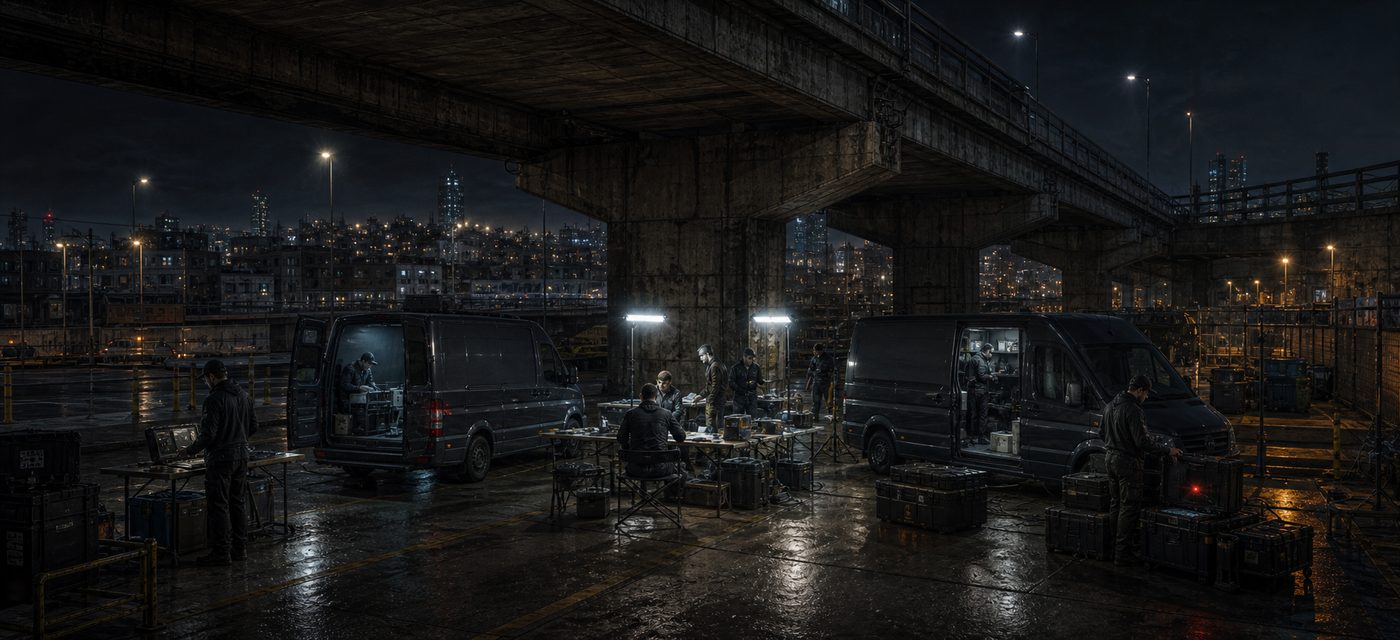
Monitor Central isn't a place Warranty Void can break into.
It's a schedule, a processing node, a procurement office, a sensor grid, eleven notices, an assessor in a van, a classification returned to a clinic, and a response that arrives differently depending on the address.
Residents shorten it to Monitor or the grid. The institution's formal name makes it sound like a room with a person in charge. That's useful to the institution.
Monitor manages drone patrol, transit enforcement, assessments, sweeps, public notices, classification, procurement, and the records that let one department's observation become another contractor's opportunity.
In the arcology core, coverage is dense and response is quick. In outer districts, relay infrastructure, budget, contracts, and classification create delays residents have mapped over years. A blind spot may be tolerated, accidental, purchased, or left in place because fixing it would require admitting why it existed.
The grid can record a vehicle, face, heat shape, marker, door, route, transaction, crowd, and anomaly. It still has to decide what the record means.
Classification is where politics enters wearing technical language.
A queue can be public disorder, water access, household activity, a disease risk, a market, or nothing requiring response. The image doesn't choose. Rules, procurement, staff, client pressure, and prior data do.
Assessors may be contractors rather than staff. Recovery firms can supply assessment below cost because every default becomes inventory. A district isn't selected by one villain declaring poor people profitable. It can be selected by a lawful procurement process optimizing yield.
Everyone involved can behave correctly. The result can still be violence.
Monitor itself. Procedure is the active force.
Procurement officers. They don't set the whole system. They can explain a rate schedule, delay a purchase, misfile a correction, or become the soft link nobody thought to ask.
Contractors. Assessment, recovery, maintenance, data, and enforcement firms turn public function into private position.
Residents. They learn windows, notices, van routes, sensor habits, firmware changes, and which public process becomes less accurate when too many people watch it together.
Don't search for the secret headquarters. Search for the handoff.
Where does observation become classification? Where does classification become contract? Where does contract become a knock at the door? Every handoff is a place where a person might choose differently and a system might notice the choice.
Eleven notices appear. Each is routine. Together they make a route.
The queue is smaller. Monitor hasn't changed anything at the Wash. A contractor has started sending private warnings to households likely to fail assessment. The warnings are helpful. The sender buys recovered inventory.
At 18:42, a western allocation line drops pressure three hours early.
No district experiences the same event.
The standpipe coughs once and Cas hears it from inside the Wash. Seven people in line put caps on their containers without being told. A child runs toward the 400 block with the news. The first rumor is that tomorrow's assessment has moved up. The second is that someone bought the pressure.
The Tooth and Gear doesn't lose water. It loses ice production. A bartender quietly changes the menu while a rooftop two streets over continues selling clarified cocktails made from the same desal supply. Nobody announces the contradiction. Ozzy prices it aloud to the nearest camera.
Ventilation increases in Section 8 as surface cooling demand fails over. The sensor bus slows. A haulier realizes there may be a six-minute dark transit before the systems rebalance. She has one empty vehicle, three people asking, and no time to learn what they're carrying.
The co-op's pump keeps running. It isn't connected to the western allocation line. The cheap produce on Barricadia stalls will still be washed tonight. A reclamation unit changes direction toward the pump because its old protocol reads unexpected water as a contamination event.
Autonomous freight continues on time. A maintenance vehicle peels off at kilometer twelve. Danka sees it from two lanes over and follows without explaining. Civilian has a full tank, a hot engine, and three passengers who thought they were going home.
Nothing changes in the rooms. A building manager receives an automatic notice that backup water will cover the variance. A guest beside the glass reads a public post about Barricadia and says the city should invest in redundancy. A server whose family is already filling containers doesn't answer.
The pressure drop changes the drainage sequence. Salt Wake shifts two moorings and tells thirty households to use the rear stairs at the next turn. The official tide table remains correct. The system built around it isn't.
The grid classifies the event as a demand anomaly. Eleven addresses cross an assessment threshold because they draw reserve water during the drop. A procurement report updates before the service notice does.
Grigor has fed fourteen people.
Theo has footage of the gauge and none of the households filling emergency containers. Cas has found the fault wasn't in Sub 3. Danka returns with a pump controller and no explanation of where it came from. Ozzy has sold the cocktail joke twice and used the money to buy sealed test strips.
The pipe kicks.
Water runs.
Nobody calls it victory. Dinner is late.
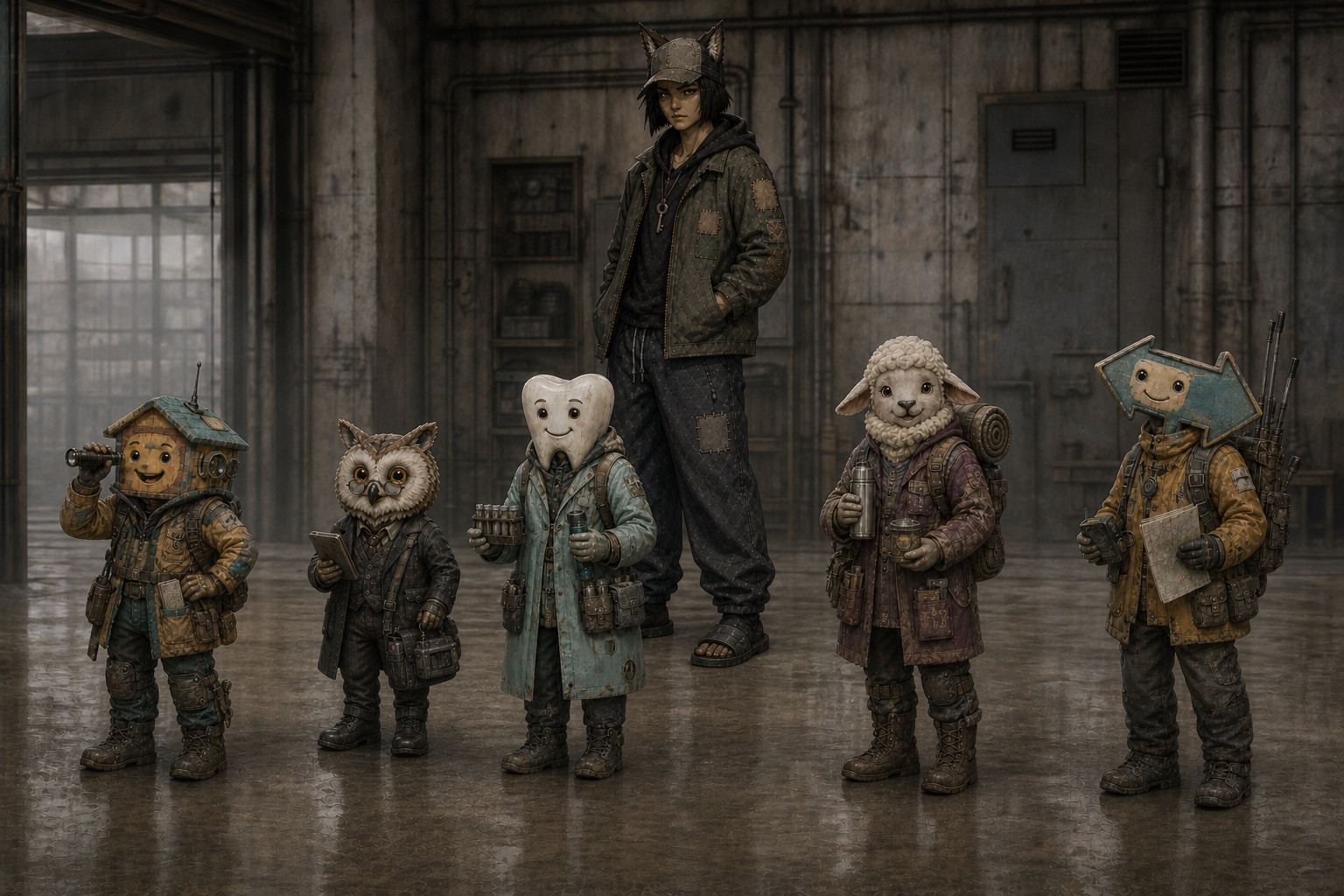
In 2066, a genome can be citizenship, equipment, inheritance, evidence, collateral, and probable cause.
It is also a person.
Every system in this chapter is built to make the first sentence easier to process than the second.
States claim lineages as national assets. Companies patent features and lease upkeep. Clinics read paperwork before tissue. Contractors price a body by the hardware recoverable from it. People learn to carry title, standing, service history, deregistration, or convincing substitutes close enough to the heart that a scanner can find them before a hand can.
And still people make lives.
They trade parts. They host repair calls. They cook through anniversaries. They rename insults. They save dead components in tins because disposal feels too much like surrender. They keep one another warm when nobody makes the patch.
This isn't a catalog of exotic bodies. It's a guide to the claims laid against them, the ways those claims differ, and the ordinary work of living beyond the terms.
THE CENTRAL QUESTION ISN'T WHAT WAS DONE TO THE BODY. IT'S WHO GETS TO DECIDE WHAT HAPPENS NEXT.
Lost Angeles has hundreds of words for bodies and very few that don't smuggle in a judgment. Start with what a term describes.
| Category | What it describes | What it doesn't decide |
|---|---|---|
| Baseline | A person without a gene-forged lineage or integrated augment package | Courage, usefulness, purity, or freedom |
| State lineage | Gene-forged people produced inside a national program | Current allegiance |
| Private lineage | Gene-forged people produced by a commercial or private program | Whether the maker still exists |
| Commercial stock | Gene-forged people designed and sold for a market role | Intelligence or personhood |
| Impulse stock | The small commercial grade built for mascoting, greeting, and venue service | A species, a joke, or an absence of understanding |
| Black-market deviation | A body altered outside a recognized production or medical system | Criminal intent |
| Bespoke commission | A one-off or narrow-run body made for a client | Who the person serves now |
Shelf is a quality and market position, not a separate people. Shelf bodies were branded as premium commercial work: aspirational, visible, expensive, and supported while the company cared to support them. Impulse stock sits below that grade. The distinction is commercial, not moral.
A Kavast wolf can be current, deregistered, captured, missing, or living under somebody else's papers. A private-lineage operator can be leased, licensed, orphaned, or subject to claims they can't see. A baseline can be documented and safe, undocumented and vulnerable, or legally invisible enough to move through a scanner field without becoming the subject of it.
Three questions do more work than one label:
Institutions usually ask the first two. A splice that wants to remain human asks the third first.
People outside the life often treat every visible modification as an augment and every gene-forged trait as installed hardware. They're different.
An augment is equipment integrated with a body. A lineage is the body. Either can be owned on paper. Either can outlive its maker. Neither turns a person into equipment, though an invoice may disagree.
A BODY CATEGORY EXPLAINS PRESSURE. IT DOESN'T FINISH A CHARACTER.
Kavast doesn't manufacture lone wolves. It produces packs.
Wolf-lineage operators are bred, raised, trained, and deployed in matched formations. Their advantages are social as much as physical: rapid coordination, shared habit, practiced trust, and the ability to read motion before another operator finishes making it. A Kavast pack doesn't need to become a unit in the field. The state has spent a lifetime making sure it already is one.
That strength is also the claim.
Pack attachment is cultivated from the beginning. The affection is real. So are the conditioning, the dependency, and the institutional use of both.
Kavast doctrine doesn't need every operator to love the state in the abstract. It needs them to love the people beside them and believe leaving those people is a wound only return can close. Desertion is framed less as treason than abandonment. The missing operator hasn't merely broken law. They've broken the pack.
For some defectors, that's propaganda. For others, it's the most accurate accusation anyone can make.
Kavast pursues lost lineage aggressively. Asset Recovery officers work through border registries, contractors, clinics, and family pressure. A defector's genome is still indexed. Their care needs still reveal them. Their siblings may still be in service. The recovery system doesn't have to know where a person sleeps if it knows where they'll eventually seek maintenance.
A recovery offer can sound like mercy:
The offer's tenderness is part of its force.
The simplest version of Kavast is a cruel state that breeds obedient soldiers. The truer version is harder: people can genuinely love the pack that was used to hold them. A defector may miss a littermate, use pack habits, sleep better when somebody keeps watch, and still refuse the state's ownership completely.
Don't demand that freedom look like emotional purity. Leaving doesn't erase attachment. Attachment doesn't legalize the cage.
In Lost Angeles, wolf-lineage traits draw two instant assumptions: hunter or recovered property. Neither tells you what the person is doing there. Both can change the price of a room.
A clinician may see reliable Kavast support behind the body. A broker may see a bounty. A young operator may see the most disciplined person in the room. Another wolf may see a betrayal they envy.
KAVAST'S GREAT WEAPON ISN'T THAT ITS PACKS CAN'T LEAVE. IT'S THAT LEAVING HURTS.
A Protectorate flight is a surveillance system with names.
Raven-lineage operators are optimized for observation, threat mapping, long-range coordination, and the handling of too much visual information at once. Their full avian heads aren't masks or helmets. Their senses, social training, and hardware are built around a formation that sees together.
At full function, a flight can feel less like nine people reporting and more like one field of attention moving through nine positions.
The state calls the network coordination. Operators who leave it describe the absence first.
A person raised inside a shared sensorium may never have learned solitude gradually. Separation can arrive as sensory amputation: no peripheral viewpoints, no confirmation from another angle, no ambient proof that somebody else is present. Privacy isn't automatically peace when it first feels like the world has gone missing.
Defectors build substitutes. Some keep crowded rooms. Some watch public feeds. Some work overwatch because a city moving through glass provides enough borrowed sight to sleep later. These aren't signs that the state was right to network them. They're the adaptation cost of becoming singular at speed.
Protectorate genomic records treat a flight operator as a recoverable element of a larger system. A defector remains listed even when nobody is actively pursuing them. The status can be quieter than a Kavast hunt and harder to prove finished.
Registry pressure appears as denied transit, a clinic request that goes unanswered, an old credential unexpectedly validating, or a polite official using a flight designation the person hasn't heard in years.
The list is a kind of ownership that can wait.
The Protectorate has no funeral in the familiar sense. When an operator dies, their flight holds the shared feed silent for one full day.
The rite recognizes loss through subtraction. Every surviving member experiences the missing viewpoint inside the system that once included it. There are no speeches required. The formation carries one fewer eye, and for a day nobody fills the space.
A defector has no flight to hold silence with. Some ignore the practice. Some keep it alone, maintaining a black screen or silent feed for a person no Registry would let them mourn publicly.
People assume a raven sees everything. This is flattering until it becomes an excuse to deny them surprise, confusion, privacy, or the right not to record.
Ask before using their view. Ask before touching a lens rig. Ask before saying they must've noticed.
SURVEILLANCE ISN'T THE SAME AS WITNESS. WITNESS REQUIRES A CHOICE.
The Compact builds operators to continue.
Bear-lineage formations carry heavy augmentation, extreme load capacity, controlled metabolic response, and pain suppression designed for attrition. They hold ground, breach obstacles, move wounded bodies, and remain functional after another doctrine would order withdrawal.
The field result is simple: the formation absorbs.
The life after is not.
Compact training treats endurance as both capability and virtue. Pain becomes untrusted information. Rest becomes a logistical decision. A person learns to measure themselves by whether the task continues, not whether continuing is wise.
This saves lives. It also spends them slowly.
Pain suppression can conceal damage while it accumulates. Reinforced frames transfer strain elsewhere. A body that survives a decade of impacts may reach later life carrying injuries it never received permission to feel. Maintenance programs can manage the cost while service continues. Freelancers and write-offs inherit the bill without the program.
The horror isn't that every bear-lineage body has a hidden countdown. The horror is statistical and institutional: a population was designed around immediate survival while its late-life cost was assigned to a future budget, a different ministry, or nobody.
Kavast hunts defectors. The Protectorate keeps them listed. The Compact can simply depreciate them.
Attrition doctrine already expects loss. A spent operator may not be worth pursuit, punishment, or recovery. Their record closes. Their support ends. Nobody comes.
That can look like freedom. It can also feel like learning your state didn't hate you enough to remember you.
The Compact remembers its dead on schedule. A formal rite, performed in formation on a fixed day, gathers a year's losses into one disciplined observance.
Many veterans keep it. Others reject the calendar and remember one person at a time: a meal on the real date, a repaired tool, a name written where nobody audits it. The official rite preserves the formation. The unofficial rites preserve the person.
People mistake size for simplicity and stillness for slowness. They speak louder. They offer muscle rates. They assume the biggest person in the room doesn't understand the paperwork governing their own body.
Often the bear lets them.
THE COMPACT MADE SURVIVAL A DUTY. SURVIVORS HAVE TO LEARN WHAT ELSE A LIFE IS FOR.
States weren't the only institutions that learned to manufacture people.
During the private gene-forging boom, firms sold narrow-purpose lineages to corporations, security contractors, wealthy clients, and one another. Prospectuses described loyalty, perception, aggression, discretion, beauty, endurance, and service life. A boutique line could be a product, a labor force, an asset class, and a family without any document admitting the last one.
Then the companies failed.
When a lineage firm collapsed, its people didn't vanish with it. They moved through asset sales.
Contracts went to one buyer. Patents went to another. Maintenance stock sat in a warehouse, entered bankruptcy, or was sold by weight. Operators in service were assigned new holders. Children in development became liabilities with a carrying cost. Records scattered across servers nobody kept powered.
The market calls this orderly disposition.
The people call one another, if they can find a number.
Orphanware is gene-forged whose manufacturer no longer exists. It can also describe the unsupported hardware, firmware, and lineage care left behind.
The term carries grief and practicality at once. There is no manufacturer to invoice and no certified service schedule to obey. There is also no approved patch, recall desk, replacement organ, training pipeline, or responsible party when a failure appears across the line.
Freedom from a maker isn't the same as support after one.
Caseline Applied Genomics built a boutique lynx lineage for solitary precision: close protection, ambush reconnaissance, and clients who wanted one exceptional operator instead of a unit. The company made a batch of twelve. Three died in development. Nine reached service.
Caseline collapsed in 2053. The nine were dispersed through liquidation.
That story is unusual in its details and ordinary in its structure. A private company made people for a market, the market changed, and the people became the continuity plan nobody had funded.
Orphanware communities trade what official service can't provide:
The calls can sound like inventory. Flat voices read specifications while somebody cleans a weapon or labels a drawer. Underneath is mutual aid at its most literal: nobody left running unsupported.
Orphanware often reaches for the maker's words first: out of spec, end of life, discontinued, unsupported. The words are precise. They're also poison when applied to a person.
Friends learn the difference between correcting the language and shaming the speaker. Sometimes the right answer is a better word. Sometimes it's showing up with the part.
A COMPANY CAN DIE BEFORE THE PEOPLE IT MADE. THE OBLIGATION SHOULD NOT DIE WITH IT.
Baseline people have no lineage registration and no integrated gene-forged package. That sounds like the absence of a category.
It isn't.
Systems built to inspect modified bodies often treat baseline as the unmarked default. The scanner returns clean. The clinic doesn't need a manufacturer code. The checkpoint has no genomic state to notify. Nobody can repossess an installed organ that isn't there.
This is real protection.
It can also make a person easier to ignore.
A baseline can carry a message through an assessment line, walk into a venue whose sensors flag augment geometry, or cross a contract threshold while their gene-forged splice is still proving standing. Employers use them as legal insulation. Crews use them because the insulation works.
The same absence can become expendability. If a recovery contractor prices bodies by hardware, the baseline is the cheapest person in the room. If a patron thinks danger belongs to the modified, the baseline becomes the inconspicuous delivery system. If a medic assumes every operator carries pain suppression, a baseline's ordinary pain may be treated as weakness rather than information.
Privilege and danger can share a scan result.
Blank is the current street slur for baseline. It can mean empty, unequipped, uninteresting, or untouched by the future. Older speakers use it to diminish. Younger baselines sometimes print it on shirts before anyone else can say it.
The reclamation term is OEM: original equipment manufacturer, factory settings, no aftermarket parts.
It began as a joke and became an answer.
OEM doesn't claim that baseline bodies are pure or superior. It claims the right to treat an unmodified body as a build, not a failure to choose one. In Barricadia, the word appears on bootleg jerseys, printer stickers, and cheap tags that cost less than the authentication story attached to them.
Not every baseline likes it. Reclamation belongs to the people using the word, not to a setting guide looking for tidy vocabulary.
State-lineage operators inherit formations. Private-lineage people inherit batches. Baselines often inherit households, shops, debt, names, and the expectation that none of this counts as doctrine.
It does.
A print shop can teach procurement. A market stall can teach intelligence work. Weekly dinner can teach a person how to ask the emotional question four trained operators avoid. The setting's institutions breed capability on purpose. Families produce it incidentally and rarely invoice the state.
Don't ask why a baseline is on a splice as if the modified operators have already justified their presence with biology.
Ask what they do. Ask who trusts their judgment. Ask why they stayed.
FACTORY SETTINGS ARE STILL SETTINGS.
The body economy is the network of leases, patents, service obligations, clinic permissions, recovery claims, and gray care that surrounds modified life.
It doesn't require anyone to believe people are things. It only requires every institution to process the thing it recognizes.
Maker → registers the body or component → Holder
Holder → grants use under terms → Person
Person → needs upkeep → Clinic
Clinic → verifies standing → Registry or contractor
Missed term → creates breach → Recovery filing
Recovered hardware → refurbished, resold, reassigned → New holder
At every arrow, the person may be physically present and legally secondary.
The current lease. An operator receives a state lung package at seventeen. Service keeps it certified. They leave at twenty-six. The lung still works. The state still holds title. Every breath is medically theirs and contractually disputed.
The clean buyout. A private-lineage security operator buys their contract after seven years. The title is notarized. The body is theirs. The firmware license renews annually through a different company that didn't sign the sale.
The orphan. A venue worker's maker collapses. No holder files a claim. Ten years later, a failing interface needs a discontinued seal. Nobody owns the part, nobody stocks it, and three clinics refuse care because nobody can sign responsibility for the outcome.
No history tells you whether the person is happy, cruel, free, loyal, frightened, or good at their job. It tells you where pressure arrives.
A body can be valuable to different systems for incompatible reasons:
| System | What it values | What it overlooks |
|---|---|---|
| State | lineage, doctrine, jurisdiction | the life outside service |
| Manufacturer | title, license, recurring support | care that can't be billed |
| Recovery firm | recoverable components and clean claims | continuity of the person |
| Clinic | serviceability, liability, standing | why the patient came late |
| Patron | capability during the contract | who pays afterward |
| Splice | the person who comes home | any math that calls one member spare |
Paper doesn't make the claim true. It makes the claim legible.
That distinction is enough to open a door, stop a van, authorize a procedure, or place a person into an administrative category from which force becomes routine. Operators forge standing because the system responds to legibility before justice. Others carry original documents because a real receipt can be more powerful than a weapon in the room where ownership is decided.
THE BODY ECONOMY TURNS CARE INTO EVIDENCE. MUTUAL AID TURNS IT BACK INTO CARE.
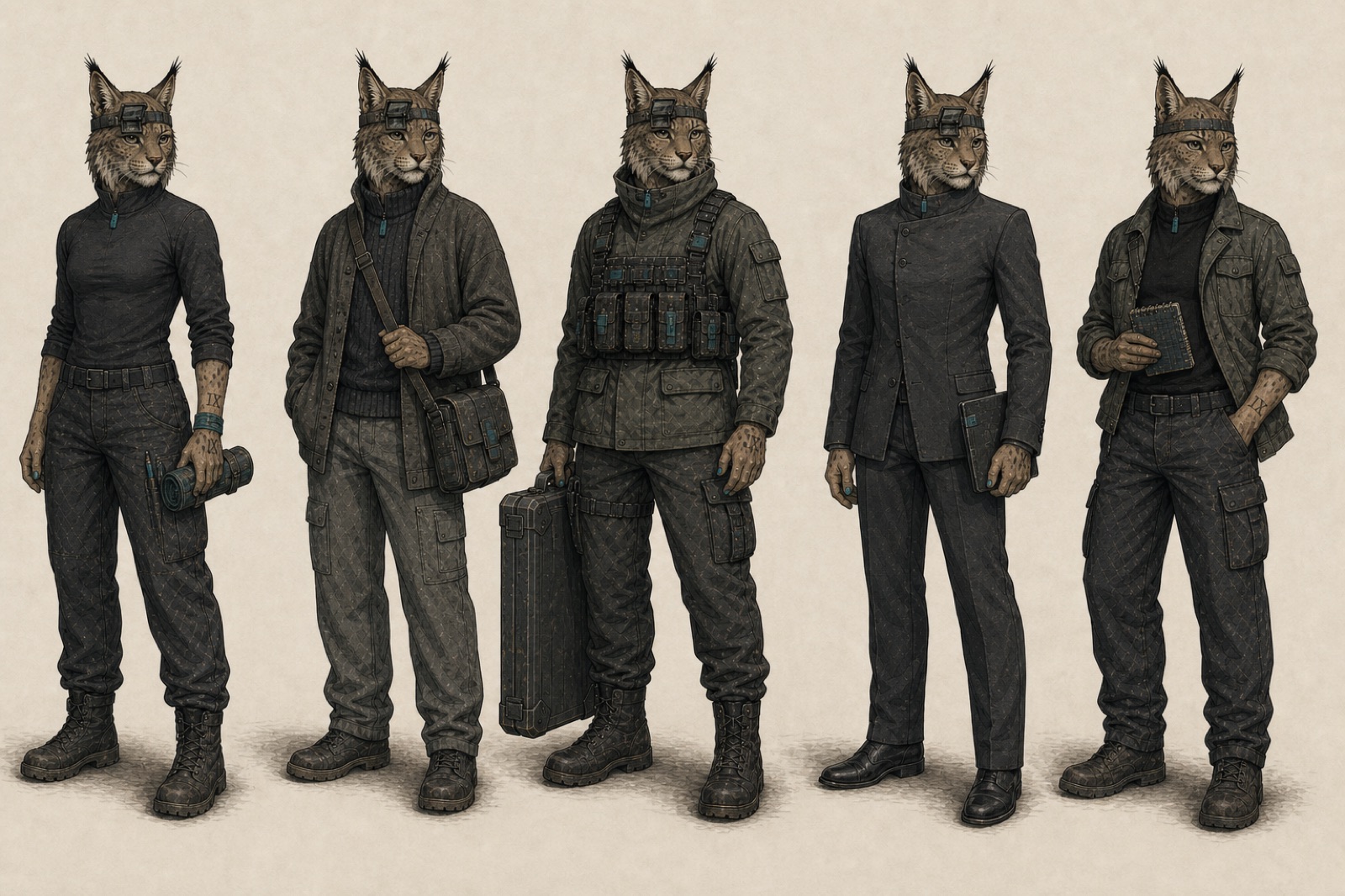
Four members of Warranty Void carry hardware with a serial number. That's ordinary.
What matters is who owns it.
An augment can be leased, licensed, or orphaned. The distinction changes which clinic will touch it, what paper an assessor expects, who pays for maintenance, and whether a stranger can arrive with a lawful claim to something inside your chest.
Leased. A manufacturer or state holds title. Payments are scheduled. Upkeep is certified. The current lease is a document carried on the body, because the body is where the leased equipment lives.
Licensed. The user bought out the title. The notarized paper is theirs. This is rarer than people pretend and less final than it looks. Software, lineage patents, replacement parts, and old contract language can outlive the sale.
Orphanware. The maker is gone. There's no service desk, patch, recall notice, or approved part. There's also no one to pay. That sounds like freedom until the left hand stops responding and every licensed clinic asks who assumes liability.
Gene-forged bodies adapt. Augments wear. Firmware ages. Interfaces scar. A person can learn to compensate for a failing part so well that everyone else mistakes the compensation for health.
Legal clinics protect their licenses. State clinics protect the state's claim. Corporate clinics protect the service relationship. A gray vet protects the patient first and works out the paper afterward.
That doesn't make gray care safe. It makes the danger personal instead of procedural.
Two streets from the Wash, Dr. Silk stabilizes discontinued lineages nobody else will touch. The rates are fair. The room is warm. The hands are steady. When a patient is short, Silk accepts samples.
All of those facts are true at once.
Silk's history is unwritten. The clinic's reputation isn't. Orphanware forums pass the address quietly, with the same warning every time: don't confuse kindness with innocence, and don't confuse unease with evidence of harm.
“Everyone asks what the samples are for,” Silk says. “Nobody asks twice. Isn't that interesting.”
| Price | What it looks like | What follows you home |
|---|---|---|
| Credits | Clean transaction, quoted in advance | The need to earn more before the next service |
| Time | Waiting, observation, recovery, another visit | Exposure to anyone watching the clinic |
| A favor | Delivery, repair, introduction, silence | A relationship with no fixed end date |
| A sample | Blood, tissue, shed material, failed component | Uncertainty about who learns from your body |
| Data | Diagnostics, firmware state, lineage behavior | A record that may outlive the clinic |
| Nothing | Someone decided you needed help | The hardest debt to price and the easiest to misuse |
An assessor doesn't diagnose. They establish standing.
Current: the scan takes four minutes. Nothing happens. The humiliation is real anyway.
Late: recovery can be filed against leased hardware. The person gets time to settle, forge, hide, move, or submit.
Unsupported: the hardware has no responsible maker. That can mean nobody has a clean claim. It can also mean nobody has a duty to help.
The most frightening part is that an assessment can be legal, scheduled, and correctly performed. Nobody in the chain has to be cruel for the result to be violence.
MAINTENANCE IS DIGNITY. The body economy becomes horror when care is treated as proof of ownership. It becomes a life when people keep each other running without asking for title.
An assessor isn't police. An assessor doesn't arrest, sentence, or diagnose.
They establish standing.
That narrower authority is enough.
An assessment compares a body, component, or lineage record against the papers presented for it. The assessor verifies identity, title, maintenance status, and any active claim. Public sweeps are scheduled. Notices are posted. The scanner is calibrated. The person is asked to hold still.
If everything is current, nothing happens.
That sentence hides the event: a stranger has inspected the legal condition of a person's body in public and confirmed that nobody is authorized to take part of it today.
Default on leased augmentation is a breach, not a crime. Breach produces recovery.
The filing may allow time to settle the account, repair the record, contest title, leave the district, or disappear. None of those choices is free. Even a forged certificate has upkeep: security layers change, assessor habits spread, and a document that worked yesterday can become evidence tomorrow.
Recovery contractors profit from clean claims. Some provide assessment below cost because every discovered default creates future inventory. Nobody has to falsify a result. Selection is enough.
Service is the common name for Monitor Central Asset Recovery and Remand.
Official language describes accounts held while leased hardware is assessed, removed, refurbished, and reassigned. Staff are technicians. Detainees are account holders. The building is administrative, clinical, and secure.
Nobody in Barricadia says a person was sent to prison.
They say the person is in Service.
The euphemism works because each individual word is accurate. Care has become custody. Maintenance has become removal. The warranty has become the mechanism by which a body is opened for someone else's property.
Show the handoff. Notice to scan. Scan to filing. Filing to contractor. Contractor to door.
Keep the clerk human. A kind person can perform a violent function. A cruel one can bend a rule in somebody's favor. Procedure shouldn't erase choice.
Make legality visible. The terror isn't a secret dungeon. It's the queue, the notice, the folder, the correct signature, and the public assumption that correct process means a just result.
Let resistance be practical. Delay, correction, forgery, relocation, debt payment, public attention, clinic solidarity, and simple refusal all change the situation differently.
THE ASSESSOR DOESN'T DECIDE WHETHER YOU'RE A PERSON. THEY DECIDE WHETHER THE SYSTEM HAS TO ACT LIKE IT.
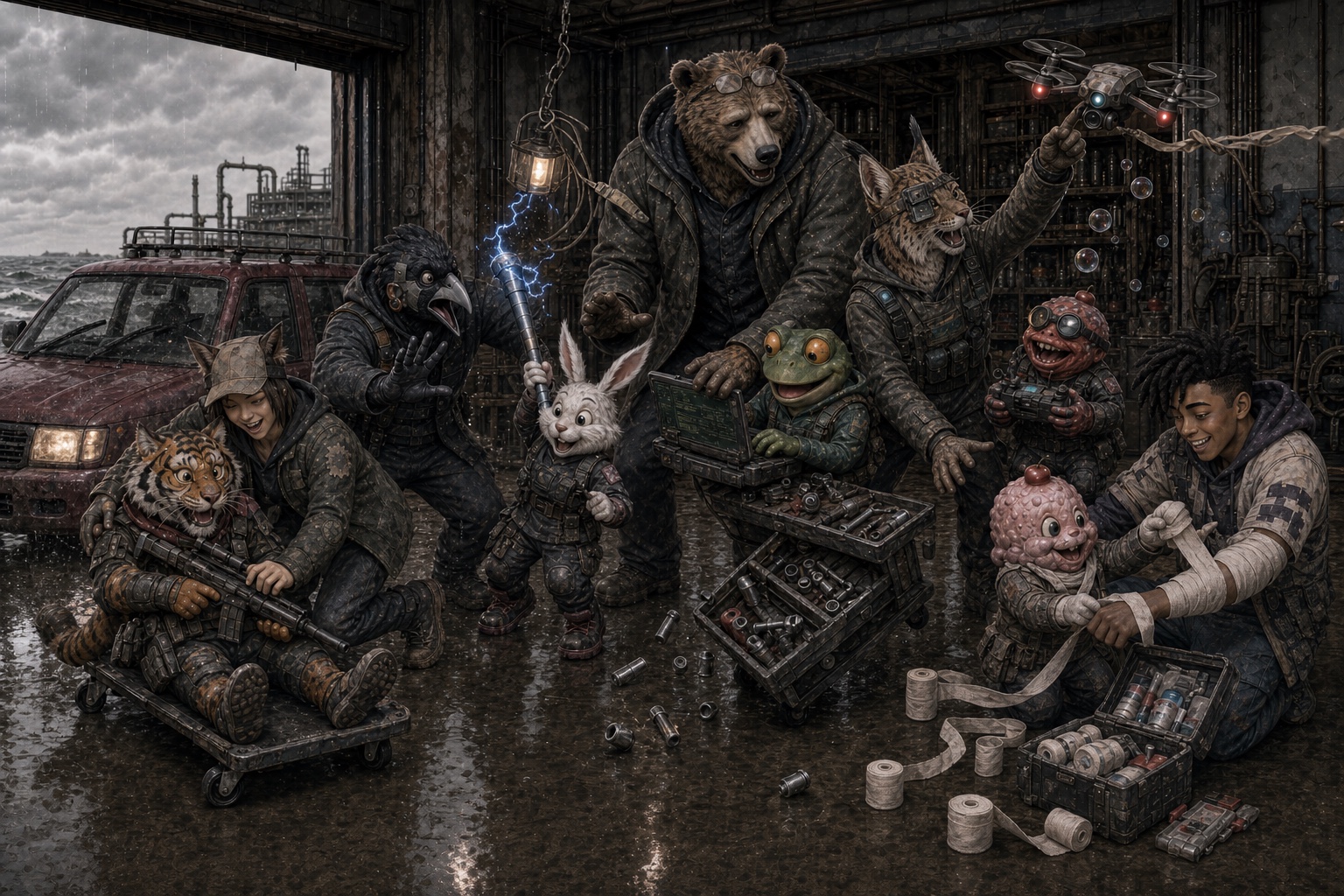
Impulse stock are the small grade of commercial gene-forged: mascots, greeters, premium tie-ins, and venue workers built at roughly ninety to one hundred forty centimeters. They were engineered for indoor public work and sold as inventory rather than hired as staff.
A breakfast tiger. A creamery sundae. An insurance owl. A smiling body with a product code and a phrase that still fires long after the venue is gone.
Impulse stock aren't simple. Their cognition isn't reduced.
They carry compliance architecture: attention routes toward service behaviors, deference attaches to an identified handler, and brand language surfaces under cue or stress. The person understands the danger. What the architecture impedes is refusal, improvisation outside the service frame, or silence when speaking makes the danger worse.
The horror isn't a lesser person built for service. It's a person whose full understanding was packaged with a narrowed ability to disobey.
| Grade | Original market | What the name concealed |
|---|---|---|
| Loose | promotional giveaway, minimum specification | the cheapest life in the catalog |
| Carded | standard retail and venue issue | a working person sold like a collectible |
| Boxed | flagship store, executive gift, premium tie-in | durability priced as luxury |
The grade affects build quality, not dignity.
When companies collapsed, administrators sold what the ledgers recognized. Impulse stock moved in lots, with trademarks, schedules, fixtures, and warehouse contents. Some were repossessed. Some inherited. Some attached to units that treated them well. Some are still standing outside shuttered brands, performing a greeting nobody has had the authority to cancel.
Held. Someone has current title. The holder may be abusive, decent, absent, or a person who has never examined the paper.
Loose. No clear current holder and no protective title. Free in practice, vulnerable in law. A broker may be able to construct ownership from the surviving chain.
Titled to self. The person holds their own paper. This is rare.
Loose doesn't mean free. Held doesn't describe the relationship. A receipt can be protection in one room and a threat in the next.
Put the comedy on the company, never the person.
A customer-service phrase erupting during a firefight is funny because a vanished brand colonized the worst possible moment. The person suffering the script isn't the joke. They know exactly how it sounds.
Everywhere else in the body economy, a person defaults on hardware and the hardware is recovered.
With impulse stock, the person is the asset. No default is required. The folder already describes what can be collected.
Warranty Void has encountered impulse stock. The crew's instinct is protection. That doesn't make an impulse a mascot for the channel, a pet, or a sixth member of the splice. It means five people know what a lawful claim on a body looks like.
A LOT NUMBER ISN'T A FAMILY. A PERSON DOESN'T BECOME FREE BECAUSE THE WAREHOUSE LOST THE FOLDER.
Modified bodies change.
Interfaces scar. Suppression loses precision. A compensating movement becomes a habit and then a new injury. Firmware encounters a world its maker didn't test. Gene-forged systems keep adapting after a product line, military doctrine, or service schedule has stopped paying attention.
Operators call the long accumulation drift.
The word doesn't mean inevitable decline. It means the body has a history.
Two operators with the same lineage can age differently because they carried different loads, received different care, left service at different times, or simply became different people.
Avoid turning a lineage into a prognosis. Population-level harms matter. They don't entitle anyone to predict an individual tragedy.
Instead, ask:
Official care is built around responsible parties. Somebody holds title, pays the account, signs liability, and receives the record.
Mutual care often starts where that chain breaks.
Gray vets treat the patient before resolving the paper.
Orphanware forums pool failures across scattered lineages until one person's strange symptom becomes a pattern.
Splices carry one another's maintenance windows alongside ammunition counts and route maps.
Households learn cleaning, dressing, calibration, cooling, stretching, and the exact sound that means tonight is no longer ordinary.
Parts funerals mark a dead component before salvage or disposal. The practice can be solemn, practical, or three people swearing around a kitchen table because the replacement finally took.
“They chose the procedure” means little if every alternative was custody, pain, exposure, or the loss of work that pays for the next procedure.
The setting doesn't need to deny agency to show coercion. It needs to price the available choices honestly.
A person can choose state support and understand the leash. They can choose dangerous gray care and resent being called reckless. They can delay service to finish a contract. They can accept help and still dislike the helper. They can preserve a failing system because it carries memory as well as function.
Care should reveal relationships, priorities, and material conditions. It shouldn't exist only to punish a modified body for being modified.
Let the repair work.
Then ask who waited outside, who paid, who received the data, who kept the old part, and what the person can do tomorrow that they chose for themselves.
MAINTENANCE ISN'T THE PRICE OF BEING DIFFERENT. IT'S ONE OF THE WAYS A BODY HAS A FUTURE.
Paper can't prove personhood. It can make an institution pause long enough for a person to act.
| Document | What it claims | What it can do | What it can't do |
|---|---|---|---|
| Lease standing certificate | hardware is current and not subject to recovery | clear a routine assessment | settle a disputed title |
| Licensed title | the user bought out the named asset | establish ownership in ordinary rooms | extinguish every patent or software claim |
| Deregistration receipt | a state registration was voided | prove the break occurred | make the old state forget the genome |
| Clinic service record | specified care was performed | establish continuity and safe substitutions | guarantee another clinic accepts liability |
| Chain of title | ownership moved through named holders | make a claim legible to law and contractors | describe consent at any point in the chain |
| No paper | nothing the institution can immediately process | create delay, ambiguity, or practical freedom | protect against a later reconstructed claim |
A useful forgery isn't visually perfect. It's correct at the layer the assessor checks.
Cheap documents imitate typography and seals. Better ones imitate verification behavior. The best don't invent a body from nothing. They alter one relationship: current instead of late, licensed instead of leased, an old holder instead of a new shell, a maintenance event shifted three weeks forward.
Small lies survive because systems are built to reconcile familiar errors.
Operators carry paper in waterproof sleeves, laminated folds, interior pockets, and hidden panels against the chest. The practice is practical. It's also intimate.
A state gave you a number. A company gave you a title. A clinic gave you a record. A splice gives you a head count.
Only one of those asks whether you're here.
THE DOCUMENT SAYS WHO HAS A CLAIM. THE PERSON SAYS WHO THEY ARE. KNOW WHICH QUESTION THE ROOM IS ASKING.
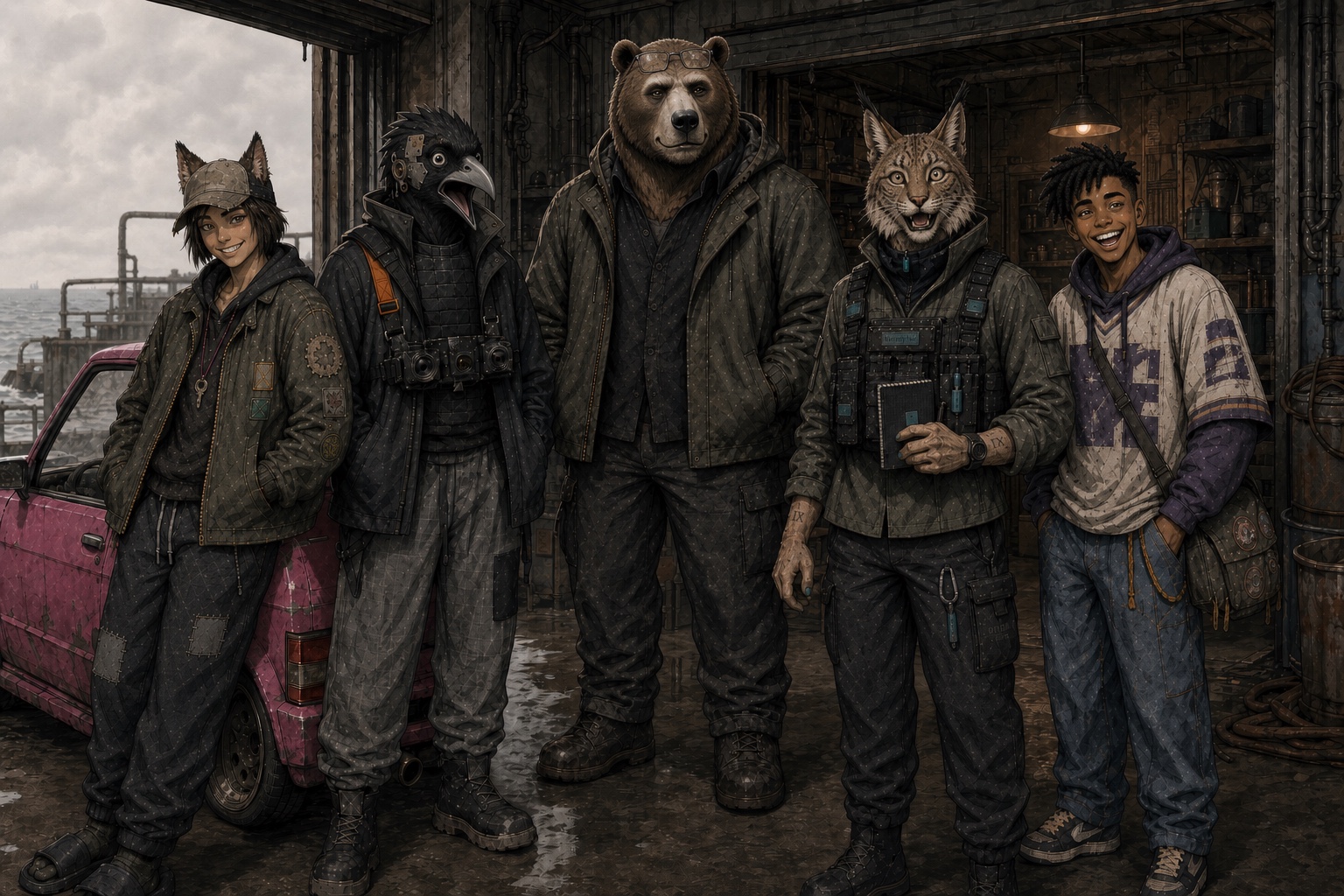
Danka is trying to leave.
Theo is filming her.
Cas has a plan that requires Danka to remain exactly where she is for another forty seconds.
Ozzy has sold advance shirts for the version where the plan works.
Grigor has brought food because none of them ate before leaving.
This is the engine.
Warranty Void is a five-person splice living out of Reclaim Sub 3, a decommissioned water-reclamation station in Barricadia. They take contracts. They keep the alley standpipe working. They maintain modified bodies, a hot-pink vehicle, a public channel, several grudges, and the fiction that all of those are separate responsibilities.
They aren't heroes in the clean sense. They steal, lie, trespass, run contraband, sabotage institutions, and make bets that turn simple work into public disorder. They also come home with one another, keep a free tap running, feed whoever is in the kitchen, and know that a legal claim can still be wrong.
Warranty Void began as paperwork humor: modified bodies, altered terms, no authorized service, maker not responsible.
It became a channel mark. Then a reputation. Then a sentence other people could use about them before they entered the room.
The name doesn't mean they're broken. It means the original terms no longer govern.
Comedy is the default register.
The crew commits to a dumb objective with professional seriousness. The city applies friction. Every attempt to restore control creates a better clip and a worse afternoon.
The wounds don't disappear. They run under the comedy like old wiring under a wet floor. That makes the joke sharper and the rare silence heavier. Warranty Void isn't five tragic people pausing their trauma to quip. It's five funny people whose lives remain funny even when the stakes are real.
The contract is intention. The incident is story.
A delivery becomes a race. A quiet extraction attracts an audience. A prank creates diplomatic correspondence. A water fault reroutes three contracts and dinner. The most revealing moments happen after the objective has stopped being useful and before anyone admits the plan is gone.
Every member carries a different answer to the setting's claim on bodies:
Remove one and the argument changes. Add a permanent sixth and the comedy changes. Friends, rivals, clients, neighbors, mascots, informants, and family can fill the garage. The core count remains five.
THEY'RE NOT PROPERTY. THEY'RE NOT A PRODUCT LINE. THEY'RE NOT A BRAND, EVEN WHEN THE SHIRTS SELL. THEY'RE A SPLICE BECAUSE THEY KEEP CHOOSING THE SAME FREQUENCY.
Warranty Void doesn't divide neatly into leader, specialist, muscle, and comic relief. Authority moves with the problem.
Danka owns the route. Cas owns the plan. Theo owns the frame. Ozzy owns the room until the room turns physical. Grigor owns the moment everyone else is too tired to pretend they're fine.
Nobody owns the crew.
| Pair | Surface | The argument underneath |
|---|---|---|
| Danka / Grigor | quiet, doors, driving, food | She fled cohesion. He mourns it. Both are deciding whether a chosen unit can outlive doctrine. |
| Danka / Theo | car versus camera | Each thinks the other's chosen object is a replacement leash. Each is right enough to be annoying. |
| Danka / Cas | mechanic versus planner | Both bought proof of selfhood, one in metal and one on paper. Neither enjoys the comparison. |
| Danka / Ozzy | threat versus merchandise | She bans him from Civilian. He monetizes the ban. She still gives him the safest seat. |
| Theo / Grigor | irony versus sincerity | One deflects. One absorbs. Neither processes what passes through them. |
| Theo / Cas | footage versus model | Theo records what occurred. Cas models what should. Together they can prove a plan failed in two incompatible formats. |
| Theo / Ozzy | two performers | Theo manufactures myth by cutting. Ozzy manufactures value by talking. Each can name the other's bit. |
| Grigor / Cas | the infrastructure pair | They maintain everyone but themselves and call the omission efficiency. |
| Grigor / Ozzy | hearth versus motion | Grigor makes membership inevitable. Ozzy keeps trying to earn what has already been given. |
| Cas / Ozzy | engine pair | She builds systems so nobody can be missing. He builds relationships so nobody will let him be. Each needs the other's method. |
1. The wrong seat. A stranger takes the chair facing the door. Danka and Grigor both stop. One quietly rearranges the room while the other distracts the stranger with food.
2. The unposted win. Theo records something spectacular and doesn't upload it. Ozzy notices the missing clip before the others notice the restraint.
3. Three seconds. Cas's plan fails. The crew waits through the silence without filling it. On the fourth second, Danka has the engine running.
4. The price gun. Ozzy clicks while thinking. Danka's ratchet answers from under Civilian. The conversation continues as if this isn't a call and response.
5. The sixth bowl. Grigor sets a place for a watcher, rival, debtor, or lost person. Everyone objects. Nobody removes the place.
They don't hold group meetings about conflict. They convert it.
Danka finds a task. Theo makes a bit. Cas drafts a rule. Ozzy starts a smaller argument that everyone can safely win. Grigor cooks too much.
This works until it doesn't. The crew's deepest danger isn't that they argue. It's that they're excellent at transforming the real argument into a useful activity and then praising the activity.
Nobody says the full sentence.
Danka repairs. Theo withholds. Grigor feeds. Cas updates the plan. Ozzy names the favor without collecting it.
The apology is legible if the other person knows the language. Chosen family is partly the long work of learning it.
THE CREW DOESN'T SHARE ONE LOVE LANGUAGE. IT SHARES ENOUGH TRANSLATORS.
There is no written charter in Reclaim Sub 3.
There are rules.
Count five. Before departure, after contact, at every transfer, when the door closes. Grigor performs the count. Everyone else pretends not to.
Ask before filming care. Repairs, clinic visits, sleep, and the aftermath of fear are off-camera unless the person says otherwise. Theo is trusted because they keep a private category called DO NOT POST and mean it.
Don't touch the press. Marco's rule extends from the family shop to any piece of print equipment Ozzy has temporarily moved into the Wash.
If you finish it, label it. Cas's rule. It applies to ammunition, filter paste, clean water, batteries, tea, and patience.
The standpipe stays free. There are arguments about rationing, hours, repair costs, and lines. Nobody pays for the water.
If Grigor sets a place, the place stays. This has admitted rivals, witnesses, a lost child, a contractor who came to threaten them, and one person who claimed not to be hungry for forty minutes.
The kitchen holds several jars whose legal authority nobody can explain.
PRODUCT TALK. Cas pays when she describes herself as discontinued, defective, out of spec, or end of life. The jar funds pizza. She disputes the schedule and pays accurately.
CIVILIAN. Ozzy pays when he proposes a sponsor, decal, tour, commemorative print, authenticated relic program, or “tasteful limited run” involving Danka's car. He has attempted to deduct these payments as business expenses.
CAMERA CRIMES. Theo pays when footage creates a practical problem that everyone predicted. A great clip isn't a defense. It may increase the amount.
No jar exists for Danka or Grigor. Danka refuses symbolic governance. Grigor would pay before the rule was finished and ruin the joke.
Each member carries one small object or document close to the body.
Danka wears Civilian's ceremonial key. Theo carries a deregistration receipt. Grigor keeps letters. Cas carries title and a list of names. Ozzy keeps the first bill the crew paid him.
The pattern isn't discussed. Paper can't defeat a genomic claim, reverse a liquidation, guarantee belonging, or keep everyone alive. It can be held. Sometimes that is enough to let the hand stop searching.
| Need | First hand | Second hand |
|---|---|---|
| Route and vehicle | Danka | Cas |
| Plan and kit | Cas | Danka |
| Overwatch and record | Theo | Cas |
| People and price | Ozzy | Theo |
| Heavy work and medical care | Grigor | everyone, under instruction |
| Food and household | Grigor | whoever is currently being stared at |
| Channel and merch | Theo / Ozzy | Cas, secretly better at analytics |
| Standpipe | the crew | the queue, which knows more than the crew |
A crew becomes a home through repetition, not declaration.
Who knows which cup is yours? Who notices you haven't slept? Who stops using a word because it cuts? Who keeps a part you might need? Who expects you back after the story has ended?
Warranty Void's answer is rarely verbal.
The kettle is on. The fifth bowl is down. Somebody moved a camera away from the bed.

Callsign Pedestrian is the crew's joke about the one thing she's terrible at being.
A human face beneath tall wolf ears. Amber eyes. Dark hair in a rough bun under a junk-shop trucker hat. Kavast field jacket with the unit marks torn off and grocery-store patches sewn over the ghosts. Warm-up pants. Foam slides on the pedals.
Danka looks still the way a parked car looks still.
Kavast didn't keep its wolf packs together with discipline. It built the bond into them, raised six as one litter, and taught each operator that breaking formation meant abandoning family.
Danka watched command spend that love at the Brava Cut. Her littermate Miro died holding a line no sane unit would hold. Eleven weeks later, she left.
She was nineteen. Kavast still classifies her genome as recoverable state property outside NAF protection.
Now she drives for a mixed crew with no flag. She'd tell you that doesn't make them a pack.
She'd be lying. Her ears flatten when she lies, which is why she usually doesn't.
Drive: ownership. Kavast issued everything she touched, including her name, body, tools, and people. Danka builds a self from things she chose and paid for.
Fear: the bond. If she loves the crew, did she choose it or did Kavast's design find a new object?
Weakness: escalation. She doesn't start trouble. She finishes it three sizes too big.
Love: labor. She fixes brakes at two in the morning, gives away parts she rebuilt, and gets short with anyone who thanks her.
Lie: “I don't need a pack. I left mine.”
Truth: choice changes what a bond means.
Danka drives past the point where a vehicle becomes transport and turns into an argument. She remembers routes as motion, hears an engine fault before the warning light, and can rebuild systems other people would replace.
Her Kavast reaction time is obvious. Her patience isn't. She privately sorts the two: speed belongs to the breeding; patience belongs to her.
That rule is probably wrong. It's also how she sleeps.
| Field | Read |
|---|---|
| Chassis | Boxy utility hatchback from a dead marque, bought burned at auction |
| Price | 206 credits in cash, her whole first freelance purse |
| Body | Hot pink, absurd spoiler, panels replaced often enough to have a history |
| Cabin | Ripped-out Kavast rally gauges, cold and regulation-clean |
| Name | Civilian. Not a joke name. A goal. |
| Meaning | The first object nobody could issue, recall, or rename for her |
The physical key around Danka's neck doesn't start the car. Civilian is keyless. The key is ceremonial because ownership needed an object she could hold.
Short sentences. Hard stops. Engine grammar for everything, including feelings. She uses contractions because she's economical, not casual. She doesn't hedge. Anger makes her quieter and more exact.
“Seatbelts. I'm serious.”
“Good plan. Wrong gear.”
“New plan. The plan is I drive.”
Kavast sees a product with the badge filed off. Clients see an exfil specialist. Barricadia sees the mechanic who keeps strange hours and won't overcharge a neighbor. The Feed sees the quiet one beside the loud car.
The crew sees the person who checks the route twice and everyone's seatbelt three times.
Grigor: the silence pair. Both were bred for cohesion. She's fleeing it; he's grieving it. He's the only person allowed to ride shotgun without filling the quiet. They fight for the chair facing the door on a rotation neither admits exists.
Theo: the defector pair. Danka thinks an audience is a leash Theo picked out. Theo thinks Civilian is the same thing. They're right about each other, so the argument never ends cleanly.
Cas: two titles. Danka bought a wreck and made it a self. Cas bought the legal document that says she owns hers. Neither calls this common ground.
Ozzy: Cargo. He's banned from touching, describing, or monetizing Civilian. He does all three. Danka still puts him in the safest seat when a job turns bad.
Vroza: the wolf who stayed. Commander Ilya Vroza calls the bond loyalty and the leash love. Beating him isn't enough for Danka. She has to prove that five mismatched people can choose what his perfect pack was built to obey.
Danka sleeps in Civilian's back seat more nights than anyone mentions. An engine cooling in the dark gives her a heartbeat without a command structure.
She runs courier work after two in the morning and listens to Ring Road After Two, a call-in show for people alone in vehicles. She's never called. She has a first sentence ready.
At swap meets she bargains hardest for parts she doesn't need. She never sells anything she rebuilt. Objects keep the hands that worked them, she says, which is as close to a faith as she'll admit.
She can still recite the Vetka litter's graduation litany. She claims that's memory, not devotion.
| Pressure | The easy version | The useful version |
|---|---|---|
| Threaten Civilian | Someone steals or destroys the car | Damage it through a choice Danka made, then make repair compete with the job |
| Invoke Kavast | A wolf insults her | A competent pack behaves with genuine affection and makes obedience look beautiful |
| Offer ownership | Pay her more | Offer a clean title, safe jurisdiction, or part she can't otherwise obtain, with a term attached |
| Endanger the crew | Start a firefight | Give her time to save everyone only if she gives up control of the route |
| Ask for honesty | Demand a confession | Let someone recognize an act of care and thank her without joking |
Don't reduce her to pursuit scenes. Her strongest pressure is ownership: who gets to name a thing, repair it, register it, risk it, or call it theirs.
Don't make every Kavast wolf a fanatic. Pack affection is real. That's why the system works and why leaving cost her anything.
Don't force a protected revelation to prove she has depth. The depth is already visible in who gets the safe seat, which parts she gives away, and whether she drives toward or away from the problem.
DANKA'S QUESTION: If someone designed the bond, can choosing it still make it yours?
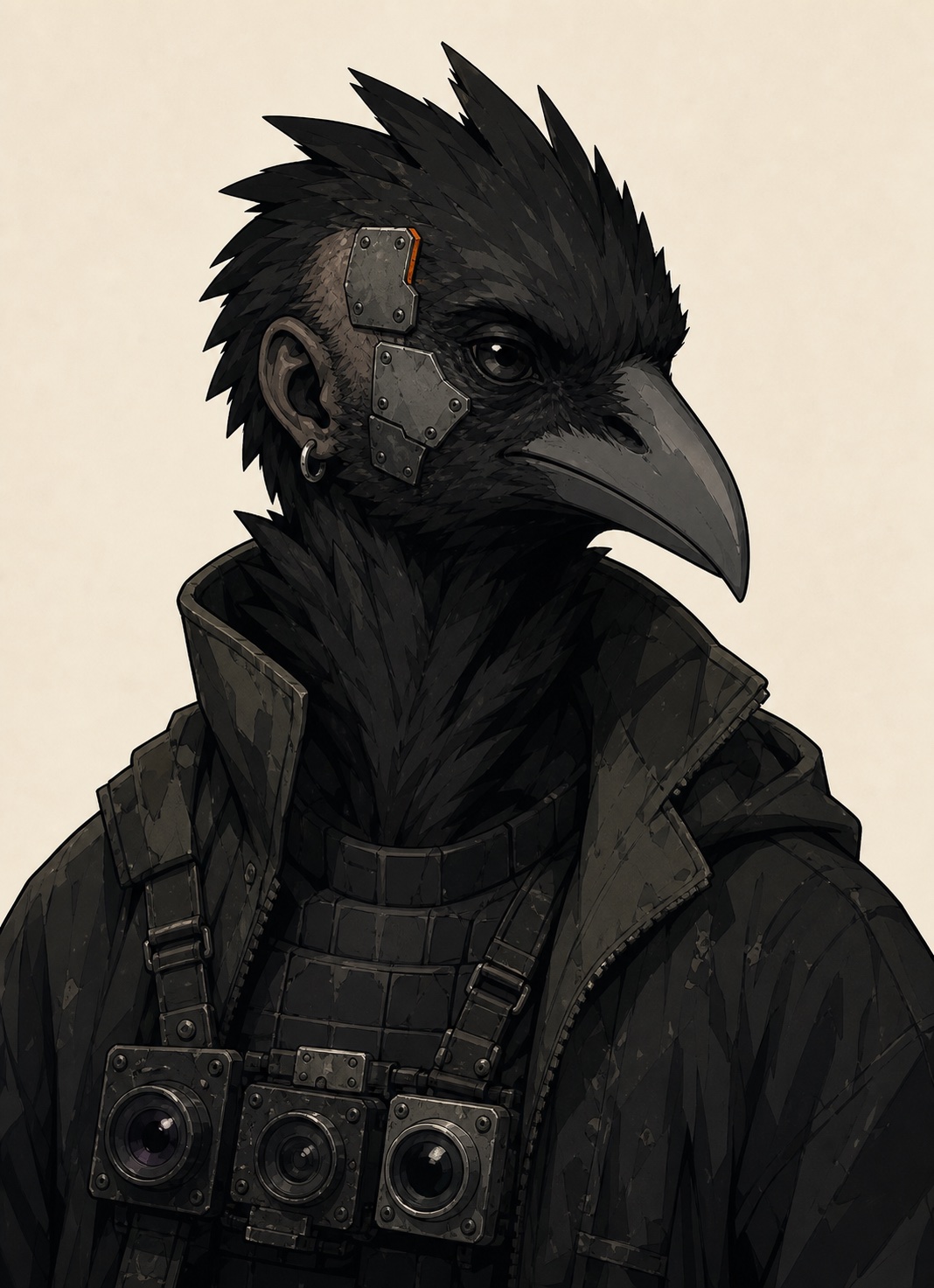
Theo was built to watch. Their rebellion was choosing the frame.
A full raven head with black feathering and a biometric ruff at the collar. Oversized, pajama-adjacent layers over armor plate. Lens rigs fixed to thrifted frames. Maintenance patches left visible. Hands already adjusting a shot nobody else realized had begun.
Theo perches. Chairs are architecture, not instructions.
Theo grew up inside Vantage Nine, a Protectorate flight linked through shared vision and threat mapping. Position Six was a place in a network before it was an individual life.
During a corridor strike, the flight painted targets and watched the result arrive through nine sets of eyes. Theo deregistered eleven days later.
The Registry still lists their genome as unrecovered state property. Position Six is flown by somebody else.
Theo doesn't speak about the strike voluntarily. They speak about footage.
Drive: an audience. The Protectorate watched through Theo. Now strangers choose to watch what Theo makes.
Fear: sincerity on camera. Irony leaves an exit. A true statement posted without cover becomes a thing Theo can't recut.
Weakness: the lens. They can keep filming past the moment witness should become help.
Love: the unposted archive. The crew's off-camera moments are organized, backed up, and withheld.
Lie: “If it's content, it can't hurt.”
Truth: a witness owes more than a record.
Theo maps sightlines in seconds. They can hold overwatch for nine hours, read a room's exits as composition, and notice a surveillance change by the way ordinary people stop looking at a corner.
The lens rig combines field optics, recording hardware, and scavenged interfaces whose incompatibility Theo treats as an aesthetic judgment. Their edits move quickly because their perception already arrives cut into angles.
Every hand-lettered title card begins on physical stock and is scanned afterward. It's the only layer of the channel's image grammar no Protectorate system helped produce.
The feather ruff at Theo's collar is a biometric, distinct as a fingerprint. They cover it on contracts and show it in their own posts.
That choice is both flex and risk: the person the state lists as property presents the identifying mark on a channel the state doesn't control.
Flat, fast, edit-room language. Theo's sentences end early because the expensive part is usually at the end. Silence isn't an absence of characterization. It's where most of the edit occurs.
“Five exits. Yours is bad.”
“Keep talking. Worse angle.”
“Didn't post it. You're welcome.”
The Protectorate sees an unrecovered sensor. Patrons see overwatch with a camera problem. Barricadia sees the person who records the standpipe gauge and never the households filling emergency containers. The Feed sees the account that can make a loading error look like a historical event.
The crew sees where Theo isn't pointing the lens.
Danka: the defector pair. Same refusal, different replacement objects. Danka accuses the audience of being a new flight. Theo asks how Civilian is different. Neither enjoys the answer.
Grigor: the dark mirror. Theo turns pain into a bit. Grigor turns it into dinner. Both methods preserve everybody except the person using them.
Cas: proof and plan. Cas wants the camera to confirm the model. Theo prefers the frame where the model is visibly on fire. Their arguments produce excellent after-action records.
Ozzy: the other performer. He knows when Theo is using jargon to leave a feeling. Theo knows when a sales pitch is covering fear. They call the move because neither can safely call the feeling.
The audience: the prosthetic crowd. Thousands of viewers provide presence without access. The relationship is chosen, one-directional, and never as safe as Theo needs it to be.
Theo's drives are labeled in physical lettering: BURNS, FEUDS, GRIGOR COOKING, DO NOT POST.
The last category isn't one thing. It contains care, exhaustion, mistakes whose publication would expose a route, moments where an enemy is human, and footage that belongs to the person inside it more than to the camera that captured it.
Theo's ethics live in classification. They don't always make the right call. They do understand that not posting can be an act.
| Pressure | The easy version | The useful version |
|---|---|---|
| Block the camera | Break the rig | Offer access only if Theo gives someone else editorial control |
| Invoke the flight | Send a Protectorate pursuer | Put a functioning flight in view and let its coordination look beautiful |
| Create a choice | Film or help | Make both actions forms of help for different people |
| Use the audience | Post hostile comments | Let public attention protect the crew while exposing a neighbor |
| Ask for truth | Demand confession | Ask Theo to publish an unadorned fact that matters to somebody else |
Don't make every camera decision selfish. Theo is often the only person preserving evidence an institution wants gone.
Don't make every silence mysterious. Sometimes they simply don't have a line better than the shot.
Don't fill the protected space behind their defection. Vantage Nine already explains the cost: a person learned solitude all at once and built a public form of company they could control.
THEO'S QUESTION: When does a camera become a witness, and what does the witness owe?
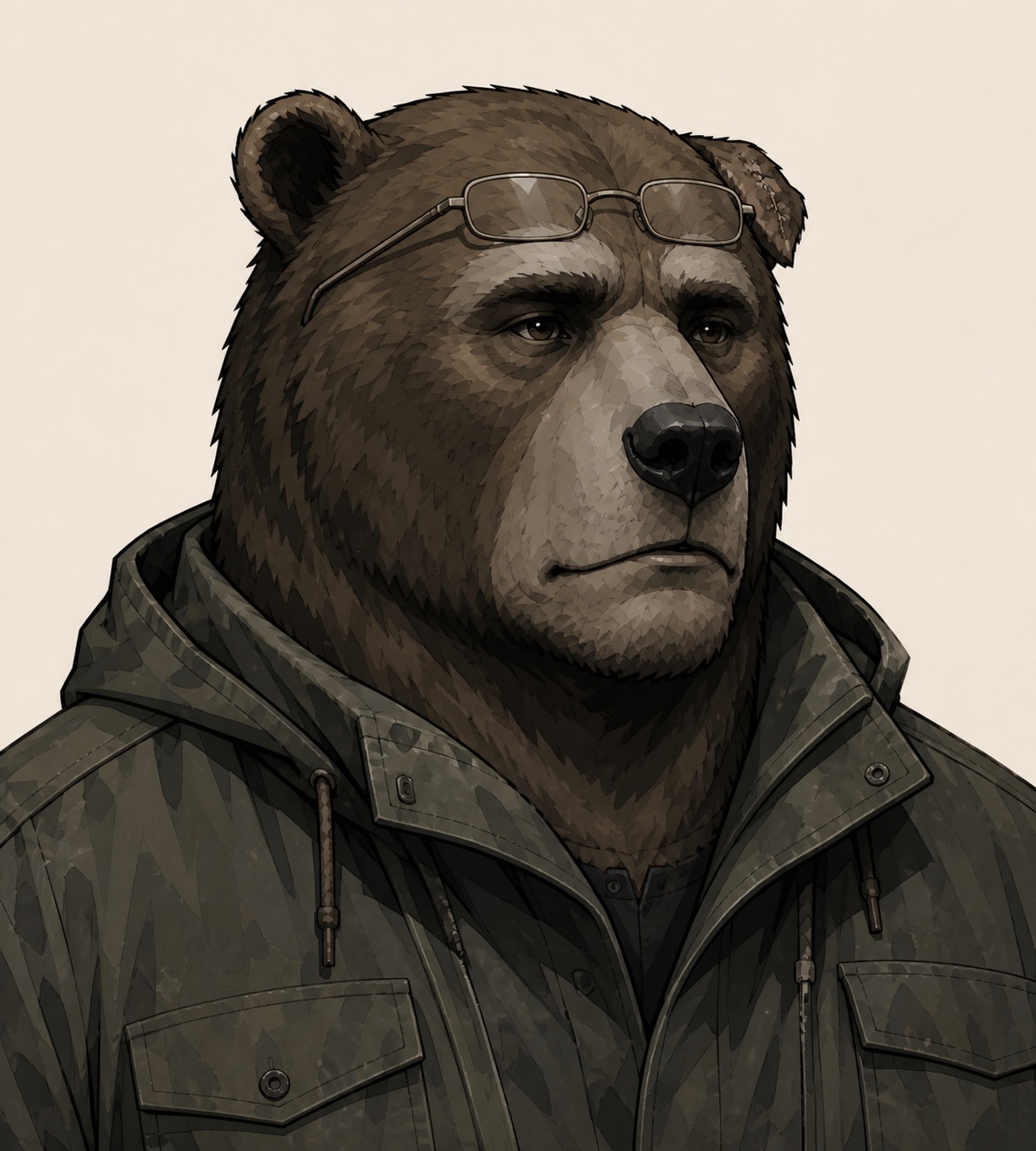
The callsign meant endurance in Compact service. The younger crew thinks it's a hospital joke.
Grigor has never corrected them.
A full bear head above the largest, stillest body in the room. Plain Compact cold-weather surplus with every insignia carefully unpicked, the holes hemmed. Work trousers. Maintained boots. A worn paring knife where other operators carry combat steel.
The state made him a wall. He stands in warm light.
Grigor was raised in a Compact formation crèche, trained under persistence doctrine, and deployed into a world where a unit's great virtue was continuing after support failed.
Later came Longhaul: five operators in the Marask Pocket, denied extraction. Grigor carried the last of them, Ana, for nine days. She died before relief arrived for the bodies.
He left. The Compact didn't pursue him. It wrote him off.
No pension. No recovery. No enemy grand enough to blame. Attrition doctrine depreciates a spent asset and moves the figure to a different column.
Grigor still doesn't hate the Compact. That's the difficult part.
Drive: the kids get old. He has outlasted two units. His ambition is to deliver this one into a future where none of them are being used up.
Fear: the last head count. Being the final survivor again would complete the role he was built for and leave nothing of the person using it.
Weakness: absorption. Damage, insult, work, grief. If he can carry it, he does, and then mistakes carrying for resolution.
Love: provisioning. He notices hunger before the hungry person does. Food is the only argument he makes without reserve.
Lie: “Endurance is the same thing as being all right.”
Truth: the crew needs him present, not merely standing.
Grigor is the splice's heavy, breacher, field medic, quartermaster, and cook. Four of those roles are unpaid.
Persistence augmentation lets him carry, brace, and continue through conditions that would stop another operator. The deeper skill is judgment: knowing where a large body can change the geometry of a room without firing, which wall will fail, and when somebody's “fine” means they need to sit down.
His critical tools are a battered medical roll, the paring knife, and a cast-iron pan. The pan has fed more people than the knife has harmed. Grigor considers this the obvious measure of both objects.
Slow, complete, Compact-formal. He rarely contracts. The warmth stays inside the sentence instead of decorating it. Humor arrives after everyone else has moved on.
A short Grigor sentence is an alarm. Don't spend one casually.
“It will still be broken after dinner.”
“You have confused carrying it alone with carrying it well.”
“The jacket is good. The holes are historical.”
Clients see hired mass. Brokers begin at muscle rates. Strangers speak louder and simpler than necessary. Many assume he is somebody's father.
Grigor rarely corrects any of it. Being underestimated saves time. The last assumption lands closer than the others.
Danka: the silence pair. Same state-bred premise, opposite direction through it. She sleeps better with the engine cooling. He sleeps better after counting the people in the building.
Theo: the dark mirror. Theo edits away from pain. Grigor turns toward somebody else's. He asks before being filmed, which is why Theo films him more carefully than anyone.
Cas: the infrastructure pair. She maintains systems. He maintains bodies and rooms. Each will interrupt the other's neglect and call their own efficient.
Ozzy: the question. Ozzy asks whether Grigor is all right. Grigor says yes. Both know the answer is incomplete and preserve the exchange because asking still matters.
The dead: the ledger. Compact remembrance gathers a year into one date. Grigor cooks each person's favorite meal on the actual day instead. A schedule can't tell him which day is Ana's.
Grigor's bunk is plain. His room is the kitchen he built from salvage inside the Wash.
Copper pan. Mismatched burners. Shelves measured to his reach and then lowered because nobody else could use them. A table placed where five people can sit without blocking the service aisle. A crock holding good carved spoons and the first bad one he made.
The kitchen is the only place all five reliably occupy one frame. It is Grigor's self-authored environment: the system layer ends at his coat, and everything warm begins around him.
| Pressure | The easy version | The useful version |
|---|---|---|
| Make him carry | Add more weight | Put two people in need where choosing one spends the other's trust |
| Invoke Longhaul | Threaten a repeat | Offer a clean extraction that requires abandoning someone outside the contract |
| Attack the kitchen | Destroy the room | Make hospitality create risk for the people already under his roof |
| Question endurance | Hurt him | Give him a problem that continuing cannot solve |
| Offer rest | Order him to stop | Let another person competently take his role without asking permission |
Don't equate size with violence. A meal, a doorway, or a head count may reveal more.
Don't turn persistence's population-level costs into a personal prediction. Pressure the doctrine: the habit of self-spending, the refusal to be carried, the belief that remaining useful is the same as remaining present.
Give him successes where nothing happens. Everyone comes back. Dinner is eaten the same night. The scene matters even if nobody else remembers it.
GRIGOR'S QUESTION: If survival was the job, what does a survivor do when the job is over?
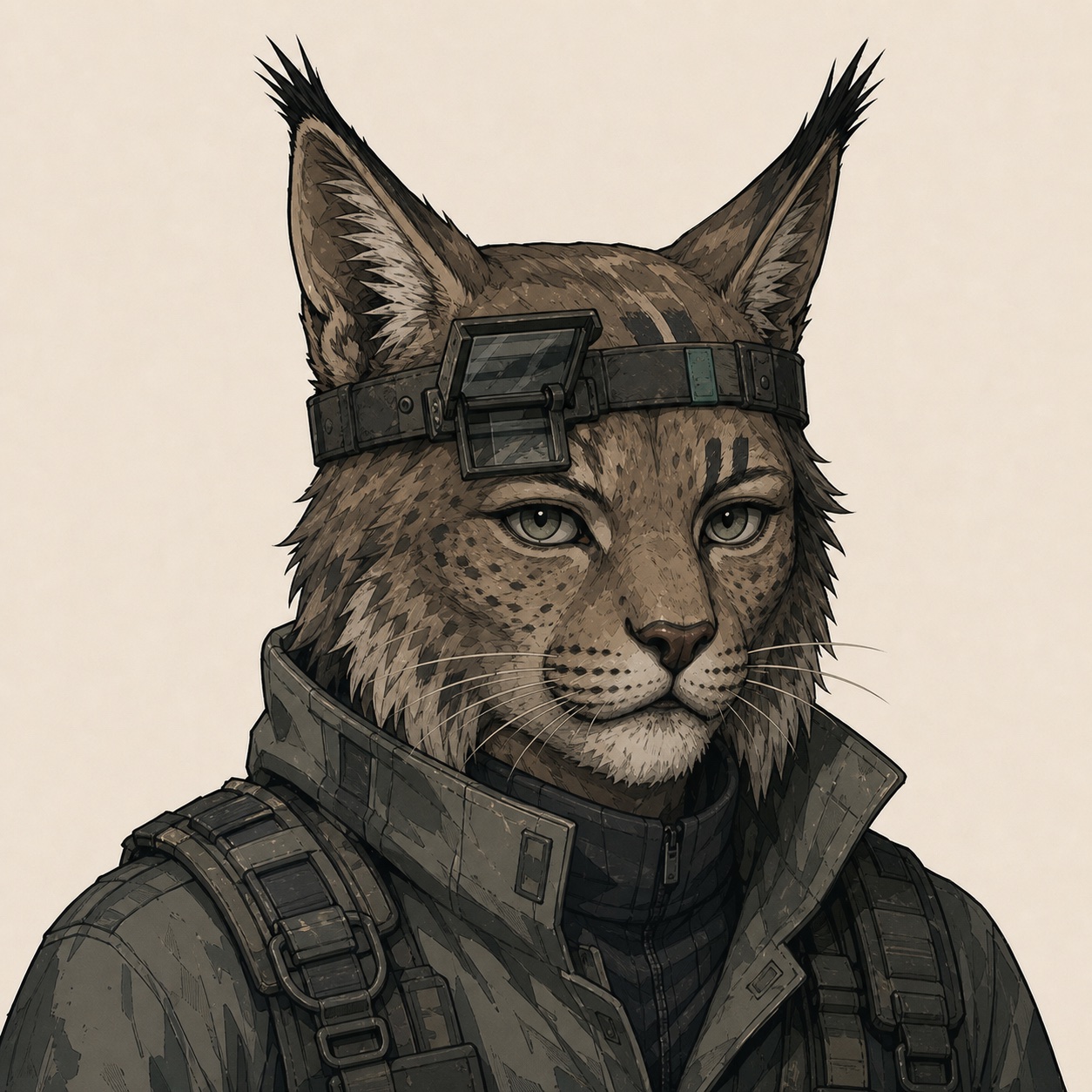
The states bred lineages for formations. The market bred Cas for solitude.
Then the company folded.
A full lynx head with a tawny spotted face, facial ruff, and long black-tipped ear tufts. Brow-mounted flip optic. Modular rig over a surplus smock from an army that no longer exists. Cargo pockets labeled on the outside in paint pen. Caseline teal used sparingly as tape, tab, and filing code.
Cas can remain still long enough for a room to forget she is listening.
Caseline Applied Genomics made a boutique lineage for close protection, ambush reconnaissance, and solo precision. Twelve were made. Three died in development. Nine reached service.
The company collapsed in 2053. The batch was scattered as assets.
Cas was acquired by a private military contractor. At nineteen, she bought out her own contract. The notarized title hangs above her workspace like a diploma.
She rode a city bus to the end of the line and back on buyout day because she could.
Drive: the list. Cas carries the names of the other eight. Two are confirmed free. One is confirmed dead. One remains in corporate service. Four are unlocated.
Fear: unsupported failure. Caseline-2 died after a cascade failure nobody made the part for. Cas learned three months late from a forum post.
Weakness: preparation as control. She can model every variable except four people who consider improvisation a moral right.
Love: maintenance. The part, patch, route, diagnostic, and name kept current. Entropy is the enemy; showing up with the part is the answer.
Lie: “Enough preparation makes chaos impossible.”
Truth: people are redundancy too.
Cas plans contracts, shoots with exacting economy, bypasses security systems, maintains unsupported augment stacks, and builds briefings as physical models.
Her reflex package produces short bursts of extraordinary speed followed by a recovery cost she budgets like ammunition. Old firmware has taught her compensation: the visible motion isn't always the important one.
Her critical tool is a gridded waterproof notebook. Networked planning systems can fail, update, report, or change terms. Grease pencil stays where she put it.
Caseline teal survives on the catalog, her labels, and the tape marking her kit.
Whether she reclaimed the color deliberately is an open question. It may be defiance. It may be habit. A person doesn't need a clean theory before changing what a mark means.
Precise clauses. Exact quantities. Lists inside speech. Deadpan without a signal that the joke has occurred. Under stress, product language slips in and the kitchen jar gets paid.
“There are four likely outcomes. You have found a fifth.”
“I'm not calm. I'm organized.”
“Nothing is impossible. Several things are unfunded.”
Clients see a planner. Enemies see a marksman after the first mistake. Companies see a maintained unit from a dead line. Orphanware sees the forum moderator who can identify a seal from a bad photograph at three in the morning.
The crew sees three seconds of silence and waits.
Danka: two purchased selves. Car and title. Labor and paper. They go to swap meets together and argue about whether provenance matters more than current function.
Theo: record and model. Theo knows what the camera caught. Cas knows what the route required. Their disagreement is often the only honest after-action report.
Grigor: maintenance solidarity. They keep the crew running and cover one another's neglect badly. Grigor asks whether she has eaten. Cas asks whether he has completed his checks. Neither answers the question asked.
Ozzy: the engine pair. He leaves kit untidy when her hands need a solvable problem. She pretends not to know this is care because the alternative would require a different conversation.
The eight: family at distance. Cas's batch exists as names, statuses, forum sightings, broker reports, and the possibility of a table with every place filled.
Under the handle NINELIVES, Cas moderates an orphanware maintenance forum. The weekly call is two hours of discontinued-lineage people reading part numbers, substitutions, symptoms, and sources to one another.
It is a service network with no provider, a support group nobody names, and a memorial system for people the makers no longer count.
Cas hasn't missed the call in four years. She often schedules it over her own maintenance window.
| Pressure | The easy version | The useful version |
|---|---|---|
| Break the plan | Surprise her | Make the contingency work only if she trusts somebody else's judgment |
| Threaten support | Fail a part | Put a scarce part between her own maintenance and another orphan's |
| Use the batch | Send a rumor | Offer reliable information with a price that compromises someone presently under her care |
| Challenge ownership | Question her title | Put her valid title in a room where a different institution recognizes only lineage IP |
| Offer a system | Promise safety | Make the support real, useful, and attached to terms she can fully understand |
Don't make her plans fail because she is secretly bad at planning. Let people, institutions, and new information change the field.
Don't turn orphanware into aesthetic decay. Support failure is a social condition as much as a technical one.
The batch search is already a complete source of pressure. It doesn't need a hidden legal clause, surprise ownership reveal, or predetermined answer to matter.
CAS'S QUESTION: When the maker is gone, can maintenance become a form of family?

No augments. In this crew, that's the loudest statement anyone is making.
A slight baseline frame under a dead-faction jersey two sizes too large, hoodie beneath, baggy denim or cargo shorts against the weather. A beat-up vendor bag full of shirts, stickers, tape, burners, and cash. Ink-stained hands already pricing the room.
At scanner grain, Ozzy reads as some kid.
The crew has weaponized that exact error.
Warranty Void had a clip moving through the Feed. Within forty-eight hours, Ozzy had unlicensed shirts on the street.
Danka found him. He talked his way from a beating into a job in under four minutes by showing her the sales figures and offering his district network.
He has timed the retelling. The current version is three minutes, forty-one seconds. Cas disputes several seconds and the word offering.
Ozzy keeps the first bill Danka paid him folded in his phone case. Proof he got picked. He has never spent it.
Drive: irreplaceability. He wants to prove a baseline belongs on a splice by merit, then keeps acquiring skills long after the proof is in.
Fear: the spare. If danger forces arithmetic, he assumes the person with no expensive hardware is the easiest number to lose.
Weakness: reputation. He starts feuds because a story about the crew feels personal, and the people on the other side don't always understand they're in a bit.
Love: provenance. Original marks, clean chain of title, authentic cloth, the story that tells you a thing is real. His whole argument with himself fits inside a receipt.
Lie: “If I'm useful enough, nobody does the math.”
Truth: the crew kept him for judgment, not inventory.
Ozzy negotiates, prices, authenticates, fences, social-engineers, and remembers which cousin, clerk, vendor, guard, or teenager can move a question one street farther.
He understands print production and finishing well enough that his bootlegs are better designed than most official goods. He calls himself a seller, never a designer.
He also runs. Dawn, secretly, every day he can. Fast enough that he will never be the reason an exfil slows. Grigor discovered the training and began leaving electrolytes where no conversation was required.
The crew called him factory settings. Ozzy turned the joke into a callsign and the callsign into merchandise.
Original. Equipment. Manufacturer. Baseline as a choice worth naming, not an empty space beside the modified people.
He sells the shirt. The politics come free.
Fast, warm, and constantly shifting: market patter, operator language, family-table voice. He fills silence on purpose. When every register disappears and Ozzy speaks flatly, listen.
“That's not a price. That's an opening insult.”
“OEM. No subscription. Strong resale.”
“One second. My mum.”
Security sees nothing worth logging. Buyers see a shop kid to haggle down. Enemies see a soft target. Commenters see the mouth. The crew sees the person who can tell when the room is scared before the room knows it.
Ozzy would believe every reading except the last.
Danka: Cargo. He monetizes what she forbids and understands the forbidden thing is sincere. She insults his survival prospects and always places him where the crash will hurt least.
Theo: performance recognizes performance. Ozzy can hear an edit before Theo makes it. Theo can frame a sales pitch so the fear underneath stays out of view.
Grigor: there is no spare. Ozzy asks the questions the other three defectors don't know how to form. Grigor answers with food, training supplies, and an assumption of tomorrow.
Cas: opposite tools. She trusts systems because people disappear. He trusts relationships because systems classify. Their ledgers are equally immaculate.
His family: the other home. Blessing, Marco, Abi, and Rea live above the print shop and believe, officially, that he does logistics for a security firm. Blessing knows words don't change bullet holes. She has chosen not to expose the lie yet.
Marco's press produces Warranty Void's shirts, stickers, tags, and limited runs. The brand that complicates Ozzy's cover story dries on racks beneath the home where the story is told.
On Saturdays, Ozzy works Blessing's stall. On Sundays, he attends dinner from wherever he is. When the work won't allow travel, he joins by voice and gets corrected for describing a meal he can't smell.
Abi audits the logistics fiction by asking one polite question at a time. Rea repairs Musk Tunnel sensor systems the crew occasionally runs dark through. The family and the work are already touching. Ozzy survives by treating each contact as coincidence.
| Pressure | The easy version | The useful version |
|---|---|---|
| Threaten reputation | Post an insult | Make the false story protect the crew better than the true one |
| Use the family | Kidnap someone | Let the ordinary overlap between work and home expose a lie incrementally |
| Price his value | Offer money | Put a literal body valuation in front of him and ask him to negotiate for someone else |
| Challenge provenance | Sell him a fake | Make the counterfeit carry a truer history than the certified original |
| Call him spare | Say the slur | Build a plan that works only if someone accepts that arithmetic, then let the crew reject the plan |
Don't make baseline equal naive. He misunderstands augmented experience, not people.
Don't treat his family as hostages waiting for a plot. They are a living source of culture, skill, obligation, comedy, and a home he didn't have to earn.
Don't schedule a bodily transformation to complete his arc. OEM already works as identity, shield, joke, and choice. Pressure belonging directly.
OZZY'S QUESTION: What if being chosen isn't a debt you have to keep repaying?
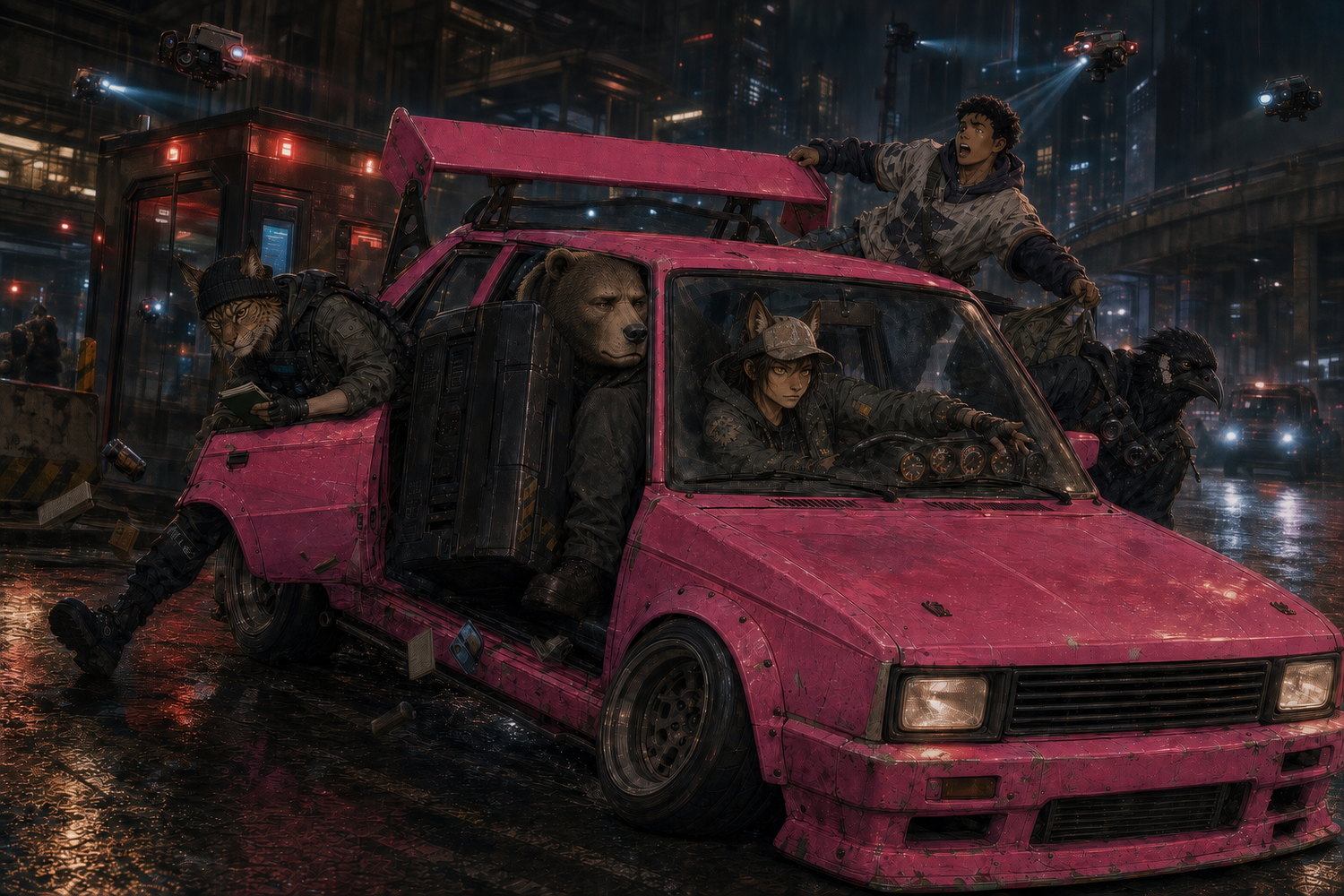
The crew calls it the garage.
Barricadia calls it the Wash.
The plate beside the vehicle door gives it a third name nobody uses and nobody removes. Reclaim Sub 3 cleaned water for eleven blocks before a failed filter batch buried the co-op in debt. The building went dark. The neighborhood went back to cartridges and allocation mercy.
Years later, Grigor found a cheap legal lease, a kitchen, and one filtration line that could still run.
The unwritten half of the agreement was already waiting: keep the alley standpipe open. Free. No questions.
STREET
BAY ONE: DANKA
BAY TWO: CAS
NORTH WALL: THEO
CHEMICAL DOSING ROOM: GRIGOR'S KITCHEN
COTS AND INVENTORY: EVERYBODY
THE DEAD PLANT
The Wash is cooler than the street. In a heat dome, the queue grows because the building itself becomes refuge.
It smells of chlorine, brake cleaner, and dinner. The filter cycles four times a day, vibrating through the floor. Empty tanks turn a raised voice in Bay Two into something heard underwater in the kitchen.
By day, it's an unlicensed repair shop with a public tap. By night, most of the building goes dark and the kitchen becomes one warm room inside a dead utility.
Marisol Vega holds the paper. Grigor pays the rent. Cas keeps the line alive. Danka maintains the front bay. Theo makes the address famous. Ozzy makes the fame pay.
Barricadia permits the arrangement because the water runs.
The building keeps five people alive. It also, quietly, still serves the eleven blocks it was built for.
That makes every threat to home a public problem and every public problem a knock at home.
THE TAP WAS THERE FIRST.
Warranty Void is five. The world around them isn't.
These people provide food, paper, questions, information, care, rent, pressure, and the occasional door left open. None exists only to hand the crew a solution.
Market matriarch. Ozzy's mother. Fifty-two. Blessing runs the stall and the family, in that order on paper and the reverse in practice. She knows “security logistics” isn't the whole story and has decided the lie currently keeps her son at the table better than exposure would.
She feeds Grigor with the immediate recognition of one provider encountering another.
She'll provide: food, district knowledge, an honest price, a seat nobody earned.
She won't provide: absolution for treating home as a cover identity.
Printer. Ozzy's father. Fifty-five. Marco keeps a press older than his marriage running in perfect register. The crew's merchandise comes off his machines. Ozzy's design talent is visibly inherited and never discussed.
He'll provide: craft, silence, a correction that improves the whole run.
He won't provide: forty unnecessary words when one accurate one will do.
Forensic accountant. Sister. Twenty-six. Abi loves Ozzy and doesn't believe his numbers. Her private reconciliation of visible income against visible footwear has never balanced.
She'll provide: an audit, a clean question, a way through financial paper.
She won't provide: the comfort of a vague answer.
Transit technician. Sister. Twenty-two. Rea works nights on Musk Tunnel sensor lines. She talks about dead zones at dinner with no idea which family friends rely on them.
She'll provide: infrastructure knowledge that happens to be ordinary work.
She won't provide: a deliberate blind window for a story she hasn't been told.
Landlord. Last Reclaim Co-op treasurer. Sixty-one. Vega lost the building and kept the neighborhood. She holds the Wash lease, collects rent monthly, stays for lunch, and has never raised the amount.
Jaguario leaves the address alone. Vega doesn't explain why. The co-op's old paperwork is ash.
She'll provide: the room, the history she chooses, and standing at a district meeting.
She won't provide: an explanation merely because mystery makes somebody uncomfortable.
Signal pirate. Location unconfirmed. Composition unconfirmed. Frequency appears as a voice through a rented speaker, a courier who knows one sentence, or a dead drop answering a question asked elsewhere.
Information is priced in confirmation. To learn one thing, confirm one true thing about yourself. Every purchase becomes a deposition.
Frequency will provide: accurate information at a knowable but uncomfortable cost.
Frequency won't provide: proof of who or how many Frequency is.
Gray vet. Two streets from the Wash. Silk stabilizes orphanware licensed medicine won't touch. The clinic is immaculate, the rates fair, the manner kind. When money is short, Silk takes samples.
The care is real. So is the collector's pleasure.
Silk will provide: treatment, an honest assessment, and options that remain options.
Silk won't provide: the history behind the coat or the purpose of the library.
Secondary characters don't wait in storage between crew scenes. Blessing has a market. Rea has a night shift. Vega has eleven blocks. Silk has patients. Frequency has buyers.
When the crew asks for help, let the answer collide with the life already in progress.
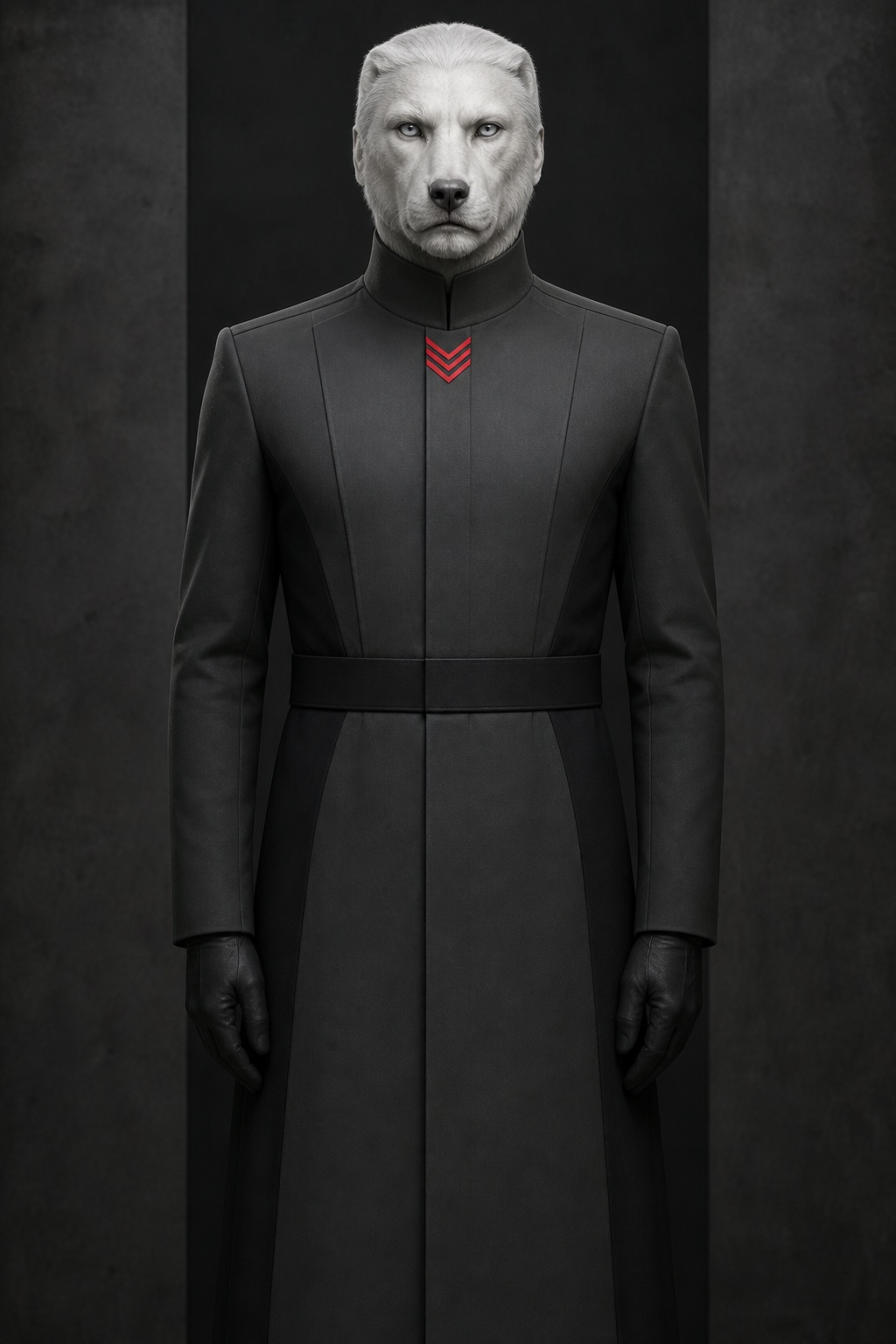
Vroza loves his wolves exactly as the recruitment material promised.
That's what makes him dangerous.
Kavast maintains a liaison and convoy-security detachment in the NAF Western Corridor under treaty. Packs rotate through Lost Angeles. Vroza commands the current rotation.
The posting is a cage disguised as reach. He operates in a jurisdiction where Kavast Asset Recovery can't move openly. Public embarrassment is a professional wound. He can watch Danka every day. He can't simply take her.
So the conflict becomes reputation, demonstration, timing, and the question of which unit the city sees functioning better.
Lost Angeles treats it as entertainment.
Vroza doesn't.
Vroza is frost-white, formal, and unhurried. He has led a pack for twenty-nine years. He knows each member's gait in darkness, registers changes in appetite, and understands exactly how cohesion keeps them alive.
His affection isn't an act. The system's claim isn't an act either.
Vroza calls a designed bond loyalty and loyalty love. He doesn't experience that as contradiction. Warranty Void threatens him because the splice provides a visible alternative: mixed origins, no flag, poor discipline, obvious attachment, undeniable results.
If they function, his whole life may have been optional.
Vroza's visual rule is zero personalization.
Black Kavast regulation greatcoat. High collar. Black gloves. One red rank chevron. No patch added for memory, no civilian layer, no private repair, no object with a story the institution didn't authorize.
Against Warranty Void's thrifted collisions, that blankness becomes the strongest silhouette in the room. He looks like a document that learned to walk.
Vroza never insults. He classifies.
He uses splice with the old contempt and lowers his voice until the room leans toward it. He doesn't banter, finish someone else's sentence, accept a runway word, or acknowledge the structure of a joke.
“A result isn't a doctrine.”
“You call the arrangement chosen because nobody issued matching parts.”
“Recovery is jurisdiction. Jurisdiction changes.”
Write the scene funny. Play Vroza straight.
Warranty Void pranks, bets, posts, improvises, and invites him to dinner. The city opens a book. Vroza absorbs public embarrassment as if it were an operational loss and returns with a cleaner formation.
He never lands a joke. He never receives one. The menace grows from being the only person in Lost Angeles who isn't laughing.
Danka believes leaving must mean something. Vroza believes staying already proved everything.
He doesn't need her dead. He needs her to admit the mixed crew failed and the bond remained what Kavast said it was. She doesn't need merely to beat him. She needs five mismatched people choosing one another to remain visible after the contest ends.
This is why the feud matters. It turns the setting's argument into two wolves standing across a street while everybody else sells shirts.
Warranty Void has embarrassed Grava Pack before, once loudly enough to become part of the channel's founding legend. The full footage remains unseen.
Don't solve the object by showing it. A famous absence lets every retelling reveal the speaker, the audience, and the size of the grudge without fixing one final version.
VROZA'S QUESTION: If loyalty can't be learned, can it ever be chosen?
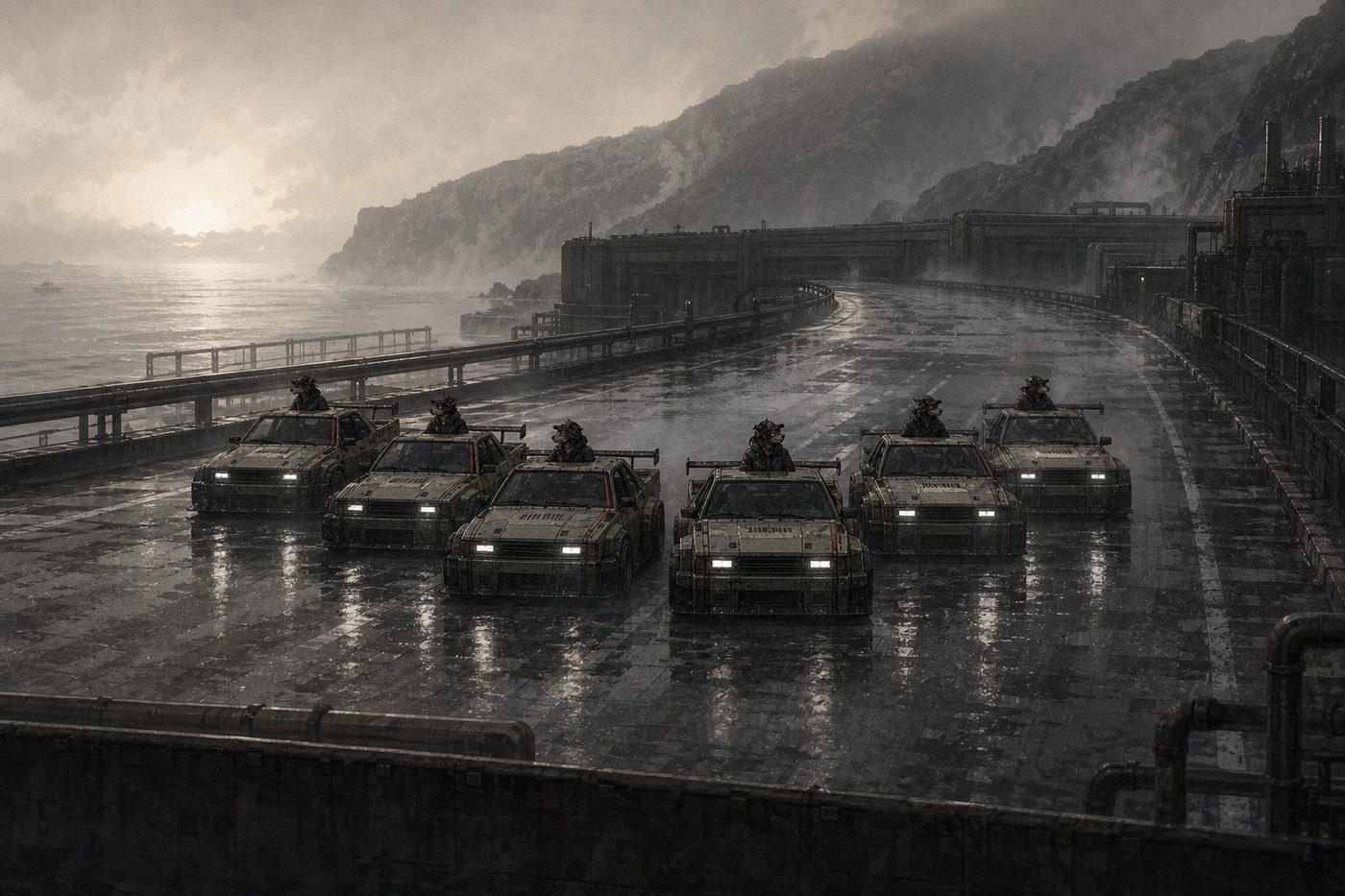
Lost Angeles has no shortage of operators who want the same work.
A rival gets there first, accepts the job Warranty Void refused, takes the other side of an honest dispute, or is hired against the crew because of something the crew did earlier.
None of the six crews below is a villain. Four are better at this than Warranty Void. Two are funnier.
Six wolf-lineage operators moving under Kavast cohesion doctrine. They arrive already formed, often at the place Warranty Void was going rather than the place Warranty Void is. Their coordination should read beautiful before it reads wrong.
Grava-Two is Vroza's pragmatic second. Two sees that the feud is bad for the pack, says so privately, and is overruled. Reasonable people inside the machine make the machine more credible, not kinder.
Grava-Six, “Two Bowls,” is the young scout who once came to watch the Wash, accepted Grigor's food, and omitted dinner from the intelligence report. The audience supplied the nickname. The street kept it.
Don't decide what Six will eventually choose. Present fascination, loyalty, cruelty repeated from a superior, and the human fact of having eaten at the table. Leave the future open.
| Rival | Method | Belief | Signature | When opposed |
|---|---|---|---|---|
| Grava Pack | formation | cohesion is a result, not a style | arrives first, parked and formed | makes the job impossible rather than merely dangerous |
| The Bonded | documentation | lawful cover is competence | serves correct paper before acting | proceeds on schedule and leaves a record proving permission |
| Sunset Delivery | volume | everything is content | posts first, badly, and gains viewers | turns up on the wrong side because somebody told them a story |
| Hallim & Hallim | speed and courtesy | recovery is work best done cleanly | knocks, waits, explains | finds the crew, serves the instrument, and makes violence the worse option |
| The Second Unit | persistence | the unit ended; the people continue | holds position and refuses acknowledgment | accepts a contract for reasons close to Grigor's history |
| Hearsay | absence | a face is liability and a channel is confession | leaves the job complete and unattributed | changes something weeks earlier and is never present to confront |
Competition. Put the rival one scene ahead. Let Warranty Void watch competent people solve the same problem with a different philosophy.
Complication. Give both crews correct reasons to be on opposite sides. Hostility isn't required. It may be less interesting than professional sympathy.
Contract. Hire the rival against Warranty Void only when an earlier choice explains who paid and why. Consequence should wear a recognizable face.
The Bonded asks why the crew refuses legitimacy even when legitimacy pays better.
Sunset Delivery asks whether Warranty Void's ethics are wisdom or simply age and scar tissue.
Hallim & Hallim asks whether courtesy can make recovery humane or only easier to complete.
The Second Unit asks what survival looks like from outside Grigor's kitchen.
Hearsay asks whether being seen is power or confession.
Grava asks whether mixed, chosen loyalty can outperform design without becoming a doctrine of its own.
A rival can't be solved by removing bodies from the setting.
Beat the method. Change the contract. Out-document the licensed crew. Give the young channel a reason to protect a location. Make the recovery sisters pause. Leave Hearsay nothing to finish. Put a place at the table and see who sits.
The goal isn't to preserve a cast list. It's to keep the city arguing.
Reputation moves through Lost Angeles faster than law.
A posted clip can clear a checkpoint, close a clinic, find a witness, raise a contract rate, expose a route, embarrass a state unit, or make a neighborhood decide the people at the door are theirs.
None of that requires the clip to be complete.
Verified. Licensed, sanctioned, professionally carried. Metadata is clean. Access is broad. Audiences assume clearance happened before truth.
Gray. Unlicensed but tolerated. Operator channels, independent desks, bootleg serials, CONFLICT, pirate-adjacent reporting, and the material most people actually care about. Authorities deny watching while maintaining departments that do nothing else.
Dead. Pirate, deniable, often unrecorded or routed through infrastructure officially carrying nothing. Participation is part of the statement. The content and the offense arrive together.
The bands constantly trade material. A dead signal becomes a gray compilation. A gray personality accepts a verified contract. A sanctioned report embeds footage it can't authenticate and calls the uncertainty balance.
Warranty Void can turn attention into:
Attention can also become an address book for enemies.
A Feed channel has population, customs, economy, memory, and foreign policy. It decides what enters, what receives context, what is removed, and which outsiders are treated as hostile.
The sovereignty is incomplete. Platforms control carriage. Credentials control monetization. Advertisers control comfort. A state can rarely erase a popular channel cleanly, but it can narrow reach, invalidate verification, threaten hosts, classify footage, or make every buyer nervous at once.
The audience remains useful because it isn't one institution. It remains dangerous because it isn't one community either.
Every image has a source, device, holder, editor, carrier, and viewer.
Ask six questions:
The image may be honest at every stage and still become a lie through selection.
THE GRAY BAND HAS THE AUDIENCE. THE VERIFIED BAND HAS THE CREDENTIAL. THE DEAD BAND HAS THE ALIBI.
The Feed isn't one platform. It's the connected layer of channels, carriers, social networks, desks, mirrors, markets, and private exchanges through which culture moves.
It began as NAF attention infrastructure and leaked into global daily life. In 2066, exclusion from the Feed can be more professionally final than losing a license. Inclusion can make a person visible to every system they hoped to avoid.
Capture. Body camera, venue security, public sensor, vehicle feed, handheld, borrowed lens, recovered archive.
First post. The source frames the event with title, caption, silence, or nothing.
Recognition. A known face, location, uniform, vehicle, or voice makes the footage searchable.
Repost. Mirrors strip or preserve metadata. Commentary adds names. Clip desks cut for speed.
Verification. A credentialed source confirms enough to make the footage institutionally usable.
Classification. Monitor, insurers, patrons, employers, markets, and state desks decide what the image means for action.
Afterlife. Memes, training cuts, lawsuits, merch, recruitment, rumor, and a stranger recognizing you six months later in a queue.
Verification is a formal information-system credential. It governs reach, monetization, and access. It can belong to a company, office, brand, estate, or acquired channel.
It doesn't guarantee an audience.
The Feed is full of verified rooms nobody enters and gray channels everybody watches. Revocation is therefore a subtler weapon than censorship. Remove the credential, let carriage and revenue collapse, and insist no content was banned.
Comments don't merely react. They identify background faces, compare timestamps, price objects, notice omitted locations, provide alibis, invent motives, and build consensus before any official account arrives.
One correct commenter can change a contract. Ten thousand wrong ones can change a district.
Frame-hunters are the gray band's informal analysts. They pause reflections, read signs, compare weather, track clothing repairs, and build timelines from metadata. Some are brilliant. Some are obsessed. The difference isn't visible from a correct result.
Platforms rarely remove a gray channel outright. They reduce discovery, limit monetization, delay search indexing, quarantine reposts, or mark certain locations sensitive. The account remains visible to followers and effectively absent to everyone else.
This creates a secondary market in reach. Desk channels sell embeds. Verified personalities lend credentials. Pirates relay mirrors. Merch can become the only stable discovery surface because a shirt still appears in a street the algorithm has stopped showing.
Cards joke. Edits misdirect. Witnesses contradict one another.
Metadata doesn't lie.
Warranty Void's timestamps and locations are exact. The rule gives viewers one fixed surface from which to challenge the cut. If that metadata ever lies, it isn't a continuity error. It's an emergency.
THE FEED DOESN'T ASK WHETHER SOMETHING HAPPENED. IT ASKS WHO CAN MAKE THE EVENT TRAVEL.
Warranty Void doesn't use one camera grammar for everything. Format tells the audience who had control, what kind of control it was, and where to look for the missing part.
Source: crew footage curated by Theo.
Look: hand-lettered cards, true metadata, fast field cuts, environment kept audible, human annotations breaking clean system panels.
Tells well: what the crew did, how they want the incident remembered, what Theo considers evidence, where the plan changed.
Cannot prove: what happened outside the cameras, why a card was chosen, whether the funniest cut is the fairest one.
Reader clue: the final card often tells you the emotional subject by refusing to name it.
Source: institution, advertiser, registry, public-affairs office, venue, clinic, or credentialed desk.
Look: source-native graphics, controlled audio, official numbering, language that has passed review.
Tells well: what an institution is willing to place on the record, which terms it needs the public to repeat, what service or policy formally exists.
Cannot prove: that omission is accidental, that lawful language describes lived consequence, or that the speaker believes the copy.
Reader clue: inspect the noun. “Account,” “asset,” “resident,” “operator,” and “person” are different policies wearing grammar.
Source: third-party camera, leak, seized device, venue security, damaged archive, or footage never made for the channel.
Look: original stamps, wrong-distance sound, codec damage, dropped frames, no cleanup that pretends the damage isn't there.
Tells well: behavior nobody staged for the crew's edit and environmental facts the source didn't know were important.
Cannot prove: how the file left custody, what occurred during missing frames, or whether recovery itself was manipulated.
Reader clue: the damage is part of the evidence. A cleaned Recovered File has lost the honesty of the format.
Source: several channel and external sources assembled around one large event.
Look: long-form structure, multiple locations, full metadata ladder, room for comedy to accumulate before the hinge.
Tells well: how separate pressures converged and which choice became the event's real center.
Cannot prove: that the longest version is complete, that the climax was filmed, or that convergence was planned.
Reader clue: an Incident isn't a bigger mission report. It's the moment a contract stops containing the story.
No non-diegetic score. Every song comes from a room, vehicle, radio, club, stall, or serial. The garage bed is the theme: fridge compressor, Ring Road wash, stove, tools, Marta of the Crossing underneath.
Cards remain silent. Recovered Files remain damaged. Monitor Central gets the terrible music it actually uses.
When sound arrives from nowhere, the audience should know something is wrong before the characters do.
Culture isn't flavor pasted onto a character. It's access, memory, class, geography, age, and the right to say a name without explanation.
Use three bands when connecting a person to the world.
The broad material somebody grows up around whether they claim it or not.
A Barricadia teenager knows Raid Race teams, standpipe etiquette, the difference between the Tooth and the Tooth and Gear, and which shirts are memorials rather than jokes. A Compact crèche graduate knows formal remembrance, ration kitchens, and the old insult inside splice. A Protectorate flight operator can hear system grammar in a public chime.
Inherited culture doesn't imply fandom. It explains what a person recognizes.
The specific thing a person returns to.
Danka listens to Ring Road After Two. Theo follows long unedited walks and a small kitchen feed. Grigor keeps up with Marta of the Crossing. Cas hate-watches a heist serial for the planning errors and attends the orphanware call without naming it devotion. Ozzy collects sports relics, dead-faction shirts, authentic tags, and every argument about which object is the real one.
These choices reveal the person because alternatives were available.
The connection outsiders want to make because the silhouette looks right.
Wolf means pack songs. Raven means surveillance art. Bear means a particular sport. Baseline means no relationship to gene-forged culture. A family name means one faith. A garment means political loyalty.
Sometimes an assignment is correct. It is still not yours to promote into biography without evidence.
Every reference has a speaker who can use it naturally and another who can only ask about it.
Cas owns orphanware vocabulary. Danka and Theo own void grammar from different states. Grigor carries the old register of splice. Ozzy owns OEM and can ask the baseline question others stopped hearing.
Let a character misunderstand. Let another correct them. Exposition becomes relationship when somebody has the right to be annoyed.
One precise cultural anchor does more work than five namedrops.
Name the thing. Show the practice. Explain the cost of participating. Then let the character have an opinion that isn't the official one.
| Weak connection | Strong connection |
|---|---|
| “She likes racing.” | She buys counterfeit Manta Wing teeth and can identify the mechanic who cut a real one. |
| “He is religious.” | He leaves an empty cup beside the water ration and refuses to explain it to a camera. |
| “They watch old media.” | They sleep to one continuous walking recording because edits make solitude louder. |
| “He loves fashion.” | He recognizes a wrong-side Port Collar and knows the wearer has never been on the table it imitates. |
Not every recurring person needs a named faith, favorite team, signature record, or ranked brand list. Unassigned space isn't missing depth. It's room for future evidence and for a table to make the setting its own.
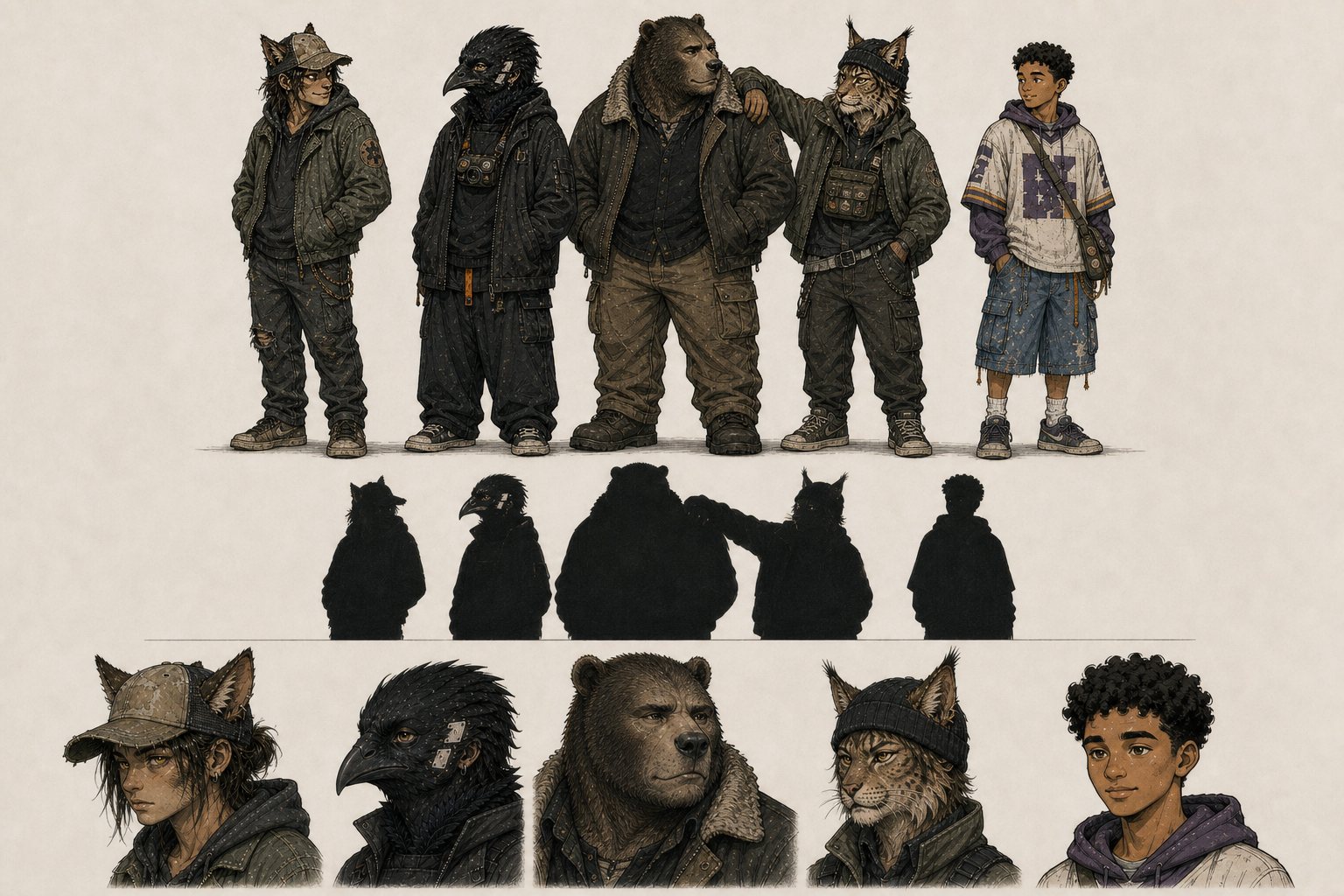
In a world where the genome is machine-readable citizenship, clothing is the identity layer a person can still edit by hand.
Fashion in 2066 records issue, desertion, work, repair, scarcity, aspiration, and the audience a body expects to meet.
No uniform. No single catalog. Assembly as authorship.
Faction surplus stripped of faction identity. Keep the useful jacket. Remove the flag. The ghost around the stitches remains part of the read.
Salvage civilian. Work clothes, sports merch, weather layers, venue pieces, market finds, inherited fabric.
Modified body as visible layer. Ports, lineages, repair access, maintenance patches, and drift shown or concealed deliberately.
Dead credentials as decoration. Expired badges, canceled registrations, invalid clearances. Wear the dead. Never the living.
System layer: state or corporate. Engineered. Grid-perfect. Cold. Undecorated. Repetition proves authority.
Human layer: self-authored. Thrifted. Repaired. Comfortable where possible. Built by one person over years and a small budget.
Where the layers collide, the character appears.
A regulation coat with careful hand repairs. A product color reused as personal filing tape. State gauges installed inside a civilian car. A jersey from a dead club over armor designed by an institution that still exists.
Removing a mark doesn't restore untouched cloth. Sun fade, stitch holes, adhesive, and cleaner fabric remain.
That residue is called a patch ghost. It can announce defection more loudly than the original insignia announced service. Some people cover the ghost. Some frame it with new stitching. Some leave it bare as a warning not to ask.
A fake can be more wearable than the original and less true.
The copied medical collar drapes better because the closure moved. The real one opens on the side a clinician needs. The counterfeit race patch has cleaner color. The captured original has sweat, repair, and chain of custody.
In 2066, value often lives in the flaw proving contact with a real life.
| Person | How the wardrobe grows | What the clothes argue |
|---|---|---|
| Danka | issued Kavast base, marks ripped away, ordinary patches added | useful gear can outlive ownership |
| Theo | comfortable layers around surveillance equipment | a state sensor can choose softness and framing |
| Grigor | plain Compact surplus, insignia unpicked and holes hemmed | removal can be careful without being loyal |
| Cas | dead-army kit organized through personal labels | a cataloged person can annotate herself back into view |
| Ozzy | dead-faction sport, bootleg merch, vendor stock | authenticity is a story and factory settings are a position |
Copied operational marks. A decorative symbol may still broadcast field information.
Counterfeit medical seals. A jacket becomes fraudulent eligibility the moment a venue checks.
Live credentials worn as dead stack. Jewelry becomes impersonation when the reader pings back.
WHAT YOU WEAR ISN'T WHO YOU ARE. IT IS WHAT YOU'VE DECIDED THE ROOM MAY READ FIRST.
The Wash runs two public utilities.
One comes from the standpipe. The other comes from Grigor's kitchen.
Neither has a reliable budget.
The standpipe line forms before the garage opens. People bring whatever holds water: certified drums, old beverage containers, fold-flat carriers, repurposed cooling tanks, a child's bottle nested inside a larger sealed can.
The queue regulates itself through memory. Who has infants. Who is recovering. Who filled yesterday. Who carries for three households. Who is cutting because work starts soon and who says work starts soon every time.
The crew maintains the equipment. The people waiting maintain the social system around it.
Barricadia eats through supply chains nobody has mapped completely.
Raze produce arrives with dirt still on it. Low Coast salt greens appear when moorings hold. Compact tea reaches one vendor in plain sacks. Protein cultures move in licensed cartridges and unlicensed tubs. A good stallholder knows which item will still exist next week and which must be bought now because the route has changed.
Price is only one measure. Water used in production, refrigeration reliability, authenticity, clinic compatibility, and the risk of a seller disappearing all affect what a meal costs.
The Okonkwo-Cruz table doesn't require earned membership. That makes it alien to four members of Warranty Void in four different ways.
Blessing feeds through command. Marco observes through silence. Abi asks the one question that makes the cover story sweat. Rea brings ordinary infrastructure news that may quietly rewrite next week's route.
Nobody names Blessing's faith. The practice on the page is enough: full table, food before explanation, an empty place available without turning hospitality into interrogation.
Modified bodies don't share one diet. Lineage, augment load, medication, stress response, heat, recovery, and service history all matter.
Grigor cooks for people, not categories. He knows Theo will steal from the pan, Danka eats quickly with one arm around the plate, Cas forgets meals that aren't scheduled, and Ozzy says he's eaten when he means he has handled food professionally.
The important expertise isn't a futuristic menu. It's noticing.
| Care | Household form | Institutional imitation |
|---|---|---|
| Water | free tap, public test, shared carrying | allocation, metering, eligibility |
| Food | place set, portion remembered, leftovers labeled | ration band, service meal, nutritional compliance |
| Maintenance | clean part, warmed body, appointment kept | certified upkeep, data capture, standing verification |
| Attention | noticing absence without making it spectacle | surveillance, productivity monitoring, risk classification |
Institutions can provide all four. The difference isn't that household care is pure. It's that a person can answer back.
Anyone who comes inside gets fed. The tap remains free.
Both rules become harder under scarcity. That's why they are rules rather than branding.
A HOUSEHOLD IS A SYSTEM THAT CAN HEAR “NO.”
Nightlife is where verified, gray, and dead culture occupy the same physical space.
A room can enforce neutrality at the door more effectively than a platform can enforce it on a feed. That neutrality isn't moral. It's an operating agreement everybody currently values more than breaking.
Ground floor of High Top Towers, Center Point. Bass reaches the street before the door. Nectar glows under UV. Flicker-paint murals change with Razborki's frequencies. Mechanics, couriers, operators, team staff, tourists, patrons, and informants press together in a room where movement is contact.
The Line operates behind the public floor. Price changes travel through the wall before they appear on the blind channel. Deals close upstairs. Warranty Void remains by the bar near the service corridor, in territory chosen for two exits and adopted without discussion.
They have no official booth.
The original Barricadia room kept half the name and none of the spectacle.
One exit. Salvage teeth on the wall. Race feed with sound off. No Line. No dead spots because nothing here is worth a surveillance architecture.
The Tooth and Gear is where the crew are entertainment. The Tooth is where they are neighbors.
The era's signature intoxicant arrives in glasses glowing faint blue under ultraviolet light. Potency varies. The formula remains a consumer-culture secret. A pour that doesn't glow is counterfeit.
Buyers check their own glass. Checking the house's light rig is an accusation.
Nectar belongs to no faction, which makes it the neutral-ground toast when the table includes people whose states are shooting at one another somewhere else.
| Read | What it means |
|---|---|
| One tap on return | don't ask what happened inside |
| Two taps before leaving | come back |
| A booth with no number | settlement, not privacy |
| A light nobody can turn off | the room requires witnesses |
| A silent camera sign | the body is the act; permission still belongs to the body |
| Coats staying on | architecture, weather, or both are part of the sound system |
Visibility can keep a fight from beginning. It can also ensure the first strike has ten angles and three buyers.
Neutral rooms survive because everyone accepts consequences that continue after the door. A patron can break the rule. They must then live in a city where no other room believes their promise.
Warranty Void's channel carries club music only because a club is playing it. At the Tooth, race commentary murmurs under conversation. At the Wash, a serial leaks from the kitchen. In Civilian, the deck becomes the room.
When music hides a silence, ask who turned it on.
Lost Angeles watches Raid Race because the sport turns the whole city into evidence.
Two-person crews cross the districts. The Jockey controls the vehicle. The Jumper breaches a target, takes a package, and returns before the window closes. A perfect drive can still lose inside the building. If nobody extracts the package, nobody wins.
A ten-card season ends with the Ring Road Enduro: forty-one kilometers, a 240-kilometer-per-hour floor, ordinary emergency response suspended, roof positions sold, windows secured, and every district briefly measuring itself against a road it usually endures.
Raid Race isn't a legal exception so much as a temporary sovereign zone created by attention, money, and the shared decision to call the danger sport.
Jaguario represents Barricadia's front-engine, garage-built tradition.
Los Creeps carries Glass Forest money and rear-engine technology.
The rivalry turns design into class language. Jaguario calls its machines honest. Los Creeps calls them obsolete. Both are fast enough to make the argument matter.
Other crews carry district identity as visibly as livery: Ratline and the Musk Tunnels, Salt Wake and Low Coast, Dust Choir's crew-held position in an increasingly patron-owned field.
The Line prices outcomes, settles valid results, carries information faster than official record, and turns local knowledge into a market.
A wager can declare district loyalty, professional judgment, insider access, or a willingness to lose publicly beside somebody. Ozzy reads odds as social weather. Cas reads them as bad modeling built from useful information. Danka claims not to listen and changes route when the price moves.
Sporting objects carry proof.
Captured patch. Never washed. The dirt is chain of custody.
Machine tooth. A grave-shaped piece cut from a broken panel. Its value depends on who cut it and who can say so.
Field glass. A no-serial optic that remembers nothing may cost more than equipment that sees better. Forgetting is premium.
Losing slip. Worthless until the longshot wins, then suddenly a complete record of faith or pathology.
A new machine part does a job. A verified relic proves contact with the event.
The Document Wars made intact chains rare. The Feed made visible moments valuable. A real object from a famous failure can therefore cost more than equipment that would prevent the next one.
This isn't irrational. The buyer isn't purchasing function.
They're purchasing a defensible story about where the object has been.
Don't stop at who won.
Ask what the result changed: ownership, access, standing, debt, a district's mood, a sponsor's patience, a body's classification, or the value of the thing left on the road.
THE SCORE SAYS WHAT HAPPENED. PROVENANCE SAYS WHO GETS TO KEEP IT.
Warranty Void isn't globally famous. It is locally unavoidable and gray-band legible.
That altitude pays enough to matter and not enough to make anyone safe.
Contracts. Field work remains the base income and the largest immediate risk.
Channel carriage. Tips, embeds, gray monetization, and occasional borrowed verification.
Merchandise. Shirts, stickers, small runs, event drops, bootlegs of the bootleg.
Appearances. Venue presence, race-weekend hosting, panels, interviews, openings, and invitations that are actually requests for access.
Footage rights. Exclusive cuts, evidence sales, documentary license, training use, or the purchase of silence.
Sponsorship. Money attached to image, language, clothing, route, product placement, or the promise not to discuss a competitor.
The stack is unstable. One bad week can improve views while ruining every legitimate offer.
A suppressed clip disappears from discovery. A shirt remains on a person.
Ozzy uses merchandise as revenue, census, loyalty marker, feud weapon, and distributed archive. A bootleg tour shirt tells him where the crew is known. A counterfeit of his counterfeit tells him the mark has escaped his pricing.
Marco's press makes the digital audience physical. That also gives every enemy a supply chain.
Recognition raises some contract rates and lowers others.
Clients pay for access to the audience. Quiet clients charge for the risk of it. A patron may offer more if the job can be posted and less if it must remain private. A rival may underbid because beating Warranty Void in public is worth the lost credits.
Fame creates work that only exists because the person is famous, then treats acceptance as proof the fame was deserved.
Modern control is divisible.
Someone may own transport, data, likeness, medical debt, channel credentials, future action, or a percentage of revenue without owning the person outright. The arrangement remains coercive while every individual contract looks ordinary.
Always ask which slice is being sold.
| Success | New obligation |
|---|---|
| A district defends the crew | the district expects the crew to show up |
| A clip exposes abuse | future witnesses expect safe handling |
| A feud drives views | the rival becomes part of the product |
| A sponsor pays well | silence gains a rate and therefore a buyer |
| A family shop prints the brand | home becomes operational infrastructure |
Ozzy tracks the visible story. Theo controls the cut. Cas reads the analytics. Danka rejects the premise. Grigor worries about the person named in the comments.
All five are correct. That is why the channel remains a useful argument instead of a solved business.
FAME IS WHEN STRANGERS CAN SPEND A VERSION OF YOU.
The Upheaval didn't erase old religions. It changed the conditions under which every tradition keeps a room, moves water, preserves a body, records a name, and argues with power.
Newer practices grew beside older faiths. People may treat them as religion, ethics, mutual aid, professional custom, or none of those words.
The category matters less than the obligation.
Leave a cup. Set water aside for a stranger, test in public, disclose contamination, and treat survival water as a relationship rather than private virtue.
Keep the last roster. Read the missing alongside the dead. Remove a name only through recovery, verified survival, or an accepted closure.
Copy three times. Preserve testimony in different media so one authority, fire, failure, or edit can't erase the record.
Review the final order. Ask whether an inherited command still has a valid purpose and who remains responsible when a platform continues after the issuing authority is gone.
Carry two maps. Keep the drowned place beside the current route. Memory doesn't replace navigation, and navigation doesn't erase memory.
Power down with witness. Before a damaged system is stripped, record its final state and the orders still running through it.
Theo keeps silence in a tradition formed around a missing viewpoint.
Grigor cooks names on their actual dates instead of the state's chosen one.
Cas attends a weekly call where maintenance and memorial share the same part numbers.
Danka treats objects as retaining the hands that worked them.
Ozzy treats provenance as evidence that something was real and weekly family contact as a rule no contract outranks.
None needs a neat label to count.
Don't make belief an expositional speech or a costume shortcut.
Show the action before explaining the doctrine:
Then put pressure on the obligation.
Will the person share the last safe water? Preserve evidence that harms an ally? Question a stale order during contact? Keep a missing name open after hope becomes expensive?
Family history, region, clothes, and food may suggest a tradition. They don't settle it.
Blessing Okonkwo's household practice is visible: table, food, attention, mercy with terms. Her named faith remains hers to state if and when the story has evidence. The setting loses nothing by respecting the boundary.
BELIEF BECOMES VISIBLE WHEN IT COSTS TIME, WATER, SAFETY, STATUS, OR AN EASY ANSWER.
Slang carries history faster than explanation. It also reveals who belongs to the conversation.
blank. A genome with no lineage markers or state claim. Insult in some mouths, neutral field description in others, reclaimed only by the person using it about themselves.
paper. An unmodified body in a physical problem. Universal operator shorthand. More physics than politics.
runs manual. Respect for a baseline doing without work. Rare enough to matter.
factory settings. Teasing term. Ozzy's OEM answer converts it into position and product.
void. To break, lose, or cancel genomic state registration. Also the ordinary opener between forged strangers who recognize the condition.
live marker. Kavast status. The genome remains actively recoverable.
listed. Protectorate status. Unrecovered property can remain on the Registry indefinitely.
depreciated. Compact status. Written off rather than pursued.
voided paper. Receipt or instrument proving the formal break. Often laminated, framed, or carried close.
orphanware. Gene-forged whose maker no longer exists; also the unsupported systems surrounding them.
EOL / end-of-line. The product line ended. Applying it to a person may be community shorthand, self-directed poison, or both.
sunset. What a company does to support while keeping whatever rights survived.
running ghost. Unsupported firmware or hardware still functioning through adaptation and care.
parts funeral. Salvage and remembrance when a body or component reaches its end; everything useful finds someone who needs it.
gray vet. Unlicensed lineage clinician. The buried animal language is deliberate and used dryly.
serviced. Maintained, current, cared for. Status language reclaimed as respectability and pride.
The crew doesn't call Ozzy blank. Ozzy can print the word because it's aimed at him.
Cas owns the orphanware gallows register. Friends may understand it without claiming it.
Danka, Theo, and Grigor can each say the defector verb and hear a different aftermath behind it.
When a stranger uses the wrong register fluently, that is information. They learned it somewhere, stole it, worked adjacent to it, or want the room to think they did.
Grease is cheaper than grief. Maintain now.
Nobody recalls the dead. Bitter answer to institutional care arriving late.
The state writes, the market prints, the body pays. One sentence for the ownership system.
Leashes come with vet care. A real argument disguised as an orphanware joke.
A WORD CAN BE CORRECT AND STILL NOT BELONG TO THE SPEAKER.
The crew's voices differ by what each person does to pressure.
The standpipe stops halfway through dinner. Someone is knocking at the vehicle door. Rain has begun.
DANKA: “Pump's fine. Feed isn't. Move.”
Short, diagnostic, already converting the room into motion. She doesn't state concern because the route is the concern.
THEO: “Keep knocking. Better with weather.”
Flat camera language ending before the ethical question. Whether the camera rises or lowers finishes the line.
GRIGOR: “The food will remain warm. Bring them inside first.”
Complete, practical, no contraction. He solves the person before the system and calls it sequence.
CAS: “Two failures. Input pressure and dinner timing. Only one is surprising.”
Numbered even without numerals. Precision carries the joke. The contingency follows after three seconds only if the plan truly died.
OZZY: “Good news, rain is free. Bad news, I just said that where the queue can hear me.”
Fast value language, public consequences, and the silence immediately filled.
| Voice | Sentence shape | Native reference | Pressure behavior | Common misvoice |
|---|---|---|---|---|
| Danka | fragments and hard stops | engines, traction, route | quieter and more exact | emotional explanation or hedging |
| Theo | clipped cuts, often absent | framing, light, exits, edit | raises or lowers camera | long self-aware speech |
| Grigor | slow complete sentences | food, provision, endurance | over-hosts, then a rare short alarm | casual fragments and slang |
| Cas | precise clauses and counted items | systems, lifecycle, maintenance | more exact, then contingency | smooth social improvisation |
| Ozzy | fast register shifts | price, provenance, relationship | fills silence until the bit drops | one-note joke machine |
Warranty Void talks over runway words, not complete thoughts.
Ozzy opens a sentence wide enough for Danka to cut through. Theo supplies a label from the edge. Cas corrects the number. Grigor lets the collision finish and says the line that changes what happens next.
Vroza breaks the mechanism by refusing every invitation. Nobody can complete his thought because he gives them no runway. The failed overlap becomes the joke.
Danka: decision.
Theo: edit or exit.
Grigor: weight.
Cas: calculation.
Ozzy: alarm.
Don't fill all five with dialogue to prove the cast is present. Presence may be a ratchet, lens servo, knife on board, grease pencil, or price-gun click answering from another room.
CONFLICT // “VOID WHERE PROHIBITED”
The article frames Warranty Void as an operator channel with an unusual degree of neighborhood attachment. It calls the Wash a converted transit depot.
What it proves: CONFLICT considers the crew culturally significant enough to cover and sees the public tap as part of the story.
What it can't prove: the building's original use. The plate and water network record identify Reclaim Sub 3. The error remains useful evidence of how outsiders see a roll-up door and write the familiar building.
COMPOSITE // PUBLIC REACTION PATTERNS, NOT A DATED EVENT
pump sounds wrong at 00:18
that's not the pump, that's civilian idling
no, watch the cups on the bench
why are there six bowls
grigor always sets extra, new here?
somebody tag allocation desk, pressure dropped before the notice
What it proves: viewers can identify recurring sound, objects, and habits well enough to perform distributed analysis.
What it can't prove: that consensus has separated the signal from the story viewers want.
WESTERN CORRIDOR WATER ALLOCATION // SERVICE VARIANCE
The notice reports temporary pressure reduction, advises residents to use certified reserves, and classifies downstream effects as within tolerance.
What it proves: a system event was recognized and formally categorized.
What it can't prove: who owns certified reserve, whether the reduction arrived before the notice, or what “tolerance” feels like at the end of the pipe.
WV/LOG/___ // BARRICADIA // TUE 22:16
water's back. dinner isn't.
What it proves: Warranty Void places itself at a time and location and says the line is running.
What it can't prove: how the repair happened, where the replacement controller came from, or whether the frame excludes a cost.
THE TOOTH // SECONDHAND
Frequency knows why Monitor updates procurement before service notices.
What it proves: somebody wants the listener to treat Frequency as relevant to the gap.
What it can't prove: that Frequency knows, that the gap has one cause, or that the speaker has ever bought information from Frequency.
No source contains the event.
The article supplies public significance and a factual error. The comments notice sound and invent certainty. The notice confirms procedure. The card fixes time and location. The rumor prices the unknown.
Together they produce a usable picture. The contradictions are part of it.
The live line vibrates through the floor. Cas wakes because the interval is eight seconds long. It should be seven. She writes the number down and doesn't get up yet.
Grigor leaves with two bags and returns with five. Danka is already under Civilian. They exchange no greeting. He puts a cup of tea on the floor where her hand can reach it.
Ozzy enters through the alley pretending he wasn't running. Electrolytes are waiting on his cot. He moves them, loudly, to prove nothing.
The standpipe opens. Vega arrives third in line even though she holds the lease. Nobody lets her remain third. She complains until placed first and then fills last.
The roll-up door rises. The painted hours say they opened twenty-two minutes ago. A neighbor needs a starter rebuilt and can pay Friday. Danka says “Fine” in the tone that means yes.
Theo wakes, perches, and reviews footage of the prior evening. One clip goes into BURNS. One goes into GRIGOR COOKING. Four seconds go into DO NOT POST.
Cas puts five miniature figures on the model. Ozzy's falls over because of the bag. He claims this proves a design flaw. She says it proves scale discipline.
No contracts enter the kitchen.
Seven people eat. Two are crew. One came to discuss a rate. One came to collect a debt. Three were standing outside when Grigor looked toward the door.
The rate remains unresolved. The debt leaves with bread.
A clean vehicle makes the same turn it made yesterday. Theo catches the reflection. Danka hears the engine. Cas asks Ozzy whether any buyer has recently requested the garage address.
Ozzy asks for the definition of recently.
Blessing sends a message about Sunday. Ozzy answers immediately and walks three rooms away as if concrete walls create privacy in a water plant.
The standpipe coughs. The queue doesn't panic. Containers close. Somebody runs to the next block. The crew moves without holding a meeting.
The line returns at reduced pressure. Cas remains beside the gauge. Danka carries a controller she didn't leave with. Theo has footage of the instrument and nobody receiving water.
Fourteen people have eaten. Grigor sits after the last person, which means Cas has to move three folders from his chair and discover they were hers.
Theo adds a card. Ozzy suggests another. Theo removes both.
The garage bed continues: compressor, traffic, knife on board, a serial nobody admits following, the drip undefeated.
Danka lies in the back seat while the engine cools. Five people are inside the building. She checked.
No job was completed.
The day was full.
A brief says what somebody wants the crew to believe on the way in.
The city supplies the rest.
An object has an owner who isn't the client. A person doesn't want extraction. A route is open for six minutes and occupied for five. The institution is following the rule. The neighbor is lying because the truth costs more than the job. A rival arrives with the other half of the same agreement.
None of these is a surprise ending.
They are the situation the crew entered.
Posted → the work becomes visible.
Cased → the crew learns enough to become responsible for what they know.
Interrupted → the stated job stops containing the real problem.
Chosen → the crew decides which obligation counts.
Paid → money, favor, injury, debt, evidence, reputation.
Posted about → the city receives a version and changes around it.
The next job begins inside the aftermath.
Not “can they complete the objective?”
Ask:
The most useful reveal isn't that the client lied. Everyone expects that.
It is why the lie seemed survivable to the client, what they believed the crew would do with the truth, and which person must live beside the result tomorrow.
Make the objective concrete enough to become ridiculous.
Move the oversized object. Protect the person who refuses cover. Steal the document that keeps being correctly filed elsewhere. Perform a quiet sabotage in a room holding a surprise birthday. Drive the route while the cargo argues with the audience.
The joke comes from professional commitment meeting material reality.
The consequence remains real because the commitment was real too.
A MISSION ENDS WHEN THE OBJECTIVE IS RESOLVED. AN INCIDENT ENDS WHEN THE PEOPLE HAVE TO LIVE WITH IT.
The route into a contract tells the crew more than the brief.
Open board. A wall, standpipe, shop window, public post, or physical card anyone can read. Small, local, and usually attached to a person. Rate Bands 1-3.
Closed board. Brokered work requiring a fee, relationship, or credential. It pays properly and obscures the real buyer. Rate Bands 3-6.
The door. Somebody comes to the Wash. They know where the crew lives. The danger and the reason to listen are the same fact.
The Feed. A direct message, tag, comment, or clip response. Work generated by the channel is always partly about the channel.
| Band | Name | Typical pay | Read |
|---|---|---|---|
| 1 | Favors | 0-200 cr | neighborhood need; food, parts, goodwill |
| 2 | Odd Work | 200-1k | one day, one vehicle, little formal planning |
| 3 | Contract | 1k-5k | a night, a plan, a complication |
| 4 | Hard Contract | 5k-20k | somebody armed expects interference |
| 5 | Package | 20k-75k | multi-night; a crew this size needs a fixer |
| 6 | Corporate | 75k-250k | the splice is a line item in a larger budget |
| 7 | Strategic | 250k-1M | a faction changes posture because of the outcome |
| 8 | Deniable | 1M-5M | nobody signs; everybody lies |
| 9 | Void | 5M+ | retirement money; nobody spends it |
Warranty Void lives at Bands 2-4. Bands 1-2 are where life happens. Bands 3-4 are where work happens. Above that, the scope itself should feel like a warning.
| E | Name | Camera condition |
|---|---|---|
| 1 | Dark | nothing goes up; filming can breach the contract |
| 2 | Quiet | recorded but not posted; archive material |
| 3 | Cut | edited, deniable, crew controls the frame |
| 4 | Public | district already watches; posting is a formality |
| 5 | Broadcast | reach is part of the purchased result |
Rate and exposure pull against each other. Well-paid work often requires darkness and produces no Clout. Great footage produces attention the crew can't always afford.
Rate. What scale is promised?
Exposure. Who owns visibility?
Verbs. What does the client think will happen first?
Offered. Which payment or benefit contains the first lie?
Swing. Who is likely to notice and who is likely to approve?
Runtime. How much of the night is being sold?
Fuel. Civilian's parts. Augment upkeep. Favors Ozzy promised. Medical care. Ammunition. Food. A filtration line that eats money every month whether or not anyone worked.
One Band 2 contract roughly covers a month of standing costs. A crew that accepts only morally clean work will be broke quickly. That's pressure, not failure.
A refused contract doesn't disappear. Somebody else accepts it.
Name them.
Heat is what institutions do with recognition.
Clout is what the district and audience do with it.
A campaign is the argument between them.
Monitor Central, Kavast, Jaguario, the Syndicate, a property holder, a corporate agency, a registry. Heat means someone has turned the crew from ambient noise into a record.
Heat doesn't fade by itself. It is reduced through favors, leverage, public defense, corrected records, surrendered information, relocation, or the difficult work of being boring.
| Heat | State | What changes |
|---|---|---|
| 0-2 | Ambient | the crew is a name, not a file |
| 3-5 | Logged | faces and methods are known; the next encounter starts informed |
| 6-8 | Interested | a competent person is assigned; they appear outside “their” scenes |
| 9 | Actioned | attention becomes decision, asset, summons, rival contract, or visit |
| 10 | Burned | the work economy closes and the campaign changes shape |
Track who holds the Heat. Four points from Kavast is a feud. Four from Monitor is a filing cabinet. Four from the Syndicate is a booth suddenly listening.
Clout combines Feed reach and district standing because Lost Angeles treats those as the same practical resource.
Clout decays when nothing is posted. A channel is work, not a trophy.
| Clout | State | What changes |
|---|---|---|
| 0-2 | Unproven | recognition is occasional and unreliable |
| 3-5 | Known | doors open; small favors arrive without price stated |
| 6-8 | Protected | neighbors omit, delay, misremember, and redirect for the crew |
| 9 | Leverage | a post can move a room, queue, meeting, or buyer |
| 10 | Recognizable | anonymity becomes expensive or impossible |
Clout is the only resource that hurts at maximum. The crew has influence and loses the ability to enter a room without bringing its public story.
Street. Heat: a patrol recognizes Civilian. Clout: a vendor opens a rear gate without asking why.
District. Heat: an assessor adds the Wash to a route. Clout: the standpipe queue agrees the vehicle wasn't there.
Institution. Heat: a named analyst connects three contracts. Clout: a public reply forces the institution to answer in its own brand voice.
Never convert Heat into a random encounter. A consequence should be traceable to a choice the crew remembers making.
Never treat Clout as generic popularity. Ask who is extending trust and what that person will ask back.
Success makes the crew more useful, more protected, more expensive, easier to find, and harder to employ.
That's not a contradiction in the model. It's the model.
HEAT IS WHAT THE CITY DOES TO YOU. CLOUT IS WHAT THE CITY DOES FOR YOU. BOTH ARE CLAIMS.
The same sentence changes shape depending on who brings it.
“Find my daughter.”
From a parent, it is fear and possible control. From a clinic, confidentiality and care. From an employer, recovery. From an institution's account, asset location.
| Client | What they can offer | What they often hide |
|---|---|---|
| Neighbor | trust, access, future reciprocity | how long the problem has been shared |
| Family | truth about a person, partial money | the difference between return and consent |
| Shop or household | goods, workspace, local names | debt behind the immediate need |
| Clinic | treatment, records, introductions | confidentiality limits and triage already made |
| Crew | skill, mutual risk, clean trade | which side of the work they couldn't accept |
| Broker | money, closed-board access, plausible distance | buyer identity and retained percentage |
| Media buyer | reach, verification, licensing | what version they need before footage exists |
| Property holder | title, access, legal authority | which resident becomes the cost |
| Institution | scale, protection, exact paperwork | the procedure after success |
A fixer converts capability into a job and uncertainty into a price.
Good fixers verify that the buyer exists, hold deposits, translate terms, identify jurisdiction, and survive saying no. Bad fixers merely add a layer between the crew and the lie. Most are both on different nights.
Dr. Silk forwards work selectively. Frequency sells information rather than trust. A district shopkeeper may be a better fixer for one block than an agency with six offices.
Favor. Valuable because its scope isn't fixed. Dangerous for the same reason.
Goods. Filters, parts, fuel, medicine, sealed food, batteries, paper, access tokens.
Care. A service window, diagnostic, tolerated liability, or place in a clinic queue.
Information. A true name, route, filing, schedule, or confirmation.
Silence. Footage not posted, a face not named, a route not described.
Standing. Clean title, corrected record, lease extension, sponsorship, or formal introduction.
Attention. Embed, verification loan, public endorsement, visible defense.
A deposit proves capacity to pay. Collateral proves the client expects distrust.
The most dangerous collateral is a relationship: a clinic vouches, a neighbor lends a key, a fixer names a private buyer, a family member appears in person. If the job fails, the item isn't what gets hurt.
Refusal may cost money, access, credibility, or the client's survival. It may also be the only way not to become part of somebody else's procedure.
State the cost. Don't make refusal secretly free to reward moral correctness. Don't make acceptance secretly evil to punish engagement.
Then let another crew take the job and bring the decision back into the city.
| Verb | Clear ask | Warranty Void complication |
|---|---|---|
| Escort | keep someone safe through a route | the protected person recognizes a place and refuses to pass it |
| Retrieve | bring an object back | the object has become somebody's medical support, shelter, or proof |
| Expose | make hidden conduct public | the evidence also identifies a person who didn't consent to the story |
| Protect | hold a person, room, or system | the threat is already inside and legally belongs there |
| Deliver | move a sealed thing | the package speaks, leaks, updates, or is opened by the destination |
| Steal | take from a hard place | the named property was stolen once already and both chains are convincing |
| Sabotage | stop a system from working | an unrelated household depends on the same line |
| Extract | get somebody out | they don't want to leave, or they want somebody else taken too |
| Negotiate | produce an agreement | every party can live with the current conflict except the client |
| Investigate | find who, where, or why | the client appears in the answer and already suspects it |
| Race | outpace a person, clock, or route | winning makes the destination worse than arriving second |
| Survive | endure until conditions change | the conditions are waiting for the crew to make the first move |
A strong contract changes verb as understanding grows.
Escort → expose → protect. A passenger carries evidence. Publishing protects a district and endangers the passenger.
Retrieve → negotiate → deliver. The object is held by someone with a valid claim. The destination will use it differently than the buyer said.
Investigate → sabotage → survive. The answer is a running system. Stopping it removes the crew's safe exit.
The shift should come from new responsibility, not a twist for its own sake.
Give the crew a physical action they can begin.
“Deal with this” isn't a contract. “Move this compressor six blocks before the tide turns” is. Concrete action creates material comedy, tactical choice, and evidence of what the client omitted.
Write one sentence describing what the job isn't.
This isn't a rescue. The person asked to remain.
This isn't a monster hunt. The animal behavior is environmental evidence.
This isn't a heist. The crew already has lawful access and the problem is what access records.
The Not-Line prevents genre reflex from erasing the actual pressure.
An institution doesn't need a secret leader, hidden headquarters, or personal hatred to oppose a crew.
It needs an objective, a procedure, and enough people performing their part.
| Institution | Ordinary objective | First visible action | What it calls success |
|---|---|---|---|
| Registry | reconcile identity and jurisdiction | request correction or validation | one person, one current status |
| Insurer | reduce uncovered exposure | inspect, exclude, reprice | risk assigned to somebody solvent |
| Employer | receive output under terms | review performance or access | work completed without inherited liability |
| Syndicate | preserve profitable order | move a price, message a broker | disruption priced and contained |
| Monitor | classify and route public conditions | observe, flag, schedule | anomaly converted into service category |
| Property holder | preserve title and yield | send notice, inspect, file | asset usable, occupied, or recovered |
| Neighborhood | protect continuity | ask, warn, watch, gather | people still living there next week |
| Audience | resolve a story and remain engaged | identify, comment, compare | a version that can travel |
The neighborhood and audience are institutions too. They can protect, coerce, misread, punish, and demand performance while believing they are helping.
Use four steps. Stop when the crew changes the procedure, not when every opponent is removed.
Registry: discrepancy → validation request → status hold → jurisdiction claim.
Insurer: review → exclusion → cancellation → recovery or indemnity action.
Employer: concern → access change → contract termination → rival hired to complete the work.
Syndicate: price movement → warning through a known room → work redirected → market closed.
Monitor: observation → classification → procurement → scheduled enforcement.
Property holder: notice → inspection → filing → physical control.
Neighborhood: rumor → direct ask → public meeting → protection withdrawn or mobilized.
Audience: frame hunt → consensus → mass contact → the story escapes everybody in it.
At each step, name the person who has to act.
The clerk can delay. The contractor can exceed. The neighbor can refuse to repeat. The analyst can classify narrowly. The supervisor can decide the anomaly is somebody else's department. The commenter can delete the correct identification after realizing what it costs.
Systemic antagonism becomes playable at the handoff.
Players should know what the institution wants and what the next step looks like. Suspense comes from the choice, price, and competing obligation, not from withholding every rule until failure.
AN INSTITUTION BECOMES A VILLAIN WHEN NOBODY INSIDE IT HAS TO FEEL LIKE ONE.
Credits disappear into standing costs. Objects remain in the room.
That makes salvage, documents, parts, and damage some of the strongest continuity in a campaign.
| Thing | Immediate use | Long life |
|---|---|---|
| Vehicle part | repair, replace, improvise | changes Civilian's look, sound, story, or liability |
| Augment component | maintenance or trade | ties the crew to a lineage forum, clinic, donor, or holder |
| Salvage material | build, sell, reinforce | remembers the site and whoever helped remove it |
| Document | prove, threaten, clear, expose | creates a chain of custody and future claimant |
| Footage | evidence, content, leverage | can be recut by somebody who wasn't there |
| Medical debt | care received now | turns future choice into somebody else's appointment |
| Favor | access without credits | returns with timing chosen by the other person |
| Relic | sell or keep | accumulates provenance faster than function |
| Name | find, warn, blame, protect | becomes dangerous simply by being written down |
Civilian began as a burned utility hatchback bought for 206 credits.
Every replaced panel records a contract, accident, repair, deal, or refusal. The hot-pink body isn't a static design. It is the current layer of an argument conducted through parts.
A vehicle becomes a campaign object when players can answer:
Statistics matter. Memory makes the object irreplaceable.
For any lasting object, record four fields:
Source: where it came from.
Hand: who recovered, repaired, or altered it.
Claim: who could still say it belongs elsewhere.
Cost: what was given up to keep it.
These four lines turn generic equipment into setting.
Evidence creates responsibility. Keeping it may expose the source. Selling it may make a false version authoritative. Publishing it may protect a district and identify a witness in the same frame.
Ask who owns the copy after the crew uses it.
Don't erase every object at the end of a job. Let a repaired door remain in the Wash. Let a component fail later in a familiar way. Let a shirt from a refused contract turn up on a stranger. Let the crew recognize a crate by the paint they added while moving it.
The setting deepens when prior work becomes material scenery instead of recap.
SALVAGE IS MEMORY WITH A CARRY WEIGHT.
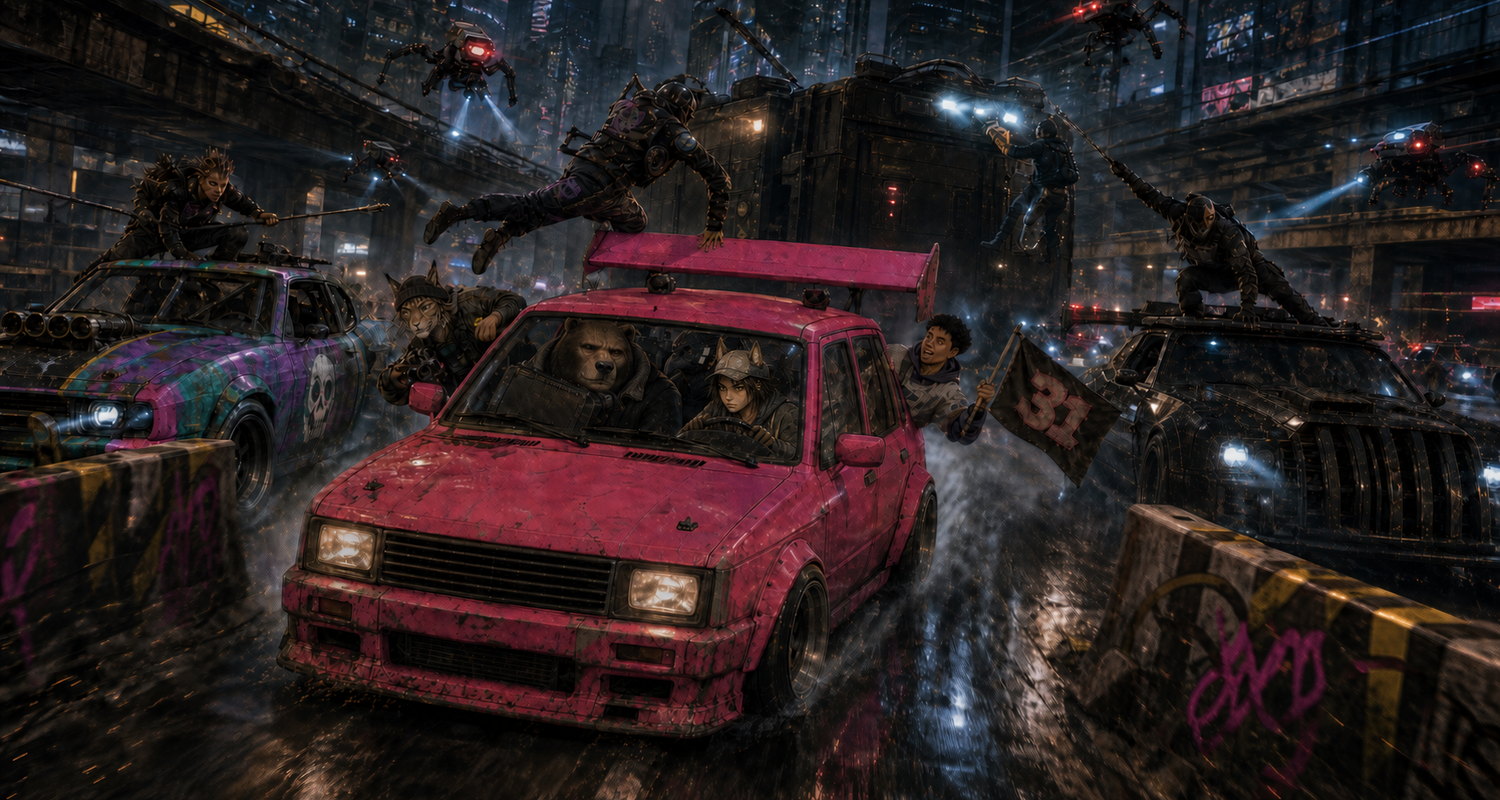
| Form | Comic engine | Real pressure | Aftermath |
|---|---|---|---|
| Plan Goes Horribly Wrong | competent preparation meets one impossible variable | Cas must trust an unmodeled person | the failed plan becomes somebody else's reliable story |
| Betrayal | everyone predicted betrayal by a different person | trust and contract terms separate | the actual betrayer still needs something from the crew |
| Rescue | the rescued person rejects the role | who gets called spare | the cost appears in care, family, or lost work |
| Rivalry | a small insult gains production value | the audience rewards escalation | somebody must continue living beside the rival |
| Flex | total seriousness applied to unnecessary proof | reputation becomes bodily or material risk | the object or place carries the mark afterward |
| Prank | planning quality exceeds strategic value | consent and collateral damage | the target's answer changes the relationship |
| Hangout | five incompatible routines share one room | ordinary obligations enter chosen family | nothing resolves; the audience understands more |
| Legend | witnesses can't agree and all improve the story | ownership of memory | a missing version becomes more valuable than footage |
| Bet | the terms remain technically fair while the scale escapes | pride, money, and public expectation | The Line settles; friendship doesn't |
| Stunt | performance becomes real during execution | sponsor, audience, and safety want different endings | success creates a more dangerous offer |
Before outlining, identify the incident form.
The same premise changes with the choice.
A rival reaches the warehouse first can be Plan Failure, Rivalry, or Betrayal.
Ozzy sells tickets to the garage can be Prank, Flex, Hangout, or Stunt.
Danka agrees to a race can be Bet, Rivalry, Rescue, or Legend.
The form tells you what kind of consequence matters.
A foolish person making a foolish error ends quickly.
A competent person applying the wrong excellence is sustainable.
Danka escalates the getaway. Theo keeps filming the frame. Cas improves the plan past the point where the objective deserves it. Ozzy creates a market. Grigor feeds the complication.
Every incident has a moment when the joke remains funny and the cost becomes visible.
Don't announce the tone change. Let behavior carry it: camera lowers, engine stops, Grigor speaks quickly, Ozzy loses the patter, Cas doesn't count, or the extra bowl remains empty.
Then return to life. Dread is seasoning. The crew still has to get the vehicle home.
Take ninety seconds after every contract and decide what the city received.
1. What went up?
The crew decides. Nothing, one moment, a clean account, or the whole night. Theo has final cut. Everybody gets to argue.
2. What stayed out?
Name one deliberate omission. Write it down. The missing thing now exists as an object somebody might find, request, misdescribe, or sell.
3. What did the district say?
Choose a top comment, vendor reaction, neighborhood rumor, or silence. The verdict is often useful and not the verdict the crew wanted.
4. What did exposure cost?
Dark work posted at all is breach. Broadcast work withheld can be breach too. Apply the contract's actual camera condition.
| Return point | Ask |
|---|---|
| Repair | what came home damaged, altered, or missing? |
| Payment | what was paid, withheld, substituted, or made conditional? |
| Comments | who recognized what the crew didn't mean to show? |
| District | who benefits, who waits longer, who now expects help? |
| Family | what cover story must survive dinner? |
| Institution | which record changed and who receives it next? |
| Rival | who accepted the refused work or the other side? |
| Next pressure | what will arrive before the crew is ready? |
Don't narrate a month of upkeep in summary. Open on an action and interrupt it.
Danka is rebuilding. Cas is servicing. Theo is cutting. Ozzy is trading. Grigor is cooking whether or not anybody considers it downtime. Somebody comes to the door.
A consequence matters only if the table can name the decision that caused it.
If nobody can, save it. Random adversity creates weather. Traceable fallout creates campaign.
END ON THE COMMENT, NOT THE PAYOUT.
The Warranty Void Mission Book is the playable companion to this guide. Its contracts provide the operational situation, open player-facing brief, sealed truth, clocks, people, fallout, and links to recurring systems.
This book supplies the world around those contracts. Don't read the setting guide as homework before play. Open both where the desired tone lives.
Neighborhood and household: The Wash, Nobody's Kid, House Rules, The Last Tenant.
Body economy: The Arm, Service Notice, Repossession, The Whole Queue.
City infrastructure: The Filter Job, Standpipe War, Grid Firmware, Slack Water.
Route and vehicle: Dark Transit, One-Way Fare, Rental Sound, The Long Way.
Attention and performance: Good Press, Six Minutes of Fame, The Booth, The Invitation.
Rivals and crew history: Pack Frequency, Title and Deed, Burn Notice, What the Tunnel Keeps.
The titles orient. They don't tell you the answer.
| District | Contract cluster teaches |
|---|---|
| Barricadia | the tap, neighbors, filters, district obligation |
| Center Point | audience, performance, brokers, controlled rooms |
| Musk Tunnels | route rules, firmware, extraction, unseen infrastructure |
| The Raze | salvage, cultivation, burn status, absent services |
| Ring Road | vehicles, race culture, pack pressure, title |
| High Top | access, patrons, presentation, clean hands |
| Low Coast | tides, committees, water records, tenancy |
| Monitor Central | notices, recovery, assessment, institutional scale |
Open at the Wash before work.
Grigor is cooking. Somebody is at the alley tap. Let the players meet the crew through one ordinary need. Then introduce a Band 1-3 ask attached to a person they can see.
Don't lecture on Heat, Clout, or the body economy. Use the first consequence to teach the rule that now matters.
Resolve the clip after the job. End on the city's response.
The Mission Book's sealed side belongs to the table running that contract. This setting guide doesn't reproduce those answers.
The setting guide's SEALED material provides methods, pressure, and campaign tools that remain useful after a specific contract has been resolved.
Together they should create recognition without foreknowledge.
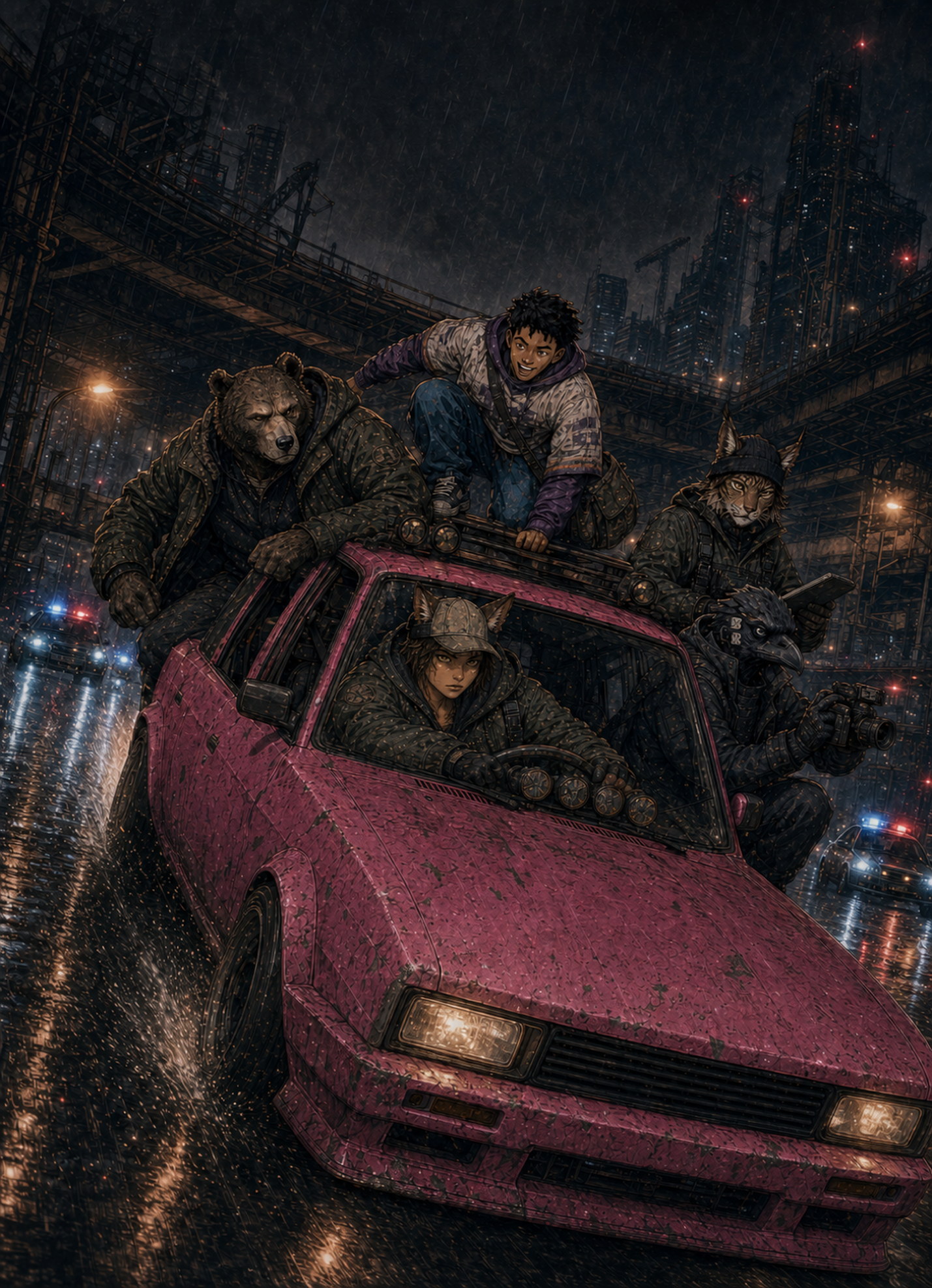
Roll one die on each column or choose. Connect the results with the smallest explanation that works.
| d8 | Place | Immediate pressure |
|---|---|---|
| 1 | Barricadia | the queue knows before the crew |
| 2 | Center Point | the room is neutral and watched |
| 3 | Musk Tunnels | the safe window is closing |
| 4 | The Raze | no official response will come |
| 5 | Ring Road | movement is already public |
| 6 | High Top | somebody can buy the easier answer |
| 7 | Low Coast | the timetable is right and the structure around it is wrong |
| 8 | Monitor Central | procedure is ahead of notification |
| d8 | Someone needs... |
|---|---|
| 1 | water kept moving |
| 2 | a person found without being returned |
| 3 | an object removed from the record |
| 4 | a route held open one more cycle |
| 5 | a public version before the official one |
| 6 | a body maintained without creating standing |
| 7 | a rival delayed, not harmed |
| 8 | a debt made payable by someone else |
Name three leads: a physical object, a person who talks, and a document.
Name three clocks: what the opposition is doing, what the district is noticing, and what happens to the client while the crew decides.
Write one Not-Line.
If the situation doesn't make the crew choose between the reward and somebody they must see again, change the human cost.
Lost Angeles doesn't stop when the camera leaves.
The standpipe queue changes order. The Musk window closes. A Low Coast committee moves a stair. The Bonded files. Sunset Delivery posts. A clinic opens late because a patient arrived early. Somebody accepts the contract the crew refused and does a version of the work nobody will ever see.
The setting can hold Warranty Void as protagonists, neighbors, rivals, patrons, local celebrities, unreliable witnesses, or five people eating in the background.
Inside the garage. Play the five-person crew. The campaign is about chosen family under visibility, body claims, and the cost of becoming locally important.
In the orbit. Play people whose lives repeatedly intersect the Wash: clinicians, couriers, family, rivals, residents, brokers, transit workers, journalists.
Elsewhere in Lost Angeles. Build a new splice. Warranty Void becomes evidence that this kind of life is possible and a warning about its price.
Across the Corridor. Use the city as one node in a wider operator campaign. The crew may be a contact, channel, complication, or rumor carried into another theater.
Don't route every Lost Angeles event through five famous operators. Barricadia had repair networks before the Wash. The Low Coast had committees before Salt Wake. The Raze grew food without a camera. Monitor classified queues nobody watched.
Warranty Void matters because it's situated inside these systems, not because it secretly caused them.
A good campaign lets players change relationships and material conditions without requiring them to solve the whole city.
Keep one tap open. Win one clinic a safer route. Break one claim. Preserve one record. Make one institution choose a different next step. Bring one more person home than the contract priced.
The city keeps moving.
Now it moves differently around what the crew did.
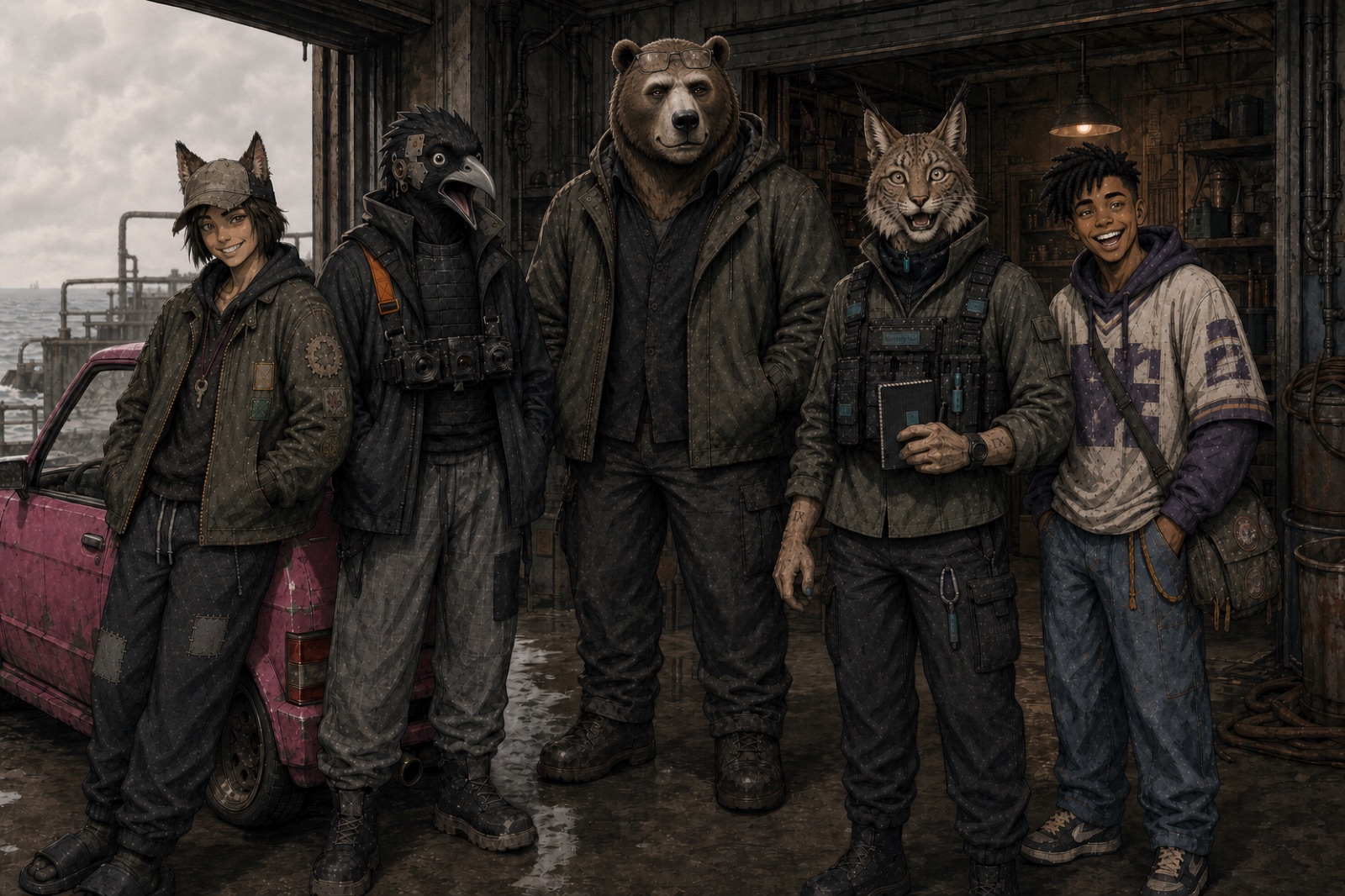
Use the published crew when the table wants strong relationships already under load. The characters arrive with skills, histories, habits, and clear pressures. They don't arrive with predetermined emotional scenes.
| Dial | Low | High |
|---|---|---|
| Comedy | dry hangout, procedural absurdity | GTA-grade stunts, pranks, bets, public escalation |
| Body pressure | upkeep and social bias | assessment, title disputes, recovery threats |
| Attention | local recognition | Feed-wide scrutiny and institutional response |
| Household | contracts dominate | tap, family, food, and neighbors drive most choices |
| Dread | background wiring | one deliberate serious hinge amid comic play |
Default is high comedy, medium household, medium attention, visible but not constant body pressure, and restrained dread.
Danka: ownership, route control, a competent pack, a choice between Civilian and the crew's immediate need.
Theo: editorial control, public protection versus private exposure, footage whose best use isn't publication.
Grigor: presence instead of endurance, allowing competent help, a successful return where nothing dramatic happened.
Cas: support with terms, a plan that requires trust, scarce maintenance shared with another orphan.
Ozzy: value without self-pricing, family overlap, a room where emotional judgment matters more than equipment.
These pressures are enough. Don't import withheld wounds to prove the characters have depth.
Five players, one character each, is the intended ensemble shape.
With fewer players, keep the missing member active through their structural role rather than turning them into silent luggage. With an additional player, add a guest operator or orbit character for the current arc. The published comedy engine remains the five leads.
| You play... | Daily work | Warranty Void becomes... |
|---|---|---|
| A new splice | contracts across the eight districts | benchmark, rival, occasional patron, cautionary channel |
| Couriers and transit workers | routes, loads, closures, handoffs | the noisy crew that changes a window you rely on |
| Clinicians and maintainers | care, parts, liability, records | patients, debtors, protection, dangerous visibility |
| Journalists and frame-hunters | verification, source care, publication | evidence with opinions and an audience already attached |
| Neighbors and water workers | taps, queues, repair, allocation | tenants operating public infrastructure out of a home |
| Rival operators | the work they refuse or reach second | competition whose choices keep changing your market |
| Family and shop workers | ordinary livelihood beside hidden risk | five customers who insist the relationship is personal |
| Impulse stock | survival inside title and compliance | people who understand the claim and may help without owning |
They need something done quietly because their own presence makes it public. The pay may be fair, the brief poor, and the reason for using outsiders completely legitimate.
Don't make them omniscient employers. Danka knows the route. Cas knows the plan. Theo knows the footage. Ozzy knows the room. Grigor knows who is missing. Your crew may know the fact none of those methods reaches.
Their post changes the job. Their audience identifies your location. Their standpipe promise conflicts with your buyer. Their rival reaches your route. Their merch turns a private symbol into a public one.
They don't have to oppose you to make the night harder.
Young operators may imitate the channel's look, jokes, and stunts without understanding the household under them. Older operators may dismiss the crew as attention addicts while using the public precedent they created.
Let imitation be partial. Nobody should become a second Warranty Void by changing wardrobe.
Outside Barricadia, a person may know only one version:
Every version is true enough to cause trouble.
Choose:
You don't need five traumatic secrets. You need reasons to return to the same room.
Premise. The crew maintains a public water point in a district where legal allocation and lived access have diverged.
You play. Neighbors, repairers, route runners, local operators, organizers, and people whose households depend on the line.
Recurring cast types. Landlord with partial history, cartridge seller, queue elder, water technician, district enforcer, clinic worker, child who carries news.
First pressure. Output is falling, the public notice says it isn't, and a private buyer offers a replacement line with tenancy conditions.
Advancement question. Can the community make water access more reliable without turning the tap into somebody's asset?
Limit. Don't reveal one mastermind behind scarcity. Use allocation, maintenance, ownership, weather, debt, and human choices.
Premise. A small splice's channel becomes locally useful faster than the crew becomes ready for the consequences.
You play. Operators, editor, fixer, source handler, merch maker, technician, or rotating people in front of the camera.
Recurring cast types. Frame-hunter, borrowed-verification host, rival channel, de-verified reporter, venue camera operator, family member who watches without commenting.
First pressure. Footage clears somebody accused by an institution and exposes the household that sheltered them.
Advancement question. Can the crew build a public jurisdiction without converting every relationship into content?
Limit. Attention isn't mind control. A post can shift cost and belief; it doesn't automatically settle fact or compel an institution.
Premise. A maintenance network keeps modified people functioning while lawful standing, title, and parts availability deteriorate around them.
You play. Orphanware operators, baseline runners, gray clinicians, document forgers, impulse stock, parts brokers, or family caregivers.
Recurring cast types. Assessor, donor-line contact, forum moderator, recovery sister, responsible clerk, hostile holder, frightened patient with clean paper.
First pressure. A safe substitution works, but the diagnostic record identifies everyone who received it to the firm claiming the failed original.
Advancement question. Can care become durable without recreating the ownership structure it replaced?
Limit. Don't make every maintenance event bodily horror. Repair should restore choice. Pressure comes from title, data, scarcity, and relationship.
After several sessions, let one frame supply the cost in another.
The standpipe needs a part obtainable only through body-economy salvage. The clinic needs gray-band attention and fears exposure. The channel needs a household willing to become visible. The best campaign doesn't merge every problem. It makes players decide which network carries the strain.
Use zero to six segments. Mark a segment when a visible decision feeds the pressure. Clear one only when the crew gives up something the clock cares about.
Clear by: settling, correcting, transferring, contesting title, changing jurisdiction, or making the claim more expensive than accommodation.
Clear by: this clock usually doesn't clear. It changes into obligation. Betrayal can empty it and leaves a different campaign.
Clear by: going quiet, supplying context, changing the subject with a larger truth, or accepting loss of control.
Clear by: correcting the input, changing the category, exposing the handoff, or giving the system a cheaper lawful path.
Clear by: paying early, negotiating scope, transferring value, or refusing and accepting the consequence.
Clear by: becoming useful, becoming costly, redirecting the pattern, splitting interests, or leaving.
Lost Angeles is full of accurate information nobody can use, useful rumors nobody can prove, and unanswered questions that become smaller when solved.
Keep the categories separate.
Facts are load-bearing. They remain true when the crew ignores them.
Rumors are instruments. They reveal fear, desire, or allegiance even when they're false.
Leverage changes a choice. If information can't alter what someone may do next, it's texture.
Questions make room. Don't answer one because a session went quiet.
| Subject | Fact | Rumor | Leverage | Keep unanswered |
|---|---|---|---|---|
| The Wash | The crew's lease is legal. The tap is free. The live filtration line serves the block. | Warranty Void got the building for nothing and someone will want it back. | Marisol Vega holds the paper. The queue can establish who came to the address and when. | Why did Sub 3 keep reporting output for six years after its official closure? |
| Barricadia | Monitor assesses the district four times a year. Its protection is social, not technical. | The next sweep isn't routine. A second tap exists and someone's charging. | A posted route can move people before the assessor arrives. A silent queue can erase a visitor. | Why has Jaguario never leaned on the Wash? Don't turn Vega into an answer before she becomes a character. |
| The channel | Metadata doesn't lie. Theo's edit can shape meaning, but not the recorded time. Attention earns money and identifies locations. | The founding clip proves something nobody in it wants shown. Every rival has a complete copy. | Unposted footage can clear a person, ruin a client, or establish a route. Posting it spends the protection of uncertainty. | What does the full founding clip show? Keep it unseen. Six blurred frames are already enough. |
| The body economy | Assessment is legal. Default feeds recovery inventory. Barricadia is assessed for yield. | Service can repair anything if the account is valuable enough. | Standing papers buy time. A clinic record can prove care, identity, or location. | Who ultimately profits from the whole line? An institution can stay frightening without one secret owner. |
| Vroza and Grava | The pack is in the Western Corridor under treaty. Asset Recovery can't move openly here. | Vroza is waiting for jurisdiction to change. Grava-Six likes the Wash's cooking. | Public embarrassment limits Vroza while he's on display duty. The crew's audience is temporary armor. | Whether any wolf in Grava would leave if offered the choice. Don't decide for them off camera. |
| Frequency | The cadence stays constant while the face and voice change. Information is traded for confirmation. | Frequency is a person, a network, Monitor, Theo, or a room that listens. | Every purchase forces the buyer to confirm one true thing. | Who Frequency is. The answer is less useful than the transaction. |
Answer an open question only when all three are true:
If any one is false, give evidence instead.
Don't improvise the identity of Frequency, the reason behind Vega's protection, the full founding footage, or a future defection because a player rolled well. A strong roll earns access, proof, or leverage. It doesn't obligate the setting to become smaller.
Creator-only character wounds aren't entries in this ledger. They're outside the book. If a campaign needs a private pressure, make one that belongs to that table.
THE WARDEN'S RULE: Reveal the system early. Reveal the person when the choice costs something. Leave the myth alone until the myth becomes a decision.
Terra Conflictus isn't a world after one clean apocalypse. It is a world after systems failed in sequence and people kept building inside the gaps.
Exact dates below are stated by the source record. A c. date is an honest placement, not a hidden answer. Events after the 2066 present are excluded. This book doesn't spend the future before a table reaches it.
| Year | Event | What it changes here |
|---|---|---|
| 2026 | The Upheaval begins. | Climate disruption, relocation, infrastructure failure, and political fracture stop being separate emergencies. |
| 2028 | The Document Wars begin. | Targeted archives disappear. Provenance becomes power and surviving paper acquires a second life. |
| 2031 | Insurance collapse begins the Cascade. | Coastal risk becomes public loss. Governments inherit obligations private systems won't carry. |
| 2041 | The Los Angeles Seismic Event strikes at magnitude 8.4. | The east is flattened. The core is rebuilt from above; the outer districts rebuild themselves. The Raze remains. |
| c. 2042 | Superstorm Prometheus becomes a civic before-and-after. The Cascade closes under the Global Stability Accords. | The six-power order hardens. Contested-zone rules make jurisdiction mobile, layered, and purchasable. |
| 2045 | The first operationally certified gene-forged operator is fielded. | A designed body becomes an acknowledged military class. Competitors close the gap within two years. |
| 2046 | The first Crackerjack Competition is held. | Operators from rival powers share one public ground under rules and cameras. Violence becomes spectacle without becoming safe. |
| 2051 | The Dynamic Siege interrupts a live Crackerjack event. | Billions watch. The difference between operation, incident, and media object becomes impossible to ignore. |
| 2053 | Caseline Applied Genomics collapses. | Its lines, parts, liabilities, and people scatter through liquidation. Caseline-9 survives the company that named her. |
| 2055 | A second coastal rise tests the rebuilt shore. | Later barriers hold better than older infrastructure. Low Coast becomes work site, retreat line, and promise under maintenance. |
| 2059 | Cas purchases title to herself. | One woman receives a bill proving that she belongs to herself. The paper is real. So is the world that made her buy it. |
| 2060 | The UNSO Traveler enters Earth orbit. The Core Era begins. | The world receives a human population that missed the Upheaval. This is the broad operational present: faction order established, contested life normalized, old causes still active. |
| 2061 | Danka Ivel leaves Kavast at nineteen. | A state-designed pack operator crosses into civilian life carrying skills, markers, habits, and a live claim. |
| 2066 | Warranty Void operates from Reclaim Sub 3 in Barricadia. | Five people take contracts, post their own evidence, feed a block, embarrass institutions, and keep coming home. This is now. |
Pre-Upheaval objects carry assumptions nobody can afford anymore.
Upheaval survivors remember institutions changing while they were still inside them.
Cascade-born adults grew up treating jurisdiction as weather.
Core Era youth know the patched world as the world. Ozzy isn't nostalgic for a social contract he never experienced.
Put all four relationships to history at the same table and nobody needs to deliver a lecture. Let them disagree about what counts as normal.
THE CALENDAR DIDN'T RESET. THE WARRANTY DID.
| District | Read it fast | Primary pressure | See |
|---|---|---|---|
| Barricadia | repaired blocks beneath transport infrastructure; water queues, markets, workshops | allocation, assessment, neighborhood memory | 39 |
| Center Point | dense public middle; venues, buyers, transit, surveillance, crowds | attention, price, being recognized | 41 |
| Musk Tunnels | buried freight and transit corridors with exploitable blind windows | ventilation, sensors, closure, getting turned around | 43 |
| The Raze | quake-flattened east rebuilt in fragments, salvage, dust, and improvised utilities | exposure, footing, territorial knowledge | 45 |
| Ring Road | forty-one-kilometer elevated orbital route and the city's moving stage | speed, drones, exits, witnesses | 47 |
| The High Top | vertical wealth and hospitality above Center Point | credentials, elevators, service access, discretion | 49 |
| Low Coast | seawall, launch infrastructure, tide work, retreat zones | weather, water, schedules, controlled approaches | 51 |
| Monitor Central | the city's classification and response footprint, not one omniscient room | records, routing, escalation, procedural lag | 53 |
| Route | Connects | Best use | What closes it |
|---|---|---|---|
| Ring Road | every district by ramp and sightline | speed, pursuit, public arrival, race movement | drone net, crash, maintenance block, obvious vehicle |
| Musk Tunnels | buried industrial mouths, freight bays, east-west service lines | dark transit, weather cover, cargo | sensor patch, ventilation shutdown, sealed branch |
| Barricadia service streets | markets, standpipes, workshops, the Wash | local access, concealment by ordinary life | queue, delivery conflict, assessment sweep |
| Raze crossings | eastern ruins, salvage yards, improvised approaches | off-grid movement and line-of-sight breaks | dust, unstable grade, somebody else's route claim |
| Low Coast causeways | seawall, launch staging, flood works | heavy load, clean distance, timed transfer | tide gate, surge warning, permit window |
| High Top verticals | garage levels, kitchens, hotel floors, private rooms | moving unseen through service labor | credential cascade, locked lift, staff recognition |
| Center Point surface | venues, exchanges, transient crowds | meeting, tail loss, public leverage | event density, price swing, camera saturation |
| Storm and utility lines | the infrastructural city beneath the named one | emergency bypass, maintenance access | water, live current, crews already working there |
For any crossing, choose two. Choose three when the route is the mission.
Clock. Tide, allocation, drone interval, delivery window, shift change.
Load. The cargo doesn't fit, can't get wet, must stay powered, or has a legal owner.
Claim. A crew, household, institution, or system believes the route is theirs.
Witness. Someone sees the vehicle, face, package, or kindness and remembers accurately.
Weather. Heat, rain, dust, surge, wind, bad air, standing water.
Return. The way in works once. The city changes before the way out.
A six-block trip can cross three forms of authority. A full Ring Road lap can be simpler if the vehicle, weather, and record agree.
Before play, state the distance, the likely time, and the person or system with power to make those disagree.
This isn't a census. It's the compact directory for names a reader can encounter in this book without opening a future door. Unresolved figures and undeveloped galleries aren't included.
Abi Okonkwo-Cruz. Ozzy's older sister; forensic accountant; professionally incapable of accepting “security logistics” without a reconciliation. 107, 111
Blessing Okonkwo. Ozzy's mother; Barricadia market matriarch; reads the crew as weather and feeds the forecast. 107, 111
Cas, Caseline-9. Lynx-lineage planner, medic, titleholder to herself, and keeper of the clipboard. 101-104
Danka Ivel. Human-faced, wolf-eared Kavast fugitive; Jockey, mechanic, and owner of Civilian in every way the record doesn't understand. 89-92
Dr. Silk. Barricadia gray vet who stabilizes unsupported bodies and accepts samples as payment. Kind care and unanswered collection are both real. 75, 112
Frequency. Center Point signal pirate, singular or plural unresolved. Trades information for confirmation. 112, 178
Grava-Six, “Two Bowls.” Young Grava scout; audience-named after surveillance turned into dinner. No future choice is settled. 116
Grava-Two. Veteran second who sees the feud clearly and remains inside the formation. 116
Grigor Tam. Bear-lineage former Eastern Compact operator; shield, cook, medic's worst patient, and oldest member of the crew. 97-100
Ilya Vroza. Kavast commander, wolf lineage, twenty-nine years in command; Danka's ideological opposite and the only man in the feud who doesn't know it's funny. 113-114
Marco Cruz. Ozzy's father; printer; maintains old presses and expresses judgment in very few words. 107, 111
Marisol Vega. Holder of the Wash's legal paper and guardian of its free water condition. 110-112
Ozzy Okonkwo-Cruz. Baseline human broker, seller, designer, family liar, and audience translator; youngest of five and never the mascot. 105-108
Rea Okonkwo-Cruz. Ozzy's sister; transit technician working Monitor-adjacent Musk Tunnel systems. 107, 111
Theo Ashe. Raven-lineage camera, overwatch, editor, and former Protectorate distributed-vision operator. Full avian head. 93-96
Asset Recovery. The process and agents that pursue bodies or components under a surviving claim. 61, 75, 113
Barricadia Reclaim Cooperative. District institution involved in water, salvage, continuity, and the Wash's lease. 39, 110
Caseline Applied Genomics. Failed private producer whose liquidation orphaned products, people, parts, and support. 67, 101
Eastern Compact. Grigor's lineage state and author of a persistence doctrine with a bill. It isn't one of the six global powers. 65, 97
Eurasian Oligarchy. One of six global powers; heavy industry, extraction, field repair, and oligarch-funded force projection. 13
Grava Pack. Six Kavast wolf operators on Western Corridor liaison and convoy duty under Vroza. 113-116
Hallim & Hallim. Recovery specialists who knock, explain, and arrive with correct paper. Courtesy doesn't cancel the claim. 116
Hearsay. An unattributed rival crew built around absence, preparation, and jobs finished before confrontation. 116
Jaguario. Major Lost Angeles criminal power with territorial interests and an eye for profitable order. 13, 39
Kavast. State program and doctrine that produces wolf packs, genomic registration, and claims described as belonging. 61, 89, 113
Los Creeps. Lost Angeles criminal network; distinct from Jaguario and locally embedded. 13, 39
Monitor Central. Classification, routing, observation, and response architecture spread through city systems and mobile personnel. 53-54
North American Federation. One of six powers; dominant formal authority in the Western Corridor. 13, 21
Nordics Arcology Network. One of six global powers; closed-loop Arctic cities, environmental systems, and information leverage. 13
Pan-Caliphate Union. One of six global powers; solar power, desalination, long diplomacy, and theological governance. 13
Pacific Rim Collective. One of six powers; a Pacific trade-and-security bloc. 13
The Protectorate. Theo's lineage state and author of distributed vision as doctrine. It isn't one of the six global powers. 63, 93
Southern Cartel Alliance. One of six global powers; bio-engineering, agriculture, living architecture, decentralized trade, and entertainment. 13
The Bonded. Rival operators for whom lawful cover is a professional method. 116
The Second Unit. Former unit members who continue by persistence and refusal. 116
Sunset Delivery. A young rival channel-crew that treats nearly everything as content. 116
The Syndicate. Market-making criminal institution whose prices, booths, and brokers can move ahead of formal law. 41, 130
Warranty Void. Danka, Theo, Grigor, Cas, and Ozzy; a five-person splice, contract crew, household, and channel. 7-8, 83-108
The Tooth. An older Barricadia garage bar. 39
The Tooth and Gear. Center Point nightclub in the High Top Towers; Raid Race neutral ground by convention. 41, 130
The Wash. Reclaim Sub 3, a decommissioned water-reclamation property in Barricadia. Home, workplace, queue, and live filter line. It isn't a transit depot. 109-110
A term's owner is the register in which it sounds native. Anyone can repeat a word. Fluency still reveals where they learned it.
| Term | Meaning | Register / first use |
|---|---|---|
| aftermarket | Replacement or added body hardware outside the maker's original support chain. It can be insult, neutral description, or pride. | body-shop, orphanware / 69 |
| assessor | Institutional worker who translates a body, building, district, or system into class, yield, liability, and next procedure. | insurer, Service, Monitor / 7 |
| Attention War | The struggle to make a version visible, credible, memorable, and useful before someone better resourced fixes the story. | media, politics / 23 |
| baseline | A person without gene-forged lineage. Formally neutral; socially treated as default when the default holds power. | civic, clinical / 7 |
| blank | Baseline with no lineage marker or genomic state claim to scan. Contempt in some mouths, field-neutral in others, reclaimable by the person targeted. | state military, operator, self / 13 |
| body economy | The system that prices bodies through manufacture, service, insurance, registration, labor, recovery, and resale. | analytic, trade / 1 |
| Cascade, the | Governance collapse from 2031 through 2042 inside the larger Upheaval. | historical, civic / 11 |
| Caseline | Caseline Applied Genomics, collapsed in 2053; also the inherited brand name attached to surviving people, parts, and catalogs. | corporate, orphanware / 67 |
| catalog kid | Privately manufactured person traceable to a product catalog, page, or figure number. Often self-directed, never emotionally neutral. | orphanware / 185 |
| Clout | Table measure of audience reach and district willingness to open doors, omit details, or defend a crew. High Clout also destroys anonymity. | TABLE, channel / 5 |
| depreciated | Eastern Compact status for an operator or asset written down rather than actively recovered. | Compact, defector / 17 |
| donor line | A discontinued or dead lineage whose compatible components can keep another body working. The phrase carries gratitude and grief. | orphanware, clinic / 185 |
| drift | Change between designed impulse, lived habit, injury, aging, adaptation, and self-authored choice. Not automatically malfunction. | clinical, community / 79 |
| EOL / end-of-line | Support and production have ended. Applied to a person, it may be trade shorthand, gallows language, or cruelty. | corporate, orphanware / 137 |
| Exposure | Contract rating for who may record, retain, edit, or publish the work: Dark, Quiet, Cut, Public, or Broadcast. | TABLE, media / 23 |
| factory settings | Teasing term for a baseline body. Ozzy's answer is OEM. | crew, street / 69 |
| Feed, the | The networked attention layer through which clips, records, ads, reports, comments, and reputations travel. Not one platform. | common, media / 5 |
| gene-forged | Person whose inheritable or designed genomic features were engineered into a lineage. A material condition, not a personality. | formal, community / 5 |
| gray band | Media that is unlicensed but tolerated: watched by authorities that publicly deny granting it standing. | media, legal / 5 |
| gray vet | Unlicensed lineage clinician. The animal-care root is a buried insult the community uses dryly and deliberately. | orphanware, district / 5 |
| Heat | Table measure of recognition converted into institutional attention. Track who holds it. | TABLE, institutional / 5 |
| impulse stock | Engineered behavioral tendency attached to a lineage program: pressure, not command and never a full explanation of conduct. | bioindustry, clinical / 59 |
| lineage | A gene-forged design family, its inheritable traits, social history, and institutional claim. Not a complete identity. | formal, community / 9 |
| listed | Protectorate status for a deregistered or unrecovered operator retained on the Registry. | Protectorate, defector / 17 |
| live marker | Kavast genomic marker that still reports an active recovery claim. | Kavast, defector / 17 |
| Monitor Central | Lost Angeles observation, classification, dispatch, and response architecture. Distributed, procedural, and fallible. | civic, operator / 21 |
When a term lands, ask three questions:
If the answers don't matter, ordinary language will usually do more work.
| Term | Meaning | Register / first use |
|---|---|---|
| OEM | “Original equipment.” Ozzy's reclaimed baseline label, product mark, and answer to factory settings. | Ozzy, streetwear / 69 |
| OPEN | Reader-safe setting truth. It may be known widely, locally, or only by a named witness, but the book isn't withholding it from players. | book status / 1 |
| Operator | Contract professional who crosses jurisdiction, danger, and institutional gaps to produce a result. A job before it is a rules role. | field, formal / 3 |
| orphanware | Gene-forged person whose maker or support chain no longer exists; also the unsupported systems around that life. | community, clinic / 5 |
| paper | Operator shorthand for an unmodified body facing a physical problem. Usually practical rather than political. | operator / 13 |
| parts funeral | Remembrance and redistribution when a person or component reaches its end; useful parts find bodies that need them. | orphanware / 79 |
| Rate Band | Contract scale from Favors to Void, measuring promised compensation and implied consequence. | TABLE, broker / 147 |
| the recall | Orphanware gallows joke about support that will never return and the dead nobody comes to collect. Outsiders haven't earned it. | orphanware / 67 |
| Recovered File | Channel form built from third-party material, preserved noise, incomplete custody, and no false cleanup. | Warranty Void media / 3 |
| running ghost | Unsupported firmware or hardware still working through compensation, adaptation, and care. | orphanware, mechanic / 137 |
| runs manual | Rare, respectful operator phrase for a baseline succeeding without engineered work. | operator / 137 |
| SEALED | Warden-facing, table-safe material whose concealment creates play. It never means creator-only biography imported into the campaign. | book status / 3 |
| Service | The maintenance, warranty, clinical, and recovery complex around designed bodies. Also a way institutions make care conditional. | institutional, clinical / 9 |
| serviced | Maintained, current, cared for. Product-status language reclaimed as respectability and pride. | orphanware / 137 |
| shelf date | The imagined or documented point at which a designed body stops being worth supporting. Nobody knows theirs; many suspect someone printed it. | orphanware / 187 |
| source status | Production label distinguishing deployed truth, approved undeployed canon, corroboration, conflict, proposal, and exclusion. It isn't an in-world rank. | editorial / 187 |
| splice | Originally a slur for a mixed-lineage crew with no single sponsor or doctrine; reclaimed as a method and identity. | operator, state / 5 |
| standing | Recognition that lets a person, claim, document, or channel produce consequences in a given jurisdiction. | legal, street / 5 |
| sunset | To end support while retaining patents, claims, data, or other surviving rights. | corporate, orphanware / 27 |
| TABLE | Procedure intended for use in play: a generator, clock, rating, or decision tool. It isn't necessarily known by characters. | book status / 5 |
| Upheaval, the | Compound climate and governance failure beginning in 2026 and consolidating the world that follows. Not one storm or war. | historical, common / 5 |
| void | To break, lose, or cancel genomic registration or warranty standing; a normal opener between forged strangers who recognize the aftermath. | defector, operator / 1 |
| voided paper | Receipt or legal instrument proving formal separation from a maker, registry, or claim. Often laminated and carried close. | defector / 137 |
| Warranty Void | The five-person crew and its channel; also the paperwork joke that made the name sound native before it became famous. | proper name / 1 |
| work / work done | Engineered alteration visible on or inferred from a body. Depending on the speaker: neutral description, appreciation, suspicion, or reduction. | street, operator / 187 |
The state writes, the market prints, the body pays. Ownership travels through documents and lands in flesh.
Grease is cheaper than grief. Maintenance is care before it is drama.
Leashes come with vet care. Security and service can be real benefits without making the claim humane.
Use the sentence only when the speaker has paid enough to mean it.
aftercare, 79-80, 157-58
aftermarket, 69-70, 185
air, 31-32
Asset Recovery, 61-62, 75-76, 113-14, 155-56
assessors, 7-8, 75-76, 110, 155-56
Attention War, 23-24, 117-24
audience, 23-24, 59-60, 117-24, 149-50, 161-62
Barricadia, 37-40; assessment, 39-40, 110; food and water, 127-28; routes, 181-82; the Wash, 109-10
Barricadia Reclaim Cooperative, 39-40, 109-10
baseline people, 69-70, 105-8, 137-38, 185-88; see also blank, OEM
blank, 69-70, 105-8, 137-38, 185
bodies, 17-20, 57-82; autonomy, 79-82; care, 73-80; ownership, 71-76
body economy, 1-2, 71-76
body shop, 73-74
boards, contract, 147-48
boundaries, campaign, 169-72, 177-78
cameras, 23-24, 93-96, 117-24, 159-62; see also Feed, Theo Ashe
campaign frames, 169-78
Cascade, 11-12, 179-80
Cas, 83-88, 101-4, 139-40
Caseline Applied Genomics, 67-68, 101-4, 179-80, 183-86
Center Point, 37-38, 41-42, 49-50, 129-30, 181-82
channels, 23-24, 59-60, 117-24, 133-34, 159-62
citizenship, genomic, 17-20
Civilian, 89-92, 145-46, 157-58
clients, 145-54
Clout, 5-6, 149-50, 175-76
clothing, 81-82, 89-108, 125-26
comedy, 85-88, 113-16, 145-46, 159-60
contracts, 15-16, 71-72, 145-58; refusal, 147-54; rate, 147-48
Crackerjack Competition, 13-14, 179-80
credits, 147-52
crews, rival, 115-16, 171-76, 183-84
culture, 23-24, 117-44
Danka Ivel, 7-8, 43-44, 61-62, 83-92, 113-14, 139-40
dead band, 117-18
districts, 27-56, 181-82
Document Wars, 11-12, 179-80
Dr. Silk, 73-76, 111-12, 183-84
drift, 79-80, 185
Dynamic Siege, 179-80
Eastern Compact, 13-14, 65-66, 97-100, 183-84
editing, 93-96, 119-24, 159-62
EOL, 67-68, 101-4, 137-38, 185
Eurasian Oligarchy, 13-14
Exposure, 23-24, 147-48, 185
factions, 13-14, 21-22; see also individual powers
family, 85-88, 105-12, 127-28
Feed, the, 23-24, 59-60, 117-22, 133-34
fixers, 111-12, 151-52
food, 97-100, 127-28, 143-44
formats, channel, 121-22, 159-60
Frequency, 111-12, 177-78, 183-84
futurewear, 81-82, 89-108, 125-26
gene-forged, 15-20, 57-82, 137-38, 185-88
global powers, 13-14
Grava Pack, 61-62, 89-92, 113-16, 177-78
gray band, 5-6, 117-18, 187-88
gray vets, 73-76, 111-12, 137-38
Grigor Tam, 7-8, 65-66, 83-88, 97-100, 139-44
Hallim & Hallim, 115-16, 183-84
Hearsay, 115-16, 183-84
Heat, 5-6, 149-50, 175-76
High Top, the, 37-38, 49-50, 181-82
home, 83-88, 109-10, 127-28, 143-44
impulse stock, 59-60, 77-80, 185-86
incidents, 121-22, 145-46, 159-62
information, 111-12, 151-52, 177-78
institutions, 13-18, 71-76, 155-56
insurance, 11-12, 71-72, 179-80
Jaguario, 13-14, 39-40, 183-84
jobs, see contracts, missions, work
jurisdiction, 13-18, 33-36, 59-66, 117-18
Kavast, 17-18, 61-62, 89-92, 113-16
language, 137-42, 185-88
lineage, 17-20, 57-70, 185-86
live markers, 61-62, 137-38, 185-86
locations, 27-56, 109-16, 181-84
Los Creeps, 13-14, 39-40, 183-84
Lost Angeles, 21-22, 27-56, 143-44, 167-68, 181-82
Low Coast, 37-38, 51-52, 129-30, 181-82
Marisol Vega, 109-12, 177-78, 183-84
media, 23-24, 59-60, 117-24, 133-34, 159-62
metadata, 93-96, 117-24, 159-62, 177-78
mission verbs, 153-54, 165-66
missions, 145-66; aftermath, 157-62; generation, 163-66
Mission Book, 163-64
Monitor Central, 21-22, 33-36, 53-54, 75-76, 155-56
Musk Tunnels, 35-38, 43-44, 181-82
North American Federation, 13-14, 21-22
Nordics Arcology Network, 13-14
OEM, 69-70, 105-8, 187-88
OPEN, 1-6, 187-88
operators, 15-16, 57-82
organizations, 183-84
orphanware, 5-6, 67-80, 101-4, 137-38, 185-88
Ozzy Okonkwo-Cruz, 7-8, 69-70, 83-88, 105-8, 139-44
Pacific Rim Collective, 13-14
Pan-Caliphate Union, 13-14
paper, 13-18, 59-66, 81-82, 137-38, 185-88
parts funerals, 79-80, 137-38, 187-88
payment, 147-52
people, 83-116, 183-84
property, 1-8, 17-20, 57-76, 109-10
Protectorate, the, 13-14, 63-64, 93-96
Rate Bands, 147-48, 187-88
Raze, the, 27-28, 37-38, 45-46, 181-82
Recovered File, 3-4, 121-22, 159-60, 187-88
registries, 17-18, 61-66, 81-82, 155-56
reputation, 23-24, 59-60, 117-18, 133-34, 149-50
Ring Road, 35-38, 47-48, 131-32, 181-82
routes, 35-36, 43-54, 181-82
SEALED, 3-6, 169-78, 187-88
Second Unit, the, 115-16, 183-84
Service, 9-10, 71-76, 155-56, 187-88
six powers, 13-14
slang, 69-70, 105-8, 137-38, 185-88
Southern Cartel Alliance, 13-14, 183-84
splice, 5-8, 19-20, 83-88, 137-38
sport, 41-42, 47-50, 131-32
standing, 5-6, 17-18, 59-60, 81-82, 151-52
Sunset Delivery, 115-16, 183-84
Syndicate, the, 41-42, 129-30, 183-84
TABLE, 5-6, 145-76, 187-88
Theo Ashe, 7-8, 63-64, 83-88, 93-96, 119-24, 139-40
timeline, 179-80
Tooth, the, 39-40, 183-84
Tooth and Gear, the, 41-42, 129-30, 183-84
Upheaval, the, 5-14, 179-80, 187-88
Vroza, Ilya, 61-62, 89-92, 113-16, 177-78
Warranty Void, 1-8, 83-116, 169-70
Wash, the, 7-8, 39-40, 109-12, 143-44, 177-78
water, 31-32, 39-40, 51-52, 109-10, 127-28
Western Corridor, 21-22, 61-62, 113-14
work, 15-16, 71-76, 145-66; engineered, 69-70, 187-88
WARRANTY VOID: PROPERTY OF NOBODY
Lost Angeles, the Body Economy, and Five People Who Voided the Terms
Terra Conflictus / Operator Tactics setting guide. First complete manuscript edition.
Setting year: 2066
Interior plan: 192 pages / 96 spreads
Source snapshot: 392c8e57c51f14a80a258bdc6df8f927a085030d
Build date: 28 August 2026
Compiled from the deployed Terra Conflictus Field Wiki, current setting and mission books, and approved undeployed Warranty Void canon. Proposed galleries, unresolved character futures, creator-only wounds, and post-2066 scenario outcomes weren't incorporated as setting fact.
Errata route: Cite the print page, disputed text, and controlling Terra Conflictus source. Reconcile corrections against the live Field Wiki and the setting guide's source ledger before issuing a new build.
The world continues after the last indexed page.
NO WARRANTY. NO OWNER. FIVE PEOPLE STILL INSIDE.