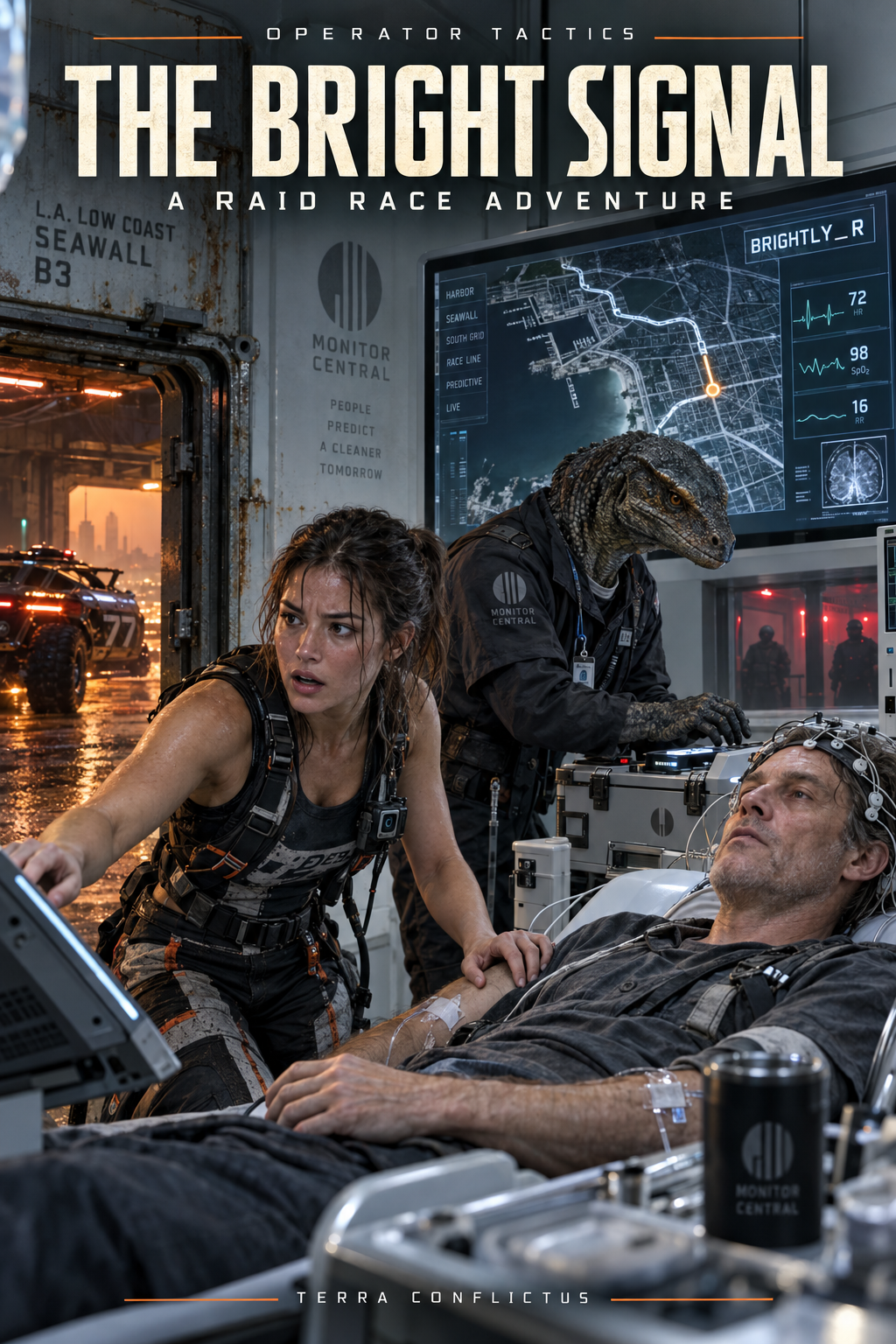
The Bright Signal runs in a specific visual world. Barricadia smells like coolant, engine fluid, and the particular chemical edge of flicker-paint that hasn't fully cured. The Tooth and Gear fills at 11 PM and doesn't thin out until the coastal sun finds the horizon. The Musk Tunnels carry filtered air with a metallic taste that feels like luxury to anyone who's been breathing Raze weather all season. The Low Coast seawall carries salt and desal chemistry on every breeze.
The people moving through this world wear stripped kit — faction surplus with the insignia cut away, dead credential stacks worn on chains at the collar, gene-forged modifications displayed rather than hidden. Jaguario's flicker-paint shifts from burnt orange to deep copper in the coastal light. Los Creeps machines run matte black with a reflective circuit trace that only catches under drone light. Monitor Central equipment is NAF corporate gray: no style, no pretense, engineered to function and nothing else. Every marked object tells you where someone came from.
Lean into the contrast. The investigation beats happen in spaces loud with human presence — the Tooth and Gear's bass, the garage's fluorescent clatter, the Raze's concrete-dust atmosphere. The facility in Beat 4 is medically quiet. Clean air. Steady temperature. A controlled space that doesn't belong where it's buried. The horror of Sector C lands harder when everything leading to it felt alive.
How This Adventure Works
The Bright Signal is a hybrid adventure. Investigation scenes and the facility infiltration run on standard Operator Tactics rules. Three scenes switch to Raid Racer (OT_Raid_Racer) for vehicle action. Each Raid Racer scene is marked with a ■ RAID RACER SCENE header and includes setup, table configuration, clocks, and special rules for that specific event.
You need: the Operator Tactics core rules, OT_Raid_Racer, a team of kitbashed miniature vehicles, and this document.
Contents
- The Dramatic Engine
- Background: What Really Happened
- The Setup
- Mission Brief
- The Five Beats
- The Clocks
- Climax Variables (1d6)
- Key NPCs
- Leverage Points
- The Not-Line
- Campaign Integration
- Running in a Different City
- Module Roll Tables
1. The Dramatic Engine
Lita Brightly's father is alive, wired into a Monitor Central neural link, and being used to predict Raid Race movements — while the people responsible for putting him there need the players to find this out at exactly the wrong moment.
That sentence is the whole adventure. Everything else is the pressure that makes it matter.
What This Adventure Is About
A man has been turned into infrastructure. He's not dead and he's not free. His daughter has spent a season inside Raid Race trying to find him, and she's finally close enough to be dangerous. The players are the people who can actually do something about it.
The adventure asks one question across three sessions: when you find him, what do you do? Rescue means shutting down the neural link, which may kill him. Leaving means Monitor Central keeps using him. There is no clean answer. The players make the call.
The Shape of the Adventure
Two modes of play run through The Bright Signal in sequence. Standard OT rules handle the investigation, the social maneuvering, and the facility infiltration. Raid Racer handles the three vehicle sequences: the tunnel approach, the extraction sprint, and — if Climax Variable 3 triggers — the chaos of an open-city heist with no drone prediction.
The vehicle sequences are not optional set-pieces grafted onto the investigation. They are the moments when the stakes become physical. Players build their teams, kitbash their vehicles, and know exactly what's riding on the Heat they accumulate.
2. Background: What Really Happened
Five years ago, Renn Brightly was a Raid Race Jockey running with Mo Money Jaguario's B-team. Not a champion. A mid-level competitor who happened to be exceptionally good at reading drone patrol patterns — good enough that he could map Monitor Central's predictive response algorithms from inside a live event.
Monitor Central's AI flagged him as a structural vulnerability before he knew he was one. During a heist in Glass Forest, a security drone capture went off-script. Renn was not processed into standard private detention. He was taken to a NAF black-site sublevel beneath an active Monitor Central hub in the Low Coast seawall infrastructure.
The neural link was experimental. It worked. Renn's intuitive understanding of drone patrol logic turned out to be a trainable asset. Monitor Central doesn't just run his pattern-recognition. It consults it. The system has been improving its Raid Race interdiction rates by 11–19 percent per season since the link went active. The drone swarms are better. Competitors are burning out faster. Nobody has connected the dots yet.
Mo Money knows. He was the one who cooperated with the initial capture, believing Renn would be held for a season and released. He has not told Lita. The guilt is the reason he watches Kid Spin from across the street.
Why Now
Three things converged at the start of the 2060 season to make the situation unstable. First, the drone interdiction rates are drawing analyst attention on the Feed. Second, Lita Brightly's Verified credentials just cleared, and she's asking questions that are getting close. Third, the NAF official responsible for the program — Director Amaras Vond — is facing a contract review. When the contract ends, so does Renn.
3. The Setup
The adventure begins when Frequency contacts the players. She has been intercepting Monitor Central traffic for two years and recently decoded an encrypted sub-channel she'd been sitting on. The channel carries behavioral prediction data tagged to active Raid Race competitors.
The data tag on the signal reads: BRIGHTLY_R. Asset classification: ACTIVE. Contract renewal: pending.
Frequency has a theory. She needs someone to confirm it in the field.
What the Players Know at the Start
Primary objective: Locate the source of the BRIGHTLY_R signal and determine what it is.
Secondary objective: Retrieve any intel on the facility and the people running it.
Tertiary (if Lita is involved): Determine whether Renn Brightly is alive and if so, what condition he is in.
4. Mission Brief
Duration: 2–3 sessions.
Tone: Investigative heist with a moral gut-punch at the center.
Player Count: 2–4 operators. Works best with Lita Brightly as NPC companion or player character.
System: Standard OT rules for investigation / infiltration. Raid Racer vehicle rules for Beat 3, the extraction, and Climax Variable 3.
Vehicle Teams: Each player builds a Raid Racer team before the adventure starts. Recommended budget: 40 Salvage. See OT_Raid_Racer for team building rules. Build something fast. The tunnels reward speed. The extraction rewards survival.
Entry Point: Standalone or as the climactic arc of the championship season (sessions 7–9).
5. The Five Beats
Beat 1 — The Tip-Off
The players investigate Renn Brightly's disappearance through The Raze and Barricadia: old mechanics, a retired Jumper who drove with him, the woman who ran the timing booth at the amateur circuit. No vehicle action. This is a conversation beat — information in exchange for trust, honesty, or something the contacts need.
What they find: Renn vanished mid-event in Glass Forest. No crash footage. No custody record. No death notice. The capture drone had a modified chassis profile. Vasca Threl, who drove with Renn that night, sketched it afterward and never showed anyone. The chassis matches a Monitor Central medical-transport unit.
The beat closes when Frequency triangulates the signal to a Low Coast maintenance hub. She gives the players a 72-hour window. The main clock starts here.
Raze weather runs at a different temperature than the rest of Lost Angeles. Concrete dust suspended at breathing height. Heat radiating off surfaces that have been decomposing in open air for nineteen years. Vasca's sideline repair operation sits between a water vendor and a parts salvage stall on the outer circuit's maintenance strip — she's not hard to find. She never hid.
What she looks like. Stripped kit: a three-layer jacket that started as NAF transit surplus and has been reworked so many times there's nothing left of the original except the cut. Dead stack at her collar — a Jaguario B-team badge, two expired race credentials, something that might be an old medical clearance tag worn smooth on one side. The chassis sketch has been folded into the jacket's inside pocket since the night she drew it. She hands it over without being asked once she decides the players are worth it.
What the players find in The Raze besides Vasca. Amateur circuit graffiti on every concrete surface — team marks, route claims, Calavera skulls in three different hands. A Jaguario-adjacent parts shop two stalls down run by a retired mechanic who knew Renn. Drone overflight every 22 minutes. The players can set a watch by it if they're paying attention. This is their first free piece of intel on Monitor Central's patrol timing.
Beat 2 — The Map Room
The players acquire three things: a maintenance access credential (from Bonzer Kabesh, in exchange for evidence on a Los Creeps recruiter running blacklists), a partial facility map (from Frequency — maintenance corridors only, sublevel is dark), and confirmation of what the neural link is (from Dr. Silk or a Tooth and Gear data broker).
Each acquisition costs something. Bonzer costs time. Dr. Silk wants a biological sample from a gene-forged competitor with template drift — which implicates Java Monsoon. The data broker already knows something about one of the players and wants it confirmed.
Beat 2 closes when players have a credential (valid 48 hours) and confirmation: Renn Brightly is alive, wired, and his contract renewal is in 36 hours.
Bass you feel in your teeth before you reach the door. Inside: nectar served in glasses that glow faint UV-blue under the bar lighting, flicker-paint murals shifting on the walls in time with Razborki's frequencies, the crowd packed tight enough that movement becomes a contact sport. The air conditioning fights the body heat and loses. It always loses on race weekends.
The Bonzer Kabesh meet happens in a VIP booth along the north wall. Bonzer runs elevated — dressed for a Feed appearance in a jacket with sponsor tags that are one season out of date, which tells the players everything about his current standing with Mo Money. He drinks fast. He checks the room every ninety seconds. He wants to do this transaction and leave before anyone credible sees him talking to people he can't explain.
The data broker works the second acoustic dead spot in the club — third stall from the wall in the men's bathroom, where the sound system's interference pattern doesn't reach. Dead credentials on every flat surface of his jacket, organized with a precision that suggests archival intent rather than fashion. He already knows something about one of the players. He was waiting for them to come to him. That's how he prefers it.
Razborki is at the DJ booth tonight. His vehicle is in the loading dock out back — flicker-paint in Jaguario colors with a small Calavera skull hand-painted at the fuel cell housing in flat black, slightly off-center, added after a sponsorship fell through three seasons ago. If the players think to ask him about the tunnels before Beat 3, he'll give them one piece of route intel for free. He's that kind of person.
The Musk Tunnel sensor grid was updated three days ago. The patrol window Frequency planned on is gone. Players push through anyway — but Monitor Central will have an elevated alert state when they reach the maintenance hub. How elevated depends on how clean they run the tunnel.
Set up the Raid Racer table using Traversal Mode (Raid Racers, Section 10) and the setup box below, which is the full course. There is no package and no target vehicle in this scene: run the tunnel as five gates — the chicane, the narrows, the midpoint blocker line, the long bore, the service ramp — and treat the blocker line as a gated obstacle. The players' vehicles must reach the far table edge (the Low Coast maintenance hub entrance). Monitor Central drones enter from table edges. NAF transit enforcement vehicles start at the midpoint as blockers.
| Table size | 3' × 3' minimum. Narrow tunnel corridors — two lanes wide at most. |
| Terrain | Concrete barriers, stalled transit vehicles, maintenance bays (cover). No open ground. Tight turns throughout. |
| Player deploy | Near table edge (Barricadia side). All vehicles in starting zone. |
| Blockers | 2 NAF transit enforcement vehicles on sedan hulls. Start at midpoint. They don't attack. They block. Passing them cleanly is a Drift, Ordinary 4+. Ramming through is a Race Roll at −1 that costs 1 damage on your sled, 1 damage on theirs, and 2 Security Pressure. Going around costs an extra action. |
| Drones | Sensor drones (not combat). Three in the bore. One drone activates every round regardless of what the players did, in order, moving its full move toward the nearest player vehicle. If a drone is within 3" at the end of its activation, roll 1d6. On 5–6: signal flagged, Alert Level +1. The Jumper's non-contact suppression (a Raid Roll against the drone's optics, no damage) breaks a lock and pushes that drone back 6", which is what buys the round back. This is a schedule, not a punishment: the drones close whether or not the Jockey is having a good night. |
| Win condition | At least one player vehicle reaches the far table edge with the driver Raider intact. |
| Alert floor | The Tunnel Run starts at Alert Level 1, not 0. The patrol window died to a firmware patch three days ago and Monitor Central already knows something is moving in the bore. A clean run holds it at 1. It cannot be driven back to 0. |
| Failure | All player vehicles wrecked. Or Alert Level reaches 4 before extraction — the hub is locked down on arrival. |
Tunnel air tastes like the inside of a machine — filtered, temperature-controlled, carrying a metallic edge from recycled air that's been through too many cycles. In Barricadia, that's luxury. The tunnel carries engine noise differently than the surface: sound bounces between concrete walls and arrives from multiple directions simultaneously. Players who came from the Raze will feel the temperature drop before they see the first sensor drone.
The NAF transit enforcement vehicles are fleet gray with a yellow corridor stripe. No style. The sensor drones are smaller than the combat units — optical clusters mounted on six-limbed chassis that move with an insect stillness between activations. The red indicator light on each drone's chassis pulses on standby and goes steady the moment the sensor array locks onto a vehicle. Players will learn to watch for that transition. It's the only warning they get.
The two NAF blocker vehicles at the midpoint are doing their job correctly. They're not hunting. They're positioned across the tunnel to prevent unauthorized transit, and they'll hold that position unless directly rammed. The drivers inside are having a conversation. Neither is looking at their sensor display. This matters at Alert Level 0–1. It stops mattering at Alert Level 2.
The Tunnel Run has no package. It is a pure traversal event. The goal is to get through without burning out or lighting up the security grid.
Alert Level tracks how much noise the players make. Every drone contact, every collision with a blocker, every burnout advances it by 1. Alert Level at the end of the Tunnel Run modifies the facility approach in Beat 4 and sets the opening value of the Security Pressure track for the Extraction Sprint (see Section 10, Raid Race Rules).
Razborki is the designated driver for this event if he is functional. If he was left in bad shape during the approach, replace him with a player-controlled Raider who suffers −2 to all Race Rolls (TACT) for this event, and Jockey LINE starts at 2 instead of 3. If Jockeys are carrying passengers or cargo, they begin the scene in Chase Zone rather than Locked In.
Alert Level Effects on the Facility
| Alert Level | Effect on the Facility |
|---|---|
| 1 | One security tech at the entrance. Credential passes easily. No questions. This is the floor. A clean tunnel run lands here. |
| 2 | Two operatives. Credential required. They scan it. It passes — but they log the entry. |
| 3 | Two operatives, one supervisor. Credential passes but the supervisor wants to verify by comm. Players have until end of their next action before he connects. |
| 4 | Lockdown. Entry via credential impossible. Players must find the secondary route from the partial facility map — a maintenance crawlspace that bypasses the checkpoint but adds one round to the facility approach clock. |
Beat 4 — The Facility
Sector A: Maintenance Entry
Standard NAF utility infrastructure. Nothing looks out of place. That's the tell.
The entry level is a working water reclamation relay. Maintenance workers run a 12-hour rotation. The credential works here, modified by the Alert Level from the Tunnel Run.
A maintenance tech named Henk is finishing his shift early. He took this shift for the overtime. He wants to go home. He will not look closely at credentials if the players give him a plausible reason to leave. He will raise an alarm if anything feels wrong.
What this sector delivers: A passcard for one of the two sublevel access routes (on Henk's belt). The second route is on a panel schematic the players can read while he's not looking.
The water reclamation relay looks exactly like what it's supposed to be. That's what makes it wrong. NAF utility infrastructure this clean, this precisely lit, in a seawall foundation that doesn't appear on any public registry — someone spent money on the cover. Henk's toolkit is consumer-grade, same brand as every outer-district repair shop. His uniform is standard NAF maintenance issue, unwashed but intact. He is what the credential said he would be: a man finishing a shift, thinking about a kid at home.
The access panel to the sublevel route is behind a secondary junction box. The panel has a combination lock that's been defaulted to the last four digits of the facility's internal ID number — the kind of shortcut taken by maintenance workers who open the panel twice a year and don't want to look up the code. A player who reads the facility ID number from the junction box label has the combination without a roll.
Sector B: The Sublevel Corridor
Below the maintenance level, the infrastructure changes. Filtered air. Steady temperature. Power draw that doesn't match a relay station. Forty meters under the seawall foundation.
Two NAF security operatives at the junction. Professional and alert. They are running deterrence protocol, not engagement protocol — a credible cover story or a maintenance emergency will redirect them more effectively than a firefight.
A wall terminal shows asset classifications: seven entries, all names, all contract status. BRIGHTLY_R is third from the top. Status: ACTIVE. Contract renewal: 21 hours. The other six names are below it.
Sector C: The Link Room
Medical-clean. White surfaces that have never seen natural light. The air smells like nothing — filtered past the point of smell, which is its own kind of wrongness after the seawall corridor's salt-and-concrete. The biometric monitoring rigs are commercial medical equipment, not military. Consumer brands. Someone ordered these through a legitimate supply channel, paid the catalog price, filed the purchase order. There is a small cot in the corner that has been slept in regularly — an orderly, rotating, someone who checks on him. That detail is worse than the equipment.
Renn Brightly looks like his file photo if you add five years and subtract the decision to be present. His eyes are open. The iris response is normal. He tracks motion. When a player moves across the room, his gaze drifts — not to follow the movement, but away from it, toward whatever the model is showing him right now. His hands are unrestrained. He has not tried to leave.
The terminal beside the unit shows his current task in plain text. No encryption on the display. Whoever runs this facility does not expect anyone to be here who isn't supposed to be.
Medical-clean. A single reclining unit at the center. IV lines, neural interface crown, biometric monitoring. A man who looks older than his file photo, breathing steadily, eyes open and unfocused.
Renn Brightly is alive. His biometrics are active. His brain activity is high. He does not respond to his name, to touch, or to sound. He is running the prediction model.
The terminal beside the unit shows his current task: cross-referencing Jaguario team movement data from the last six events against projected route choices for the upcoming Ring Road qualifier.
Disconnecting the neural link requires a shutdown sequence from the terminal. The terminal requires Director Vond's authorization code. The players don't have it. They have 20 minutes before the corridor security runs a check.
Once the players resolve the Link Room — whatever they decide — the facility goes to alert. The moment they exit the maintenance hub, the road becomes a Raid Racer event. Their vehicles (or Razborki's vehicle, if functional) are already positioned in the Low Coast seawall access road.
The extraction sprint runs from the maintenance hub to the Low Coast suborbital launch point: the same extraction zone used in standard Raid Race events. This is the final physical sequence of the adventure. Whatever was resolved in the Link Room rides in the vehicle with them.
| Table size | 3' × 4'. Open coastal road with seawall barriers and maintenance structures. |
| Terrain | Seawall parapet (impassable, elevated edge), desal conduit pipes (rough ground), maintenance storage containers (blocking). One long straight down the coastal road, interrupted by two chokepoints. |
| Player deploy | Near edge (maintenance hub side). Vehicles start in Gear 2. |
| The package | Whatever was in the Link Room. If Renn was extracted, he is the package — treated as a carried-objective token on the primary vehicle. If the players extracted data or the Vond authorization file, that is the package instead. |
| Extraction zone | Far table edge (suborbital launch point). A single vehicle reaching the zone with the package wins the event. |
| Security Pressure | Opens at the Alert Level reached during the Tunnel Run (1–4). Advances by 1 each round automatically (the facility alarm is live). Destroying a drone costs +1. Lethal force against any operator costs +2. At 4: Monitor Central reinforcements. At 5: Pressure ticks again at start of each round. At 6: event blown — Renn is moved before extraction arrives. Track using the Security Pressure rules in Section 10 of the Raid Race supplement. |
| Drone response | Vond notified when alarm sounds. Her travel time is 4 turns. If she arrives before extraction, she deploys a Command Drone. It is a hard target: any roll against it is two steps harder, −2 on the die. Gel-cannon (3 Security Pressure on a hit) and taser grapple (Stall on a hit). The Command Drone targets the package carrier only. |
| NPC rival | If Javier Monsoon is in play (campaign mode), a Los Creeps vehicle may appear at table entry on Round 2. They want the data on that terminal too. They are not enemies. They are not allies. The GM decides what they do. |
The Extraction Sprint is not a clean getaway. It is the moment where the players find out what their Raid Racer team is actually built for.
A vehicle carrying Renn (if alive) cannot make called shots to cargo without automatically failing. He is not a data disc. Handle him accordingly.
If Razborki was non-functional during the Tunnel Run and the players had to improvise an extraction driver, that driver still suffers −2 to all Race Rolls (TACT) for this event. Any Jumpers acting during the Extraction Sprint use Raid Rolls and track GRIP normally. FLOW states carry over from the facility infiltration if the GM judges no scene break has occurred.
Beat 5 — Resolution
The resolution is determined by the Climax Variables and the players' choices in the Link Room. Regardless of outcome, five things must be true at the end of the adventure:
- Lita Brightly knows the truth about her father.
- Mo Money's role in the original capture is either exposed or one revelation away from it.
- The six other names on the terminal are in the players' possession.
- Director Vond knows the facility was accessed. She does not yet know by whom.
- Frequency has enough material for the story she's been building.
6. The Clocks
Main Clock
Secondary Clocks
7. Climax Variables (1d6)
Roll once when players enter the Link Room, or choose the variable that best reflects the choices they've made to get here.
| Roll | Variable |
|---|---|
| 1 | The shutdown sequence is interrupted mid-process. Renn regains partial consciousness for approximately 90 seconds. He asks for Lita. He asks about Mo Money. He knows what Mo Money did. |
| 2 | Director Vond arrives early — the audit was moved up. She enters from a second access route the players don't know exists. She already has the termination order signed. |
| 3 | RAID RACER TRIGGER — see below. The shutdown sequence causes Monitor Central's drone interdiction to fail citywide. Twelve competitors run blind in an active raid event. The chaos is live on every Feed. The Extraction Sprint happens inside this. |
| 4 | Renn cannot be safely disconnected. The link is too integrated. Disconnection kills him. Players can leave him running, destroy the facility (killing him), or find a third option within the check window. |
| 5 | Lita is with the players. When she sees her father, she freezes for one full turn. Then she goes for the terminal. She does not have the authorization code. She tries anyway. |
| 6 | Razborki shows up at the facility entrance, functional and armed, having followed the players against instructions. He has Mo Money's Monitor Central authorization codes. They work on Vond's terminal. |
When Variable 3 triggers, the shutdown sequence cuts Renn's neural link mid-cycle. Monitor Central loses predictive capacity citywide. Every active Raid Race event is now running without drone interdiction. The chaos surfaces immediately on the Feed.
The Extraction Sprint (above) runs simultaneously with a live Raid Race event on the same table. Add the following elements to the Extraction Sprint setup:
| Rival teams | 2 NPC Raid Race vehicles deploy from the near table edge at the start of Round 2. They are not targeting the players. They are running their own event — chasing an NPC convoy package. They will collide with, block, or accidentally ram player vehicles. They are not enemies. They are chaos. |
| The convoy | An NPC convoy vehicle enters the far table edge in Round 1 and moves 6" per round automatically (standard Raid Race convoy rules). It carries a package unrelated to the players' objective. Rival teams are after it. |
| Security Pressure | Rival teams' event starts its own Security Pressure at 0. The players' Security Pressure track (carried over from the Extraction Sprint) continues to advance. Monitor Central drone interdiction is offline. Transit enforcement drones are still active and trigger Security Pressure advances for both tracks simultaneously when engaged. |
| Win condition | Players still need to reach the suborbital launch point with their package. The rival teams' event runs in parallel and does not need to resolve cleanly. |
Variable 3 is the adventure's loudest scene. The extraction sprint was already a pressure cooker. Now there's a live event happening around it.
The rival NPC teams should feel like force-of-nature obstacles, not targeted enemies. They are doing their own thing. The players are doing theirs. The city does not care.
If the players are feeling clever, they can use the rival teams as interference — drawing transit enforcement drones, blocking Vond's Command Drone line-of-sight, or even letting a rival team accidentally collect Vond's attention.
8. Key NPCs
The look. Ghost kit — nothing identifiable to any faction or market. The only expensive item she carries is her intercept array, housed in a case that looks like a commercial music production kit from 2047 with the manufacturer sticker still on it. The sticker is not accidental. Her personal register is a journalist's register: practical gear, no dead stack, nothing that marks her as someone who's been anywhere. She built that invisibility on purpose and it took years.
What she wants. The story. She has been building the BRIGHTLY_R file for two years. She needs operators to confirm the intel and get physical evidence she can't pull remotely.
What she's afraid of. The Cyber Syndicate. Someone has been probing her communication intercept array with military-signature probes. She gives this information if asked. She doesn't volunteer it because it would make her look like a liability.
In Raid Racer scenes. Overwatch only. She can relay Monitor Central patrol timing — once per Raid Racer event, she can tell the players when the next drone activation is coming (skip the drone's end-of-round movement for one round).
Voice. Precise. Former journalist habits. Asks questions in clusters. Angry in a very controlled way.
The look. Full NAF bureaucratic presentation. She does not wear AR shielding in office settings — that's a tell for people with something to hide. She wears it in fieldwork because fieldwork is the only context where her expressions are ever relevant to anyone else. Her Command Drone is the most expensive piece of equipment on any table she appears at. Cleaner and more dangerous than anything the operators are running. She chose it for exactly that reason.
What she wants. The program to survive the audit. She built it. She believes it works. She is prepared to defend this to anyone.
What she's afraid of. The original authorization had a signature she forged. The audit surfaces it if anyone looks closely.
In Raid Racer scenes. If she arrives during the Extraction Sprint, she deploys a Command Drone. Any roll against it is two steps harder (−2 on the die). Gel-cannon inflicts 3 Security Pressure on a hit; taser grapple applies the Stall condition on a hit. She does not drive herself. She directs.
Voice. Economy of words. Never raises her voice. Most threatening when she's being helpful.
Current state. Conscious at a functional level. Running the prediction model continuously. Brief windows of surface awareness when the model pauses.
What he knows. Everything Monitor Central has used him for. Every event. Every competitor. He knows about Mo Money. He has had five years to think about it.
If he speaks (Variable 1). He doesn't ask to be saved. He asks players to tell Lita he's sorry he was good at something he should have kept quiet about.
Voice. Incomplete sentences. The model keeps pulling at his attention. He loses words mid-thought.
The look. Stripped kit that's been stripped so long it stopped being a statement and became a posture. Three-layer jacket, NAF transit surplus at the original cut, unrecognizable now. Dead stack at the collar — a Jaguario B-team badge, two expired race credentials, one medical tag worn smooth on one side from five years of fingers finding it in the dark. She is not performing anything. She retired from performing anything the night Renn disappeared.
What she gives. The chassis sketch. The correct timeline. She wants to know if he's alive.
After the adventure. She has one more piece she's been holding: she saw who gave the capture order the night Renn was taken. She tells the players this when they come back with the truth.
Voice. Dry. Has been waiting five years to be useful. Not going to waste the moment.
The look. Jaguario team livery three generations out of date, which he wears without embarrassment because he was there for all three generations. The flicker-paint on his vehicle is correct Jaguario burnt orange but he hand-painted a Calavera skull at the fuel cell housing in flat black after a sponsorship fell through — slightly off-center, the proportions wrong in a way that's somehow right. His nectar of choice is the rail pour. He does not order the top shelf. He does not order the top shelf because the rail pour is faster.
Raid Racer role. Designated driver for the Tunnel Run and Extraction Sprint. Jockey (Race Rolls use TACT). Baseline TACT of 4 — treat as Good threshold for Race Rolls. Nectar addiction makes his reliability variable. LINE starts at 3 when he is functional. When he is not, he does not drive at all: see the Reliability roll below, which is the governing text.
Reliability roll. Roll 1d6 before each Raid Racer event. On 1–2: non-functional, −2 to all Race Rolls (TACT) for that event (another Raider takes the wheel, LINE starts at 2 instead of 3). On 3+: functional.
Variable 6. If this triggers, Razborki shows up at the facility entrance with Mo Money's Monitor Central authorization codes. He followed the players because he's been carrying those codes for years and finally understands what they're for.
9. Leverage Points
The chassis sketch. Physical evidence from Vasca Threl. Useful for pressuring contacts and getting Frequency's immediate attention.
Alert Level management. Players who run the Tunnel Run clean keep the facility entry options open and lower the opening value of the Security Pressure track for the Extraction Sprint. Alert Level is the one resource entirely in player hands before they reach the hub. Every point saved here is one less round of pressure during the sprint.
The terminal list of six other names. Acquired in Sector B. Multiple factions will pay or threaten to get it back. Deciding what to do with this list is a campaign-level choice that outlasts the adventure.
Vond's forged authorization signature. In a physical archive in Sector C, one shelf, one folder. Changes the terms of any confrontation with her.
Mo Money's complicity. Not found in the document — Renn tells the players if Variable 1 triggers. Leverage over Mo Money for the rest of the campaign.
Razborki's authorization codes. Mo Money gave him legacy Monitor Central access codes years ago. They work on Vond's terminal. Mo Money still has active contractor status with Monitor Central — a relationship he has never disclosed to anyone.
The 20-minute check cycle. Established in Sector B. Players who find it have a precise countdown in Sector C. Players who push through have a surprise.
The rival NPC teams (Variable 3 only). The chaos of a live Raid Race event running through your extraction zone is a liability. It is also interference you can use if you think fast.
10. The Not-Line
This is not a rescue mission. A rescue mission has a correct answer: get the person out, go home. This adventure does not have that. Renn may not be extractable. Getting him out may kill him. The correct answer is whatever the players decide it is, and they have to live with it.
This is also not a vehicle game with a story attached. The Raid Racer scenes exist because the stakes need to be physical at the right moments. The investigation and the infiltration earn the extraction. The extraction earns the resolution.
11. Campaign Integration
If Run During the Championship Season
Best placed between the Ring Road Qualifier and the Ring Road Enduro. The championship standings are tight. Java's instinct bleed is worsening. The players are being pulled away from the championship at the worst possible moment. That tension is the point.
The Raid Racer teams built for this adventure are the same teams that run the Ring Road Enduro. The vehicles players build and kitbash for The Bright Signal will carry the season's final event. The scars they accumulate here ride into the finale.
If Run as a Standalone
Brief: what Raid Race is, who Frequency is, who Lita is, what the BRIGHTLY_R signal means at surface level. Mo Money's connection stays buried until Renn tells them — or doesn't.
Threads That Continue After
- The six other names. Whatever players do with this list generates future pressure.
- Mo Money's involvement. If this surfaces before the Ring Road Enduro, the season's emotional climax changes entirely.
- Director Vond. She knows the facility was accessed. She will find out who. Long-burn antagonist.
- Frequency's story. Whether she publishes — and what it does to the program, Vond, and Mo Money — is a campaign-ending question.
- Vasca Threl deserves an answer. If the players come back with the truth, she tells them who gave the capture order. The GM fills in who. The adventure provides the architecture.
12. Running in a Different City
The Bright Signal was written for Lost Angeles 2060, but its architecture is portable. The adventure's dramatic core — a person turned into infrastructure, an impossible rescue at the center of a sport built on surveillance — works in any OT city that has an underground vehicle culture, a surveillance apparatus, and contested infrastructure where things get hidden from the people who own the surface.
The substitutions below identify the structural role of each Lost Angeles element. The clocks, leverage points, Climax Variables, and five-beat structure carry without modification. What changes is the atmosphere and the visual register of each scene.
Structural Substitutions
| Lost Angeles Element | Structural Role | What to Replace It With |
|---|---|---|
| Barricadia | The outer district. Working-class, motorsport culture, the home team. Financial pressure. Specific industrial pride. | Any outer-ring district with a competitive vehicle or performance culture that's been squeezed by core infrastructure priorities. The garage, the sponsor debt, and the emblem borrowed from something older are all portable. |
| The Tooth and Gear | Neutral ground. The one space where rival factions share a room without immediate violence. Noise-based surveillance countermeasure. Information economy underneath the entertainment cover. | A contested zone market, a transit platform with a bar culture, a licensed venue that sits on a faction boundary by design. Needs one technical reason surveillance doesn't work inside it. Needs one person who knows everyone. |
| The Musk Tunnels | The Raid Racer transit corridor. Semi-controlled, sensor-patrolled, narrow enough to reward skill over speed. Generates the Alert Level that modifies the facility approach. | Canal network (navigable by modified watercraft), elevated rail maintenance corridor, underground transit infrastructure, desal conduit access routes. Needs sensor drones, enforcement blockers, and a clear "far edge" as the destination. |
| Low Coast seawall | The facility's outer shell. A working public utility that provides credible cover. Has maintenance workers, a plausible credential system, and a sublevel that contradicts the surface function. | Flood barrier maintenance substructure, water reclamation relay, power grid junction, atmospheric processing station. Needs a Henk — one worker who just wants to finish their shift and go home. |
| Suborbital launch point | The extraction zone. A high-traffic, NAF-adjacent endpoint that the sport uses as a legitimate finish line. | Port departure staging, transit hub, elevated interchange, any space where speed and legitimacy overlap and the NAF has a reason to look away during the event. |
| Raid Race / Ring Road event | The spectacle that makes the vehicle sequences meaningful. Generates four billion viewers. Runs despite NAF tolerance, not with it. Uses the same infrastructure the operators are infiltrating. | Underground canal racing, elevated highway runs, aerial drone racing through contested infrastructure. The Jockey/Jumper structure and package mechanics apply unchanged. The vehicles change. The audience doesn't. |
Flooded London Version
The facility is inside the Thames Barrier maintenance substructure — the sections not included in the post-Upheaval restoration contract and never fully mapped by EO or NAF surveillance. The transit corridor is the underground canal network, navigable by modified shallow-draft craft. The Raid Racer scenes run as canal sprint events under the flood-line infrastructure while drone nets triangulate from the elevated positions above. The neutral ground is the Waterloo Interchange market.
The outer district is the elevated neighborhood network — rope kids, canvas zones, the scene level at the fourth floor where EO visibility stops. The sport is underground canal racing: modified salvage-hull craft, Jockey/Jumper structure unchanged, packages launched from the tidal transit terminals. Kitbashed watercraft replace the flicker-paint ground vehicles. Everything else is identical.
Splice Punk register shift: In Flooded London, the stripped-kit aesthetic goes harder on rope bridge culture and elevated neighborhood geography. The dead stacks are older. The mark culture is denser. The acoustic dead spots in the neutral ground come from water reflection interference rather than engineered bass frequencies. The contrast between the scene level's human noise and the facility's medical quiet still lands.
Generic City Framework
For any OT city not listed above, establish five elements before you run:
- The outer district. Where the operators' contacts live. Has pride, financial pressure, and a reason to distrust the core. The sport runs here. Renn disappeared from here. The emblem on every surface belongs to something the district built.
- The neutral ground. Where factions share a room. Has a technical surveillance countermeasure. Has an information economy that the cover story conceals. Has at least one person who knows everyone in the room and is selling to all of them.
- The transit corridor. The Raid Racer route to the facility. Narrow. Sensor-patrolled. Alert Level generates here. The feel should shift from the outer district's human warmth to something colder and more institutional.
- The facility shell. A working public utility containing a sublevel that shouldn't exist. Has maintenance workers. Has a credential system with a plausible gap. Has a Henk.
- The extraction zone. The finish line. High-traffic. NAF-visible. The players drive toward it carrying whatever they decided to take from Sector C. The sport used it first. Now the operators are using it to leave.
Wherever you run this adventure, the operators moving through it wear stripped kit, flash the build, and carry dead stacks. The brands change. The posture doesn't. Flicker-paint becomes whatever the local vehicle culture decorates with. The Tooth and Gear's nectar becomes whatever that city's neutral ground serves. The mark culture on the transit corridor walls is in whatever visual language the local splice scene uses.
The contrast that drives the adventure — the human, loud, visually-claimed world of the outer district against the medically quiet wrongness of the facility — lands in any city. Build the beats before the facility to feel alive. Build the Link Room to feel like it doesn't.
13. Module Roll Tables
These tables are specific to The Bright Signal. Use them when the situation calls for variety or when a player's action opens a space the adventure text doesn't directly address. None of them are mandatory — they exist to keep the GM moving rather than improvising from scratch under pressure.
D6: What the Beat 1 Contact Needs First
Roll when a Beat 1 contact is willing to talk but names a condition before they do. Replace or stack with the conditions already written in the Beat text.
| Roll | Condition |
|---|---|
| 1 | Confirmation that the players are not working for Monitor Central, the Syndicate, or Mo Money. They need to say something that only someone outside those organizations would know or say. |
| 2 | A name. Someone who vouches for the players. If the players don't have one yet, the contact suggests Vasca Threl — who they already know, or who the players now have a reason to find. |
| 3 | A piece of information in exchange: something about a rival team's current activity, a patrol timing window, an overheard Syndicate conversation. The contact has currency to spend and wants to trade. |
| 4 | Time. They're in the middle of something and the players interrupted. Come back in two hours. The two hours will cost something from a clock. |
| 5 | Discretion. They've been watched before. They want this conversation off the street, off the circuit, somewhere the Raze weather and the ambient noise make recording equipment useless. Moving there costs time. Staying there feels wrong. |
| 6 | Nothing. They've been waiting. They hand over what they have before the players finish their first sentence. Something about the players or their timing scared them into action. The GM decides what. |
D6: Tunnel Run Complications
Roll at the start of each new round of the Tunnel Run. On a 1–2, a complication occurs. On a 3+, the round runs as normal. Complications stack with the Alert Level system — they add pressure, not replace it.
| Roll | Complication |
|---|---|
| 1 | Maintenance crew. Two workers in a marked van are parked in the right lane ahead, running a scheduled repair. Not hostile. Not armed. Completely in the way. Going around them takes an extra Move action. Ramming them advances Alert Level by 1 and generates a worker injury report in the system within 10 minutes. |
| 2 | Sensor grid update. Monitor Central just pushed a firmware patch to the tunnel drone network. All drones recalibrate — skip their normal activation this round, then activate twice next round. Players who figure out the pattern can exploit the gap. Players who don't get hit twice. |
| 3 | Stalled vehicle. A civilian ground transport has broken down in the left lane. Hazard lights on. Civilian inside, on a comm call, not paying attention to traffic. Narrow gap on the right. Players must decide: go around (safe, costs positioning) or thread the stalled vehicle against the barrier (fast, a Race Roll at your own threshold or take 1 damage from the scrape). |
| 4 | Emergency broadcast. Monitor Central pushes a transit alert through the tunnel's public address system — a stolen vehicle report that matches the description of one of the player vehicles. The blockers at the midpoint get a priority update on their screens. They don't look up from it yet. Players have one round before they do. |
| 5 | Tunnel section goes dark. A lighting failure in the next 12" of tunnel. No visibility beyond 3". Sensor drones in the dark section navigate by heat signature rather than optical. Thermal-management modifications help. Everything else hurts. The dark section clears in one round as emergency lighting kicks on. |
| 6 | Second team. Another vehicle appears at the far table edge moving toward the players — not hostile, running the same tunnel in the opposite direction for unrelated reasons. Driver panics when they see the player vehicles and stops dead in the center lane. Everyone has to go around. Takes one round. Advances Alert Level by 1 for the noise it generates. |
D6: What Renn Says (Partial Consciousness Windows)
Use this table when Variable 1 triggers, or any time the GM wants Renn to surface briefly. Roll once per window. Each window lasts approximately 90 seconds of in-world time. He may not say everything on the result — the model keeps pulling at his attention and he loses words mid-thought.
| Roll | What He Says |
|---|---|
| 1 | "Tell Lita — tell her I'm sorry I was good at something I should have kept quiet about." He doesn't ask to be saved. He asks about Mo Money. He knows what Mo Money did. He has had five years to think about it. If players don't bring Mo Money up, he does. |
| 2 | "The other six. You found the list." He already knows they accessed the Sector B terminal — the model runs on the same system. He can name three of the six if players ask. He refuses to name them if players don't ask. He says: "They didn't earn this. Make sure they earn it." |
| 3 | "The drones got better because of me. Every season they got better. Every Jockey who burned out —" He stops. Comes back. "I couldn't stop it from in here. I tried. The model doesn't have an off switch." He pauses. "They told me it did." |
| 4 | He asks about the Ring Road Enduro. Current standings. Who's running the Manta Wing. Whether Jaguario made it to the qualifier. His face changes when he hears the answer — not sadness, something more specific. He's been watching every event from inside the system that runs the drones that hunt the competitors. He knows their routes better than they do. |
| 5 | "Vond's authorization — the original. It's in the physical archive. Third shelf, green folder." He gives them exactly this. Then: "I've been waiting for someone to come for that folder longer than for someone to come for me." He means it. He is not being cruel. He is being accurate. |
| 6 | He asks for the players' names. He repeats each one once, quietly, like he's filing them somewhere the model can't reach. Then he says something about the weather in Lost Angeles — something specific and impossible to know from inside a sublevel beneath the seawall. His eyes go unfocused again. He's back in the model. The weather comment stays with the players after. |
D6: The Six Other Names (Sector B Terminal)
Populate the terminal list when players access it in Sector B. Roll for each of the five unknown names (Renn is the sixth, already known). Names connect to different factions — the more players know about the world, the harder this list hits.
| Roll | Asset Classification |
|---|---|
| 1 | A retired Raid Race Jockey, four seasons ago. Listed as ACTIVE. Status: ROUTE PREDICTION. The players may have heard the name as someone who "left the circuit to focus on family." Contract renewal: 14 months. |
| 2 | A current Raid Race competitor still running the circuit. One the players may have raced against or interacted with. Listed as ACTIVE. Status: COMPETITOR BEHAVIORAL MODEL. Contract renewal: 6 weeks. This one is recent. This one was taken recently. |
| 3 | A signal intercept specialist. Listed as ACTIVE. Status: COMMUNICATIONS PATTERN ANALYSIS. If Frequency is in play, this name is someone she knows — a colleague who vanished three years ago. She said they burned out. The GM decides whether to tell her what this means or let the players carry it. |
| 4 | A gene-forged with documented navigational enhancement. Listed as ACTIVE. Status: TERRAIN MAPPING INTEGRATION. Contract renewal: 9 months. The name appears on a missing persons report that was never resolved. The report was filed by a family in the outer districts. The report is five years old. |
| 5 | Listed as SUSPENDED. Status: SYSTEM INTEGRATION FAILURE. Contract renewal: TERMINATED. This one didn't survive the process. The entry's timestamp is two years ago. No further documentation. Players who look for a second file find it locked under Director Vond's personal authorization. |
| 6 | A name the players recognize from the current campaign — someone living, working, and apparently free. The GM populates this with whoever would hit the table hardest. Listed as ACTIVE. Status: SOCIAL NETWORK MAPPING. Contract renewal: 3 months. They have no idea. |
D6: Extraction Sprint NPC Driver Behavior
If Climax Variable 3 triggers (Open City), or if the GM wants to add texture to the rival NPC vehicles during the Extraction Sprint, roll for each rival vehicle at the start of their activation. Re-roll each round — behavior is reactive, not fixed.
| Roll | What the Rival Vehicle Does This Round |
|---|---|
| 1 | Cuts directly toward the convoy package, ignoring the player vehicles entirely. If a player vehicle is between the rival and the package, treat the rival as a ramming vehicle: contact costs 1 damage on each sled. They are not targeting players. They simply don't care. |
| 2 | Brakes hard and repositions — a drone it was tracking has redirected toward the player vehicles, and it wants to use the players as a distraction. It drops back 4" and holds. Next round, it will move through whatever corridor opens up. |
| 3 | Runs a block on the nearest transit enforcement drone — deliberately drawing it away from both the convoy and the players. Risky. Smart. They know what they're doing. Players can use the opening this creates if they're fast. |
| 4 | Loses its nerve at a chokepoint and stops. The vehicle is functional. The driver is not moving. This vehicle is now terrain for one full round before the driver overcomes the hesitation. Any vehicle that was behind it has to go around. |
| 5 | Goes for the package simultaneously with the players. Not hostile — but if the players have the package and this vehicle gets alongside them, the rival driver makes a hand signal that could be interpreted as an offer to share the extraction zone. This is not in their mission brief. The GM decides if they mean it. |
| 6 | The rival vehicle has taken a drone hit and is trailing smoke. It moves at half speed this round and is clearly not going to make the extraction zone. The driver looks over at the nearest player vehicle. The GM decides what that look means. |
Quick Reference
Which Rules When
| Beat | System |
|---|---|
| Beat 1 — Tip-Off | Standard OT investigation |
| Beat 2 — Map Room | Standard OT social / puzzle |
| Beat 3 — Tunnel Run | ■ RAID RACER (Traversal) |
| Beat 4 — Facility | Standard OT infiltration |
| Extraction Sprint | ■ RAID RACER (Raid Race event) |
| Variable 3 add-on | ■ RAID RACER (Open City chaos layer) |
Clocks at a Glance
Three Questions
What do players want right now? To find out if Renn Brightly is alive and what was done to him.
What stands directly in the way? Monitor Central infrastructure, a contract deadline, and the fact that rescue may not be possible.
What happens if they fail? Renn is decommissioned. The six names stay buried. Mo Money never faces what he did. Frequency loses her story. Lita never gets her answer.
The Not-Line
This is not a rescue mission. It's a mission to find out what rescue costs — and then decide if you pay it.