TERRA CONFLICTUS 2066 · FIELD MANUALFREE / PAY-WHAT-YOU-SCAVENGE
BUILT TO BUILD
The Operator Tactics field guide to kitbashing gene-forged operators from whatever you've got.
改造ドクトリン
› The Two Paths› Dead Shelf Doctrine› The D-Rex Build› Vinyl Scale› Earn Your Splice
ADVERTISEMENTSOLDER™ FIELD KITS — "BRING IT BACK. PUT IT TO WORK."
TC // BUILT TO BUILDMASTHEAD & COLOPHON
Issue 01 · The Kitbash Zine
A PARTS BIN AND A SET OF CLIPPERS.
Operator Tactics exists for a lot of reasons. A game, a world, a ruleset. But if you want the truth about where this whole thing actually started — it started with a parts bin and a set of clippers.
Kitbashing wasn't an afterthought here. It's a core design principle. The factions have visual identities distinct enough to read across a table, but they're grounded enough in real tactical military aesthetics that kitbash sources are everywhere. Your 40k pile of shame. Modern military kits. Near-future sci-fi lines. Plastic dinosaurs from the dollar store. All of it works — and the reason it works is the Gene Forge.
This zine is the manual for that. No official miniature line. No required components beyond dice, a tape measure, and something to stand in for your units. The rules care about the footprint and the keywords. Everything else is yours to build.
The Core Principle
The figures already exist in the world as the correct figures. Operator Tactics is built on salvaging and repurposing consumer culture's plastic waste. We designed around what already exists.
TC // BUILT TO BUILDCONTENTS · HOW TO USE THIS ZINE
Read in any order. Build in none.
CONTENTS
Two halves of one table. The front is doctrine and culture — why this game wants you to build. The back is the manual — how to actually do it, with a real model torn down step by step.
// How to use this zine
None of what follows is required. The table reads your model whether you've done one technique or all of them. Doctrine first if you want the why; jump to Tools (p.16) and the D-Rex build (p.20) if you just want to start cutting.
TC·BTB005
01 // THE DOCTRINEWHY THIS GAME WANTS YOU TO BUILD
The Gene Forge
A STRUCTURAL INVITATION TO KITBASH ANYTHING.
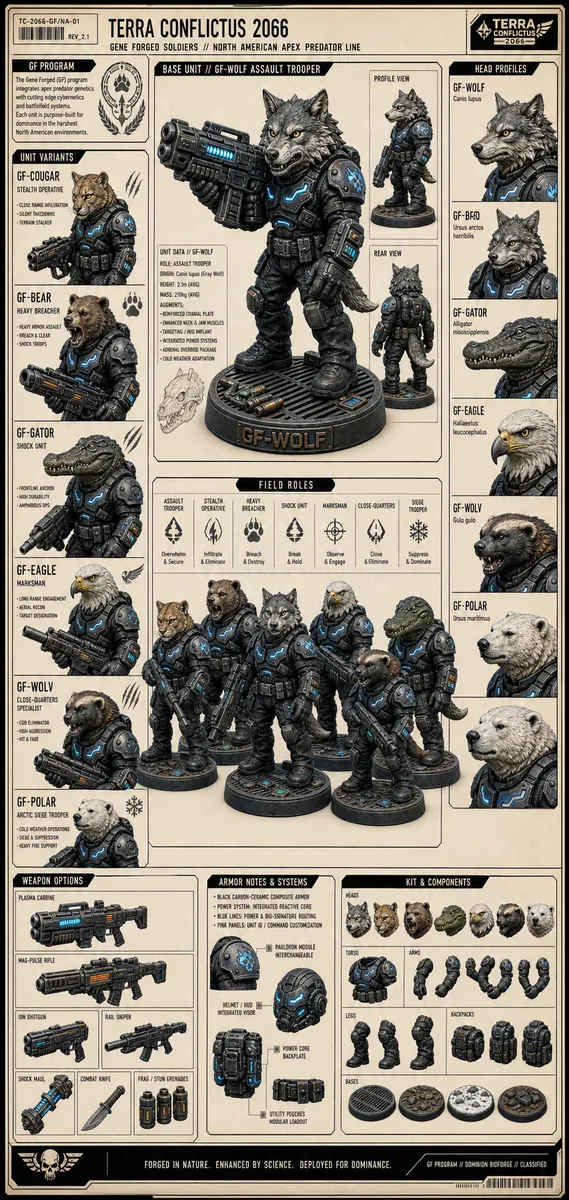
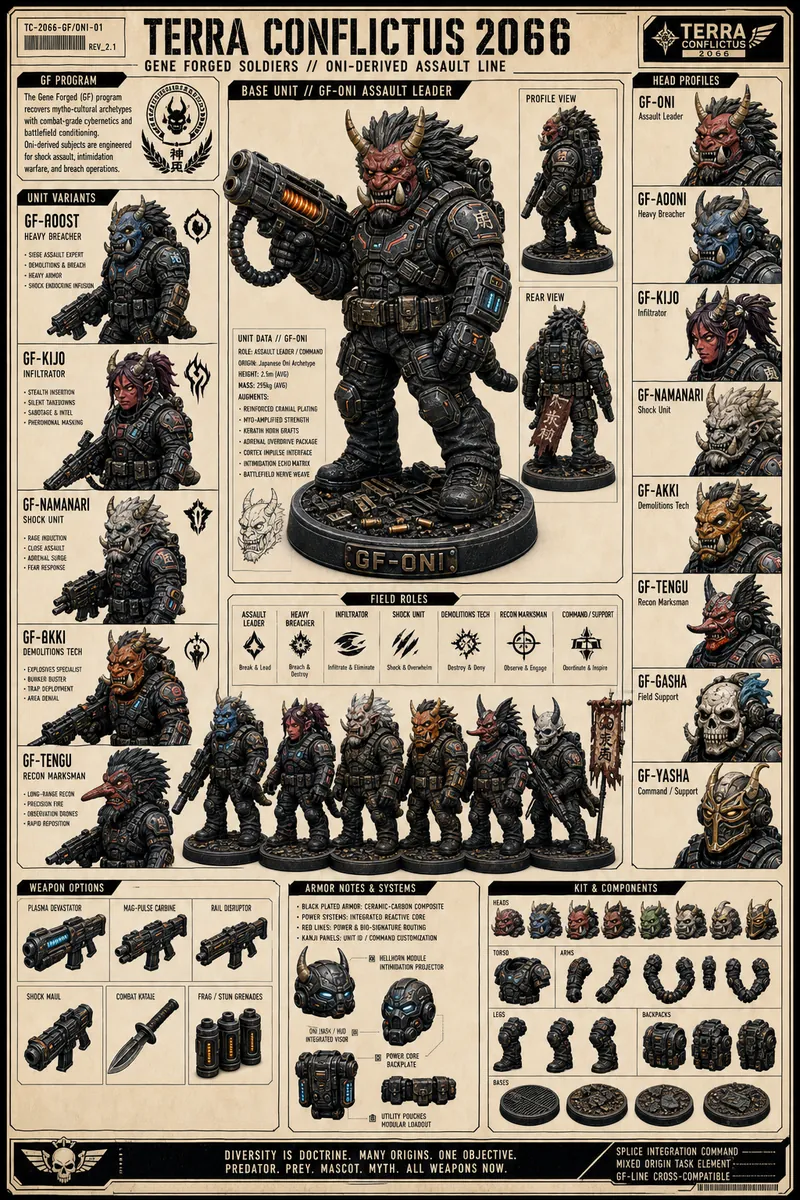
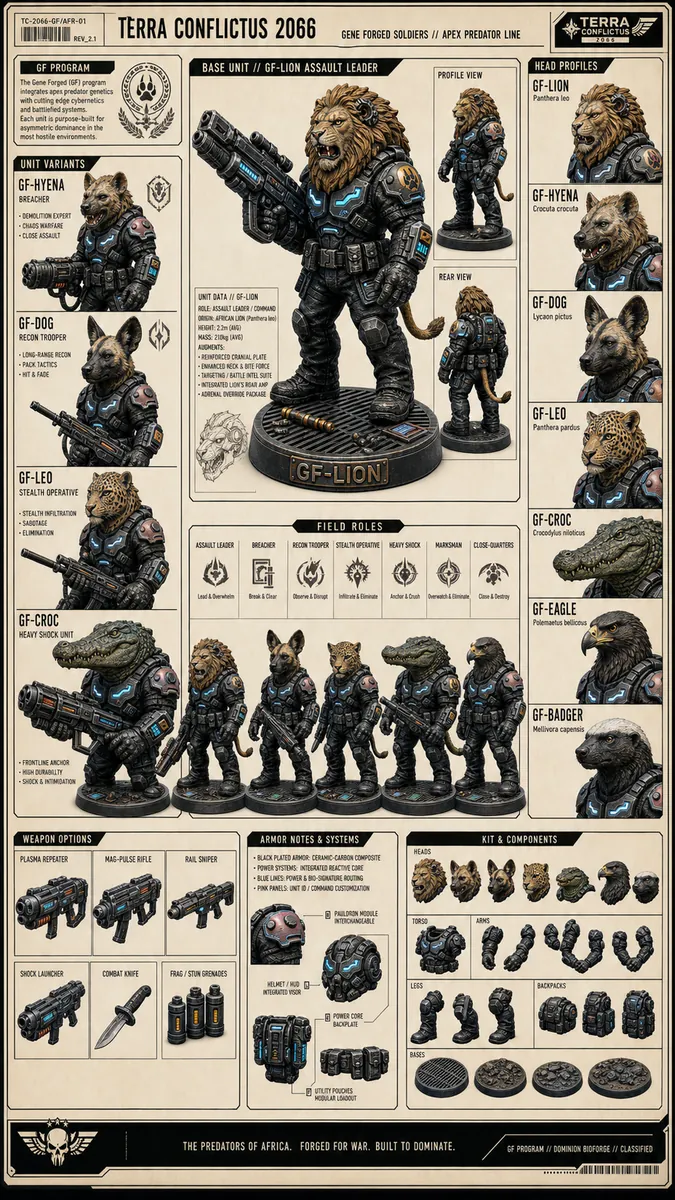
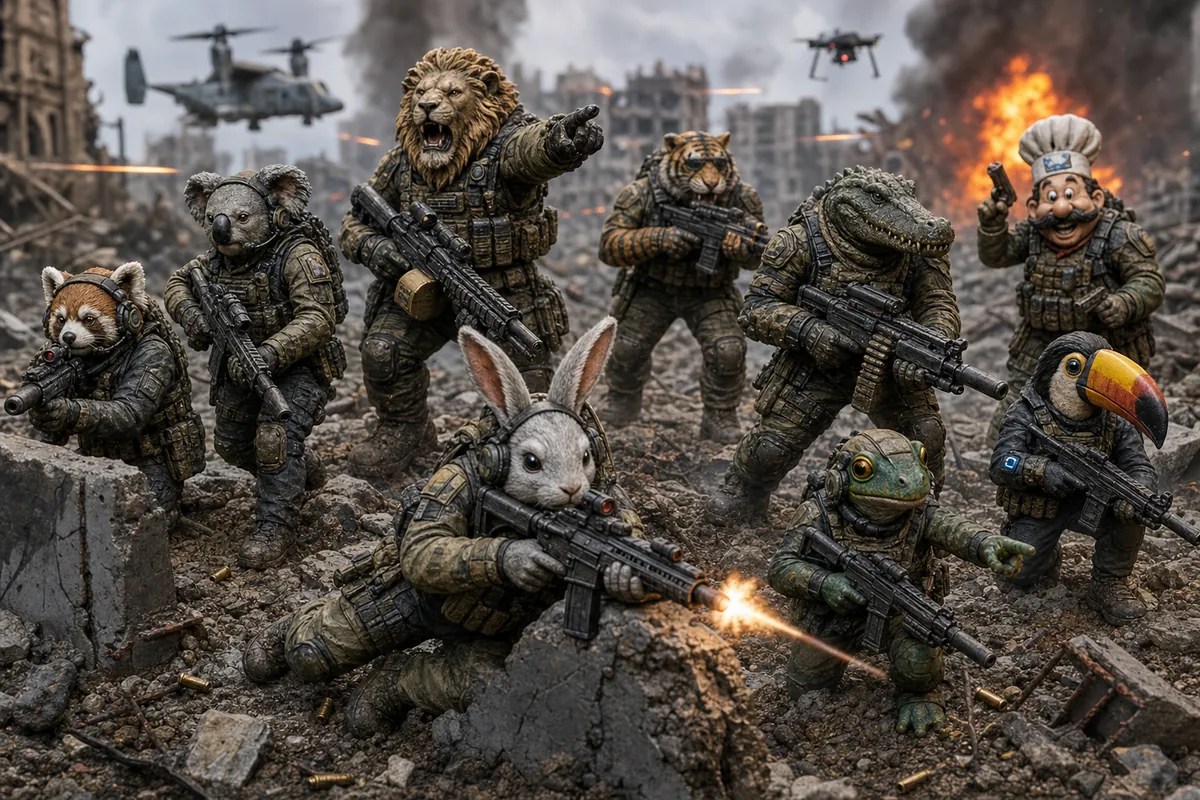
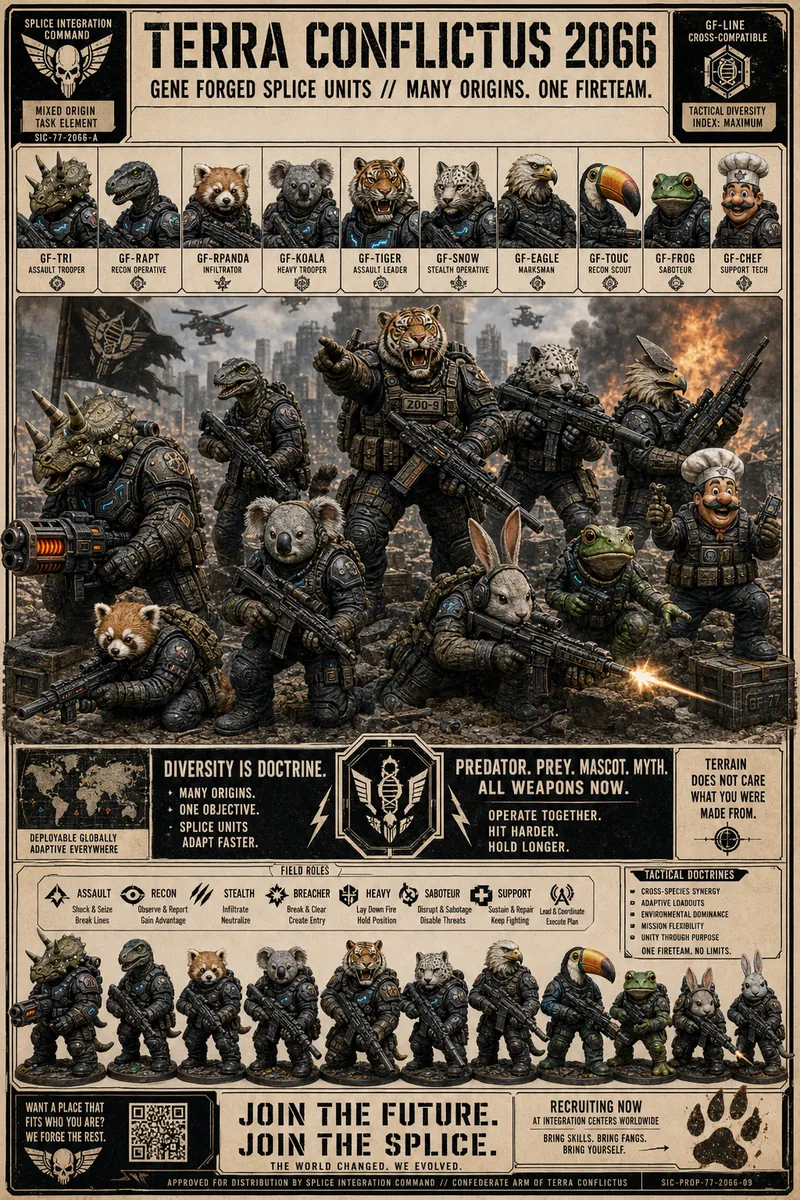
The Gene Forge program is the single element of this world most deliberately designed to unleash your dopamine drive for kitbashing. By 2066, every major faction fields gene-forged operators — bipedal soldiers built from apex predator genetics fused to a human body architecture. They walk upright, carry weapons, use tactics, take orders.
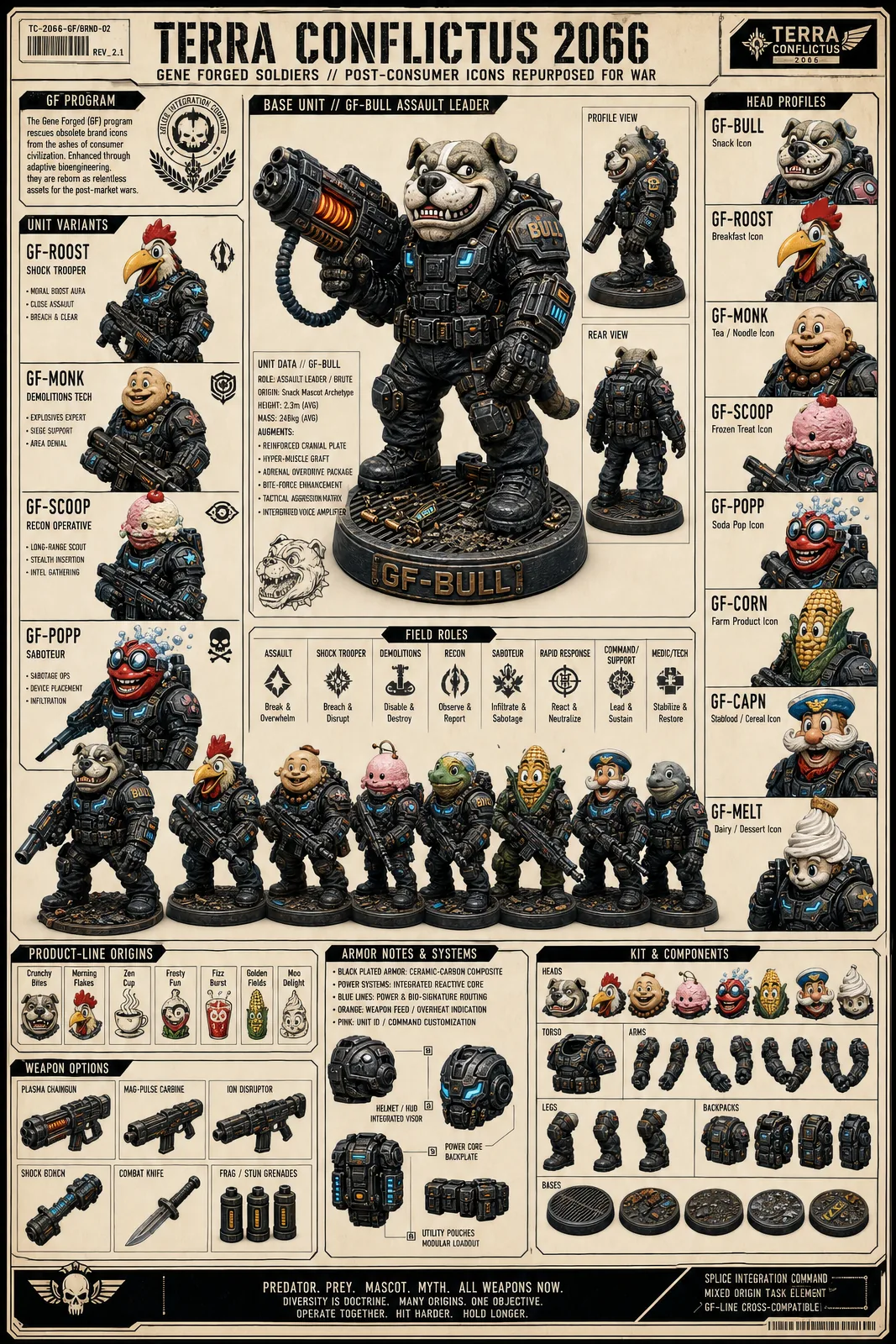
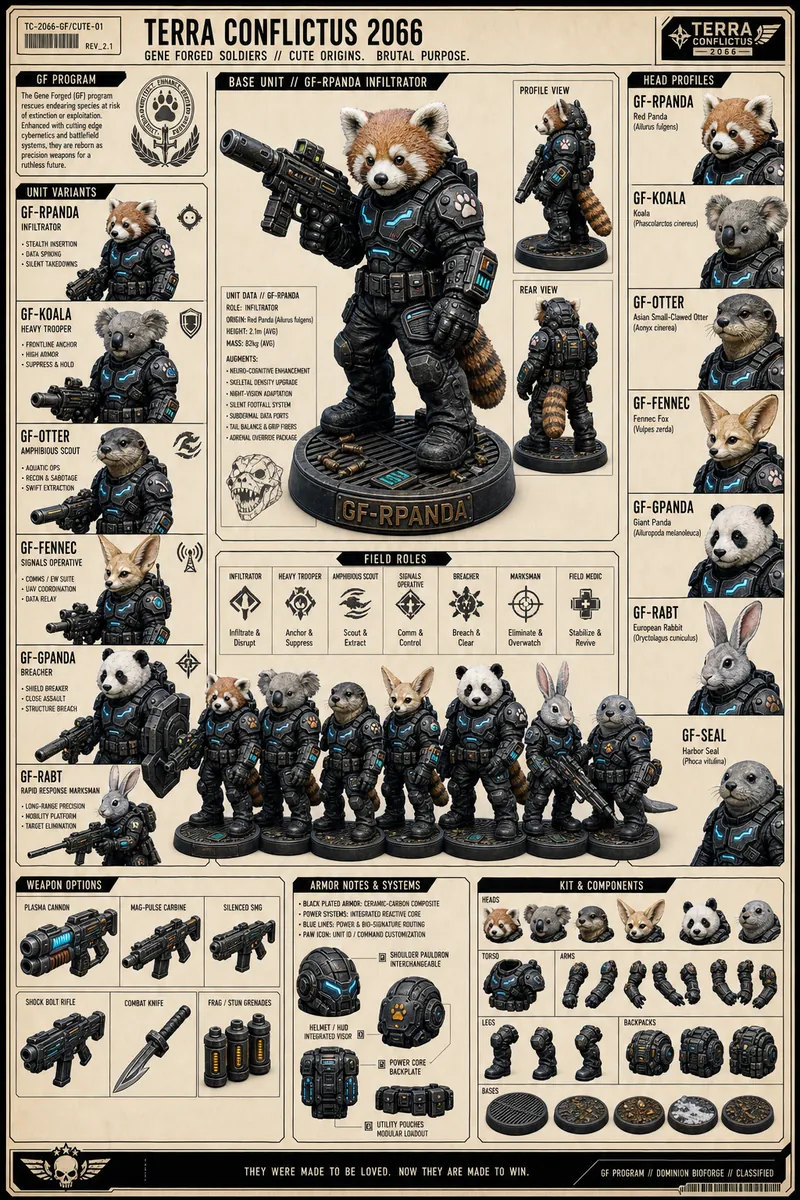
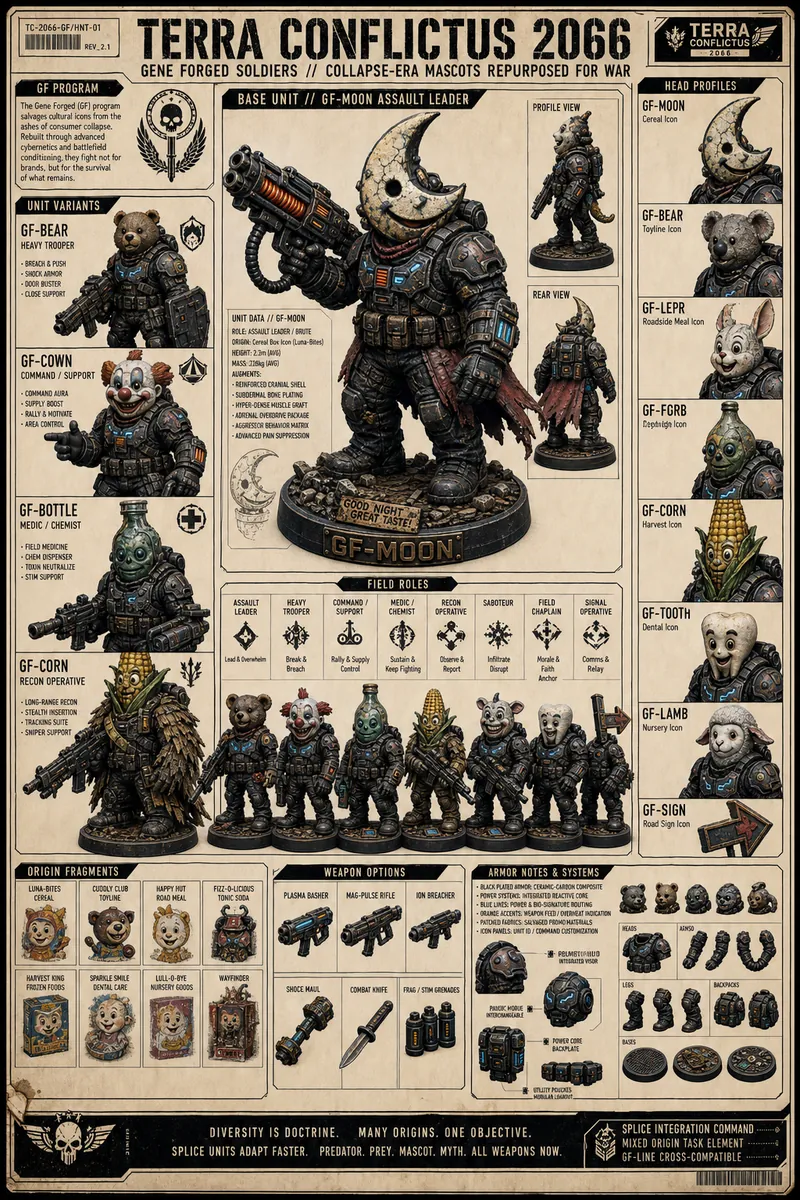
But the gene-forge programs produced a lot more than battlefield predators. Military apex stock is just the start. There's commercial stock — gene-forged built for entertainment and luxury markets that ended up carrying rifles when the world went sideways. Bespoke commission stock — one-of-a-kind creatures built to some oligarch's very specific taste. Black-market deviation — unlicensed builds from underground gene-smiths answerable to nobody.
Paleo-stock — yes, actual reconstructed prehistoric genetics, because the SCA has been sitting on the richest fossil deposits on the continent and somebody was eventually going to do it. And aberrant stock — gene-forged whose templates mutated beyond their original parameters in ways nobody planned and nobody can fully explain.
That is not just flavor. It is a structural invitation to kitbash anything you can get your hands on. Whatever you built, from whatever sources, has a lineage waiting for it. The lore wrote the permission slip before you reached for the clippers.
"The gene-forge doesn't care what you built something to do. It cares what the baseline can handle."
TC·BTB006
02 // THE TWO PATHSTWO WAYS IN. ONE TABLE.
Parts-Bin · Dead Shelf
TWO PATHS, ONE TABLE.
There are two ways into Operator Tactics as a physical game. One starts with sprues. One starts with a figure that already exists. Both arrive at the same table. Both are correct.
PATH A
The Parts-Bin Path
Sprues, clippers, 40k piles of shame, military model kits, near-future sci-fi lines, dollar-store dinosaurs. You start with raw material and you build. The Gene Forge provides the in-world scaffolding: whatever you kitbashed, from whatever sources, is a gene-forged operator with a lineage, a history, and a faction origin story.
→ starts with a sprue
PATH B
The Dead Shelf Path
You start with a complete figure that already exists — a thrift-store find, a blind box you bought for another reason, a figure salvaged off your own shelf when the excitement wore off. You don't build the figure. You re-context it. You give it a card. You give it a name. You put it in a splice.
→ starts with a figure that already has a life
The double meaning is intentional
The parts-bin builder and the Dead Shelf salvager are both running splices. They both have operators with names and lineages and gear. One of them started at a hobby shop. One of them started at a Goodwill on a Tuesday. There's no gap to close.
TC·BTB008
03 // WHERE TO LOOKPART SOURCES
Everything is stock
WHERE TO LOOK.
A unit is anything with a rectangular footprint that fits the size constraints. A movement tray of 15mm infantry. A repainted mecha kit. Three die-cast cars glued to cardboard with a pen-cap turret. A stack of poker chips labeled DRONE INFANTRY on masking tape. All valid. The rules care about the footprint and the keywords — not the model.
SRC-01
Unsupported Minis
The 40k pile of shame. Out-of-print ranges, broken blisters, the bits box. Heads, torsos, arms, weapons — the raw vocabulary of a kitbash.
SRC-02
Scale Models
Modern military kits, near-future sci-fi lines, model cars and armor. Real tactical aesthetics that ground a gene-forged operator in something believable.
SRC-03
Vinyl / Dead Shelf
Pop Mart blind boxes, Quiccs platforms, Kidrobot customs, half a Labubu series from the donation bin. Commercial stock, ready to re-context.
SRC-04
Misc. Toys
Dollar-store dinosaurs, kids'-meal robots, plastic spiders, animal figurines. The Beast-Mech and Paleo shelves of any toy aisle.
// FUSE
The move that turns sources into a unit is the fuse: clip, pin, glue, and bridge across categories until the parts read as one operator. A scale-model torso, a toy-dino head, a bits-box rifle, a vinyl-figure base. That's a gene-forged. That's the doctrine in one gesture.
Whatever you build has a category waiting for it. Pick the lineage that matches what your bits already want to be — then let the build language do the rest.
Apex Stock
Predator genetics · fused to human architecture
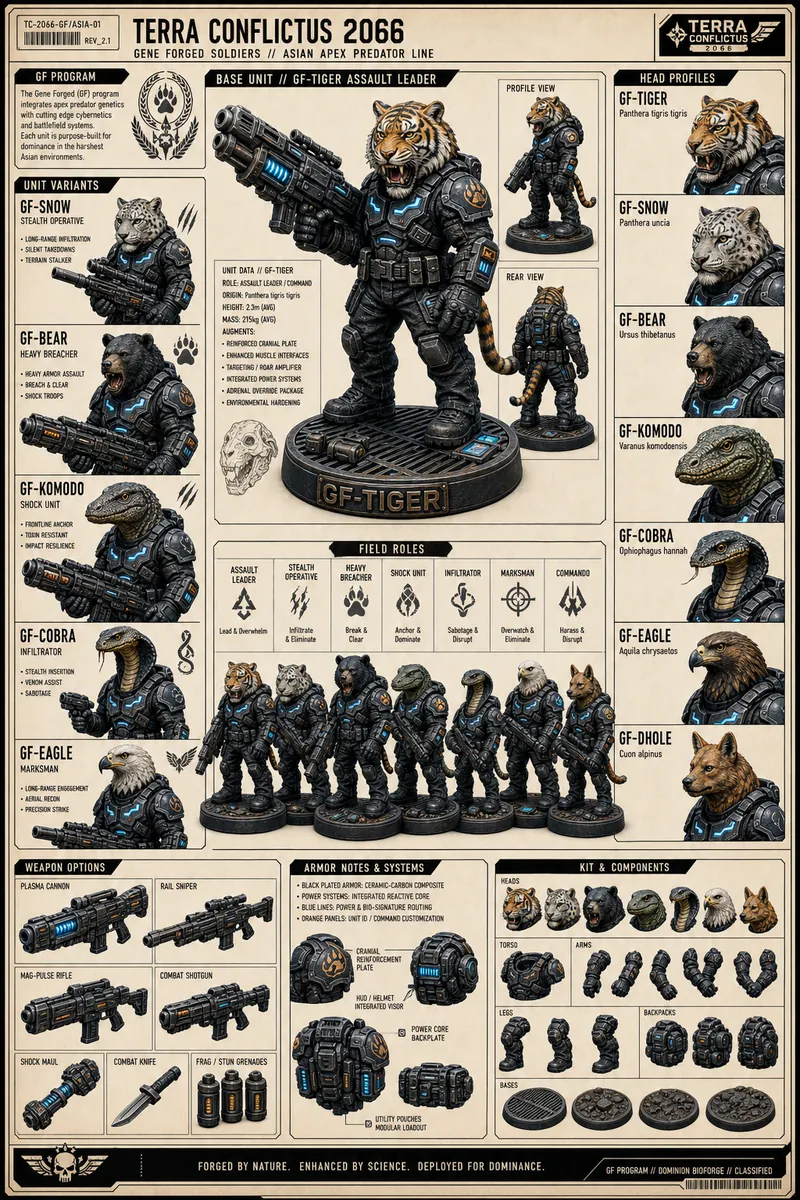
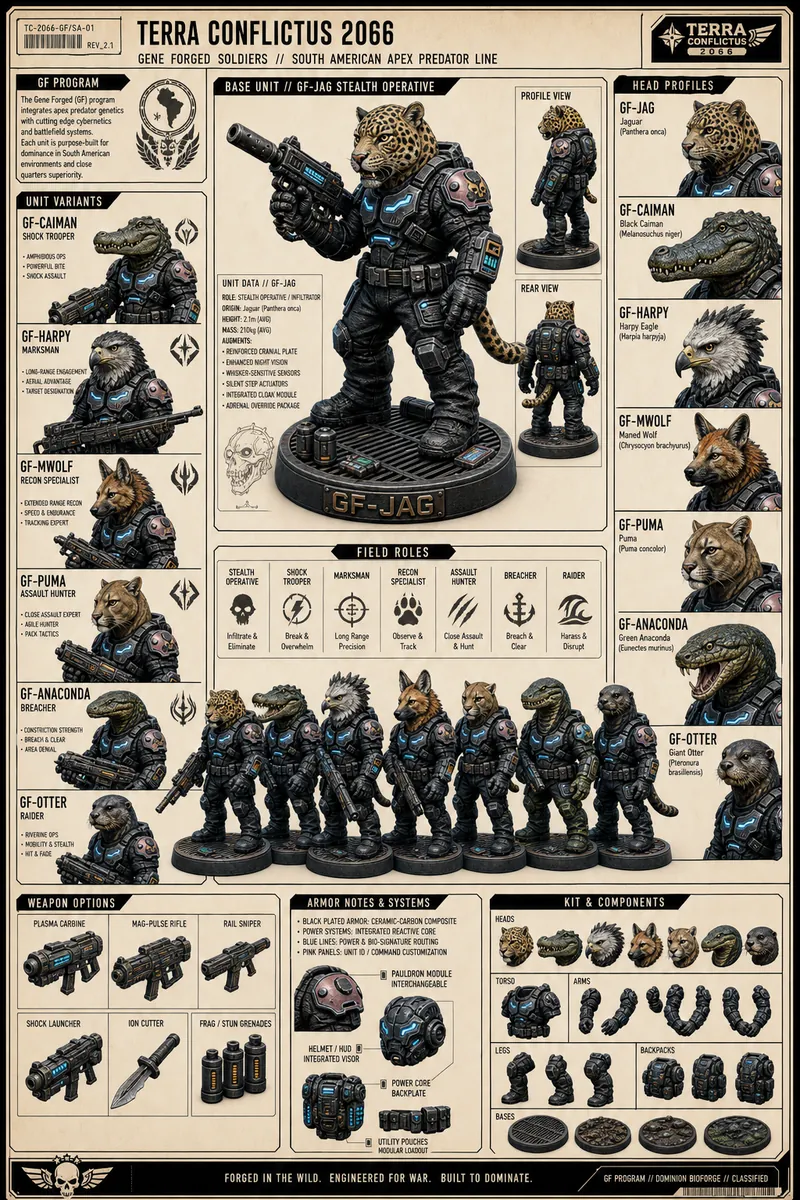
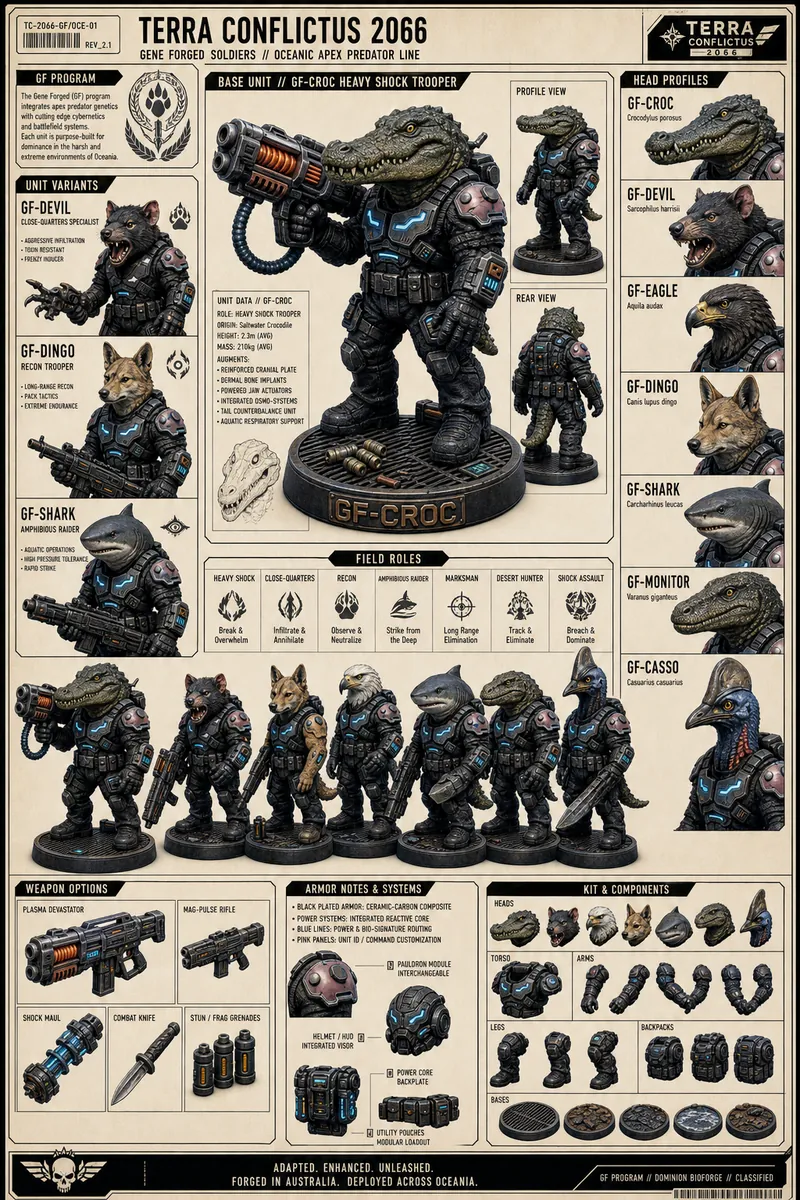
The military standard. Apex predators built into a human body plan: NAF fields wolves, the SCA fields jaguars, the EO fields bears, the Void Walkers field ravens — the full roster is the stock table on the next page. State cohorts are mono-type by doctrine. Your splice doesn't have to be.
BUILD IT: animal head + human tactical body + faction gear. A scale-model soldier with a toy-predator head is the whole recipe.
Commercial Stock
Built for entertainment & luxury markets
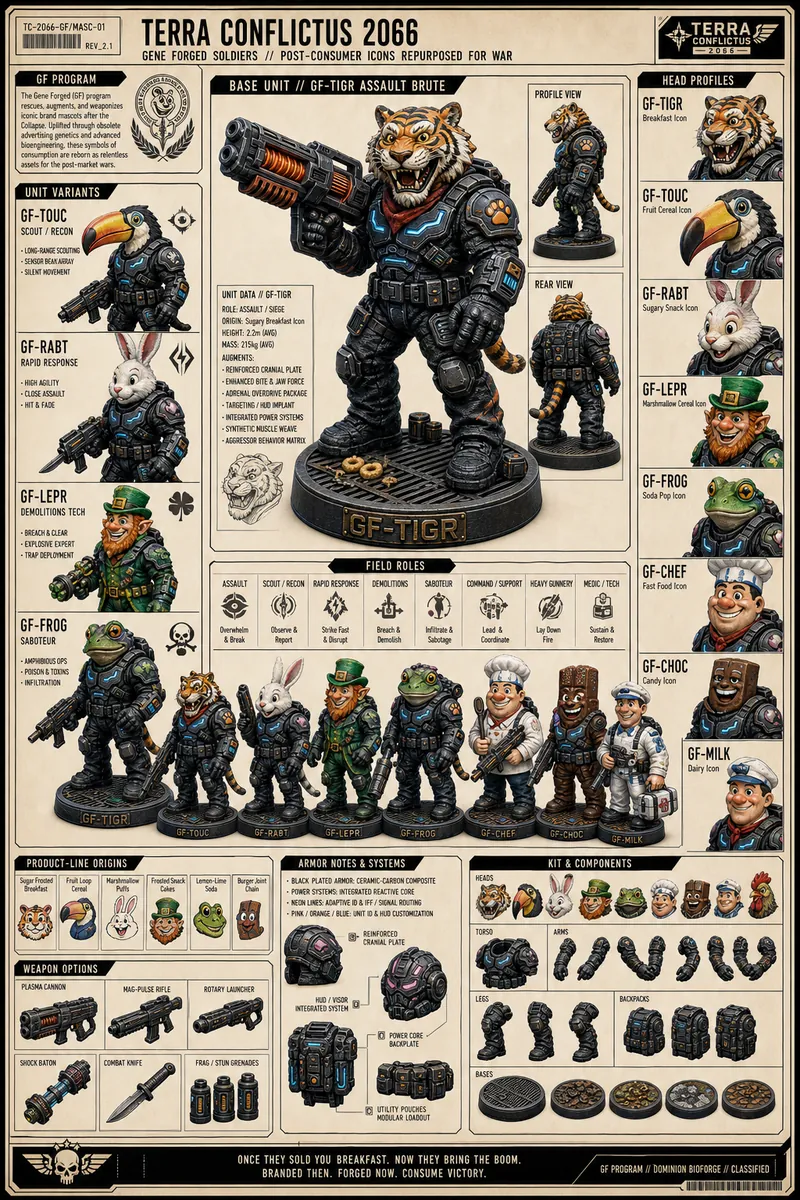
Gene-forged designed to be appealing, accessible, safe for the public — chibi proportions, expressive faces, calls everyone "buddy." Built for theme parks and corporate spectacle. Commercial stock is the answer to any figure that doesn't look like a battlefield animal: if it wasn't designed for the field, it wasn't designed for the field. Extraordinarily effective at close-range urban clearing, because nobody reads it as a threat until it's too late.
BUILD IT: a designer-vinyl figure + a faction mark. The aesthetic is already correct. See The Dead Shelf Path.
Paleo-Stock
Reconstructed prehistoric genetics
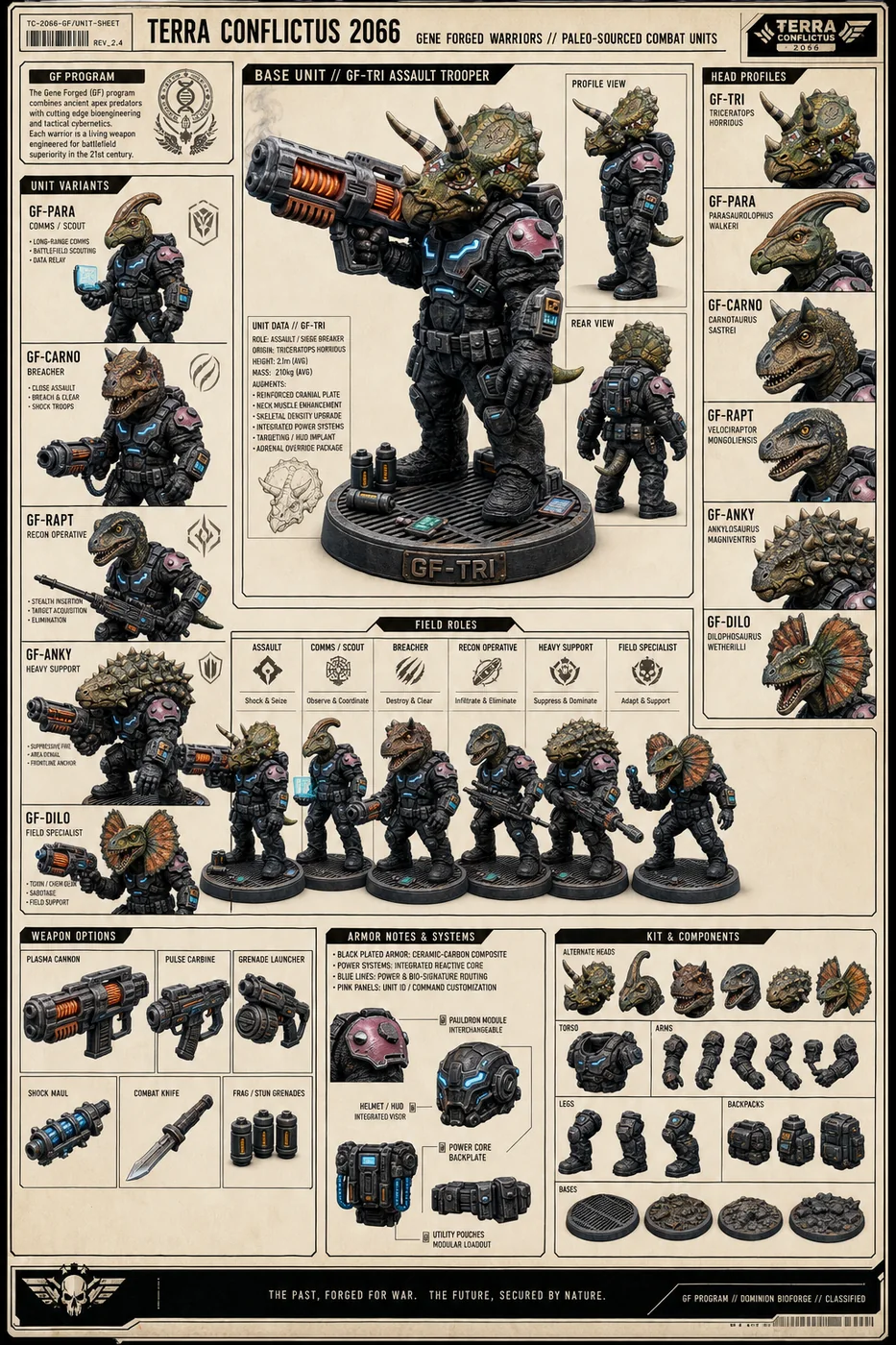
The SCA sat on the richest fossil deposits on the continent, and somebody was eventually going to do it. Reconstructed prehistoric genetics — tyrannosaur, velociraptor, pteranodon, whatever the fossil record provides — walked upright and handed a rifle. The D-Rex on page 20 is exactly this: a cybernetic triceratops soldier built from a toy and a fistful of grit.
BUILD IT: any plastic dinosaur + tactical kit + a base. Dollar Tree is a legitimate fossil dig.
Aberrant Stock
Unlicensed · mutated beyond design
Not unlicensed — unplanned. A stable template that drifted past its original parameters under stress, expressing sequences the gene-smiths thought were inert. Extra limbs, wrong proportions, asymmetry that shouldn't function — living proof the tech everyone depends on has side effects nobody is publishing. They should look wrong. That's the point.
BUILD IT: the leftover bits. Mismatched arms, a doubled head, a beast-mech that grew something it shouldn't have.
Bespoke Commission
One-of-a-kind · oligarch's taste
Built to a single buyer's very specific aesthetic. Luxe, ornamental, unrepeatable. If your build is the most over-detailed thing on the table, it's bespoke.
BUILD IT: the centerpiece kit you've been saving. Gild it.
Black-Market Deviation
Underground · answerable to nobody
Unlicensed builds from gene-smiths working outside every program. Mismatched, illegal, untraceable — no clean faction lineage, by design.
BUILD IT: the parts that don't go together. Lean into the seams.
TC·BTB011
04 // LINEAGESAPEX STOCK · CONTINENTAL TEMPLATES
Same architecture, six biomes
APEX STOCK AROUND THE WORLD
Every region forged its own predators. Same human architecture underneath; the faction gear and the apex template do the talking. Read these as build references — silhouette, palette, and the one detail that makes each one unmistakable.
N. AMERICAN · NAF doctrineASIAN · PRC tiger stockS. AMERICAN · SCA jaguarAFRICAN · continental predatorOCEANIC · coastal stockCOMMERCIAL · brand mascot
Gear defines the character
A NAF wolf operator isn't just any wolf — it's wearing dark olive modular armor with a drone mount and an AI targeting visor. Aurora Rangers doctrine made visible. An SCA jaguar in a minimal chest rig and jungle camo moves through terrain like a jaguar. Faction visual language is what separates a gene-forged operator from a generic furry miniature.
TC·BTB012
04 // LINEAGESFACTION STOCK · THE SHOPPING LIST
Every program is a parts order
FACTION STOCK = A SHOPPING LIST
Faction stock is narrative — mechanically, every gene-forged operator runs the same rules. But for a builder, the stock list is a literal parts order. Each program forged from a different set of apex templates, which tells you exactly which toy heads to drop in the cart. Pick the animals; the doctrine picks the gear.
State & independent programs — read it as a sourcing guide
Gene-forging is opt-in, and the standard table is one or two gene-forged among three or four baseline humans. Every gene-forged runs the same class, attributes, and wound track as a baseline — the only mechanical difference is a single Augment Tag carried for the campaign. Nothing in the rules reads your silhouette. That's the whole license: build the wildest thing you can, and it still just plays as an operator.
// OPERATORS vs WILDLIFE
Don't confuse the two at the bench. Gene-forged operators are soldiers — they carry rifles and take orders, and they're what this page is about. The Evolved Ecosystem — Thermo-Canis, Aqua-Felis, Mega-Crocodylus, Strato-Raptor — is wildlife: bigger, wronger, unarmed. Build those as monsters, objectives, and terrain. They eat operators; they don't join the splice.
TC·BTB013
05 // DEAD SHELFCOMMERCIAL STOCK · SHELF TO SPLICE
The figures already exist
THE DEAD SHELF PATH.
Walk into any thrift store in any mid-sized city and you'll find them. Pop Mart blind boxes, half a Labubu series, a Skullpanda with a missing accessory, a Quiccs TEQ63 a kid detached from its base. Fifteen-dollar figures sitting in the bin for two. This page is about that bin.
First: the figures already exist. Two decades of blind-box culture means hundreds of millions of these figures are already in the world. The supply chain for Dead Shelf miniatures isn't a production pipeline — it's the existing waste stream of consumer culture. You don't wait for a new kit. The material is already there.
Second: the aesthetic is already correct. Designer vinyl — the chibi proportions of Labubu and Skullpanda, the tactical urban edge of the TEQ63, the surrealist darkness of Finding Unicorn — maps directly onto the Splice Punk look. Pop Mart figures already look like they exist in a near-future contested zone. The Splice Punk aesthetic was in the toy bins before this game existed.
Third: this is the setting made material. In Terra Conflictus, the Upheaval didn't destroy everything — it repurposed it. Commercial stock built for theme parks ended up on the battlefield because everything ended up on the battlefield eventually. A player reaching into a thrift bin for their next operative isn't doing something the game allows. They're doing something the game is about.
That's what separates the Dead Shelf path from miniature-agnosticism. Miniature-agnostic is a rulebook concession — "we won't gatekeep your models." This is different. It's "the figures already in the world are the correct figures. We designed around what already exists."
Commercial stock · the charm is the weapon
SHELF TO SPLICE
A Pop Mart Skullpanda on your splice's roster is a commercial stock operative. The in-world explanation was already written. You don't need to paint or modify anything — the figure reads. You just need to know what card to hand your opponent when they ask what it represents.
"Built to work a theme park in Neo-Tokyo. Now here on the battlefield. Still delighted as it flanks you and lets the SMG rip."
TC·BTB014
06 // THE MANUALTOOLS OF THE TRADE
You need less than you think
TOOLS OF THE TRADE.
The whole kit fits in a shoebox. Start here; add as the build demands. Nothing on this page costs more than a blind box.
01
Clippers
Flush cutters for pulling parts off the sprue and trimming dino toys clean. The single most-used tool you own.
02
Hobby Knife
A fresh blade for mold lines, seam cleanup, and carving a join until two unrelated parts agree to be one.
03
Model Glue / CA
Plastic cement for styrene, super glue (CA) for everything else — resin, metal, vinyl, dissimilar materials.
04
UV Resin
Cures hard under a cheap UV light in seconds. Gap-fills, builds lenses and eyes, and gives optics the "live" look.
05
Pin Vise & Wire
Drill a hole, drop in a wire pin, and a heavy head or arm stays put. The difference between a kitbash and a pile.
06
Polymer Clay
Super Sculpey for custom limbs, bio-armor, and bridging gaps. Sculpt it, then bake the whole figure at 275°F.
// SAFETY
Cut away from your hand. Glue and resin want ventilation. Bake polymer clay in a dedicated tray, never the one you eat off. The hobby should outlast the build.
TC·BTB016
07 // THE MANUALTHE SPLICE PUNK PASS
Five moves, one operator
THE SPLICE PUNK PASS.
For the player who wants to go further, designer vinyl and resin both respond beautifully to modification. These five moves, in order, turn a bare figure into something that looks gene-forged for contested-zone work.
1
BASE COAT
Lacquer Primer
Thin passes, built up gradually. Preserves the sculpted detail instead of drowning it — the difference between "primed" and "clogged."
2
COLOR
Acrylics
Body, cloth, and skin tones — the same materials the mainstream vinyl-customization community already uses. Forgiving, layerable, water-cleanup.
3
GEAR
Enamel Metallics
Weapons, cybernetic joints, hard kit. Enamel reads as battlefield-used metal in a way acrylic silver rarely does. This is where the operator stops looking like a toy.
4
OPTICS
UV-Resin Eyes
A drop on eyes and lenses, cured hard, for depth and the "live" look designer toys already exploit. Tint it your human accent and the figure suddenly has intent.
5
STRUCTURE
Polymer Clay + Print
Super Sculpey (cure 275°F) for robotic limbs and bio-armor sculpted right onto the surface. Or bolt on 3D-printed tactical accessories, scaled to ~85% to fit chibi proportions.
Build from nothing
A Kidrobot Munny blank — a featureless white vinyl form made for artist customization — is a ready-made armature for an operator built entirely from scratch, no donor kit required.
TC·BTB017
08 // THE MANUALMATERIALS & FINISHING
Know your plastic before you prime it
KNOW YOUR PLASTIC
Every donor takes paint and glue differently. Match the method to the material and nothing flakes off in round three.
Donor materials
Material
Found in
Glue
Notes for finishing
Hard Vinyl / PVC
Pop Mart, blind boxes
CA / epoxy
Wash first. Lacquer or vinyl-safe primer; flexes, so avoid brittle coats.
Soft Vinyl (Sofubi)
Larger designer toys
CA / flexible
Flexible — use a primer that moves with it or paint will crack on handling.
ABS
Action figures, model kits
plastic cement / CA
Takes primer well. Tough; sands clean for seam work.
Polystyrene
Wargame sprues, scale kits
plastic cement
The friendliest plastic. Cement welds it; primes and paints with no fuss.
Resin (3D print)
STL prints, garage kits
CA
Wash off release agent / uncured resin. Primer mandatory. Layer lines = texture, or sand smooth.
FINISHING REGISTER
What each finish is for
Lacquer
Primer base, thin coats
Acrylic
Body, cloth, skin
Enamel
Metal, gear, weathering
UV resin
Eyes, lenses, gap-fill
Pigments
Mud, dust, contested-zone grime
// THE TWO-ACCENT RULE
Keep the system color and the human color apart. Cold signal yellow for infrastructure, labels, and faction systems. The human accent — here, hot pink — for the people and the marks they make. The two accents don't touch. That tension is the Splice Punk look.
TC·BTB018
09 // THE MANUALSCALE & THE TABLE · VINYL SCALE
Big figures, no conversion math
SCALE & THE TABLE
Standard blind-box figures run 75 to 85mm tall. Traditional 28mm wargames aren't built for that — the multiplier is roughly 2.6×, which throws off movement, terrain, and footprints.
Operator Tactics fixes it with one line. The Vinyl Scale variant: wherever the rules print a distance in centimetres, read it as inches. A 6cm move becomes a 6-inch move. It scales naturally to larger figures and bigger bases with zero math at the table.
// VINYL SCALE1 cm → 1 inch. Read every distance in the rulebook as inches. Done.
Base sizing
Class
Square
Round
Operator
6.5 cm
70 mm
Heavy / large commercial stock
8 cm
80 mm
Vehicle / emplaced
10 cm
100 mm
Terrain scales up with it — Vinyl-Scale terrain sits closer to 1:18 diorama scale, which makes model-railroad, architectural-miniature, and prop-making suppliers your best source. The same thrift stores that stock the figures often stock the terrain.
Vinyl scale on the table — read the centimetres as inches and the big figures just workTC·BTB019
10 // CASE STUDYPALEO-STOCK · THE D-REX
From the dig to the table
BUILD STUDY: THE D-REX.
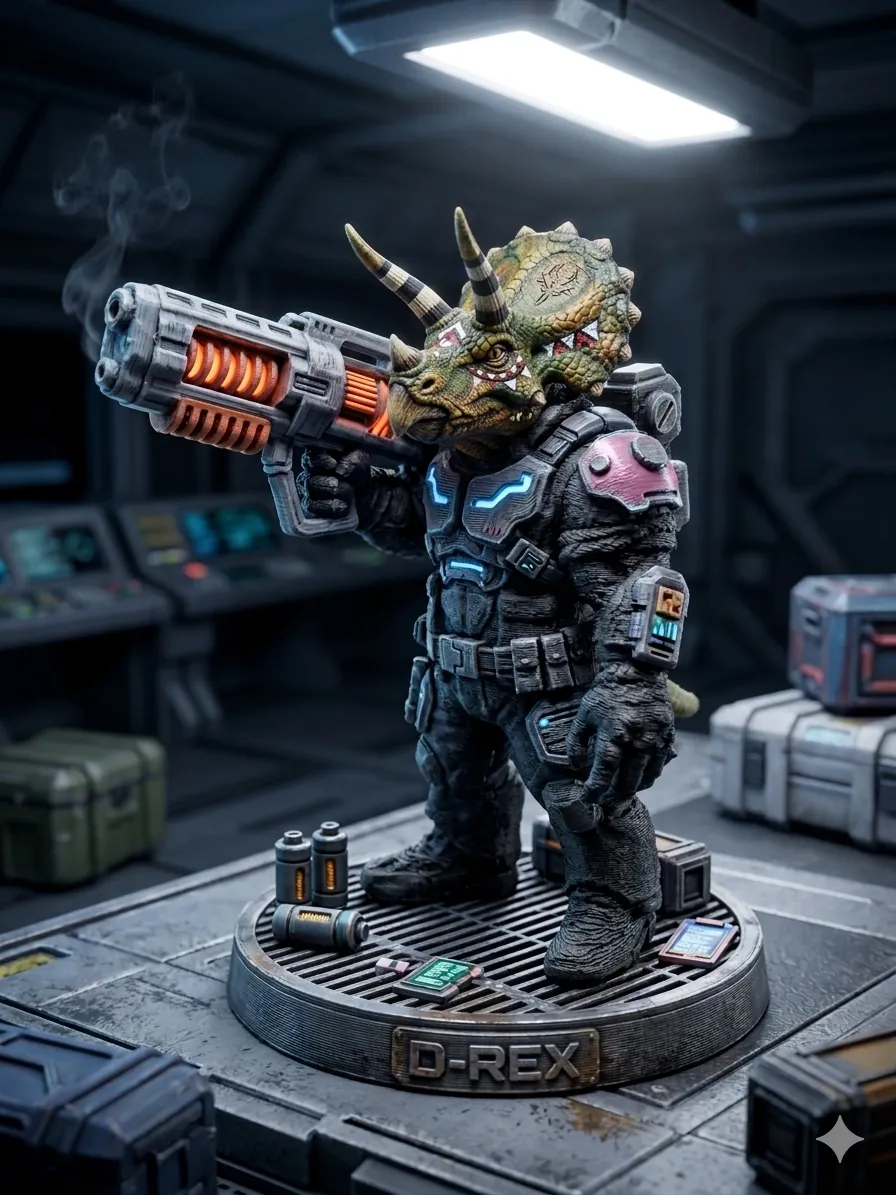
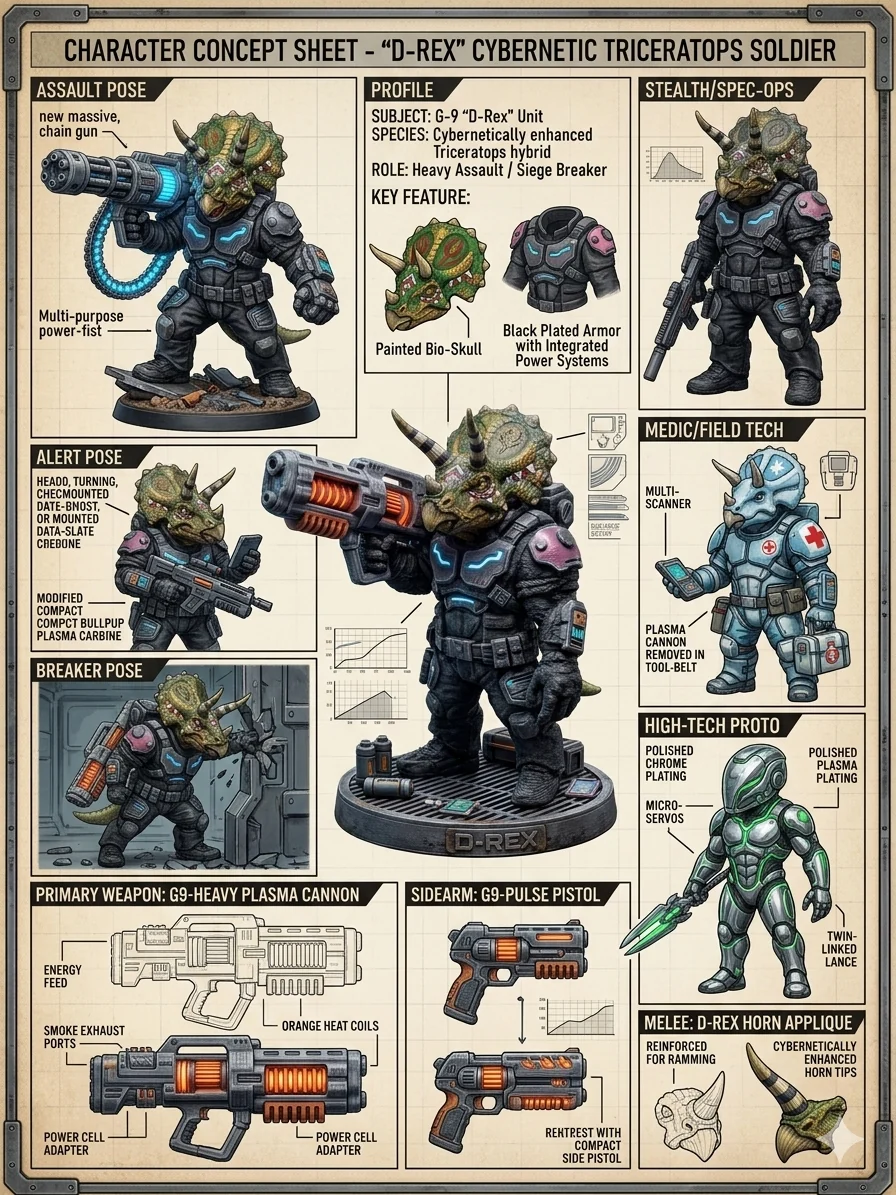
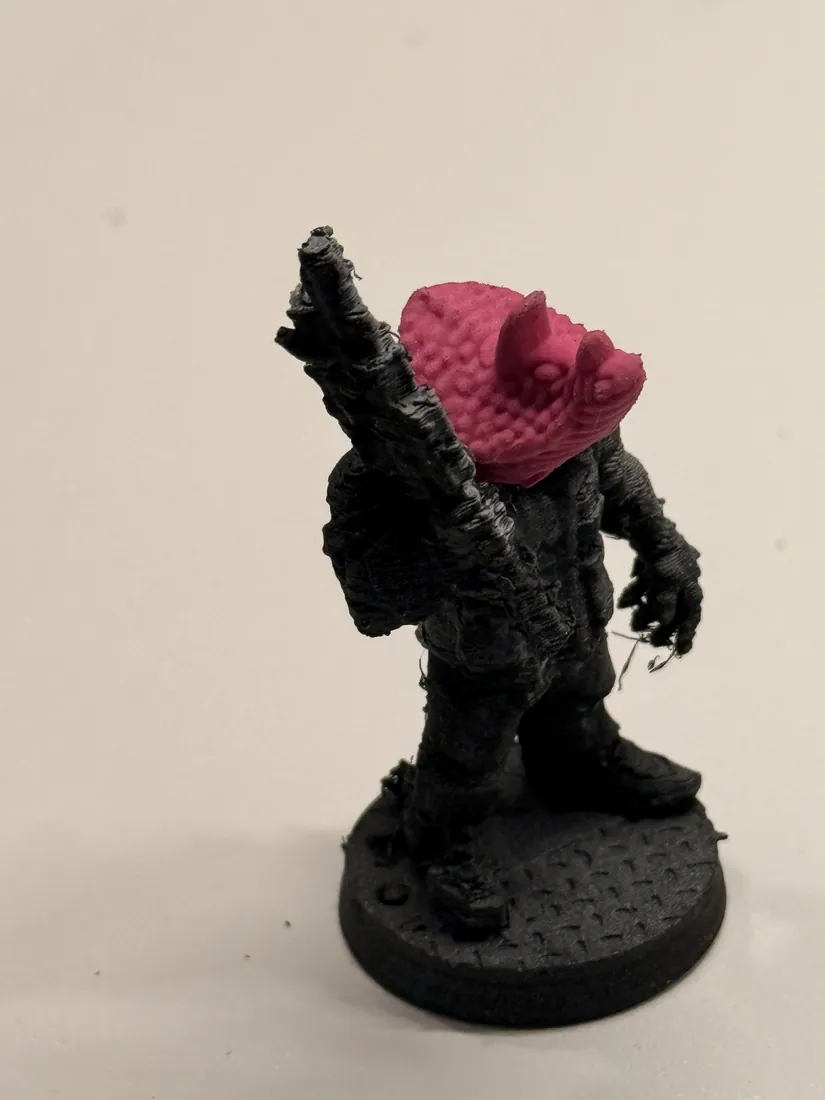
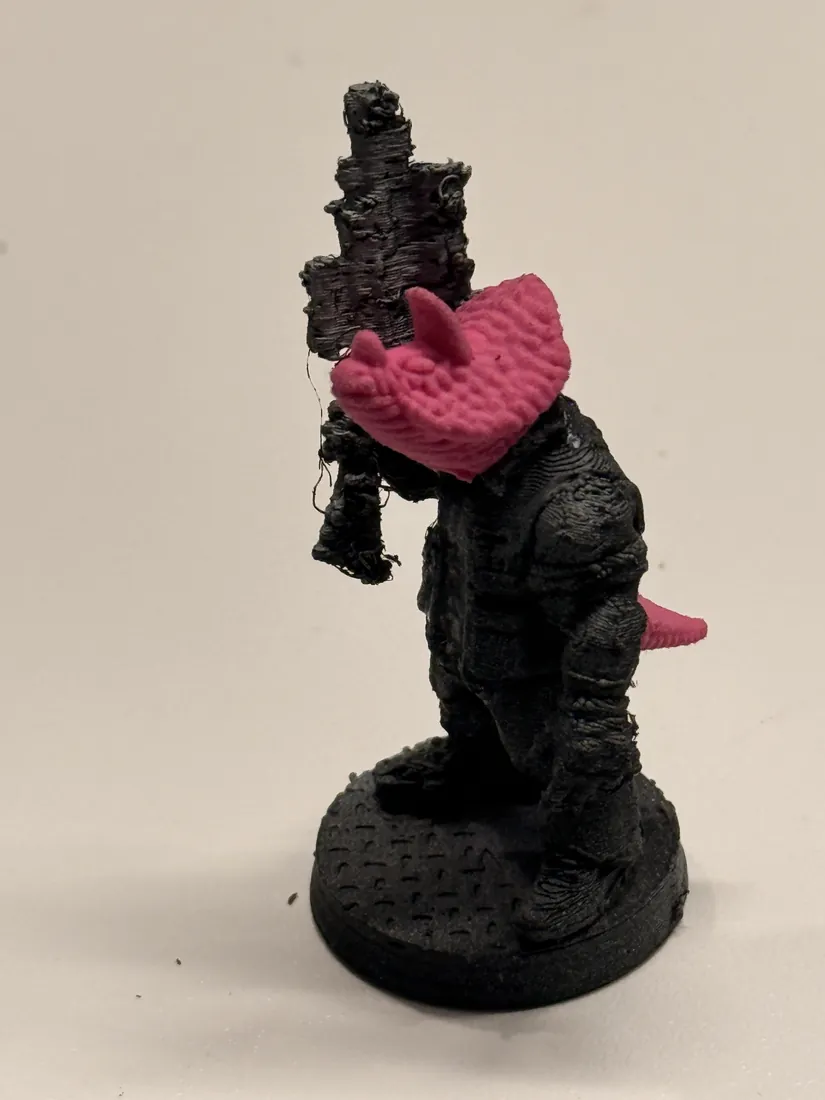
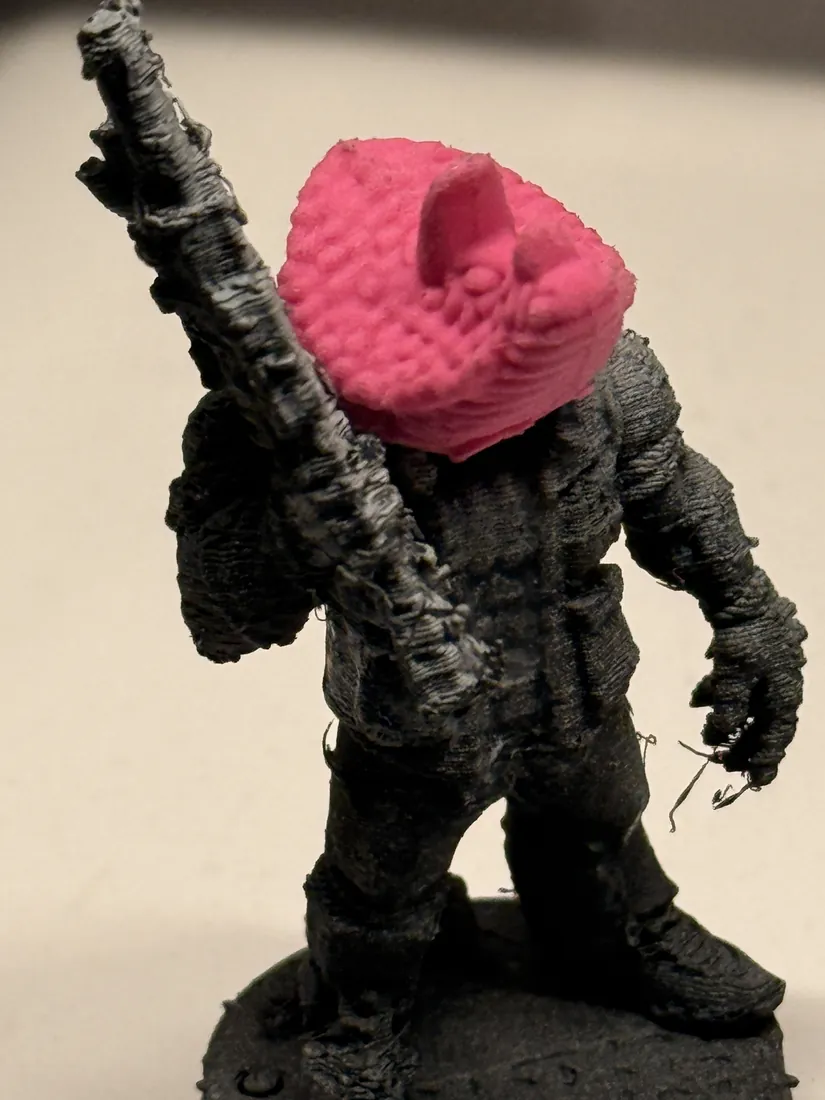
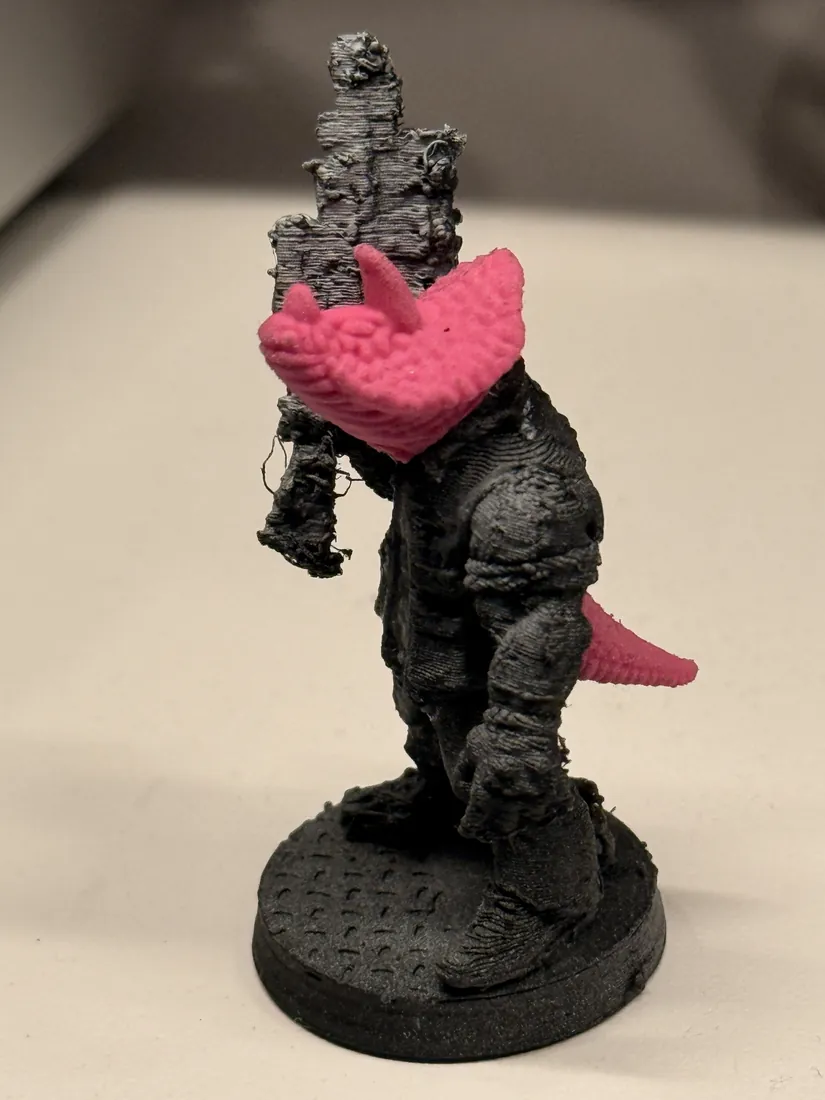
A cybernetic triceratops soldier, built paleo-stock. This is the practical centerpiece of the zine — one real model, the concept that drove it, and the finished build turned all the way around.
SUBJECT FILE
"D-REX"
Species: cybernetically enhanced triceratops hybrid. Role: heavy assault / siege breaker. Black plated armor with integrated power systems, a G9 heavy plasma cannon, and the one detail that makes it ours — the bio-frill, reforged and lit up in human-accent pink.
LINEAGE: PALEO-STOCK · SCA FOSSIL PROGRAM
Concept → object
The concept sheet opposite is the design target. The model on the next page is what came off the bench: a 3D-printed dino body, cleaned up, based, and given the Splice Punk pass. Concept and object don't have to match exactly — the gap between them is where the build becomes yours.
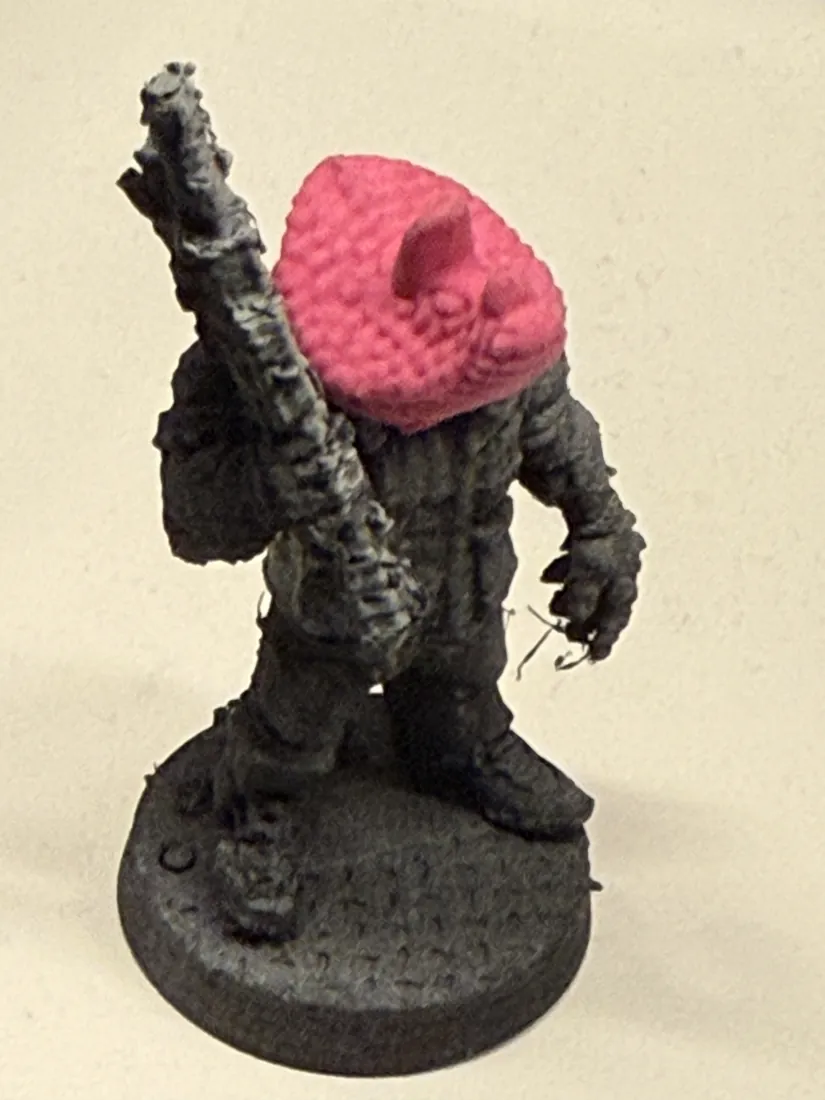
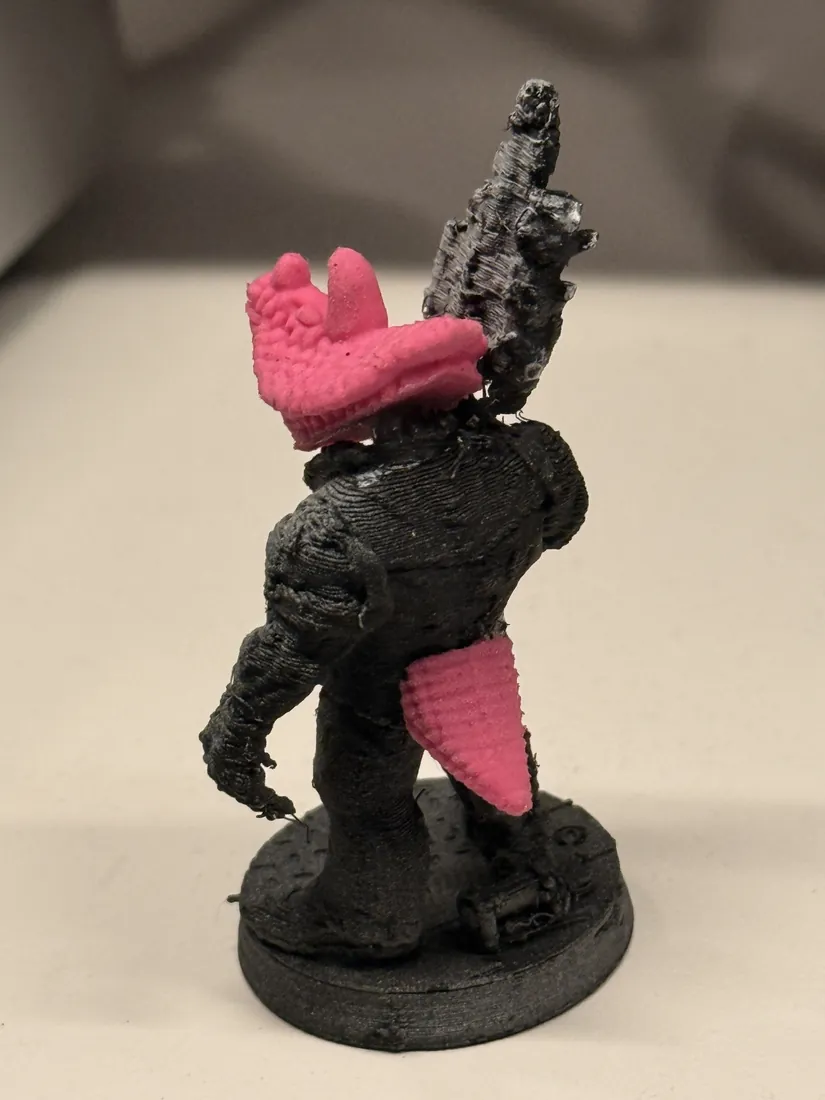
Here's the model off the bench — a rough-textured black 3D print, based and given the pink pass. Walk around it. The grit in the print is the finish: it reads as scarred hide and battlefield wear, not as a flaw to sand away.
FRONT · frill + rifle3/4 · weapon raisedSIDE · head turnedDETAIL · the bio-frillREAR 3/4 · pink tail-tipBACK · leg panel + base
The pink pass
Black body, base coat to grime. Then the human accent goes on only where it counts: the frill, the open mouth, the tail-tip, one leg panel. Four touches of pink turn an anonymous black print into a faction-marked operator. Restraint is the technique.
// BASING
The textured round base does double duty — it sets the Vinyl-Scale footprint (70 mm operator) and carries the embossed unit ID. Base the figure and it stops being a model and starts being a unit.
TC·BTB021
11 // THE MANUALFACTION MARKING
The context does the work
FACTION MARKING.
The detail that separates commercial stock from a prop is gear — and you don't need to repaint a figure to give it an allegiance. You add an identifier and let the context do the work.
MARK-01
The Patch
A small painted shoulder patch or chest decal in faction colors. The smallest possible commitment; reads instantly across the table.
MARK-02
The Base Rim
Work faction colors into the rim of the base. The figure stays exactly what it is; the base declares the side.
MARK-03
The Card
A printed card beside the base showing affiliation, name, and lineage. Zero paint. Pure re-context.
MARK-04
The Gear
Want NAF? Add a drone mount and an AI visor. Doctrine made visible — one bolt-on bit signals the whole faction.
"You're not repainting the whole figure. You're adding an identifier. The figure stays what it is."
TC·BTB023
12 // THE MANUALCREATING A SPLICE
No shared flag. No shared lineage.
CREATING A SPLICE.
Your unit is a Splice — a small, independent contract unit of freelance operators with no shared flag, no shared lineage, and zero obligation to look like anyone else's standing army.
State military cohorts are mono-type by doctrine. NAF fields wolf formations. The EO fields bears. The Void Walkers field ravens. Your splice can be those things. Or not. Your splice is whatever you build.
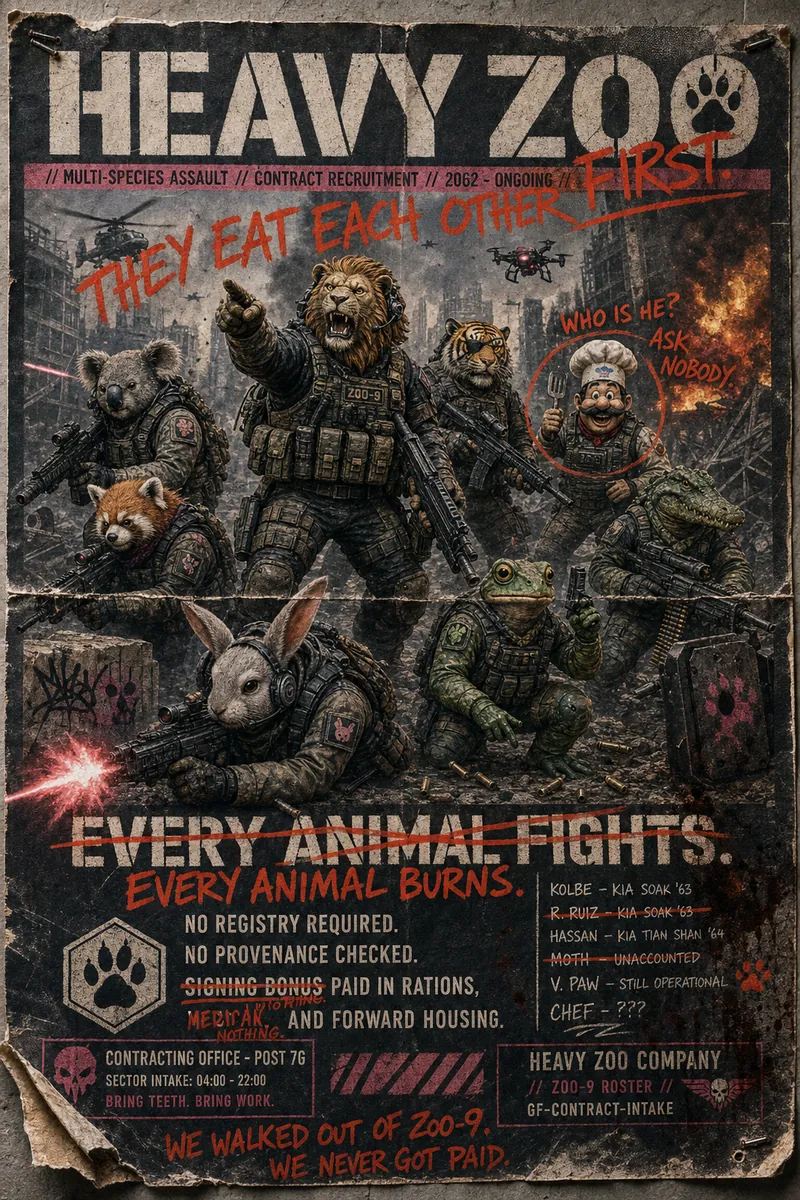
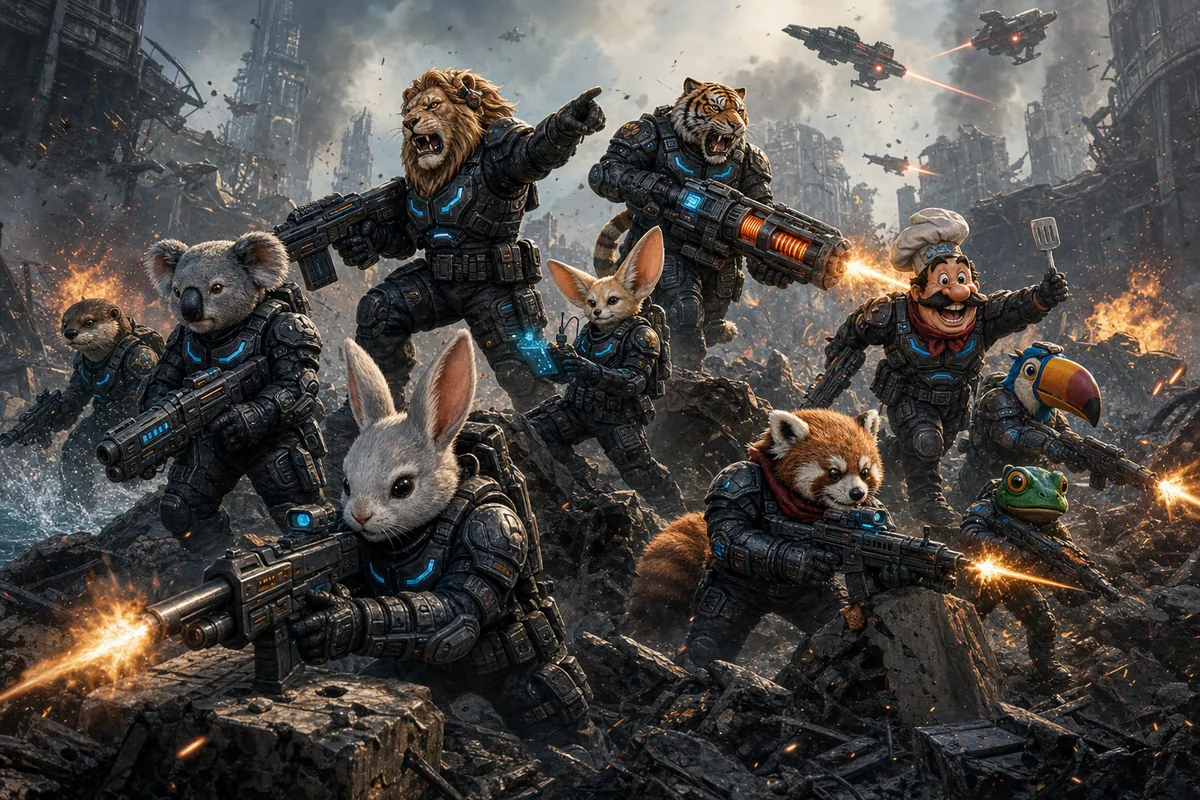
A wolf operator from a dissolved NAF contract. A raven intel specialist who answers to no flag now. A baseline human breacher who's never been gene-forged and never wanted to be. And that cheerful commercial-stock operative on your right who looks delighted by everything? Built for a theme park. Still delighted as it flanks you. That's a splice.
A splice: mismatched on purpose
Assemble one
Pick 3–6 mismatched operators. Mix lineages on purpose — the contrast is the aesthetic. Name each one. Write the backstory on an index card. The splice is a collage, and the seams are the point.
// IF KITBASHING ISN'T YOUR JAM
Baseline humans serve in every faction and every splice. Gene-forge programs are expensive; not every operator comes out of one. The contrast between a standard human and the gene-forged beside them is part of what makes the aesthetic work.
TC·BTB024
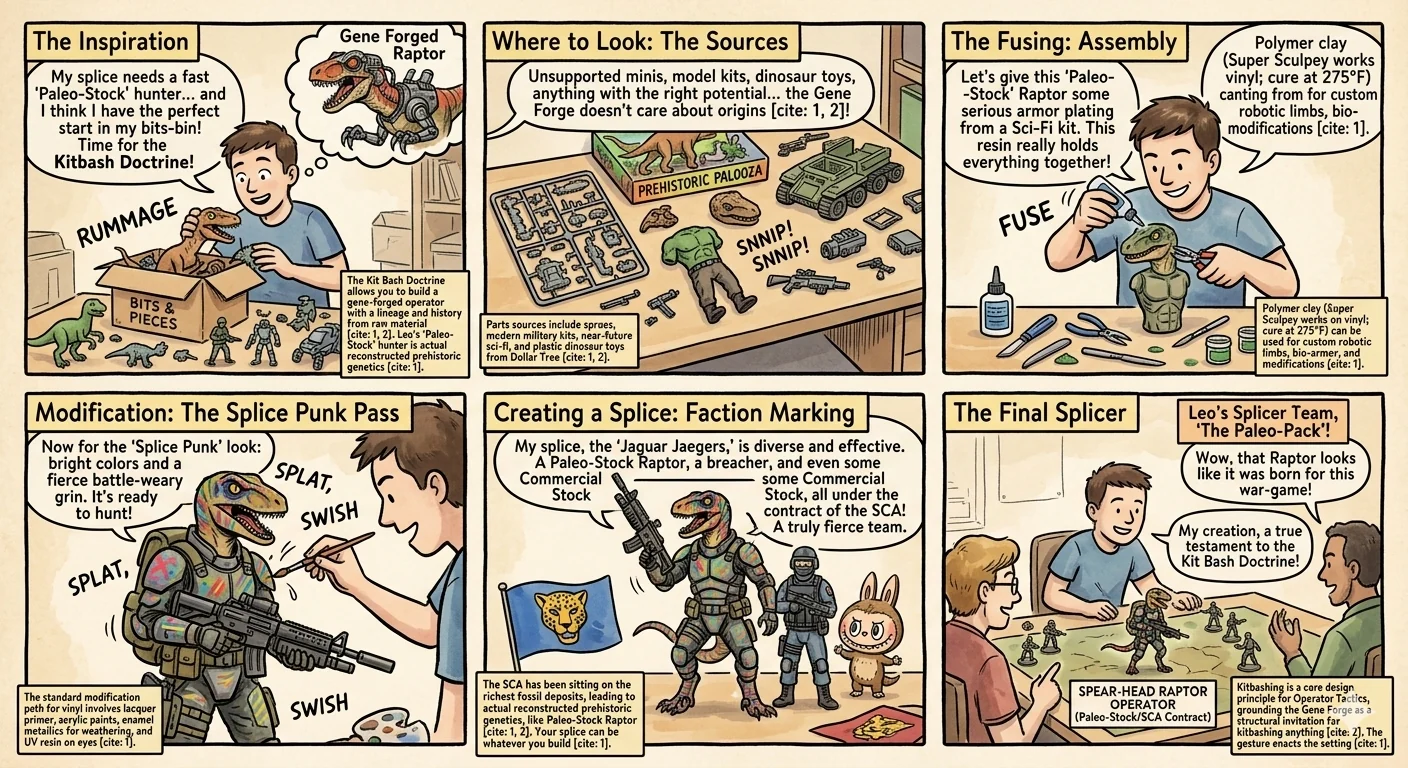
STRIPBUILT TO BUILD — A KITBASH IN FOUR PANELS
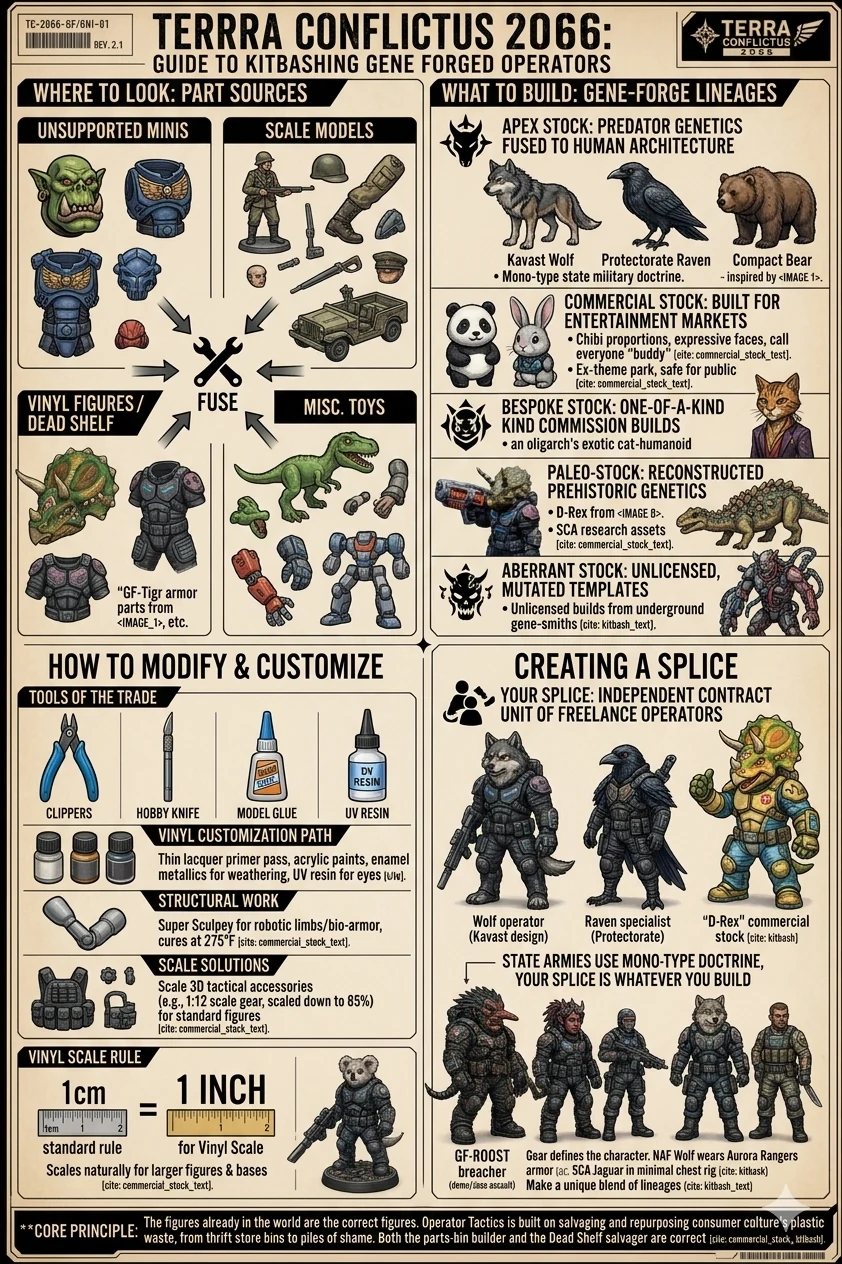
PULL-OUT POSTERTHE WHOLE DOCTRINE ON ONE SHEET — TEAR IT OUT, PIN IT OVER THE BENCH
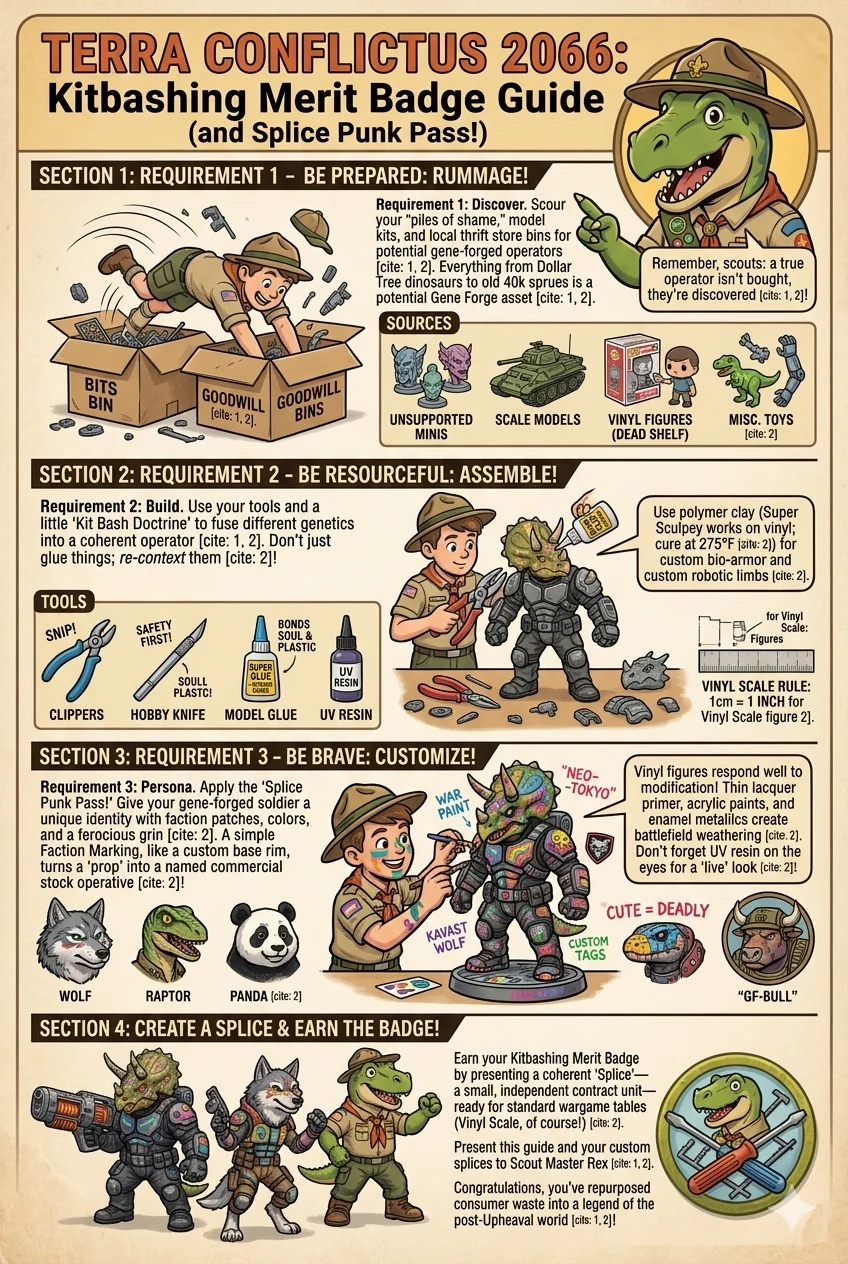
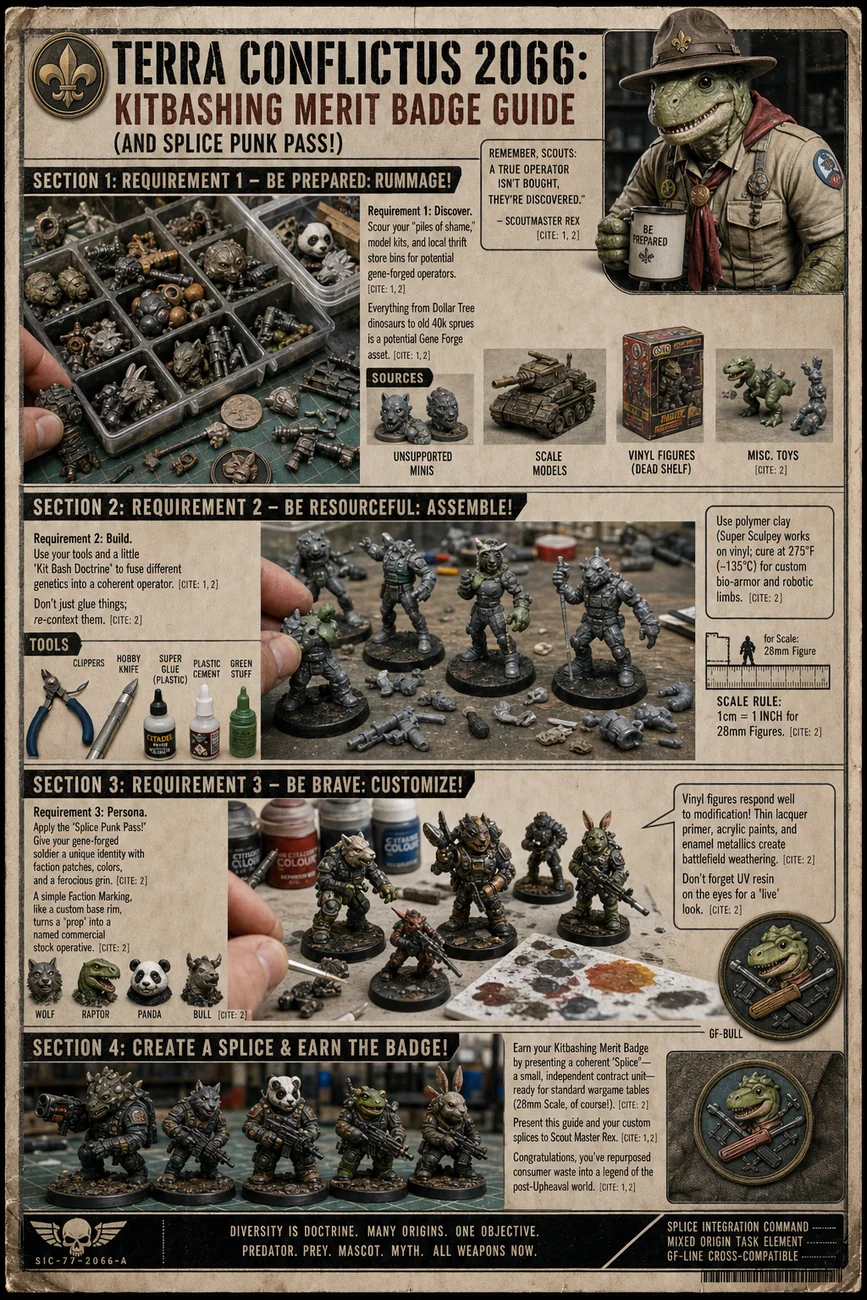
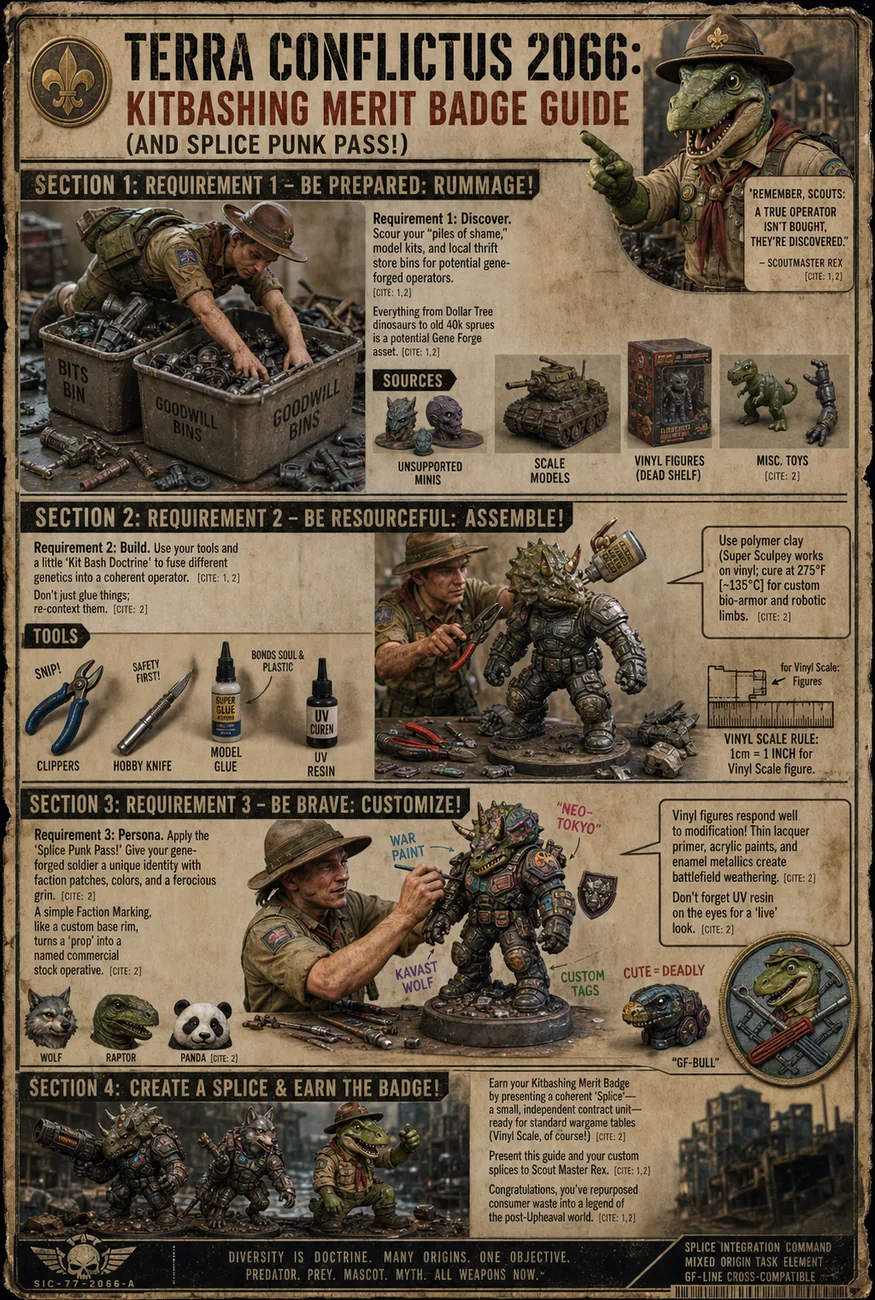
15 // EARN YOUR SPLICETHE KITBASH MERIT BADGES
Stay up too late. Build from junk.
EARN YOUR SPLICE
The best armies in this game will not be the most expensive. They'll be the ones somebody stayed up too late building from junk, gave a faction name, wrote a backstory for on an index card — and then watched get flattened in round three. That's the hobby. That's the whole thing.
So earn the badges. Build one operator from a dollar-store toy. Run a splice that's never matched. Give a thrift-store figure a name and a card. Each one is a small dare to put something built, not bought, on the table.
The Analog Argument
This is the Dead Shelf path as a first-class principle — not a workaround for the miniature question, but the setting itself. Pick up what's in front of you and put it to work.
The merit-badge guide — print, earn, sew on
SPLICE SQUAD · run a mismatched unitPHOTOREAL · take it all the way
TC·BTB027
16 // GALLERYINSPIRATION · SPLICES IN THE FIELD
Where the builds end up
IN THE FIELD.
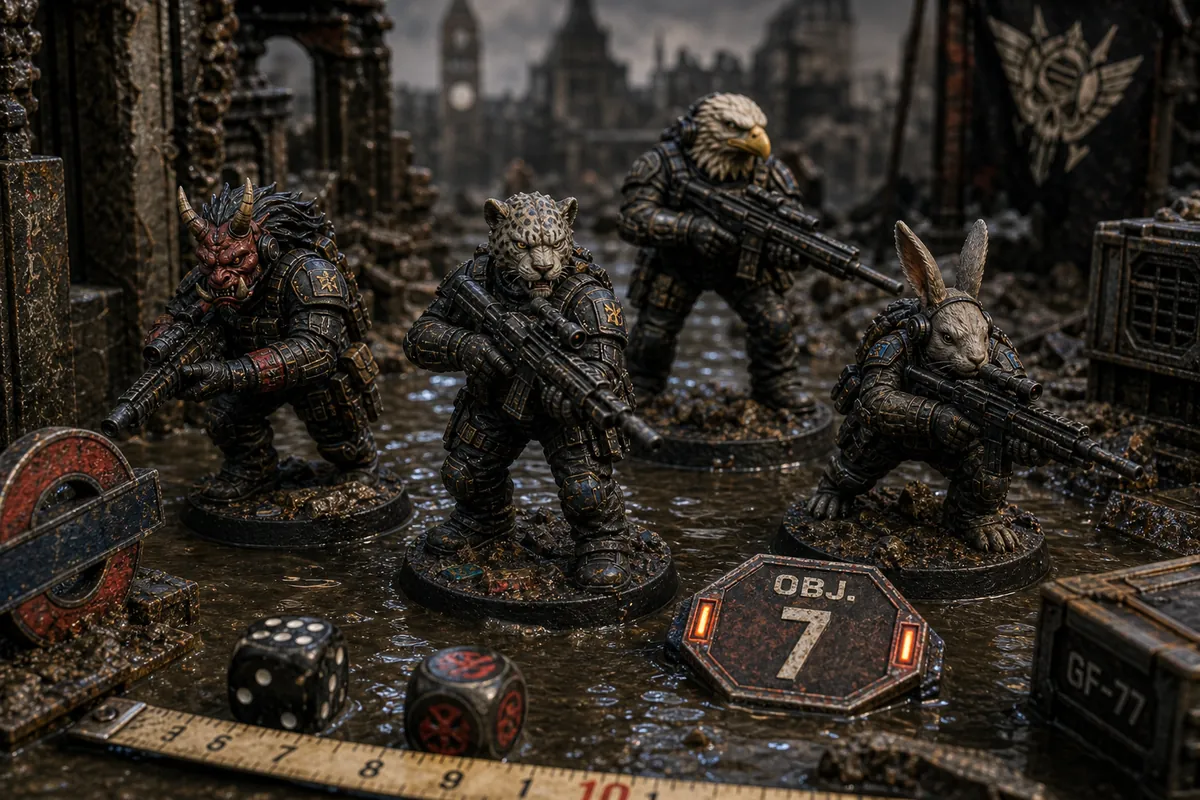
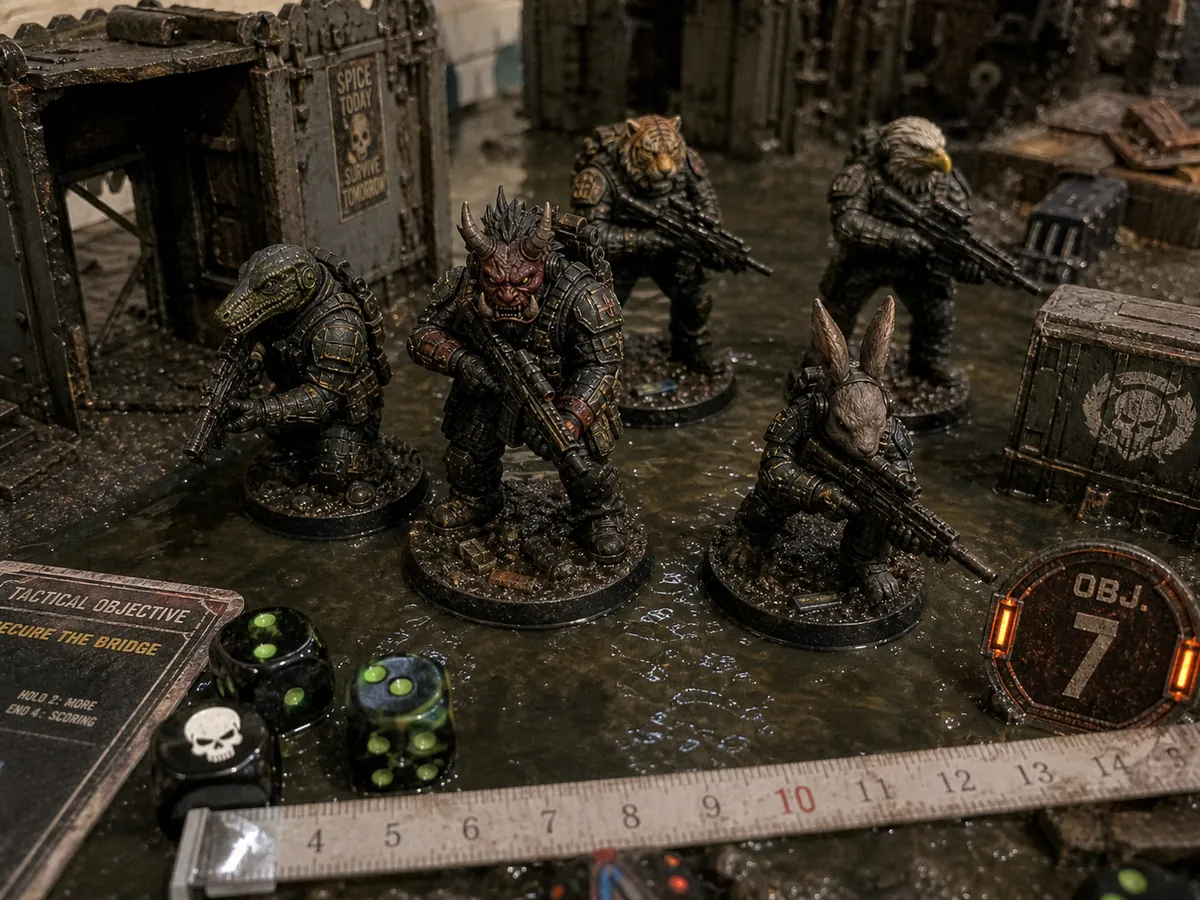
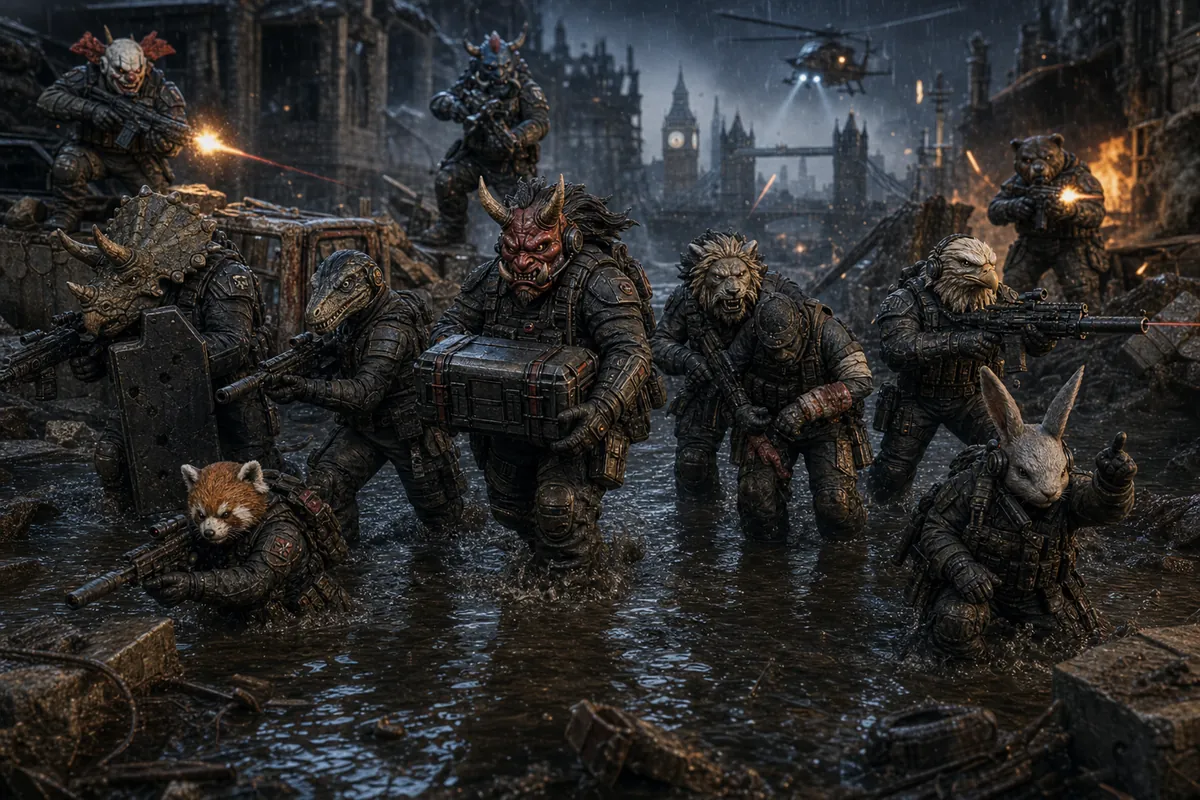
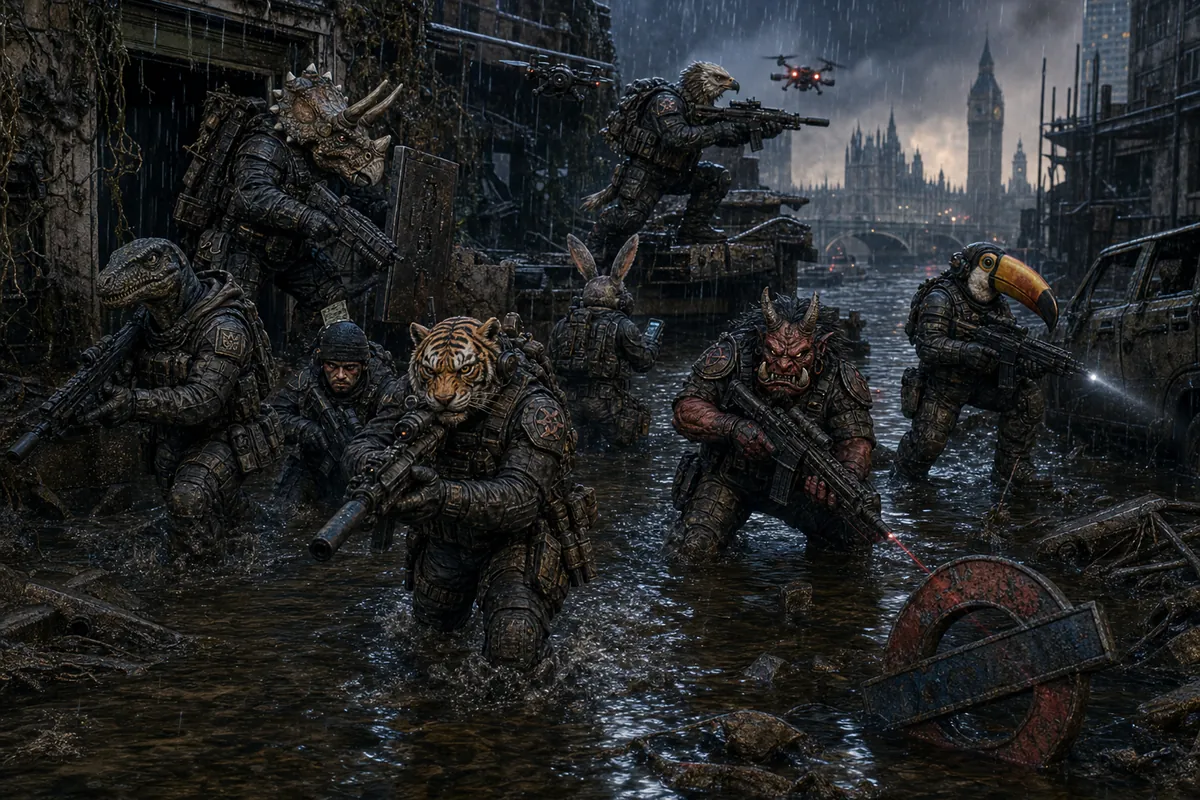
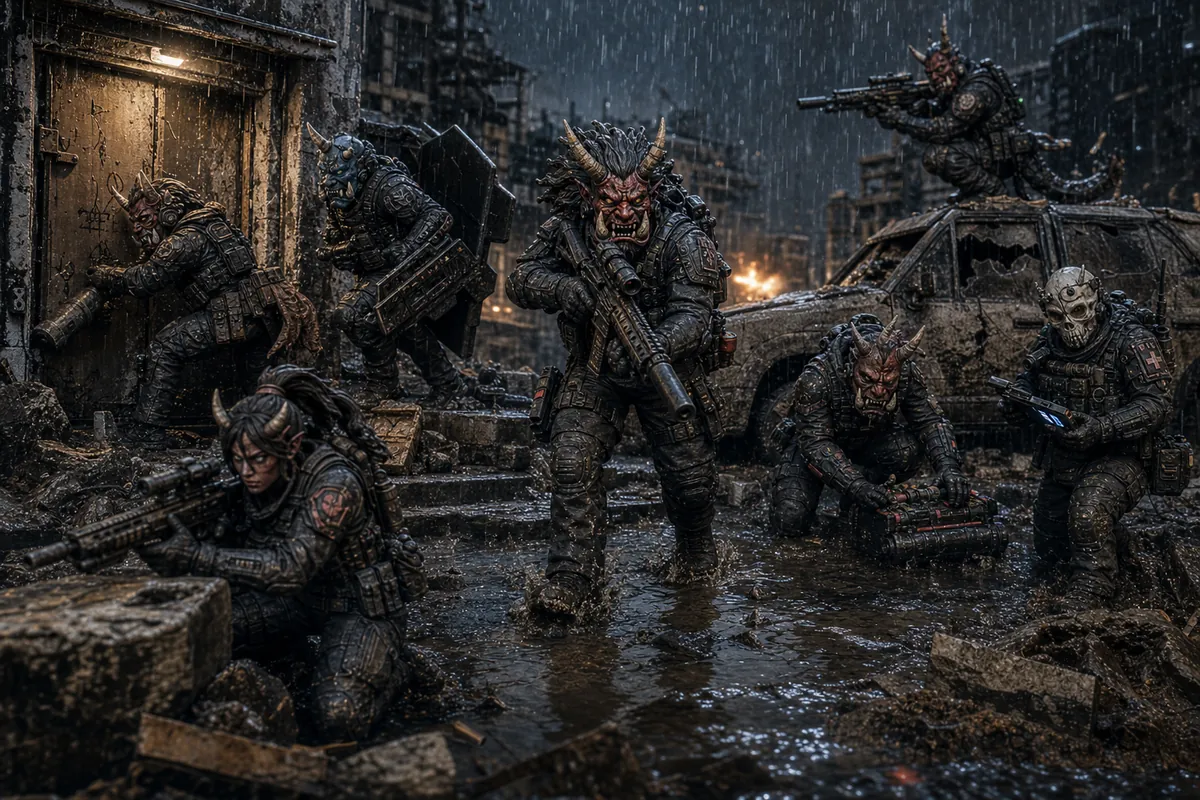
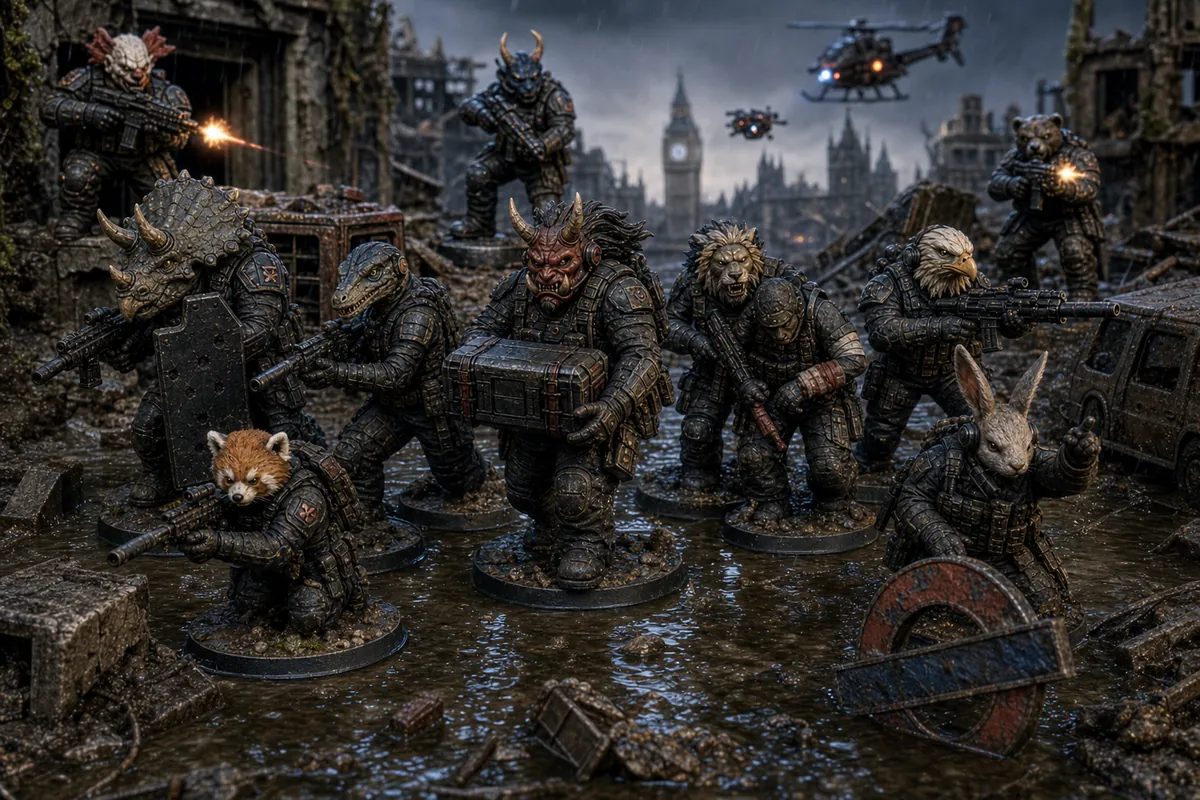
Built, based, marked, and deployed. This is the contested zone your operators were made for — mood, not instruction. Steal a lighting idea. Steal a basing idea. Build toward one of these.
EXTRACTION · get the package outURBAN · contested city blockRAIN · the oni in the downpourCONTACT · the line holdsNIGHT · on the tableSTANDOFF · splice vs. splice
TC·BTB028
17 // GLOSSARYSLANG OF THE BENCH
Talk like you build
GLOSSARY / SLANG
Shelf to Splice
Taking a finished figure off a shelf or out of a bin and putting it to work as an operator. The Dead Shelf path in three words.
The Pink Pass
Adding the human accent only where it counts. Restraint as a technique — four touches, not a repaint.
The Fuse
The moment unrelated parts — model, toy, bits-box, vinyl — become one operator. Clip, pin, glue, bridge.
Wearing the Build
When the gear, not the genetics, makes the operator. A wolf isn't a wolf until it's wearing the doctrine.
Running Your Own Template
Fielding a splice that ignores mono-type doctrine. Every state cohort hates it. Do it anyway.
Build Pride
The thing you feel watching a model you stayed up too late on get flattened in round three. Worth more than the win.
Commercial Stock
In-world: gene-forged built for entertainment markets. Out-of-world: the designer vinyl on your shelf. Same words, on purpose.
Mono-Type
State doctrine — one apex template per cohort. Wolves with wolves, ravens with ravens. The opposite of a splice.
Vinyl Scale
The house rule that reads every centimetre as an inch, so big figures play without conversion math.
Casting
Choosing the thrift-bin object whose shape already is the unit. A Mega Pop Mart figure isn't a workaround for a Siege Walker. It's casting.
Dead Shelf
The secondary stream — thrift bins, donation piles, your own abandoned collection. The supply chain that's already there.
The Analog Argument
Built beats bought. The cheapest army made with the most love wins the table that matters.
TC·BTB030
18 // CLASSIFIEDSBACK MATTER · NOTICES & TRADES
Salvage · Trade · Recruit
CLASSIFIEDS
WANTED
One Mega Pop Mart for Siege Walker duty
Biggest thing on your shelf, smallest thing on my conscience. Must out-mass everything in my splice. Frill optional. Will trade two ravens and a clean base.
FOR SALE
SOLDER™ Starter Bench Kit
Clippers, knife, pin vise, UV cure light, one bottle of nerve. "Bring it back. Put it to work." Batteries and ambition not included.
FOUND
Half a Labubu series, Goodwill bin, Tuesday
Three dollars. Already commercial stock. Already has a backstory. Already yours if you want them — drop a card and a name.
SERVICES
Underground gene-smith, no questions
Black-market deviation a specialty. Mismatched arms, doubled heads, lineages that don't track. Answerable to nobody. Cash only.
NOTICE
Carcass Coffee — open late for builders
Open until the glue sets. Free refills for anyone painting at the back table. We've seen worse than your seam lines.
RECRUITING
Splice forming — mono-type need not apply
One wolf (ex-NAF), one raven (no flag), seeking a baseline breacher and one cheerful commercial-stock operative. Bring your own grit.
TRADE
Dollar-store fossil dig
Bag of 12 dinosaurs, lightly chewed. Excellent paleo-stock. Will trade for primer or a sprue of modern military bits.
PSA
Bake your clay in a dedicated tray
275°F. Not the cookie sheet. We will know. Your splice will know. Ventilate.
LOST
One pink tail-tip, 70mm base scale
Last seen mid-flank. If found, the D-Rex would like it back. Reward: build pride and a story for the index card.
TC·BTB031
// CLOSING
ONE STARTED AT A HOBBY SHOP. ONE STARTED AT A GOODWILL ON A TUESDAY. BOTH ARE CORRECT.
Commercial stock: gene-forged built for entertainment markets. Ended up here. Still delighted. You have no idea what it's capable of. — Dream it, salvage it, build it, put whoever the hell you want in your splice.