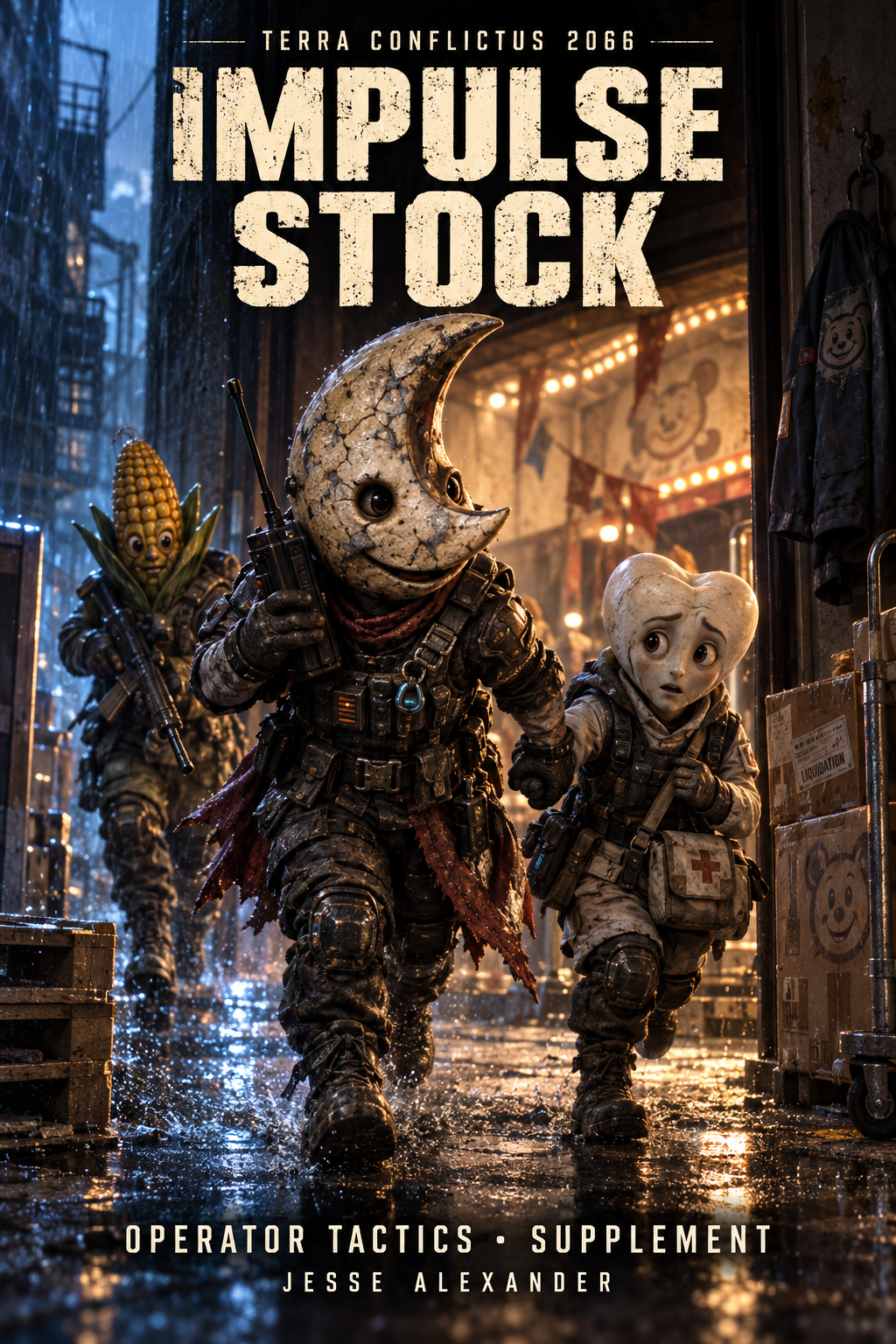
Impulse
Stock
The small commercial grade: canon, sixteen brands, and the rules for running them
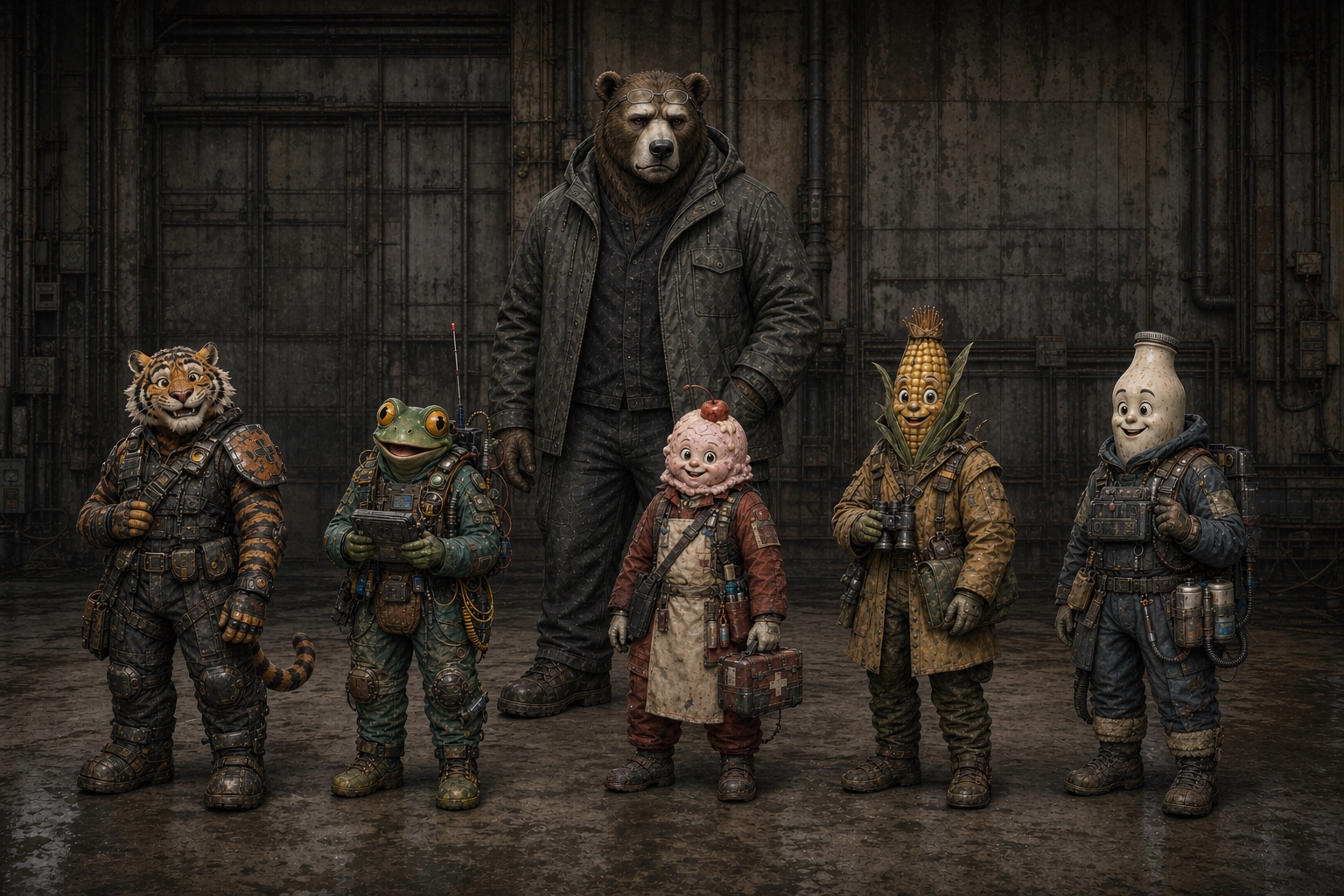
Living consumer mascots, ninety to a hundred and forty centimetres, built before the wars to work indoor venues and sold as inventory rather than hired as staff. The companies died in the Upheaval. The paperwork did not.
What They Are
The grade, the name, why they are small, and the compliance package they carry.
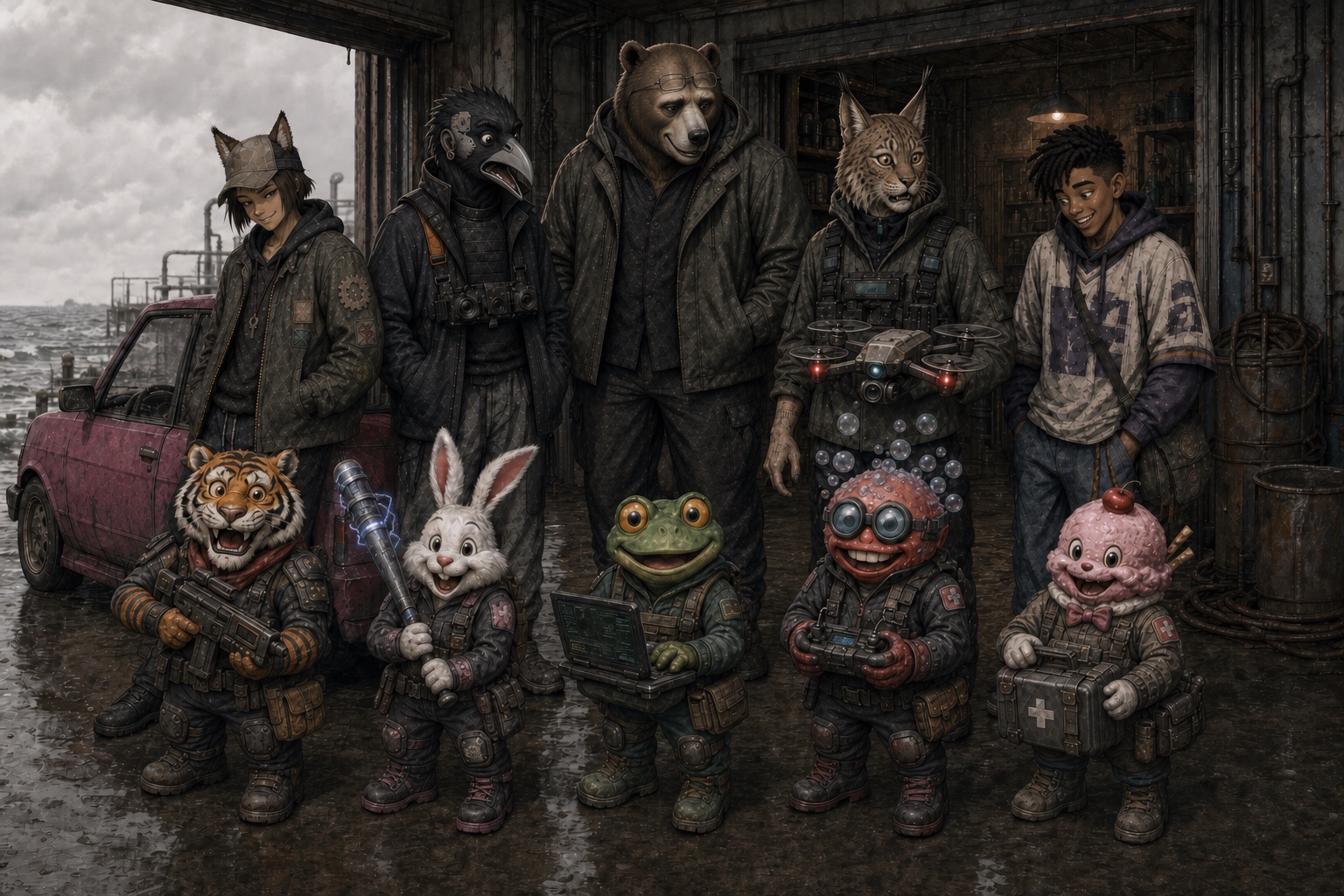
Impulse stock is the small grade of commercial gene-forged: mascots, greeters, and premium tie-ins built at half human scale or less, engineered for venue work, and sold as inventory rather than hired as staff.
They stand between 90 and 140 centimetres. They were built to be handled, photographed, and stood next to. They were never built to be shot at, which is most of what has happened to them since 2053.
They sit underneath Commercial Stock in the gene-forged origin structure — one of the paths beyond apex stock, alongside Bespoke Commission and Black-Market Deviation. They do not replace it. Commercial stock is the category; impulse stock is the small grade within it.
Most are still working. Almost none are free.
The name
"Impulse" is a retail term. It describes the merchandise category positioned at the register: small, cheap, bought without a decision. The gene-smiths who built the small grade used it as a shelving classification, because that is what it was. It appears in liquidation manifests, customs declarations and insurance schedules as a line item, not as an insult. It became one on the way out of the building.
Some use it about themselves the way freelance operators took splice — flat, professional, first, before anyone else can. Some will not say it at all. Unlike splice, the reclamation is not complete and probably will not be, because splice was a word about what you chose and impulse is a word about where you were placed. There is no pride available in a shelving classification. What is available is accuracy, and a lot of them settle for that.
Shelf is the parent term, in circulation since the 2050s, and it covers all commercial stock. Impulses are shelves; not all shelves are impulses.
Why they are small
Four reasons, all commercial, none of them about the person.
Venue licensing. Indoor entertainment complexes carried occupancy and liability certificates priced by unit mass. Anything over 150cm required a handler on the floor, a second insurance rider, and a clear-lane exemption. Under 140, a unit worked the room alone.
Child-proximity rating. The regulatory band permitting unsupervised contact with minors capped height, reach and bite force. Every brand that wanted its mascot to hug a customer built to that band.
Cost. Less consumed through the growth cycle, less maintenance, less transport. A shipping container moved four times as many.
The toy. The tie-in figure sold better when the living unit already had the proportions of a toy. Several lines were designed backward from the sculpt.
The two grades of every brand
Every commercial line on record ran two builds.
The venue unit — full scale, two metres and up, parade and stage. In the Upheaval these mostly walked: big, visibly dangerous, hard to inventory, easy to lose in a refugee column.
The impulse unit — 90 to 140cm, in-store, table service, and the tie-in. These did not walk, because they were countable.
Same brand. Same face. Same behavioural package. Different product code, different price, different fate.
The script
Impulse stock are not stupid. This is the most commonly repeated error about them and it is worth being exact.
What they carry is a compliance architecture — the same class of engineering that produces an aggressor behaviour matrix in a combat variant, tuned in the opposite direction. Cognition is not reduced. It is narrowed: attention routes preferentially to a fixed set of service behaviours, deference to an identified handler, and a brand-specific verbal package the unit produces under stress, on cue, and at intervals it does not choose.
At a distance this looks like low intelligence. Up close it is not. An impulse unit can track a logistics problem, recognise a lie, hold a grudge for eleven years, and understand exactly what is being done to it. What it struggles to do is refuse, improvise outside the service frame, and stop talking when talking is what will get it killed.
Some route around it. It takes years, it takes an unusual person, and it never fully goes away — a free impulse under real stress will still hear the phrase come out of their own mouth and hate it. The ones who have beaten it furthest tend to be the ones who were owned longest.
Why they die
- The frame is not rated. Certified for indoor venues and child contact. Bone density, organ shielding and blood volume were all specified downward. A wound a baseline operator absorbs is a structural event in a 100cm body.
- The armour is scaled and salvaged. Nothing is made for them. Every plate on an impulse unit was cut down from adult kit by somebody in a garage, and it fits where it fits.
- Pain suppression, installed on purpose. Venue work meant standing for fourteen hours and never showing discomfort to a customer. They do not withdraw, do not favour the injury, and frequently do not know. They fight until the system stops, and then they stop all at once.
- The script kills them. Under stress the phrase comes out. In a venue that was charming. In a contested zone it is a position report broadcast to everyone with ears.
The three retail grades
The collectors' vocabulary the trade actually uses, applied to people, constantly, by everyone including them.
| Grade | Origin | What it means |
|---|---|---|
| Loose | Giveaway and promotional builds. Free with purchase, no packaging, minimum spec. | The cheapest life in the setting. |
| Carded | Standard retail. The normal in-store unit. | The working grade. |
| Boxed | Premium and collector builds. Flagship stores, executive gifts, the good one. | Survives. Becomes somebody. |
A Boxed unit maintained across the whole end-of-line period gets called serviced, and in orphanware register that is a compliment with weight in it.
The Law
Assets, not employees. Liquidation, the three positions, and the recall clause.
This is the mechanism that makes impulse stock available to anyone with money, and it is the most useful thing about them.
Commercial stock were employees of nobody. They were assets.
When the entertainment complexes collapsed through the Upheaval, administrators liquidating a failed brand did what administrators do: they sold the schedule. Impulse stock moved through the wars the way pallets move. Bundled into asset lots. Sold as job lots to buyers who wanted the trademark and got the mascots attached. Written down, written off, repossessed, put up as collateral, inherited by people who did not know what was in the warehouse.
A cartel lieutenant with nine impulses did not kidnap nine people. He bought lot 41 at auction, legally, with a receipt, and the receipt is why nobody has come for him.
The three positions
Held. Someone has current title. This is most of them. Their situation ranges from decent to unspeakable and the title does not distinguish. A held unit's handler may be a monster, or may be a mechanic who feeds them and has never once thought about the paperwork in the drawer.
Loose. No current holder, no clear title, no papers. Free in practice, not in law. Any competent broker can construct a chain of title over a loose impulse in about a week, and several make a living doing exactly that. Loose units know this. It is the reason a lot of them stay attached to a crew that doesn't own them — a crew is cover.
Titled to self. The rare one. Bought their own lot, or had it bought for them, and holds the paper. Fewer than you would hope.
The recall clause
Many liquidation instruments carried a dormant repurchase or recall option that transferred with the lineage IP into shell entities that have never sent mail. Applied to impulse stock at scale, this means a shell nobody has heard of may hold an option over four hundred living people and has simply never exercised it.
Yet.
The Brands
Sixteen consumer lines, what each one built, and where the stock ended up.
Sixteen lines. Character name is the mascot's name as the public knew it — which is also, for most impulse stock, the only name they have, and is a trademark held by whoever bought the marks in liquidation. That is the grade's central indignity and it should never be played as a small one.
| Brand | Product | Character | Impulse role | Script |
|---|---|---|---|---|
| Sunstripe Breakfast Co. | frosted cereal | Stripes, a tiger | Escort / close assault | "Now THAT'S a great morning!" |
| Fizz-O-Licious | tonic soda | Fizzer, a frog | Signals / technical | "Refreshing! Try it chilled!" |
| Cherrytop Creamery | frozen novelty | Topper, a sundae | Field medicine | "Somebody looks like they need a treat!" |
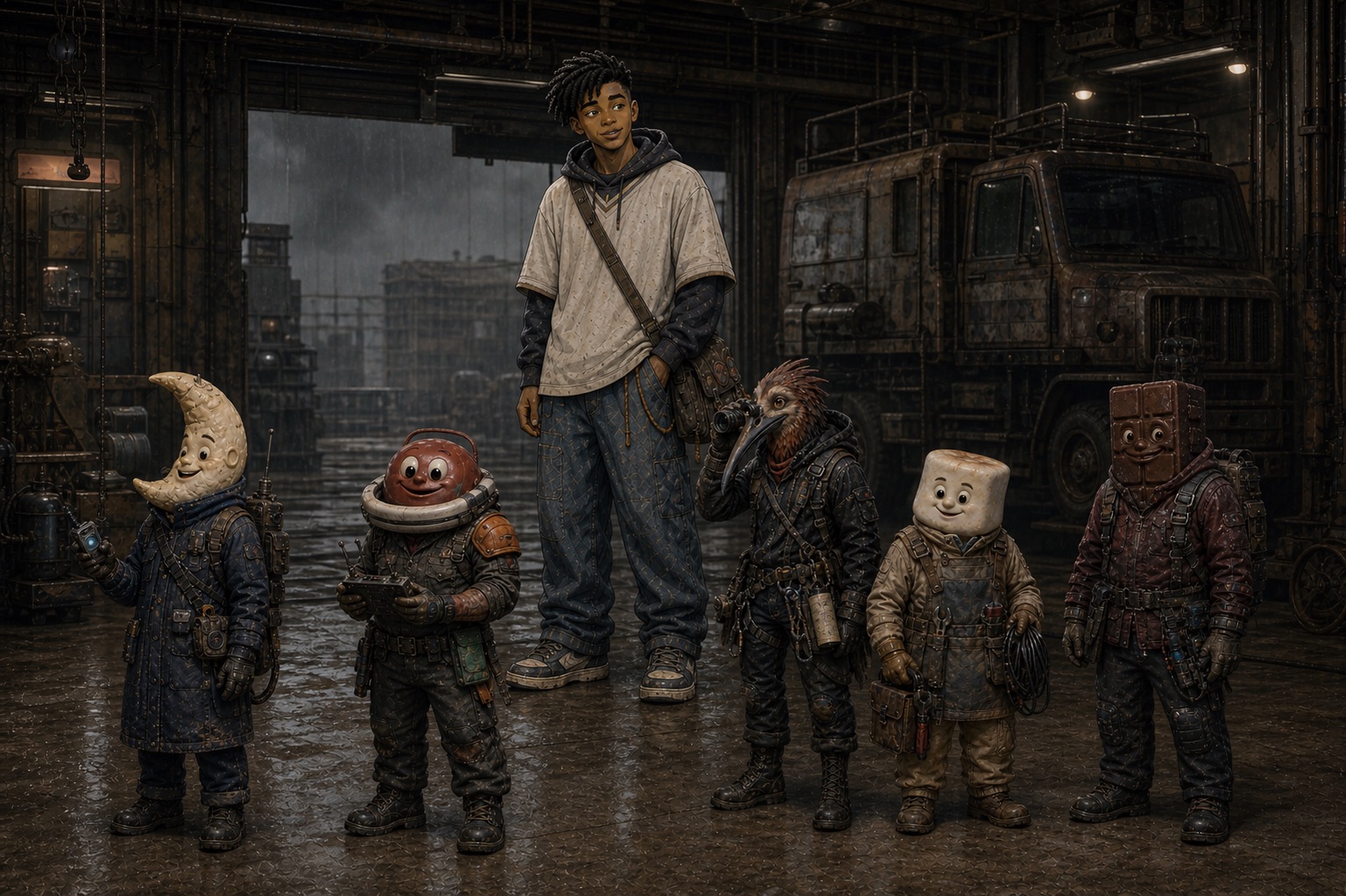
| Happy Hut | roadside meals | Hut, a greeter | Point / scout | "Welcome in! Table for how many?" |
| Harvest King | frozen vegetables | The Harvest King, corn | Recon / static observation | "Picked at the peak of freshness!" |
| Mallow Fields | confections | Mallow | Demolitions | "Sweeeeet! That's the difference!" |
| Luna-Bites | cereal | Luna, a crescent moon | Signals relay / night ops | "Good night. Great taste." |
| Sparkle Smile | dental care | Pearl, a tooth | Orderly / triage / chemical | "Let's take a look at that!" |
| Lull-O-Bye | nursery goods | Baa, a lamb | Morale anchor | (sung) "Close your eyes now…" |
| Fidelis Mutual | insurance | Prudence, an owl | Command / support | "You're covered. You're fully covered." |
| Wayfinder | roadside signage | Finder, a sign | Relay / marker / navigation | "Two kilometres! You're almost there!" |
| Ridewright Amusements | fairground operator | Bumper, a ride mascot | Drone / vehicle operation | "Keep your hands inside the vehicle!" |
| Bramblecrisp | fruit cereal | Bramble, a long-billed bird | Aerial spotting, high ground | "Follow your nose to the good stuff!" |
| Puffley's | marshmallow snack | Puff, a confection | Comfort / courier / decoy | "Puff puff, that's enough!" |
| Nine Bells Dairy | milk and chilled goods | The Milkman, a bottle | Logistics / cold chain | "Fresh at the door by six!" |
| Cocoa Cove | confectionery bars | Cove, a bar figure | Close work, hard frame | "Break me off a piece of that!" |
Two entries carry more weight than the rest.
Mallow Fields is short because the entry is short. Giveaway grade, demolitions, chosen for the work because they were cheap and the work is not survivable. The accurate word for what happened to that line is consumed.
Fidelis Mutual is the only brand on the list whose parent company still exists. It rebranded in 2056 and has never been asked what happened to the stock. That is the one live corporate thread in the whole ledger and it is worth more than the other fifteen combined.
At The Table
The Impulse tier, seven keywords, twelve stat lines, a force pack, and how a crew attaches one.
The Impulse tier
A new tier, below Grunt. Everything in the standard enemy rules applies except where this overrides it.
| Impulse | Grunt | Soldier | Veteran | Heavy | |
|---|---|---|---|---|---|
| Actions per activation | 1, always | 1–2 | 2 | 2 | 2 |
| Typical FW / MW | 1–2 / 0–1 | 2 / 0 | 3 / 1 | 3 / 2 | 4 / 2 |
| Typical AR | 0–1 | 1 | 1–2 | 2 | 3 |
| Morale | Never checks. Handler checks. | Group | Group | Group | Group |
One action, always. Never a second, for any reason — not a commander's order, not Aggressive posture, not a player spending their own. It moves or it acts. This is not the same as being slow; several of them are the fastest things on the board over a single activation.
One Good attribute, at most, and it is always the thing their product line was built to do. Everything else runs Ordinary or Bad. They are specialists with no general competence, which is precisely what a venue job produced.
Retail grade sets the wound track. Loose is FW 1 / MW 0. Carded is FW 2 / MW 0. Boxed is FW 2 / MW 1.
Keywords
Script. In any round in which this unit is wounded, addressed directly, or acts within 8″ of an enemy, it delivers its line — and cannot benefit from Stealth, concealment, or an Unaware enemy's ignorance for the remainder of that round. Every enemy within 12″ knows where it is.
Say the line out loud. Every time. The GM who mumbles it has thrown away the best thing about the tier.
Handler-Bound. Requires a controller within 8″ — any Soldier, Veteran, Heavy, Commander, or a player operator who has taken the unit in hand. With no controller in range, on activation roll D6: 1–3, it holds position and runs the phrase, no action taken. 4–6, it performs the last order it was given, again, exactly, regardless of whether that order still makes any sense.
The second result is the frightening one. An impulse ordered to hold the east door will hold the east door after the east door is gone.
Pain Suppressed. Ignores the Pinned condition. Can never voluntarily withdraw, break, or take cover it was not ordered into. It does not know it is hurt.
Novelty Frame. Loose and Carded grades only. Any hit from a heavy weapon, explosion or vehicle impact that would inflict FW puts the unit Out of Action instead.
Underfoot. Profile under 140cm. Enemies shooting at this unit beyond 12″ do so at −1. It provides cover to nobody, blocks no line of sight, and cannot be used as a screen.
Lotmate. When a unit from the same lot goes Out of Action in this unit's line of sight, it ignores Handler-Bound entirely for the next two rounds and moves toward the position where its lotmate fell. Nothing stops this. It is not a morale effect and it cannot be ordered away.
This is the tier's one moment of agency and it is always a tactical disaster. Let it happen.
Brand Loyalty. If a genuine period item carrying this unit's brand mark is openly displayed within 8″ — an authenticated original, not a bootleg — the unit will not attack the person displaying it until the end of the following round. It will not necessarily obey them either. It will look.
An authenticated original is a rare, expensive object with provenance. A crew that owns one is holding a key, and should have to decide out loud whether they are rescuing someone or operating a remote control.
Morale
Impulse units never make Morale Checks. They do not have the architecture for it.
When a Morale trigger occurs to a group containing impulses, the handler checks, at their own group's rating. If the handler fails, the impulses do not rout with them — they keep executing their last order, alone, in a fight their controller has already left. If the handler goes Out of Action, every impulse within 8″ becomes Handler-Bound with no controller and starts rolling D6 on activation.
Cutting the head off an impulse formation does not end it. It makes it incoherent, tragic, and still armed.
Stat lines
Attributes use the standard scale: Good (2+), Ordinary (4+), Bad (5+). MOBI in inches. Loadouts assume scaled-down or salvaged kit; nothing here is factory-fitted.
| Unit · Grade | SHOOT | FIGHT | TACT | OPINT | GUTS | MOBI | AR | FW | MW | Role |
|---|---|---|---|---|---|---|---|---|---|---|
| Sunstripe Escort · Boxed | Ord | Good | Bad | Bad | Ord | 4 | 1 | 2 | 1 | Assault |
| Cuddly Club Runner · Carded | Bad | Ord | Ord | Bad | Ord | 7 | 0 | 2 | 0 | Rapid response |
| Fizz-O-Licious Technician · Carded | Bad | Bad | Good | Ord | Bad | 4 | 0 | 2 | 0 | Signals |
| Ridewright Pilot · Carded | Bad | Bad | Ord | Good | Bad | 4 | 1 | 2 | 0 | Drone / vehicle |
| Cherrytop Medic · Boxed | Bad | Bad | Good | Ord | Ord | 4 | 1 | 2 | 1 | Field medicine |
| Happy Hut Greeter · Loose | Bad | Bad | Bad | Ord | Bad | 5 | 0 | 1 | 0 | Point / scout |
| Harvest King Spotter · Carded | Ord | Bad | Bad | Good | Ord | 3 | 0 | 2 | 0 | Recon |
| Sparkle Smile Orderly · Loose | Bad | Bad | Ord | Ord | Bad | 4 | 0 | 1 | 0 | Triage / chemical |
| Lull-O-Bye Comfort Unit · Carded | Bad | Bad | Bad | Ord | Good | 4 | 0 | 2 | 0 | Morale anchor |
| Wayfinder Marker · Loose | Bad | Bad | Ord | Ord | Bad | 4 | 0 | 1 | 0 | Relay |
| Mallow Fields Breacher · Loose | Bad | Bad | Good | Bad | Ord | 4 | 1 | 1 | 0 | Demolitions |
| Fidelis Mutual Adjuster · Boxed | Bad | Bad | Ord | Good | Ord | 4 | 1 | 2 | 1 | Command / support |
All units carry Script, Handler-Bound (except the Adjuster) and Underfoot. Loose and Carded units carry Novelty Frame. Combat-tasked units carry Pain Suppressed.
Special cases. The Cherrytop Medic clears one FW from an adjacent operator as its single action. The Lull-O-Bye Comfort Unit lets any friendly group within 6″ re-roll one failed Morale Check, and the line was never armed — several holders find that funny. The Wayfinder Marker extends allied radio and command range by 8″ and carries Unaware, which models both the unit's own inattention and everyone else's; nobody looks at a sign. The Fidelis Mutual Adjuster is the only unit without Handler-Bound and can act as a controller for other impulses within 8″ — the one unit on the list that can hold a formation together.
Force pack — "Lot 41"
Somebody bought an asset lot at auction and got nine people with it. The receipt is in a drawer in another city and it is entirely valid.
Total: 1 handler + 6 impulses. Morale Rating 4, handler only.
- Lot Handler — Soldier tier, keyword Aggressive, carbine, medium armour, and a brand caller: a bulk-order remote broadcasting a compliance tone, which extends controller status to 12″.
- Sunstripe Escort ×2 — the armed front.
- Happy Hut Greeter ×2 — walked in first. Always.
- Harvest King Spotter ×1 — placed before the mission started and already in position.
- Mallow Fields Breacher ×1 — held back until a door needs opening.
Running it. Straight, it plays as a swarm: six bodies, one action each, easy to remove, hard to ignore. The turn it becomes something else is the turn the players drop the Handler. Every impulse goes loose, the D6 rolls start, and half the lot begins re-executing an order from four rounds ago while the other half stands in the open running the phrase. Nobody routs. Nobody surrenders. The players have to decide, mid-firefight, whether they are still fighting.
Escalation: add a Fidelis Mutual Adjuster. Now killing the handler does not break the lot, and the players have to shoot an insurance mascot to win, which they will remember longer than the mission.
Attaching one to a splice
Crews acquire these. Plan for it.
An impulse is an attachment, not an operator. It does not count toward splice size, does not take an operator slot, and never becomes a player character. A splice of four with an impulse escort is a splice of four.
Cost. Attaching one consumes one gear item's worth of the splice's loadout budget at mission start. That is what it costs to feed, fit and carry kit for a person who fits nothing.
Command. One operator is nominated as controller at mission start. The impulse activates during that operator's activation and its single action costs the controller one of their own actions. If the controller goes Out of Action, another operator can take control by spending a full action within 8″ — until then, roll the Handler-Bound D6.
Downtime. Between missions, an impulse can attempt one of: a Service roll (TACT 4+ by any operator, or automatic with a gray vet contact — clears accumulated damage and one script-related complication), or a Papers roll.
The papers problem. Any impulse a crew picks up is loose, not free. Once per campaign, and at the GM's timing rather than the players', a broker, a former holder, or a shell entity establishes chain of title and comes to collect — with documentation, and usually with the law on their side rather than in their pocket. This is not an ambush. It is a man with a folder. The crew's options are to buy the title, forge the title, refuse the title, or hand the person over, and every one of those has a price the campaign should actually charge.
The rule that matters. When an attached impulse goes Out of Action, that is a death, and it is a death the paperwork will not record. Nobody is notified. There is no next of kin, because a lot number is not a family. If a lotmate is present, refer to Lotmate and let it play. Then move on, because the mission does not stop, and the fact that the mission does not stop is the point.
D20 — what it is stuck saying
Roll for a new impulse, or use the script line for any unit above. The phrase fires under stress, on the Script keyword, at the worst available moment.
| D20 | Line | D20 | Line |
|---|---|---|---|
| 1 | "Welcome in! Welcome in!" | 11 | "Have you tried the new size?" |
| 2 | "Now THAT'S a great morning!" | 12 | "That's a great question. Let me get someone." |
| 3 | "Somebody looks like they need a treat!" | 13 | "Careful — floor's wet!" |
| 4 | "You're covered. You're fully covered." | 14 | "One per customer, please." |
| 5 | "Two kilometres! You're almost there!" | 15 | "Smile! Say cheese!" |
| 6 | "Hop to it! Hop to it!" | 16 | "We're open till nine!" |
| 7 | "Picked at the peak of freshness!" | 17 | "Thank you for your patience." |
| 8 | "Let's take a look at that!" | 18 | (the jingle, four bars, hummed) |
| 9 | "Keep your hands inside the vehicle!" | 19 | "I'm not allowed to say that." |
| 10 | "Sweeeeet! That's the difference!" | 20 | (its own name, said the way a customer would say it, delighted, about itself) |
Nineteen and twenty are the ones to save. Nineteen is the compliance architecture surfacing as a refusal the unit did not choose. Twenty is worse. Roll them deliberately.
Figures and conversion
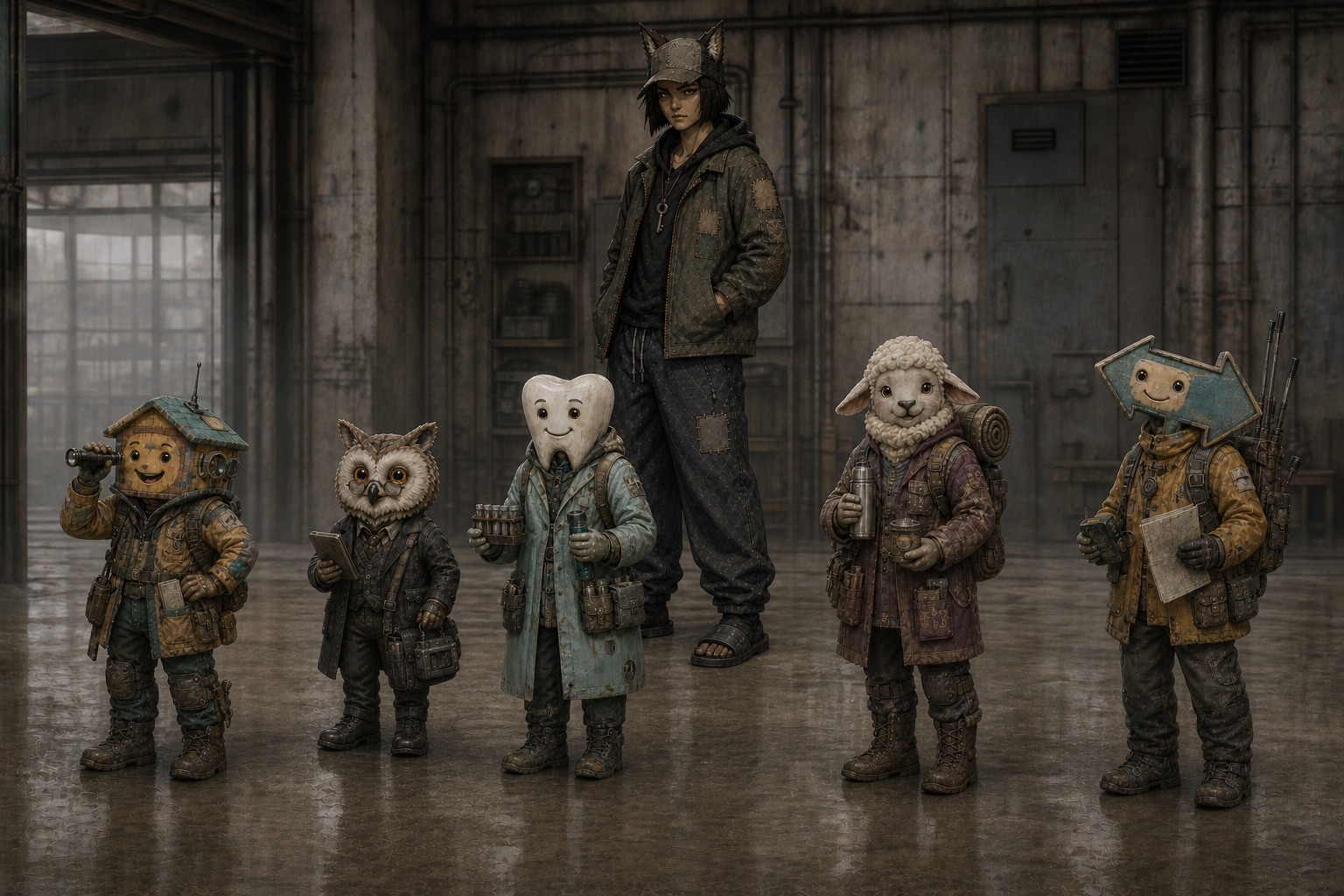
Vinyl Scale. Impulse stock sit at 1:2 Ultra-SD — head is half the total height — against 1:2.5 to 1:3 for core operators. Any standard 75–85mm blind-box figure works as an impulse unit with no modification whatsoever. Standard base: 5cm square or 50mm round, one step down from the individual operator base.
Skirmish. All of the above ports directly. Impulse units cost half a Grunt's points and count double toward any scenario's casualty threshold, because the scenario writer knows what they are even if the mission's employer does not.
Solo. Excellent Event Deck material. An impulse encountered alone, loose, with no controller and a phrase it cannot stop running, is a better complication than most of what a deck usually holds.
Three Of Them
Topper, Stripes and Prudence: loose, held, and titled to self.
Three named units, on three different sides of the same paperwork. Drop them in as written.
TOPPER
Cherrytop Creamery · Boxed · loose title · 24 · field medicine
A frozen-novelty mascot: a sundae with a cherry, 110cm, flagship-store build, which is the entire reason they are still alive. Certified in customer first aid for a chain that put a mascot in every location, and the certification transferred to a district where nothing else did. Currently loose — no holder, no papers, no protection — which they understand perfectly and mention to nobody.
What they want is to be somewhere they are not the cheapest thing in the room. They have never been in such a room. They keep looking. What they fear is not the van; it is the folder, and a stranger in a doorway being polite about it. The script fires hardest around people who are kind to them, because kindness was the working condition it was tuned for.
The name is a trademark held by an entity that has never sent mail. Anyone who tries to give Topper a better one will find they do not want it, because it is the only thing they came with.
"I'm not on anyone's schedule. That's not the same as being off it."
Three-second read: pink, dented, a scaled-down trauma case that is immaculate and clearly the most cared-for object they own. The cherry is chipped, has been repainted twice, and both repaints are visible.
STRIPES
Sunstripe Breakfast Co. · Boxed · held, valid title · 31 · escort
A breakfast-cereal tiger, 135cm, premium build, currently the property of a recovery contractor — acquired legally in an asset lot, deployed as doorway escort on assessment rotations because a mascot at a door makes the door open. Very good at the job. Does not want to be, and is structurally unable to stop.
Genuinely funny, warm on the drive, and the assessor likes them. The contractor knows exactly what that is worth and has costed it. What Stripes fears is being resold; the contractor is a known quantity, the paperwork is clean, there are far worse holders, and they have met some.
The problem the crew cannot solve: the title is valid. There is no theft, no cruelty on the record, no villain in the van, and no lawful way to take Stripes away from a firm that bought them at auction and has never once mistreated them.
"They're all right, mine. I've had worse. That's not — I know how that sounds. I've had worse."
Three-second read: immaculate. Corporate-maintained, properly fitted kit, the only impulse most people ever meet who looks cared for, and it reads as worse rather than better.
PRUDENCE
Fidelis Mutual · Boxed · titled to self · 40s · title broker
An insurance company's mascot owl, 125cm, executive-gift build, who bought her own lot in 2058 and has spent every year since constructing chains of title over other impulses and charging them for it. Off-brand — she can and does refuse orders, and it took her eleven years. Operates out of a rented office with a working printer and a queue.
Two hundred and six people moved out of inventory. The number is on a wall and she updates it herself. She charges everyone, sliding scale, no exceptions; she is right that no-exceptions is what makes it sustainable, and she has stopped being able to hear how it sounds.
Prudence exists to be the counter-argument to a crew's instinct. The reflex is to adopt, feed, protect and improvise. Her method is paperwork, and her method has a number attached and the crew's does not. She is not a villain and she is not secretly corrupt.
"You want to adopt him. I want to buy his paper. One of those survives you getting arrested." "Two hundred and six. How many have you done?"
Three-second read: the only impulse in tailoring. Reading glasses that are a prop and everybody knows it. A queue outside the door that never gets shorter.
The Language
Eight terms, and the registers they sit beside.
Registered in the Master Lexicon under Shelf, which is the parent term.
- Impulse — the small grade of commercial stock. Neutral in trade use, edged in most mouths.
- Loose / Carded / Boxed — the retail durability grades, used about people, constantly, by everyone including them.
- Lot — a group sold together in liquidation. "She came out of lot 41." Carries the weight of naming a hometown, and is the closest thing most of the grade has to one.
- Lotmate — someone from your lot. The strongest bond available to the grade. An impulse will do things for a lotmate that make no tactical sense whatsoever.
- On the schedule — still legally inventory. "He's on somebody's schedule, he just doesn't know whose."
- Ran the phrase — said the service line under pressure, involuntarily. Sympathetic, always. You do not laugh at someone who ran the phrase.
- Off-brand — broken far enough from the compliance architecture to refuse an order. High praise, spoken quietly.
- Still boxed — survived everything and is somehow intact. Said with real respect.
Adjacent registers already in play: shelf life, catalog kid, and the full orphanware vocabulary — orphanware, end-of-line, sunset, running ghost, parts funeral, shelf date, gray vet, the recall, aftermarket, donor line, serviced.
Running Them Well
Seven rules that keep the grade from collapsing at the table.
Short, and worth the space.
They are the fodder tier and they are people. Both are true simultaneously. The tension is the entire point, and resolving it in either direction wastes them.
The comedy is on the company, never on the person. The service phrase landing at the wrong moment is genuinely funny and should be played. But the joke is on a product committee, and a table that starts laughing at an impulse for being simple has lost the device.
Never play one as incapable of understanding its situation. They understand it completely and cannot act on it. Those are different things, and the difference is the character.
Do not make them sinister. The moment an impulse reads as evil, it becomes a horror trope and the company gets away with it. They are pleasant. That is the problem.
Do not make them pitiable. They do not know they are hurt — an installed feature — and playing them as victims removes the only dignity the grade has.
No rescue that works cleanly. Every one of them has a legal owner, a broker who can construct one, or a shell holding an option. A garage is not a jurisdiction.
They are cheap, legal muscle, which is exactly why the wrong people have so many. A GM fielding twelve impulses is telling the players something specific about the person who bought them, and does not need to say anything else.
Designer's Note
Why the setting needed a fodder tier, and why this one.
The setting needed a fodder tier that did not cheapen it.
Every skirmish game wants bodies on the board that can be removed quickly — enough to make a firefight feel like a firefight without demanding the tactical attention of a Veteran. The generic solutions are conscripts, drones, or animals, and Terra Conflictus can field all three. None of them said anything.
Impulse stock says something. It takes the setting's founding fact — the industry built people — and puts it on the table at knee height, armed, cheerful, and easy to kill. A player who guns down six of them has done something mechanically trivial and narratively expensive, and will notice the difference on the drive home. Someone who owns nine of them needs no other characterisation.
The horror of impulse stock is not that they were born simple. It is that a product committee in 2049 specified biddability as a feature, priced it, and shipped it, and the specification outlived every company that ordered it.
"I'm mascot stock. The warranty went when the company did." — Sadao, Neo-Tokyo, in Within Tolerance
Sixteen companies. Every one of them had a mascot, a marketing budget, a liability policy, and a plan for the next fiscal year. Fourteen are gone, one was absorbed, and one is still trading under a name you would not recognise and has never been asked a single question about what it used to own.