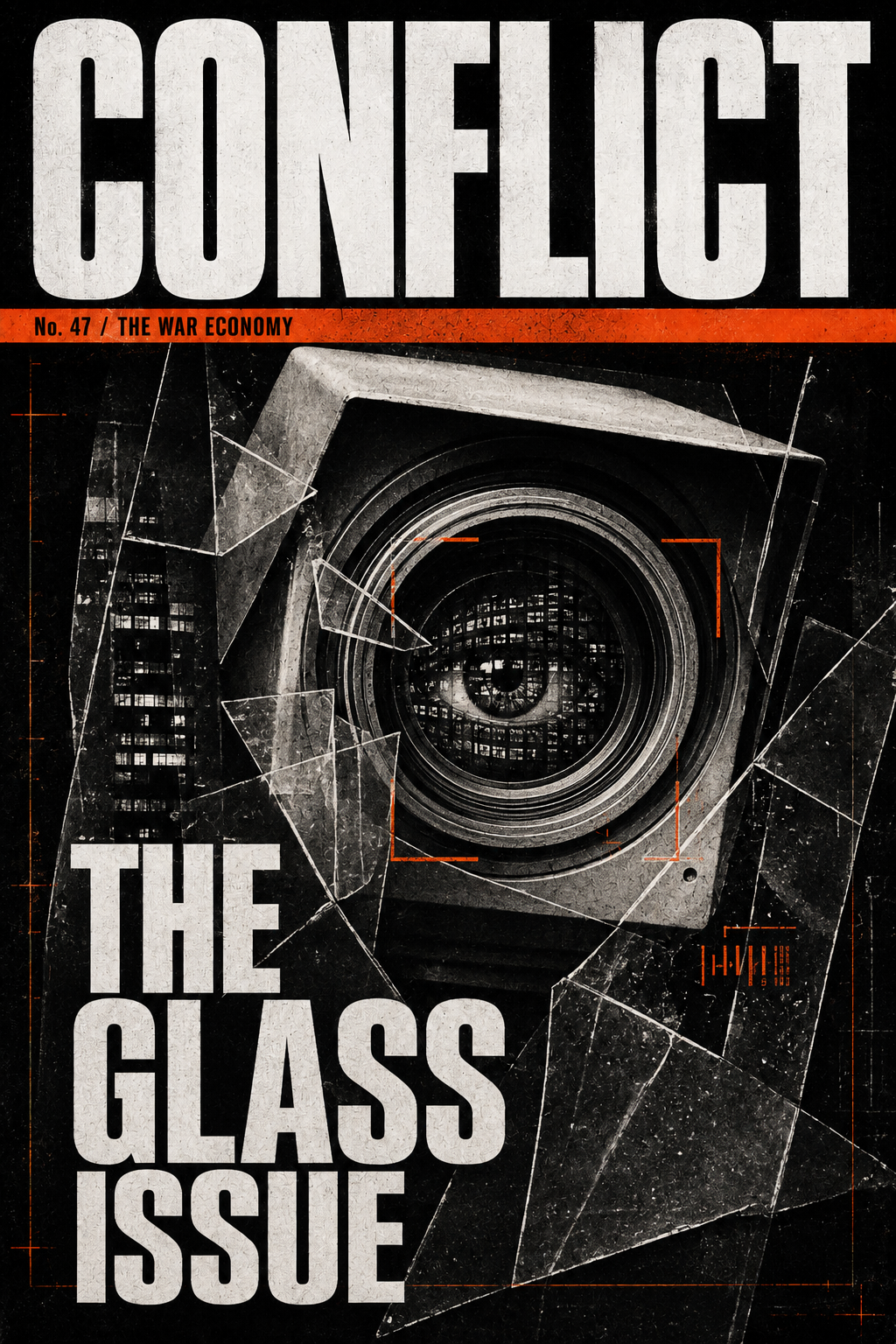
Owned by people who would rather see first than be seen at all.
Sold through bonded dealers only. Each unit serialized, registered, and traceable. We are aware some buyers consider traceability a defect. Those buyers are not our buyers. The glass remembers where it has looked. So do we.
CONTRIBUTORS
Lynx build, former splice op, writes the way she used to move, low and gone before the lens finishes its sweep. For EMBEDDED she spent nine days on a private watch floor where operators are tracked, scored, and sold by the second, and where the staff read her label off the way she sat down. She filed the piece from three different rooms because she did not want any one camera to have all of it. We pay her in full and on time. She has counted the exits in our office. We watched her do it.
Covers the watching economy from the offices that sell it rather than the streets that absorb it. She talked Sabine Crale, who runs acquisitions at the surveillance contractor CLARION, into an evening for THE ROOM WHERE EVERYONE LIED, and spent the days after deciding which of Crale’s answers had been rehearsed for her specifically. She concluded all of them, and printed them anyway, because a rehearsed answer is still a confession about what the speaker expected to be asked.
Holds a post in material forensics at the New Lagos Institute and a quieter sideline telling collectors whether the recovered optic they paid for ever actually looked at anything. She wrote MATERIAL CULTURE about a spotting scope that did the seeing at three engagements and was never once seen itself. She works without a screen in the room, which her students find theatrical until they notice she is the only one of them nobody can locate at any given hour.
Spent eleven years on the wrong end of other people’s optics and is therefore qualified to write THE MANUAL on leaving a camera zone without leaving a file. He teaches a short course on the subject that has no roster, no address, and no record of having met. The graduates know who they are. That is the entire curriculum and, he insists, the only passing grade.
Goes to the cities that have decided being watched is the same as being safe. For CITY OF BAD IDEAS he spent eight days in Neo-Tokyo’s Sightline district, where the cameras outnumber the residents and the residents have stopped minding, mostly. He came back with a phone full of footage of himself that he did not take, could not delete, and was charged a fee to view.
There used to be a word operators said before a job, almost a prayer, and the word was clear. Clear corner, clear roof, clear sightline. It meant no one is looking. It meant, for the length of a held breath, you were the only one who knew where you were. I want you to sit with how strange that sentence reads in 2066. The condition that word described does not exist anymore. There is no clear corner. There is a corner with a lens on it, and a second lens watching the first one in case the first one is bought.
This is the issue about glass, which is the issue about being seen, which is the only subject left that touches every other one. We have done debt and thirst and salvage and the cold, and each time I told you the theme was the whole war in one word. This time I am telling you the theme is the whole war in one eye. Everything that happens in theater now happens in front of something that records it, scores it, and sells it onward before the dust settles. You are not paranoid. You are correct. The difference used to matter. It has stopped.
For most of these pages that is, in the grim and reliable way of our world, good copy. There is a market in being seen and a richer one in not being, and both markets are full of people worth your contempt. We rank the worst of them on page 20, and I will warn you now that the woman who runs acquisitions at CLARION appears both there and in the feature interview, because both are true at once. She sells the watching. She is very good at it. Yael Drift sat across a table from her for an evening and came away with the clearest account I have read of how a person decides that a human being walking down a street is a product with a refresh rate.
We will teach you to leave a camera zone without leaving a file, which our Manual contributor insists is still possible and our lawyers insist we describe as fiction. We will walk you through a city that put a lens on every corner and called it safety, and show you who collects the fee. We profile the unseen as carefully as the overexposed, because the Ghost Medal who has never been photographed is the other half of this story and the prouder one.
And then there is the night I am going to ask you to stop being entertained.
You know the name HALO. Everyone does. That is the whole problem. She is a Crowd Favorite, entertainment-grade build, the most watchable operator the Crackerjack has produced in a decade, and she is going into drift in public on a schedule the broadcast analysts now discuss the way they once discussed her reflex time. Four billion people watch her move. Not one of them will look away when the movement starts to fail, because the failing is, to them, content. Cass Rennick spent nine days on the watch floor where that footage is cut, priced, and sold as betting data while it is still warm, and on page 26 she will take you inside the room where a person dying of being seen is a strong quarter. The snark comes off for that one. I edited it with the snark off.
Here is the thing the whole issue circles. Being watched is not neutral. It does something to a person. It bends them. The operator who knows the lens is on starts performing for it, and the performance costs something the lens never pays back. There is exactly one operator we know of on whom this has no effect, and you have heard the line about her so many times it has gone soft in the mouth. The cameras do not change how Phoenix Reeves fights. We used to print that as praise. This quarter I finally understood it as a diagnosis of everyone else.
So the issue holds both registers, because the lens holds both. We are dazzled and we are sick about it, frequently on the same page. Welcome to it. Assume you are being recorded. You are. The only choice left is what you do while you know it.
THE COMMISSION RELEASES A “TRANSPARENCY DASHBOARD” THAT TRACKS EVERYONE EXCEPT THE COMMISSION
The GSOTC’s new public-facing portal lets any subscriber follow an operator’s position, heart rate, and elimination probability in real time during a match, for a fee. It does not, several users have noted, allow anyone to follow where the data goes after the match, who buys it, or which factions receive the unredacted version. The commission called the dashboard “a milestone in audience trust.” Trust now has a refresh rate. It is two seconds.
NEO-TOKYO’S SIGHTLINE DISTRICT REACHES ONE CAMERA PER FOUR RESIDENTS
The municipal optics census, leaked rather than published, confirms what residents already assumed by feel. The Sightline district now fields more registered lenses than the population it observes, before counting private and unregistered units, which the census did not. District authorities describe the saturation as “comprehensive coverage.” A noodle vendor on the third tier described it as “living inside someone else’s memory.” Both descriptions are filed under public safety.
HALO’S DRIFT READINGS NOW HAVE THEIR OWN BETTING LINE
Three exchanges in the GSOTC observation gallery are taking action not on whether the Crowd Favorite wins but on whether her movement will deviate from baseline before the third engagement, and by how much. The gene-forged operator’s spec drift has been converted into a market with a spread. Her management has not commented. Her management, per one source on the watch floor, receives a percentage. The percentage is the comment.
FACEPLATE BAN AT THE CRACKERJACK ALUMNI GALA LASTS FORTY MINUTES
Organizers announced that anti-recognition baffle hoods, popular among Ghost Medal types who do not wish to be filmed at social events, would not be permitted at this season’s alumni dinner, citing “a culture of openness.” Four operators left. A fifth removed her hood, looked directly into the nearest gallery camera for a slow count of ten, and put it back on. The ban was quietly rescinded before dessert. The footage of the count is the most-traded clip of the quarter.
CLARION OPENS A SECOND WATCH FLOOR AND WILL NOT SAY WHERE
The private surveillance contractor confirmed it has doubled its persistent-tracking capacity to meet “unprecedented client demand,” in a statement that named no location, no client, and no capacity figure. CLARION resells operator movement to factions, exchanges, and what it terms “heritage broadcasters.” Its growth is the clearest available index of how much the war is now worth watched rather than fought. The figure is not public. The new floor is somewhere you have been.
A FACTION DEPLOYS “DECOY OPERATORS” WHOSE ONLY JOB IS TO BE SEEN
The unit, baseline humans dressed and kitted to read as gene-forged on optics, exists to draw surveillance budget away from the operators who matter. They walk routes. They are filmed. They are tracked at expense by three intelligence services who have, as of this printing, learned nothing. The decoys are paid by the appearance. One told a stringer he has never been better compensated for less, and has never felt more like furniture.
“THE DATA BELONGS TO THE COMMISSION” STENCIL APPEARS INSIDE THE COMMISSION
The protest stencil, long a fixture on GSOTC perimeter fencing, was found this month on the interior wall of a commission data-processing suite that has no public access and, officially, no unmonitored corridors. It was photographed before removal by a camera that should have also photographed whoever applied it. That footage is missing. The stencil read, as it always does, EVERY OPERATOR IS TRACKED. Underneath, in different paint: AND YET.
VOLKOV’S FIELD GLASSES CHANGE HANDS AGAIN, NOW WITH A CAMERA INSIDE
The binoculars Major Aleksandra Volkov used at the New Moscow blockade, sold at auction last year, have resurfaced in a different private collection, modified. The new owner had a covert recording unit fitted into the right barrel so that the instrument of one famous act of seeing now also performs the unseen kind. Volkov’s granddaughter, asked for comment, sent four words. We will print three of them: “She watched to decide.”
PHANTOM VIPERS DECLINE BROADCAST AGAIN, FORFEIT NOTHING, GAIN A LEGEND
The Ghost Medal outfit once more refused the gallery’s enhanced-tracking package for its operators and once more finished without a single clean facial capture entering the public archive. The commission lists this as “limited media participation.” The betting markets list it as a 19 percent uplift in wagers on Viper matches, because nothing draws a watching economy like a thing it cannot watch. The Vipers, asked to comment, did not appear to comment in.
HERITAGE OPTICS MARKET DISCOVERS THE “UNSEEN” PREMIUM
Recovered combat scopes and spotting glasses that can be tied to a specific reconnaissance action now outsell weapons from the same engagements at New Geneva auction. The reasoning, per one dealer, is that “the rifle only ended a thing, but the glass knew it first.” A spotting scope attributed to a confirmed Ghost Medal sniper sold for 31,000 credits. The provenance could not name the sniper. That was the selling point.
NEW SERVICE WILL SHOW YOU EVERY CAMERA THAT SAW YOU TODAY, FOR A FEE
A subscription product out of the Sightline district aggregates public and semi-public optics feeds and returns a daily map of every lens that captured the subscriber, where, and for how long. It does not remove the subscriber from any of them. It cannot. It only shows you the size of the thing. Sign-ups spiked, then collapsed, then stabilized among people who, the operator says, “would rather know the exact dimensions of the room than keep imagining it bigger.”
A DEAD CHANNEL RADIO HOST READS OUT THE NAMES OF OPERATORS WHO DIED OFF-CAMERA
On a broadcast nobody can locate and everybody hears, the host spent eleven minutes reading names of operators killed in engagements the commission never captured, never scored, and therefore, by the logic of the dashboard, never confirmed. The host called it “the part of the war that happened where the lens was not.” The list was forty-one names long. None of them appear in any official archive. All of them appear now in a recording that cannot be taken down because no one can find where it lives.
The Phantom Viper at the alumni gala who removed her baffle hood, looked into the gallery camera for a slow count of ten, and put it back on. She gave them exactly the amount of face she chose, on her clock, and not a frame more. Everyone in the room understood it as a sentence. The sentence was: I decide when you see me. Correct, and the best-dressed thing said all night without a word.
The Crowd Favorite’s body double at the same gala, hired to stand in the bright part of the room so the real operator could rest in the dark part, working the lens like it owed him money. He angled for every camera. He found the light without being told. He is paid to be looked at and he has come to need it. You can always tell the person who would rather be seen than safe. They face the wrong way at a door.
The reconnaissance veteran wearing a plain billed cap pulled low, no logo, no slogan, brim cut to break a facial-recognition lock at the exact angle the Sightline cameras prefer. It looks like a tired man in a hat. It is a tired man in a hat who has read the spec sheet of the thing watching him and dressed for it. Function disguised as fatigue. The highest form of field tailoring there is.
The tactical-lifestyle buyer in a 2,000-credit “privacy mesh” cloak that pulses faint infrared to confuse thermal optics, worn to a rooftop party with no optics at all except the ones his own followers brought. He is invisible to a sensor nobody pointed at him and extremely visible to everybody who paid to be there. He has confused being unseen with being interesting. The cloak works. The instinct does not.
The gene-forged operator with a visible drift tremor who wears short sleeves to a Crackerjack function and lets the gallery cameras have the tremor, flatly, without performing calm over it or shame under it. She is not hiding the cost and she is not selling it. She is refusing to let the lens decide what her own hand means. That refusal is the whole posture, and it reads from across a room.
The baseline influencer wearing a cosmetic “drift cuff,” a fashion band that fakes the flicker of a real gene-forged monitoring readout, to a watch party, so that the cameras she invited will read her as having a cost she has never paid. 350 credits. She bought the look of being surveilled for damage. The damage is the part you cannot order. She skipped it and kept the receipt where the lens could find it.
The relay-crew chief who keeps a piece of matte tape over the indicator light on every camera in her own facility, not to blind them, just to stop them telling her when they are recording, because she has decided she will behave as if the answer is always yes. The cameras still work. She just refuses to be managed by their little red honesty. Operational paranoia, correctly calibrated, worn as a habit instead of a costume.
The collector who installed a working one-way observation mirror in his New Geneva study so guests can be watched from the next room “for security,” then bragged about it at dinner, to the guests, in the room. The mirror is real. The menace is borrowed. A surveillance setup you announce is not surveillance. It is interior decoration with a confession attached.
The Dune Specters scout who arrives at the checkpoint bar, clocks the camera positions in one slow pass on the way to his seat, and chooses the stool in the seam where two coverage cones do not quite meet. He does not mention it. He does not look pleased with himself. He just drinks in the one square meter of the room that nobody owns a copy of. This is literacy. Most people cannot read the ceiling.
The off-duty operator livestreaming his own decompression at the same bar, narrating the room to an audience, panning across the faces of people who came here specifically to be in the one place the war was not filming. He has brought the lens in himself, for free, and pointed it at strangers who never agreed. The worst camera in any room is the one a guest carries in voluntarily.
Pre-Upheaval reading glasses, real prescription, on a CLARION analyst who quit the watch floor and now refuses to wear anything with a sensor in it, including the company-issue smart frames she handed back. The glasses do one job, the oldest one, helping a tired person see a page. Nothing in them is looking back at her. After eleven years on the floor, she says, that is the only luxury she still wants.
“Heritage recon” smart frames sold to civilians, styled after a famous scout’s field optics, that record everything the wearer sees and upload it to a brand “to improve the experience.” The original scout used his eyes to keep his people alive. These use yours to build a dataset you do not own and cannot leave. You are paying to be the camera. Take them off. Give them to no one. Step on them.
THE BAFFLE HOOD (GHOST MEDAL ISSUE)
CLARION ANALYST SMART FRAMES (COMPANY ISSUE)
RECONNAISSANCE FIELD OPTIC (AUTHENTIC, UNGLAMOROUS)
COSMETIC DRIFT CUFF (CIVILIAN FASHION)
HALO BROADCAST RIG (CROWD FAVORITE, COMMISSION-FITTED)
SABINE CRALE
Crale runs the desk that decides whose movements CLARION captures, packages, and resells, and to whom. She refers to living operators as “assets with a refresh rate,” not as a slip but as a methodology, and she will explain the methodology to you patiently if you let her, as she let Yael Drift on page 44. She sells the watching to factions, to exchanges, and to the betting gallery, and she has never once been required to tell any of the people she sells about it. She is not a monster in the cartoon sense. She is worse. She is a professional who has solved the problem of conscience by reclassifying it as a data-retention question.
THE HALO DRIFT EXCHANGE
Not one person but the consortium of bookmakers who opened a market on whether and when a specific gene-forged operator’s body will fail her in public. They priced a human being’s neurological decline as a wager with a spread and a settlement window. The line moves when her readings move. When she has a bad night, somebody collects. They will tell you they only reflect the market. The market is people watching a woman come apart and asking for odds.
DELPHINE OKU
Oku built the company that wired the Neo-Tokyo Sightline district end to end and sold it to the municipality as protection. The cameras did reduce certain crimes and did relocate others to the tiers Oku’s contract did not cover, which happen to be the poorest. She now licenses the same footage back to residents who want to see what saw them, charging them twice, once in taxes to be watched and once in fees to find out how thoroughly. She calls this “closing the trust loop.” The loop is a noose with a subscription.
VANCE TROY
Troy has built an audience by livestreaming his presence in places operators go to not be filmed, panning across the faces of people who never consented, monetizing the one thing those rooms were for. When a Ghost Medal veteran asked him, quietly, to stop, he filmed the asking and captioned it “tense encounter with a real one.” He has never been in an engagement. He has been in many rooms, ruining each of them, and selling the ruin as access. Four stars from his audience. Zero from every door he has ever walked through.
COMMISSIONER ELIAS VANTH
The man who approved fitting Crowd Favorites with eleven additional capture points and feeding their biometrics directly to the exchanges, under the heading “audience trust.” Vanth has never worn the rig. He has worn the office where the rig is approved. He decides which operators become a broadcast and then requires them to carry the broadcast on their bodies into combat. Asked whether the additional weight and exposure compromised operator safety, he said the data showed “strong engagement.” It does. Engagement is up. So is the drift line.
THE “UNSEEN VAULT” AUTHENTICATORS
An anonymous operation that authenticates recovered combat optics by attaching the names of Ghost Medal operators who specifically built their careers on never being named. They sell a scope by claiming it belonged to someone whose entire value was that no one could prove what belonged to them. Every certificate they issue is a small theft of the one thing the dead operator successfully kept. The optics are probably real. The names are a violation dressed as provenance.
RAESON FALK
Falk is the man who bought Volkov’s field glasses and had a recording unit fitted inside one barrel, so that an instrument famous for one woman’s act of seeing now also does the kind of seeing she never agreed to. He installed a working one-way mirror in his study and told his dinner guests about it while they sat in front of it. He collects the apparatus of observation the way other men collect art, and he has never understood that the binoculars were never about the glass. They were about who was holding them, and why, and what she decided. He owns the object and missed the point, expensively, on purpose.
The cloak baffles thermal optics perfectly. There were no thermal optics. There were only the cameras his own guests carried, which see in plain light, which he forgot, because he was thinking about the war and not about the party. Invisible to a sensor nobody aimed. Famous to everybody who came.
The fashion cuff loops a beautiful drift readout on the left. The real one is on the right and shows nothing dramatic, because the operator wearing it has learned to read her own decline before the dial does. The influencer wanted the dial. The operator wanted the morning. Only one of them ordered theirs.
He paid for the map of every lens that captured him that day. The map arrived. It did not remove him from a single frame. It only told him the exact dimensions of the room he already lived in. He renewed the subscription. He says the number is a comfort. The number is forty-one cameras before lunch.
Styled after a famous scout’s field optics. The scout used his eyes to keep thirty people alive. The frames use yours to build a dataset, “to improve the experience.” The experience being improved is not the wearer’s. He is the raw material. He paid retail to become the camera and called it a tribute.
The mirror is genuine. The room behind it is real. He told the table about it while the table sat in front of it, which converted a surveillance device into a party anecdote and a menace into an embarrassment. A watcher who needs you to know he is watching has already surrendered the only thing watching is good for.
His entire job is to be filmed by three intelligence services who think he matters. He walks the route. He gets tracked at expense. He has never been better paid and has never felt more like furniture. The decoy is a success. The man inside the decoy goes home and cannot decide whether being watched for nothing is better or worse than not being watched at all.
The protest stencil turned up on an interior wall the commission says has no unmonitored corridor. The camera that should have caught the hand that painted AND YET caught nothing. Either the wall is not as watched as the dashboard claims, or someone with access to the footage is also a believer. The commission would prefer you assume the first thing.
The graph is a person. The peak is a bad night. The exchange settled, and somebody collected, and the operator did not know there was money riding on the worst thing happening to her until a stranger at a function told her the line had moved. There is a chart of her decline that updates faster than her own doctor does. The chart has more subscribers, too.
The certificate names the Ghost Medal sniper the scope “belonged to.” The sniper spent a career making sure no certificate could ever say that. The authenticators have sold the one thing she successfully kept and called it provenance. The glass is probably real. The name on the paper is a grave being opened to raise the resale value.
The tracking package locked onto Table 14 forty minutes before the subject arrived, because the gallery had sold her seat to a buyer who wanted the approach. She read the angle from the door, the way she reads every room, and took the next table instead. The package has a beautiful clean capture of a chair. The chair has paid for itself. She has not been in a frame since.
The first thing they do, before the badge, before the briefing, before the form I am made to sign promising not to describe the room I am about to describe, is watch me walk across it. I know they are doing it because I do it too. Old habit, lynx build, you read a body by how it spends its weight, and the floor supervisor reads mine across forty feet of carpet and has my whole résumé before I reach his desk. Splice op. Reflex line. The way I clear a doorway without deciding to. He does not say any of it. He says, “You sat down fast,” which is a way of saying he saw me check the exits, which is a way of saying we both know what I am, which is a way of saying welcome to the watch floor, you are now also a feed.
CLARION sells persistent awareness. That is the phrase on the wall, persistent awareness, in a font that cost money. What it means in the room is six rows of analysts in front of a monitor wall the size of a hangar door, each of them following operators who do not know they are being followed, scoring those operators second by second, and pushing the scores out a pipe to whoever is paying. Factions pay. Exchanges pay. The Crackerjack betting gallery pays the most and complains the loudest. The product is you, in motion, slightly before you move, because the whole art of the floor is the half-second of prediction. They do not sell where you are. Anyone can sell where you are. They sell where you are about to be, and they sell it to people who will be there waiting.
I am here because Ines called it the glass issue and said she wanted “the apparatus, not the victim,” and then, in the next breath, because she is Ines, said I would find the victim inside the apparatus anyway and I should not flinch when I did. She was right on both counts. She is always right on both counts. It is the most irritating thing about working for her and the reason I keep doing it.
We do not sell where you are. Anyone sells where you are. We sell where you are about to be, and we sell it to the person already standing there.
The analysts are good. I want to say that before I say the rest, because it would be easy and dishonest to make them ghouls. They are mostly young, mostly tired, mostly the kind of person who is excellent at a hard thing and has not yet asked what the hard thing is for. They wear company frames that watch them watching, a little inward-facing sensor logging where their eyes go and for how long, and when I point this out to one of them, a woman named Pell who has been on the floor three years, she pushes the frames up onto her forehead and says, “Yeah. They flag that as an attention lapse. The frames think the only valid place for me to look is the wall.” Then she looks at the wall. We both do. On feed 14 a Phantom Viper is moving through a night op in a city I am not allowed to name, and the floor cannot get a facial lock on her, and three analysts are leaning in like it is the most interesting thing that has happened all week, because it is. The thing the watching economy wants most is the thing it cannot watch.
On the third day I learn how the floor talks about the people on the wall. Nobody uses names. Names are upstairs, in Crale’s shop, attached to the billing. On the floor everyone is a callsign and a number and a color, and the color is the part that took me a while. Green is a clean track, target behaving to model. Amber is deviation, the operator doing something the prediction did not expect, which on this floor is the same as the operator being interesting, which is the same as the operator being worth more. And red is what they call a “strong quarter.”
I ask Pell what makes a strong quarter. She does not want to answer. I wait, because waiting is also a thing the lynx build is good at, and eventually she says, “When the deviation is the story. When people are not betting on whether they win. They are betting on whether they hold together.”
I already know who she means. Everyone in theater knows who she means. But I make her say it, because I am also, in this room, doing my job, and my job is worse than hers in exactly one respect, which is that I will print it.
“HALO,” she says.
You know HALO the way four billion people know HALO, which is to say you know the rig and the smile and the impossible economy of her movement, the entertainment-grade build doing the thing the SCA built that template to do, which is be watched. She is the most watchable operator the Crackerjack has produced in a decade. She is also, and these are not two facts, going into drift in public on a schedule that the floor tracks more closely than her own medical staff does.
On the fifth day they put her up on the center panels because there is a match and the match is, in the only sense the floor cares about, a strong quarter. The feed is gorgeous. The commission has fitted her with eleven capture points and every one of them is earning. There is a chest lens and two helmet lenses and a biometric array that runs straight to the exchanges, and the array is what the floor is actually watching, because the array is the drift line, and the drift line is the bet.
Green is behaving to model. Amber is deviation. Red is a strong quarter. A strong quarter is when people stop betting on whether she wins and start betting on whether she holds together.
I watch a woman come apart in eleven angles and I watch a room of decent tired people convert it into a number in real time, and I want to tell you I did something, that the lynx in me put a chair through the monitor wall, that I am better than the floor. I did not. I stood at the back where two coverage cones do not quite meet, the one square meter of the room nobody owns a copy of, and I watched, because that is what I came to do, and the only honest sentence I can offer you is that being in the room did not make me cleaner than the room. It made me one more set of eyes on her. The lens does not care whose eyes. It only counts them.
Her hand goes at the second engagement. Not dramatically. A baseline would not see it. The whole floor sees it, because the whole floor is built to see exactly this, the half-second where the movement stops tracking to what her template should be able to do. On the exchange feed the line jumps. Somewhere, several people who have never met her are now slightly richer. On feed center, HALO resets her grip and keeps going, because that is what the rig is for, the rig is rated to survive the engagement, and the question nobody at the commission will answer is whether the person inside it is.
I get to her on the seventh day. Not on the floor. The floor would never allow it and would log my eyes doing it. I get to her the way you get to anyone in this world, sideways, through a relay-crew chief who owes me from a different life, in a corridor with one camera that has been wearing a square of matte tape over its indicator light for so long the tape has gone gray.
She is smaller than the rig. They all are. She knows exactly who I am inside of two seconds, reads my label clean, the way I read the supervisor, the way everyone in this issue reads everyone, and she almost smiles about it, the involuntary thing forged do when they clock another forged, less a greeting than species recognition.
“You were on the floor,” she says. Not a question. “I could feel the count change.”
I tell her I am sorry, which is useless, and true, and I say it anyway.
“Don’t,” she says. “Everyone watches. You at least came down the corridor to do it to my face. The four billion will not. They will watch the night I lose it and they will call it the night they were there.”
The four billion will watch the night I lose it and they will call it the night they were there. None of them will be there. That is the whole deal. You are seen by people who will never have to look you in the eye.
I ask her the only question I have that is not cruel. I ask her why she does not pull the capture points, refuse the rig, go the way the Phantom Vipers go, into the seam, off the wall. She looks at me like I am very young, which, by the count that matters to her template, I am.
“Because the Vipers were never the show,” she says. “You can only disappear if they were not selling tickets to you. They built me to be watched. The watching is not a thing that happens to my career. The watching is my career. The day I stop being seen is the day the SCA template line gets quietly defunded and the next entertainment-grade girl gets the rig. I am not choosing to be watched. I am choosing not to be replaced. There is no third door. I have looked for the third door for six years. There is the wall, and there is the gallery, and there is no door.”
My last night I go back to the floor because I want to see it one more time with what I now know. The match replays on the wall, the strong quarter, the eleven angles, the line jumping at the second engagement. Pell is there, frames pushed up on her forehead, taking the attention-lapse flag on the chin because she has decided, three years in, that there are some things she will not let the company tell her where to look at.
“You met her,” Pell says. Not a question either. The floor reads bodies. I came back carrying something I did not leave with.
“I did.”
“Is she okay?”
I think about the corridor and the gray tape over the little red light and the way she said there is no third door, and I give Pell the only answer that is not a lie.
“She is exactly as okay as the room will let her be,” I say. “Which is the problem. The room sets the number. She just has to live inside it.”
Pell nods. She pulls the frames back down over her eyes, because the break is over, because the wall is waiting, because persistent awareness does not pause for a conscience. On feed 14 the Phantom Viper is moving again through a city with no name, still unlocked, still unsold, the one bright unbought thing on a wall of bought ones. The floor leans in. They cannot help it. Neither can I.
I file from three different rooms, because I do not want any one camera to have all of it. The readings are not encouraging. They never are. That is why we keep taking them.
Awareness is no longer a posture. It is a subscription, and it is comprehensive.
CLARION operates under New Zealand Sanctuary commercial arbitration. Subjects of CLARION coverage are not notified, are not entitled to notification, and are not, under any applicable framework, our clients. Our clients are the people watching them. You are reading this because you are one or the other. We already know which.
You cannot beat a modern camera zone by being invisible. Invisible is a fantasy sold in a 2,000-credit cloak to people who have never been on the other end of a watch floor. There is no garment that removes you from a saturated environment. The Sightline district fields more than one lens for every four residents, and that is the registered count. Start from the true premise: you will be captured. The question is never whether you are seen. The question is whether what was seen can be turned into a file with your name on it. Those are different problems. The second one is the one you can actually work.
Recognition systems do not see a face the way a person does. They see a set of distances and angles, and they lock when enough of those land inside tolerance. You defeat the lock at the margins. A brim cut to the angle the local cameras prefer. A jaw turned a few degrees off the approach line they expect at a chokepoint. Not a mask. A mask is a flag, and a flag draws the analyst who would otherwise have scrolled past you. The goal is not to look hidden. The goal is to look boring enough that the system files you as nobody and the human never gets curious. Boring is the only camouflage that scales.
If you are gene-forged, the floor reads your build off the way you spend your weight before it reads your face. The lynx clears a doorway without deciding to. The reflex line resets a grip in a window a baseline cannot. They flag the movement, not the man. So when you need to be no one, you move like a baseline on purpose, slow at the door, sloppy on the corner, weight in the wrong place. It costs you the edge that keeps you alive in a fight. That is the trade. You cannot be both unseen and at full spec. Pick the one the situation is actually asking for, and do not let pride pick it for you.
Coverage is not total even where saturation is. Cones overlap, but they overlap imperfectly, and where two of them fail to meet there is a seam, a volume nobody owns a clean copy of. The scouts who survive read the ceiling the way they read terrain. Pick the stool in the seam. Take the table the package was not sold. It is not paranoia and it is not theater, it is literacy, and most people cannot read a ceiling at all because they have never once looked up to check who is looking down.
A single capture is a photograph. A file is a thread, the same subject followed from frame to frame to frame until the system is confident it has been watching one person the whole time. You do not have to vanish. You have to break continuity often enough that the thread will not hold. Change the silhouette between coverage zones, not inside one. Hand the bag to someone else at the seam. Be three slightly different boring people across a district instead of one consistent interesting one. The floor can track anything. What it cannot do cheaply is decide that four mediocre tracks were always the same person. Make that decision expensive and most of the time nobody pays for it.
The cheapest way onto a watch floor is to bring your own informant. Smart frames that upload what you see. A lifestyle band that logs where you went. A handset that pings a tower the way a flare pings a sniper. The most over-observed people in theater are the ones who pay retail to carry the camera themselves. If a thing in your kit can talk to anyone, assume it is talking to everyone. The relay chief who tapes over her own indicator lights has the right instinct and the wrong scope. Do not trust the little red light to tell you the truth. Behave as if the answer is always yes, because it is.
None of this makes you free. It makes you expensive. That is the entire achievable goal in 2066, to be a harder file than the next person, so that when the budget gets allocated it gets allocated to them. This is not a guide to disappearing. Nobody disappears anymore. This is a guide to not being the cheapest thing on the wall. Be expensive. Be boring. Be gone before the analyst gets curious. And if it works, you will never know it worked, because the proof of success is a file that was never opened. Make your peace with a victory you cannot see. It is the only kind this subject offers.
The scope has no serial number. This is the first thing the collector tells me, and he tells me as if it were a flaw he has generously overlooked, when in fact it is the entire object. A serial number is a thread. A thread leads to a requisition, a requisition to a unit, a unit to a name. Someone, at some point, took a file to the housing of this glass and removed the one mark that could have turned a piece of equipment into a piece of evidence. That act of removal is the most eloquent thing about it. It tells you the person who carried this understood, better than anyone in the heritage market understands now, that the value of a recon optic is not in being recovered. It is in never having been recordable at all.
I have been given one hour, in a private room in New Geneva, with a magnifier and no camera, the second condition imposed by me, not him. The collector is the kind of man who uses the word provenance as a verb. He paid 31,000 credits. He outbid, he wants me to know, a weapons collector, because in the current market the glass that saw the engagement now outsells the rifle that ended it. The reasoning he repeats to me is one I have heard from three dealers this season, almost word for word, which is how you know it is doing real work in the trade. The rifle only ended a thing. The glass knew it first.
The body shows the wear pattern of long real use. The focus ring is worn smooth on one side only, the side a right thumb would ride, turned so many thousand times in the dark that the knurling has gone to glass itself. The objective lens has a coating scratch at four o’clock, off-axis, the kind you get from a hasty stow against grit and not from a display shelf. This optic was used by one person, for years, in conditions that did not allow for care. None of that is in dispute. What is in dispute is the name.
The rifle only ended a thing. The glass knew it first. In this market the seeing is worth more than the ending, which is the only honest thing the market has ever said.
The certificate that came with the scope attributes it to a Ghost Medal sniper, a single-name operator out of a reconnaissance outfit that finished four Crackerjacks without ever entering a clean facial capture into the public archive. I will not print the name on the certificate, for the same reason I am about to give you for why the name is almost certainly an obscenity. The whole career of the operator it claims was built, deliberately, at real cost, on the principle that nobody would ever be able to attach an object to her. She filed the serial off her own glass. She declined the gallery’s enhanced tracking every season she was eligible. She is, if she is alive, exactly the kind of person who would rather you held an anonymous scope forever than a named one for an hour. The certificate undoes, for resale value, the single achievement of her professional life.
I track the chain as far as it goes, which is not far, because the chain was designed not to go far. The scope surfaced through the Unseen Vault authenticators, an operation whose entire method is to take optics that were made anonymous on purpose and reattach the names their carriers removed. They sell you the seeing and they sell you the name, and the name is the part that was never theirs to sell. I reach, eventually, a reconnaissance veteran who served alongside the operator the certificate claims. He will talk to me only with no recording, which by now is the recurring condition of this entire issue, the people closest to the truth all asking for the cameras off.
“She filed the number off herself,” he tells me. “First week I knew her. I asked why. She said a scope with a number is a scope that can testify against you. She did not mean in a court. She meant the object would outlive her and tell a story she did not approve. She spent her whole life making sure no object could point back at her. And now there is a certificate in a glass case pointing at her with her own equipment.”
I ask him the question I have been saving. Is the attribution even correct. Is this her scope.
She filed the number off so the object could never testify. They put a certificate on it. Whether it is hers or not, they have made her glass do the one thing she built her life to stop it doing. It is talking.
He is quiet for a long time. “I do not know,” he says finally. “And that is the part that would make her laugh, if she is the laughing kind, which she was not. They may have it right. They may have it wrong. There is no way to check, because she removed the way to check. So they did the next best thing for a market. They decided. A decision and a fact are not the same, but in a glass case, under good lighting, with a certificate, they weigh exactly the same, and the heavier one is whichever the room wants to be true.”
The scope will outlast the collector, the certificate, and the operator it may or may not have belonged to. Low-dispersion crystal does not degrade. In fifty years someone will open this case and find an object that did all the seeing and was never once seen, with a name bolted to it that it spent its working life refusing. The seeing is real. The name is a guess wearing the costume of a fact. The glass, which knew everything first, has finally been made to lie, and it cannot even do that loudly. It just sits there, looking outward, at a room full of people looking in.
The bar is on the thirty-eighth floor and it has no cameras. Sabine Crale chose it for that reason and tells me so within the first minute, the way another person might point out the view. “I spend my days inside other people’s sightlines,” she says. “I drink in the one room in this city I have personally confirmed is blind.” She has confirmed it. She had a team sweep it. The woman who sells persistent awareness to half the factions in theater will not have a glass of wine anywhere she has not first established that no one is watching, and she does not appear to find this funny, and I decide early not to be the one to point out the shape of it.
She is precise, well dressed, and entirely without the nervousness I expected from someone whose work I find obscene. She runs the desk that decides whose movements CLARION captures and to whom those movements are sold. She is the person who described living operators, on a recorded earnings call, as “assets with a refresh rate.” I open there, because I am not going to get a better chance.
“You called people assets with a refresh rate.”
“I did.”
“On a call. On purpose.”
“It is the most accurate phrase I have. An operator in motion is an asset, in the sense that someone will pay to know about them, and they have a refresh rate, in the sense that the value of knowing decays and must be renewed. I am aware the phrase is ugly. Ugly and accurate are not opposites. In my experience they keep close company.”
Ugly and accurate are not opposites. In my experience they keep close company.
“The people you track do not know you are tracking them.”
“Correct.”
“Does that trouble you.”
“It would trouble me if I had told them I was not. I have never told them anything. There is no broken promise in our model because there is no promise. A person walking through a saturated environment has no expectation of privacy that survives contact with the facts. The cameras were already there. I did not install them. I make the footage useful. Useful is the entire crime, and it is not a crime.”
I tell her that the absence of a promise is not the same as the absence of a wrong. She nods, as though I have made a competent move in a game she has played longer than I have.
“You are describing a moral intuition,” she says. “I respect it. I do not run a desk on it. The intuition says a person should be able to move through the world without an unknown party profiting from the knowledge of where they will be next. It is a lovely intuition. It died, as a practical matter, about the time the second camera went up to watch the first one. I did not kill it. I am simply not in the business of pretending it is alive.”
“You sell to the betting gallery.”
“We sell to several markets.”
“You sell the drift readings on a gene-forged operator to people wagering on whether her body fails in public.”
For the first time she takes a moment. It is not hesitation, exactly. It is a person deciding how much of the true answer the room can hold.
“We sell biometric telemetry,” she says. “What the exchange builds on top of it is the exchange’s product, not mine.”
“That is the cleanest sentence you have said all night.”
“Thank you.”
“It was not a compliment. It was too clean. You rehearsed it.”
I do not sell the wager. I sell the telemetry. What the gallery builds on it is theirs. Yes, I have practiced saying that. You practice the sentences you expect to need. You should see the ones I have not had to use yet.
She almost smiles. “Of course I rehearsed it. You practice the sentences you expect to need. I expected to need that one tonight and here we are. You should see the ones I have not had to use yet. They are better. I am saving them.”
This is, I will admit, the moment I stop being able to dismiss her. A cartoon would have squirmed. Crale simply tells me she came prepared to be asked the worst question and shows me the shape of the preparation, because the preparation is, itself, the most honest thing she can offer. She is not hiding the machine. She is letting me hear it run.
I ask her the question I actually came with, which is not about law and not about the gallery. I ask her what she would not sell.
She turns her glass a quarter turn. “A child,” she says. “We decline minors. Before you decide that is a low bar, understand that I had to write the policy, which means there was a request, which means somebody asked, which means the bar exists because someone tried to walk under it. So. That.”
“Anything else.”
“The Vipers.” She says it flatly. “We do not take the contract on the Phantom Vipers anymore. Not for ethics. For futility. They cost more to track than anyone will pay for the result, because the result is usually a clean image of an empty chair. There is an operator in that outfit who reads a room’s coverage off the ceiling and sits in the one seam we do not own. We sold her seat to a client once. She took the next table. The client received a beautiful, expensive photograph of furniture.” She looks, for a moment, something close to admiring. “I respect a person who has made herself not worth the budget. It is the only defense that has ever actually worked against me. Not a cloak. Not a mask. Just being too expensive to bother with. She solved me with arithmetic.”
“You sound like you wish more people did it.”
“I would be out of a job if they did. I find I can hold both of those at once. Most nights I do.”
Near the end I ask whether she is ever watched. She gives me the only laugh of the evening, short and real.
“Constantly,” she says. “By my competitors, my clients, and at least one faction that has never paid me and never will. I assume a file on me is being refreshed somewhere right now. That is why we are in a room with no cameras. It is the one indulgence I allow myself, an hour a week in which I am, by confirmed sweep, nobody’s product.” She finishes the wine. “Everyone should have one room like this. Almost no one does. I sell the reason almost no one does. I am aware. I told you. Ugly and accurate keep close company. I keep company with both. The bill is mine. CLARION can afford it. You would be amazed what people will pay to be told where someone is about to stand.”
We settle up. She pays. She leaves first, and I notice she pauses at the door, just slightly, and reads the corridor before she steps into it, the same half-second the operators do, the same the lynx did, the same everyone in this issue does. The woman who sells the watching checks who is watching her. There is no one. She has made sure. It is the loneliest competent thing I have ever seen a person do, and she does it every week, and she would not change places with the Viper for anything, and I am no longer certain she is wrong.
You know you have entered the Sightline district because the advertising stops trying to sell you things and starts trying to reassure you. The hoardings on the boundary do not push noodles or pharma or faction loyalty. They say, in three languages and a clean municipal typeface, YOU ARE SAFE HERE. SOMEONE IS ALWAYS WATCHING. The second sentence is offered as the proof of the first, and for the residents, mostly, it has come to be exactly that. I spent eight days trying to find the seam between safe and watched in a place that has decided they are the same word, and I will tell you now that I did not find it, and that the not-finding is the story.
The numbers, leaked rather than published, put the district above one registered camera for every four residents, before the private and unregistered units that the census politely did not count. You feel it as a pressure more than a sight. You stop, on the second day, doing small private things in public, not because anyone told you to but because the body works it out on its own. By the fourth day I caught myself rehearsing my own face on the way to buy tea, arranging it into something that would read as nobody, and I had been in the district ninety-six hours. The residents have been here for years. They do not rehearse anymore. They have arrived somewhere past rehearsal, into a flat municipal calm that the district sells as trust and that felt, to me, like a room everyone has agreed not to mention is on fire.
The company that wired the district is Sightline Safe, founded by Delphine Oku, who sold the municipality protection and delivered coverage, which are not the same product though they rhyme. The cameras did reduce certain crimes. They also relocated others to the upper tiers, the poor ones, where Oku’s contract does not reach and the lenses thin out and the municipal typeface stops promising anything at all. Safety, in the Sightline district, is a thing you can see the edge of. It ends precisely where the people who could not afford to be watched begin.
The hoarding says someone is always watching, and offers it as the proof you are safe. On the upper tiers, where the cameras thin out, the people have worked out what that sentence means turned around. If watching is safety, then they are the ones it was never bought for.
I had tea on the third tier with a woman who has lived in Sightline for eleven years. She runs a stall. She likes the district, with reservations she delivers the way you deliver weather. “My daughter walks home at any hour,” she says. “I do not worry. That is real. I will not pretend it is not real, because the people who hate the cameras always want me to pretend it is not real, and it is.” She refills the tea. “And. I have not had a conversation I would call private since 2061. I talk to my sister in the one corner of the stall the pole camera cannot reach, and we both know that is what the corner is for, and we have stopped saying anything in it that matters, because a corner you have to use is a corner they already know to listen to harder.”
This is the thing the district does that the brochure cannot. It does not take your secrets. It takes your belief that you have anywhere to keep them. The corner the camera cannot reach becomes, by being the only one, the most watched corner of all, because the watchers are not stupid and a known blind spot is just a place to point a human. Oku now sells residents a subscription to see the footage of themselves, to find out how thoroughly they were observed, which means they pay once in tax to be watched and once in fee to measure it. She calls this closing the trust loop. I watched a man on the second tier pull up his own day on a paid screen, every lens that had caught him, a map of his own ordinary errands rendered as a surveillance product he was renting, and he looked at it the way you look at a scar in a mirror, with a kind of tired ownership. “Forty-one cameras,” he said, “before lunch.” He did not say it like a complaint. He said it like a weather report from a climate he has stopped expecting to leave.
On my last evening I went up to the top tier, past the edge of the coverage, where the promises stop. It is poorer up there and darker and, by the district’s own logic, more dangerous, and it was the first place in eight days I could feel my own face relax. Nobody was watching because nobody had paid to watch the people who live where watching was never sold. The same fact reads as abandonment from below and as the last private air in the city from above, and both readings are correct, and that contradiction is the whole district in one staircase. Down here you are safe and seen and you have nowhere to put yourself. Up here you are exposed and forgotten and, for the length of a dark street, nobody’s product.
I took the train out. On the platform a clean municipal sign thanked me for visiting and reminded me, warmly, that my safety had been someone’s priority the entire time. I believed it. That was the worst part. It was true. Someone had watched me the entire time, and I had been safe the entire time, and I could not work out anymore whether those were two facts or one, and I understood that the district had succeeded, because the residents cannot work it out either, and they have stopped trying, and the stopping is what gets sold back to them as peace.
VEILTECH “NOCTURNE” PRIVACY MESH CLOAK
SIGHTLINE SAFE “SEE YOURSELF” RESIDENT SUBSCRIPTION
HALE & ARGUS MERIDIAN-12 SPOTTING GLASS
CLARION “PERSONAL HORIZON” AWARENESS REPORT
UNSEEN VAULT “ATTRIBUTED PROVENANCE” CERTIFICATE
THE CLEAR CORNER
The Clear Corner, the held-breath certainty that for one moment you were the only person who knew where you were, died this quarter when the last meaningful blind spot in a major theater was fitted with a lens to watch the lens that was already there. It survived for a century on the simple arithmetic that there are more corners than cameras, and it died when that arithmetic flipped. The Clear Corner is survived by the Seam, its diminished heir, a volume nobody owns a clean copy of, which still exists for those who can read a ceiling but no longer offers certainty, only a discount. No services. The wake is held in the one square meter at the back of every watch floor where two coverage cones fail to meet. Stand in it quietly. Do not tell anyone it is there.
THE OFF-CAMERA DEATH
The Off-Camera Death, the dignity of dying somewhere the war was not filming, was declared deceased this quarter by the logic of the commission’s transparency dashboard, under which an engagement that was not captured, scored, and confirmed did not, in any official sense, occur. Forty-one such deaths were read aloud on a broadcast nobody can locate. None appear in any archive. The Off-Camera Death is survived by its only mourner, a host on a dead channel who refuses to let the unrecorded go unsaid, and by the families, who knew all along, and who do not require a dashboard to confirm what a closed casket already states. No museum. No capture. That was always the point.
THE PRIVATE CONVERSATION
The Private Conversation died in the Sightline district when the last unobserved corner became, by being the only one, the most observed, because a known blind spot is just a place to point a human. It is survived by the gesture of it, two people leaning into the one square the pole camera cannot reach, saying nothing that matters, performing privacy for a watcher they both assume is there. The Private Conversation did not leave a body. It left a habit. People still lean into the corner. They have simply stopped putting anything in it. The funeral is ongoing and continuously recorded.
THE BENEFIT OF THE DOUBT
The Benefit of the Doubt, the old willingness to take a person’s account of themselves before consulting the record, died this quarter in a culture that now has a record of nearly everything and consults it first. It used to be that a person’s word was the primary source and the footage, if any, the corroboration. The order has reversed. The footage testifies and the person explains the footage. The Benefit of the Doubt is survived by the Replay, which is faster, colder, and frequently wrong in a way that feels like certainty. It is also survived by the small number of people who still, against the evidence, choose to believe a face before a frame. They are getting older. Nobody is replacing them. No services. The eulogy was deleted for retention reasons.
Baffle hood, working, Ghost Medal grade, the kind that photographs as a hole. Not the fashion mesh. I will know the difference and so will you. Paying in credits or in the location of a camera you would rather nobody knew about. Trade considered. Lens included.
“Authenticated” recon scope, certificate attached, name attached, both of them probably lies. Before you ask: the glass is real, the provenance is inventory, and the operator it claims spent her life making sure no paper like this could exist. Sold cheap. The cheapness is my conscience showing.
To the analyst keeping the second log off-system: I know which deviations you saved. They were the only times we looked like people on your wall. Keep it where you keep it. The frames think you are looking at the wall. Keep looking at the wall.
Information on the disposition of biometric telemetry sold from Crackerjack competitor No. 9, the drift readings, the exchange feed, the settlement records. We are not command. We are not the gallery. We are a forged-rights collective with a long memory and one name. The line moved on a woman’s worst night. Somebody collected. The records surface. You decide how.
One privacy mesh cloak, “Nocturne,” worn once to a party with no thermal optics and therefore worn for nothing. Defeats a sensor you will never meet. Useless against the camera in your friend’s hand. 600 credits or best offer. The lesson is free and I have already learned it.
For the forty-one read aloud on the dead channel, the ones who died where the lens was not and were therefore never confirmed. Bring no cameras. Confirm nothing. Your presence is the only record we will keep and we will not keep it anywhere they can subscribe to it. Location passed by voice only.
HALO, if anyone forwards you this: there is no third door, you are right, but there is a corridor with gray tape over the little red light, and a person who came down it to your face once. The count changes when I am near. You will feel it. That is not surveillance. That is somebody choosing to look at you instead of the wall.
Pre-Upheaval reading glasses, real prescription, nothing in the frame that talks to anyone. Just lenses. For a former watch-floor analyst who has handed back every sensor she was issued and wants, for the first time in eleven years, to see a page that is not also seeing her.
Heritage “recon” smart frames, civilian, record everything you see and upload it “to improve the experience.” Never worn after I read the agreement. The experience being improved is not mine. Will trade for any object that does only one thing and reports to nobody.
FALK: the houseguest reviewed the barrel. The houseguest is not coming back and is not afraid of you. The glasses saw something and they are keeping it from you specifically, which is the binoculars getting the last word, which Volkov would have enjoyed. Check the recording. Or do not. It already knows.
500 credits for the make and firmware of the third-tier Sightline pole camera that has been looping an empty street for eleven months. We do not want it fixed. We want to know how it broke, so the same thing can break, on purpose, elsewhere. This is not vandalism. This is research.
The one photograph of the Phantom Viper, the only one, the one that must never be sold. I do not want to buy it. I want to confirm the person holding it is keeping it the way it deserves to be kept. If you are that person you will know why this ad is not a threat. Reply by not replying.
The retained footage of the figure the commission’s own cameras could not identify, interior wall, the AND YET job. We are not asking who it was. We are asking how a person walked a monitored corridor and came out unresolved. The method is the prize. The name is yours to keep.
CLARION analyst smart frames, company issue, “not for sale,” which is exactly why they are for sale. Inward sensor disabled by me, badly, you should check my work. Three years of my attention lapses are logged in here and I am selling them back to the only person they ever belonged to. Starting bid: whatever you think a watched watcher is worth.
To the reconnaissance veteran promised a clean room: it was not clean. We are sorry. We have the device. We have not played it and we will not. We are returning it to you so that you, and not the room, decide whether it speaks. The cameras off was a promise somebody broke. This is us keeping it late.
Schematics for any registered Sightline lens with a documented blind cone. Distributing free to upper-tier residents who pay for a system aimed at everyone but them. The brochure says someone is always watching. We would like to give a few people one square meter where that sentence is false.
Dead Channel Radio recording, the night the host read the forty-one names. I did not make this copy and I do not know who did. It cannot be taken down because no one can find where it lives. I am not selling the file. I am selling you the frequency and a chair. Sit in it. Hear them. Pay what it was worth, which is everything.
To whoever has the room with no cameras on the thirty-eighth floor: I sat across from you and I have not stopped thinking about the half-second you read the corridor before you stepped into it. You sell the watching and you cannot drink under it either. I am not sure that is hypocrisy. I think it might be the only true thing you said. The coffee is on me. It will be terrible. The room will be clean. I checked.
There is a thing the camera does that nobody put in the brochure. It does not just record you. It changes the thing it records. The operator who knows the lens is on fights a little for the lens. The resident who knows the corner is watched stops using the corner. The Crowd Favorite who knows four billion people are counting her steps starts counting them too, and the counting is the beginning of the failing. We built a machine to capture the truth and the machine deforms the truth in the act of capturing it, and we have decided, as a civilization at the edge of a dying future, that this is an acceptable cost of feeling safe.
The question this issue asks, in every department, in every caption, in every classified aimed at someone who will never read that far, is not whether we should watch. We will. The lenses are up. The arithmetic flipped. The question is what the watching does to the watched, and who profits from the difference, and whether there is anything left that the lens cannot turn into a number.
There is. We found it in the same place we always find the real thing, which is in the people who paid the price the apparatus is selling. We found it in a Phantom Viper who reads a ceiling and sits in the seam and has made herself, by patience and arithmetic, too expensive to bother with. We found it in an analyst keeping a second log of the only moments her wall looked human. We found it in a relay chief who tapes over the little red light and behaves as if the answer is always yes. We found it in a woman who sells the watching and cannot drink a glass of wine until she has confirmed, by sweep, that for one hour she is nobody’s product, and who would not trade places with the Viper for anything, and who is, I think, the loneliest person in this issue.
And we found it in a corridor with gray tape over a camera light, where a Crowd Favorite who is dying of being seen looked another forged in the eye and said the four billion will watch the night she loses it and call it the night they were there, and none of them will be there, because being seen by people who will never have to look you in the eye is not the same as being known. It is the opposite of being known. It is the most populated kind of alone there is.
The lens can price your position. It can price your next step. It can price the moment your hand fails and sell it before it cools. It cannot price the choice to come down the corridor. It cannot price the analyst’s refusal, the chief’s tape, the Viper’s empty chair, the one photograph that must never be sold. These are the things that happen in the half-second the apparatus does not own, and they are the only things that have ever been worth anything, and the apparatus knows it, which is why it keeps trying to buy them, and why it never quite can.
The cameras do not change how Phoenix Reeves fights. We printed that for years as a compliment. This quarter I finally heard it as the saddest sentence in theater, because of what it says about the rest of us, who are changed, all the time, by the knowledge of the eye. To be unbent by being watched is now a thing so rare we name an operator after it. Everyone else is performing. Everyone else is counting their own steps. Everyone else is becoming, slowly, the version of themselves the lens prefers.
We are a magazine that cares too much about who is looking. We know this. But the look is intelligence. Who watches whom, and who pays, and what it costs the watched, tells you exactly where the power sits now, and it does not sit where the ordnance is anymore. It sits behind the glass.
Assume you are being recorded. You are. The only freedom left is what you do in the seam, where the cones do not meet, in the one square meter nobody owns a copy of. Find it. Stand in it quietly. Do not tell anyone it is there.
// CLARION watch floor, on the seat that was sold before the subject arrived