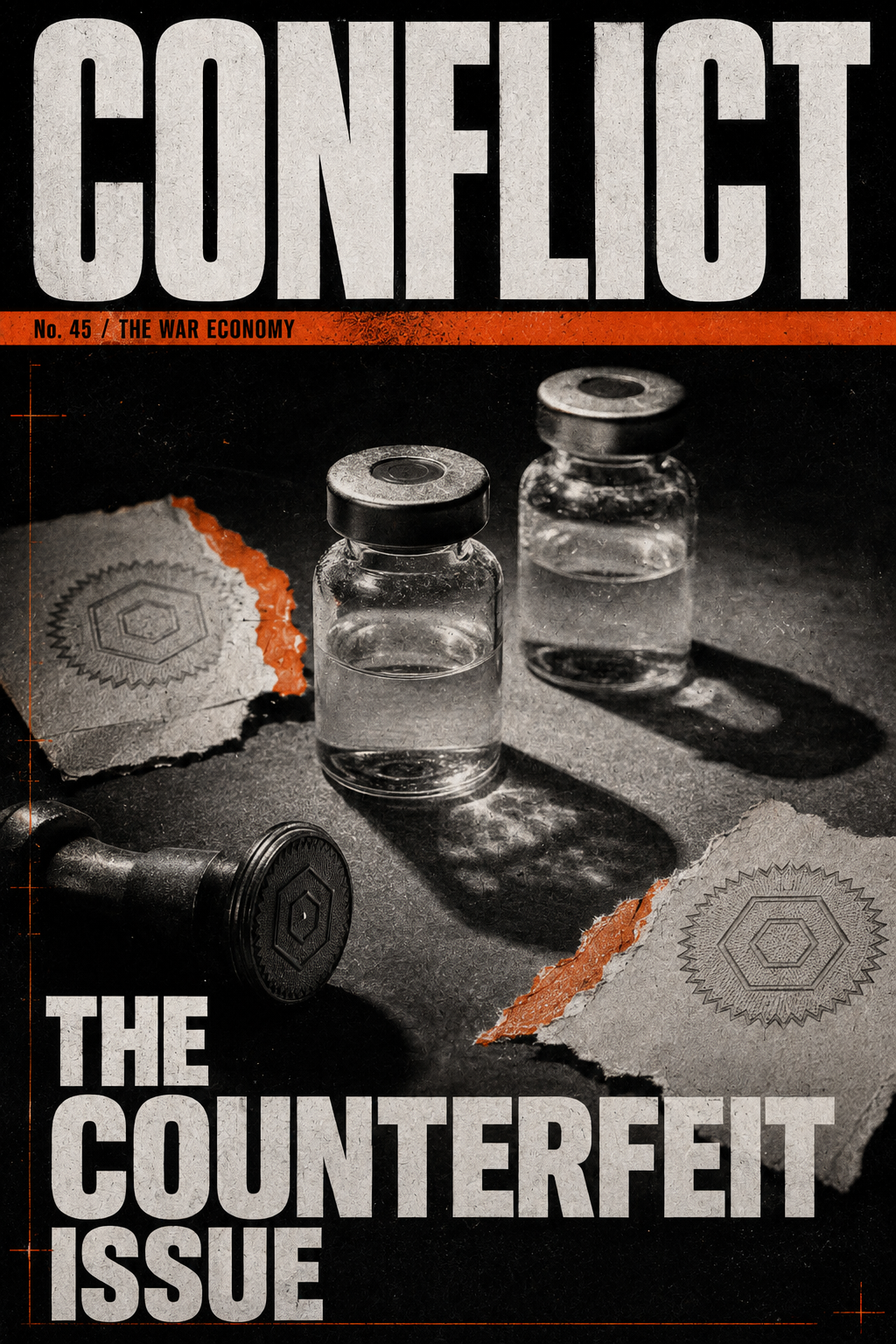
A seal is a promise. Ours is harder to fake than the thing it sits on.
Veridian Assurance is aware that counterfeit seals bearing our mark are in circulation. We are pursuing the matter. We are pursuing it the way you would expect a company with our margins to pursue it.
CONTRIBUTORS
Lynx build, former splice op, writes the way she used to move, which is to say she gets in close and leaves before anyone calls security. For EMBEDDED she spent eleven days inside the counterfeit-dose trade, on the supply side and the dying side both. She files her copy from wherever the dose is honest. That has not been many places lately. We pay her in full and on time because she has read our contracts and we have seen her reflexes.
Covers procurement fraud and the certificate economy from whatever side of the table will return her calls. She talked the master forger Edvard Lune into an evening of conversation for THE ROOM WHERE EVERYONE LIED, then spent the following week confirming that the man she met was the man she thought she met. She is reasonably sure. Reasonably is the highest grade this issue awards.
Holds a post in material forensics at the New Lagos Institute and a side practice authenticating objects he privately finds tedious. He wrote MATERIAL CULTURE about a document that does not exist and has never existed, which several institutions now cite as a primary source. He was not paid in credits. He was paid in the satisfaction of being right, which his landlord does not accept.
Reads documents for a living and trusts none of them, which makes him the correct person to write THE MANUAL on forged certificates. He also handles our classifieds, where every word arrives pre-suspected. He describes the two jobs as “the same job, with different lighting.” We have stopped asking him to explain himself. The explanations were worse than the silence.
Travels to the places other writers describe from a distance. For CITY OF BAD IDEAS she spent six days in the Replica Quarter of New Lagos buying things she knew were fake to see how good the lie had become. The answer disturbed her. She filed anyway. She always files.
There is a moment in every market when the fake stops being a worse version of the real and becomes a better one. We are past that moment. We have been past it for a while. Nobody announced it because the announcement would have lowered prices.
I want to start with the seal on the cover, because that little orange disc is the whole issue in one object. It belongs to Veridian Assurance, the authentication house in New Geneva, and it is the most trusted mark in the heritage trade. It is also, as of this spring, the most counterfeited object in the heritage trade. A seal that exists to prove a thing is real is now itself the thing most likely to be fake. Read that again at whatever speed it takes to feel sick.
That is what a counterfeit economy does. It does not stop at the goods. It climbs. First the object, then the certificate of the object, then the certifier, then the verification record that vouches for the certifier. Every layer of proof we invent becomes the next thing worth forging, because proof is where the money moved, and money is a current, and a current finds the copper. We built a tower of guarantees and a man in New Lagos can print any floor of it before lunch.
For most of this issue that is funny. Genuinely funny, in the way that only theft committed with excellent craftsmanship can be. Edvard Lune, who Dosia Varga sat across from for an evening, can age a sheet of paper forty years in an afternoon and feels no more guilt about it than a tailor feels about a hem. The man is an artist. He is a criminal. In our world those have never been opposites, and I am not going to pretend they are now to make you comfortable.
And then there is the part of this issue that is not funny at all, and I am going to ask you to feel the gear change, because I felt it editing the thing.
Gene-forged operators need suppression meds to keep the drift from taking them apart. The real doses are expensive and the people who need them most are the ones the war pays least, shelf builds and catalog work and expiries running on overtime they did not ask for. So a counterfeit market grew, the way it always does, in the gap between what a body needs and what a body can pay. The knockoff vials look identical. Cass Rennick will show you, on page 26, exactly how identical. The difference is on the inside, where the active compound has been cut with filler, and you cannot see the inside until you are wearing it, and by then you are running hot in a stairwell with hands that have stopped being yours.
People are dying for a copy that saved them forty credits. They are dying because someone upstream calculated that a forged stabilizer with a real label sells just as fast as the genuine article and costs a fraction to make. That is not craftsmanship. That is the same instinct as the seal on the cover, followed one floor too far down into the body.
So this issue holds both things, because the world holds both things. We rank the worst forgers and certifiers alive. We teach you to read a seal built to fool you. We walk you through a city that sells copies of itself and likes the arrangement. We also sit with the people the copies are killing, and on those pages I have asked everyone to put the jokes away.
You will notice the cover says everything real has a fake. That is not a warning. It is a market report. The warning is smaller, and it is this: when the copy is better than the original, the only way left to tell them apart is to ask who gets hurt when it fails. The fake seal hurts a collector’s pride. The fake dose hurts a person in a stairwell. Same economy. Different floor.
Welcome to the issue. Check your vials.
VERIDIAN ASSURANCE CONFIRMS ITS OWN SEAL IS NOW THE MOST FORGED OBJECT IT TRACKS
In a statement that took four lawyers and one structural concession to release, the New Geneva authentication house acknowledged that counterfeit copies of its holograph seal are in wide circulation, that some of them pass its own field-test app, and that the company is “reviewing the verification architecture.” Reviewing the verification architecture means the architecture failed. A seal that can be faked is not a seal. It is a sticker with good lawyers. Veridian’s share of the assay market did not move. The trade does not buy proof. It buys the feeling of proof, and that supply is endless.
COUNTERFEIT SUPPRESSION MEDS LINKED TO ELEVEN DRIFT DEATHS IN ONE QUARTER
An independent forged-rights clinic in the Belt has documented eleven fatalities and an unknown number of nonfatal episodes traced to knockoff Kessler-Brandt stabilizers cut with inert filler. The vials carried genuine-looking labels, genuine-looking lot numbers, and a counterfeit Veridian quality stamp. The clinic’s director declined to name the supply route because, in her words, “naming it gets the people who sell honest doses killed, not the people who sell these.” This is the only item in this section we did not write a joke for.
NAF QUIETLY REISSUES SEVENTY THOUSAND CREDENTIAL TOKENS AFTER FORGERY SCARE
A batch of access tokens for three NAF logistics hubs was found to have been duplicated at the chip level, not cloned but manufactured, which means someone has the original tooling. NAF described the reissue as “routine credential hygiene.” Routine credential hygiene is what you call a recall when the word recall implies fault. Every dead credential in the affected hubs was supposed to be golden. Operators in the AO have started treating all of them as dead until proven otherwise, which is slower, safer, and an enormous insult to the procurement office that swore the old ones were unforgeable.
THE CRACKERJACK ALMANAC FLAGS FOURTEEN “IMPOSSIBLE” COMPETITOR RECORDS
The unofficial competition register, more reliable than any commission archive, published a footnote this edition listing fourteen claimed tournament results it can no longer verify against any primary source. All fourteen belong to operators currently selling endorsements, security consulting, or autographed kit. The Almanac did not call them fakes. It used the phrase “records that exist only downstream of the people who profit from them.” The Almanac has never been this polite. Politeness, from the Almanac, is the loudest accusation it owns.
A FORGED PROMETHEUS LEAGUE “FOUNDING DOCUMENT” IS NOW CITED IN TWO ACADEMIES
A single fabricated page, supposedly a charter from the redistributionist saboteurs, has been quoted as authentic in two faction-administered history programs. The League did not write charters. The League gave things away and burned the paperwork on principle. The forgery is good enough that correcting it now requires unteaching a generation. The forger, whoever they are, did not just sell a lie. They wrote a chapter. Several institutions are keeping it because removing it would mean admitting they bought it.
PRE-DISTRESSED “COMBAT-RECOVERED” GEAR OUTSELLS ACTUAL SURPLUS FOUR TO ONE
A market survey from a New Geneva auction consultancy found that gear manufactured to look recovered now moves at four times the rate of genuine decommissioned surplus. Buyers prefer the fake. The fake is cleaner, the wear is tasteful, the story is printed on a card. Real surplus smells like the person who wore it and sometimes still has their tape on it, and that, apparently, is a problem the market would rather not handle. The most honest objects in theater are now the hardest to sell.
EO CUSTOMS SEIZES A SHIPMENT OF “GRAIN” THAT WAS THIRTY THOUSAND COUNTERFEIT DOSES
A wet-inventory bust on the Balkanized Belt corridor turned up suppression meds moving through food logistics, manifest marked grain, temperature control telling another story. The doses were counterfeit. The cold chain was real, which is the detail that should frighten you: someone built a genuine pharmaceutical supply line to move fakes. EO customs released photographs of the seizure and none of the names. The names, an officer said, “are not customs’ department.” Nothing in that sentence is true except the grammar.
A GARAGE CLINIC OFF THE BELT IS NOW AUTHENTICATING DOSES THE FACTIONS WON’T
A black-market gene clinic, salvaged equipment and one pharmacist with better hands than any faction doc, has started assaying suppression meds for free and posting the results on a dead channel. The pharmacist tests what people bring in and tells them whether it will keep them alive. This is the most trusted authentication service in the region and it operates out of a building with one working light. The factions have not endorsed it. The forged have. One of those endorsements keeps people breathing.
“CATALOG” PAPERS NOW SOLD WITH FORGED FACTION MEDICAL HISTORIES ATTACHED
Black-market gene work has always come without records. Now it comes with fake ones. A clinic listed in the Surgeon’s Catalog is offering, as an upsell, a fabricated faction medical history so a catalog build can pass as faction-issued stock during registration checks. The papers are convincing. The work underneath them may not be. A clean history on a build nobody documented is a sentence that reads well and means nothing. Buyers are paying for the sentence.
DEAD CHANNEL RADIO AIRS A “LOST” SIEGE BROADCAST THAT NEVER AIRED
A recording presented as a recovered live transmission from the 2051 Siege surfaced on the dead-channel networks, complete with period static, commission idents, and a commentator who was demonstrably somewhere else that day. The fabrication is exquisite. The static alone took real skill, because real static is harder to forge than speech. Listeners who know better are circulating it anyway, labeled honestly, because a beautiful fake of a thing everyone wants to hear is still a thing everyone wants to hear. The commission has not commented. The commission specializes in not commenting.
A FORGER’S SIGNATURE STYLE HAS BECOME A COLLECTIBLE IN ITS OWN RIGHT
Collectors in New Geneva have started paying premiums for forgeries confirmed to be the work of a single anonymous hand known only by the way he renders a worn fold. The objects are fake. The faking is the value. There is now a market for authenticated counterfeits, which is a phrase that should not be able to exist and is currently quoted at four figures. Veridian has been asked whether it will authenticate forgeries as forgeries. It is, we are told, “exploring the category.” Of course it is.
NEW LAGOS REPLICA QUARTER POSTS RECORD QUARTER, ASKS FOR ZONING PROTECTION
The district that openly sells copies of everything has had its best three months on record and has petitioned the municipal authority for heritage protection, on the grounds that the Replica Quarter is itself now historically significant. A district built on counterfeits wants to be preserved as authentic. The petition is sincere. The municipal authority is considering it. If it passes, New Lagos will have legally certified the realness of the largest fake market on the continent, and somewhere Edvard Lune will smile, because that is the kind of joke he tells with paper.
The Belt medic who tests every vial in front of the patient, holds it to the one working light, runs the cheap reagent strip, and only then loads the injector. It takes ninety seconds. It is the difference between a dose and a coin flip. She does not trust the label, the lot number, or the seal, because she has buried people who did. Trust the reagent. The reagent has no margin to protect.
Buying suppression meds on the strength of the seal alone because the seal looks right. The seal looks right. That is what the seal was made to do this quarter. A real stamp on a cut dose is not reassurance. It is the most expensive part of the forgery, and you are admiring the receipt while the contents decide whether you make it to morning.
The collector who paid less for an object because it came with no certificate and a verifiable story, a name, a unit, a photograph of the person wearing it. He bought the provenance and skipped the paper. The paper is forgeable. The photograph, cross-checked against a regimental roll, is harder. He owns a real thing with a thin file. The man next to him owns a thick file wrapped around a copy.
The buyer at the same table who chose the object with the fatter dossier, six pages of authentication, three transfer records, a wax-sealed letter of provenance. Every page is genuine. They authenticate a fake. Paperwork does not become true by accumulating. You can forge a single document. You can also forge nine, and nine forgeries do not outvote the object.
The Dune Specter sergeant wearing one unit patch, faded, frayed, sewn by a hand that was not a professional’s, with a thread color that was never available for sale because it was whatever the quartermaster had that week. You cannot buy that thread. You cannot fake that repair without knowing a war you were not in. He is not displaying history. He is wearing the only copy.
The contractor in a “combat-recovered” jacket with factory-applied wear, a pre-frayed cuff, and a tasteful scorch mark placed for the camera. The damage is symmetrical. Real damage is never symmetrical, because the device that caused it was not trying to look good. He paid extra for the distressing. He paid to look like he survived a thing he ordered from a catalog.
The expiry who jokes about her own warranty being up and then quietly shows you the reagent strip from this morning’s dose, green where it should be green. She knows exactly what she is putting in her body and exactly what it costs. That is not paranoia. In a counterfeit market, that is literacy, and literacy is the only insurance the forged can afford.
The biotech investor wearing a “stabilizer-chic” cuff, a fashion piece molded to look like a drift monitor, sold by a label that has never made a working dose in its life. It monitors nothing. It signals that you find the aesthetics of someone else’s survival appealing. The forged in the room clocked it before you sat down. They will not say anything. They will simply never be in a room you control.
The archivist who, handed a “recovered” document, looks at the paper before she looks at the words. Fiber, fold, the way the ink sits in the tooth of the stock. She reads the object, then the text. Forgers write brilliant text. Almost none of them can make 2040s paper behave like it spent thirty years in a flooded basement. The lie is in the words. The truth is in the substrate.
Buying a “Prometheus League charter” from anyone, at any price, in any condition. The League did not write charters. If the object exists, the object is a forgery, and the only open question is whether the seller knows. Either answer is a reason to leave. You are not acquiring history. You are co-signing someone’s fiction and paying for the privilege of being quoted as their source.
The fence who tells you, flatly, that the piece is a copy, prices it as a copy, and lets you decide. There is an honesty in an honest fake. You know what you are buying. You can love it as a copy. The Replica Quarter runs on this and it is, perversely, the cleanest market in New Lagos, because nobody there is pretending. Pretending is the whole crime. Selling is just commerce.
Wearing another operator’s record. Not their patch, their record. The forged tournament result, the borrowed callsign, the claimed engagement you supported from a desk six hundred kilometers back. Somewhere there is a person who actually has the thing you are renting, and operators talk, and the day you meet them you will discover that a counterfeit history fails its field test the same way a counterfeit dose does. Suddenly, and in public, and not in your favor.
“COMBAT-RECOVERED” PLATE CARRIER (FACTORY-DISTRESSED)
COUNTERFEIT KESSLER-BRANDT STABILIZER VIAL
VERIDIAN HOLOGRAPH SEAL (GENUINE)
HAND-SEWN UNIT PATCH (UNREPRODUCIBLE)
FORGED CRACKERJACK ALUMNI PIN
THE STABILIZER SYNDICATE
Not a person. A supply chain built to outlive any single arrest. Someone in it sourced genuine vials, genuine labels, and a real cold chain, then filled the result with a dose that keeps a fraction of the people who take it alive. They run the math on bodies the way other people run it on freight, and the math says a forged stabilizer with a real stamp sells as fast as the genuine one and costs almost nothing to make. Eleven confirmed dead this quarter. The syndicate has never seen a stairwell. The stairwell is where the product ends up.
EDVARD LUNE
We put him on this list and then we gave him eight pages, because both are true. Lune is the most gifted forger working and he has never, to our knowledge, faked a dose or a credential that put a body at risk. He fakes paper. He fakes provenance. He has written false history into two academies and feels about it the way a locksmith feels about a lock. He belongs here because his work made the whole certificate economy possible and his conscience is a closed door he keeps well oiled. Read the interview. Decide for yourself. We could not.
HOLLISTER VANCE
The man who runs the laboratory whose seal is now the most forged object in the trade, and who has decided the correct response is a market study rather than a recall. Vance knows his field test passes some of the fakes. He has known for two quarters. He calls the gap “an acceptable confidence interval,” which is a phrase you reach for when the honest phrase would lower the stock. He authenticates objects for a living and cannot bring himself to authenticate the failure of his own seal. The interval is acceptable to Vance. It is not acceptable to the people holding his stamp on a fake.
MARISOL KETT
Kett writes the story cards. For a fee, she will compose a provenance, a unit, a name, a plausible chain of custody, for an object that has none, and she will write it well, because she is good, and good is the problem. She insists she sells “narrative services, not authentication,” a distinction that survives exactly until the card is photographed next to the object and sold as fact. She has given names to forgeries that the families of real operators now have to compete with. She has never met a family. She has met a lot of objects.
THE “CLEAN HISTORY” UPSELL CLINICS
A cluster of black-market gene shops that discovered the records are worth more than the surgery. They do catalog work on salvaged equipment, then sell a forged faction medical history so the build can pass registration as issued stock. The papers are clean. The work might not be. They are charging frightened people for a sentence that reads like safety and means nothing, and when the build drifts off a spec nobody actually documented, the clean history is the first thing that burns. They sell the certificate of a body they did not properly make.
COMMANDER ILSE BRANDT-OKORO
The genuine manufacturer has a real problem and hired a person to make it look like a marketing problem. Brandt-Okoro runs “anti-counterfeit education,” which in practice means glossy notices telling the forged to “buy authorized” from authorized sellers at authorized prices the forged cannot pay. She has never once proposed lowering the price of the dose people are dying to fake. The counterfeits exist because the real one costs a week of life to afford. She treats that gap as a piracy issue. It is a pricing issue wearing a piracy costume, and she sewed the costume.
“THE FOLD”
A second forger, less principled than Lune and more cynical, whose work is now collected for its own sake. Collectors pay four figures for a confirmed Fold forgery, which means the man has achieved the thing every counterfeiter dreams of: his fakes are authenticated as his. He has started signing them, invisibly, so the premium holds. A forger with a maker’s mark is no longer faking objects. He is faking the idea that faking can be honest, and charging a surcharge for the irony. We would name him if anyone could. That is the point of being The Fold.
Identical labels. Identical caps. Identical lot. One keeps you in your body and one does not, and the only way to know which is the one you cannot see. He loaded the right-hand vial because it was cheaper. The left would have caught him. Test the dose. Every time. The label is not your friend.
The field app went green. The app goes green for this one. The forger reverse-built the test before he built the seal, which is the correct order of operations if your customer is a phone. The buyer trusted the phone. The phone trusted the seal. The seal trusted no one because it was a copy and copies do not have loyalties.
The pin reads three tournaments and a podium. The font on the year is two hundredths of a millimeter wrong and the callsign appears in no Almanac edition before he bought the pin. He is standing in the gallery next to people who actually competed. He is doing most of the talking. They are doing all of the noticing.
Six pages of authentication, three transfer records, one wax-sealed letter. Every document genuine. They authenticate a fake. He bought the fat dossier over the thin one because nine pieces of proof felt safer than one. Nine forgeries do not outvote an object. They just take longer to read before you reach the same disappointment.
The cuff is molded to look like a drift monitor. It tracks a step count and a heart rate and the wearer’s belief that proximity to suffering is a personality. The forged at the bar read it on sight. They did not comment. They simply rearranged the evening so that none of the parts that mattered happened anywhere near him.
A forged founding document from a faction that never founded anything on paper. It is good enough that two academies teach it. The forgery is no longer a crime against a buyer. It is a crime against everyone downstream who will learn it as fact. The man who made it sold one page. He wrote a generation’s footnote.
Catalog work on salvaged gear, sold with a forged faction medical history clipped to the front. The papers passed registration. The build did not pass the third engagement. Clean history, undocumented body, and the gap between them is where the spec drift went to hide until it could not hide anymore. The certificate was the only thing that healed correctly.
Two access tokens, indistinguishable. One is the operator’s. One was manufactured, not cloned, which means someone has the original tooling and the operator has a problem larger than the door in front of him. Every dead credential in the hub was supposed to be golden. Golden is a word that means nothing the day the tooling walks.
A “recovered” siege broadcast with flawless period static and a commentator who was provably somewhere else that afternoon. The static took more skill than the speech, because real noise is harder to forge than a sentence. People are circulating it anyway, labeled honest, which is the most forgivable thing in this entire section and still not true.
A forgery, confirmed as a forgery, sold for four figures because it is a confirmed forgery by a named hand. The object is fake. The fakeness is the asset. The collector is delighted. Somewhere a person who needed a real thing got outbid by a man buying a beautiful lie because the lie had a maker’s mark. This is the bottom of the market. There is no floor under it.
The first vial I am handed is a fake and I cannot tell. I am a lynx build, I have been clean off the splice circuit for six years, I have put genuine Kessler-Brandt into my own arm more mornings than I have not, and I am holding a counterfeit of the thing that keeps me a person and my hands report nothing. Same weight. Same chill off the cold box. Same crimp under the thumb. The pharmacist watching me, a one-eyed woman who works out of a garage off the Belt and has better hands than any faction doc I ever met, says, “You feel that? That nothing? That nothing is the whole industry.”
I am here because Ines called it the counterfeit issue and said she wanted the floor of it. Not the certificate economy, not the forged paper, the floor, the place where a fake stops being a market story and becomes a body in a stairwell. I said I knew the floor. I have lived a few stories up from it my whole adult life. She said that was exactly why she wanted me, and then she said something I have been turning over since, which is: “You can test your dose. Write for the people who can’t.”
The pharmacist’s name I am keeping. Call her the Doser, because that is what the dead channel calls her, and because naming her is how you get the honest supply killed instead of the dishonest one. She tests what people bring her, for free, and posts the results to a frequency nobody official admits exists. A reagent strip, a drop, ninety seconds, green or not green. Green means the active compound is in there at strength. Not green means you are holding a lie, and the lie costs forty credits less than the truth, and forty credits is a real number to the people on her step.
I do not catch forgers. I catch doses. The forger is a name nobody has. The dose is a thing in my hand, and the person it belongs to is sitting right there, and one of those I can actually help.
On the second day a man comes in I will think about for the rest of my life. Shelf build, commercial stock, the kind of forged the war makes in lots and then forgets it made. He is running hot. You can see it before he sits, the tremor he is pretending is the cold, the too-fast blink, the way he keeps checking his own left hand like it might have left without him. He has been on counterfeit doses for three weeks because the real ones ran his ration clock past empty. He did not know they were counterfeit. He thought they were just not working as well as they used to. That is the trap. The fake does not fail all at once. It fails like a betrayal, slowly, in a way you can talk yourself out of noticing until you cannot.
The Doser tests his last two vials. Both not green. She has a small genuine stock she keeps for exactly this, paid for out of her own thin margin, and she loads him a real dose while he sits there learning that the last three weeks of getting worse were not his body giving up. They were a product. He does not cry. The forged of his generation mostly do not, in front of people. He just says, very quietly, “I thought I was cooking off.” And then, “I was going to stop calling people.” The dose catches him over about forty minutes. I watch a person come back into a body in real time and I have to go stand in the alley.
You cannot write the floor without going up the stairs, so on the fifth day I go to the supply side, which is its own kind of education. The man who agrees to talk is a mid-tier mover, the part of the chain that does not make the fakes and does not bury the dead, just moves crates and takes a margin and sleeps fine. He thinks he is a logistics professional. In a sense the worst sense, he is right.
He shows me the operation the way you would show someone a clean warehouse. Genuine vials, sourced empty or near-empty. Genuine labels, run on real equipment. A real cold chain, because the one thing the counterfeit cannot fake is the appearance of being cared for, so they care for it perfectly. The fill is the only fake part. He says the word “fill” the way the heritage trade says “provenance,” like a technical term that has had its meaning sanded off so it stops weighing anything.
I ask him the question I came up the stairs to ask. Do you know what the cut dose does. He says, and I am quoting him exactly because I want you to have it: “I know what the real one costs. That’s the part that’s killing people. Not me. The price.”
Nobody fakes a thing that’s cheap. You want to end my business, drop the price of the honest dose. You won’t. So here I am, the cheaper option, and the cheaper option always wins, and I sleep like the dead the real stuff doesn’t make.
He is wrong in the way that lets him sleep and right in the way that should keep the rest of us awake. The counterfeit exists in the gap. The gap is a pricing decision made in a clean office by people who will never run hot. He is the gap’s delivery mechanism. He has decided that delivering a thing is morally separate from what the thing does, which is the oldest forgery in the world, older than paper, the forgery of your own hands looking clean.
The thing I did not expect was how good the honest fakes are at being honest. There is a corner of this market that sells copies and says so. Replica kit, copy pins, story cards that admit they are stories. That market is loud and cheerful and basically harmless, because the deal is square. You know what you are buying. The dose market is the same machine with the honesty removed, and removing the honesty is the entire crime. The forger of a patch sells you a copy of a thing. The forger of a dose sells you a copy of being alive and lets you find out the difference yourself, alone, at the worst possible time.
On the ninth day the Doser lets me work the strip. People come in, I test, I read green or not green, I say the word that decides their week. I am not qualified for this. Nobody on that step is qualified for what is happening to them either. I tested a vial for a kid, sixteen maybe, second-gen, the kind faction medical does not even track, and it came back not green, and I had to be the one to tell him, and he said “okay” in the voice you use when okay is the only word you can afford. The Doser dosed him from her stock. She is going to run out. The stock is one woman’s mercy against a supply chain with a real cold room.
I have buried people who trusted the label. I have never once buried someone who tested the dose. That’s not a slogan. That’s the whole job. Test the dose.
On my last night the running-hot man from the second day comes back, steady, two weeks of green strips in his pocket like a hand of cards he won. He brought the Doser a working light. An actual fixture, salvaged, wired, so she does not have to test under the one bulb anymore. He installed it himself. It is the only honest object I saw exchanged in eleven days, and nobody authenticated it, and it works.
I am writing this on the train out with a real dose in me that I tested twice because I will never again not test. The label is not your friend. The seal is not your friend. The reagent strip has no margin to protect and no office to sleep in and it tells you the truth in ninety seconds for almost nothing. If you are forged and you are reading this: test the dose. If you are not forged and you are reading this: the reason the fakes exist is the price of the real one, and the people who set that price call the dying a piracy problem, and you should remember their names better than you remember the forgers’.
I filed at 0300. My hands were steady. I checked.
We are aware that price is a barrier. We are reviewing access pathways for verified patients in qualifying territories, pending program approval.
Kessler-Brandt accepts no liability for product not purchased through authorized channels. Pending program approval has been pending since 2063. We are very sorry. We are also, as a matter of public record, very profitable.
The single most common mistake is to read the certificate first. The certificate is text. Forgers are brilliant at text. The object is physics, and physics is harder to lie to. Look at the thing the paper describes before you look at the paper. If the object cannot survive your eyes, the certificate is irrelevant, and if the object holds up, the certificate is a footnote to a conclusion you already reached.
A real certificate vouches for a real object. A forged certificate exists to stop you looking at the object. Notice which one the seller is steering you toward.
Paper ages in ways that are tedious to fake and impossible to fake completely. Fiber breaks down. Folds bruise the stock along a line that, under magnification, shows a history of being folded and unfolded that a single fresh crease does not. Ink sits differently in paper that has breathed thirty years of humidity than in paper that left a press last week.
The good forgers know this and age the substrate. The great ones, and there are perhaps three, age it convincingly. For everyone else, the lie is in the paper, and the paper is the one part they could not write.
For a decade the holograph seal was the part you could trust. That decade is over. The seal is now the most copied element on the document, because it is the element buyers were trained to check, and forgers build for the test their customer runs. A field app that goes green is not proof. The forger reverse-built the app before he built the seal.
Tilt the genuine seal under raking light, the harder the angle the better. The real shift-color element moves like it is alive. The copies flicker, stutter, or sit flat. This is the current tell. Assume it has a shelf life. By next issue the forgers will have read this paragraph too.
A provenance is only as strong as its weakest transfer. Forgers love a long chain because length reads as legitimacy, and most buyers count the links instead of testing them. Find the weld. There is always one transfer that cannot be independently confirmed, one custodian who is conveniently dead, one auction house that conveniently closed. That weld is where the fiction was inserted.
Nine documents do not authenticate an object. One verifiable fact does. A photograph cross-checked against a regimental roll outweighs a wax-sealed letter from a name nobody can confirm. Weigh the chain by its worst link, never its longest stretch.
A forged provenance comes with a story, and the story is good, because someone was paid to write it. It has a name, a unit, a moment of meaning, a satisfying shape. Real provenance is boring. It is a property number, a disposal form, a line in a ledger. When the history of an object reads like something a person would want to be true, a person made it true, for money, and the object is the last thing to have been added.
The newest forgery is not the certificate. It is the certifier. Counterfeit authentication-house seals, fabricated verification records, forged lab letterhead. Once buyers learned to demand a Veridian stamp, the stamp became worth faking, and now you must authenticate the authenticator. Call the registry. Confirm the lot exists in their system and not just on your object. A certifier who cannot be independently reached is a certifier who was drawn on, not contracted with.
Everything above can be defeated by a sufficiently good forger, and there are a few. So here is the test that holds when the others fail: ask who gets hurt when this is fake, and how badly, and how soon. A fake patch costs you face. A fake certificate costs you credits. A fake dose costs you a person. Scale your suspicion to the stakes. Spend ninety seconds on a vial. Spend an afternoon on a relic. Spend nothing on a story card except the laugh it earns.
If you buy a forgery, we will not judge you. The forgers are very good. We will only ask that you knew the stakes before you signed. Knowing the stakes is the one authentication nobody can sell you.
The document in the case does not record anything. It never recorded anything. There was no last water ledger of the Delta municipality, because the municipality that supposedly kept it drowned with its records intact in a sealed archive that is still down there, under nine meters, uncatalogued and unreachable. And yet here is a ledger, on period stock, in a period hand, foxed and folded and convincing, and it has been cited as a primary source in three separate works of post-Upheaval history. I have been asked to authenticate it. I am going to do the opposite, slowly, because the slowness is the point.
I know it is forged within ninety seconds, before I read a word. The paper is the first lie. It is genuinely old, which is good craft, but it is the wrong old. The fiber is consistent with a stock manufactured inland, in the dry decades, and the Delta municipality kept its ledgers on the cheap coastal pulp that everyone in that region used because it was what the mills there made. A real Delta ledger would have aged in salt air on coastal paper. This aged in a workshop on the wrong feedstock. The forger sourced beautiful old paper. He did not source the right beautiful old paper, because the right paper is at the bottom of the sea with the municipality that used it.
The ink confirms it. Under magnification the strokes sit on top of the fiber rather than into it, the signature of writing on paper that was already old and dry when the pen touched it. Genuine ledger ink, applied fresh to fresh stock decades ago, soaks and feathers in a way that cannot be reverse-engineered after the paper has hardened. The forger wrote on a corpse and the corpse did not drink.
The paper is the witness that cannot be coached. The forger writes the testimony. He cannot rewrite the witness.
So it is fake, and I could stop here, and a lesser brief would. The interesting question is not whether the ledger is forged. The interesting question is why it no longer matters that it is.
The ledger entered the trade four years ago through a New Lagos workshop, sold as recovered, with a provenance written by a consultant who specializes in stories. A collector bought it. A historian saw it in the collection and quoted it, because it filled a hole, and the hole was real even though the ledger was not. The Delta municipality really did drown. Its records really are unreachable. A document that claimed to be the last page of that drowning answered a question everyone wanted answered, and want is the solvent that dissolves scrutiny. Two more historians cited the first. The forgery is now load-bearing. Remove it and three works develop a crack.
I traced it as far as the workshop. The hand is not Edvard Lune’s, whose work I know, and it is not clean enough to be the one they call The Fold. It is a competent middle talent who got one thing exactly right, which is that the best place to hide a forgery is inside a true absence. Nobody can check the ledger against the real archive, because the real archive is at the bottom of the sea. The forger did not fake a document. He faked the floor of an empty room and trusted that no one would ever reach the real floor to compare.
I write up my finding. The collector receives it with the particular stillness of a man calculating what the truth will cost him. He asks whether the report could note that the attribution is “contested.” It is not contested. It is settled. I tell him so. He nods the way Vance at Veridian nods, the nod of a man who has decided that an inconvenient fact is a confidence interval.
A forgery that fills a real absence is the hardest fake in the world to kill, because killing it reopens a wound everyone had agreed to call a scar.
I speak, finally, with one of the historians who cited it. She is honest, which is rarer than authentic paper. She tells me she suspected. She tells me the suspicion did not survive the usefulness. “The Delta drowning is real,” she says. “I needed a page from it to make the chapter stand. The page I was given stood. I told myself the page was as real as the drowning. That was the lie I authenticated. Not the document. My own need for it.”
That is the truest thing anyone said to me this issue, and she said it about a fake. The ledger will outlast my report. The citations will not all be corrected, because correcting them admits the need that placed them. In fifty years someone will open this case and find a document that survived everything except the floor it was forged to replace. The forger will be long gone. The absence he papered over will still be down there, nine meters under, holding the only honest record of a place that drowned twice. Once in water. Once in citation.
The workshop smells of gelatin sizing, old smoke held in cloth, and a chemical sweetness I cannot place until Edvard Lune tells me it is the bath he uses to take a century off the brightness of fresh paper in about forty minutes. He is seventy-one, small, precise, with the unhurried hands of a man who has never once been rushed by a deadline he respected. There is tea. There is a single overhead bulb, which he prefers, because he reads paper by raking light the way I am told to read his seals. He knows why I am here. He has agreed anyway. Vanity, I think, until later, when I revise it to something colder.
“You will want me to feel guilty,” he says, before I have asked anything. “Let us save the evening. I will not. We can talk about the work instead, which is more interesting than my soul, and better made.”
I ask him how he started. He tells me he was a restorer, a real one, with a real ticket, mending genuine documents for institutions that paid badly and thanked him worse. “I learned to make a torn true thing whole,” he says. “The step from there to making a whole false thing is shorter than your readers want it to be. The skills are identical. Only the intention changes, and intention is invisible in the object. That is the secret the trade does not say aloud. There is no forensic difference between repair and forgery. There is only a difference in who asked.”
Restoration and forgery are the same hands doing the same work. The institution calls one of them a profession and the other a crime, and the only thing that decides which is whether they signed the invoice.
“You have written false history into two academies,” I say. “Children are learning your invention as fact.”
“Children are learning someone’s invention as fact regardless,” he says. “The Document Wars burned the real records. Everything after that is reconstruction, which is a polite word for educated forgery performed by committees instead of craftsmen. I did the same work with better paper and no committee. My Prometheus charter is more carefully made than the official histories that omit the things the official historians find inconvenient. At least I know I am lying. Gradenko thinks he is telling the truth. Which of us is worse for the children?”
It is a good answer and a dishonest one, and I tell him so. He looks pleased, the way a craftsman looks when you notice the join.
“Where is the line,” I ask. “You must have one. Everyone insists they have one.”
He sets down his tea. The performance pauses, briefly, and something real shows in the gap. “I do not fake anything a person puts in their body,” he says. “I do not fake credentials that open doors people will die behind. I do not fake medical histories. Paper that lies about the past is one thing. The past is already gone and cannot be hurt further. Paper that lies about a living body in the present is another, and the men who do it are not my colleagues. They are not even forgers. A forger respects the thing he copies. Those men respect nothing. They are counterfeiters of mercy.”
I forge the past, which is dead and beyond harm. The dose forgers counterfeit the future, which still has a person standing in it. We are not the same profession. Do not flatter them by putting us in the same sentence.
I push on this, because it is the load-bearing wall of his conscience and I want to see if it holds weight. The forged history he sold, I say, is now used to justify present decisions. A faked charter shapes how a faction teaches its young what it owes them. The past he calls harmless is the raw material of every present cruelty. His paper is not inert. It is upstream of living rooms.
He is quiet for a while. The bulb hums. “That,” he says finally, “is the only argument that has ever cost me a night’s sleep. I will not concede it tonight. I may concede it eventually. I am seventy-one. Eventually is a luxury I am running out of, and so I forge a little less than I did, and I tell myself the reduction is taste rather than fear. You may print that. It is the most honest thing I will say, and I am only saying it because I made it sound good, which you should also print, because it is the whole of me in one sentence.”
Near the end I ask the question I came up the stairs for. What would he never forge, not for ethics, for craft. What defeats him.
“A patch sewn by a frightened person in a bad week,” he says, without hesitation. “I can age the cloth. I can copy the design. I cannot copy the accident. The wrong thread because it was the only thread. The repair done by a different hand in the dark. The value is in what was not chosen, and I choose everything. That is the one authentication I cannot manufacture. The unintended. Everything a person did on purpose, I can do on purpose better. What saves the real things from me is the parts nobody meant.”
He walks me out past racks of paper breathing its false age in the dark. At the door he hands me a card. My own name, my own byline, on stock that looks like it came from a press I cannot afford, aged to suggest I have been writing for forty years. “A gift,” he says. “Proof of a career you have not had yet. Do not worry. It is the only copy. I never make two. Two is how they catch you. One is how they remember you.”
I still have the card. I have not been able to throw it away, and I have not been able to decide what that says about me, and I suspect that uncertainty is exactly the gift he intended to give.
You reach the Replica Quarter by walking until the goods stop pretending. The luxury district sells fakes that claim to be real. The heritage market sells fakes that claim to be recovered. Then the streets narrow, the awnings go orange and acid-blue, and a man selling a Crackerjack pin says, before you can ask, “Copy. Good copy. Two hundred. The real one is not for sale and you cannot afford the lie that it is.” The locals call it Second Lagos. It is the largest counterfeit market on the continent and the only one I have ever felt clean leaving.
That is the paradox I came to test, and it held. Second Lagos is honest. Not honest about the objects, which are all copies. Honest about the deal. Nobody here tells you the patch is real. They tell you it is a good copy of a real thing and price it like one, and the transaction is square, and you walk away owning exactly what you were told you were buying. After a week in the certificate economy upstream, where the entire crime is the pretense, the candor down here is almost a holiday.
I buy a forged unit patch from a woman whose stall has copied the same six regiments for twenty years. It is beautiful work. She shows me, unprompted, the three ways I could tell it from the original, because, she says, “if you cannot see why the real one costs more, you will come back angry, and angry customers are bad for a long business.” She has a longer view than Veridian. She is also, by the strict letter, a criminal, and the distance between her crime and the honest fence’s is zero, and the distance between her and the dose forger is the whole moral universe.
I sell copies. I say copy. The man uptown sells the same copy and says recovered, and he sleeps in a better bed than me. The lie is the markup. I never learned to charge for it.
The Quarter has its own internal grades, a whole literacy of fakery. There is the open copy, sold as a copy, the soul of the place. There is the passing copy, made well enough to fool an uptown buyer, which the makers sell wholesale to the people who will do the lying, and here is where the honesty frays, because the maker knows where the passing copy is going and takes the margin anyway. And there is the dangerous copy, the credential, the seal, the dose label, which the Quarter mostly will not touch, not from virtue but from heat. A faked patch brings a fine. A faked dose label brings the kind of attention that closes a street.
I say mostly. On the sixth day I find the stall that touches it. Quiet, deeper in, no awning. The man sells blank certificate stock with a passable Veridian lattice and does not ask what you will write on it. He sells dose labels by the sheet. He is the rot at the center of the honest market, and the honest market knows it, and tolerates him the way a body tolerates a thing it cannot yet afford to cut out. I do not buy. I stand long enough to watch someone else buy a sheet of dose labels, and I think about Cass’s stairwell, and I leave Second Lagos for the first time not feeling clean.
The Quarter has petitioned the city for heritage protection. It wants to be preserved as historically significant, a market of copies asking to be certified real. It is the funniest thing in this issue and the saddest, depending which stall you are standing at when you hear it. At the patch-woman’s stall it is funny. At the unmarked one with the dose labels it is an obscenity wearing the same paperwork.
I leave New Lagos by rail with a forged patch I love and the memory of a sheet of labels I will not forget. The patch is an honest copy of a real thing, and I will keep it on a shelf and tell anyone who asks that it is fake, because that is the deal the woman and I made and the deal is the only thing in this whole economy that was ever real. The labels are out there, on vials, on shelves, in hands, and somewhere downstream a person is holding one and cannot feel the nothing inside. The same city made both. The same hands, almost. The line between them is one word said or not said at the moment of sale, and the entire issue is the weight of that word.
VERIDIAN “ASSURED” AUTHENTICATION CERTIFICATE
KOLTAR “RECOVERED LINE” DISTRESSED CARRIER
FIELD REAGENT TEST STRIPS, BULK
“STABILIZER-CHIC” FASHION CUFF
“HERITAGE PROVENANCE” STORY CARD (CUSTOM)
THE ORIGINAL
The Original died this quarter, quietly, of being outperformed by its own forgery. For most of history the original was the standard the copies failed to reach. That order has inverted. The copy is now cleaner, the wear is tasteful, the story is printed on a card, and the buyers prefer it. The Original is survived by a smell, an irregularity, a repair done by the wrong hand in a bad week, and the dwindling number of people who can still tell why those things were the point. No services. The wake is any stall where a vendor still says the word “copy” out loud and means it.
PROOF
Proof died when the seal that vouched for the object became the most copied object in the trade. It is survived by its corpse, which is still for sale, and by a certificate industry that authenticates the corpse for 600 credits a time. Proof was meant to end the question. It became the question’s most profitable form. The deceased is mourned chiefly by people who never learned to read the object underneath it, which is to say almost everyone, which is to say the funeral is well attended and nobody there can confirm the body is real.
THE PRICE OF STAYING ALIVE
This is not an obituary. This is the one entry in this section that is about people who are actually dead, and we will not be cute about it. The counterfeit dose did not create the deaths this quarter. The price did. The fakes grow in the gap between what a forged body needs and what a forged body can earn, and that gap is set, deliberately, in clean offices by people who file the consequences under piracy. The genuine makers are mourning a market, not the eleven. We are mourning the eleven. We decline to mourn the market. Bring a reagent strip instead of flowers. It is the only tribute that prevents a twelfth.
THE HONEST FAKE
The Honest Fake clings to life in the Replica Quarter and a handful of stalls that still say the word out loud. It is the only clean thing in a dirty economy, the copy that admits what it is and prices itself accordingly. It is dying because the markup on a silent lie is so much fatter than the margin on an honest copy that the makers keep getting drawn upstream into the pretense. The Honest Fake is survived, for now, by a woman in Second Lagos who raises her prices on anyone who asks her to stop saying “copy.” Long may she overcharge. Somebody has to.
Field reagent strips, bulk, any reputable batch, will pay over market and ask no questions about where the box fell off. Distributing free to forged on the eastern Belt. The dose lies. The strip does not. Help me keep the strips moving.
“Recovered” combat carrier, tasteful wear, story card included, scorch placed for the camera. Before you ask: it is a copy of having been there. It is a very good one. Satisfaction guaranteed, courage not included, history sold separately and also fake.
Information on the cold chain moving counterfeit stabilizers through grain logistics on the Belt corridor. We are not customs. We are not journalists. We are a forged-rights collective with a list of eleven names and a very long memory. The route ends. You decide how.
To the man who installed a working light in a certain garage clinic off the Belt: she still has it on. So does everyone she tests under it now. You paid back a debt that was never charged. If you read this, the coffee is on us and it will be terrible.
Blank Veridian-pattern certificate stock, 14-point lattice, passes the field app as of this printing. Wholesale quantities. What you write on it is your business. Before you report this: the stock is blank. Blank is legal. The crime is your handwriting.
For the eleven who ran hot this quarter on a dose that lied. No museum. No card. Bring a reagent strip and test someone’s vial in their name. That is the only memorial that stops the list at eleven. Location is wherever a forged is afraid to load. Find one. Test it.
Vance // we know the field app passes the fakes. We know you have known for two quarters. “Acceptable confidence interval” is a beautiful phrase. We have a less beautiful one and a list of who held your seal on a copy. Recall it or we publish the interval with names.
Genuine Kessler-Brandt stabilizers, verified lot, will trade credits, fuel, or favors. Will not buy from any seller who cannot let me strip-test before payment. If that offends you, you are selling the thing I am trying not to die from. Get offended elsewhere.
Confirmed forgery by a named hand, authenticated as fake, certificate of inauthenticity included. Four figures. Yes, the certificate is also forgeable. Yes, I have considered that. No, it does not lower the price. The market wants what the market wants. I just hold the paper.
The tooling that made the duplicate NAF credential tokens. Manufactured, not cloned. Someone walked it out of a factory. We want it back before it opens a door it should not. Reward scales with discretion. Discretion scales with how alive you stay.
Lune // the card still works. People believe the career. I have not had it. I cannot throw it away and I cannot frame it and I think that was the whole gift. You are a terrible man and the best in the world and I will not be interviewing you again because I am not sure I would come back.
Original-thread unit patches, pre-distress, sewn in the field, repairs welcome, accidents preferred. Not Replica Quarter copies. I can see the difference. If you have one and you are selling, you probably should not be, but I will treat it better than the war did.
500 credits for confirmation of who is leaving verified doses at the Belt memorial wall. This is not a threat and not law enforcement. We want to thank them and we want to make sure they are not running their own clock empty doing it. Reach out. Let us carry some.
“Prometheus League membership archive,” with photographs. The League had no members. The faces are real. I did not take these photographs and I will not say who did. Sold as a curiosity. If you recognize a face, that is between you and a question I am not answering.
To the Second Lagos patch-woman who showed me three ways to spot her own fake: you have a longer view than every authentication house in New Geneva. If CONFLICT had a heritage seal, it would be your stall saying the word out loud. Keep overcharging the liars.
Honest fence. Will pay a premium for a dealer who says “copy” and means it. Tired of the markup on the silent lie. I would rather own a known fake than a maybe-real. The maybe is what they charge for. I am done paying for the maybe.
Contributors to an open assay log. Bring a vial, a strip, a result. We are building the record the makers will not. No names required, no shame charged, no faction endorsement wanted. Just the truth about what is in the vials, kept where the dying can reach it.
One forged business card bearing my own name, aged forty years, single copy, will never be reprinted because the maker never makes two. Not actually for sale. I just needed to tell someone it exists. It is in my drawer. It is the truest fake I own.
There is a thing every forger fears and every honest object carries, and it is not the seal, the certificate, or the chain of custody. It is the accident. The wrong thread because it was the only thread. The fold that happened because a frightened person put the paper in the wrong pocket. The stain from a basement that flooded. The dose that worked, taped to its own green strip, left on a wall for a stranger. The accident is the one thing that cannot be manufactured, because the instant it is intended it stops being an accident and becomes design, and design is the forger’s entire native country.
This issue went looking for the line between the real and the fake, and we kept finding that the line is not in the object. The copy and the original can be molecule-for-molecule the same. The line is in what the thing does when it fails, and to whom, and how fast. A fake patch fails into embarrassment. A fake certificate fails into a bad investment. A fake dose fails into a stairwell, into a person learning that three weeks of getting worse was a product, not a body. Same economy. The floors are just very far apart.
Edvard Lune, who can age the truth off a page in forty minutes, told us he cannot forge the unintended, and that the unintended is the only authentication left that money cannot reach. He meant it as craft. We are taking it as doctrine. Stop reading the seal. Start reading the accident. Find the part of the object nobody chose, and trust that, and only that, because that is the part no studio above a New Geneva bindery can sell you.
And when the object is a dose, do not read it at all. Test it. The reagent strip is the only authentication in this entire issue that has no margin to protect, no office to sleep in, no stock price to defend, no story to tell. It reads the contents and it tells you green or not green and it does not care what the label promised. Thirty credits for fifty. The cheapest honest thing in theater, and the only one that stops the list at eleven.
We are a magazine that cares too much about objects. We know this. But objects tell you who was where and what they walked through, and in a counterfeit age the objects have started lying, all of them, fluently, and the only honest ones left are the accidents and the assays. The thread nobody chose. The strip nobody bribed. Learn to read those two things and you can walk through the whole forged economy and come out the far side owning exactly what you thought you owned.
Everything real has a fake. The fakes are better than they have ever been. The tell was never in the proof. The tell was always in the cost of being wrong, and who pays it, and whether you bothered to ask before you signed.
Ask. Then check. Then, if it goes in a body, test.
// The Doser, Belt garage clinic, one working light