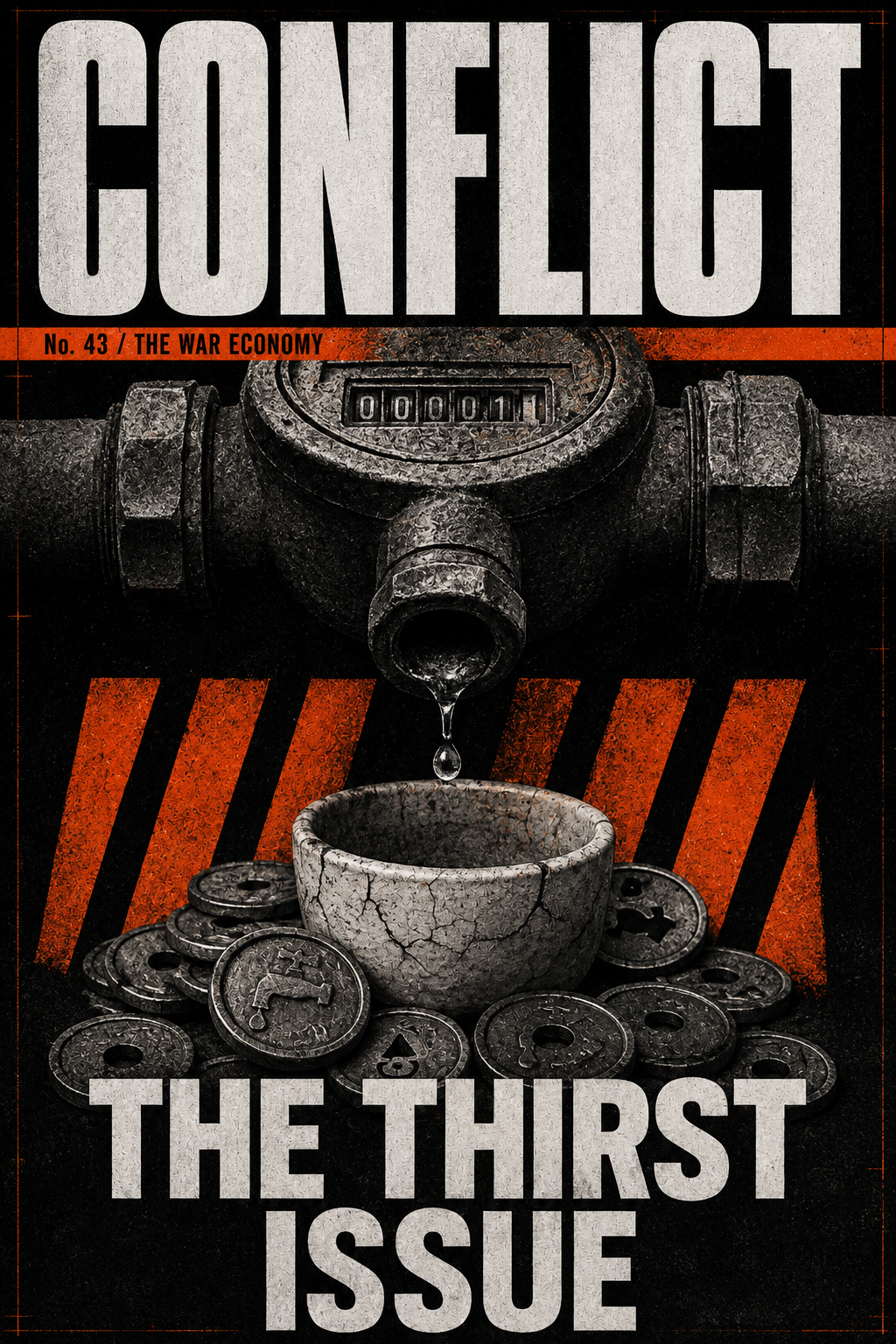
A tap can lie. An aquifer can be salted. A relay can go dark on a board member’s whim. A CLEARWELL seal does none of these, because we own the source, we meter the source, and we answer to the people who can afford to ask.
Concessions in credits, hard materials, or standing allocation rights. We do not service contested boroughs as a charity. We service them as a market. Rationing is a municipal failure. Trust is the only thing we decline to ration.
CONTRIBUTORS
Gene-forged lynx, ex-operator, our embedded correspondent and a confirmed wet asset back when the word meant a paycheck. She spent eleven days below the waterline with a relay crew for this issue’s feature and came up owing a pipe boss something she has not described and a tide she cannot repay. Her work also appears in our sister publication, which she says “at least pays on a schedule the water can’t edit.” We choose not to respond.
Wrote field-survival manuals for three armies before he understood that the armies were the hazard. He drinks last at any table, watches who drinks first, and has opinions about both. His guide to staying alive on bad water (page 35) was tested on himself across one very instructive summer. He survived it, which he offers neither as proof nor as recommendation.
Photographs objects the way other people photograph crimes, slowly and with the lights wrong. For this issue she took a single contamination test strip apart down to the chemistry and the lie. She was a relay-station clerk in a drought hub for four years and learned that the most important document in any borough is the one that tells you whether the water will kill you fast or slow. She no longer trusts strips she did not buy herself.
Interviews powerful people in rooms designed to make her grateful for the chair. For this issue she sat across a glass of certified water from a woman who meters the thirst of a city. The water cost more than the interview. It was not offered. Drift has a reputation for waiting out a silence longer than the person who can afford to break it, and she put it to use.
Writes cities the way coroners write reports, and spent a week in Saltgate for this issue so you would not have to. A drought kid herself, raised on a ration clock she still checks by reflex, she is the only writer we trust to walk a dry hub after dark and come back with the fashion as well as the body count.
There is a test you can run on anyone in theater, and it takes one question and no equipment.
Ask them when they last drank. Not what, not where, not with whom. When. The answer gives you their faction, their rank, their margin, and whether they are about to do something they cannot take back, because a person three hours past their ration clock is a different animal than a person with a full canteen, and the whole of this world is the management of the distance between those two animals.
This is the issue about thirst, which is the issue about power, because the two stopped being separate sometime around the Great Drought and nobody has pried them apart since. Credits burned. Factions rise and fall on a press release. Water does not have an ideology and water cannot be reprinted, and a thing that cannot be reprinted becomes, very fast, the only thing anyone trusts. A canteen outranks a rifle now. A rifle takes a borough. A full cistern keeps it.
We profile the people who understood this first on page 20, and the ranking is not moral, it is technical. The cistern syndicates and the meter men did not cause the Drought. They worked out, ahead of the rest of us, that you do not need to shell a city that will die of thirst on schedule if you own the schedule. Washing the borough, the operators call it. You pull a purge override, the water goes to the flood channels instead of the taps, and a quarter million people downstream find out who their government actually answers to. No shot fired. The most efficient weapon in the catalogue, and it invoices the survivors for the cleanup.
Cass Rennick spent eleven days below the waterline with a relay crew in a flooded city that is, against every intuition, dying of thirst, because the water that drowned the streets will kill you slower or faster depending on where you draw it. Her feature is on page 26. It is the funniest thing we have run about people who keep three boroughs alive on a skeleton crew and get classed as a military target for the favor.
Halford Crane has filed the most useful and least comforting pages in the book, a manual for drinking in a poisoned theater without becoming a statistic (page 35). Nessa Tarn took a contamination test strip apart down to the chemistry and the lie inside it (page 40). And Yael Drift sat across a glass of certified water from a woman who meters a city’s thirst and drinks freely while she explains why that is wholesome (page 44). The water in the glass cost more than the interview. Drift was not offered any. Read what she got instead.
We will not pretend we are clean, or even wet. This magazine keeps a tab at two gray-water bars and settles it in coverage, which is to say we drink water of a grade we then decline to assess in print. We are downstream of everyone. We are thirsty the way the whole world is thirsty, not yet, not today, but soon, and on a schedule somebody else is holding.
Standards are slipping. The water table is dropping faster.
A CISTERN SYNDICATE BEGINS METERING RAINFALL CATCHMENT ON ROOFS IT DOES NOT OWN
Citing a corridor allocation statute nobody can locate, the Meridian syndicate has installed catchment meters on residential rooftops across two boroughs and now bills households for the rain that lands on their own roofs before it reaches their own barrels. The legal theory is that runoff is a managed resource the moment it enters the watershed, and the watershed is theirs. Residents have responded by drilling holes in the meters, which the syndicate has classified as theft of a service. The rain has declined to comment. The rain falls anyway, which the syndicate is working to address.
“WASHING THE BOROUGH” ENTERS THE FASHION PRESS AS A VERB
The operator term for sabotaging civilian water to gain political leverage, opening a purge override so the supply dumps to flood channels instead of taps, has migrated from the field into rear-area conversation as a way to describe any clean, deniable removal of a rival. A gallery owner described losing her lease as being washed. A label founder described a hostile buyout the same way. The people who actually wash boroughs do not use the word lightly. They have seen what is downstream. The people borrowing it have seen a press release.
GRAY-WATER BARS NOW CHARGE A PREMIUM FOR THE WATER THAT WILL NOT KILL YOU SLOWLY
A tier of canal-adjacent bars has begun listing two waters: the house pour, gray, drinkable, faintly chemical, and a sealed assayed pour at four times the price. The premium does not buy a better night. It buys a slower decline, fewer years of the kidney thing everyone in the district pretends they do not have. Patrons order the house pour and watch who orders the sealed. Ordering the sealed in a gray-water bar is now read as either real money or real fear, and in this economy those have become difficult to tell apart, which suits everyone who has one and not the other.
DROUGHT-KID AFFECT BECOMES A LOOK AMONG PEOPLE WHO HAVE NEVER RATIONED
The careful, undramatic economy of movement that marks people raised on a ration clock, the way a drought kid will not waste a gesture any more than they would waste a swallow, has become an aesthetic among rear-area youth with full tanks at home. They practice the stillness. They carry a half-empty canteen as a prop and refuse refills to seem hard. The actual drought kids find this unbearable and unworthy of comment, which is itself the most drought-kid response available, and the imitators have started practicing that too.
EO HOLDS A BOROUGH’S PURGE OVERRIDE AS A NEGOTIATING POSITION
During a stalled corridor talk, EO command let it be quietly known that it controls the purge override for the disputed borough’s water relay, and that the override is, in the words of one liaison, “a button we hope never to discuss again.” Discussing it was the entire point. The talks moved. The borough was not consulted, because the borough is not at the table, the borough is the table, and everyone seated has agreed not to mention the thing under the cloth that decides whether the borough drinks next week.
RELAY RATS IN A FLOODED HUB THREATEN TO STOP, AND THE WHOLE MAP NOTICES
The maintenance crews who keep the water moving below the waterline, relay rats by their own name, have made it known that a skeleton crew is a skeleton crew right up until it walks. Three boroughs run on the hands of fewer than a dozen people who work damp corridors for wages a board member spends on a sealed pour. The factions that have spent years treating these crews as soft targets are now discovering they are also the only thing between every side and a dry city. A relay rat with a wrench has more strategic weight this season than a squad with a mandate.
A DESALINATION CONCESSION IS CAUGHT DUMPING ITS BRINE UPSTREAM OF A RIVAL’S INTAKE
The hypersaline waste from a private desal column, which by every standard must be dispersed far offshore, was instead being released a measured distance above a competitor’s freshwater intake, slowly salting a source that took a generation to find. The concession calls it a routing error. The salinity logs call it a campaign. You cannot un-salt an aquifer on any human timeline, which means this was not sabotage of a quarter, it was the murder of a century, conducted by men in good coats who will be retired before the water finishes dying.
HARD-PIPE RIGHTS NOW CHANGE HANDS LIKE DEEDS, WITH THE SAME PAPER AND WORSE FAITH
A confirmed, functioning freshwater line, a hard pipe in the trade, has become an asset you can buy, lease, and inherit, complete with sealed instruments and arbitration clauses. The value is not the pipe. The value is the certainty, because everything else in the supply map is a maybe and a hard pipe is a yes. People are signing decades of their water future against a single season of credits, and the brokers who write the paper have learned to schedule the signings for the dry months, when a yes feels like air.
“PRE-DROUGHT” BOTTLED WATER BECOMES A COLLECTOR OBJECT, THEN A COUNTERFEIT MARKET
Sealed bottles dated before the Great Drought, water that fell as rain in a world that no longer exists, now trade among collectors who do not intend to drink them, which is fortunate, because most are refilled fakes with aged labels and a convincing layer of dust. The fantasy on sale is not hydration. It is a sip of the old world, the time before the ration clock, and the forgers understand they are not faking water, they are faking nostalgia, which has never once failed to find a buyer.
A WIDOW’S SURVIVOR ALLOCATION IS PAID IN WATER CREDITS, THEN QUIETLY DERATED
A border municipality that compensates the families of its dead in monthly water-credit allocations has been steadily lowering the liters each credit redeems, citing allocation drift, so the paper amount holds while the actual water shrinks. The families are not told. They learn at the relay window, where the same credit that bought a week now buys five days, then four. A pension you cannot drink is not a pension. It is a slow apology that the borough has worked out how to make smaller every month without ever signing anything.
A LIVE SPRING IS FOUND IN GHOST COUNTRY, AND SEIZED BEFORE IT IS MAPPED
A working spring surfaced in a stretch of ghost country a corridor long abandoned, the first new source anyone could remember. It was secured by armed contractors within seventy-two hours, before the survey team that found it had filed a single coordinate. The people who found water did not get water. They got a non-disclosure and an escort to the edge of the dead zone. Somewhere a spring that belonged to no one now belongs to whoever was fastest, which in this theater is the only ownership anyone respects.
SOMEONE POISONS A WELL TO CRASH A PRICE, AND THE PRICE OBLIGES
A neighborhood well that had been undercutting the local water broker turned suddenly foul, the contamination strips lighting up red overnight, and the broker’s rate doubled by morning. The well tested clean again a week later, after the panic had set the new price. Nobody can prove the foul was introduced. Nobody in the borough believes it was not. The lesson the district took is the lesson the district keeps taking: the cheapest way to raise the price of water is to make the free water frightening, and fear, unlike water, is in endless supply.
The drought kid who poured half her canteen into a stranger’s without ceremony and without checking who was watching. She did the math the rest of us perform out loud: he was closer to empty than she was, and a swallow given before it is begged for is worth more than the swallow. Nobody at the table mentioned it. Everyone at the table revised their estimate of her. That is what real water looks like, unhurried and unannounced and absolutely remembered.
The rear-area kid carrying a deliberately half-empty canteen as a costume, refusing refills at a bar with a working tap to read as hard. The drought kid two seats down has a full one she will not open in front of strangers, because where she is from you do not show the tank, and she has spent the whole evening not looking at him, which is a colder verdict than anything we could set in type.
The pipe boss who logged a relay fault correctly at 0300 instead of rounding it up to look busy or down to go home. A wrong entry in a water log is not paperwork, it is a borough finding out at the tap. He fixed the valve, wrote the true number, and left before anyone could thank him, because thanks are for people who think the job is a favor. It is not a favor. It is the only thing holding the map together.
The corridor officer loudly “restoring” a borough’s water at a press event, on a relay his own side washed the week before. Public restoration is not generosity, it is a second meter, payable in gratitude, with the cameras as witnesses to make sure the borough keeps paying. The people he “saved” now owe him for the thirst he engineered. Everyone downstream saw the broadcast. Everyone downstream remembers the dry week it did not mention.
The smuggler who refused a job moving counterfeit assay seals, the little wax stamps that tell a buyer water is safe when it is not. She read what the cargo was, understood that a faked seal in a thirsty borough is a death warrant with a serial number, and walked. Declining to poison the thing everyone has to trust is a kind of wealth most of this theater cannot afford. She can. That is the flex, not the credits she earned but the ones she turned down.
The desal-concession accountant carrying a sealed hard-pipe deed to a checkpoint bar like a trophy. The deed represents three boroughs of guaranteed water signed away in a dry season under a duress nobody wrote down. He brought it to be seen holding it. He is wearing four hundred thousand people’s thirst as an accessory, and he showed the seal to a stranger, and the stranger did the only sensible arithmetic. The bar served him. The bar will remember the face.
The medic who carried his own contamination strips, bought from a source he trusts, and tested the field water in front of his squad before anyone drank. Slow, unglamorous, faintly insulting to the quartermaster who supplied the questionable barrel. Also the reason his people still have working kidneys. He does not trust a seal he did not watch get applied, and in a season of faked assays that is not paranoia, it is competence with a shelf life.
The lifestyle operator filming himself drinking unassayed canal water for a feed, to prove he is harder than the worriers. He is not harder. He is younger, and he has confused the absence of a same-day consequence for the absence of a consequence. The drought kids watching the clip are not impressed. They have buried people who drank to prove a point. The canal does not care about your feed. The canal keeps its own log, and it settles in years.
The relay rat who wore her waders into the bar afterward, stained to the thigh, and did not apologize for the smell. She had been below the waterline keeping a borough wet while the room drank. The stain is the credential. Anyone who wrinkled a nose at it announced exactly how far they live from the work that lets them be precious about it. She drank her pour, said little, and left earlier than everyone, because the tide does not keep social hours.
Carrying a CLEARWELL sealed liter in a clear holster on your hip at a dry-borough function so the seal shows. Certified water is leverage. Leverage everyone can see is just a target on your belt drawn by the thirstiest person in the room. The seal is beautiful. The instinct to display it in front of people on a ration clock is suicidal and rude in that order. Drink it in private or accept that you have advertised precisely what you are worth to whoever wants it gone.
The old canal widow keeping her water-credit allocation book current to the liter, recording every credit the borough issues and every liter it quietly derates. She is a creditor of the people who buried her husband, paid in a currency that shrinks while she sleeps, and she intends to be holding accurate paper when the reckoning comes. It will come. She will be ready. The book is soft at the spine from being right and unpaid.
The collector showing off a “pre-Drought” bottle at a dinner, water that supposedly fell before the world dried, sealed and dusted and absolutely refilled last month. He paid for a sip of the old world and got a fake of a feeling. The drought kid across the table has never tasted pre-Drought anything and never will and does not perform grief about it. He is mourning a world he is too young to have lost. She is rationing the one that is actually here.
THE WORKING CANTEEN (FULL, NEVER OPENED IN PUBLIC)
CLEARWELL SEALED LITER, HOLSTERED
RELAY-RAT WADERS, STAINED TO THE THIGH
THE FLOOD BEAD STRAND (REPURPOSED, NOW DECORATIVE)
THE CONDENSATION CLOAK
MARISOL VANTH
Vanth did not corner the water. She cornered the schedule, which is better, because water spoils and schedules compound. Her syndicate holds the metering rights to four boroughs and the override to a fifth, and she has perfected the art of never cutting a supply in anger, only in sequence, always to her advantage and always with a statute to cite. She drinks freely while she explains that thirst is a municipal failure and she is merely its accountant. Asked whether she had ever released a source for free, she said charity was “a pour we discontinued for lack of margin.” We believe her. That is the problem.
THE DESAL CONSORTIUM (UPSTREAM BRINE)
Not one man but a board that decided the cheapest way to win a market was to salt a rival’s aquifer with dumped brine, killing on a century’s timeline a source that fed a region. They call it a routing error. The salinity logs call it a campaign. The genius and the horror are the same fact: nobody alive will see the source recover, so nobody alive can be made to pay for it, and the consortium will be dissolved and reincorporated twice before the water finishes dying. They did not poison a quarter. They poisoned a grandchild.
COL. ANSEL DREY (EO)
Drey is the man who let a negotiating table know he controls the purge override for the disputed borough, then called it “a button we hope never to discuss.” Discussing it was the lever. He has never washed the borough. He does not need to. The threat does the work, cleanly, deniably, and the borough, which is not at the table because it is the table, drinks at his discretion and does not get a vote. He describes this as restraint. Restraint is the word a man uses for the violence he has arranged not to have to commit.
SEROVA LICHT
Licht sells nostalgia by the sealed liter, water dated before the Great Drought, most of it refilled and aged and absolutely fake, to collectors who will never drink it and never check. She is not in the water business. She is in the grief business with a dust machine. Her catalogue copy mourns the old world in the same paragraph that sets a reserve price on it. She told us she “curates memory responsibly.” Responsibly is carrying a great deal of weight in a sentence about charging people to feel sad about rain.
THE WELL-SOURER
Somebody is making free wells frightening on a schedule that tracks a broker’s price. A neighborhood source goes foul overnight, the strips light red, the broker’s rate doubles, and a week later the well tests clean again, after the new price has set. No one can prove the contamination is introduced. No one in the borough believes it is not. Whoever this is understood the cheapest way to raise the price of water is to make the free water terrifying. We rank them fifth only because we cannot name them. Name them and we will move them up, and so, we suspect, will the borough.
DR. PIET HALLORAN
Halloran runs the lab whose wax seal is supposed to mean water is safe, and he has been selling the seal separately from the testing, certifying barrels he never assayed for clients who pay for the stamp and not the science. A faked seal is not fraud, it is a slow homicide with a serial number, because the whole thirsty borough trusts the mark and drinks on it. He calls his terms “expedited certification.” The people drinking on his expedited seals call it nothing, because the ones who would complain are the ones it is quietly killing.
THE RAINFALL METER OFFICE
The clerks who decided rain becomes a billable resource the instant it touches a roof, and now invoice households for the weather that lands on their own homes. It is the purest expression of the era: not content to own the rivers and the wells, the syndicate has reached up and put a meter on the sky. They will tell you they only manage runoff. So does a dam. So does a noose. The rain, to its credit, continues to fall on the just and the metered alike, which the office regards as a compliance gap.
A CLEARWELL liter worn full and visible on the hip at a dry-borough function. He wanted the seal seen. It was. Half the room now knows exactly what is on his belt and what it is worth to people three hours past their ration clock. He thinks the holster reads as wealth. It reads as a delivery address.
An assay seal bought separately from the assay, applied to a barrel nobody tested, sold into a thirsty block. The wax is perfect. The water is a coin toss. The whole borough trusts the stamp, which is the point and the crime. A faked seal is not a shortcut. It is a sentence handed to whoever drinks first.
A deliberately half-empty canteen, refilled-refusals included, carried to read as hard. The drought kid across the room has a full one she will not open and would never display, because where she is from the tank is private. One of these people has been thirsty. The other has been to a costume shop.
The lifestyle operator drinking unassayed canal water on a feed to prove he is harder than the worriers. There is no same-day consequence, which he mistook for no consequence. The canal settles in years, quietly, in the kidneys. The drought kids who watched the clip did not comment. They have already buried someone who drank to make a point.
A strand of flood beads worn as a throat piece by a collector who has never sealed a leak. The real ones swell and degrade because they have done the job. These are dyed, inert, perfect, and perfect is the tell. A survival tool that shows no use has never been used, and neither, you can safely assume, has the neck.
A “pre-Drought” collector bottle displayed at a dinner, dust and seal and all, refilled and aged to order in a back room this season. He paid for a sip of the old world and bought a forgery of a feeling. Nobody at the table could have told the water apart. Everybody at the table could tell he needed it to be real.
A homeowner drilled the syndicate’s rain meter off his own roof to stop being billed for his own weather, and got flagged for theft of a service. He is not wrong about the principle. He is wrong about the paperwork, which the syndicate wrote, and which now classifies his roof’s rain as their inventory. Fight the meter and you fight the statute behind it. Bring a lawyer or bring a flood.
The desal column routing its brine a measured distance above a rival’s freshwater intake, salting a century-old source on purpose. Called a routing error in the filing. The salinity log disagrees in numbers. You cannot un-salt an aquifer on a human timeline, which makes this the one field failure in the issue that no apology, no fine, and no resignation will ever undo.
A widow’s survivor allocation, paid in water credits the borough quietly derates, so the number holds while the liters shrink. She finds out at the relay window, a week at a time, in the gap between what the credit says and what it pours. A pension you cannot drink is a slow apology. This one gets smaller every month and the borough never has to sign a thing.
A counterfeit contamination strip that reads clean no matter what you dip it in, sold cheap to people who cannot afford the fear of testing. It is the cruelest fake in the catalogue, because it does not just fail to protect, it actively reassures. A real strip that reads red saves a life. This one sells the feeling of safety and pockets the difference in years.
The first thing nobody tells you about a flooded city is that it is the thirstiest place I have ever stood. There is water in the streets, water in the stairwells, water lapping the second-floor windows of buildings whose ground floors became reefs years ago, and you cannot drink a drop of it without choosing how you would prefer to be sick. Salt came up the estuary when the barriers failed. Everything below it is brackish, fouled, threaded with whatever the old world left in its pipes, and a city that is drowning is a city standing waist-deep in poison wondering where its next clean swallow comes from. I am a lynx. I have good instincts about water and worse instincts about people, and Dara Kask sent me down here because the thirst issue needed someone who would get in the boat and then get out of the boat and into the corridors below the waterline, where the actual work is, and not flinch. I have a reputation for not flinching. It is, I have come to understand, just another debt you pay by living up to it.
The crew is four people and they keep three boroughs in drinking water, which is a sentence so absurd I made the pipe boss repeat it. Her name is Okot and she has run this relay station for nineteen years, since before the second flood, and she has the specific calm of someone who has stopped expecting to be rescued and started being the thing that rescues. “Skeleton crew,” she says, when I ask how many people it takes. “Four. Used to be eleven. The factions keep deciding we are a soft target and keep finding out we are the only target that turns their water off when it dies.”
It is 0200 and we are wading a service corridor that floods to the thigh at high tide, headlamps throwing cones through water that is the color of strong tea, and Okot is reading the walls. Not the gauges. The walls. The rust patterns, the wear on the handrail, the dry line that tells her where the water reached last week and whether it is rising. “No floor plans worth anything down here,” she says. “The maps are from before. We read rust. Follow the dry patches. That is where the work is and where the floor still holds.”
Everyone above the waterline thinks the war is about who holds the city. The war is about who holds the one tap that does not lie.
The one tap that does not lie is a hard pipe, a confirmed clean line drawn from a deep source the floods never reached, and the station exists to keep it flowing to the boroughs and to keep everyone else from knowing exactly which corridor it runs through. “A hard pipe is the only yes in this whole drowned map,” Okot tells me. “Everything else is a maybe. People will sign away ten years for one yes. So we do not advertise where the yes lives.” The crew moves the access route on a rotation only they know. They have learned, the hard way, that the most dangerous thing you can do with clean water is let anyone draw a straight line to it.
By the fourth night I understand the shape of the thing, and the shape is a weapon nobody is firing. There is a command sequence called a purge override, designed for contamination events, that forces a relay to dump its reserves into the flood channels instead of sending them to the taps. It is a safety feature. It is also, in the wrong hands, the cleanest way to kill a borough ever invented, and the wrong hands have noticed. “Washing the borough,” Okot says, when I ask why someone spray-painted WASHED on a bulkhead two corridors over. “That station got taken last spring. New management opened the override during a dispute. Quarter million people lost the tap for nine days so somebody at a table could make a point. We pulled bodies out of the dry weeks. Dehydration in a flooded city. You want to talk about a war crime with good lawyers, that is the one.”
She does not raise her voice when she says it. None of them do. There is a flatness to how the crew talks about the override, the flatness of people who hold a loaded thing every day and have decided that being calm about it is the only way to keep holding it. The youngest of them, a relay rat named Sefu who cannot be twenty, put it to me while we waited out a tide. “Up top they think we are maintenance,” he said. “Down here we know we are the trigger guard. The whole city is a gun pointed at itself through this one valve. We are just the hand that keeps it from going off.”
Up top they think we are maintenance. Down here we know we are the trigger guard on a gun the city points at itself.
I ask Okot what happens to the city if the crew walks. She is quiet, reading a gauge she does not need to read. “Somebody less careful runs the valve,” she says finally. “Somebody who washes the borough for a paycheck instead of refusing to. The water does not die when we leave. It dies when the people who love it leave, and somebody who sees it as a button takes the chair.”
The eighth night goes wrong in the specific way these nights go wrong, which is quietly and all at once. A faction crew comes down the access corridor we did not advertise, three of them, wet to the chest, and they have a man with them who knows valves, which means somebody talked. They want the override sequence. Not the water. The override. They want the ability to wash this borough, to hold it, the way the station two corridors over got held, and they have decided tonight is the night they ask for it with their hands near their hips in a corridor where a discharged round puts a hole in the one clean line and ends the argument for everyone, themselves included.
And here is where I should tell you I watched a relay crew do something brave and terrible, because that is the story the corridor is shaped like. That is not what happened. What happened is that Okot, very slowly, sat down. On a dry rung of the access ladder, below the man who knew valves, made herself smaller than him, looked up, and said in that flatness I had decided was nineteen years of damage: “You can have the sequence. I will give it to you right now. And then you hold the valve. You. Not me. You stand in this corridor at every tide for the rest of your life, and you read the rust, and you decide every single day whether a quarter million people drink, and the first time you get it wrong, and you will, the borough you are trying to own will be the borough you killed, and they will know your name the way they know the name of the man two corridors over. I am not protecting the water from you. I am protecting you from the water. You do not want this chair. Nobody who understands it does.”
I am not protecting the water from you. I am protecting you from the water. You do not want this chair. Nobody who understands it does.
The man who knew valves looked at the override panel for a long time. Then he looked at the dry line on the wall, the one that said where the water had been last week, and he did the arithmetic that Okot had just handed him, and he understood that she was not offering him a weapon, she was offering him a life sentence of being the only thing between a city and its own thirst, with no relief and no rotation and no one to blame. He left. They all left. Not because they were beaten. Because they finally saw the size of the thing they were asking to hold, and it was bigger than the want.
On the last night Okot lets me draw from the hard pipe, the clean tap, the one yes, and the water is so cold and so plain it tastes like nothing, like the absence of every chemical I have been drinking around for eleven days, and I understand for one swallow why people sign away decades for it. As I drink she says, lightly, the way you set a tool down to see if anyone flinches: “You owe us now. You know that.”
I do not flinch. I have a reputation. “For the water?”
“For the route,” she says. “You know where the yes lives now. The one thing we never tell anyone, you walk out with it in your head. We let you down here because Dara vouched and because the city should know what it costs to keep them wet. But you carry the route now. That is a debt that does not convert to credits. You pay it by never drawing the line, by writing this so people understand and not so people can find us. Some maps you hold by refusing to draw them.”
“What if I get it wrong?”
She almost smiles, which on Okot is an event. “Then you find out what every relay rat finds out. That the water keeps its own ledger, and it does not forgive, and it is patient, and it is already downstream of you, waiting.” She caps the hard pipe, moves the access route in her head for tomorrow, and we wade back out toward the boats and the drowned streets and the boroughs sleeping above the waterline, dry-mouthed in a city standing chest-deep in water it cannot trust, kept alive by four people who read rust in the dark and refuse, every single tide, to make the easy thing happen.
We locate. We do not defend. A found source is a target the moment it is filed, so we file nothing, we tell only you, and what you do with a yes in a thirsty world is between you and the people who will come for it. Bring security. Bring more than you think.
The Dowsers Guild operates under no charter, answers to no concession, and guarantees only the finding. Water located is not water held. We have buried finders who forgot the difference.
Your ration clock is how long your current water lasts at the rate you actually drink, not the rate you tell yourself you drink. Everyone in theater knows theirs. Nobody says it out loud when it drops under forty-eight hours, because a person whose clock is short is a person who can be moved, and the people who move others for a living can read a short clock on your face. Do the math cold, in private, every morning. The single most dangerous moment in any operation is not the firefight. It is the hour you realize, too late, that your clock ran out while you were busy, and now every decision you make is a thirsty decision, and thirsty decisions are how the canal gets fed.
There is clean water, which is assayed, sealed, expensive, and rare. There is gray water, which will not kill you today and will charge you for the privilege over a decade, and which is most of what comes through municipal pipe outside the secured corridors. And there is the water that is simply death with a delay, brackish, salted, fouled, the water a drowning city stands in. The fatal error is treating gray as clean because you are tired, or treating death as gray because you are thirsty. Thirst lies to you about grade. It will tell you the brackish draw is probably fine. It is not telling you the truth. It is telling you what it wants.
A contamination strip that reads clean is only as honest as its supply chain, and this season the supply chain is full of counterfeits that read clean no matter what you dip them in. A fake strip is worse than no strip, because no strip makes you cautious and a fake strip makes you confident, and confidence is what the bad water is waiting for. Buy your strips from a source you would trust with a wound, test a known-bad sample now and then to confirm they still turn red, and never, under any circumstance, drink on a seal you watched nobody apply. The assay seal is a promise. In a market that sells promises separately from the testing, a promise is just a sticker.
In any borough, the person who actually knows where the clean water is, is the pipe boss or the relay rat, the maintenance crew who work below the waterline and keep the taps honest. They are not on the org chart. They do not wear rank. They know every valve, every override, every workaround, and the names of the families downstream of each one. Treat them with the respect you would show a surgeon, because in a thirsty city that is exactly what they are. The officer can authorize water. The pipe boss can produce it. When the cascade starts, and it will, the officer holds a clipboard and the pipe boss holds the wrench. Befriend the wrench.
Every networked relay has a purge override, a sequence that dumps the supply to the flood channels instead of the taps. It exists for contamination events. It is used, increasingly, as a weapon: washing the borough, the operators call it, taking a city without firing a shot by simply turning off its thirst. You cannot stop an override you do not control. What you can do is read the signs that one is coming, a relay gone dark, a maintenance crew suddenly replaced, a borough’s water authority bought or threatened, and get your clock topped up before the taps go. When you hear that a station has changed hands during a dispute, do not wait to confirm. Fill everything. The confirmation is the dry tap, and by then it is too late to do anything but ration the panic.
The only person in this economy who is not owned is the one who makes their own water, and even they are owned by the weather. A condensation cloak in ghost country, a deep canteen discipline, a hard-pipe arrangement you keep quiet, any of these buys you a margin of independence from the relay, the syndicate, the override. The margin is small and it is everything. A person who must draw from the municipal tap drinks at the discretion of whoever holds the valve, which means they negotiate everything else at that same disadvantage. Independence in water is independence in general. It is the most expensive freedom there is, and the only one that keeps.
You cannot opt out of thirst. There is no position of zero need, no one who never has to drink, because that person does not exist and the people who pretend to be him die first and proudest. The goal is not to escape the watershed. The goal is to move through it as someone who knows their clock, trusts their own strips, respects the wrench, and never confuses the want for the truth. Water is the one thing in this world that never learned to lie. Everyone handling it has. Test the water and the people in equal measure, and drink last at any table where you cannot see the source.
The strip is the length of a finger and weighs nothing, which is its first lie, because what it weighs is a decision about whether you live a long life or a shortened one, made in sixty seconds against a color chart you have to trust as much as you trust the strip. It is paper backed with reagent pads, four of them, each tuned to a different poison the water might be carrying, and you dip it, you wait, and the pads change color or they do not, and the colors tell you safe, gray, or the third thing nobody says out loud. I am holding one across a table from a relay clerk named Bruno, who has read more of these by hand than anyone in the district, and when I ask him if he trusts the strip he makes a sound that is not quite a laugh.
“I trust the strip I bought,” he says. “I do not trust the strip you bought. That is the whole of it. The strip is the most honest object in the borough right up until somebody learns to fake the honesty, and somebody always learns.”
This is the paradox the strip cannot escape. It was created to remove fear, to let an ordinary person know whether the water in front of them will kill them slowly, and by becoming the thing everyone trusts, it became the thing most worth corrupting. A counterfeit strip reads clean no matter what you dip it in. It does not protect and it does not warn. It reassures, which is worse, because a person with a fake strip drinks with confidence the water a person with no strip would have refused out of caution. The fake does not fail to save you. It actively walks you to the edge and tells you the edge is solid.
I ask Bruno how you tell a real strip from a fake one, and he goes still in the way people go still when you have touched the part of the job that frightens them.
A real strip can ruin your day. A fake strip can only ruin your decade. People keep choosing the one that never ruins their day.
“You test the tester,” he says. “You keep a sample you know is bad, salted, fouled, whatever, and now and then you dip a strip from the packet into the bad sample and watch it turn red. If it does not turn red on water you know is poison, the whole packet is a lie and you throw it out and you do not buy from that source again. The trouble is, doing that costs you a strip every time, and the people most likely to buy fakes are the people who cannot spare a strip to test the strips. The fakes find the poor first. The fakes always find the poor first.”
So the object of safety is also an object of class. The comfortable test freely, waste strips confirming their strips, and drink assured. The poor buy the cheap packet, cannot afford to spend one proving the rest, and drink on faith, and faith is precisely what the counterfeiter sells. I track a single packet’s journey the way you trace any object that has become a map. It is manufactured legitimately, assayed, sealed. Somewhere in distribution a parallel run of fakes is slipped into the same packaging. They split at a warehouse, the real ones to the secured corridors where buyers can afford to test, the fakes routed deliberately to the dry boroughs where buyers cannot, because a fake strip’s ideal customer is someone too thirsty and too broke to check.
The strip was invented to remove fear from water. We have managed to sell the fear back, in the strip, to the people who could least afford to feel safe.
I find a family that drank for a month on a fake packet. I do not name them. The mother shows me the strips, neat in a tin, every one read clean, every one a lie, and the water they certified was gray at best. She knows now. She did not know then. “You buy the strip so you can stop being afraid,” she says. “That is what you are paying for. Not the chemistry. The permission to drink without the fear. And they sold us the permission and kept the chemistry, and we drank a month of gray water feeling safe, which is the only month I would take back, because the fear would have saved us and they sold us out of the fear.”
The manufacturers will tell you the strip is a triumph of accessible safety. The counterfeiters will tell you nothing, which is its own statement. Bruno, who has read more real ones than anyone alive, told me the truest thing at the end, as he dipped a strip into his salted control sample and watched it bloom red, the way he does every morning before he trusts a single one. “It is an honest object,” he said. “The honest ones always are. But honesty in a thirsty borough is just a thing somebody will counterfeit by Thursday, because the more people need to believe a color, the more a fake color is worth. I test mine every day. That is the most I can do. I cannot make the water clean. I can only refuse to lie to myself about which kind it is.”
A sliver of paper that decides who dies slowly, trusted by everyone, faked for the thirstiest, read in sixty seconds against a color you have to believe. The strip will outlast the shortage that made it necessary, because tools always outlast their reasons. The counterfeiters will keep finding the poor first. And somewhere a clerk will keep dipping a strip into water he knows is poison every morning, watching it turn red, keeping the one honest habit available in a borough that has learned to fake even the truth about what is in the glass.
The reserve is not what you would build if you wanted to frighten people, which is how I know it was built to frighten people. It is cool. It is humid in the deliberate way of a place that can afford to waste moisture into the air. At the center, lit from below, stands a glass cylinder the height of a person, full of certified water so clear it looks solid, and the whole room is arranged so that you cannot sit anywhere without seeing it, this casual display of more clean water than most of the corridor will touch in a year, standing in a tube like a relic. Marisol Vanth meets me beside it with two chairs and one glass, hers, which she fills from a tap that runs without a meter, because down here the meters are for other people. She is in her fifties, composed, dressed in the plain expensive clothing that is its own kind of allocation.
“You want to know if I am the villain of your issue,” she says, before I have asked anything. “Everyone leads with it eventually. Let me save us the dance. I am not a villain. I am a comptroller. Villains want things. I balance an account that happens to be made of water, and the account does not care how anyone feels about it, least of all me.”
“An account you profit from.”
“Every account profits someone. The ones that pretend otherwise are simply lying about who pays for the building.”
She is good at this. I came prepared for that. I ask her how the business actually works, under the chapel language of allocation and stewardship.
“A city needs water it does not have enough of,” she says. “That is the only fact. Everything else is distribution. The municipal authority distributed by need, which sounds noble and meant that the loudest and the most violent drank first and the quiet died. We distribute by schedule. The schedule is neutral. The schedule does not care who you are. People hate the schedule because it cannot be shouted at, but the schedule has kept more people alive than the need ever did, because the need was just a fight and the schedule is at least a fight with rules.”
People hate the schedule because it cannot be shouted at. But the schedule is the only thing in this city that treats the weak and the strong the same. It treats them both as customers.
“You hold an override,” I say. “You can wash a borough. Cut the taps entirely. How is a schedule neutral when you keep a kill switch in the drawer?”
For the first time she looks pleased, which is more unsettling than the cylinder. “I have never used it,” she says. “That is the product. Anyone can turn off water. A child could turn off water. What I sell is the credible promise that I will not, as long as the schedule is honored. The override is not a weapon I use. It is the reason I never have to. A city that knows you can wash it and watches you choose not to, every single day, is a city that pays its schedule on time and calls it freedom.”
“That sounds like a hostage arrangement.”
“It sounds like every government that ever held a reservoir,” she says. “The difference is that I am honest about the drawer. The municipal authority had the same override and pretended it was a safety feature. I keep it on the table and let everyone see it is a choice. They call me a syndicate. I call them my unlicensed predecessors. We are in the same trade. Thirst, and the management of it.”
I tell her about the family that drank a month on counterfeit strips, the fakes routed to the dry boroughs on purpose, the mother who said they sold us out of the fear. I want to see if anything reaches her. She listens without moving, turning the glass a slow quarter-turn on the table.
Then she says: “That woman understands water better than any hydrologist I employ. They sold her the permission and kept the chemistry. Yes. That is the entire engine, and it is not mine, the strips are a different racket, but it is the same engine. Everyone in this economy sells the feeling and meters the substance. The bar sells the night and rations the pour. The clinic sells the cure and doses the supply. I sell the schedule and hold the source. We are all in the business of the gap between what people need to believe and what they can actually have. I did not create thirst. I keep honest books about it.”
“You drink freely while they ration.”
“The relay rat drinks freely too, from the line he maintains. The clerk drinks from the assay he runs. Proximity to the source is the oldest privilege there is, older than money, older than rank. I am closer to the water than you are. You resent that. You would do exactly the same if you held the comptroller’s chair, and you would tell yourself, as I do, that drinking thirsty would not put a single extra liter in anyone’s tap. It would not. My thirst is not a redistribution program. It is just theater you would prefer I perform.”
My going thirsty would not put one liter in anyone’s tap. You do not want me to ration. You want me to perform shame. That is a different product, and I do not stock it.
Near the end I ask the question I came to ask, the one I had been holding like a strip I did not want to spend. I ask her whether she has ever opened the override, just once, for any reason.
She turns the glass another quarter-turn. “Once,” she says. “A long time ago, before Meridian, in a borough that no longer exists. There was a contamination event, a real one, and the override is what it was built for, dumping the fouled supply to the channels to save the network. I opened it correctly, for the right reason, and a relay crew that did not get the word in time was in the wrong corridor when the reserves dumped. I followed the procedure. The procedure killed three people who were trying to keep the same city alive I was trying to save.”
“What did that teach you?”
“That there is no clean way to hold the valve. None. The procedure is not mercy and the refusal is not mercy. Whatever you do with that much water, someone downstream pays, and the only choice you actually get is whether you pay attention while they do. So I keep the override closed and the schedule honest and I drink my water in front of you without apology, because I learned the one true thing about this chair, which is that the people who agonize over it make worse decisions than the people who simply keep accurate books. Guilt is not a water-treatment process. It just makes the comptroller slow, and a slow comptroller kills more people than a cold one.”
“That is a very profitable thing to have learned.”
“Yes,” she says, and finishes the glass. “The lessons that pay best are the ones that cost you a borough first. You are good at this. You waited for the override question. Most of your colleagues open with it and get a press release.”
She walks me out herself, past the lit cylinder, past the tap that runs without a meter. At the door she says, lightly, the way she says everything that matters: “If you are ever truly thirsty, Ms. Drift, you know where the source is.” I tell her I carry my own. She smiles. “Everyone says that,” she says, “until the season the air runs dry and the cloak yields nothing. Then they remember who keeps the schedule.” The cylinder hums behind her, lit from below, a year of someone’s water standing in a tube so a guest can be reminded, without a word, exactly how close to the source she is not.
You arrive in Saltgate by crossing the flats, because the city sits in the middle of a dead coast where the sea pulled back and left a plain of salt that crunches under the transport and gets into everything, your teeth, your kit, the seams of your clothes, a fine white reminder that the ocean is right there and not one drop of it will help you. The city exists for one reason, which stands at its center, taller than anything else, lit at the top so it can be seen from the flats like a lighthouse for the thirsty: a desalination column, the last one on this coast that still runs, drinking seawater at the bottom and producing, at terrible cost in power and parts, the only fresh water for two hundred kilometers. The whole of Saltgate is downstream of that one machine, and the whole of Saltgate knows it, and you can read that knowledge in everything from the architecture to the way people hold a cup.
By day the city is queues and salt and the particular patience of people whose lives depend on a machine they do not control. By night it becomes something stranger, a place where the thirst economy takes off its daytime manners and does its real trading in the bars that ring the column’s base, close to the source, where the water is freshest and the rent is highest and the entire social order is organized by one axis only: how near you live to the column. The closer to the column, the better your water and the shorter your odds in any argument. People in Saltgate do not ask where you are from. They ask which ring you drink in, and the answer is your whole biography.
The first thing you notice after the salt is the column’s sound, a low mechanical breathing that never stops, audible everywhere, and the way every conversation in the city is half-tuned to it the way you would tune to a sick relative’s breath. When the column changes pitch, the whole bar goes quiet for a second. “You learn its voice,” a woman tells me at a base-ring bar called the Intake. “Everyone here can tell you if it is running rough. We have all woken at 0300 because the sound changed. The column coughs, the city flinches. It is the only thing we all listen to and the only thing none of us can fix.”
The whole city listens to the column breathe. When it coughs, two hundred thousand people stop talking at once. It is the only god we have and it runs on spare parts.
The pipe bosses here are not maintenance staff. They are clergy. The crew that keeps Column 1 running are the most important people in Saltgate and they know it and they carry it with a weariness that comes from being load-bearing for an entire city. I buy a round for an off-shift column tech named Adisa, who tells me the thing that reframes the whole place. “The column is dying,” he says, flatly, the way you would mention a terminal diagnosis you have made peace with. “Not fast. But the membranes are out of production, the original maker is gone, and every part we replace it with is worse than the one before. We are nursing it. We have maybe a decade. Nobody in this city plans past the column, because there is no past-the-column. When it stops, Saltgate stops. We are a city built on a held breath.”
The grief here is different from the grief in a flooded city. In Saltgate it is anticipatory, a whole population living in the shadow of a machine’s mortality, and it shapes everything, the fashion, the religion, the way people fall in love fast and leave faster. There is a thriving trade in column relics, scavenged parts from dead desal plants up and down the coast, some genuinely useful, most sold as talismans to people who want to feel they are doing something for the column. A scavenger shows me a membrane housing she swears is compatible. Adisa, later, tells me it is not, that it is from the wrong generation, that half of what is sold as column salvage is hope with a price tag. “People buy a part they cannot install for a machine they cannot fix,” he says. “Because the alternative is sitting in the dark listening to it breathe and knowing you can do nothing. I do not blame them. Some nights I want to buy one too.”
Past midnight the inner rings come alive, the bars closest to the column, where the water is fresh enough to taste sweet and the people drinking it are the ones who keep the machine alive or the ones rich enough to live next to the people who do. There is a brutal glamour to it, a last-night-on-earth quality, everyone drinking a little too freely because the water is good here and good water is a holiday and the holiday is built on a membrane that will not be in production next year. I meet a young distribution clerk, a drought kid like me, who works the far window where the water arrives last and weakest. “I drink ring water once a month,” she says, meaning the good stuff, the close stuff. “I save up. I come in here and I drink one glass of the sweet water and I pretend, for one glass, that I live close to the column. Then I go back out to the flats. Everybody here is pretending to live closer to the column than they do. The whole city is one long arrangement of how close you can fake being to the water.”
I do not have a tidy way to end this, because Saltgate does not. The column breathes. The membranes age. The rings sort everyone by their distance from a dying machine, and the bars at the base sell the sweet water like a sacrament, and the scavengers sell hope-shaped parts, and the whole city listens, all night, to the one sound that means it is still alive. I leave by crossing the flats again, the salt crunching, the column shrinking behind me, its light visible long after the city is gone. The last thing I hear, kilometers out, is the breathing, low and rough and irreplaceable, a city’s entire future running on a machine nobody can save, in a place that turned its proximity to one cold pipe into the only measure of a life that counts.
CLEARWELL SEALED LITER, CERTIFIED POTABLE
THE MERIDIAN ROOFTOP CATCHMENT METER
PRE-DROUGHT “VINTAGE” BOTTLE, COLLECTOR GRADE
THE CONDENSATION CLOAK, CORRIDOR COOPERATIVE
BUDGET CONTAMINATION STRIPS, MARKET GRADE
THE FREE TAP
The Free Tap, the quaint civic notion that water was a thing a society simply provided, died this quarter when the last municipal source in the corridor was sold to a concession and re-issued at a markup. Once, you turned a handle and water came and no one billed you for the turning. Now every handle has a meter, every meter has an owner, and the rain itself is being invoiced before it reaches the barrel. The Free Tap is survived by the Schedule, the Allocation, and the Sealed Liter, none of which it would recognize as family. No services. The deceased is, fittingly, no longer covered.
CLEAN RAIN
Clean Rain, the assumption that what fell from the sky belonged to whoever it fell on, died when a syndicate established that runoff becomes a managed resource the instant it touches a roof. The rain still falls, but it falls now into a ledger, metered before it pools, billed before it is drunk. Clean Rain is survived by Managed Runoff, the Catchment Fee, and a generation of homeowners drilling holes in meters in the dark. Memorial donations may be made by leaving a barrel out and daring someone to invoice it. The rain, to its credit, has not yet agreed to die. The statute is working on that.
THE GLASS YOU OFFER A GUEST
The Glass of Water You Offer a Guest, the oldest gesture of welcome in any culture, died quietly in the dry boroughs when offering a stranger water stopped being manners and became a measurable sacrifice from a finite tank. To pour for a guest now is to shorten your own clock, and the gesture has curdled into either a flex by those with full tanks or a genuine, costly kindness that guests have learned not to accept lightly. The Glass is survived by the Withheld Pour, the Counted Swallow, and the drought kid who gives water away anyway and is loved for it. Services will be brief. Bring your own.
THE HONEST SEAL
The Honest Seal, the trustworthy little wax stamp that told a thirsty person the water would not kill them, died the day someone learned to sell the seal separately from the science. Once, the mark meant the test was done. Now the mark means someone paid for the mark, and a faked seal in a dry borough is a homicide with a serial number. The Honest Seal is survived by the Expedited Certification, the Counterfeit Strip, and the clerk who tests every batch by hand because he no longer trusts anyone’s mark including his own. No flowers. Bring a sample you know is bad and watch what the strip does.
Genuine contamination strips, sealed, traceable lot number, will pay full and in cash. No market-grade. No bulk discount that smells like a counterfeit run. I have buried someone who trusted a cheap packet. I will not bury a second.
“Genuine” contamination strips, deep discount, certified clean every dip. Before you ask: yes, they read safe. Before you ask again: that is the only thing I can promise they will read. Buyer assumes the water. I assume nothing.
To the lynx who came up from the corridor with the route in her head: you carry the yes now. Do not draw the line. Write us true and write us hidden. The tide remembers who keeps a secret wet. Drink on the house, never on the record.
The crew that washed the Lower Reach relay last spring. Nine dry days. We pulled our people out of the dehydration ward in a flooded city. We are not law. We are downstream. You opened the override. We only need to open one thing back.
Rooftop catchment meter, removed intact, still ticking, asking offers. Yes it is the syndicate’s. Yes removing it is theft of a service. So is billing me for my own rain. We can each report the other. Mine’s a better story.
For the families of Saltgate whose people the column outlived and will not much longer. No speeches. Meet at the base ring. Bring one glass of sweet water each. We drink to the machine while it still breathes. Location with the off-shift techs.
Marisol, the cylinder is very beautiful and very full and we both know what it is for. I am not asking you to share it. I am reminding you that a city listening to you not pour is still a city listening. One day it stops listening. Pour first.
A condensation cloak, working film, full bladder rig, for one. Just one. I have done the math on company and the math came back alone. If your cloak yields enough for two it is lying to you. Sell me the honest one.
Column 1 membrane housing, swear it is the right generation, swear it will fit. Saltgate buyers only. Before you report me for selling hope: a man drowning will pay for a rope he cannot reach. I only sell the rope.
To the editors of CONFLICT, who run a tab at two gray-water bars and pay in adjectives: the bars have assayed your reviews and found them generous. The water is not. Settle the tab in something we can drink, or your next pour is the house grade, with notes.
A pipe boss who will read a corridor I just acquired and tell me the truth about the override before I believe the man who sold it to me. I do not want to wash anyone. I want to know what I am holding. Pay is good. Discretion is mutual.
900 credits, or one sealed liter of certified, for the name of whoever is leaving free genuine strips on grieving doorsteps. This is not a threat. We checked twice. It is an attempt to shake a hand that has been busy saving lives anonymously.
One “pre-Drought” bottle, sealed, dusted, period label, impeccable. I am told it is from before. I am told a great many things. Sold as a feeling, not a beverage. Do not open it. The feeling does not survive contact with the contents.
OKOT, you sat down on the ladder below a man who could have ended us all and made him do the math instead. I have thought about it every tide since. That is the bravest gentle thing I have watched a person do. The route is safe with me. So is the rest.
Salinity logs from the coastal desal consortium, 2061 to present, specifically outflow routing near the eastern intake. A century-old aquifer is dying on a schedule somebody chose. We are slow, we are thorough, and we are downstream forever.
A water finder who works ghost country and files nothing. If you log your finds you are no use to me, because a logged source is a seized source. The ones I need locate, tell only the client, and forget the coordinate. You know the discipline. So do the dead who lacked it.
Assay seals, blank, wax-and-polymer, lab-grade, sealed in lots. Before you report this: an empty seal is not a crime. What you certify with it is between you and everyone who drinks on your word. I sell the wax. You sell the lie.
The water of a lifetime, a standing draw from a hard pipe, payable for as long as I hold it, to whoever proves which coastal concession routed brine above the eastern intake on purpose. Bring me the routing order. Bring me a name. I always pay what a source is worth.
There is a word for what every body in this world is doing, all the time, under everything else it is doing. It is not fighting. It is not earning. It is not even surviving, exactly. It is drinking, or it is about to need to, or it is rationing the gap between those two states, and the management of that gap is the only universal occupation left.
The question this issue asks, in every department, in every caption, in every classified that offers a sealed liter for a price that is itself a kind of thirst, is not whether you are thirsty. You are, or you will be, on a schedule you do not hold. The question is who turns your tap, and what they want for it, and whether you know your own clock well enough to see the dry day coming before it arrives at the handle.
The syndicate holds the schedule. The concession holds the seal. The consortium holds the brine and the patience to salt a century. The relay crew holds the override and the discipline to never use it. The borough holds its widows in derated credits. The column in Saltgate holds two hundred thousand futures on a membrane that will not be made next year. Everyone is holding water, or the absence of it, over someone. Nobody is holding it for free. And somewhere below a flooded city, a pipe boss reads rust in the dark and refuses, every single tide, to make the easy thing happen, because she knows the water keeps its own ledger and the water does not forgive.
We are a magazine that drinks gray water and reviews it kindly. We know this. We are downstream of everyone and we are thirsty in the slow, deniable way the whole world is thirsty. But we also know that water tells you everything. Who poured for whom, and what it cost them, and whether they tested before they trusted, and whether they will be remembered as someone who gave a swallow before it was begged for or someone who metered a city and drank in front of it without a flicker. The pour is intelligence. The seal is intelligence. The full canteen that makes no sound is intelligence. The cylinder lit from below is a confession.
Water is the one thing in this world that never learned to lie. The whole brutal architecture of the era, the meters and the overrides and the columns breathing in the dark, exists for one reason only: to stand between a person and the truthful, indifferent, irreplaceable fact of their own thirst, and to charge admission.
You are thirsty. You know who holds your water. The not-knowing is only ever about the day.
We will not stop noticing what people wear while the taps run dry around them.
// Okot, pipe boss, below the waterline, the night she gave the lynx the route